Training
Anatomy of a Strongman - Episode VIII: The Body and Force Transmission - The Central Link of the Chain
September 1, 2026
Anatomy of a Strongman - Episode VIII: The Body and Force Transmission - The Central Link of the Chain
In previous episodes we followed the lower limbs, hip, knee, shoulder, elbow, forearm, hand, and ankle. Each region has its own function, but none works in isolation. Between the force generated at the legs and the implement held by the hands lies a region that must perform an apparent paradox: it must allow movement while limiting unnecessary movement. That region is the trunk.
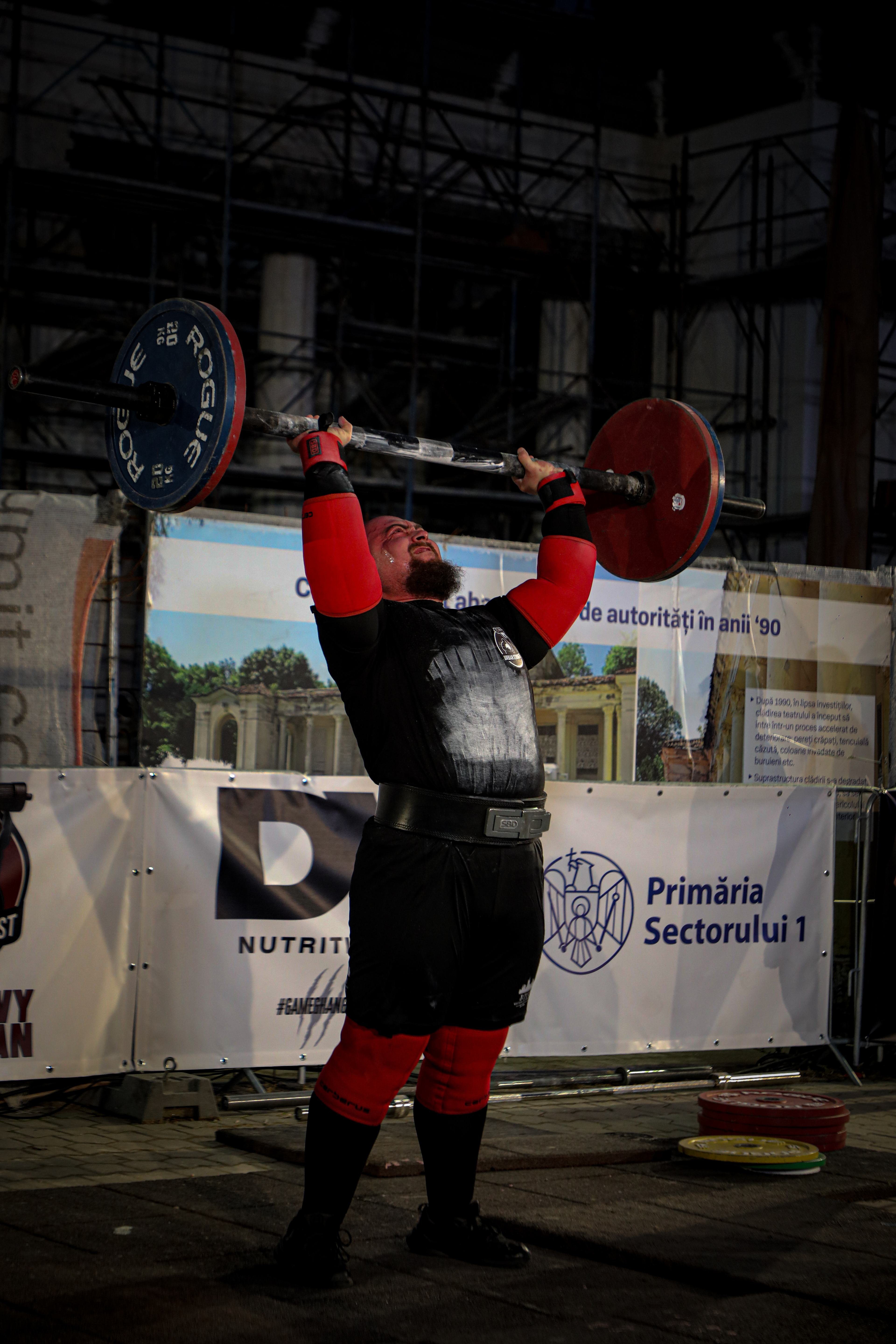
In Strongman, the trunk is challenged in almost every major event. In the deadlift, it must preserve the relationship between pelvis, spine, and implement while the hips and knees produce extension. In the yoke walk, it stabilizes a very heavy moving system. In the farmer's walk, it controls vertical, anteroposterior, and lateral forces with every step. In Atlas stone, keg, sandbag, and other awkward-object events, the trunk becomes the interface between the object and the lower limbs.
Therefore, the phrase strong core is too simple. The trunk is not merely the abdomen and not merely a collection of six-pack exercises. It is a system of muscles, joints, connective tissues, and neuromuscular control mechanisms that must manage spinal and pelvic position, create stiffness when required, and allow movement when the task requires it.
1. The Trunk as the Force-Transmission Link
Force produced by the legs does not automatically reach the implement. It must pass through the lower-limb joints, pelvis, spine, thorax, shoulder girdle, and upper limbs. Any change in system geometry can alter force direction and increase demands on structures that do not directly contribute to moving the implement.
This does not mean that every movement of the trunk is a loss. The human body is not a rigid bar. Real movement includes flexion, extension, rotation, and lateral bending, and these movements can be useful. The biomechanical goal is to control them rather than eliminate them. Stability is the ability to control movement relative to the task, not the total absence of movement.
2. The Spine - A Mobile Axis That Must Remain Controlled
The spine consists of mobile segments, intervertebral discs, facet joints, ligaments, and musculature. It must support and distribute load while allowing the thorax to orient relative to the pelvis. In Strongman, the spine is rarely purely static. It contributes to adapting the body to awkward implements, steps, acceleration, and shifts in the center of mass.
In the yoke walk, the load creates a combination of compression and moments on the trunk. Strongman biomechanics research has reported substantial trunk-muscle and spinal demands, and classic work found the yoke walk produced the highest spinal loads among the events studied. This does not mean the exercise is automatically bad; it means that it has high and highly specific mechanical demands.
3. The Pelvis - The Platform Between the Legs and Trunk
The pelvis is the meeting point between the lower limbs and trunk. Its position simultaneously influences hip geometry, functional muscle length, spinal orientation, and the direction of force produced by the legs. In a deadlift, squat, or loading event, the pelvis is not passive. It moves and rotates in coordination with the thorax and limbs.
Pelvic control is particularly important during loaded carries. When an athlete walks with a yoke, farmer's handles, or an asymmetrical object, the pelvis must remain sufficiently controlled for each leg to accept and retransmit load. Excessive pelvic oscillation consumes energy without increasing implement displacement.
4. What Does Core Actually Mean?
In sports literature, the term core can have different definitions. For Strongman, it is more useful to view it functionally than aesthetically. The region includes the abdominal musculature, obliques, transversus abdominis, multifidus, erector spinae, quadratus lumborum, diaphragm, and other muscles that contribute to trunk control.
These structures do not work independently. They form a system of pressure, tension, and control. Research on abdominal co-contraction shows that it can increase trunk stiffness under certain conditions, but stiffness should not be confused with automatic performance gains or guaranteed injury protection.
5. Intra-Abdominal Pressure and Bracing
During a heavy lift, an athlete can increase pressure within the abdominal cavity through coordinated breathing and trunk-muscle contraction. This pressure is one component of stabilization mechanics, but it should not be treated as the single explanation for strength.
Bracing can alter trunk-muscle activity and lifting kinematics. However, research does not support the simplistic idea that the harder you brace, the better you lift. Experimental work has shown changes in multifidus and internal-oblique activity and changes in trunk angles without demonstrating a universal advantage for lifting or low-back-pain prevention.
6. Breathing - More Than Oxygen
The diaphragm is both a respiratory muscle and a component of the trunk-pressure system. During heavy lifting, breathing must be coordinated with force production. This is why athletes use strategies such as inhaling before a repetition, controlled breath holding, and exhaling after the critical portion of the lift.
In Strongman, this becomes more complex because some events are brief and maximal while others last tens of seconds. The breathing strategy for a maximal deadlift is not identical to that used during a 20- to 30-meter yoke walk. The athlete must adjust according to event duration, load, and stability demands.
7. Stiffness Versus Mobility - The Paradox of a Strong Trunk
A high-performing trunk is not permanently rigid. It is a trunk that can become stiff in the appropriate direction and allow movement in the appropriate direction. If an athlete tries to lock every segment, movement may become less efficient. If too much uncontrolled motion is allowed, force may be lost.
In a carry, the trunk must limit excessive oscillation while allowing small rotations and adaptations to each step. In an Atlas stone lift, the object's position can make a perfectly neutral spine impossible throughout the movement. Effective strategy is not one universal posture but a combination of control, strength, and adaptation to implement geometry.
8. Transferring Force from the Ground to the Hands
Imagine the kinetic chain as a sequence of stations. The ground provides the external reaction. The foot receives it. The ankle and knee modulate it. The hip produces extension. The pelvis organizes the relationship between the lower limbs and trunk. The trunk stabilizes and transmits. The scapula and shoulder position the upper limb. The elbow and forearm direct force. The hand closes the final contact with the implement.
This is a useful simplification, but the system is actually bidirectional. Forces from the implement travel back through the hands, arms, and trunk toward the ground. In a deadlift, there is not simply force from the legs upward. There is a mechanical loop in which implement, body, and ground interact continuously.
9. The Deadlift - The Trunk as a Bridge Between Hip and Implement
In the deadlift, the trunk must preserve a configuration that allows the hip and knee extensors to contribute efficiently. If thoracic and pelvic relationships change excessively, joint geometry changes and muscular demands are redistributed. Biomechanical modeling indicates that spinal loading depends on trunk position, musculature, anthropometry, and lumbopelvic rhythm rather than one universal technical rule.
For Strongman, the situation is even more variable because the bar may be replaced by an axle, frame, thick bar, awkward object, or implement with a different height. The athlete therefore needs to produce force from multiple configurations rather than memorize a single ideal position.
10. The Yoke Walk - When the Trunk Must Stabilize a Moving System
The yoke walk is one of the clearest demonstrations of force transmission. The athlete must support a large load, produce rapid steps, and prevent excessive movement of the structure. Biomechanical research shows that yoke technique is associated with changes in stride length and stride rate, and an efficient strategy may reduce vertical yoke displacement and metabolic demand.
The trunk becomes a moving platform. It must be sufficiently stiff to transfer force from the legs into the structure, yet sufficiently adaptable to permit walking. Research has identified substantial spinal-muscle activation and spinal loading during the yoke walk, explaining why it is not simply walking with weight.
11. The Farmer's Walk - Force Transmission on Every Step
In the farmer's walk, the hands are the contact point with the load, but the legs create locomotion. Between them is the trunk. On every step, the center of mass moves, one leg accepts the load, the other leaves the ground, and the trunk must limit movements that would compromise balance.
Strongman biomechanics literature indicates that superior farmer's-walk performance is associated with reduced contact time and effective combinations of stride length and stride rate. Bilateral carriage also places substantial demands on trunk musculature, highlighting the trunk's role in stabilizing the load.
12. Atlas Stones, Sandbags, and Kegs - When the Implement Changes the Movement
Awkward objects change mechanics because they cannot be held at the same distance and in the same position as a barbell. They are brought close to the body, supported against the trunk, and shift the center of mass. During an Atlas stone lift, the athlete must coordinate hip extension with trunk extension and then move the object into a higher position.
Strongman research has shown that muscle-activation timing during the Atlas stone lift is important, with integration of the hip extensors before the back extensors. This illustrates the central idea of the episode: force is not simply how strong a muscle is, but also when it acts and how it connects with the other segments.
13. Asymmetry - The Body Must Transmit Force Even When the Load Is Uneven
Strongman frequently uses objects that do not behave like perfectly balanced barbells. A sandbag may have uneven mass distribution, a Husafell is held close to the body, a suitcase carry loads one side, and large implements can force the athlete to change position throughout an event.
In these situations, the trunk must control rotation and lateral bending. Quadratus lumborum, the obliques, erector spinae, and hip musculature contribute to the moments required to maintain position. Strongman research has identified important differences between bilateral and unilateral carriage in trunk-muscle activation and stiffness.
14. Fatigue - When the Chain Begins to Lose Efficiency
Early in an event, an athlete may control trunk position almost perfectly. As fatigue rises, neuromuscular control, bracing capacity, and coordination between pelvis and thorax can change. The result may be greater oscillation, altered stride length, or changed joint angles.
For Strongman, this is a performance problem as much as a physiological one. If the trunk begins to move more than necessary, energy is no longer transmitted as efficiently. Preparation therefore needs not only maximal trunk strength but also the ability to maintain control under fatigue and load.
15. Why Core Training Should Not Be Reduced to Crunches
A crunch can train trunk flexion, but Strongman demands much more. The athlete must resist flexion, extension, rotation, and lateral bending, produce moments when required, and coordinate these actions with the hip and shoulder.
Evidence on core training and sports performance is more nuanced than popular messaging suggests. Some interventions improve trunk strength, balance, or selected performance variables, but there is no evidence that one core exercise automatically produces Strongman performance.
16. The Trunk Is Not Only a Stabilizer. It Also Produces Force
In some movements, the trunk actively produces moments. The spinal extensors contribute to maintaining and changing thorax-pelvis position, the obliques can produce and control rotation, and quadratus lumborum can contribute to frontal-plane trunk control. Therefore, describing the trunk only as a stabilizer is incomplete.
In Strongman, this active force production becomes obvious in tire flips, Atlas stones, log lifts, keg loading, and other events in which the object is not in a standardized position. The body must create moments that move the implement, not merely prevent the spine from moving.
17. The Kinetic Chain - Why Every Episode in the Series Connects
The Anatomy of a Strongman series can be read as one story. The feet interact with the ground. The hip produces and controls extension. The knee and ankle modulate force. The trunk connects pelvis and thorax. The scapula and shoulder position the arm. The elbow and forearm transmit and direct force. The hand creates the final contact with the implement.
But the chain is not a simple line. It is a closed system. The implement influences the hand, the hand influences the arm, the arm influences the shoulder and trunk, and the reaction reaches the ground. The heavier and less stable the load, the more important whole-system coordination becomes.
18. What a Truly Strong Trunk Means
A strong trunk is not necessarily the one that produces the greatest force in an isolated exercise. It is the one that can control and transmit force in different configurations. It can remain sufficiently stable under compression, produce extension when the object requires it, control rotation when the load is asymmetric, and maintain this capacity as fatigue develops.
In Strongman, the trunk is where force meets implement geometry. The legs may be enormous, the arms powerful, and the grip exceptional, but if the trunk cannot connect these capacities, performance is lost between segments.
Conclusion
The body and force transmission form the logical center of Strongman. The trunk is not merely a structure that keeps the back straight, nor is it simply the region where abdominal muscles are developed. It is a dynamic system that must stabilize, produce, direct, and transmit force between the ground and the implement.
The yoke walk shows how the trunk can turn leg force into movement of a heavy structure. The farmer's walk shows how the body must be controlled on every step. The deadlift shows the relationship between hip, pelvis, spine, and implement. Atlas stones and sandbags show that implement geometry can completely change strategy. In all of these situations, performance does not belong to one muscle. It belongs to coordination.
A Strongman does not lift only with the legs and does not hold only with the hands. He produces a reaction with the ground, organizes it through the lower limbs, stabilizes it through the trunk, and transmits it to the implement. When all links work together, force becomes movement. When movement is efficient, force becomes result.
Scientific References
1. McGill, S. M., McDermott, A., Fenwick, C. M. J. Comparison of different Strongman events: trunk muscle activation and lumbar spine motion, load, and stiffness. Journal of Strength and Conditioning Research. 2009;23(4):1148-1161. DOI: 10.1519/JSC.0b013e318198f8f7. PMID: 19528856.
2. Hindle, B. R., Lorimer, A. V., Winwood, P. W., Brimm, K. A., Keogh, J. W. L. The Biomechanical Characteristics of the Strongman Yoke Walk. Frontiers in Sports and Active Living. 2021;3:671474. DOI: 10.3389/fspor.2021.671474. PMID: 33981993.
3. Hindle, B. R., Lorimer, A., Winwood, P. W., Keogh, J. W. L. The Biomechanics and Applications of Strongman Exercises: a Systematic Review. Sports Medicine - Open. 2019;5:49. DOI: 10.1186/s40798-019-0222-z. PMID: 31820223.
4. Hindle, B. R., Lorimer, A. V., Winwood, P. W., Keogh, J. W. L. A systematic review of the biomechanical research methods used in strongman studies. Sports Biomechanics. 2020;19(1):90-119. DOI: 10.1080/14763141.2019.1598480. PMID: 31132028.
5. Brown, S. H. M., Vera-Garcia, F. J., McGill, S. M. Effects of abdominal muscle coactivation on the externally preloaded trunk: variations in motor control and its effect on spine stability. Spine. 2006. DOI: 10.1097/01.brs.0000220221.57213.25. PMID: 16741438.
6. van Dieën, J. H., Kingma, I., van der Bug, P. Evidence for a role of antagonistic cocontraction in controlling trunk stiffness during lifting. Journal of Biomechanics. 2003. DOI: 10.1016/S0021-9290(03)00227-6. PMID: 14614936.
7. Coenen, P., Campbell, A., Kemp-Smith, K., O'Sullivan, P., Straker, L. Abdominal bracing during lifting alters trunk muscle activity and body kinematics. Applied Ergonomics. 2017;63:91-98. DOI: 10.1016/j.apergo.2017.04.009. PMID: 28502411.
8. Stanton, T., Kawchuk, G. The effect of abdominal stabilization contractions on posteroanterior spinal stiffness. Spine. 2008;33(6):694-701. DOI: 10.1097/BRS.0b013e318166e034. PMID: 18344865.
9. Luo, S., Soh, K. G., Soh, K. L., et al. Effect of Core Training on Skill Performance Among Athletes: A Systematic Review. 2022. PMID: 35755428.
10. Exploring the role of the core in sports performance: a systematic review of the effects of core muscle training. Frontiers in Sports and Active Living. 2025. DOI: 10.3389/fspor.2025.1630584. PMID: 41098479.
11. Trunk muscle forces and spinal loads during heavy deadlift: effects of personalization, muscle wrapping, muscle lever arm, and lumbopelvic rhythm. 2023. DOI: 10.1002/cnm.3680. PMID: 36606738.
More From The Journal
Training
The Science of Strongman Training - Episode X: Competition Programming
How to build a complete Strongman competition preparation block: calendar, events, volume, intensity, specificity, simulations, autoregulation, tapering and fatigue management.
Training
The Science of Strongman Training - Episode IX: Peaking
Peaking in Strongman: how to turn months of training into maximal competition performance by reducing fatigue, preserving adaptations and managing specificity.