
Nutrition
Series: Strongman Foods - Episode 5: Rice: Simple Fuel for High Training Volume
September 11, 2026
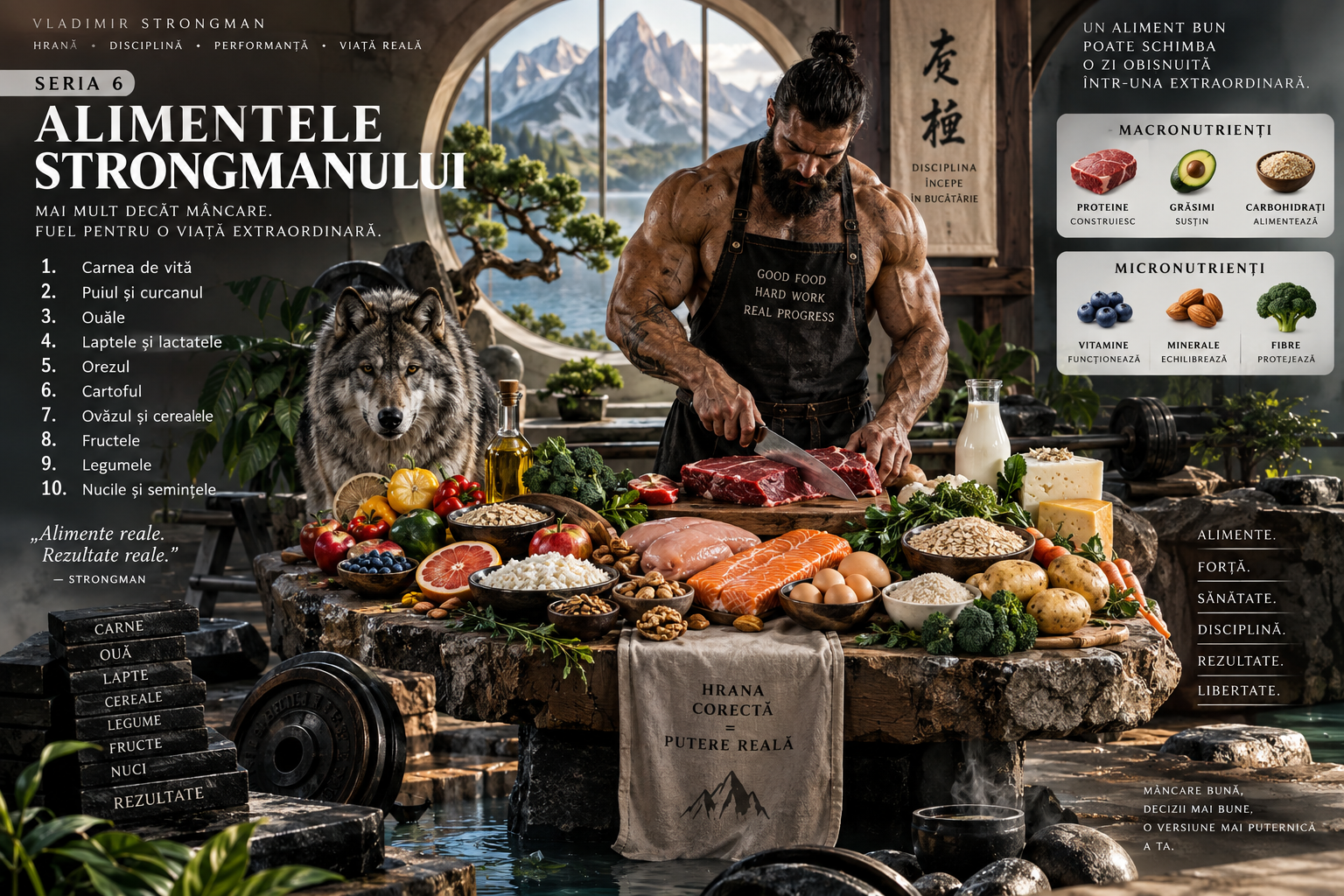
Rice is one of those foods that does not impress through novelty, but wins through usefulness. For a strongman who must support long sessions, repeated events, high workloads and sometimes several carbohydrate-based meals per day, rice offers something extremely valuable: measurable starch, little fat and often predictable digestion.
Its popularity does not mean rice has special anabolic properties. It does not build muscle directly and it cannot turn poor programming into good programming. Its role is simpler: it provides carbohydrate that can support liver and muscle glycogen, which matters during repeated heavy sets, medleys, yoke, farmers walks, log pressing and deadlift repetitions.
This episode treats rice as a performance tool rather than a bodybuilding fetish food. We examine rice varieties, glycogen, digestion, glycemic index, pre- and post-workout meals, raw versus cooked weighing, meal prep, food safety and how rice can be used differently during gaining, maintenance and calorie-deficit phases.
1. Rice is primarily a source of starch
Most of the energy in rice comes from carbohydrate, especially starch. After digestion, starch is broken down into glucose. That glucose can be used immediately for energy, stored as glycogen or, depending on total energy balance, directed toward other metabolic pathways.
For athletes, that simplicity is an advantage. Plain rice usually brings very little fat and not an enormous amount of fiber, so protein, fat and vegetables can be controlled separately in the same meal. This makes the plate easy to modify without changing the entire structure of the diet.
2. Glucose is the immediate currency of carbohydrate
Once starch is digested, glucose enters the circulation and can be taken up by tissues. Active muscle uses glucose directly and through stored glycogen. During intense work, carbohydrate use rises, and anaerobic glycolysis becomes particularly relevant when efforts last long enough that the phosphagen system is no longer the sole ATP supplier.
This is why a strongman should not think about carbohydrate only in terms of blood sugar. The practical question is whether enough fuel is available to support repetitions, sets, consecutive events and recovery between them. Rice contributes to that energy reserve without requiring a complicated nutritional formula.
3. Muscle glycogen matters during high training volume
Glycogen is one of the major ways muscle stores available carbohydrate. During a single maximal lift, glycogen is not the only performance determinant, but in a session containing many heavy sets, repetitions, accessories and events, glycogen use becomes much more important.
When training volume is high and sessions are close together, rebuilding stores between workouts becomes part of recovery. Rice is useful not because it restores glycogen better than every other carbohydrate, but because many athletes can eat it easily, repeatedly and in large amounts.
4. Strongman uses carbohydrate in more ways than it seems
A max deadlift event looks purely explosive, but a strongman day is not one single attempt. Warm-ups, progressive sets, repetition events, loaded carries, loading races and long periods under tension create a much larger energy demand than the image of one heavy lift suggests.
An athlete may therefore be strong enough for one maximal repetition yet feel empty after several events if nutrition and glycogen do not support the workload. Rice fits here as a base food that can be distributed through meals the day before and around the session.
5. White rice versus brown rice: context matters
Brown rice retains the bran and germ, increasing fiber and providing additional vitamins and minerals. White rice is more refined and consists mainly of the starch-rich endosperm. For that reason, brown rice is often automatically presented as the healthy option and white rice as inferior.
For athletes, the comparison should be functional. Brown rice can be useful in meals far from training, when fiber and satiety are advantages. White rice may be more comfortable before or after exercise, especially when large amounts of carbohydrate are needed without a large fiber load. There is no universal winner.
6. Jasmine, basmati and short-grain rice are not identical
Different rice varieties have different amylose-to-amylopectin ratios, textures and potentially different glycemic responses. Basmati often stays more separate and may produce a more moderate glucose response, jasmine is softer and aromatic, while short-grain rice is stickier and can be very easy to eat in large portions.
In practice, differences between varieties matter less than individual tolerance and how the food fits the meal. If an athlete digests jasmine rice extremely well and can eat it consistently, that practical advantage may matter more than a modest theoretical difference in glycemic index.
7. Glycemic index alone does not tell you whether rice is good for an athlete
Glycemic index describes the blood-glucose response to a standardized amount of carbohydrate from a food under specific conditions. In real life, however, rice is rarely eaten alone. Protein, fat, vegetables, total portion size and cooking all change the response of the meal.
For a strongman, the relevant question is not whether rice has a perfect glycemic index, but whether the portion fits the energy goal, digestion and timing. Around training, faster digestion may actually be useful. At other times, a slower and more satiating meal may be preferable.
8. Before training, predictability is gold
One of white rice's major strengths is that it can form a very predictable pre-workout meal. A serving of rice, a lean protein source and a modest amount of fat provides carbohydrate without overloading digestion for many athletes.
For events such as yoke, deadlift, squat or loading, abdominal discomfort can become a performance problem. A familiar meal repeated dozens of times in training is often more valuable than a sophisticated choice eaten for the first time before a hard session.
9. After training, rice helps rebuild energy stores
After a high-volume session, the body must restore not only muscle structures but also the energy stores that were used. Dietary carbohydrate contributes to glycogen resynthesis, and rice provides a simple way to deliver a substantial amount of carbohydrate in a post-workout meal.
The speed of recovery matters more when the next session is close. If a full day or two remains before the next hard workout, total daily carbohydrate intake matters more than a mythical few-minute window. Rice is useful because it makes reaching that total easier.
10. Between two sessions in one day, simplicity becomes strategic
Some athletes train twice in one day, for example strength work in the morning and events or conditioning later. In those situations, the period between sessions is not always the best time for an extremely high-fat or very high-fiber meal if it slows digestion.
White rice can become an excellent base for the between-session meal because it allows a clear amount of carbohydrate to be added quickly. Combined with well-tolerated protein and sufficient fluid, it can support energy restoration without turning digestion into a second workout.
11. On competition day, rice can help, but not in every amount
During a strongman contest, stress, heat, adrenaline and an unpredictable schedule can reduce appetite. A giant bowl of rice between events is not automatically a good idea, even if rice is normally easy to digest.
A better use may be in well-tested meals before the start or in moderate portions when enough time remains before the next event. In competition, personal tolerance and the actual time between events matter more than perfect theory.
12. Raw versus cooked weight is a major source of confusion
Rice absorbs water during cooking, so its weight rises without the water adding energy. Therefore, 100 grams of raw rice and 100 grams of cooked rice do not represent the same amount of carbohydrate or calories.
For consistency, athletes should choose one system and keep it: either weigh portions before cooking or use nutritional values for rice cooked in similar conditions. Randomly switching between the two can create surprisingly large errors in the daily diet.
13. Precise portioning is one of rice's biggest advantages
Rice is well suited to portion control because it can be cooked in bulk and divided into nearly identical containers. For an athlete tracking carbohydrate intake, that repeatability reduces variation between meals and makes week-to-week adjustments easier.
If performance, body weight or digestion calls for a change, it is easy to add or remove a defined amount of rice without rebuilding the entire meal. This precision is one reason rice appears so often in structured diets.
14. Low fat leaves room for other choices
Plain rice contains very little fat. This means the athlete can control dietary fat separately through meat, eggs, dairy, oils or other foods instead of automatically receiving a large fat load from the carbohydrate side dish.
That separation is especially useful around training, when a meal high in carbohydrate and protein but moderate in fat may be easier to digest. At other times, fat can be added deliberately to increase calorie density and improve taste.
15. Rice works extremely well as a base for protein
Beef and rice, chicken and rice, eggs and rice, or fish and rice are ordinary combinations precisely because they work. Rice has a relatively neutral flavor and does not compete with the protein source, making it easy to integrate into many meals without making the diet feel completely different.
Nutritionally, the combination lets macronutrients be adjusted separately: the meat portion determines much of the protein, rice supplies carbohydrate, and fat can be modified through the cut of meat, sauces or oils.
16. Vegetables and fiber should be timed in context
A complete rice meal with vegetables can provide fiber, potassium, vitamins and food volume. For general health, that diversity matters. Very close to a hard session, however, a huge amount of fibrous vegetables may be harder to tolerate for some athletes.
The answer is not to eliminate vegetables but to distribute them intelligently. Meals farther from training can contain more fiber, while the pre-workout meal can be simplified if the athlete knows digestion is sensitive.
17. Sodium is not supplied by rice, but it can be part of the meal
Plain rice is relatively low in sodium. For an athlete who sweats heavily, that is not automatically good or bad. Sodium can be added through salt, sauces or other meal components according to individual needs and hydration strategy.
On hot days, during long sessions or in competition, the combination of carbohydrate, fluid and electrolytes may matter more than the isolated food. Rice provides the carbohydrate base while the rest of the meal can complete the mineral side.
18. During gaining, rice can increase energy without dietary chaos
When a strongman needs to eat a great deal, one challenge is raising calories without turning the diet into a collection of difficult-to-digest foods. Rice can increase carbohydrate intake through larger portions while keeping meals relatively simple and predictable.
If food volume becomes excessive, rice can be combined with more energy-dense foods such as fattier meat, oils, sauces or dairy. This allows the athlete to adjust both carbohydrate and calorie density without replacing the basic foods entirely.
19. During a calorie deficit, portion size becomes a control tool
Rice is not a weight-loss food, but it can be easy to control in a calorie deficit. Portions can be reduced gradually while the athlete keeps the same protein source and vegetables, making the diet easier to track.
During weight-loss phases, predictability is the advantage. If the athlete knows exactly how much rice is being eaten, it becomes easier to judge whether the deficit is too small, too large or appropriate without changing ten dietary variables at once.
20. Satiety and digestion depend on portion size and context
White rice is often easy to eat, but that does not mean every amount is easy to digest. A very large serving can create fullness, drowsiness or discomfort, especially when the meal also contains a lot of fat or is eaten too close to training.
For a strongman with high requirements, distributing carbohydrate across several meals may be more comfortable than trying to concentrate everything into two enormous portions. Rice is useful precisely because it can be divided easily throughout the day.
21. Cooling rice changes part of its starch
After cooking and cooling, part of the starch can retrograde and become more resistant to rapid digestion. This resistant starch reaches the colon in a larger proportion, where it can be fermented by the gut microbiota. The effect is real, but it does not turn cooled rice into a completely different metabolic food.
For athletes, this change may slightly alter glucose response and texture, but its practical importance remains modest compared with total portion size, the rest of the meal and timing. Freshly cooked and cooled rice can both fit into a well-designed diet.
22. Food safety is essential in meal prep
Cooked rice can become a favorable environment for bacterial growth if left too long at room temperature. Bacillus cereus spores may survive cooking, and slow cooling or poor storage increases the risk of food poisoning.
For athletes cooking several days of meals at once, the practical rule is simple: cool rice quickly, refrigerate promptly, use clean containers and reheat appropriately. A meal-prep strategy that saves time is not worth unnecessary illness before training or competition.
23. A rice cooker turns rice into an almost automatic food
A rice cooker may seem like a trivial household detail, but for an athlete eating many meals each day it becomes an adherence tool. It reduces active cooking time, produces repeatable results and allows large quantities to be prepared without constant supervision.
In a performance diet, logistical details matter. Foods that can be prepared quickly and consistently are more likely to remain in the plan for months. Rice wins not only through biochemistry but also because it is remarkably easy to organize.
24. Rice provides some micronutrients, but it should not carry the whole diet
Depending on the type and processing, rice can provide B vitamins and minerals, and some products are enriched. Whole-grain rice retains more components of the grain, while white rice has a more modest micronutrient profile when it is not fortified.
A strongman diet should not expect rice to provide everything. Meat, eggs, dairy, fish, vegetables, fruit and other grains complete the micronutrient picture. Rice is the fuel base, not the entire nutritional toolbox.
25. Conclusion: rice is valuable because it is simple
Rice appears so often in strength-athlete diets because it solves a basic but important problem: how to provide a large amount of carbohydrate through a relatively inexpensive food that is easy to measure, easy to combine and often well tolerated. For high training volume, that simplicity can become a performance advantage in itself.
There is nothing magical about rice. Potatoes, pasta, bread, oats and other carbohydrate sources can serve similar roles. But few foods offer the same combination of predictability, neutrality, scalability and tolerance. For strongman, rice is more like a workshop tool than a symbol: simple, repeatable and useful.
Selected bibliography
Thomas DT, Erdman KA, Burke LM. Nutrition and Athletic Performance. Academy of Nutrition and Dietetics, Dietitians of Canada and American College of Sports Medicine. Burke LM et al. Carbohydrates for training and competition. Journal of Sports Sciences. Kerksick CM et al. International Society of Sports Nutrition position stand: nutrient timing. U.S. Department of Agriculture, FoodData Central: rice nutrient composition. European and national food-safety guidance regarding cooked rice, refrigeration and Bacillus cereus.
More From The Journal

Training
The Science of Strongman Training - Episode X: Competition Programming
How to build a complete Strongman competition preparation block: calendar, events, volume, intensity, specificity, simulations, autoregulation, tapering and fatigue management.

Training
The Science of Strongman Training - Episode IX: Peaking
Peaking in Strongman: how to turn months of training into maximal competition performance by reducing fatigue, preserving adaptations and managing specificity.