
Nutrition
Series: Strongman Foods - Episode 10: Nuts, Seeds and Energy-Dense Foods
September 11, 2026
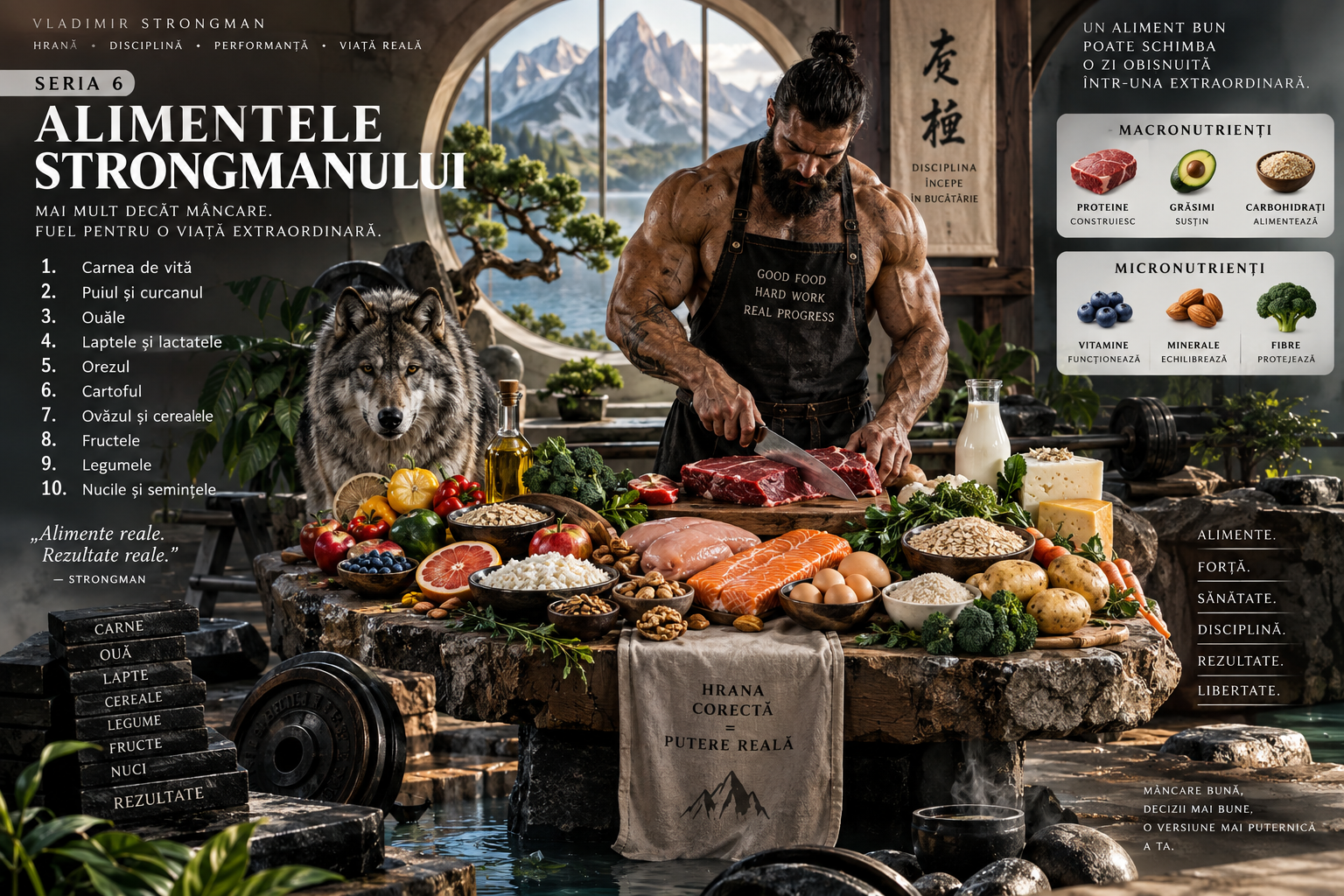
Nuts, seeds and other highly energy-dense foods occupy little space on the plate but can carry a surprising amount of energy. For a strongman trying to eat a great deal, this property can be extremely useful.
The same foods can become a trap when body-weight control is the goal. A handful of nuts, a few spoonfuls of peanut butter or a little oil can add hundreds of kilocalories without making the meal look much larger.
Episode 10 examines nuts, seeds and energy-dense foods through fat, protein, fiber, micronutrients, digestion and their practical use during gaining, cutting, training and competition.
1. Energy density means a lot of energy in a small volume
A food is energy-dense when it provides many kilocalories relative to its weight or volume. Nuts, seeds, nut butters, oils, dried fruit and some cheeses are classic examples.
For a 120-150 kg athlete or larger who must cover enormous energy needs, energy density can reduce the burden of food volume. For someone trying to lose weight, the same characteristic requires more careful portion control.
2. Nuts are compact packages of energy
Almonds, walnuts, hazelnuts, cashews, pistachios and pecans usually contain a high proportion of fat alongside protein, fiber and micronutrients. As a result, a relatively small serving can contain many calories.
They work well as a compact snack or an addition to oats, yogurt or a smoothie. They are not unlimited foods, however: the difference between 30 g and 100 g dramatically changes energy intake.
3. Seeds have a similar but not identical profile
Pumpkin, sunflower, sesame, chia and flax seeds are also concentrated in energy. Depending on the seed, they can provide unsaturated fats, protein, fiber, magnesium, zinc, iron and other micronutrients.
Because they are small, they are easy to sprinkle over food and easy to underestimate. A few spoonfuls look minor but can matter substantially to daily calorie intake.
4. Fat is the main reason for high energy density
Fat provides about 9 kcal per gram, compared with about 4 kcal per gram for protein and carbohydrate. Foods rich in fat can therefore reach high energy density without a large volume.
This is why oils, nut butters and nuts can raise the energy content of a meal very quickly. In strongman this can be exactly the solution at one time and exactly the problem to control at another.
5. Nuts provide protein, but they are not usually the main protein source
Nuts and seeds contribute to daily protein intake, sometimes meaningfully. However, their protein-to-calorie ratio is generally less favorable than lean meat, high-protein dairy or some legumes.
In a strongman diet it makes more sense to view them as energy- and fat-rich foods that also provide protein, rather than as complete replacements for primary protein sources.
6. Fiber creates an interesting paradox
Nuts and seeds contain fiber, which can increase satiety and slow eating. At the same time, they remain highly energy-dense, so feeling full does not automatically guarantee a low energy intake.
An athlete can benefit from fiber and still overshoot calories by eating directly from the bag. Portioning the food before eating is one of the simplest strategies.
7. Monounsaturated fats are common in many nuts
Almonds, hazelnuts, pistachios and other nuts can provide substantial monounsaturated fat. These fats can fit into a balanced dietary pattern in which saturated fats do not dominate total intake.
For performance, the practical message is simple: fat quality matters, but no nut should be turned into a miracle food. The context of the whole diet remains decisive.
8. Some nuts and seeds contribute the omega-3 fatty acid ALA
Walnuts, flaxseed and chia provide alpha-linolenic acid, an essential plant omega-3 fatty acid. Conversion to EPA and DHA is limited, but ALA remains a useful component of the diet.
For an athlete, these foods can diversify fat sources. They are not metabolically equivalent to marine sources of EPA and DHA.
9. Omega-6 does not need to be demonized
Sunflower seeds, sesame and many nuts contain linoleic acid, an essential omega-6 fatty acid. In a varied diet, its presence is normal and necessary.
The issue is not the simple existence of omega-6 but the quality of the overall diet and the balance of fat sources. Arbitrarily eliminating nuts or seeds for this reason is not justified.
10. Magnesium is one of the important micronutrients
Almonds, cashews, pumpkin seeds and other varieties can contribute meaningful magnesium. This mineral participates in hundreds of enzyme reactions, including neuromuscular function and energy metabolism.
For athletes, the advantage is that magnesium arrives with other nutrients. Nuts and seeds should not, however, be used as an improvised treatment for cramps or every symptom automatically blamed on deficiency.
11. Vitamin E is strongly associated with nuts and seeds
Almonds and sunflower seeds can provide substantial vitamin E, a fat-soluble antioxidant that helps protect cell membranes.
In a varied diet, these food sources are generally more useful than obsessing over megadoses of antioxidants. More is not automatically better.
12. Zinc, copper and selenium vary greatly among types
Pumpkin seeds are known for zinc, many nuts contribute copper, and Brazil nuts can contain very high selenium levels. The mineral profile differs sharply from one food to another.
With Brazil nuts in particular, excessive daily intake is not a good idea because selenium has a relatively narrow range between requirement and excessive intake. Variety and reasonable portions are safer than compulsively eating one food.
13. Walnuts combine fats, ALA and texture
Walnuts stand out for their polyunsaturated fat and ALA content. They fit easily into oats, yogurt or snacks and add calories without much volume.
For a strongman gaining weight, that is a useful quality. For one in a calorie deficit, the serving should be known because several handfuls can quickly exceed the planned energy intake.
14. Almonds are nutrient-dense and easy to portion
Almonds provide monounsaturated fat, fiber, protein, magnesium and vitamin E. Their uniform shape makes them relatively easy to weigh and integrate into a meal plan.
There is nothing magical about an exact number of almonds. What matters is the total serving and how it fits the day's energy target.
15. Peanuts are legumes but nutritionally behave much like nuts
Botanically, peanuts are legumes rather than nuts. Nutritionally, however, they are rich in fat, protein and energy, so they are used in a similar way in the diet.
Peanut butter is particularly practical for athletes who need many calories. Versions with substantial added sugar or oils can change the product profile, so the label still matters.
16. Cashews and pistachios add variety, not magic
Cashews and pistachios combine fat, protein, carbohydrate, fiber and minerals in a profile that differs somewhat from almonds or walnuts. Their taste can help diversify the diet.
For athletes, variety can improve adherence and micronutrient coverage. There is no need to assign every nut a separate and sophisticated role.
17. Chia and flax provide fiber and ALA but can increase digestive bulk
Chia and flaxseed are rich in fiber and ALA. Chia can form a gel in liquid, while ground flax is often easier to integrate into yogurt, oats or smoothies.
Large amounts can cause fullness, gas or discomfort, especially when introduced suddenly. Close to hard training, more fiber is not necessarily an advantage.
18. Pumpkin and sunflower seeds are easy to add and hard to estimate by eye
Pumpkin seeds can contribute magnesium, zinc and iron, while sunflower seeds provide vitamin E and unsaturated fats. Both are extremely easy to sprinkle onto meals.
That convenience can quietly double the serving. For a precise calorie plan, occasional weighing helps recalibrate visual estimates.
19. Nut butters compress energy even further
Grinding nuts or peanuts into a paste makes the food easier to consume quickly. Two or three spoonfuls disappear easily into a smoothie or onto bread and can substantially raise meal calories.
For a strongman with limited appetite, this is an excellent tool. During a calorie deficit, the same ease of consumption can make portion control more difficult.
20. Dried fruit, oils and snack mixes can multiply energy density
Raisins, dates, dried apricots, oils, granola, nut-and-fruit mixes and combinations with chocolate can concentrate energy into a very small volume.
These foods are excellent when compact energy is needed, but portions can easily drift upward. A seemingly healthy trail mix can become very calorie-dense without providing the same fullness as a large meal.
21. During gaining, energy-dense foods can rescue appetite
A strongman with very high energy needs may be limited not by willingness to eat but by digestive capacity. Nuts, nut butters, olive oil, dried fruit and higher-fat dairy can reduce the total food volume required.
The best strategy is not to turn the entire diet into concentrated foods, but to combine a nutritious base with enough energy-dense options to reach calorie targets without constant discomfort.
22. During a calorie deficit, portion size matters more than a food's reputation
Nuts and seeds can remain in a fat-loss diet, but their amount has to fit the calorie budget. A food can be nutritious and still be very high in calories.
Small pre-portioned servings work better than eating from the bag. During a deficit, controlling the food environment is often more reliable than depending on willpower alone.
23. Before training, a lot of fat and fiber can slow digestion
A meal very high in nuts, seeds or nut butter immediately before exercise can increase fullness because fat and fiber slow gastric emptying.
Several hours before training, moderate amounts may be tolerated well. Closer to yoke, farmers, deadlift or medley work, many athletes prefer easier-to-digest carbohydrate and less fat.
24. On competition day, energy density helps only if digestion accepts it
Between events, appetite may be low and time short. A small amount of peanut butter, nuts or dried fruit can provide energy without a large meal, but fat is not the fastest fuel for immediate high-intensity effort.
Competition foods should be tested in advance. If energy-dense foods sit heavily in the stomach, simpler carbohydrate and lower-fat meals may work better between events.
25. Conclusion: energy density is a tool, not a virtue by itself
Nuts, seeds and energy-dense foods can provide energy, unsaturated fats, protein, fiber, magnesium, vitamin E, zinc and other micronutrients in a very small volume.
For strongman, they are extremely useful when calories are difficult to reach and must be carefully dosed when body-weight control is the priority. Their value depends on the goal, serving size, timing and digestive tolerance.
Selected bibliography
Thomas DT, Erdman KA, Burke LM. Nutrition and Athletic Performance. Academy of Nutrition and Dietetics, Dietitians of Canada and ACSM. Ros E. Health Benefits of Nut Consumption. Nutrients. de Souza RGM et al. Nuts and Human Health Outcomes: A Systematic Review. USDA FoodData Central: nutrient composition of nuts, seeds and nut butters. National Institutes of Health, Office of Dietary Supplements: Fact Sheets for Magnesium, Vitamin E, Zinc, Selenium and Omega-3 Fatty Acids.
More From The Journal

Training
The Science of Strongman Training - Episode X: Competition Programming
How to build a complete Strongman competition preparation block: calendar, events, volume, intensity, specificity, simulations, autoregulation, tapering and fatigue management.

Training
The Science of Strongman Training - Episode IX: Peaking
Peaking in Strongman: how to turn months of training into maximal competition performance by reducing fatigue, preserving adaptations and managing specificity.