1998
Lithuania's Strongest Man
First Lithuanian Strongest Man title recorded by Strongman Archives.
1st / champion
Iron Archives
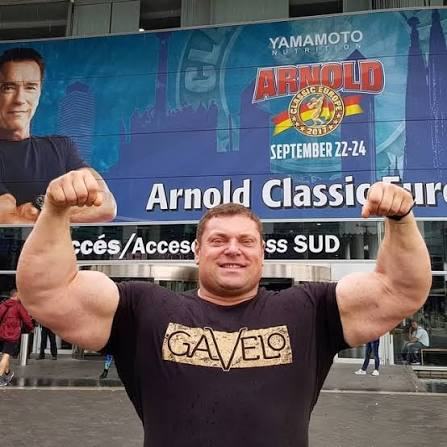
“Big Z” — four-time World's Strongest Man and eight-time Arnold Strongman Classic champion
Active athlete
Žydrūnas Savickas, known throughout strongman as “Big Z”, is a Lithuanian strength athlete born on 15 July 1975 in Biržai and one of the defining figures of the modern era of the sport. Strongman Archives credits him with 161 international contests and 88 wins, 14 World's Strongest Man appearances, 12 finals and four WSM titles, won in 2009, 2010, 2012 and 2014. He dominated the Arnold Strongman Classic in Columbus with six consecutive victories from 2003 through 2008, then returned to win again in 2014 and 2016 for a record eight titles. Savickas was also IFSA Strongman World Champion in 2005 and 2006, winner of Fortissimus 2009, a multiple European champion and a long-time Lithuanian national champion. He is especially renowned for overhead strength: he lifted a 228 kg log in 2015 and a 215 kg axle in 2010, while his 524 kg Hummer Tire Deadlift at the 2014 Arnold became an official Guinness record at the time. His career also spans international-level powerlifting, a remarkable comeback after rupturing both patellar tendons in 2001, and work as a coach, promoter, federation leader and Lithuanian local councillor.
Modern strongman history contains champions who dominated for a few seasons, specialists who redefined one event, and athletes whose names became shorthand for an entire generation. Žydrūnas Savickas belongs to all three categories. Born on 15 July 1975 in Biržai, northern Lithuania, Savickas entered strength sport before professional strongman had the global infrastructure, standardized qualification paths, specialized gyms and digital exposure that surround it today. He remained competitive long enough to face successive generations of elite athletes, from Magnús Ver Magnússon, Svend Karlsen and Mariusz Pudzianowski to Brian Shaw, Hafþór Júlíus Björnsson and competitors from the post-2015 era. Strongman Archives credits him with 161 international contests and 88 international victories, with archived results spanning 1996 to 2025. Those numbers are not decorative statistics. They describe an unusual combination of longevity, competitive volume and sustained success.
His headline achievements form one of the densest résumés in the sport: four World's Strongest Man titles in 2009, 2010, 2012 and 2014; eight Arnold Strongman Classic victories in Columbus, including six consecutive wins from 2003 through 2008; IFSA Strongman World Championships in 2005 and 2006; Fortissimus in 2009; multiple Europe's Strongest Man victories; a long series of Lithuanian national titles; and major records in log lift, axle press and specialized deadlift events. Yet listing trophies alone misses the most important feature of his career. Savickas survived structural changes in the sport itself. He competed before and after the IFSA split, before and after the Arnold became one of strongman's defining championships, through the rise of Strongman Champions League and Giants Live, and finally into the modern Masters era.
That breadth matters because strongman has never been a perfectly standardized sport. Implements change, surfaces change, distances change, rules and judging conventions evolve, and promoters can reward speed in one contest and absolute force in another. A champion who succeeds for two or three seasons may master one competitive environment. Savickas had to master several. His career therefore offers more than a record of extraordinary strength: it is also a study in adaptation. The version of Big Z who first appeared at World's Strongest Man in 1998 was not the same athlete who won the Arnold in 2003, the IFSA world title in 2005, WSM in 2009 or a Masters championship two decades later.
Biržai appears repeatedly when Savickas speaks about his childhood. In Lithuanian interviews he has described the town not merely as his birthplace but as a formative environment: school, extended family, time with grandparents and early exposure to practical work all recur in his recollections. In one interview about his roots, he spoke about grandparents living in nearby villages and particularly about his grandfather Petras, a blacksmith who continued working into old age. Savickas connected those memories with respect for work and persistence. In another interview centered on vehicles, he recalled that his father drove a bus and that childhood included riding with him and developing an interest in cars and trucks.
His grandfather also repaired damaged cars, and the young Žydrūnas helped dismantle, sand, repair and paint them. It would be easy to turn such details into a retrospective legend, as if working around machinery inevitably produced the future man who would pull trucks and deadlift enormous tires. That is unnecessary. The more grounded significance is that he grew up around manual competence, heavy objects and a culture in which improvement came through repeated work. These were not strongman exercises, but they formed part of the environment in which physical effort was normal rather than exotic.
Lithuanian biographical sources place the beginning of his serious interest in weights at roughly thirteen years of age. Savickas has said that he did not initially imagine an international career. He wanted to be stronger and more muscular, and Arnold Schwarzenegger was among the figures who captured his attention. The vague teenage objective of becoming strong soon became structured sport. He entered strength competitions while still young, and from 1992 he worked with coach Stasys Česnauskas, whom the Lithuanian Universal Encyclopedia identifies as his coach. That long relationship became one of the stable threads running through a career otherwise defined by changing federations, formats and opponents.
Savickas's powerlifting résumé is substantial enough to have been a major career on its own. The Lithuanian Universal Encyclopedia records ten Lithuanian powerlifting championships between 1995 and 2005, Lithuanian Cup victories from 1994 through 2000, European runner-up finishes in 1999, 2000 and 2001, and a world runner-up result in 2000. The same source lists Lithuanian records in the over-125 kg class, including a 425.5 kg squat in 2005, a 400 kg deadlift in 2004 and a 1,090 kg total in 2004. These figures matter because powerlifting provided a standardized test of the raw qualities that later appeared in strongman.
Powerlifting also supplied a method. Squat, bench press and deadlift offer unusually clear feedback: the load is known, technique can be repeated and progression can be measured over long periods. Savickas carried that culture of quantification into a sport whose external appearance can look improvised. Strongman implements may be awkward, but elite performance is not random. The athlete needs a force base and then must learn to express it through a log, axle, yoke, stone, frame or vehicle. Savickas's early career is a particularly clear example of that translation from barbell strength to object strength.
The boundary between powerlifting and strongman was also less rigid in the 1990s than it often is for modern specialists. Strongman contests included deadlifts, squats, presses, holds and carries in which a powerlifter's base could transfer directly, while the sport still rewarded athletes willing to compete frequently across disciplines. Savickas's national strongman results show rapid progress: Strongman Archives places him third at Lithuania's Strongest Man in 1996, second in 1997 and first in 1998. That same year he reached World's Strongest Man in Morocco. At twenty-three, he was already moving beyond a national powerlifting identity into international strongman.
The 1998 WSM debut looks very different from the Savickas the public would know a decade later. Strongman Archives records him third of four in his group in Tangier. Results were uneven, although he won the carry-and-drag event. At WSM 2000 in Sun City he again finished third in his group and missed the final, but won the tire flip and performed strongly in the axle press and power stairs. Those early appearances already hinted at two traits that would become central: unusual overhead ability and a capacity to learn specialized implements. They also showed what still needed development. He had strength, but not yet the event efficiency and movement economy of his championship years.
The nickname “Big Z” became an internationally convenient version of a Lithuanian name that many English-speaking announcers initially found difficult. Over time it became much more than shorthand. Two characters came to identify a competitive style: immense static strength, measured body language and the expectation that any overhead event might turn into a record attempt. The brand, however, was created after years of less glamorous work. Between 1998 and 2001 Savickas continued to powerlift, compete nationally and accumulate international strongman experience. Nothing guaranteed that the process would produce a world champion.
In 2001, at a contest in the Faroe Islands, Savickas suffered the defining medical crisis of his early career. During a stone event, he failed to control the load and sustained severe bilateral knee injuries widely described in English-language strongman history as ruptures of both patellar tendons. Lithuanian popular reporting sometimes renders the episode more loosely as damage to both kneecaps. What matters biographically is the severity: surgery followed, normal walking was impossible for a period, and Savickas later acknowledged that he seriously considered whether returning to sport was realistic.
For a super-heavyweight athlete, bilateral disruption of the knee-extension mechanism threatens almost every strongman task. Squat, yoke, farmer's walk, stones, deadlift setup and overhead drive all depend on the legs. Recovery therefore required much more than healing tissue. It required rebuilding muscle, range of motion, confidence and tolerance for heavy loading. Savickas's later description of the period is valuable precisely because it avoids a cinematic version of recovery: there was no single heroic day. There were months of limited function followed by progressive exposure to work.
The significance of the comeback becomes clear when placed beside what followed. Within a relatively short period he was not merely competing again but standing on the World's Strongest Man podium. In strength sport, tendon injuries can permanently reduce confidence even after mechanical healing. Savickas instead built a second athletic trajectory that was dramatically better than the first. The injury therefore belongs at the center of his biography, not as inspirational decoration, but as a factual turning point after which the entire championship career still had to be constructed.
At World's Strongest Man 2002 in Kuala Lumpur, Savickas finished second behind Mariusz Pudzianowski. The result was remarkable in its own right given the previous year's injury, but it also opened one of the defining competitive narratives of the 2000s. Savickas returned to finish second again in 2003 at Victoria Falls and again in 2004 in Nassau. Three consecutive runner-up finishes can be described as three defeats, but that framing is too narrow. They represent a sustained position at the edge of a global title during the same period in which he was building a separate dynasty at the Arnold Strongman Classic.
The Savickas–Pudzianowski rivalry is often simplified into static strength versus speed. The actual contrast was more complicated. Pudzianowski was exceptionally fast, conditioned and efficient in transitions, yet strong enough to avoid catastrophic losses on heavy events. Savickas possessed a larger advantage in many presses, deadlifts and squats, but learned over time to become competitive on yoke, farmer's walk, Fingal's Fingers and loading sequences. Their rivalry therefore pushed Savickas toward completeness. A pure overhead specialist could not repeatedly finish second at World's Strongest Man.
Those years also taught him the arithmetic of strongman. A contest is not won by reputation or by the heaviest single lift; it is won by accumulating points. Savickas became adept at maximizing favorable events and limiting damage elsewhere. That strategic discipline would later become one of his most important competitive traits. He rarely needed every event to be perfect. He needed enough top finishes in his strongest disciplines and enough control in weaker ones to arrive at the final events with the overall title still available.
If WSM initially offered Savickas repeated second places, the Arnold Strongman Classic in Columbus provided a competitive environment almost perfectly aligned with his strengths. The contest was built around absolute force and unusually heavy implements. Presses, specialized deadlifts, brutal carries and massive stones reduced the premium on pure running speed and increased the premium on force production and technical mastery under extreme loads. Arnold Sports Festival's official champion history lists Savickas as the winner every year from 2003 through 2008. Six consecutive victories against international fields constitute one of strongman's clearest dynasties.
The events became part of the Big Z iconography: Apollon's Wheels, Hummer Tire Deadlift, Timber Carry and the Manhood Stones. Yet his Arnold success should not be reduced to the phrase “static strength contest.” Carrying a massive frame up a ramp still requires foot placement, grip, balance and the ability to accelerate a huge object. Stones demand speed through the lap and extension. Apollon's Wheels requires an awkward clean before the press can even begin. Savickas won because his force base was enormous and because he repeatedly learned the details of these implements.
His 2007 performance illustrates the underlying point. Strongman Archives records him winning the max Hummer Tire Deadlift at 461 kg, the Super Yoke and Apollon's Wheels, while finishing only sixth on the Timber Carry. He still won the contest. The difference between a specialist and a championship competitor appears in that pattern: a specialist depends on peaks; a champion understands how many points can be surrendered without losing control of the total. Savickas became exceptionally good at that form of competitive mathematics.
The Arnold era also accelerated his development as an overhead specialist. In 2005, at the IFSA world championship, he won max log at 192.5 kg and Apollon's Wheels, while a European contest in the same period saw him move the log standard above 200 kg. Those numbers are smaller than the 220-plus kilogram lifts that would later define the event, but chronology matters. Savickas was not following a mature standard; he was helping create it. Each incremental record changed what the next generation considered possible.
The middle of the 2000s requires historical context because elite strongman was organizationally divided. The split between IFSA and World's Strongest Man moved major athletes into different circuits. Savickas's absence from WSM between 2005 and 2008 therefore did not represent retirement, injury or declining form. He was competing at the heart of the IFSA circuit. In 2005 at Quebec City he won the IFSA Strongman World Championships in a sixteen-man field, with victories in events including Apollon's Wheels, max log lift and Super Yoke. In 2006 at Reykjavík he defended the title and again won max log and Atlas Stones.
The two IFSA championships should be kept institutionally separate from World's Strongest Man, but they should not be minimized. IFSA contained a substantial portion of the international elite and used demanding multi-event formats. Savickas's victories demonstrated that he could win broad championships, not just a heavy static contest. In 2006 the program included stones, yoke, Conan's Wheel, deadlift hold, wheelbarrow, log and farmer's walk. He did not need to win every event. His ability to recover points through pressing, deadlifting or stones while remaining acceptable elsewhere was already fully developed.
In 2007, he placed third at the IFSA world championship in Geumsan. The result is useful because it demonstrates the limits of any simplistic narrative of invincibility. Strongman remained volatile. A few lower event placements could erase an advantage built on the log or axle. Yet even when he did not win, Savickas remained a podium athlete while continuing his Arnold dominance. His résumé in those years effectively developed in parallel columns: world-class IFSA championship results and an unmatched run in Columbus.
This period also established him as one of history's great axle pressers. Apollon's Wheels and max axle events demand a difficult clean in addition to the press. Savickas repeatedly solved both phases. Strongman Archives records a 200 kg max axle win at the 2007 IFSA world championship and later a 215 kg lift at Giants Live Turkey in 2010. The latter stood as a major historical benchmark and remains among the largest axle presses catalogued by the archive. It was the product of years of event-specific refinement, not a sudden one-off performance.
Fortissimus was one of the most ambitious attempts to test complete strongman ability with a long, punishing program and a field drawn across organizational boundaries. Savickas finished second in 2008 and won in 2009 at Montmagny. The victory is important because a long event list reduces the chance that two exceptional disciplines can hide major weaknesses. Repeated exposure makes every gap expensive. By winning Fortissimus, Savickas demonstrated that the athlete who had once been described primarily through static strength had become capable of surviving a deep all-around test.
Fortissimus also served as a cross-check between circuits. Savickas arrived with IFSA world titles and Arnold championships, then succeeded in another format against a broad field. That mattered in an era when organizational politics had prevented some of the sport's best athletes from meeting consistently. The 2009 victory made his return to World's Strongest Man especially significant. He was not coming back as a nostalgic former runner-up; he was arriving as one of the most accomplished active strength athletes in the world.
World's Strongest Man 2009 in Malta carried an obvious narrative tension. Savickas returned after several years outside the contest while Mariusz Pudzianowski had become the dominant WSM figure of the decade. Savickas had already accumulated Arnold and IFSA titles, but the World's Strongest Man trophy had escaped him through three consecutive runner-up finishes before the split. The official WSM results list Savickas first in 2009, ahead of Pudzianowski and Brian Shaw. At thirty-four, Big Z finally converted years of near-misses and parallel championships into the sport's most recognizable title.
The title's timing is central to its meaning. This was not the beginning of Savickas's elite career. By 2009 he had already won the Arnold six times and the IFSA world championship twice. WSM therefore functioned as public confirmation of a status established elsewhere. Strongman Archives also credits him with 28.69 seconds on the five-object Fingal's Fingers configuration used in the 2009 final, a performance that remains a historical reference for that setup. It is a useful counterpoint to the stereotype of Savickas as merely static: in a major moving event, he could be exceptionally fast when the task suited his mechanics.
The victory also closed one chapter of the Pudzianowski rivalry. Their careers had spent years on partially separate tracks, making direct comparison difficult. Malta brought them back into the same WSM final and Savickas finished ahead. It did not retroactively settle every argument about the previous decade, but it provided the direct championship confrontation fans had wanted. At the same time, Brian Shaw's place near the top of the field introduced the next major rivalry almost immediately.
At WSM 2010 in Sun City, Savickas faced a very different threat. Brian Shaw was exceptionally tall and massive, technically sophisticated, excellent on stones and capable of matching elite static strength with movement. Savickas and Shaw finished the final level on points, and Savickas retained the title under the tie-breaking procedure in use. The official WSM archive records Big Z first, Shaw second and Mikhail Koklyaev third. The result showed that 2009 had not been a one-season return and announced that the next phase of Savickas's career would be defined by an opponent who could directly challenge his traditional advantages.
Savickas also won Europe's Strongest Man in 2010 and produced the 215 kg max axle press at Giants Live Turkey. That lift belongs to the lineage of his overhead development rather than standing as an isolated record. By then he had spent years refining thick, non-rotating axles and Apollon's Wheels. The ability to win an all-around championship and simultaneously push an event record illustrates why he resisted easy categorization. He could be the specialist who changed a world standard and the generalist who accumulated the most points over an entire contest.
Brian Shaw won World's Strongest Man 2011 and Savickas finished second. Even in defeat, Big Z produced a major deadlift performance: Strongman Archives lists a 440 kg max strongman deadlift from the 2011 final. The exact configuration matters, as strongman deadlifts vary in bar, height and apparatus, but the lift shows that his posterior-chain strength remained among the best in the field. This became a recurring pattern during the Shaw rivalry. Savickas could lose the overall title and still leave the competition with one of the defining individual performances.
The 2012 season produced one of his most complete returns. He won Europe's Strongest Man, accumulated victories across Strongman Champions League and captured his third World's Strongest Man title in Los Angeles. The WSM podium placed Savickas ahead of fellow Lithuanian Vytautas Lalas and Iceland's Hafþór Júlíus Björnsson. In the final he also pressed a 220 kg log, another step in the sequence through which he repeatedly advanced the event. By then, the question was no longer whether Savickas was capable of regaining a lost title. He had demonstrated that his peak could be rebuilt.
In 2013 he won Europe's Strongest Man again and continued raising the log-lift standard, including a 221 kg lift and later performances beyond 222 kg. At World's Strongest Man in Sanya he finished second behind Shaw and ahead of Björnsson. Strongman Champions League added another dimension to the season: Brazil, Savickas Classic, Gibraltar, Russia, Holland and other stops appear in his record. Modern elite strongmen often prioritize a smaller number of major peaks. Savickas's era frequently demanded a much denser schedule, and he became unusually skilled at maintaining a high competitive floor across months of travel.
That schedule is easy to underestimate. An international contest is not only the event day. It includes flights, transfers, hotel sleep, equipment checks, unfamiliar food, time-zone changes and warm-up conditions outside the athlete's control. For a man around 180 kg, air travel and recovery carry additional physical costs. Savickas's huge contest count therefore reflects more than willingness to sign up. It reflects the ability to train, recover and perform inside a logistical system that repeatedly interrupted ideal preparation.
If one season had to illustrate why Savickas occupies such a large place in strongman history, 2014 would be a compelling choice. At the Arnold Strongman Classic he won the contest while producing the 524 kg Hummer Tire Deadlift recognized by Guinness World Records at the time as the heaviest tyre deadlift. He also excelled on the Austrian Oak and the 640 kg Bale Tote. The performance combined maximal pulling strength, overhead repetition strength and the ability to move an enormous load. It was not simply a collection of gym-style lifts.
The 524 kg figure requires precise terminology. A Hummer Tire Deadlift uses a long bar and large tires that change the starting height, flex and loading mechanics relative to a standard deadlift from the floor. Calling it a conventional 524 kg deadlift would be inaccurate. The specific record is impressive on its own terms and does not need inflation. Strongman is defined by such variations, and a serious record database should preserve the apparatus name instead of collapsing every pull into one category.
Later that year, Savickas won his fourth World's Strongest Man title in Los Angeles. One of the defining moments was the Giant Barbell Squat: fifteen repetitions with 329 kg in the competition configuration. A squat-for-reps event differs from a powerlifting one-repetition maximum in apparatus and judging, but it creates a distinct physiological problem. Bracing must be maintained while local muscular fatigue and oxygen debt rise with every repetition. For an athlete of Savickas's body mass to sustain technique for fifteen heavy repetitions showed how effectively he could convert maximal strength into work capacity.
The WSM podium that year placed him ahead of Hafþór Björnsson and Brian Shaw, two athletes either approaching or already in their own peak years. That context matters. Savickas was not winning against a weak transitional field. He was facing men who would define the next phase of elite strongman. The title came fifteen years after his first WSM appearance, demonstrating a competitive lifespan that had already exceeded what many athletes achieve across an entire career.
The same year he raised the world log standard to 227 kg at Giants Live Poland. The progression from roughly 220 kg in 2012 through 221, 222.5 and 227 kg before the final 228 kg mark in 2015 reveals something important about how Savickas approached records. He treated the record as a multi-year technical project. Small increments allowed repeated exposure to maximal pressing while keeping the movement within a range his training could support.
At Força Bruta in Rio de Janeiro in 2015, Savickas pressed a 228 kg log. Strongman Archives records the lift as his personal best and as the world standard of that moment. Cheick “Iron Biby” Sanou later pushed the record higher, but 228 kg remains one of the event's historical milestones. The significance is amplified by what surrounded it: Savickas was not a retired specialist appearing only for record attempts. In 2015 he also finished second at the Arnold Strongman Classic and second at World's Strongest Man behind Brian Shaw.
At nearly forty years old, he could therefore combine near-world-record maximal pressing with a genuine challenge for the overall WSM title. That pairing is rare. A record specialist can structure months around one lift, while a general strongman finalist must maintain deadlift, moving events, loading, stones and conditioning at the same time. Savickas's 2015 season shows that his overhead peak existed inside a broad competitive system rather than outside it.
In 2016 he returned to the top of the Arnold Strongman Classic in Columbus. It was his eighth victory there, adding to the six-title streak from 2003–2008 and the 2014 comeback win. Arnold Sports Festival's official champion list preserves the scale of that achievement. During the contest Savickas also pressed a 136 kg Cyr dumbbell, another example of overhead versatility. A large single dumbbell is not simply a one-arm version of a log. It demands unilateral stability, precise placement and control through a different line of force.
The same period showed the increasing physical cost of his career. Availability became less predictable and he did not compete at WSM 2016. By then Savickas had accumulated roughly two decades of heavy contest work. The engine was still capable of extraordinary outputs, but maintaining every quality simultaneously was more difficult. This distinction between strength potential and competitive availability becomes increasingly important when interpreting the later years.
Savickas returned to World's Strongest Man in 2017 and 2018, finishing ninth in the final in Gaborone and tenth in Manila respectively. For a four-time champion those positions can look like sharp decline, but the context is crucial. He was now in his early forties, carrying the cumulative wear of a very long career, while the field included athletes such as Björnsson, Shaw, Eddie Hall and Mateusz Kieliszkowski. The baseline level of deadlifting, pressing and moving-event speed had continued to rise. Reaching a WSM final at that stage was itself evidence of exceptional durability.
The broader 2017 results also prevent an overly simple “decline” narrative. Strongman Archives lists Savickas winning the Giants Live World Tour Finals in Manchester and Battle of the North. He remained capable of winning international open contests even if WSM no longer centered on him. This is a reminder that strongman is a circuit rather than one annual event. A single championship result cannot describe every aspect of an athlete's form.
Masters competition opened a second competitive chapter. Savickas won Masters World's Strongest Man in 2017 and the Ultimate Strongman Masters World Championships in 2017 and 2018. In 2018 he also competed at World's Ultimate Strongman in Dubai, where Strongman Archives lists a 460 kg 18-inch deadlift. As with the Hummer Tire pull, the height must be specified: a pull from eighteen inches is mechanically different from a floor deadlift. The value nevertheless demonstrates that enormous maximal pulling strength remained available at forty-three.
After 2018 Savickas became more selective, but his competitive career did not simply stop. Strongman Archives records victories at Pasaulio Taurė in Kaunas in 2020, Baltic Strongest Man in 2021, Masters World's Strongest Man in 2021 and multiple events in 2022, including Lithuania's Strongest Man, Pasaulio Taurė and another Masters World's Strongest Man title. The first archived Lithuanian national victory dates to 1998; winning nationally again in 2022 creates a span of twenty-four years between championship seasons.
Savickas even continued appearing in high-level open contests in 2022, including Shaw Classic and Arnold UK. He was not contending for the podium there, but the appearances created an unusually direct generational comparison. At forty-seven, after thousands of heavy competitive repetitions, he stood beside athletes much closer to their physiological prime. The important fact is not that an older Savickas could reproduce his 2014 form. It is that he could still qualify for and complete events at that level.
The archive then records him at the 2025 M50+ OSG European Championships in York, where he placed third out of twelve. At fifty he won the log-lift event with twelve repetitions and finished second in both Super Yoke and Sandbag Toss. The result is an appropriate latest archived chapter: the event most associated with his career remained a competitive advantage after he entered the M50+ division. The profile therefore uses “active” cautiously, reflecting a documented 2025 contest and the absence of a verified formal retirement announcement, rather than implying a full modern open schedule.
Savickas is almost automatically associated with the log lift, but his overhead reputation cannot be reduced to one 228 kg number. The larger achievement was versatility across implements. He was exceptional on the log, axle, Apollon's Wheels, Viking Press and heavy dumbbell. These are related movements but not interchangeable ones. A large log changes the center of mass and forces the athlete to control rotation through the clean and rack. A thick axle creates a difficult clean and often demands different wrist and torso positioning. A Cyr dumbbell requires unilateral stability and a precise line overhead. Savickas could win on all of them.
That is why historical arguments about the greatest overhead athletes become misleading if they examine only the current maximum log record. A modern athlete may own a larger single number, while Savickas's record consists of repeated wins across several overhead disciplines over more than a decade. His value lies in duration, breadth and repeatability. He could press after deadlifts, carries and squats, not only in a fresh single-event environment.
Visually, Savickas's pressing combined efficient leg drive with extraordinary shoulder and triceps strength through the final range. His massive torso created a stable rack position, and he was generally able to place the implement over his center of mass without excessive wasted motion. Those observations describe his visible mechanics, not a universal template. Anthropometry matters enormously in overhead lifting, and a lighter athlete with different limb lengths may be less efficient if attempting to copy Big Z exactly.
Equipment variation makes the accomplishment more substantial. Logs differ in diameter, handle spacing, balance and starting position. Axles can vary in flex and surface. A strongman who sets records across promoters is proving a family of skills rather than memorizing one apparatus. Savickas accumulated enough exposure that unfamiliarity became a smaller problem. The first touch of a contest implement still mattered, but he had a huge catalogue of comparable sensations from previous events.
Savickas's deadlift was sometimes overshadowed by his pressing reputation, but the numbers are elite in several distinct configurations. Strongman Archives lists 440 kg from the 2011 WSM final, 460 kg from an eighteen-inch setup at World's Ultimate Strongman Dubai in 2018 and 524 kg on the Hummer Tire Deadlift at the 2014 Arnold. These values should never be merged into one generic personal best. Start height, bar length, flex, straps and apparatus geometry change the mechanical problem. The important conclusion is adaptability across heavy pulls, not a fictitious single comparison.
The squat offers a similar contrast between standardized and strongman-specific performance. The 425.5 kg national record cited by the Lithuanian encyclopedia belongs to powerlifting and can be interpreted inside that discipline's rules. The fifteen repetitions with 329 kg at WSM 2014 belong to the Giant Barbell Squat configuration. One measures maximal strength under powerlifting conditions; the other combines strength and repetition endurance under contest conditions. Together they show an athlete capable of both ends of the spectrum.
Stones formed another major part of Savickas's competitive toolkit. Strongman Archives records important Atlas Stone wins, including the 2006 IFSA world championship, and lists a 243 kg Manhood Stone over bar at the 2011 Arnold. Heavy stone loading requires more than back strength. The athlete must crush the object against the torso, move efficiently through the lap, extend hips and knees and guide an awkward sphere to a target. Savickas was not always the fastest stone runner, but on extremely heavy stones his absolute force and torso size became major advantages.
The visual image of Big Z as a huge, apparently slow athlete waiting calmly for a press can create a misleading assumption that movement events were absolute weaknesses. The record is more nuanced. Strongman Archives lists his 28.69-second Fingal's Fingers result at WSM 2009 for the 200–320 kg configuration, as well as 30 meters with 145 kg per hand in 12.91 seconds in a 2007 farmer's walk. He also won yokes in major contests and scored well on many medleys. Pure foot speed was not his primary advantage, particularly late in his career, but he could move extremely heavy implements efficiently.
This is crucial for interpreting his eighty-eight international wins. An athlete who wins only the log but repeatedly collapses on yoke, farmers and stones cannot build that total. Savickas had relative weaknesses, but he learned to turn many of them into survivable outcomes. A middle placing on a fast event could be acceptable if a deadlift or overhead event followed and offered a chance to recover several points. Strongman rewards this kind of strategic completeness.
Strongman Archives lists Savickas at approximately 1.91 m and 180 kg. Body weight changed across his career, sometimes visibly, so 180 kg is best treated as a representative competitive figure rather than a claim that he always weighed exactly the same amount. At his open-career peak, his enormous torso and total mass offered clear benefits in pressing, squatting and certain holds. The same mass imposed costs in acceleration, heat management and endurance. Open strongman has no fixed upper weight class, so each athlete must find the point at which additional mass produces more useful force than fatigue.
Being 180 kg is not a free advantage. Every step in a yoke or farmer's walk moves the athlete's body as well as the implement. Travel becomes harder, body temperature rises quickly in long outdoor contests, and recovery from impact loading becomes more demanding. Savickas sustained that compromise for decades. In later Masters years he appeared leaner and lighter at times, consistent with a change in priorities toward mobility, health and longevity rather than maximum open-class mass.
Published interviews with Savickas describe a training philosophy that is simple at the level of principles and difficult at the level of execution: basic lifts for general strength, strongman implements for specificity, planned progression and years of repetition. He has discussed learning WSM events several weeks before the contest while not always knowing exact weights or distances. Preparation therefore involved recreating the movement pattern and building enough capacity that reasonable contest variations would not create a new problem.
In an interview with Coach, Savickas described access to a Lithuanian training base with stones, tires, logs, a squat machine, dumbbells, farmer's implements, sacks, barrels and kegs. The list captures an important stage in strongman's professionalization. Earlier generations often improvised implements; elite athletes increasingly built dedicated spaces where competition objects could be practiced systematically. Savickas belonged to the generation that helped normalize this shift from general gym strength plus improvisation toward technical event training.
His competition frequency also changed the function of training. During heavy Strongman Champions League years, contests themselves could operate as highly specific maximal exposure. A modern athlete targeting only a handful of super contests may build a long peaking block. Savickas often needed to remain near competitive condition for months. That does not mean he was maximally peaked every weekend. It means his system favored a very high floor of preparedness, with selected peaks layered onto it.
Such a model requires restraint as much as aggression. If every training day and minor contest becomes a true maximum, accumulated fatigue eventually overwhelms adaptation. Savickas's longevity implies that at least across substantial parts of his career he was able to distinguish between training that built capacity, competition that required full output and sessions that maintained technique. Exact prescriptions are not fully public, so it would be inappropriate to invent a detailed program. The broader pattern, however, is visible across decades of results.
The Lithuanian Universal Encyclopedia identifies Stasys Česnauskas as Savickas's coach from 1992. A coaching relationship beginning in adolescence and remaining a biographical reference across decades provides unusual continuity. A long-term coach does not merely know personal records. He can recognize how the athlete responds to volume, how technical patterns change under fatigue, how previous injuries influence movement and how much work is sustainable before a major competition. In a career defined externally by constant change, that continuity likely served as a stable framework.
As Savickas accumulated experience, his own technical judgement inevitably became more important. Veteran elite athletes often move from simply following prescriptions toward a collaborative process in which subjective feedback is valuable data. After thousands of heavy sessions, an athlete can distinguish normal fatigue from unusual loss of speed or the first sign that a joint is not tolerating the planned load. That form of body literacy is difficult to quantify, yet it is one of the practical advantages of longevity.
The 2001 bilateral knee injury is the most dramatic documented medical episode in Savickas's public career, but it cannot be the only cost of more than two decades of heavy strongman. Yokes, stones, deadlifts and overheads accumulate stress across knees, hips, spine, shoulders and elbows. Savickas experienced periods of reduced competition and increasing selectivity later in his career. A responsible biography should avoid retrospectively diagnosing every absence, but it can observe the changing pattern: as he aged, contest selection and recovery became more important than maintaining the enormous frequency of his prime.
Moving into Masters competition was part of that transition. Masters events are not easy versions of strongman; they change the comparison group and often allow older athletes to pursue meaningful performance without measuring every season against men fifteen or twenty years closer to physiological peak. Savickas's Masters titles in 2017, 2021 and 2022, and his M50+ podium in 2025, show that the category was not merely ceremonial. He continued to compete, solve events and win.
Savickas's professional identity extends beyond participation in contests. The Lithuanian Universal Encyclopedia states that he graduated from the Lithuanian Academy of Physical Education in 1997 and worked as a coach at the Biržai sports school from 2000 to 2004. This gives useful context to the public image of the intuitive strongman. While becoming an international athlete, he also had formal education in physical culture and practical coaching experience.
The same source records him as head of the Lithuanian strongman federation from 2006. That position matters because Savickas became not only a product of Lithuania's strength-sport system but also a participant in organizing it. Lithuania produced multiple internationally competitive strongmen, and the domestic scene maintained unusually high visibility for a niche sport. It would be excessive to assign that entire ecosystem to one person, but Savickas's formal role demonstrates influence beyond his personal results.
The encyclopedia also notes leadership of Savickas Sport Club from 2008 to 2022 and Savickas INT from 2022. Lithuanian reporting has covered fitness clubs and events associated with his name, and a BIG Z Žydrūnas Savickas sports club continues to be listed in Biržai. For a professional strongman, building businesses around training, promotion and sport is economically significant. Prize money alone has not always provided the stable career structure available in major commercial sports.
A complete biography can include personal life without treating privacy as an obstacle to be defeated. In interviews from the 2000s and 2010s, Savickas spoke publicly about his relationship and later marriage to Jurgita. A 2012 Lithuanian interview presented them as spouses working together around fitness and strongman administration, and described Jurgita's son Rosvaldas, whom Savickas had helped raise for years. Those details document that period. They should not be converted into claims about his present family status unless a recent source explicitly establishes it.
In a 2019 interview Savickas spoke publicly about marriage, travel, priorities and the fact that he did not have biological children at that time. He explained the demands of a career involving frequent travel and discussed parenthood in terms of time and responsibility. The broader biographical value lies in the logistics: dozens of contests, camps and appearances meant substantial time away from home. Elite strongman affects family life not only through training hours but through the geographic instability of an international schedule.
Savickas has also discussed more ordinary interests. In interviews he has spoken about cars, driving, watercraft, food and periods of relaxation. A 2021 conversation about vehicles returned to memories of his father driving a bus and his grandfather repairing cars. Such material is useful because it prevents the biography from turning the athlete into a collection of numbers. It should remain proportionate, however. Savickas is historically significant because of strength sport; private preferences are context rather than the central story.
Savickas has also held public office in Lithuania. Biographical and local-government sources record service on Vilnius City Council from 2011 to 2015. The official Molėtai District Municipality page for the 2023–2027 term lists Žydrūnas Savickas among the council members. These are factual components of his public biography rather than measures of sporting merit. A strongman profile can record them neutrally without turning civic activity into an ideological evaluation.
Savickas has at different times also participated in national elections and been associated with Lithuanian political organizations. Because affiliations can change, a responsible profile should attach any such statement to a date and source rather than present a historical party relationship as a permanent identity. For the purposes of an athlete biography, the most durable point is that his public recognition extended far beyond strength-sport audiences and into Lithuanian civic life.
Strongman Archives provides the clearest aggregated picture of competitive volume: 161 international contests with 88 victories, twenty national appearances with seventeen wins in its own catalogue, six regional contests with five wins, and eight single-event contests with seven wins. It records fourteen World's Strongest Man appearances, twelve finals and four titles. Lithuanian sources sometimes produce different national totals because older contests are categorized differently; the Lithuanian Universal Encyclopedia credits Savickas with eighteen Lithuania's Strongest Man championships. Rather than hiding the discrepancy, the profile identifies the source and recognizes that historical strongman databases are not perfectly uniform.
The four WSM titles came in 2009, 2010, 2012 and 2014. His runner-up finishes came in 2002, 2003, 2004, 2011, 2013 and 2015. That creates a WSM silver-medal span of thirteen years, while his podium relevance stretches across multiple competitive generations. The missing WSM seasons from 2005 through 2008 should not be mistaken for lost elite years because they coincide with his two IFSA world championships and continued Arnold dominance.
At the Arnold Strongman Classic in Columbus, the official winners list reads 2003, 2004, 2005, 2006, 2007, 2008, 2014 and 2016. Six consecutive wins followed by two later returns to the top show both dominance and adaptability. The competition did not remain static during that span. Weights increased, apparatus evolved and fields changed. Savickas had to solve a moving target.
Savickas is often described as having set dozens of world records. Historical totals vary because strongman can define a record by maximum weight, repetitions, a specific implement, a particular distance or a configuration that later disappears. A rigorous profile therefore avoids claiming one universal total without a methodology. It instead documents major verifiable marks: the 228 kg log, 215 kg axle, 524 kg Hummer Tire Deadlift, fifteen repetitions with the 329 kg Giant Barbell Squat, the 2009 Fingal's Fingers time and other implement-specific performances.
Comparing eras requires the same caution. A 2005 record should not be dismissed simply because a modern athlete has lifted more. Strongman has gained specialized equipment, better access to technical information, larger talent pools and more event-specific training. Savickas helped move the standard that later athletes inherited. When he pressed 202.5 kg on a log in the mid-2000s or 215 kg on an axle in 2010, those lifts changed expectations. Historical value includes distance from the standard of the time, not only position on today's leaderboard.
Mariusz Pudzianowski and Brian Shaw form the two major rivalry axes of Savickas's career, but they challenged him in different ways. Pudzianowski represented an exceptionally athletic model of strongman: fast between implements, highly conditioned and efficient at medleys while still strong enough not to surrender excessive points on static events. Savickas's repeated early WSM runner-up finishes forced him to become more than a barbell-dominant athlete. He had to move better, transition faster and understand precisely how many points could be recovered later.
Shaw presented a different problem. He was a super-heavyweight who could challenge Savickas in the very domains that had often protected Big Z: deadlift, stones, heavy carries and overall body mass. The 2010 tie at WSM illustrated how narrow the margins could become. During the following years, their exchanges at major championships raised the level required of a champion. It was no longer enough for Savickas to possess the strongest press; Shaw could survive those events and retaliate elsewhere.
Hafþór Björnsson then emerged as another force, while Eddie Hall, Mateusz Kieliszkowski and others signaled further specialization in deadlift, movement or explosive power. Savickas remained active long enough to meet all of them. This generational overlap makes his record especially useful for historians. Big Z is a statistical bridge between the late-1990s strongman environment, the Pudzianowski and IFSA years, and the Shaw–Björnsson era.
Championship totals dominate public discussion, but twelve WSM finals from fourteen appearances tell a separate story. Qualification groups are dangerous even for favorites. One failed stone run, grip mistake, slow medley or overhead error can eliminate an athlete before the final. Savickas converted most of his WSM appearances into finals, then reached the podium repeatedly. Six runner-up finishes accompany the four wins. That volume of high placement is a major part of the career even though second places rarely receive the same historical attention as titles.
The runner-up finishes also belong to different versions of the athlete. The silver medals from 2002 to 2004 came from a relatively young Savickas still refining movement and event strategy. The silvers from 2011, 2013 and 2015 came from a mature champion facing Shaw and the rise of Björnsson. Thirteen years separate the first and last of those second-place finishes. In a sport with high injury rates and rapidly changing event standards, that continuity is exceptional.
The four victories were also distributed rather than clustered into one uninterrupted peak. He won in 2009 and 2010, lost in 2011, won again in 2012, finished second in 2013 and won again in 2014. That pattern shows repeated reconstruction. A long career is not simply the same peak extended through time. It is a series of adjustments to aging, injury history, new opponents and new event demands.
The 2014 Arnold is a particularly useful case study because its events demanded different expressions of strength. The Austrian Oak rewarded repeated overhead power with a giant log. Hummer Tire Deadlift rewarded maximal pulling through a specialized long apparatus. Bale Tote demanded that roughly 640 kg be picked and moved. Savickas won all three. For an athlete often stereotyped as slow, the Bale Tote result is instructive: when the moving load was heavy enough, absolute force could be converted into movement efficiency.
WSM 2014 then changed the problem again. The Giant Barbell Squat asked for repetitions rather than a maximal single. Other events demanded throwing, carrying and loading. Savickas therefore had to move from the Arnold's absolute-strength emphasis to a broader championship format within the same season. Winning both competitions demonstrates a range that is obscured when the athlete is discussed only through the 524 kg deadlift or the giant log.
Savickas's career is best understood as a sequence of changing problems. Early on, the problem was converting powerlifting strength into object control. After 2001, it was rebuilding knee function and confidence. From 2002 through 2004, it was reducing the speed gap to Pudzianowski. In IFSA, it was surviving long multi-event championships. From 2009 onward, it was preserving advantages while younger super-heavyweights became stronger and more technically complete. By the Masters years, the problem became maintaining useful strength while managing decades of accumulated wear.
This framework explains longevity better than the simple statement that Savickas was unusually strong. Strength was the starting resource. What extended the career was the ability to deploy it under changing conditions. Strongman implements are deliberately awkward, and promoters often alter dimensions or sequences. Experience becomes a performance quality because the veteran has solved more related problems before. Savickas accumulated an enormous library of physical solutions across more than a hundred international contests.
Apollon's Wheels illustrates the importance of technical memory. Because the implement does not behave like a rotating Olympic bar, the clean can become the limiting factor even for a man strong enough to press the weight. Savickas learned to make the clean repeatable and to arrive at the shoulders without wasting the energy needed for lockout. Years of exposure reduced uncertainty. The implement remained brutally heavy, but it was no longer mysterious.
Logs create a related but different problem. Diameter, handle spacing and balance change the clean and rack position. Savickas set major lifts on different logs and under different promoters, showing that his skill was not tied to one piece of equipment. His world-record progression therefore reflects a robust movement pattern. He could adapt the same underlying strength to slightly different geometries rather than requiring identical laboratory conditions.
Savickas became famous for the contrast between extraordinary loads and relatively calm outward behavior. A camera cannot reveal his internal psychological state, so it would be speculative to claim that he felt no anxiety or arousal. Observable behavior is enough: routines were usually controlled, unnecessary movement was limited, and a poor event rarely produced visible panic that contaminated the next one. In long competitions, such behavioral economy can be practically valuable.
A six- or eight-event contest can punish an athlete who treats every warm-up and every arena entrance as a maximal emotional peak. Savickas often appeared to reserve intensity for the lifting sequence itself and then return quickly to recovery. This should not be turned into a universal sports-psychology rule; different athletes require different activation levels. It is nevertheless one of the visible habits associated with his unusually consistent contest performance.
One hundred sixty-one international contests represent far more than 161 competition days. They imply years of airports, buses, hotel rooms, equipment meetings, jet lag and disrupted meal schedules. A super-heavyweight athlete faces practical problems that smaller travelers can ignore: airplane seating, sleep quality, hydration, enough food and recovery after long periods of immobility. Savickas competed across Europe, North and South America, Africa and Asia, sometimes with only short intervals between events.
The dense calendar also complicates interpretation of individual placements. Not every contest was likely targeted with an identical peak. An SCL event could appear inside a larger block aimed at WSM or the Arnold. A competitor could arrive after a difficult flight or use an event as highly specific preparation. Databases record the final position but rarely capture the entire seasonal purpose. This is why Savickas's aggregate record is more informative than over-reading a single fourth- or sixth-place finish.
The powerlifting numbers should not be treated as a footnote. A 425.5 kg squat and 1,090 kg total under a national powerlifting framework show that Savickas could express strength inside standardized rules. Strongman then extended that force into awkward tools and non-standard positions. The relationship worked both ways. Squatting supported yoke and stones, deadlifting supported many pulling implements, and basic pressing supported the log and axle. Strongman, in return, forced him to preserve mobility, grip and work capacity beyond what powerlifting alone would demand.
Modern athletes often specialize earlier because both sports have become deeper and more demanding. Savickas developed during a period when cross-over was more common and exploited it. His career demonstrates why strongman historically attracted successful powerlifters: the barbell provides a measurable base, but winning requires learning what happens when the object is no longer balanced, rotating or comfortable.
Despite the international scale of his career, Savickas remained closely associated with Lithuania. He repeatedly returned to national competitions after becoming a global champion, participated in the administration of Lithuanian strongman and maintained public ties to Biržai. A club carrying the BIG Z Žydrūnas Savickas name in the town keeps that connection visible. For a niche sport, local continuity matters. Young athletes encounter the champion not only through old television footage but through a domestic sporting culture in which strongman has recognizable institutions.
The Lithuanian Universal Encyclopedia credits Savickas with eighteen Lithuania's Strongest Man titles across years stretching from 1998 to 2022. Strongman Archives uses a slightly different accounting for national results, reflecting the imperfect standardization of historical records. Whichever database is used, the central conclusion is unchanged: Savickas continued competing domestically for decades and repeatedly won after his international reputation was already secure.
A technically accurate Savickas profile must separate powerlifting records from strongman records and distinguish deadlift variants from one another. The 425.5 kg squat belongs to powerlifting. The fifteen repetitions with 329 kg belong to a WSM Giant Barbell Squat. The 440 kg pull is a specific strongman deadlift from 2011. The 524 kg mark is a Hummer Tire Deadlift. The 460 kg Dubai lift began at eighteen inches. Presenting all of them under generic labels would create false comparisons. The Sanity record fields therefore preserve apparatus and qualifiers.
The same caution applies to body weight and current status. The 180 kg value is a representative figure used by Strongman Archives, not a claim that Savickas weighs exactly 180 kg in September 2026. The active status in this profile reflects a documented 2025 Masters appearance and the absence of a verified formal retirement announcement. It does not imply that he is currently following a complete open-class schedule. Historical databases are most useful when their numbers carry context.
Savickas's influence extends beyond podiums. For a generation of athletes, heavy log lifting became almost inseparable from Big Z. Promoters repeatedly increased weights, young competitors treated overhead as a technical specialty requiring years of practice, and the language of elite pressing continued to use Savickas as a reference point even after newer world records appeared. Records are eventually broken; technical standards can remain influential long after the number changes.
His influence in Lithuania is broader because of federation, coaching and promotional roles. Savickas Classic events, national strongman structures and clubs associated with his name helped keep a connection between global achievement and local participation. Those projects involve many people and should not be reduced to one individual, but Savickas's name supplied unusual visibility and legitimacy for a small sport.
Turning the Savickas name into a sporting brand also had a practical professional logic. Strongman has not always offered the financial stability of major team sports. Clubs, appearances, event promotion, federation work, coaching and business activity create continuity beyond competition prizes. Savickas converted competitive expertise into professional capital. The audience recognized the name, and that recognition could support projects even as his open-class contest schedule became smaller.
This makes his later career look less like a retirement cliff and more like a transition. He could be a Masters competitor, organizer, federation leader, entrepreneur and public figure simultaneously. The balance between roles changed over time, but strength sport remained the central thread. Any biography that ends with his final WSM appearance therefore misses a substantial part of the story.
The question of the single greatest strongman in history cannot be solved mathematically because the sport has changed too much and contest structures are not directly equivalent. Savickas nevertheless presents an unusually substantial factual record: four WSM titles, eight Arnold Strongman Classic wins, two IFSA world championships, Fortissimus, multiple European championships, numerous SCL and Giants Live victories, major world records and competitive longevity into Masters divisions. Any serious historical comparison has to account for that evidence, even if different criteria lead observers to different conclusions.
Perhaps the most distinctive feature is the overlap of peak and duration. Some athletes have reached comparable heights at individual championships, and others have maintained long careers, but the combination of six consecutive Arnold wins, four WSM titles spread across six seasons, WSM runner-up finishes stretching from 2002 to 2015, and competitive Masters results decades after the first national titles is rare. Savickas did not possess one two-year period when everything worked. He built several competitive versions of himself.
The 2001 bilateral knee injury adds another dimension to that longevity. Without romanticizing rehabilitation, the factual sequence is extraordinary: severe injury, surgery, a period when normal walking was impossible, then a return that ultimately produced world championships and record lifts. Savickas did not simply recover to his old level. His greatest achievements came after the injury. From a sporting perspective, that makes rehabilitation one of the central chapters of the entire career.
The famous images of Savickas capture spectacular moments: a giant log locked overhead, a long bar bending under Hummer tires, a stone rising toward a platform. The real career exists in the spaces between those images. Years of training, rehabilitation, flights, ordinary finishes, losses, technical adjustments and calendar decisions made the record lifts possible. The broad lesson is not that another athlete should copy Savickas's weights or exact technique. It is that elite performance is cumulative.
From a teenager in Biržai who wanted to become stronger, to an international powerlifter, a three-time WSM runner-up before his first title, an IFSA world champion, the dominant Arnold athlete of his era, a four-time World's Strongest Man and finally a Masters competitor, Savickas's trajectory covers nearly the entire recent history of strongman. In 2025, at fifty, he could still win the log event at a European Masters championship. That continuity may be the clearest reason the name Big Z remains central to strongman's vocabulary.
Editorial note: records are named by their specific apparatus whenever the configuration differs from a standard lift. Historical contest totals may vary between archives depending on inclusion criteria; where credible sources differ, this profile identifies the source rather than treating one database as uniquely definitive.
Iron Hall data
228 KG
Max Log Lift · 2015 Força Bruta; world record at the time
Verified
215 KG
Max Axle Press · 2010 Giants Live Turkey
Verified
524 KG
Hummer Tire Deadlift · 2014 Arnold Strongman Classic; Guinness record at the time
Verified
440 KG
Max Strongman Deadlift · 2011 World's Strongest Man Final
Verified
460 KG
18-inch Deadlift · 2018 World's Ultimate Strongman Dubai
Verified
329 KG
Giant Barbell Squat · 15 reps, 2014 World's Strongest Man
Verified
136 KG
Cyr Dumbbell Press · 2016 Arnold Strongman Classic
Verified
243 KG
Manhood Stone / Max Atlas Stone · 2011 Arnold Strongman Classic, over bar
Verified
425.5 KG
Powerlifting Squat · Lithuanian national record, +125 kg class, 2005
Verified
1090 KG
Powerlifting Total · Lithuanian national record, 2004
Verified
1998
First Lithuanian Strongest Man title recorded by Strongman Archives.
1st / champion
2002
First podium finish in a WSM final.
2nd place
2003
First of six consecutive Columbus victories from 2003 through 2008.
1st / champion
2003
Second consecutive WSM podium.
2nd place
2004
Third consecutive runner-up finish at WSM.
2nd place
2005
IFSA world champion in Quebec City.
1st / world champion
2006
Second consecutive IFSA world title, in Reykjavík.
1st / world champion
2008
Sixth consecutive Arnold Strongman Classic victory.
1st / champion
2009
Winner of the Fortissimus contest in Montmagny.
1st / champion
2009
First World's Strongest Man title, in Valletta, Malta.
1st / world champion
2010
Second consecutive WSM title, in Sun City.
1st / world champion
2010
First of three Europe's Strongest Man titles recorded in 2010, 2012 and 2013.
1st / champion
2012
Third WSM title, in Los Angeles.
1st / world champion
2012
Second ESM title.
1st / champion
2013
Third ESM title; he continued his run of log-lift records in the same era.
1st / champion
2014
Return to first place in Columbus; 524 kg Hummer Tire Deadlift.
1st / champion
2014
Fourth WSM title, in Los Angeles.
1st / world champion
2015
Finished runner-up to Brian Shaw in Malaysia.
2nd place
2015
Lifted a 228 kg log, a world record at the time.
228 kg
2016
Eighth Arnold Strongman Classic title in Columbus.
1st / champion
2017
Victory in Manchester during the later stage of his open career.
1st place
2017
Masters world title.
1st / champion
2018
Second consecutive Ultimate Strongman Masters world title after winning in 2017.
1st / champion
2021
Victory in Kražiai, Lithuania.
1st / champion
2021
Returned to first place at the Masters world championship.
1st / champion
2022
Another national title more than two decades after his first win in 1998.
1st / champion
2022
Masters champion in Daytona Beach.
1st / champion
2025
M50+ European podium in York; won the log-lift event with 12 reps.
3rd place