2005
Lithuanian armwrestling and junior strongman titles
Lithuanian interviews on his early career report that in 2005 Lalas became the country's overall armwrestling champion and a junior strongman champion.
Champion
Iron Archives
2013 Arnold Strongman Classic champion and 2012 World's Strongest Man runner-up
Retired athlete
Vytautas Lalas is a retired Lithuanian professional strongman, born on 21 July 1982, and one of the leading international competitors of the early 2010s. At roughly 1.78 m tall and around 147 kg in competition, Lalas combined exceptional static strength with unusual speed and efficiency for an Open-class athlete. He finished second at the 2012 World's Strongest Man, won the 2013 Arnold Strongman Classic, placed third at the Arnold in 2016, won Lithuania's Strongest Man in 2016 and 2018, and collected multiple victories across Giants Live, Strongman Champions League and Arnold Pro events. In the 2012 WSM qualifying heats he set a world record in the Squat for Reps by completing 11 repetitions with 320 kg. Strongman Archives records his strongman career from 2007 to 2018; after leaving the main competitive circuit he remained involved in strength sport, armwrestling and the fitness industry in Ireland alongside his brothers Marius and Mantas.
Vytautas Lalas belongs to the Lithuanian generation that made strongman a sporting territory far larger than the size of the country from which it emerged. In an era shaped by names such as Žydrūnas Savickas, Brian Shaw, Hafþór Júlíus Björnsson, Mikhail Koklyaev, Krzysztof Radzikowski and Mike Jenkins, Lalas became not merely a regular finalist but the winner of one of the heaviest contests in the world and a World's Strongest Man runner-up. Modern archive profiles list him at roughly 1.78 metres and about 147 kilograms in competition, a relatively compact build for the Open class. That combination of a low centre of gravity, very thick torso, powerful arms, good speed and exceptional repeat-strength made him difficult to reduce to one specialty. He was not simply a presser, a deadlifter or a fast moving-event athlete. At his peak he could win dumbbell, farmers, medley or deadlift-for-reps events and still remain close to the leaders on stones, yoke and log.
The shortest version of his résumé is dramatic enough: second at the 2012 World's Strongest Man and first at the 2013 Arnold Strongman Classic. Yet that formula says far too little. Strongman Archives records 36 international contests and 11 international victories, four World's Strongest Man appearances, three finals and a best finish of second place, in addition to national, regional and single-event competition. His career includes two Lithuania's Strongest Man titles, wins across Giants Live, Strongman Champions League and Arnold events, a world team title with his brother Marius, and individual performances spanning nearly every major family of strongman events. The 2012 Squat for Reps world record, 11 repetitions with roughly 320 kilograms, is one of the clearest examples of why his career cannot be compressed into one famous trophy.
His biography is also a story of migration, work and elite sport pursued for years without the infrastructure now associated with a full-time professional athlete. Lalas left Lithuania for Ireland for financial reasons, worked, built businesses, continued training and moved between the life of an emigrant and the international circuit. Lithuanian sources portray him as reserved, disciplined and strongly attached to family. Rogue Fitness described him as quiet and serious, with reading among his preferred forms of recreation. Lithuanian interviews carry the same tone: calculated progress, little interest in rushing development, respect for long-term construction and a continuing relationship with his family at home. Behind the spectacular numbers was a routine built over years, an ability to adapt to injuries, family businesses and a deliberately patient idea of strength.
Vytautas Lalas was born on 21 July 1982 in the Mažeikiai area of north-western Lithuania and grew up in Laižuva. Local Lithuanian reporting offers an unusually valuable window into his childhood through interviews with his mother, Adelė Lalienė. The family had four children: a daughter, Brigita, and three sons, Vytautas, Marius and Mantas. In his mother's recollections the household was disciplined, with clear rules and a strong work ethic. That environment matters because Lalas later returned repeatedly to the idea of consistency. He said that he had learned diligence and continuity from his mother, qualities he saw as directly transferable to strength sport.
His fascination with strength began early. His mother recalled that he had been captivated by strongman from around the age of twelve and that pictures of his sporting idols remained on the walls of the family home for years. As a teenager he did not have access to the standardised equipment available to young athletes today. Training had to be improvised, and his father was sometimes part of that process: Vytautas would bring sketches and ask him to build various training devices. The image is almost a summary of the first stage of his sporting life: not a sophisticated purchased programme, but curiosity, iron, wood, family-made implements and a desire to become stronger. His father, also named Vytautas, had himself taken part in local strength contests, and his mother suggested that the attraction to strength sport may have had a family component.
When he moved to Mažeikiai for studies, Lalas entered a more structured training environment at the strength club Mažeikių švyturys. Lithuanian articles describe the gym of that period as simple, hot and almost entirely focused on iron rather than commercial fitness comforts. There he trained around bodybuilders, powerlifters, armwrestlers and other strength athletes. Armwrestling was one of the first sports in which his talent became measurable. In 2005 Lithuanian reporting records him as the country's overall armwrestling champion and a junior strongman champion. Significantly, Lalas never described the progression that followed as miraculous. In later interviews he stressed that development should be calculated and warned that young athletes who rush into extreme weights can shorten their careers.
Alongside sport, Lalas continued his education. Lithuanian sources report that he completed studies in food technology at Klaipėda University. This period was also personally important because he met his future wife, Simona, during his university years. Public information about the family remains deliberately limited, consistent with his overall public profile. Rogue Fitness explicitly identified him as married to Simona, while later secondary sources describe him as a father of three. A responsible biography should distinguish between details directly documented in strong sources and those repeated in secondary compilations: Simona's name and their meeting during the university period are well attested, while information about their children is less extensively documented in primary reporting and should be treated more cautiously.
In 2005, for financial reasons, Lalas moved to Ireland. The economic migration of many Lithuanians to Ireland and the United Kingdom during the 2000s produced a reality very different from the modern image of a sponsored professional athlete. Lalas did not leave home because a strongman organisation offered him a contract. He left to work and build a more stable economic life, and sport had to survive around that reality. His mother said in a 2013 interview that her sons understood sport as a passion that needed to be supported through other work and that both had university degrees and jobs while fitting training into the rest of life. For Vytautas, this dual identity of worker and athlete lasted long enough to shape the way he understood professionalism.
Ireland gradually became more than a place of employment. Lalas entered the fitness industry and, during the peak of his career, Rogue Fitness listed him as a co-owner of Animal Barbell Gym in Dublin. In a Lithuanian interview he said that he had opened the gym with a friend and that it had become his source of income. It was also his training base. His life remained divided between Ireland and Lithuania: during the season he returned regularly for competitions, family visits and national-circuit events. That dual geography remained relevant after retirement, when the Lalas brothers became associated with Top Performance Fitness in Kilkenny. Current public information and reviews identify Vytautas and Marius as central owner-operators known for a strength-oriented facility and direct involvement with members.
Strongman Archives begins its main senior chronology for Lalas in 2007, which fits the transition from junior strength sport and armwrestling into Open competition. Lithuania already possessed one of Europe's hardest domestic strength cultures. Competing nationally could mean facing athletes who were simultaneously national, European and world champions. For a developing strongman, that density created a brutal but highly effective school. Lalas had to learn not only how to lift heavy objects but how to manage programmes containing very different events, unfamiliar implements, varying surfaces, judging standards and the cumulative fatigue of a contest containing five, six or more disciplines.
In 2008, at twenty-six, he was the youngest member of the Lithuanian team that won a world team championship in Ukraine. A Santarvė article published immediately afterwards described him at roughly 176 centimetres and 125 kilograms, figures that show how much his body would change before his international peak. The same report captured the other side of development: he had just returned from Klaipėda after arranging surgery on his left arm following an injury. Injury was therefore not a theme that appeared only after his greatest successes. It existed before the wider international audience knew his name. Strongman is a sport in which performance and wear are often produced by the same movements, and Lalas's career illustrates that tension from an early stage.
By 2009 he was reaching domestic podium level and moving closer to the standard required for major international competition. There was no single leap that transformed him overnight into a world contender. The more accurate description is accumulation: improved technique, increased body mass, grip strength, event familiarity, recovery capacity and repeated exposure to extremely strong opponents. In later interviews Lalas used precisely that logic to explain his rise. He said he tried to follow the example of Žydrūnas Savickas by becoming a little stronger each year rather than chasing sudden leaps. That idea of slow progression is the key to understanding 2010–2013, when his results moved from WSM qualification to a final, then to a world podium and finally to the Arnold title.
The 2010 season was the genuine point at which Lalas entered the international spotlight. On 8 August he won Giants Live Poland, a contest that also served as a qualification route to World's Strongest Man. The event results already show a highly complete athlete: first in the Loading Race, first in the Log Medley, second in the Truck Pull and second in the Atlas Stones, with competitive results in Conan's Wheel, a carry medley and Farmer's Walk. That detail matters. The victory was not built on one dominant specialty but on collecting points across nearly the entire programme. In strongman, where a zero in a single event can destroy an overall placing, consistency is as strategically valuable as a spectacular record.
Qualification took him to the 2010 World's Strongest Man in Sun City, South Africa. He did not reach the final, finishing third in his group, but his event results showed that his level was no accident. Strongman Archives records group wins in the Loading Race and Deadlift, second in the Dumbbell Press and solid results in the Truck Pull and medley. The gap between qualification and the final could be created by a handful of points, one poor event or simply the way a programme matched an athlete. For Lalas, 2010 functioned as a full rehearsal: he proved he could win events at WSM, but to join the final ten he needed to narrow the difference between his strongest and weakest disciplines.
Physically, this period shows the transformation from a powerful national-level athlete into an Open-class world strongman. His bodyweight increased without destroying his speed. He did not have the obvious height advantage of a two-metre athlete in certain loading or throwing events, but he compensated with shorter pressing ranges, stability, acceleration and quick changes of direction in medleys. Over time that compact morphology became part of his competitive identity. At the Arnold, where events emphasised extreme static strength, his massive torso and pressing efficiency were assets. At Giants Live and WSM, his speed in carries and capacity for repetitions allowed him to stay competitive against much taller men.
In 2011 Lalas moved from surprise contender to established elite competitor. His Strongman Champions League Finland victory in Lempäälä came in an extremely close contest: 57 points for Lalas and 56.5 for Laurence Shahlaei, with Ervin Katona behind them. A programme containing Truck Pull, Tire Flip, Front Hold, Max Log Lift, Loading Race and Deadlift demanded exactly the kind of versatility Lalas had been developing. The win confirmed that Poland had not been an isolated result and that he could close an international contest under the pressure of an opponent only half a point away.
At the 2011 World's Strongest Man in Wingate, North Carolina, he made the step he had missed the previous year and reached the final. Sixth overall lacks the immediate glamour of a podium, but in the architecture of his career it is essential. A WSM final requires adaptation to several days of work, energy management and the ability to remain functional after qualification. Lalas demonstrated that he could tolerate that volume. More importantly, he entered 2012 with complete experience of how to win a qualifying group, how a final feels and where points are lost against athletes already established on world podiums.
Around this period his philosophy of progress became clearer. Asked in Lithuanian media why he had improved so much, Lalas rejected the idea that his progress had been rapid. He called it calculated. Some athletes, he observed, can have one spectacular year and then stagnate, while he tried to add a little every season. He cited Savickas as an example of gradual construction. He also warned that very heavy strongman training begun too early can shorten a career because a young athlete's body is still developing. Those comments are revealing in retrospect: Lalas reached his greatest results in 2012 and 2013 after years of accumulation, precisely in the window of maturity he considered more suitable for extreme strength sport.
The 2012 season marked the break between Lalas as a very good finalist and Lalas as a genuine contender for the sport's largest titles. Before World's Strongest Man, he finished second at Europe's Strongest Man in Leeds, behind Žydrūnas Savickas. This was more than a continental medal. In the circuit of the period, Europe's Strongest Man was also an important form check before WSM, and second place in a deep European field signalled that Lalas could match the athletes expected to dominate the world final. His movement, carry speed and overhead strength had become sufficiently reliable to turn isolated high event placings into major overall results.
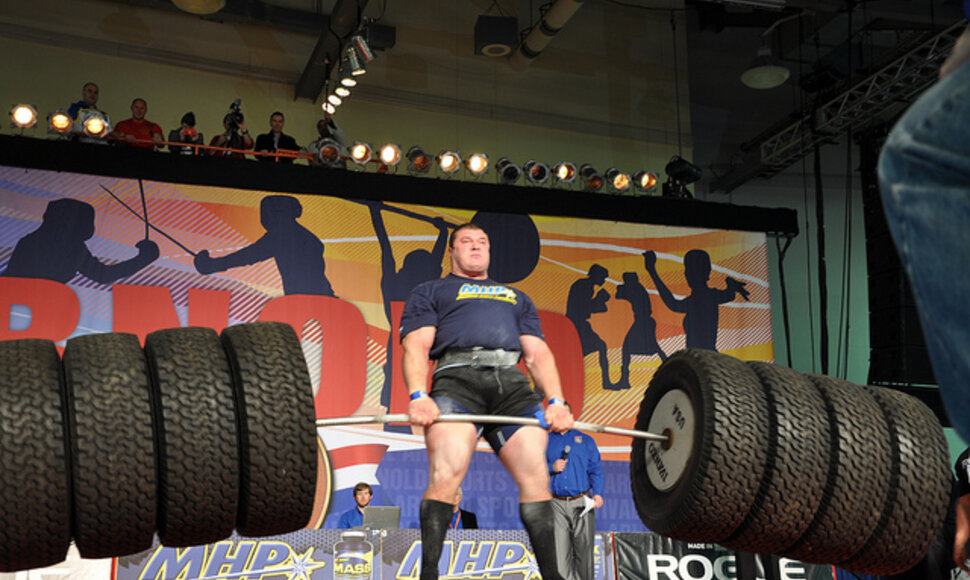
The 2012 World's Strongest Man was held in Los Angeles, with qualifying heats in late September before the final. In his group Lalas produced one of the defining performances of the season: 11 repetitions in the Squat for Reps with 700 pounds, approximately 320 kilograms, using the event's globe bar setup. IronMind reported the performance as a new world record. The context matters. This was not a standardised powerlifting squat under IPF rules but a strongman repetition event with a specific apparatus, time limit and accumulated contest fatigue. Within that correct context, eleven repetitions with roughly 320 kilograms represented an exceptional blend of maximal strength, work capacity and contest technique.
In the final Lalas scored 44.5 points and finished second. Savickas won with 49, Hafþór Björnsson was third with 42.5 and Brian Shaw fourth with 40. The margin of only 4.5 points between Lalas and the champion shows how close he came to the title. Event results reveal his profile: second in the Super Yoke, second in the Deadlift, third in the Bus Pull and Natural Stones, fourth in the Max Log Lift, with a weaker finish in the Power Stairs. He did not need to win half the final to fight for the championship. He did it through the density of good results. That consistency is one of the clearest signatures of his 2012 form.
Second place also carried symbolic importance for Lithuanian strongman. The top two were both Lithuanian, Savickas and Lalas, with Björnsson completing the podium. For a relatively small country, such a concentration of performance reflected a domestic tradition in which elite athletes frequently met in national championships and exhibitions. Lalas had developed in an environment where Savickas was not merely a television figure but a concrete standard, possible opponent and model of gradual progress. In 2012 that competitive proximity became globally visible.
After WSM, Lalas did not immediately enter an off-season. His autumn calendar continued through the Savickas Classic, World Log Lift Championships and Arnold Europe. In Vilnius he lifted 205 kilograms in the World Log Lift Championships and finished third, behind Savickas at 210 and Krzysztof Radzikowski at 207.5. For a compact athlete the log could be biomechanically favourable in range of motion, but an implement over 200 kilograms demands far more than short arms: an efficient clean, thoracic stability, triceps and shoulder strength, and the ability to transfer force from the legs and trunk into a controlled overhead line.
At Arnold Europe 2012 he finished third overall behind Savickas and Radzikowski. He won the Farmer's Walk with roughly 147 kilograms per hand in 10.67 seconds and shared the top result in the Dumbbell Press with 11 repetitions. He was third in the Max Deadlift at 420 kilograms and third in the Max Log Lift at 197.5. Those results are almost an x-ray of the Lalas skill set: excellent unilateral pressing, elite farmers speed, enough deadlift strength for a podium and the ability to stay close to specialist log pressers. Relative weaknesses such as the front hold did not erase those advantages because the points system rewarded an athlete who avoided disastrous finishes.
The end of 2012 created the psychological platform for the 2013 Arnold. Lalas was no longer arriving in Columbus as an obscure outsider. He was the world runner-up, a European medalist and an athlete who had demonstrated 400-plus-kilogram deadlift strength, 200-plus-kilogram log power and the ability to beat elite fields in farmers or dumbbell. The Arnold format, however, differed from WSM. There were fewer events, the implements were brutally heavy and each mistake carried disproportionate cost. That format suited Lalas precisely because his profile combined raw strength with precision in technical pressing events.
In early March 2013 Columbus assembled a field that, in retrospect, looks almost absurdly strong: Brian Shaw, Mikhail Koklyaev, Krzysztof Radzikowski, Mike Burke, Mark Felix, Jerry Pritchett, Hafþór Björnsson, Derek Poundstone and Adam Scherr alongside Lalas. The contest was among the heaviest of its era. Lalas finished with 35 points, Shaw with 34.5 and Koklyaev with 30. The half-point margin over Shaw shows how fragile the victory was. There was no room for a completely failed event.
In the Hummer Tire Deadlift Lalas lifted 507 kilograms and finished third. In the Manhood Stones he moved the 244-kilogram stone over the bar and remained high in the standings. He kept himself in contention on the Austrian Oak, while the event that shifted the contest most decisively was the Dumbbell Press. Contemporary result reporting credits him with five repetitions on the giant implement and the event victory. In a contest where Shaw had been accumulating points consistently, Lalas's ability to turn unilateral overhead strength into a first-place finish produced the margin that separated the trophy from second place.
The victory brought him the Louis Cyr trophy and a reported prize of 60,000 US dollars, a figure noted by Lithuanian media at the time. For his family in Laižuva the success had a very concrete dimension. His mother said that there were already so many cups and medals at home that furniture had been adapted to hold them, and some trophies had been donated to the local school museum. Lalas said that much of what he won was symbolically dedicated to his parents. He habitually called them before contests and spoke with them after events. The Arnold victory was therefore not simply the moment of an isolated athlete; it was the point at which a story begun in a family home in Laižuva reached the most extreme static-strength stage in international strongman.
The sporting importance of the win becomes clearer when the opposition is considered. Shaw would win World's Strongest Man multiple times during the decade, Björnsson would become both WSM and Arnold champion, while Radzikowski and Koklyaev were among the strongest specialists of the period. Lalas did not win a transitional contest or a depleted field. He defeated athletes who now define the history of modern strongman. That is why the 2013 Arnold remains the central competitive reference point of his legacy.
Lalas did not disappear from the circuit after the Arnold. At SCL/FIBO in Cologne in April he won again. IronMind reported a new event record of 13 repetitions with the 90-kilogram giant dumbbell and nine repetitions in the 350-kilogram deadlift, tied with Martin Wildauer for the event lead. Lalas also won the Stone Over Bar, and the overall victory came after a close battle with Hafþór Björnsson. This contest is a useful example of the difference between absolute strength and competitive strength. Pulling one maximum and repeating 350 kilograms nine times are related abilities, but not identical. Lalas could move between them without losing much efficiency.
In June he finished second at SCL Czech Republic and, several weeks later, second again at Europe's Strongest Man. In Leeds, Savickas won with 66.5 points, Lalas scored 59.5 and Radzikowski 53. Lalas was third in the Max Log Lift with 200 kilograms, remained highly competitive in the Super Yoke, was third in the Deadlift and Farmer's Walk, second in the Keg Toss and third in the Atlas Stones. Again, no single event victory carried him to the podium. It was the absence of a collapse. In a sport containing such different implements, that kind of regularity is one of the hardest qualities to build.
For the second consecutive year Lalas was European runner-up. More importantly, he did it while Savickas remained extraordinary, Björnsson was rising rapidly and Radzikowski, Shahlaei, Hall, Felix and others made every lost point expensive. When his place in strongman history is assessed, those consecutive European podiums provide essential context. There was not merely one perfect week at the Arnold. There was a period of roughly two years in which he was repeatedly among the best athletes on the major circuits.
In August 2013 Lalas returned to Giants Live Poland, the contest that had launched his international career in 2010, and won again. He finished on 53 points ahead of Krzysztof Radzikowski and Lauri Nämi. The programme included Carry & Drag, an Overhead Medley, Keg Toss, Conan's Wheel, a strength medley and Atlas Stones. The diversity of those events shows that his 2013 form was not exclusively “Arnold shape”, meaning preparation only for enormous static weights. He could also win in a faster Giants Live format that demanded transitions, conditioning and efficient movement.
At the 2013 World's Strongest Man in Sanya, China, Lalas qualified for his third final and finished sixth. After second place in 2012 and the Arnold victory in March, the result could look disappointing in isolation, but it demonstrates the volatility of strongman. Format, climate, event selection, recovery and minor injuries can rearrange an elite field quickly. Lalas nevertheless remained a top-ten world competitor in a season that had already included an unusually dense travel and competition schedule.
Taken as a whole, 2013 was probably the densest season of his career: Arnold Strongman Classic champion, SCL FIBO champion, Europe's Strongest Man runner-up, Giants Live Poland champion and World's Strongest Man finalist. None of those results occurred in isolation. They came at short intervals, across international travel and with rapid changes in preparation from extremely heavy implements to speed events and repetition work. For an athlete also managing his working life in Ireland, that density says as much about organisation and recovery as it does about the raw numbers lifted on stage.
Lalas was unusual for an elite Open strongman in the relationship between height and mass. At roughly 178 centimetres and 145–147 kilograms, he was extremely compact and broad. Rogue Fitness listed his chest at about 135 centimetres and arms at 56 centimetres during his Arnold period. Those figures should be treated as promotional-era measurements rather than laboratory data, but the overall image is clear from competition footage: a short, exceptionally thick torso, huge shoulders, powerful legs and a stable base. In pressing, that morphology can reduce total range of motion and improve stability. In squat and deadlift variations, segment lengths can create advantages or disadvantages depending on the implement and technique.
His most visible strength was overhead pressing. He lifted 205 kilograms at the 2012 World Log Lift Championships, completed two repetitions with the 200-kilogram Austrian Oak at the 2014 Arnold, five repetitions with the 124-kilogram Cyr Dumbbell at the 2016 Arnold and nine repetitions with the 102-kilogram Junior Cyr Dumbbell at Warwick in 2017. At FIBO 2013 he produced 13 repetitions with a 90-kilogram dumbbell. These results cover several forms of overhead strength: bilateral and unilateral, maximum weight and repetitions, large-diameter log and dumbbell. An athlete can be excellent at log and mediocre at dumbbell if unilateral stability or rack mechanics are weak. Lalas was competitive in both families of movement.
His deadlifting was similarly adaptable. The 507-kilogram Hummer Tire Deadlift at the 2013 Arnold is not directly comparable to a standard floor deadlift because the pulling height and flex of the system change the movement, yet it remains an elite contest performance. In 2016 at Arnold Asia he won an 18-inch axle deadlift with 480 kilograms. In 2017 he pulled 420 kilograms on the Rogue Elephant Bar, a bar that behaves very differently from an axle or Hummer setup. At FIBO 2013 he completed nine repetitions with 350 kilograms. The variety is more informative than any single number because strongman rarely asks an athlete to reproduce exactly the same lift under standardised conditions.
In moving events Lalas was dangerous because of short, fast steps, a compact position and strong grip. His Arnold Europe Farmer's Walk victory, good yoke and medley results and success at Giants Live show that his bodyweight had not turned him into a slow static specialist. This may be the most important technical characteristic of his career: he was not merely strong for his height, he retained enough speed for that strength to become points in dynamic events. Strongman rewards that conversion rather than gym strength alone.
The 2014 season began under the status earned the previous year. Lalas entered the Arnold Strongman Classic as defending champion and finished fourth. He completed two repetitions with the 200-kilogram Austrian Oak, pulled roughly 482 kilograms in the Hummer Tire Deadlift and remained competitive in a format that continued to push weights toward extreme limits. Fourth place can look modest beside the 2013 victory, but the Arnold field was becoming ever stronger and the distance between top positions was created by technical details. For Lalas, the result confirmed that his base level remained elite even when the event programme did not align perfectly with his strongest disciplines.
During the same year, however, injury began to alter the trajectory of the career. At Europe's Strongest Man, an event also linked with the World Deadlift Championships, Lalas pulled 400 kilograms and then withdrew. Retrospective archives and biographies associate the 2014–2016 period with recurring back problems. The generic phrase “back injury” can describe many different conditions, and public sources do not provide a complete medical diagnosis that would justify greater specificity. A responsible biography should therefore not invent discs, vertebrae or procedures that are undocumented. What can be documented is the sporting effect: his competitive rhythm declined and the continuity built from 2010 through 2013 was interrupted.
That interruption changes the meaning of the results that followed. The 2016 Arnold podium did not simply arrive two years after fourth place as part of a smooth line. It came after a period in which his body had to be readapted to loads that at elite level meant 400-plus-kilogram deadlifts, yokes weighing several times bodyweight and repeated pressing with 180–200-kilogram implements. Returning required more than rebuilding force output. It required rebuilding confidence in a body that had already signalled its limits.
The major contest archives do not show Lalas competing in 2015 with anything like the density of earlier seasons. In a biography built only from rankings, such a year can appear empty. For an athlete, however, absence from tables is not absence of work. Recovery from lumbar problems, preservation of muscle mass, technical adjustment and the management of a business in another country all formed part of the career even when they generated no medals. Such intervals are precisely what separate sporting chronology from a simple collection of podiums.
Lalas already had experience with surgery and rehabilitation from the arm problem reported in 2008. His stated philosophy of gradual progress becomes especially relevant here. When an elite athlete is injured, the pressure to recover lost numbers rapidly is enormous. Strongman punishes incomplete recovery: a single yoke or deadlift event can turn a manageable problem into months away. We do not have Lalas's private medical journal, but the competition chronology clearly suggests that he accepted a period of reduced activity in order to return at a genuinely competitive level.
His life in Ireland continued in parallel. Gym ownership and work in fitness gave him a professional identity that did not depend completely on prize money. That structure carried both an advantage and a cost. The advantage was independence from an unpredictable competitive season. The cost was that training, recovery, travel and business had to be coordinated constantly. For a spectator, a strongman appears on stage for a few hours; for the athlete, each appearance is the peak of a logistical pyramid. In Lalas's case that pyramid crossed borders because his family, much of his competitive identity and many events remained deeply connected to Lithuania.
The major comeback arrived at the 2016 Arnold Strongman Classic. Lalas finished third with 36 points behind Žydrūnas Savickas and Brian Shaw. The result was remarkable not only for the placing but for the quality of the individual performances. He pressed 205 kilograms on the Austrian Oak, pulled 415 kilograms on the Rogue Elephant Bar and completed five repetitions with the 124-kilogram Cyr Dumbbell. In the Bale Tote, an extreme yoke event of roughly 700 kilograms, he covered four metres in 24.22 seconds. He was also competitive in the Timber Carry. For an athlete returning after back problems, the combination of a 400-plus-kilogram deadlift and a massive yoke in the same contest was a complete test rather than a cautious check.
The 2016 podium confirms an essential point about his career: Lalas was not simply the product of a brief 2012–2013 window. Three years separated his Arnold victory from this third-place finish, and those years included equipment changes at the contest, new rivals and significant injury disruption. Returning to the podium in that context meant rebuilding enough absolute strength and technical precision to compete again with the best. The numbers from 2016 show that overhead remained a major weapon and that his deadlift had survived despite legitimate concern around the back.
That same year he won Lithuania's Strongest Man. Although Lalas was already an Arnold champion and WSM runner-up, this was his first Open national title recorded by Strongman Archives. The apparent paradox is explained by the extraordinary strength of the Lithuanian domestic scene. In earlier years, becoming national champion could mean defeating Savickas and other athletes capable of international podiums. The 2016 title therefore carried a special identity value: the athlete formed within Lithuanian strength culture and long based in Ireland finally became number one in the domestic championship he had followed since youth.
At Arnold Asia 2016 in Hong Kong, Lalas produced one of the most complete performances of the second half of his career. He won the overall contest and, according to archived results, dominated several events: the 18-inch Axle Deadlift with 480 kilograms, Atlas Stones, Max Log Lift and Super Yoke. He also remained near the top of the Truck Pull standings. The win matters because it reunites the same components that had made him dangerous during his younger peak: extremely heavy deadlifting, overhead strength, stones and speed under a yoke.
The 480-kilogram deadlift needs correct interpretation. In strongman, pulling height can radically change the weight an athlete is able to move. An 18-inch deadlift is not equivalent to a standard floor deadlift and should not be presented as the same record. Its value in Lalas's biography lies elsewhere: it shows his ability to adapt to a high start position and rigid implement in which posterior-chain strength, grip and lockout are challenged differently. He was strong not in one deadlift pattern but across several geometries.
Arnold Asia also demonstrated that the 2016 comeback was not built for a single weekend. An Arnold podium in Columbus might be interpreted as one excellent day. A national title followed by an Arnold victory in Asia showed that the form transferred. For an athlete in his mid-thirties after more than a decade of serious training, this represented genuine competitive maturity: less need to prove strength in every gym session and more ability to arrive prepared for the exact implements that mattered on contest day.
In 2017 Lalas returned to the Arnold Strongman Classic and finished sixth. He pulled 420 kilograms on the Rogue Elephant Bar, evidence that his deadlift remained world-class even though the overall result was no longer a podium. Season archives and retrospective profiles again mention back problems, suggesting that the successful 2016 return had not eliminated accumulated vulnerabilities. From this point in the career, his results need to be read alongside pain and workload management rather than as raw numbers alone.
The season nevertheless produced important victories. He won the SCL World Overhead Lift Championships in Kaunas, strengthening his reputation as an elite presser. At the Festival des Hommes Forts de Warwick in Canada he reached the podium and completed nine repetitions with the 102-kilogram Junior Cyr Dumbbell, one of the strongest marks listed for that event. At Viking Apocalypse, an Ultimate Strongman contest in Odense, he won with 45 points ahead of Mateusz Kieliszkowski. The result matters because Kieliszkowski was emerging as one of the fastest and most technically gifted strongmen of the new generation.
The 2017 results also reveal a shift in emphasis. His peak years had involved simultaneous campaigns across Arnold, WSM, Giants Live and SCL. The late career contained more contests where technical experience could compensate for recovery limitations. Overhead events remained ideal for his structure, while competitions such as Viking Apocalypse or Warwick allowed him to exploit versatility without organising the entire year around a WSM campaign. This was not withdrawal from elite sport so much as recalibration of the calendar.
The final strongman season of Lalas's career was 2018, and it condensed both the resilience and fragility of a long Open-class career. At Europe's Strongest Man he suffered a calf injury and withdrew after the third event. The final tenth-place listing says little without context because injury prevented him from completing the programme. For an athlete whose reputation had been built on consistency, forced withdrawal was the opposite of his preferred competitive style.
Several months later he returned and won Lithuania's Strongest Man for the second time. Strongman Archives records 46 points and event victories in Atlas Stones, Deadlift, Farmer's Walk and Max Log Lift. The events he won form almost a miniature summary of his career: a stone, a deadlift, a carry and an overhead. No single movement family dominates the list. The 2018 national championship therefore has an elegant retrospective quality: in one of his final major contests in Lithuania, Lalas won through exactly the same versatility that had made him world runner-up six years earlier.
At the Ultimate Strongman World Team Championships he competed with his brother Marius, emphasising the family dimension of their strength careers. The Lalas brothers won with 35 points, edging the American team of Martins Licis and Trey Mitchell on 34. Reports of the contest note that the title was decided in the final event. For a family in which three brothers pursued strength sports at a high level, the world team championship represents more than another line in a résumé: it is the moment when the family's sporting project appeared literally on the same platform.
At the Giants Live World Tour Finals in Manchester, Lalas finished fifth. Strongman Archives then lists the Burn Showdown in November 2018 as his final strongman appearance. There was no universally broadcast retirement ceremony or theatrical announcement marking a single clean ending. Rather, after years of injury, business responsibilities and shifting priorities, the circuit stopped. That quiet exit fits his public personality: an athlete known more for what he did with an implement than for grand declarations.
Vytautas's career is difficult to separate completely from those of his brothers. Marius Lalas, roughly four years younger, became an international-level strongman and Lithuanian champion in his own right. Mantas Lalas distinguished himself in armwrestling. In a family with three sons competing in strength disciplines, comparison could easily have become a source of destructive rivalry. Public sources, however, describe cooperation more often than conflict. Vytautas was the first to reach the major international stages, and his experience inevitably created a technical and logistical model for the younger brothers. Later, he and Marius competed together, won the 2018 world team championship and became active in the same Irish fitness environment.
The family connection also has a cultural dimension. In interviews with their mother Adelė, sporting success is not described as a break from the family but as an extension of the work ethic learned at home. Their parents followed competitions, received calls before events, kept trophies and photographs, and the family home in Laižuva became an informal archive of the career. When the number of cups grew, some were donated to the museum of the local school. The gesture is meaningful: the sporting record did not remain purely private property but returned to the community from which the athletes had emerged.
Individual-sport biographies often overstate personal will and understate infrastructure. The Lalas story shows the limits of that approach. A father built training devices, a mother held together a large family and remained a point of support, brothers entered strength sport, and Simona shared the realities of migration and an international competitive schedule. None of those people lifts a 200-kilogram stone for the athlete, but all help make a decade-long project possible. Strength is individual at the instant of execution and collective in the structure that sustains it.
One of the most useful ideas Lalas left in interviews is not a precise set-and-rep routine but a rule of development. Asked about his rise, he said he did not consider it sudden but calculated. He tried to improve a little each year and looked to Žydrūnas Savickas as an example of strength built over time. That position contrasts with the permanent temptation in strength sports to turn every month into a maximal test. For Lalas, the largest results appeared after years of accumulation rather than one aggressive training cycle.
He also warned against beginning extremely heavy strongman too young. In his view, a teenager or very young athlete should not copy the loads of a 140–150-kilogram Open competitor because the body is still developing and the cost may appear years later. This should be understood as Lalas's experience and opinion rather than a universal medical prescription. It is, however, coherent with his own timeline: he entered major Open competition after accumulating years of strength sport and produced his greatest results around the age of thirty to thirty-one.
His results also imply another characteristic of preparation: transfer between variants. A powerlifter can optimise three standardised lifts. A strongman must transfer qualities between log, dumbbell, axle, yoke, farmers, stones, truck pull and deadlifts from different heights on different bars. Lalas achieved that transfer at a very high level. His Hummer Tire, Elephant Bar and 18-inch axle performances are not identical, but together they show a posterior chain able to operate in different geometries. Likewise, his log and Cyr Dumbbell results demonstrate both bilateral and unilateral pressing rather than one rehearsed movement.
For a modern coach or athlete, the technical legacy is not to copy his numbers. It is the idea that a very large general strength base can be redirected rapidly toward the implement required by a contest. The 2013 season is the ideal example: within months Lalas needed to be competitive on Hummer Tire Deadlift and Manhood Stone at the Arnold, then dumbbell and deadlift for repetitions at FIBO, then yoke, farmers and Atlas Stones at Europe's Strongest Man. Changing specificity without losing the base is one of the hardest programming problems in strongman.
Injury appears repeatedly in the Lalas chronology. In 2008 local reporting said he was preparing for surgery on his left arm following a muscular injury. In 2014 he withdrew from Europe's Strongest Man after the deadlift, and retrospective sources discuss recurring back problems over the following years. In 2018 a calf injury removed him from Europe's Strongest Man. These episodes should not be used as invitations for medical speculation. Without public clinical records it is not responsible to claim which precise anatomical structure was affected in each case or how severe a diagnosis may have been. What can be documented is their effect on his calendar and competitive frequency.
In strongman, risk does not come from one movement alone. A maximal deadlift stresses the body differently from a yoke, truck pull, stones or overhead press. Competition conditions are also not standardised: bars, surfaces, temperatures and implements change. An athlete can be technically excellent in the gym and still have to manage variables beyond his control. Lalas competed across Europe, Asia, South Africa and North America, sometimes at short intervals. The physical wear of his career therefore belongs in the context of repeated exposure to changing heavy events, not as the result of one simple training choice.
More impressive than avoiding injury, nearly impossible across a career this long, was the ability to return. After the problems that disrupted 2014 and 2015, he returned to the Arnold podium in 2016. After further back difficulty in 2017, he continued to win contests. After the calf injury in 2018, he became Lithuania's Strongest Man and a world team champion in the same year. Resilience should not be confused with ignoring pain. The chronology suggests a pattern of stopping, recovering and rebuilding rather than simply forcing continuous competition.
Compared with many athletes from the social-media era, Lalas kept his private life relatively private. Strong sources identify Simona as his wife and connect their meeting to the university period. Rogue Fitness described him as married and, away from competition, as a quiet, serious man who enjoyed reading. That apparently small detail is useful because it disrupts the stereotype of a strength athlete defined only by a gym. Lalas lived in Ireland for years, managed businesses and moved within a multilingual, multicultural environment, while reading was presented as one of his preferred forms of relaxation.
Secondary sources describe him as a father of three, although high-quality public reporting offers relatively little detail. There is no reason for a sporting biography to turn children or other private relatives into public content. It is sufficient to observe that family life existed in parallel with the career and migration to Ireland. The privacy of relatives who did not choose a public role should be respected. The same principle applies to home addresses, children's schools or other information that has no relevance to the sporting story.
His mother did offer a few family details that help sketch the character around the athlete. In a 2013 interview she said that her sons did not smoke or drink alcohol and that when they returned home they enjoyed the traditional food she cooked. Such recollections should not be converted into moralism or simplistic causation between lifestyle and performance. They simply show that the public image surrounding Lalas was associated with discipline, family attachment and an existence less theatrical than the competition stage might suggest.
During his peak competitive years Lalas was associated with Animal Barbell Gym in Dublin, which Rogue Fitness listed as a business he co-owned. He told Lithuanian media that he had opened the gym with a friend and that it became his main source of income. For a professional strongman, control over the training environment is an enormous advantage. A dedicated facility can hold implements that a commercial gym would never store, accommodate long sessions, chalk, dropped equipment and loads beyond the intended capacity of conventional machines.
Later, the Lalas name became associated with Top Performance Fitness in Kilkenny. Public information and current reviews identify Vytautas and Marius as owners or central figures, and clients repeatedly describe a strength-oriented equipment selection and their willingness to assist members. Online reviews are not the appropriate evidence for competitive records, but they are useful for understanding the local reputation of an active business. The picture that emerges is a gym built around real strength-sport experience rather than the branding of a former champion alone.
The transition from athlete to gym owner changes the nature of influence. On a contest stage, Lalas could inspire through a 500-plus-kilogram Hummer deadlift. In a gym, influence is less spectacular and more repetitive: choosing equipment, correcting technique, maintaining a culture in which a beginner and an experienced lifter can coexist. That form of legacy is difficult to quantify in a database, but it matters in strength sports, where local communities often produce the next generation of competitors.
Retirement from professional strongman did not sever his connection with strength sport. Armwrestling had been present before his Open strongman career and became more visible again in public Lalas Brothers content after 2018. During 2020–2021, video material and armwrestling events featured Vytautas in training and exhibition contexts. The transition is logical: grip, arm strength and years of pressing and carrying provide a base, but armwrestling has a highly specific technique and cannot be reduced to a simple test of general strength. Lalas knew that distinction from youth, when he had already won national titles in the discipline.
Channels and material associated with the “Lalas Brothers” name kept a public presence in strength culture after Vytautas disappeared from major strongman standings. Such activity does not carry the visibility of World's Strongest Man, but it shows that his sporting identity did not end with the final contest. He remained a gym owner, practitioner, reference point for armwrestling and strongman, and a recognisable figure for Lithuanian and Irish audiences interested in strength.
It is useful to distinguish “retired” from “inactive” here. For the strongman profile, Lalas can reasonably be treated as retired because the major archives record no strongman competition after 2018. That does not mean he stopped training or abandoned sport. His subsequent fitness and armwrestling activity suggests the opposite. Retirement refers to the professional strongman circuit, not to his identity as a strength athlete.
The best-documented Lalas mark explicitly reported as a world record is the 2012 World's Strongest Man Squat for Reps: 11 repetitions with 700 pounds, approximately 320 kilograms. IronMind reported the performance as a new world record on the day. It must remain in the context of a strongman squat event rather than be converted into a world powerlifting record. The bar, depth standard, apparatus and repetition format belonged to that event's rules. Its value remains enormous precisely in the correct category: a WSM world record in squat for repetitions.
The 507-kilogram Hummer Tire Deadlift from 2013 is another emblematic figure, but context again matters. The Hummer setup uses a long, highly flexible bar and a pulling height different from a standard deadlift. Athletes can often move more weight than they could from the floor with a rigid bar. Lalas finished third in the Arnold event, which itself demonstrates the extraordinary level of the field. The number should not be presented as his standard deadlift personal record, but as a Hummer Tire performance exactly as the archives record it.
The same principle applies to 480 kilograms on the 18-inch axle and 420 kilograms on the Elephant Bar. They are personal contest performances in specific variants. Their variety is precisely what makes Lalas interesting. A single enormous figure in one setup could indicate narrow specialisation. Instead, he produced elite results on a long flexible Hummer bar, a high axle pull and an Elephant Bar, as well as heavy repetitions with 350 kilograms. That is a strongman's signature rather than the résumé of a one-lift specialist.
In overhead strength the most useful reference points include 205 kilograms on the log in 2012, two repetitions with the 200-kilogram Austrian Oak in 2014, five repetitions with the 124-kilogram Cyr Dumbbell in 2016 and thirteen repetitions with a 90-kilogram giant dumbbell at FIBO 2013. Together those figures reveal more than one maximum: maximal strength, repetition capacity, unilateral stability and implement adaptation. His Arnold Europe Farmer's Walk victory with roughly 147 kilograms per hand provides a speed-and-grip marker, while the 700-kilogram Bale Tote in 2016 demonstrates tolerance of enormous axial load.
Historical evaluation in strongman should avoid turning results into an absolute ranking across eras. Implements, calendars and rules change. Within his own context, however, Lalas competed directly with three defining figures of the period: Žydrūnas Savickas, Brian Shaw and Hafþór Júlíus Björnsson. At the 2012 World's Strongest Man he finished between Savickas and Björnsson, while Shaw was fourth. At the 2013 Arnold he defeated Shaw by half a point. Those documented results place him factually in the centre of one of the sport's strongest competitive generations without requiring speculative labels.
Lalas is also a useful example of the difference between a WSM résumé and the total value of a strongman career. He did not win World's Strongest Man, but he was runner-up and won the Arnold Strongman Classic, a contest whose implements in some seasons were heavier and whose format differed significantly from WSM. He was twice European runner-up, won Arnold Asia, Giants Live and SCL contests and national championships. A portrait built only from the number of WSM titles would miss most of that performance.
Strongman Archives credits him with 36 international appearances and 11 victories, in addition to national, regional and single-event results. Those figures indicate competitive density but cannot describe everything. Lalas competed in an era when international travel was frequent and, for most athletes, prize money and commercial support were smaller than the structures available to leading professionals today. At the same time he managed a gym and a life in the Lithuanian diaspora. Economic and logistical context therefore forms part of his longevity rather than merely a background detail.
Documenting a strongman career from the 2000s and 2010s inevitably requires reconciliation across several archives. Strongman Archives is the most useful central database for overall standings and event results, while contemporary IronMind reports, Giants Live pages, Rogue Fitness athlete material, Strongman.org, FitnessVolt and Lithuanian journalism supply context a database cannot preserve. Numbers occasionally differ between sources: a log lift may be rounded differently or appear as 200 kilograms in one archive and 205 in a contemporary event report. When this happens, the source closest to the specific event carries particular value, and the profile should preserve context rather than hide the discrepancy.
Bodyweight also varies across profiles. Some list Lalas at around 140 kilograms, others at 147, while an older article described him at 125 kilograms. There is no necessary contradiction when the figures come from different years. Strongmen change body mass with training phase, injuries and goals. For the current profile, 147 kilograms is a well-attested peak-era competition value, but it should not be read as his permanent weight during every season of his career.
The beginning of the career can likewise carry two valid dates. Lalas was already active in strongman and armwrestling in 2005, when Lithuanian sources mention the junior title, while Strongman Archives begins its senior international chronology in 2007. The profile therefore records activity from 2005 while making clear that the archive's senior record starts in 2007. A careful biography does not force one date when the sources describe different stages of the same transition.
The legacy of Vytautas Lalas rests on two immediately recognisable results but does not end with them. Second place at the 2012 World's Strongest Man put him only a few points from the sport's most famous title. Winning the 2013 Arnold Strongman Classic gave him a trophy achieved by very few athletes. Between and around those landmarks sits a complete career: a world record squat for repetitions, European podiums, Giants Live and SCL victories, another Arnold podium after injury, the Arnold Asia title, two Lithuanian championships and a world team championship with his brother.
Technically, Lalas remains an example of the compact athlete who can offset height disadvantages through efficiency, speed and density of force. His overhead strength was elite, his deadlift transferred across multiple implements and his moving events were not a typical weakness for such a massive competitor. That combination explains why he could win both the Arnold, oriented toward extreme heavy strength, and faster Giants Live or SCL contests.
On a human level, his story is that of an athlete who left Lithuania for Ireland for economic reasons, continued to study and work, built his own training environment and remained closely connected to family. He did not cultivate an excessively theatrical public personality and did not turn every difficult period into spectacle. Even retirement was quiet. In a discipline visually defined by enormous objects and extreme gestures, Lalas built a career through an almost opposite principle: calculated progress repeated for long enough.
Today his name remains connected simultaneously with Lithuania and Ireland, with World's Strongest Man and the Arnold, with the Lalas family and with gyms where experience accumulated at the highest level can be passed on. In the history of European strongman, Vytautas Lalas is not merely a footnote between the Savickas and Shaw eras. He was one of the opponents who made that era competitive, an Arnold champion in his own right and an example of elite strength built through patience, work and adaptation.
This profile was constructed by cross-checking Strongman Archives results with contemporary IronMind reporting, Giants Live contest information, Rogue Fitness athlete material, Strongman.org and FitnessVolt archives, World Log Lift result coverage and Lithuanian interviews and reporting, especially Kauno Diena, Lrytas and Santarvė. For personal information, interviews with Lalas and his family were preferred over unsourced biography compilations. For performance data, the exact implement type is preserved so that Hummer Tire, Elephant Bar, 18-inch deadlift, log and squat-for-reps numbers are not presented as standardised records directly interchangeable with one another.
Core references include Strongman Archives athlete and contest pages; Giants Live archives; IronMind reports on the 2012 World's Strongest Man and 2013 SCL/FIBO; the Rogue Fitness athlete profile; Kauno Diena interviews on his beginnings, gradual progress and Irish life; Lrytas and Santarvė family and early-career reporting; Strongman.org competition archives; FitnessVolt's Arnold Strongman Classic and Arnold Asia archives; and All Things Gym's coverage of the 2012 World Log Lift Championships. Information has been checked through September 2026.
To understand Lalas's rise, the environment that produced him matters. Lithuania did not have the population of the United States, United Kingdom or Poland, yet during the 2000s and 2010s it produced an unusual concentration of strength athletes. Žydrūnas Savickas represented the supreme standard, but around him existed a culture of national contests, team competitions, armwrestling and powerlifting that offered young athletes concrete examples rather than distant myths. An athlete such as Lalas could see what world-class strength looked like at close range, enter the same domestic ecosystem and compare his level directly with men capable of winning the largest titles in the sport.
That proximity can accelerate learning, but it also makes national success harder. A Lithuania's Strongest Man title during this period was not an administrative formality. Lalas became a World's Strongest Man runner-up before winning his first Open national championship recorded in the archives. The apparent paradox disappears once the level of domestic opposition is considered. In some countries, an athlete capable of a world podium will almost inevitably dominate at home. In Lithuania, the same athlete could return from a global medal and still face an absolute world champion in the national field.
The team culture was also important. Lalas won a world team title as early as 2008 and effectively closed his strongman career with another world team championship in 2018, this time alongside Marius. A decade separates those two markers. They demonstrate that strongman for him was not exclusively an individual ranking exercise. National and family identity could also be expressed through a team format. Lithuanian reporting makes this especially visible, often framing victories through the relationship between athlete, hometown, family and national squad.
The two signature results of the Lalas career, second at World's Strongest Man in 2012 and first at the Arnold in 2013, came in very different formats. WSM involved qualifying heats, several days of work, moving events, object loading, pulling, yoke, stones and accumulated fatigue before the final. The Arnold Strongman Classic centred on a smaller number of brutally heavy implements, with absolute strength carrying enormous weight in the overall result. That Lalas excelled under both systems is one of the strongest pieces of evidence for his versatility.
At WSM 2012, consistency created the podium. He did not build the final result around one isolated record but through a sequence of high finishes. At the 2013 Arnold, a few peak moments had disproportionate value: 507 kilograms in the Hummer Tire Deadlift kept him connected to the leaders, while the Dumbbell Press victory delivered decisive points. Those strategies are not completely separate, but they illustrate two forms of excellence. An athlete can survive a long championship through the absence of weak events or win a shorter contest through very high points in the correct disciplines. Lalas could operate in both modes.
For that reason, his historical profile should not be reduced to whether he won WSM. The 2013 Arnold was a major title, and the manner in which he won it against Brian Shaw provides direct evidence of his level in that period. At the same time, second at WSM proves that he could survive the long, diverse format of the sport's best-known competition. The two results complement each other: one demonstrates endurance within a complex championship, the other strength and precision in a contest built around extreme loads.
A local 2008 article described Lalas at around 125 kilograms and 176 centimetres, while international profiles from his peak list roughly 178 centimetres and 140–147 kilograms. The small height difference is probably a product of rounding and different measurement methods, but the body-mass change reflects a real transformation. Over several years Lalas added enough mass to compete with the largest Open strongmen without surrendering all of his mobility. That is one of the most delicate transformations in the sport: every kilogram of mass may assist stability and absolute force while potentially costing speed, conditioning and long-term physiological comfort.
In Lalas's case, the competition evidence suggests that the added mass remained functional. In 2010 and 2011 he could win loading and pulling events; in 2012 and 2013, when he was already substantially heavier, he remained extremely fast in farmers and yoke work. Public sources do not provide enough reliable detail to reconstruct his diet, bulking phases or body composition, and those details should not be invented. The external result is clear enough: additional size did not turn him into a static specialist unable to move.
His compact morphology also shaped the visual impression he made. Standing beside athletes over two metres tall, Lalas could appear comparatively small until the implement entered the frame. Then the scale changed: a weight disproportionate to his height moved with surprising efficiency. That aesthetic of dense strength contributed to his appeal among fans. He did not fit the classic silhouette of the exceptionally tall giant. His body looked almost block-like, organised around stabilising and transferring force.
The 36 international appearances recorded by Strongman Archives are not an all-time record for the sport, but they are more than enough to show that Lalas's major performances were not statistical accidents. An athlete can have a perfect day and win one contest. It is much harder to remain for years in fields containing world champions, change continents, judges and implements, and accumulate 11 international victories. Repeatability is one of the healthiest criteria for evaluating any strength-sport career.
For Lalas, repeatability appears in several forms. He won Giants Live Poland in 2010 and again in 2013. He returned to the Arnold podium three years after winning the title. He finished runner-up at Europe's Strongest Man in consecutive years. He won Lithuania's Strongest Man in 2016 and again in 2018. Such paired results are useful because they separate temporary form from structural ability. When an athlete reproduces a major result after several seasons, it indicates that the underlying technical and physical base survived changes in programme, opposition and circumstances.
The same statistics also show that he was not invulnerable. Lower placings and withdrawals during 2014, 2017 and 2018 belong to the same story. A complete profile should not remove them in order to manufacture an image of a champion without cracks. They give proportion to the victories. The 2016 Arnold podium matters more because it came after interruption, and the 2018 national title is more compelling because it followed the calf injury at Europe's Strongest Man.
Lithuania and Ireland are not merely geographical coordinates in the Lalas biography. Lithuania provided family, the first gyms, sporting models and competitive identity. Ireland provided the economic space in which he built adult life, business and much of his training infrastructure. Rather than choosing definitively between the two, Lalas lived for years in a system of circulation: working and training in Ireland, returning to Lithuania for family and competitions, then travelling elsewhere in the world for the professional circuit.
That experience also belongs to the wider history of Eastern European athletes who built careers in diaspora after European Union expansion. Strongman was not yet a sport in which most competitors could comfortably live on prize money and sponsorship alone. Moving abroad for work was not an external detail but, for some athletes, a condition that made sport possible. In Lalas's case the Dublin gym and later Kilkenny projects transformed economic migration into a durable professional infrastructure.
The fact that he remained visibly Lithuanian on the major stages while living in Ireland demonstrates how sporting identity can cross borders without dissolving. The Lithuanian flag followed his name in results; daily career construction happened largely in Ireland. After retirement the dual belonging became even clearer: Lalas remains part of Lithuanian strongman history, while his immediate gym community is associated with Ireland. It is a transnational legacy built through two decades of ordinary life rather than a marketing campaign.
Event-by-event analysis shows an athlete whose great competitive asset at his peak was the absence of one catastrophic weakness. He could win overhead events. He could place near the front in deadlift. He had speed in farmers and yoke, while stones were strong enough to avoid large point losses. In a scoring system such as WSM, that structure is extremely valuable. A specialist can win two events and still lose a contest by finishing last in two others. Lalas often built overall position through top-three or top-five finishes, then converted consistency into victory when a programme included favourable dumbbell, squat or carry events.
Power Stairs and some hold events could produce weaker results, while implements heavily dependent on height did not always provide the biomechanical advantages that pressing did. Yet Lalas often compensated through pacing and experience. At WSM 2012, for example, seventh in the Power Stairs did not destroy his championship position because he had placed very highly elsewhere. That is the arithmetic of championship strongman: an athlete does not need to be the best in the world at every movement, but must understand how much can be lost without leaving the fight.
Shorter contests changed the equation. The 2013 Arnold had so few events that every point carried enormous weight. Lalas could not afford a complete failure, and the final half-point margin over Shaw proves it. That the same athlete could manage both the WSM and Arnold structures says something about competitive intelligence as well as musculature. Elite strongman requires decisions: when to force one more repetition, when to protect the back for the next event, how aggressively to run with a yoke without losing control, and when a single additional point does not justify the risk of injury.
If the biography of Vytautas Lalas were reduced to two lines, they would inevitably contain “2012 World's Strongest Man, second place” and “2013 Arnold Strongman Classic, first place”. Complete documentation shows how much that reduction would omit. Before those results came childhood in Laižuva, armwrestling, a modest Mažeikiai gym, food-technology studies, migration to Ireland, paid work and the building of a gym. After them came injuries, recoveries, another Arnold podium, the Arnold Asia title, two national championships and a final world team championship beside his brother.
That continuity explains why Lalas remains relevant to strongman history. He represents a version of elite sport in which performance was never perfectly separated from ordinary life. He studied, emigrated for money, worked, built a business, was injured, returned and continued. At the peak of that logistical reality sit almost unbelievable moments: squatting 320 kilograms eleven times in a contest or lifting more than half a tonne in a Hummer deadlift. The contrast between the ordinary and the extreme gives the biography much of its weight.
For later generations his value is not only numerical. The message repeated in interviews, progress deliberately and do not rush extreme loading before the body is ready, carries authority precisely because it comes from someone who knew both podiums and injury. Lalas did not have an uninterrupted career and did not avoid failure. He did, however, compete long enough for his results to pass the test of repetition and broadly enough to show that the 2013 Arnold victory was not an isolated accident.
In modern strongman history, Vytautas Lalas therefore remains difficult to reduce to a stereotype: a Lithuanian formed in an exceptionally competitive strength culture, an emigrant settled in Ireland, gym owner and businessman, brother in a family of strength athletes, elite overhead specialist without being only a presser, powerful deadlifter without being only a deadlifter, and a compact athlete capable of winning both static and dynamic contests. Archives preserve the points and kilograms. The complete story explains how those numbers became possible.
One useful way to measure a career is to examine not only placings but the opponents against whom they were earned. In Lalas's case that list is exceptionally strong. Žydrūnas Savickas was simultaneously a national benchmark, a model Lalas openly referenced and a direct rival. Brian Shaw was already a World's Strongest Man champion when Lalas beat him at the 2013 Arnold. Hafþór Júlíus Björnsson was on the rise toward future WSM and Arnold titles, while Krzysztof Radzikowski, Mikhail Koklyaev, Laurence Shahlaei and Mike Jenkins represented other forms of elite strength. Later, Lalas also encountered the generation of Mateusz Kieliszkowski, Martins Licis and Trey Mitchell. His career therefore crosses two competitive waves rather than one.
The relationship with Savickas is especially revealing. Lalas did not describe him only as a rival but as a model of gradual development. Growing within the same sporting culture as an athlete who had already won the largest titles could be intimidating, but it also provided an extraordinary measuring stick. In 2012, when Lalas finished 4.5 points behind Savickas at World's Strongest Man, the distance between role model and challenger had become small enough for the championship to be a realistic possibility. Continued close finishes at Europe's Strongest Man and other contests provide a better measure of Lalas's level than any isolated gym number.
The 2013 Arnold duel with Brian Shaw provides a complementary comparison. Shaw possessed enormous size advantages and static strength already proven at world-championship level. Lalas, significantly shorter, had to manufacture points through efficiency, speed and pressing. The final half-point margin illustrates why strongman cannot be reduced to body dimensions or a single maximum. Two very different bodies can arrive near the same total through different biomechanical and tactical solutions. Lalas's victory is historically important for precisely that reason: it does not confirm one ideal strongman body, but demonstrates that versatility can overcome a far larger opponent.
In the final years of his career, athletes such as Kieliszkowski and Licis changed the equation again. The new generation brought an even sharper combination of speed, technique and implement specialisation. The fact that Lalas could still win Viking Apocalypse ahead of Kieliszkowski or take a world team title against a pairing of Licis and Trey Mitchell shows that experience accumulated during the Savickas–Shaw era remained competitive after the generational shift. These late results do not carry the weight of a WSM or Arnold title, but they provide valuable evidence of technical longevity.
Between 2010 and 2013 the progression from qualifier to major champion can be observed almost step by step. In 2010 Lalas won Giants Live Poland and reached WSM but finished third in his group. In 2011 he won SCL Finland and reached his first WSM final, finishing sixth. In 2012 he climbed onto the European podium, set the squat record in qualifying and became world runner-up. In 2013, after accumulating all of those experiences, he won the Arnold Strongman Classic. The sequence resembles a manual of competitive development: qualification first, then final, then podium, then a major title.
That evolution also suggests that contest experience had value independent of raw strength. Gym numbers can increase between seasons, but so can the ability to understand a competition's rhythm. An athlete learns how a deadlift warm-up feels after two prior events, how to react when the contest implement differs from the one used at home, how much time can be lost in a transition and how much energy must remain for stones. Lalas accumulated those lessons through a dense European calendar, and the largest results appeared when the physical base and competitive intelligence met.
The 2012 squat record and 2013 Arnold victory should therefore not be viewed as separate explosions. They belong to the same maturation phase. The squat demonstrates how large his physical capacity had become; the Arnold demonstrates how effectively he could convert that capacity into points. In strongman, this is the difference between being extremely strong and being a championship competitor. Lalas became both within the same period.
Strongman in the 2020s is more professionalised, more visible online and in many ways more specialised than the circuit Lalas entered. Athletes now have instant event footage, more sophisticated programming, greater access to physiotherapy, purpose-built equipment and global information communities. In that environment, the Lalas career remains relevant because it demonstrates the value of a transferable base. He built elite performance in an era when the exact contest implement could be difficult to reproduce in training and athletes often had to solve differences in dimensions, grip or surface on the day.
Another modern issue is the relationship between specialisation and health. Lalas's injuries show that versatility does not remove the cost of extreme loading. At the same time, his 2016 comeback demonstrates that a career can be recalibrated. The useful lesson for contemporary athletes is not to copy his weights or treat pain as a test of character, but to understand that long-term performance includes periods in which recovery and reconstruction become the central objectives. Even for an Arnold champion, progress is not a straight line.
Finally, Lalas remains relevant because morphology alone did not dictate his destiny in strongman. He lacked the height typical of many Open champions, yet found events where compactness became an advantage and developed the rest sufficiently to prevent weak events from eliminating him. For any athlete who does not fit a perfect prototype, this may be the most interesting feature of the career. Strongman does not offer one ideal body. It offers a new problem in every event, and the best competitors are those who find enough solutions.
Iron Hall data
320 KG
Squat for Reps · 11 reps; world record at the 2012 World's Strongest Man qualifying heats
Verified
507 KG
Hummer Tire Deadlift · 2013 Arnold Strongman Classic; 3rd in the event
Verified
480 KG
18-inch Axle Deadlift · 2016 Arnold Asia; event winner
Verified
420 KG
Elephant Bar Deadlift · 2017 Arnold Strongman Classic
Verified
205 KG
Max Log Lift · 2012 World Log Lift Championships; 3rd place
Verified
200 KG
Austrian Oak · 2 reps at the 2014 Arnold Strongman Classic
Verified
124 KG
Cyr Dumbbell · 5 reps at the 2016 Arnold Strongman Classic
Verified
102 KG
Cyr Junior Dumbbell · 9 reps at the 2017 Festival des Hommes Forts de Warwick; joint top mark listed in the records
Verified
244 KG
Manhood Stone / Atlas Stone · 1 rep over the bar at the 2013 Arnold Strongman Classic
Verified
700 KG
Bale Tote / Super Yoke · 4 m in 24.22 s at the 2016 Arnold Strongman Classic
Verified
147 KG / HAND
Farmer's Walk · 10.67 s at 2012 Arnold Europe; event winner
Verified
90 KG
Giant Dumbbell for Reps · 13 reps at 2013 SCL/FIBO; event record reported by IronMind
Verified
350 KG
Deadlift for Reps · 9 reps at 2013 SCL/FIBO; joint event win
Verified
2005
Lithuanian interviews on his early career report that in 2005 Lalas became the country's overall armwrestling champion and a junior strongman champion.
Champion
2008
Part of the Lithuanian team that won the world team title in Ukraine; local reporting described him as the youngest member of the squad.
World team champion
2010
His first major international victory; the result qualified him for the 2010 World's Strongest Man.
Champion
2010
WSM debut; he won the Loading Race and Deadlift in his group but did not advance to the final.
3rd in group
2011
Won in Lempäälä by half a point over Laurence Shahlaei.
Champion
2011
His first WSM final, held in Wingate, North Carolina.
6th place
2012
A major Leeds podium that confirmed his arrival among the world's elite before WSM 2012.
2nd place / European runner-up
2012
The best WSM result of his career: 44.5 points, behind Žydrūnas Savickas and ahead of Hafþór Björnsson.
2nd place / world runner-up
2012
11 repetitions with 320 kg in qualifying, a world record for the event at the time.
World record
2012
205 kg in Vilnius, behind Žydrūnas Savickas and Krzysztof Radzikowski.
3rd place
2012
Won the Farmer's Walk and Dumbbell Press and finished on the overall podium.
3rd place
2013
The defining victory of his career: 35 points, half a point ahead of Brian Shaw. He won the Dumbbell Press and pulled 507 kg in the Hummer Tire Deadlift.
Champion
2013
Won the Cologne contest, producing 13 reps with the 90 kg dumbbell and 9 reps in the 350 kg deadlift.
Champion
2013
European runner-up for the second consecutive year, behind Žydrūnas Savickas.
2nd place
2013
Won in Kostrzyn nad Odrą with 53 points, ahead of Krzysztof Radzikowski and Lauri Nämi.
Champion
2013
His third WSM final, held in Sanya, China.
6th place
2014
Completed 2 reps with the 200 kg Austrian Oak and pulled 482 kg in the Hummer Tire Deadlift.
4th place
2014
Pulled 400 kg in the deadlift and then withdrew; the episode marked the beginning of a period affected by back problems and competitive interruptions.
Withdrew after injury
2016
Returned to the Arnold podium with 36 points, including a 205 kg Austrian Oak, a 415 kg Elephant Bar Deadlift and 5 reps with the 124 kg Cyr Dumbbell.
3rd place
2016
His first Open national title recorded by Strongman Archives.
Champion
2016
Won in Hong Kong, taking the 18-inch deadlift with 480 kg, Atlas Stones, Max Log Lift and Super Yoke.
Champion
2017
Pulled 420 kg on the Elephant Bar in a season still affected by recurring back issues.
6th place
2017
Won in Kaunas in a championship centered on overhead strength events.
Champion
2017
Won the Ultimate Strongman contest in Odense with 45 points, ahead of Mateusz Kieliszkowski.
Champion
2017
Podium finish in Canada and 9 reps with the 102 kg Junior Cyr Dumbbell.
3rd place
2018
Withdrew after the third event because of a calf injury.
10th / withdrew
2018
Second national title; won Atlas Stones, Deadlift, Farmer's Walk and Max Log Lift.
Champion
2018
Won the title with his brother Marius, overtaking the American team of Martins Licis and Trey Mitchell in the final event.
World team champion
2018
One of the final major results of his career, at Manchester Arena.
5th place
2018
Strongman Archives lists the November 2018 Burn Showdown as his final strongman contest.
Final major competitive appearance / withdrew