
2000
Lithuania's Strongest Man
One of his earliest major national placings recorded in international archives.
2nd place
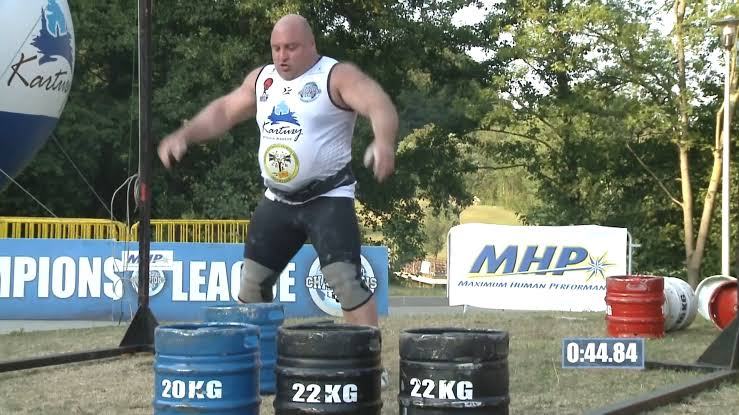
Iron Archives
2015 and 2016 World Log Lift champion and one of Lithuania's leading strongmen of the IFSA era
Retired athlete
Vidas Blekaitis is a Lithuanian strongman born on 14 April 1972 in Birštonas whose elite career stretched across more than two decades. A former powerlifter who moved into strongman in the 1990s, he became one of the most consistent members of Lithuania's exceptional generation built around Žydrūnas Savickas. He competed twice at World's Strongest Man, finished fourth at the 2006 IFSA Strongman World Championships, fourth at the 2009 Arnold Strongman Classic and second at Giants Live Finland in 2011. He won the 2015 World Log Lift Championship with 200 kg and shared the 2016 title with Rob Kearney at 202.5 kg, became a Masters world champion in 2016, won Lithuania's Strongest Man in 2014 and 2015, and captured the 2007 two-man World Strongman Team Championship alongside Žydrūnas Savickas. Strongman Archives credits him with 85 international contests and 19 international wins, with an especially strong competitive profile in Super Yoke, log lift, truck pull, pressing and endurance events. After leaving elite competition, he remained active in the sport as a coach and organizer in Birštonas.
Vidas Blekaitis, a name that should be corrected before the story begins. The initial Sanity document and some secondary references used the form “Belkaitis,” but Lithuanian biographical sources, Strongman Archives, contemporary press and competition material consistently identify him as Vidas Blekaitis. He was born on 14 April 1972 in Birštonas, Lithuania, and became one of the athletes who helped turn a small Baltic country into one of the deepest strongman nations of the 2000s. His career cannot be reduced to a single result. Blekaitis was a finalist at the IFSA Strongman World Championships, competed twice at World's Strongest Man, finished fourth at the 2009 Arnold Strongman Classic, was runner-up at Giants Live Finland in 2011, won the World Log Lift title in 2015, became a Masters world champion in 2016 and won the 2007 two-man world team championship alongside Žydrūnas Savickas. Strongman Archives records an international competition span from 2000 to 2020, with 85 international contests and 19 international victories, in addition to national, regional and single-event appearances. Blekaitis himself has placed his entry into strongman earlier, in 1994, after a background in powerlifting. The difference is not a contradiction. One date describes the beginning of his participation in the discipline, while the archive records the competitions it can document. This profile therefore preserves both. More importantly, it treats him not as a footnote to Savickas but as a complete athlete in his own right: a military serviceman during many of his prime competitive years, a coach, a father, a remarkably durable open-class strongman and a representative of a Lithuanian generation that became inseparable from the modern history of the sport.
Birštonas, education and the first foundations of strength. Public biographical sources do not provide a detailed autobiography of Blekaitis's childhood, and a responsible profile should resist the temptation to fill the gaps with convenient folklore about an exceptionally strong child. What can be documented is his deep connection to Birštonas. He was born there, later returned professionally to the town's sporting system and remained a visible figure in the community after elite competition. Birštonas is small compared with the major European training centers, and that scale helps explain one of the most consistent features of his biography: international competition never erased his local identity. According to the Lithuanian Sport Encyclopedia, Blekaitis graduated from Vilnius Pedagogical University in 1995. That academic background predates his mature international strongman career and becomes relevant when considering his later work as a coach. His path was not simply that of a very large man who discovered he could lift unusual objects. It sat at the intersection of education, military service, powerlifting, strongman and eventually coaching. In a 2021 interview he said that before strongman he practiced powerlifting and that he entered strongman in 1994. The barbell base is visible throughout his later career. He possessed the ability to generate large amounts of force from stable positions, tolerated very heavy loading and remained strong in squatting, pressing and pulling deep into his forties. Strongman, however, required him to expand that base. Implements move unpredictably, grips vary, centers of mass shift, and athletes must often run while carrying loads that would be maximal lifts in another sport. Blekaitis's career is therefore best understood as a long technical conversion: powerlifting gave him the engine, while strongman taught him to make that engine work while moving, breathing, gripping and solving new physical problems under fatigue.
From powerlifting to strongman. In an earlier Lithuanian interview, Blekaitis described watching strongmen on television and at competitions that began appearing in Lithuania, initially finding the idea of standing in the same arena almost unbelievable. Strongman was developing rapidly in the country from the late 1980s onward, and the 1990s created an environment in which powerlifting, weightlifting and strongman fed one another. The Lithuanian Sport Encyclopedia explicitly notes that the national strongman movement benefited from powerlifters such as Vidas Blekaitis, Antanas Abrutis, Saulius Brusokas and Vilius Petrauskas. His first coach is listed as Stanislovas Martinaitis. Public sources do not document every training phase or coaching change, so this biography does not invent a technical genealogy where evidence is absent. What the results do show is a successful transition from classic barbell strength to a highly versatile competitive skill set. Blekaitis did not become merely a presser or a deadlifter. His event wins include truck pulls, Super Yokes, front holds, Conan's Wheels, farmer's walks, overhead medleys, log lifts, squat-for-repetitions events and loaded carries. That distribution matters. It demonstrates that he adapted to the sport as a system rather than surviving through one exceptional event. At roughly 182 cm and around 155 kg during his heavy competitive years, he occupied an interesting physical niche. He was shorter than many international rivals but carried enormous mass relative to height. That compactness could favor stability under a yoke and efficient transfer of force in overhead pressing, although no body type is universally advantageous in strongman. Loading heights and very large stones can favor taller athletes. The important point is that Blekaitis learned to exploit his own structure. His competition record reveals a coherent athlete: exceptionally good at moving heavy frames quickly, powerful overhead and strong enough statically that those specialties translated into high overall placings.
The first years preserved in the international archives, 2000 to 2002. Strongman Archives begins its documented competition chronology for Blekaitis in 2000, when he finished second at Lithuania's Strongest Man. By 2002 he was again near the top domestically and won the Strongman Cup in Latvia, an early international victory in the European strongman circuit. These entries are significant precisely because they do not represent the beginning of his training. By the time international databases start following him, Blekaitis had already accumulated years of strongman experience on top of his powerlifting foundation. The national context also made every Lithuanian result unusually demanding. Competing for the title of Lithuania's Strongest Man in the early 2000s frequently meant facing Žydrūnas Savickas, who would become one of the most decorated strength athletes in history. The Lithuanian Sport Encyclopedia credits Blekaitis as national runner-up seven times, in 2001 and from 2003 through 2008. Strongman Archives presents some editions differently, likely because national championships, qualifying stages and competition names were not always aggregated in exactly the same way. Rather than forcing the records into artificial agreement, the larger pattern is more useful: Blekaitis spent much of his prime in an extraordinarily competitive domestic environment and repeatedly translated that pressure into international success. A second-place national result in Lithuania could represent a level good enough to defeat national champions from many other countries. That is one of the defining themes of his career. He did not need to beat Savickas every season to prove world-class ability. The strength of the Lithuanian field made domestic competition a training ground for Europe and the world.
2003 and the first World's Strongest Man appearance. Blekaitis reached World's Strongest Man for the first time in 2003 at Victoria Falls, Zambia. Strongman Archives places him in Group 4, where he finished fourth of six and did not advance to the final. On paper, fourth in a qualifying group can look modest. The event results tell a more useful story. He was second in the Train Pull, third in the Squat Lift and third in the Farmer's Walk, immediately revealing qualities that would remain central to his competitive identity: leg strength, loaded movement and traction. The same season included a third-place finish at the IFSA Ylitornio Challenge in Finland and second at Marijampolė International. At Ylitornio he won the Car Walk, while other competitions that year included victories in Hanging Yoke, Farmer's Walk and Loading Race. The pattern matters because Blekaitis was already taking points across movement, grip and strength-endurance events rather than relying on a single maximal lift. European strongman at the time was also becoming increasingly dense. IFSA events, national championships, Grand Prix contests and international invitations created a schedule in which an athlete could accumulate enormous competition experience within a season. Blekaitis embraced that environment. Each contest meant a different surface, a different yoke, log or vehicle, different judging and different travel fatigue. Strongman equipment was far less standardized than a powerlifting bar and rack. Repeated exposure itself became a form of technical training. The 2003 WSM result did not make him a finalist, but it established that his domestic strength translated to the highest televised level and gave him a reference point for the world standard he would chase throughout the next decade.
2004 to 2005, international maturation. In 2004 Blekaitis won the Strongman Cup in Riga and continued building experience across IFSA and Baltic contests. The following year brought a clear rise in competitive weight. He won the Sword of Matúš Čák contest in Trenčín against a large field and qualified for the 2005 IFSA Strongman World Championships in Quebec City. That final assembled a formidable generation: Žydrūnas Savickas, Vasyl Virastyuk, Mikhail Koklyaev, Andrus Murumets, Raimonds Bergmanis, Phil Pfister, Magnus Samuelsson and other established international athletes. Blekaitis finished seventh overall. One performance stands out. He won the Conan's Wheel with 1,202 degrees, taking maximum points in an event built around grip, bracing, pain tolerance and the ability to keep moving as the implement drags the body downward. He also pressed a 170 kg log, completed six deadlift repetitions and remained competitive in the shield carry and Super Yoke. The result reveals the quality that would define his career more accurately than any one record: scoring range. Blekaitis could collect meaningful points in very different physical tasks. The Lithuanian Sport Encyclopedia also credits him as part of a Lithuanian team that won a world team championship in 2005. Historical team competitions from the era are not always labeled consistently in modern online databases, so the profile attributes the achievement to the Lithuanian national source rather than pretending the format can be reconstructed perfectly. By the end of 2005, Blekaitis was no longer simply another strong Lithuanian standing behind Savickas. He had become an international competitor capable of beating champions from other countries and winning individual events against a world-class field.
A professional life running alongside elite sport: the Lithuanian military. The Lithuanian Sport Encyclopedia states that Blekaitis served in the Lithuanian armed forces from 2001 to 2009, while contemporary Lithuanian press described him during that period as serving in military police. Public sources do not provide enough detail to reconstruct his duties or rank, and this profile does not speculate. What matters is the overlap. The same years include appearances at World's Strongest Man, three IFSA World Championship finals, a European Championship podium, team world titles and his fourth-place finish at the Arnold Strongman Classic. He was not living inside a protected full-time professional sports bubble. Strongman in the early 2000s rarely offered the stable salaries, medical support and organizational structure associated with major professional sports. Many elite competitors maintained jobs, businesses or public-service careers while training at a level that would be full-time by any physiological definition. Blekaitis's case is particularly striking because military service places formal demands on schedule and availability. Training, recovery, travel, high-calorie eating and international competition had to coexist with institutional responsibilities. It would be too easy to turn that fact into a romantic claim that the military made him mentally stronger. There is no public evidence for such a direct causal statement. What can be said is that his prime years required unusual logistical discipline. The period from 2001 to 2009 demonstrates that elite strongman achievement can emerge from circumstances far less specialized than modern viewers might imagine. Blekaitis lifted against the best athletes in the world while maintaining a professional identity outside the sport.
2006, the best individual open world championship finish of his career. The 2006 IFSA Strongman World Championships in Reykjavík remain one of the central results on Blekaitis's résumé. He finished fourth among twelve finalists in a field filled with athletes who defined the era. For a competitor who never reached a World's Strongest Man final, the IFSA result is essential to understanding his true level. During the split between IFSA and WSM, the IFSA World Championships were not a minor alternative. They contained an enormous share of the world's elite strength talent and demanded a complete multi-event performance. Blekaitis won the Super Yoke in the final, finished second in the Conan's Wheel and scored solidly in deadlift, deadlift hold and wheelbarrow carry. He had also won the deadlift in his qualifying group. Later that season he finished second at the IFSA Ukraine Grand Prix and again won the Super Yoke, completing the course in 9.80 seconds. The archives also record a 390 kg Hummer Tire Deadlift there. Repeated superiority in the same event across different competitions tells us more than a single spectacular result. By 2006, Blekaitis was one of the strongest yoke movers in the international field. The important distinction is that he was not merely a yoke specialist who disappeared elsewhere. He possessed enough pressing, pulling, grip and endurance to turn that specialty into high overall placings. Fourth at a major world championship is the clearest numerical expression of that balance.
2007, team success, a European podium and another world final. Blekaitis's 2007 calendar captures almost every dimension of his competitive identity. He finished third at the IFSA Latvia Grand Prix after winning the Log Lift and Truck Pull and placing second in the Super Yoke. At the IFSA European Championships in Kyiv he finished third behind Vasyl Virastyuk and Andrus Murumets, establishing himself among the strongest men on the continent. Then, in Vilnius, Blekaitis and Žydrūnas Savickas won the IFSA 2-Man Team World Championships for Lithuania. The Lithuanian Sport Encyclopedia explicitly records the pair and the title. Later in the year Blekaitis returned to the IFSA Strongman World Championships, this time in South Korea, and finished sixth in the final. His signature performance was again the Super Yoke: 410 kg over 30 meters in 11.34 seconds, good for the event win and one of the fastest archived performances in that weight range. In qualification he won the Max Log Lift at 180 kg and produced several second-place event finishes, including strong results in deadlift and Conan's Wheel. Few seasons explain him better. Within one year he could stand on a European podium, win a world team title, reach another individual world final and beat the field in yoke. He was not building a career around one viral number. His strength had breadth. The year also brought official recognition in Lithuania: the national sport encyclopedia records that he received the Department of Physical Education and Sports medal “For Sports Victories” in 2007.
2008, Lithuanian depth and Globe's Strongest Man. Blekaitis remained near the top of his national field and finished fourth at Globe's Strongest Man in Moscow. In that competition he won the Truck Pull and Kettlebell Press, events that demand very different qualities. One converts whole-body strength into locomotion and traction, while the other rewards overhead coordination and repeatability. At Lithuania's Strongest Man that year he was again near the top overall, won the Squat Lift and Farmer's Walk for distance and pressed 202.5 kg in the Max Log Lift, one of his best overhead numbers to that point. Strongman Archives also records a second-place finish at SCL Lithuania. The Lithuanian Sport Encyclopedia credits him as part of another Lithuanian world team championship victory in 2008. Historical online databases do not always preserve the same naming and format details for team contests as they do for individual IFSA or SCL events, so that achievement is presented with its source rather than forced into a modern format. The season also illustrates the demands of his double life. Blekaitis was still serving in the military while competing nationally and internationally. There are no public training diaries that allow us to reconstruct exactly how he scheduled work, training and recovery, but the density of results indicates an ability to hold competitive form for long periods. Athletes of his generation often had to remain ready for many events across a year, on different implements and under less standardized logistical conditions than contemporary elite strongman.
2009, the Arnold Strongman Classic and one of the great performances of his career. Blekaitis finished fourth at the Arnold Strongman Classic in Columbus, Ohio, a contest built in that era around extreme absolute strength. For an athlete listed at roughly 182 cm and 155 kg, without the height advantage of some of the enormous men around him, a top-four finish in Columbus says a great deal about strength density and technical efficiency. Two event results remain particularly striking. He pulled 451 kg in the Hummer Tire Deadlift, placing second in the event, and won the Super Yoke with 507 kg over 11 meters in 8.47 seconds. Carrying more than half a metric ton at speed requires far more than powerful legs. The athlete must create enough initial force to break the implement from the ground, brace under immense axial compression, control oscillation and take fast but stable steps. Blekaitis had turned this combination into a specialty. The same season included second place at SCL Finland, second at Lithuania's Strongest Man and an overall victory at Marijampolė International. He also placed on the podium at the World Log Lift Championships with a 190 kg lift. The year is significant for another reason: it marks the end of the period in which the Lithuanian Sport Encyclopedia records him as serving in the military. By then he was approaching his late thirties, an age at which many athletes in faster sports are already declining sharply. Strongman operates differently. Mature muscle mass, accumulated technical experience and efficient movement can preserve performance surprisingly late, provided the athlete can still recover. Blekaitis would spend the next decade demonstrating exactly how far that principle could be stretched.
2010 to 2011 and the road back to World's Strongest Man. Blekaitis remained active in both Strongman Champions League competition and the Lithuanian circuit in 2010. At Globe's Strongest Man in Moscow he finished third overall, winning the Conan's Wheel and placing second in the Truck Pull. At SCL Finland he won the Max Log Lift with 190 kg. Those results kept him connected to the highest level of international competition. In 2011, Giants Live Finland produced one of his strongest late-career performances. He finished second overall and won three events: Front Hold, Log Lift and Truck Pull. Giants Live had become one of the principal routes to World's Strongest Man, and the Finnish podium returned Blekaitis to WSM eight years after his debut. At the 2011 competition in Wingate, North Carolina, he finished fifth of six in Group 5 and again missed the final, though he took second in both the Block Press and Car Walk. The group result demonstrates how unforgiving WSM qualification can be. An athlete may be excellent in two or three events but lose enough points elsewhere that the overall position becomes difficult to recover. Blekaitis's second WSM appearance nevertheless matters symbolically. He was not returning as a young prospect but as a 39-year-old veteran who had managed to requalify after the sport had become more professional and internationally competitive. His career is therefore distorted if judged only by his lack of a WSM final. Once IFSA Worlds, Arnold, Giants Live, SCL and European championships are included, the competitive picture becomes much clearer: Blekaitis belonged among the world's best multi-event strongmen for a sustained period.
2012 to 2013, the veteran becoming an even more complete specialist. Turning forty did not remove Blekaitis from international relevance. In 2012 he finished second at Monster Strong in Minsk, second at the SCL Savickas Classic and continued winning stages on the Lithuanian circuit. He pressed 200 kg at the World Log Lift Championships and, in domestic competition, recorded a 190 kg max axle press. Other events brought wins in medleys, Atlas Stones and Conan's Wheel. The following season produced one of the most remarkable repetitions performances in his archive: 15 squats with 300 kg in a Lithuanian championship stage. Strongman Archives preserves the result among notable squat-for-repetitions performances in that weight range. He also pressed 205 kg at the 2013 World Log Lift Championships, won a Log Lift event at SCL Slovakia and again finished second at the Savickas Classic. Chronologically, this should have been the beginning of a retirement phase. Competitively, it was not. Blekaitis still possessed maximal strength while carrying an enormous advantage in event familiarity. Strongman technique is not trivial. A yoke can be lost through excessive sway, a stone through poor hand placement, a log through an inefficient clean and a truck pull through the wrong body angle. Years of competition reduce the energy wasted on such errors. Blekaitis had become economical. He did not have to be the fastest or strongest athlete in every individual task because he could convert experience into consistent points. That efficiency would become central in 2014 and 2015, when he won major national titles at an age when most open-class athletes have already left serious competition.
2014, a national champion in his forties. Strongman Archives lists Vidas Blekaitis as the winner of Lithuania's Strongest Man 2014 at Pakruojis. His event results were emphatic: victories in Atlas Stones, Crucifix Hold, Deadlift, Super Yoke, Log Lift and Truck Pull. Across other Lithuanian championship stages that year he also collected wins in frame deadlift, keg carry, front hold, power stairs, axle press, Conan's Wheel, car hold and additional movement events. Few seasons demonstrate versatility more clearly. He was 42 years old and facing younger competitors, yet his technical repertoire covered almost every major strongman demand. Internationally, he remained dangerous. At SCL Poland he finished third overall and won the Super Yoke with 400 kg over 25 meters in 9.53 seconds. At SCL Latvia he was second overall and won both Dumbbell Press and Viking Press. At the SCL Savickas Classic he again finished second and won the 400 kg yoke over 20 meters in 8.75 seconds. He later placed sixth at the SCL World Finals. The national championship was therefore not the product of a weak calendar or protected field. Blekaitis was still internationally competitive. His compact build probably helped in certain moving events by lowering the system's center of mass and allowing short, fast steps, but body dimensions alone never move a 400 or 500 kg frame efficiently. The archive demonstrates that his technique and bracing were exceptional. By 2014 the yoke was no longer simply an event he happened to be good at. It was one of the clearest technical signatures of his career.
2015 and the World Log Lift title. This is perhaps the easiest individual championship on Blekaitis's résumé to communicate to a broad audience. At the MHP World Log Lift Championships in Vilnius, he pressed 200 kg and won the title. IronMind reported the competition in October 2015 and noted that his final successful lift looked controlled, with Krzysztof Radzikowski finishing behind him at 195 kg and Dainis Zageris at 190 kg. The title carries particular symbolic weight because log lifting had become one of strongman's defining specialist disciplines, while Lithuanian strength culture was inevitably associated with Žydrūnas Savickas, the greatest log presser of the era. Winning a world log championship inside that national environment, even in a contest where Savickas was not competing, meant meeting an unusually demanding standard. Blekaitis had already exceeded 200 kg in competition before the title and would do so again. Strongman Archives records 205 kg in 2013 and again in 2018. The significance of 2015 is that the number became a championship. The same season also brought another Lithuania's Strongest Man title, giving him consecutive national wins in 2014 and 2015 according to Strongman Archives. He continued scoring strongly in Strongman Champions League competition, including a Viking Press event win at SCL Poland. He was 43 years old. This was not a Masters title but an open world single-event championship. His overhead ability demonstrates one of the peculiarities of strength sport: maximal force and highly practiced technique can remain elite long after the peak age of speed-based sports.
2016, entering Masters competition without abandoning the Open field. At 44, Blekaitis won the Ultimate Strongman Masters World Championships in Belfast. In the same year he shared first place at the World Log Lift Championships with American Rob Kearney, both successfully lifting 202.5 kg. That result effectively gave Blekaitis a second consecutive world log title after his 2015 victory. A Masters world title should not be mistaken for a ceremonial version of the sport. The implements remain massive and the field consists of athletes carrying decades of accumulated strength as well as decades of physical wear. Blekaitis was especially notable because he continued to compete against younger open-class athletes at the same time. In 2016 he was second at Lithuania's Strongest Man, fourth at SCL Finland and fifth at SCL Latvia. At the Finnish contest he won the Front Hold and Overhead Medley and placed third in the Minibus Pull. The mixture of Masters and Open competition reveals that age-category strongman was not being used as a disguised retirement. Blekaitis was still testing himself directly against the current open field. This phase is particularly instructive from a training perspective, even though his complete programs are not public. As athletes age, some qualities decline faster than others. Recovery slows, accumulated joint damage matters more and repeated high-speed work can become more expensive. Maximal strength and technical efficiency, however, can remain extraordinarily resilient. Blekaitis appears to have protected those qualities while keeping enough movement ability to remain competitive in pulls, yokes and medleys. His results rather than speculation about methods are the strongest evidence that the adaptation worked.
2017 to 2018, overhead strength and Masters podiums. In 2017 Blekaitis finished second at the SCL World Overhead Lift Championships and remained a major figure in Masters strongman, taking second at Masters World's Strongest Man and third at the Ultimate Strongman Masters World Championships. At an Arnold Series Qualifier in Katowice he finished third overall, and Strongman Archives records a 380 kg max deadlift there, his best documented standard deadlift in competition. In 2018 he pressed 205 kg at the SBD World Log Lift Championships in Alytus and finished second behind Žydrūnas Savickas. He was again runner-up at Masters World's Strongest Man. The 205 kg lift is especially revealing because it came at age 46 and matches the highest log result listed in his competition archive. Not every physical quality declines on the same timetable. Maximal strength, particularly in an athlete carrying substantial muscle mass and decades of event-specific practice, can survive well beyond the ages normally associated with athletic peak performance. That does not mean the cost disappears. Blekaitis would later discuss meniscus surgery and other health problems. Recovery necessarily becomes more demanding. Yet the competitive numbers show that his nervous system, technique and muscular strength could still combine to produce world-class overhead performance. These later years also correct a common distortion in how his career is remembered. If the reader looks only at WSM, there are two appearances and no final. If IFSA, Arnold, World Log Lift and Masters competition are added, the same athlete suddenly appears across world finals, podiums and championship victories over nearly two decades.
2019, a 47-year-old still relevant in Open competition. The 2019 season is one of the strongest arguments against treating Blekaitis's late career as ceremonial participation. At the Savickas Classic he finished second overall and won the Squat Lift with 12 repetitions at 300 kg as well as the Overhead Medley. At the SBD World Log Lift Championships he pressed 200 kg and reached the podium. He finished second at the Europa Strongman Cup in Kartuzy and second again at Sword of Matúš Čák. At Pasaulio Taurė in Kaunas he was fourth. He also competed at Masters World's Strongest Man, where his overall placing was lower, but the density of the season remains remarkable. Performing twelve 300 kg squats in an open contest at age 47 occupies a rare region of strength-sport physiology. Accumulated injury risk, joint wear, slower recovery and the challenge of maintaining the body mass required for elite strongman all become more significant with age. Blekaitis solved those problems well enough to continue beating younger athletes in individual events and placing highly overall. The same period also shows his role gradually changing. He was still a competitor, but he had already been coaching in Birštonas for years. Strength sport allows those identities to overlap. The process of explaining technique to others can coexist with personal competition, even if public sources do not allow us to claim that coaching directly extended his own career.
2020 and the final competitive chapter. Strongman Archives ends Blekaitis's competition chronology in 2020, with the Lithuanian veteran still reaching the podium at a national championship stage in Kražiai. In a 2021 interview with Lrytas, he explained that the pandemic disrupted further plans and that retirement had become inevitable. One story from the period captures the instincts of a lifelong competitor. He arrived at an event in the role of a judge rather than an athlete, without the equipment he would normally use, and was persuaded to compete. After borrowing shoes and a belt, he finished second behind Žydrūnas Savickas. The anecdote is more useful as a portrait than as a statistic. After roughly a quarter-century in strongman, Blekaitis had accumulated so many competitive habits that he could shift almost instantly from official to athlete. The pandemic, age and accumulated physical issues nevertheless drew a natural line under elite competition. He said publicly that he did not intend to return to major sport and felt he had already proved what he could prove. Retirement therefore did not read as defeat. It was not caused by one bad placing or one catastrophic injury. It was a stage decision made after remaining competitive until close to age fifty. In a sport where careers can be shortened by major injuries, joint damage or the simple impossibility of sustaining the body mass and recovery demands, that longevity is an achievement in itself.
Retirement as a change of role rather than disappearance. After 2020 Blekaitis did not leave the world of strength. He left the rhythm of elite competition while continuing to work with athletes, children and the sporting community of Birštonas. The transition was unusually natural because coaching had already existed alongside his competitive career. The Lithuanian Sport Encyclopedia records him as a weightlifting coach at the Birštonas Sports Centre from 2007 onward. For more than a decade, coaching and competing were simultaneous identities. Once the second ended, the first became more visible. Post-retirement interviews show a man whose emphasis had shifted toward family, health, teaching and local projects rather than personal proof. In 2023, material about the new Birštonas Sport and Wellness Centre described him working with schoolchildren, providing individual training and discussing nutrition with clients. In 2026 the center credited him with involvement in organizing and presenting the twenty-seventh Nemuno galiūnas strongman contest. The status field in this profile therefore lists Blekaitis as retired only from elite strongman competition. It does not mean retired from sport. He remains part of the infrastructure through which strength knowledge, standards and competitive memory pass to another generation. For a relatively young sport, that continuity matters. Results can survive in databases, but a sporting culture survives because experienced people continue to teach how the work is actually done.
Super Yoke, the event that explains Blekaitis most clearly. If one event had to be chosen as the best technical summary of his career, Super Yoke would have the strongest case. His archive contains repeated victories at world and European level rather than one isolated performance. He won the yoke in the 2006 IFSA World Championship final, won it again at the 2006 Ukraine Grand Prix, carried 410 kg for 30 meters in 11.34 seconds to win the event at the 2007 IFSA World Championships, and at the 2009 Arnold Strongman Classic moved 507 kg for 11 meters in 8.47 seconds. In 2014 he carried 400 kg for 25 meters in 9.53 seconds at SCL Poland and the same weight for 20 meters in 8.75 seconds at the Savickas Classic. These numbers matter because a yoke is not simply a weight resting on the shoulders. The pick must be explosive without creating uncontrolled sway. The torso has to remain rigid under immense compression. Breathing becomes restricted. Steps must be fast enough to score well but controlled enough that oscillation does not turn every stride into a brake. Blekaitis repeatedly solved that equation. His relatively compact stature may have contributed to system stability, but anthropometry does not explain elite execution by itself. Decades of heavy movement practice refined the pick, acceleration and rhythm until they became competitive reflexes. The yoke therefore summarizes the larger athlete: enough brute strength for extreme loads, combined with movement economy and control.
Log Lift and the construction of an overhead reputation. The 2015 world title was not an isolated peak. Before and after that championship, Blekaitis repeatedly pressed logs in the 190 to 205 kg range at international level. Strongman Archives records 190 kg at the 2009 World Log Lift Championships, 200 kg in 2012, 205 kg in 2013, 200 kg for the 2015 world title, 202.5 kg in 2016, 205 kg in 2018 and 200 kg in 2019. A decade of numbers around the elite threshold is more informative than one personal best. The log is a technical implement. It must be rolled or pulled efficiently into the lap, cleaned to the chest, stabilized in a position where the athlete can breathe and then driven overhead. A very strong presser can still lose enormous amounts of performance through an inefficient clean or poor rack position. Blekaitis accumulated enough experience to make the implement a specialty. At Giants Live Finland in 2011 he won the Log Lift, while domestic results also show a 190 kg axle press in 2012, confirming that his overhead ability was not dependent on one object. In 2019, at age 47, he was still pressing 200 kg in world-level log competition. That longevity is one of the strongest pieces of evidence for his quality as a strength athlete. It points to the interaction of structure, skill and the ability to maintain the musculature required for a movement that places relentless stress on shoulders, elbows and upper back. The profile does not claim a secret program or special method Blekaitis never published. The competition results are enough to establish the conclusion.
Pulling strength, from vehicle pulls to a 451 kg Hummer Tire Deadlift. Blekaitis was not known as an absolute deadlift specialist in the same way he was known for yoke or log pressing, but pulling strength was far from a weakness. Strongman Archives lists a 380 kg standard max deadlift from the 2017 Arnold Series Qualifier and, more dramatically, 451 kg in the Hummer Tire Deadlift at the 2009 Arnold Strongman Classic. The Hummer variation uses a long flexible bar, elevated loading and a very different mechanical profile from a conventional floor deadlift, so the 451 kg figure should never be presented as if it were a standard barbell pull. This profile keeps the implement explicit for exactly that reason. Vehicle pulling, however, was one of his most consistent competitive weapons. He won Truck Pull at the 2007 IFSA Latvia Grand Prix, Globe's Strongest Man 2008 and Giants Live Finland 2011, among other high finishes. Truck pull turns posterior-chain strength into a problem of body angle, traction, rhythm and acceleration. High body mass can help create ground force, but poor foot placement or an upright torso can waste that advantage. Blekaitis combined his mass with efficient movement. The pattern mirrors his yoke success: he was particularly dangerous when a massive load had to be set in motion and then kept moving. This is a key distinction in his profile. His strength was not static in the everyday meaning of the word. He could lift heavy weights, but many of his best performances came from moving those weights, vehicles or frames through space.
Endurance, grip and the events that rarely become headline records. Popular strongman culture often reduces the sport to deadlift and log press, yet championships are frequently decided by less glamorous events: holds, carries, medleys, Conan's Wheel, front hold and farmer's walk. Blekaitis was valuable precisely because he could score in these areas. He won the Conan's Wheel at the 2005 IFSA World Championships with 1,202 degrees. He won Front Hold at Giants Live Finland in 2011. Across Lithuanian and SCL competitions he recorded victories in Farmer's Walk, Car Hold, Crucifix Hold, frame carry, keg carry and multi-implement medleys. These events demand a different relationship with fatigue. A maximal deadlift may be decided in seconds. In a front hold, every second after the shoulders begin to burn becomes a psychological negotiation. In farmer's walk, grip, breathing, foot speed and balance must survive simultaneously. In a medley, the athlete changes implements, heights and contraction patterns without meaningful recovery. Blekaitis spoke publicly about the importance of psychological resilience, patience and long-term work. His record in endurance events gives those ideas a concrete background. Mental toughness cannot be measured directly from a results table, but an athlete who repeatedly performs well in holds and carries after several previous events clearly possesses a strong capacity to tolerate accumulated effort. That kind of strength is difficult to compress into a single personal-record number, but it is exactly what separates a specialist from a complete contest athlete.
A strongman's body is not a fixed number. The profile uses 182 cm and approximately 155 kg because those values appear consistently in competition archives, but they should be treated as reference points rather than permanent measurements. Strongman bodyweight changes across seasons, age, health, preparation goals and competitive demands. After retirement and the health issues he discussed publicly, Blekaitis said that he altered his diet and lost roughly 20 kg. The 155 kg figure therefore describes his heavy competitive form far better than his post-career body. At 182 cm he was shorter than many rivals in the 190 to 200 cm range but carried enormous total mass for his height. In some events that compactness could be useful. A lower system may aid stability under a yoke, while pressing and squatting leverage differs from that of a very tall athlete. Other events, particularly loading to high platforms or handling very large stones, can reward height. Strongman is ultimately the art of negotiating those tradeoffs. There is no perfect body for every event. Blekaitis turned his own structure into a highly efficient system for yoke, pressing, vehicle pull and repetition events. His longevity also suggests that he learned to adjust preparation as his body changed, although the exact details of those adjustments were never published and should not be invented.
What Blekaitis said about talent, psychology and work. An older Lithuanian interview offers one of the most useful windows into his view of strength sport. Asked what a person needs in order to become a high-level strongman, he emphasized the interaction of natural talent, a physically robust structure, psychological qualities and a great deal of sustained work. The answer avoids two opposite myths. One claims that strongman is purely genetic: either a person is born enormous and powerful or has no chance. The other insists that effort alone can produce any outcome. Blekaitis's position, after years of elite competition, was more realistic. In a sport that places hundreds of kilograms across the spine, hips, knees, shoulders and elbows, anatomy and tissue tolerance matter. But predisposition without patience, technique and years of repetition remains unused potential. He also stressed the psychological side, a concept that is easily romanticized. In his case the biography gives it substance: military employment during elite seasons, dense international schedules, physical problems, repeated comebacks and open-class competitiveness after forty. His philosophy appears less about drama than accumulation. Strongman is not built in one short training block. Blekaitis entered the discipline in 1994 and was still pressing 200 kg logs in 2019. Twenty-five years separate those points, enough time for technical patterns to become more than learned movements. They become part of how the body understands effort.
The Lithuanian generation and the impossibility of understanding Blekaitis in isolation. He competed during a period when Lithuania produced an extraordinary density of strongmen. Žydrūnas Savickas dominated much of the international circuit, but behind and beside him stood athletes such as Antanas Abrutis, Saulius Brusokas, Vilius Petrauskas and Vidas Blekaitis, many with backgrounds in powerlifting. The Lithuanian Sport Encyclopedia links the rise of national strongman directly to this strength-sport foundation. In such an environment, second place at a national championship could represent a level high enough for international podiums. That is why describing Blekaitis merely as “Savickas's teammate” is reductive. The two men shared the 2007 two-man world team title and represented the same national strength culture, but Blekaitis built his own record: fourth at the 2006 IFSA Worlds, fourth at the 2009 Arnold, a European podium, a Giants Live podium, a World Log Lift title, a Masters world championship and numerous international victories. At the same time, competing domestically against Savickas almost certainly raised the practical standard, even if no invented rivalry is needed to dramatize the point. The rankings are enough. Blekaitis could finish behind Savickas in Lithuania and then travel abroad to defeat national champions from other countries. Few facts better illustrate the depth of Lithuanian strongman during its golden era.
Lithuania as a team and strength as a collective identity. Strongman looks like one of the most individual sports imaginable: one athlete alone against an implement. Yet Blekaitis's history includes a significant team dimension. The Lithuanian Sport Encyclopedia credits him with world team titles for Lithuania in 2005 and 2008, while the 2007 pairs championship is documented clearly. In Vilnius, Vidas Blekaitis and Žydrūnas Savickas won the IFSA 2-Man Team World Championships. Team formats alter the psychology of the sport. The objective is no longer simply to maximize one athlete's score. Strengths must complement one another, and a weak event for one partner can be offset by another. For a small country, such victories also carry a national sporting significance. Lithuania was not represented only by one superstar. It had sufficient depth to field multiple world-class athletes. Blekaitis was particularly suited to team competition because of his versatility. A narrow specialist can be difficult to deploy in a broad event program. An athlete strong in yoke, truck pull, log, holds and carries can cover many scoring problems. These team titles therefore add a dimension that individual rankings alone cannot show. His legacy belongs not only to his own list of placings but to the period in which Lithuania became synonymous with elite strongman strength.
Vidas Blekaitis the coach. The Lithuanian Sport Encyclopedia records him as working as a weightlifting coach at the Birštonas sports center from 2007 onward. The date is striking because it falls inside his competitive prime. In 2007 he was still an IFSA World Championship finalist, a European medalist and a world team champion. He therefore began passing strength knowledge to others while still accumulating elite results himself. Coaching requires a different competence from personal performance. An athlete may execute a movement intuitively without being able to explain it. A coach has to convert sensation into instruction, identify positional errors, adjust training volume to the person and accept that another athlete does not possess the same limb lengths, mobility, recovery or tolerance for work. Blekaitis's background across powerlifting, strongman and general weight training provided a broad vocabulary for that role. Recent material from Birštonas shows that his coaching is not limited to professional strongmen. It includes children, adolescents, private clients and people pursuing general fitness. That widening of the audience is a sign of professional maturity. A former champion's success as a coach cannot be measured only by trophies won by elite students. It can also be measured by the ability to make strength training understandable, structured and appropriate for people with very different goals. In that sense, Blekaitis moved from being a product of Lithuanian strength culture to becoming one of the people who help reproduce it.
The new Birštonas Sport and Wellness Centre and the professional stage after competition. By 2023 local reporting and institutional material presented Blekaitis working in the modern Birštonas Sport and Wellness Centre, a facility of more than four thousand square meters created through a multimillion-euro investment. The contrast with the early 1990s is considerable. Blekaitis lived through several stages in the evolution of Lithuanian strength sport: the early domestic contests, the IFSA explosion, professional international circuits, television growth, Strongman Champions League and Giants Live, and then modern training infrastructure at home. In the new Birštonas facility, his role included activities with schoolchildren, individual training and guidance for people seeking improved physical condition. Articles also mentioned him discussing diet with clients. This profile does not turn those references into a claim that he is a licensed dietitian or physician, because the sources do not support such a statement. They simply show that nutritional habits formed part of his practical coaching conversations. More importantly, the center gave his accumulated experience an institutional home. For Birštonas, having a former world-level competitor working inside a community facility means that knowledge which might otherwise survive only in old television footage and competition tables remains accessible to local athletes.
Organizer and presenter after the competitive years. Blekaitis's continuing relationship with strongman is visible in local events as well as coaching. In the summer of 2026, the Birštonas Sport and Wellness Centre credited him with involvement in organizing and presenting the twenty-seventh edition of the Nemuno galiūnas contest. Six years after the final competition listed in Strongman Archives, he was therefore still standing beside the implements, only in a different role. Organizing a strongman contest requires expertise that spectators rarely see. Events must be chosen, implements checked, surfaces made safe, athlete order managed, judging coordinated, recovery time considered and delays absorbed without destroying the rhythm of the spectacle. A former competitor possesses an obvious practical advantage: he knows how a badly designed event feels from inside the body. He understands that the line between impressive and unsafe can be a poorly measured implement, unstable surface or rushed transition. Public sources do not assign every technical decision at the 2026 event to Blekaitis, so this biography does not overstate his responsibility. His continued presence is important enough on its own. He functions as a bridge between generations. The man who competed against the strongest IFSA athletes can now stand beside the platform while another generation learns how the sport works. Strongman needs those bridges because much of its expertise remains tacit, passed through practical demonstration rather than textbooks.
Family and the limits of responsible personal biography. Blekaitis never built his public profile through constant exposure of private life, so this account does not turn his family into narrative decoration. A 2021 Lrytas interview nevertheless contains details he chose to make public. That year Blekaitis and his wife Rasa welcomed a daughter, Braina, born on 24 August. He was 49 and spoke about the child as a gift of maturity and a source of energy for opening a new chapter after the competitive years. From an earlier marriage he has an older daughter, Vesta, who was eleven at the time of the interview. The article also referred to Rasa's two adult children from a previous relationship. These details matter not because of celebrity curiosity but because they help explain the priorities Blekaitis himself described. For decades, calendars had revolved around competition dates, travel, maximal loading and the constant management of recovery. Family became increasingly central as that rhythm ended. Reporting from 2023 again presented him with Rasa and young Braina, reinforcing the picture of a more local and settled phase of life. It would be too neat to claim that fatherhood caused retirement. The career was already nearing its natural conclusion, the pandemic disrupted competition and his body had accumulated wear. A better description is that late fatherhood gave positive meaning to a transition that had already become necessary.
Health after decades of very heavy sport. In the same 2021 interview, Blekaitis publicly discussed meniscus surgery and an episode of digestive problems serious enough to result in hospitalization and a subsequent change in diet. A sporting biography should not diagnose retrospectively or claim causes that physicians and the athlete have not established in public. It can, however, record what he chose to disclose. Blekaitis said that after changing his diet he lost roughly 20 kg. He had greatly reduced sugar, flour-based foods, potatoes and pork, while eating more poultry, rabbit and beef. These details are not presented as a nutrition protocol for readers. They describe one person's adaptation after his body no longer had the same competitive objective. In strongman, very high body mass is often instrumental. It can improve stability, leverage and total strength, but maintaining it also has costs. Once elite competition ends, the practical need to remain above 150 kg disappears and long-term health can take priority. Blekaitis appears to have accepted that change in logic. This is an important part of athletic identity. For someone whose public value has been measured for years in body mass and kilograms lifted, reducing size can feel psychologically complex. His post-career interviews instead suggest recalibration. Strength remains part of who he is, but it no longer needs to be demonstrated through the same physical extremes.
Cooking, smoking food and the person beyond the gym. One of the most vivid details in Blekaitis's post-retirement interviews is his interest in smoking food. He discussed preparing meat, fish, cheeses, eggs and even butter in a smoker and considered the possibility of turning the hobby into a more organized home-production activity. The detail may seem trivial beside a 507 kg yoke, but for biography it is valuable precisely because it shifts the lens from athlete to person. For decades food in a strongman's life is inevitably also fuel: calories, protein, frequency, digestion and body mass. After competition, the same relationship can recover elements of taste, craft and family ritual. Public sources do not present Blekaitis as an established food entrepreneur, so the profile does not convert an idea into a business achievement. The interest itself is enough. Smoking food rewards patience, temperature control, repeated procedures and comfort with slow processes. There is an amusing parallel with strength training, although no causal connection needs to be invented. After a life measured in kilograms and seconds, Blekaitis found satisfaction in processes whose results arrive slowly. Such details are useful because they counter the one-dimensional image of a strongman. Champions have homes, children, hobbies and ordinary forms of pleasure. Competitive performance can dominate a life without being the entire life.
How Blekaitis's records should be read. The term “personal record” is more complicated in strongman than in standardized powerlifting. A deadlift may be performed from the floor, from an elevated position, on an axle, with a long flexible bar or with Hummer tires. A 500 kg yoke can cover ten meters or twenty, and surface, frame width and pick height all change the task. A 200 kg log in a single-lift championship is not identical to another log in a medley. For this reason the Records section of the Sanity profile keeps implement and context explicit. Blekaitis's 451 kg Hummer Tire Deadlift is not presented as a conventional 451 kg floor deadlift. His best standard max deadlift documented by Strongman Archives is 380 kg. The 507 kg yoke is linked to its 11-meter distance and 8.47-second time at the 2009 Arnold Strongman Classic. The 410 kg yoke from 2007 is linked to 30 meters and 11.34 seconds. His 205 kg log represents the highest competition value listed in the archive and was matched at the 2018 SBD World Log Lift Championships. Outside strongman, the Lithuanian Powerlifting Federation preserves a 290 kg Masters bench press record for his age and bodyweight category from 2013. Contextual precision matters for any site that wants to function as an archive rather than a collection of impressive numbers. Blekaitis has enough verified performances that none need exaggeration.
Sources and the differences between archives. Reconstructing a strongman career that began in the 1990s inevitably leaves areas of uncertainty. Strongman Archives is exceptionally rich in event-by-event results, but its international chronology for Blekaitis begins in 2000. Blekaitis himself has said that he entered strongman in 1994. The Lithuanian Sport Encyclopedia provides a different type of national and biographical chronology, including seven Lithuanian runner-up finishes and world team titles in 2005 and 2008. Competition names changed, some national stages functioned as parts of larger championships and historical promoters did not always preserve complete digital records. This profile therefore uses a conservative method. When reputable sources appear to describe an achievement differently, the information is kept in its source context rather than forced into a false single version. The same principle applies to bodyweight. The approximately 155 kg figure describes his competitive heavy phase, not his present weight. “Active since 1994” reflects the athlete's own account, while “international archive record 2000–2020” reflects the database. Good biography does not hide such differences. It makes them visible. In a young sport, accuracy does not mean pretending every historical detail is perfectly certain. It means recognizing where the document ends and assumption would begin.
Blekaitis's place in strongman history. To an audience that encountered the sport almost exclusively through World's Strongest Man television, Vidas Blekaitis may appear peripheral because he never reached a WSM final. That is one of the limitations of writing strongman history around a single franchise. From 2005 through 2007, the IFSA Strongman World Championships contained a huge share of the world's elite athletes, and Blekaitis finished seventh, fourth and sixth in three consecutive editions. In 2009 he was fourth at the Arnold Strongman Classic, a contest famous for extreme loading. In 2011 he finished second at Giants Live Finland. He won a World Log Lift Championship, a Masters world championship, a two-man team world title and national championships in one of the strongest countries in the sport. Strongman Archives credits him with 85 international contests and 19 international victories. Taken together, those facts describe a world-class athlete even without a WSM final. His legacy is also stylistic. Blekaitis represents the highly complete European strongman developed through powerlifting, capable of lifting enormous static loads but equally comfortable running with a yoke, pulling vehicles, enduring holds and surviving repetition events. He did not need one viral lift to justify relevance. His value was built through repetition across seasons and across event types.
A living legacy. By 2026 Vidas Blekaitis no longer needs to step under a half-ton yoke to establish what he was. The tables preserve the numbers: a 205 kg log, a 451 kg Hummer Tire Deadlift, a 507 kg Super Yoke, fourth at the 2006 IFSA Worlds and the 2009 Arnold Strongman Classic, the 2015 World Log Lift title and the 2016 Masters world championship. The complete biography says more. It tells the story of a man from Birštonas who moved from powerlifting into strongman, served in the Lithuanian military through many prime competitive years, competed inside a generation dominated by one of the greatest strongmen in history without losing his own sporting identity, remained competitive after forty and eventually converted experience into coaching. It includes family, changes in health and diet, a daughter born during a major life transition and ordinary hobbies that occupied some of the space once consumed by competition schedules. Most importantly, it is a story of continuity. In 2026 Blekaitis is still present around athletes and contests, not as a museum piece but as someone who understands how strength is built and what it costs. In a history of Lithuanian strongman, his name should not be confined to a footnote after Žydrūnas Savickas. It deserves its own chapter: world-level competitor, world champion in a specialist event, exceptional yoke and overhead athlete, unusually durable veteran, coach and one of the men who gave depth to Lithuania's golden era of strength.
The powerlifting foundation and a 290 kg bench press. Although Blekaitis is remembered primarily as a strongman, his powerlifting background should not be treated as a disposable opening chapter. The Lithuanian Powerlifting Federation preserves a 290 kg bench press in its Masters record tables, achieved in Marijampolė in 2013 in the +120 kg bodyweight class and Masters 1 age group. The number is remarkable not only because of the load but because of when it occurred. Blekaitis was already over forty and simultaneously active in international strongman. Bench press is not a standard event in major strongman contests, but it reveals the size of his general pressing reserve. Strength in the triceps, pectorals and shoulder girdle can support overhead work, even though the transfer is never direct. A log has to be cleaned from the ground and pressed vertically while the athlete stands and stabilizes the entire body. Bench press removes those demands and creates a different mechanical problem. For that reason the 290 kg lift should not be used to predict a log press mathematically. Its value is contextual. It demonstrates that Blekaitis was not simply technically efficient with unusual implements. He possessed exceptional general upper-body strength under a standardized rule set as well. It also shows that the relationship between his original sport and strongman remained active long after the transition of the 1990s. In the same general period he could hold a Masters powerlifting record and press more than 200 kg on a log in international competition. For an archive, that bridge is useful because strongman records are inherently difficult to compare across implements. A regulated bench press provides a more stable reference point. In Blekaitis's case it reinforces the picture already created by yokes, logs, trucks and carries: the event skill was supported by a very large underlying strength base.
A career built through competitive volume. Strongman Archives' figure of 85 international contests can be read too quickly as just another statistic. In reality it describes a method of athletic formation that has become less common in modern elite strongman. Blekaitis competed across countries, circuits and formats, sometimes at short intervals, moving between Lithuanian championships, IFSA, Strongman Champions League, Giants Live, the Arnold Strongman Classic, specialist log competitions and Masters events. Every trip introduced different equipment, surfaces, travel stress and sometimes slightly different rules. In strongman, those variables are not merely background noise. They are part of the test. A log with a different diameter changes the clean. A yoke with a different frame construction changes oscillation and stride. Asphalt, track surface, grass or indoor flooring changes traction in truck pull and farmer's walk. An athlete with dozens of contests develops a physical library of solutions that cannot be reproduced completely in training. Blekaitis's longevity should therefore be understood together with his competitive frequency. He learned not only how to become strong but how to adapt quickly. That helps explain why he remained relevant while the organization of the sport moved from the IFSA era through Strongman Champions League, Giants Live and newer professional formats. He survived the changes technically as well as physically. His record crosses two decades in which strongman loads increased, broadcast standards changed and younger generations arrived with increasingly specialized preparation. Blekaitis continued to reach podiums and win individual events through that transition. The ability to remain useful under changing competitive conditions is one of the strongest arguments that his quality belonged not to one narrow era but to the deeper skills of the sport itself.
The difference between reputation and archival evidence. Blekaitis is a useful example of why a complete strongman database matters. International fame in the sport has often been shaped by television exposure, language, promoter relationships and repeated appearances in a small number of flagship contests. An athlete can therefore have a stronger competitive résumé than his recognition among casual fans suggests. Blekaitis never reached a World's Strongest Man final, but he competed in three IFSA World Championship finals during the split era, reached fourth at one of them, placed fourth at the Arnold Strongman Classic and accumulated major podiums and event victories across Europe. His career becomes much clearer when individual events and non-WSM circuits are restored to the picture. The archive does not need to inflate him into a champion he was not. It does something more useful: it shows the actual breadth of his work. The result is a profile that sits between two distortions, neither reducing him to Savickas's contemporary nor exaggerating him into a dominant world champion. Blekaitis was a durable, technically complete international strongman whose best years coincided with one of the deepest eras of Lithuanian strength.
Iron Hall data
380 KG
Max Deadlift · 2017 Arnold Series Qualifier
Verified
451 KG
Hummer Tire Deadlift · 2009 Arnold Strongman Classic; second in the event
Verified
205 KG
Max Log Lift · 2018 SBD World Log Lift Championships
Verified
190 KG
Max Axle Press · 2012 Lietuvos galiūnų čempionato
Verified
507 KG
Super Yoke · 11 m in 8.47 s, 2009 Arnold Strongman Classic
Verified
410 KG
Super Yoke — speed · 30 m in 11.34 s, 2007 IFSA World Championships; event win
Verified
300 KG
Squat for Reps · 15 reps, 2013 Lietuvos galiūnų čempionato
Verified
290 KG
Bench Press · Lithuanian Masters 1 +120 kg record, Marijampolė 2013
Verified
440 KG
Powerlifting — Squat · 2013 Super-Cup of Titans, single-ply; documented by OpenPowerlifting
Verified
320 KG
Powerlifting — Bench Press · 2015 Super-Cup of Titans, single-ply; highest bench listed by OpenPowerlifting
Verified
1112.5 KG
Powerlifting — Total · 440 squat + 300 bench + 372.5 deadlift, 2013 Super-Cup of Titans, single-ply
Verified
2000
One of his earliest major national placings recorded in international archives.
2nd place
2002
An early international victory in a 14-athlete contest.
Champion
2003
WSM debut in Victoria Falls, Zambia; second in the Train Pull within his group.
4th in group
2004
European Cup victory in Riga, Latvia.
Champion
2005
Won the international contest in Trenčín from a 22-athlete field.
Champion
2005
In Quebec City he won the Conan's Wheel event against one of the strongest fields of the era.
7th place
2005
The Lithuanian Sport Encyclopedia credits him as a member of Lithuania's winning team.
World team champion
2006
His best individual finish at an open multi-event world championship; he won the Super Yoke.
4th place
2006
International podium in Kyiv, including an event win in the Super Yoke.
2nd place
2007
European podium in Kyiv behind Vasyl Virastyuk and Andrus Murumets.
3rd place
2007
Won in Vilnius for Lithuania together with Žydrūnas Savickas.
World champion
2007
Finalist in South Korea; won the 410 kg Super Yoke over 30 m in 11.34 s.
6th place
2008
The Lithuanian Sport Encyclopedia lists him with Lithuania's winning team.
World team champion
2008
In Moscow he won the Truck Pull and Kettlebell Press events.
4th place
2009
Pulled 451 kg in the Hummer Tire Deadlift and won the 507 kg Super Yoke.
4th place
2011
Won the Front Hold, Log Lift and Truck Pull events.
2nd place
2011
His second World's Strongest Man appearance.
5th in group
2014
National title in a contest where he won most events, including log, yoke, deadlift and truck pull.
Champion
2014
Podium at one of Lithuania's major SCL contests.
2nd place
2015
Second consecutive national title recorded by Strongman Archives.
Champion
2015
Won in Vilnius with 200 kg ahead of Krzysztof Radzikowski and Dainis Zageris.
World champion
2016
Won the Masters world title in Belfast.
Masters world champion
2017
Masters world runner-up in Raleigh, North Carolina.
2nd place
2017
World overhead runner-up; 180 kg log in the contest.
2nd place
2018
Lifted 205 kg, his recorded competition best on the log.
2nd place
2018
Another Masters world podium.
2nd place
2019
At 47 he remained competitive in the Open division, winning Squat Lift and Overhead Medley.
2nd place
2020
His final competitive season recorded by Strongman Archives; a podium achieved close to age 50.
2nd place
2016
Shared the victory with Rob Kearney; both lifted 202.5 kg in Kaunas.
World champion, joint 1st