
2001
Strong Riga 800
Earliest international appearance recorded by Strongman Archives.
4th place
Iron Archives
2004 World's Strongest Man and 2007 IFSA World Champion
Retired athlete
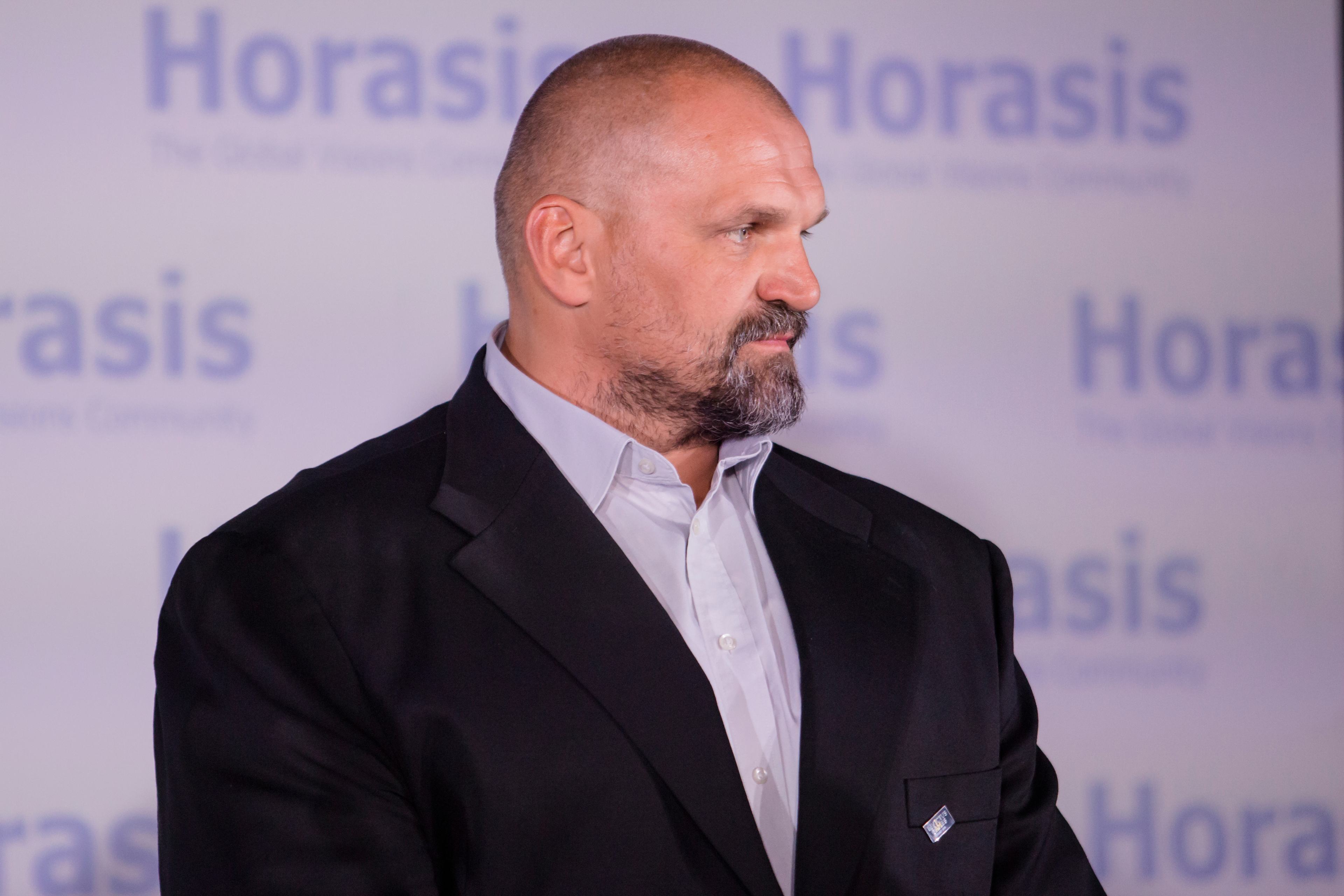
Vasyl Yaroslavovych Virastyuk is one of the defining strongmen of the early-2000s generation and the first Ukrainian to win World's Strongest Man. A former shot putter and member of Ukraine's athletics system, he moved into strongman in 2000, reached the WSM podium in 2003 and won the 2004 contest in Nassau. After the split in international strongman, he became one of IFSA's leading athletes: runner-up at the 2005 IFSA World Championship, third in 2006, and world champion in 2007 in Geumsan, South Korea. He also finished second at the Arnold Strongman Classic three years in a row, from 2005 through 2007, and won the 2007 IFSA European Championship. Strongman Archives lists him at 1.91 m and about 145 kg, with an archived international career spanning 2001–2008. After retirement he remained involved in Ukrainian strongman development, and since 2021 he has served as a member of Ukraine's parliament.
Vasyl Virastyuk, the Ukrainian force who crossed two worlds of strongman. Vasyl Yaroslavovych Virastyuk was born on 22 April 1974 in Ivano-Frankivsk, western Ukraine, in a family where physical work and sport were not abstract ideas. His father worked as a truck driver, while his older brother Roman Virastyuk became an international-level shot putter, winning bronze at the 1994 European Championships and reaching major Olympic and world finals. For Vasyl, Roman was not merely an older sibling but his first athletic model and the person who led him into organized track and field. In interviews, Vasyl recalled trying several sports as a child, including football, wrestling and shooting, before arriving at the athletics facilities connected to the physical-culture college in Ivano-Frankivsk at around ten years of age. There he was introduced to coach Ivan Hryhorovych Sharyi. That decision organized roughly the next sixteen years of his sporting life. He specialized in the shot put, an event that demands mass, explosiveness, coordination and technical discipline, and that education helps explain part of the strongman he later became. Unlike an athlete who enters strength sport directly from general gym training, Virastyuk learned early how to convert force into a precise and repeatable movement. After completing eighth grade he entered the local physical-culture college, and from 1992 to 1994 he completed military service. He later returned to the sports system and worked for several years as an athletics coach. Ukrainian biographies and his own interviews describe him during this period as an athlete with genuine Olympic ambitions. He did not reach the international level achieved by Roman, yet he rose to the Ukrainian classification of international-class master of sport in athletics and competed within the national athletics structure. World Athletics lists a shot-put personal best of 19.82 m from 1997, although the same database displays an incorrect birth month; for that reason the personal data in this profile follow the official Ukrainian parliamentary register and Strongman Archives, both of which give 22 April 1974. The more important point is not the exact shot-put number but the long apprenticeship behind it. Virastyuk spent adolescence and early adulthood inside a system that taught volume, technical repetition, periodization and tolerance for training. When strongman appeared, he was not starting from zero. He already possessed the body, experience and working culture of a trained athlete.
From athletics to a life split between work and the gym. The end of the 1990s was a period of transition for Virastyuk. Shot put no longer offered the sporting or financial path he wanted, and he moved from Ivano-Frankivsk to Lviv. He worked as a driver and security guard for a major company while continuing to train. Several Ukrainian interviews describe the period without the usual mythology of the future champion: his training bag stayed with him, shifts ended late, and on some days he reached the gym after ten at night. In 2000 he also completed security training and obtained a professional qualification. From a sporting perspective, this was the point at which his story could easily have settled into that of a respectable former athlete. Instead, a discipline that was only beginning to organize itself in Ukraine entered his life. Volodymyr Kyba, involved in developing strength competitions and the Ukrainian federation of powerful athletes, had noticed Virastyuk around 1999 and urged him to try strongman contests, then often promoted locally as “Bogatyr Games.” Vasyl was not immediately convinced. Strongman was far less standardized than athletics, and the events looked almost theatrical: oversized objects, trucks, logs, stones, frames and concrete-filled suitcases. Yet the lack of standardization suited his qualities. A decisive early experience came in Yalta in 2000. Contemporary and later accounts describe him winning the contest or, in one 2003 account, all five events he entered. For an athlete leaving a discipline measured to the centimeter, the experience offered a radically different language. Strongman asked him to solve problems: how to lift an object without a conventional bar, how to move quickly with hundreds of kilograms in the hands, how to pull a vehicle, how to save enough energy for the next event. Virastyuk quickly realized that he possessed an unusual combination of size, explosiveness, speed and endurance. His strongman career effectively began in 2000, and domestic success followed quickly. Ukrainian sources credit him with repeated Strongest Man of Ukraine titles during the first part of the decade, while Strongman Archives confirms archived national victories in 2002, 2004 and 2007. Differences exist because the local circuit of that era was not preserved with the same consistency as major international competitions. The essential trajectory is clear: within months, a former shot putter working in security had become one of Eastern Europe's most promising strength athletes.
The first international seasons and the education of a versatile strongman. Strongman Archives begins Virastyuk's international chronology in 2001 at Strong Riga 800, where he finished fourth. The event results already reveal the athlete he would become. In Riga he won the Crucifix Hold, placed second in the Max Log Lift at 160 kg, and competed across a program that included loading, Conan's Wheel, car deadlift and truck pull. In 2002 he appeared in contests such as the IFSA Winter Cup International, EFPAS European Strongest Man and several events in Ukraine. He placed third at EFPAS European Strongest Man and, in the same year, Strongman Archives records him as champion at UFSA Ukraine's Strongest Man. He was not yet a fully formed world-class athlete. The results show wide fluctuations: he could win a grip or pressing event and then lose major points in a medley or technical event. What stands out is the speed of adaptation. Virastyuk later said that during these years he searched the internet obsessively for information about how foreign athletes trained. He did not have a specialized strongman coach and described himself as largely self-coached, progressing by trial, error and observation. That lack of infrastructure makes the rise more significant than a simple results list suggests. Western Europe and North America already had established networks of contests and specialized implements. In early-2000s Ukraine, many of those tools and methods had to be built, borrowed or improvised. Virastyuk came from athletics and therefore understood programming, but strongman demanded a different logic. It was not the refinement of one movement but the construction of an entire library of movements. Farmer's walk required grip and speed; yoke required rigidity and balance; truck pull converted the legs and back into a traction system; Atlas Stones demanded position, technique and tolerance for abrasion; log and axle pressing required mobility and stability unlike anything in shot put. During these seasons his body was recalibrated from throwing to multi-event strength. Bodyweight increased, training became more event-specific, and competition supplied information that a gym could not. The process would eventually make him one of the best carrying athletes of his era. At first, however, it was more like learning a new alphabet: the language of awkward objects, fatigue and points.
2003, the true arrival among the world's elite. World's Strongest Man 2003 at Victoria Falls, Zambia, was the moment Virastyuk ceased to be merely an intriguing Eastern European athlete and became a credible world-title contender. The qualifying program tested exactly the blend of strength and movement that suited him: tire flip, log medley, Atlas Stones, train pull, squat lift and farmer's walk. Strongman Archives records him winning the group train pull in 25.44 seconds and the farmer's walk, then winning farmer's walk again in the final. He finished third overall behind Mariusz Pudzianowski and Žydrūnas Savickas, two athletes who would define much of the decade. The podium mattered for more than the medal. It showed that Virastyuk could now survive a long contest against the very best, across highly varied events. A Ukrainian Weekly feature published after the 2003 contest presented him as an athlete who had only recently begun to treat strongman as a true profession even though he had already collected national and regional success. The same article preserved one of the most vivid images from his early international career: Virastyuk discussing the train pull beside Victoria Falls and explaining that the Zambian contest had shown him both his strengths and the areas he still needed to improve. Third place was not produced by one spectacular performance. It came from the ability to score heavily in carries, pulling and overhead work while limiting damage in weaker events such as deadlift or stones. That distribution became essential the following year. World's Strongest Man is not won by one isolated record. It is won through point management. An athlete must understand where to attack and where to survive. Virastyuk learned that arithmetic at the highest level in Zambia. The year was also important for the collective identity of Ukrainian strongman. Ukrainian sources describe him as captain of national teams in World Strongman National-style contests, with Ukraine winning “strongest nation” team titles in 2003 and 2004 and later again in 2006 and 2007. Those team events are less consistently preserved in individual databases, but they matter when assessing his role in the development of the sport at home. By the end of 2003 Virastyuk represented more than his own results. He was becoming the public face of an emerging Ukrainian strength tradition.
Building a champion: 2004 before World's Strongest Man. The 2004 season shows how deliberately Virastyuk converted a world podium into a title campaign. In March he competed at Arnold's Strongest Man and finished sixth. The placing does not look extraordinary beside what followed, but Columbus was built around brutally heavy objects and absolute strength, and repeated exposure to those loads raised his static ceiling. In June, at the World Muscle Power Classic in Canada, he finished second overall and won the Back Lift with 1,190 kg, one of the heaviest documented competition figures of his career. In July, at the IFSA All Strength Challenge, he won farmer's walk, log medley and super yoke. At the Moscow Grand Prix he placed third overall and again won farmer's walk. Those results define the athlete he had become: Virastyuk was exceptionally dangerous whenever he had to carry massive loads quickly and efficiently. His strength was not only vertical. It was locomotive strength, the ability to maintain tension while the body itself moved. Accounts published after his WSM title describe very frequent training periods, combining barbell work, event practice, conditioning and coordination. One 2004 source referred to as many as nine training sessions in a week during certain phases. Numbers like that must be interpreted in context, including how an athlete defines a session, but the larger point is clear: Virastyuk was no longer training around a job as an enthusiastic amateur. Preparation had become a professional system. Carrying events were especially valuable weapons. A farmer's walk or yoke demands acceleration of an enormous mass followed by control as every step tries to create lateral movement. The throwing background had already taught him to manage trunk position and force transfer. Strongman added body mass, grip and endurance. In the same season he collected another national title recorded by Strongman Archives. By the time he arrived in Nassau for the 2004 World's Strongest Man, he was no longer the surprise bronze medalist from the previous year. He was a contender who knew precisely which events could produce wins and who had spent an entire season competing against elite opposition. The title was not a one-week spike of form. It was the logical end of a very steep development curve.
World's Strongest Man 2004 in Nassau: the contest that fixed his name in strongman history. The 2004 edition used an unusual extended qualifying format in which athletes accumulated points across numerous head-to-head and general events before the best six advanced to the final. Virastyuk was superb through that stage. Strongman Archives records him at or near the top in truck pull, carry and drag, farmer's walk, safe lift, Fingal's Fingers, Atlas Stones and super yoke. Even where he did not dominate, he avoided disastrous point losses. That consistency is the heart of championship strongman. The final contained eight events: medley, fridge carry, deadlift, squat lift, safe lift, truck pull, loading race and Atlas Stones. Virastyuk won the Fridge Carry and the anchor-carry/farmer's-walk medley. He was second in the Squat Lift and second on Atlas Stones in 27.43 seconds, only three tenths behind Mariusz Pudzianowski. He did not need to win most events. He did what great multi-event competitors do: remained permanently connected to the top of the scoreboard. The official World's Strongest Man results list Virastyuk first, Žydrūnas Savickas second and Magnus Samuelsson third. Pudzianowski had competed in the final but was later disqualified after a positive test for a banned substance, and the official placing was adjusted. Virastyuk's winning margin over Savickas was one point, a reminder of how narrow elite strongman can be. When he later recalled the victory, he described the emotional confusion after realizing he had won, not knowing whether to laugh or cry. For Ukraine, the title carried special significance. He became the first Ukrainian champion of World's Strongest Man and entered a lineage previously dominated by athletes from northern and central Europe and North America. For international strongman, the result showed how geographically broad the elite had become. For Virastyuk personally, the speed of the rise was extraordinary: roughly four years after his first serious strongman experience, he was officially World's Strongest Man. What the trophy photograph hides is the mathematics behind the result: two final-event wins, several high placings, damage control in weaker events and enough consistency to keep Savickas one point behind. The 2004 title was not an accident of event selection. It was the product of versatility built specifically for a multi-event championship.
After the title: pressure to confirm and a sport that split in two. In an individual sport, a first world title changes the meaning of every contest that follows. Virastyuk was no longer an outsider. Every placing was measured against the label of WSM champion. The end of 2004 and beginning of 2005 showed that his elite form continued. At the Sweden Grand Prix in December 2004 he deadlifted 330 kg and won the farmer's walk, recorded by Strongman Archives at 12.48 seconds. In 2005 he returned to the Arnold Strongman Classic and finished second behind Žydrūnas Savickas. Columbus was almost the philosophical opposite of World's Strongest Man: fewer compromises for television, extremely heavy implements and a strong emphasis on maximum force. Moving from sixth in 2004 to second in 2005 showed that Virastyuk's static ceiling had risen substantially. The season also brought a serious injury. In a 2006 interview he described tearing a biceps at the Arnold, undergoing surgery and spending roughly two months before returning to training. According to his own account, about three and a half months after surgery he was competing again. Such timelines should not be copied as medical templates by recreational athletes; rehabilitation depends on the injury, procedure and medical team. Biographically, however, the episode demonstrates the aggressive pace of elite strongman. Later that year Virastyuk finished second at the IFSA World Championship in Quebec City. This is where the major institutional change in his career becomes essential. International strongman split during the middle of the decade. A substantial part of the elite, including Virastyuk and Savickas, competed under IFSA, while World's Strongest Man continued with a different pool of athletes. His absence from WSM after 2004 therefore does not mean that he disappeared from world-class competition. Quite the opposite. Between 2005 and 2007 he competed repeatedly against extraordinary depth in IFSA and at the Arnold. He was second at the 2005 IFSA World Championship and second again at Arnold. If 2004 had proven his WSM versatility, 2005 demonstrated that he could remain on podiums in a system that often rewarded even heavier, more static strength.
2006, competitive maturity and the event profile that came to define him. If 2005 had been the year of recovery from the biceps tear and adaptation to the new strongman landscape, 2006 showed a mature Virastyuk capable of scoring almost anywhere. He finished second at the Arnold Strongman Classic again. Strongman Archives records a 401 kg Hummer Tire Deadlift there, second place in the Super Yoke, second in Apollon's Wheels and a win in the Weight Throw. The 401 kg figure remains one of his best-known static performances and is listed as his archived Hummer Tire Deadlift personal record. In May, at the IFSA Russia Grand Prix, he lifted a 200 kg log, second in the event and the best max log in his Strongman Archives record. The same contest included a 225 kg shoulder press on a machine-style implement, another demonstration of his overhead strength. He finished second at the IFSA Hungary Grand Prix and won both the Ukrainian Open and the IFSA Ukraine Grand Prix during the year. At the World Strongman Cup in Austria he placed second overall and won the loading race and log lift. All of that led into the IFSA World Championship in Reykjavík. There he finished third overall. His signature event was the Deadlift Hold, which he won with 87.83 seconds. He was also second in Super Yoke and Wheelbarrow Carry and second in the Max Log Lift with 190 kg. The combination tells us something important about his athletic profile. Virastyuk was large and extremely strong, but he was not built only around one maximal contraction. He had an unusual ability to sustain force and carry load through time. Deadlift hold demands grip, back strength and tolerance for an increasingly severe burning sensation that cannot be solved entirely through technique. Yoke asks for another kind of endurance, with axial compression and fast footwork under load. Wheelbarrow and farmer's walk add movement and control. In many contests these events separated a strong specialist from a complete strongman. Virastyuk repeatedly belonged to the second category. It is therefore fitting that when he discussed the sport in interviews, he emphasized that a great “bogatyr” was not simply the person who lifted the most in a gym. Speed, coordination, endurance, psychology and adaptation to unfamiliar implements mattered enormously. His 2006 season was the practical proof of that philosophy.
Arnold Strongman Classic and the repeated comparison with Žydrūnas Savickas. To understand Virastyuk's place in his era, the Columbus series is essential. In 2005, 2006 and 2007 he finished second at the Arnold Strongman Classic three years in a row. In another career, three consecutive runner-up finishes at one of the heaviest contests in the world would look like a period of near-domination. In Virastyuk's case the context was even more severe: the man in front of him was Žydrūnas Savickas, perhaps the most formidable static-strength and overhead specialist of the generation. The Arnold of that period rewarded exactly the qualities Savickas possessed: huge axles, Hummer Tire Deadlift, timber carry, massive stones and awkward presses. Virastyuk did not always match Savickas in maximum static output, but he stayed close through a combination of pressing, yoke, dumbbell work and mobility. In 2007, for example, he won the Arnold Dumbbell Press with six repetitions, placed second in Super Yoke and Timber Carry, and third in Apollon's Wheels. He pulled 389 kg in the Hummer Tire Deadlift and loaded the 220 kg Manhood Stone for two repetitions. Those results show why it was difficult to remove him from contention through event design. The rivalry should not be inflated into a personal feud. The evidence shows a performance rivalry: two elite athletes meeting repeatedly under different formats. At Arnold, Savickas usually held the edge. At World's Strongest Man 2004, Virastyuk finished one point ahead. At the 2005 and 2006 IFSA World Championships, Savickas won while Virastyuk placed second and third. In 2007 the order reversed at the world championship. That alternation is one of the keys to the period. Strongman no longer had one uncontested championship ecosystem, and event selection mattered enormously. Savickas became almost impossible to beat as a contest shifted heavily toward pressing and absolute strength. Virastyuk grew more dangerous as carries, medleys and loaded races accumulated. Their repeated meetings offer a useful lesson: “strongest” is not a simple laboratory measurement in this sport. Strongman presents a set of physical problems. The champion is the athlete who solves the particular set better than everyone else on that day.
2007, the peak season. Virastyuk entered 2007 with a rare combination of experience and urgency. He was 32, already a World's Strongest Man champion, an IFSA world runner-up and bronze medalist, a repeated Arnold podium finisher, and an athlete who had already endured serious injuries. In March he finished second at Arnold for the third consecutive year. Two weeks later, at the IFSA Latvia Grand Prix, he placed second overall and won the Super Yoke. In May he won Ukraine's Strongest Man in Kyiv. In July came a title less familiar to casual international fans but significant to the record: the IFSA European Championships, also in Kyiv, where Strongman Archives lists him as champion. Virastyuk therefore arrived at the IFSA World Championship in strong form. What makes the final in Geumsan, South Korea, even more notable is that he later said he had entered that period carrying physical problems and without complete confidence in his ability to perform at full capacity. The competition used qualifying groups followed by a twelve-man final. In his group Virastyuk won the Carry Medley and Conan's Wheel and placed second in deadlift. In the final, Strongman Archives records a clear victory in the medley containing a 125 kg sack, 180 kg shield and 160 kg farmer's walk, completed in 55.54 seconds. He won the Super Yoke in 11.34 seconds and the Frame Carry for distance with 52.63 m. He was second in Stone Over Bar. In the Max Axle Press he lifted 185 kg, the best axle maximum in his archived record. A poor deadlift placing in the final cost points, but the carry events created enough separation. Virastyuk finished with 57.5 points, ahead of Mikhail Koklyaev on 52.5 and Žydrūnas Savickas on 51.5. Derek Poundstone placed fourth. The names show the level of the field. This was not a championship won against shallow opposition but against athletes who became permanent reference points in strength sport. The 2007 victory made Virastyuk IFSA world champion three years after his World's Strongest Man title. In an institutionally divided era, that dual identity is the most distinctive part of his résumé. He had proven capable of winning both the varied, television-oriented WSM format and the often brutally heavy IFSA system.
What actually won the 2007 IFSA final: movement under load. Event by event, Geumsan reads almost like a biomechanical signature for Virastyuk. He did not build the championship by setting a dominant deadlift maximum or crushing everyone in one press. He built it through medley, yoke and frame carry, events in which an athlete must turn force into speed without surrendering control. In the Super Yoke, every step under several hundred kilograms creates oscillation. If the torso softens, the frame begins to swing and the clock punishes the athlete immediately. A very strong man can still be slow; a fast athlete can still lack the force to stabilize the implement. Virastyuk combined the two qualities well enough to make yoke a repeated source of wins. Frame carry added grip and metabolic management. The final medley required the body to change the location and nature of the load several times: sack, shield, then farmer's walk. Winning all three families of event in one world final was not coincidence. It reveals that his central gift was strength applied while moving. The same formula explains why the 2004 World's Strongest Man suited him. There he won the Fridge Carry and a medley, while the qualifying stage included excellent results in farmer's walk, carry and drag, yoke and Fingal's Fingers. Modern statistical conversation often centers on deadlift and log because those events produce clean record numbers. Virastyuk's career is a reminder that strongman's historical identity is messier. Champions have always been asked to pick up something enormous, unbalanced or awkward and take it somewhere faster than another enormous man. In that sense Virastyuk was archetypal. His listed competition weight of around 145 kg at 1.91 m made him huge but not the largest man in every elite lineup. In interviews he reported reaching roughly 158–164 kg during some training periods, so bodyweight clearly moved with the demands of the season. That matters because loaded movement rewards a complicated balance. Mass supports absolute force and stability, but it costs oxygen and speed. For several seasons Virastyuk found an unusually effective compromise. The 2007 world title may be the clearest evidence of that balance.
Static strength: better than the label of “carry athlete” suggests. It would be inaccurate to describe Virastyuk only as a mover. His competition records show genuinely elite static strength for the period. Strongman Archives lists a 330 kg conventional-style max deadlift in 2004, a 401 kg Hummer Tire Deadlift in 2006, a 200 kg Max Log Lift in 2006 and a 185 kg Max Axle Press in 2007. At the 2004 World Muscle Power Classic he won the Back Lift with 1,190 kg. These figures must be interpreted in the context of the specific implements and rules. The Hummer Tire Deadlift at Arnold uses a long bar and a different pull height from a standard deadlift, so it should not be equated directly with a powerlifting pull. Axle press uses a thick bar with different clean mechanics and often no rotating sleeves. Log lift changes the center of mass and the position of the elbows and torso. Virastyuk was not the absolute record setter of his generation in those movements; Savickas, for example, had a higher overhead ceiling. Yet the numbers were large enough that rivals could not simply design a static contest and expect him to disappear from the scoreboard. More importantly, he produced them inside complete competitions. A 200 kg log performed after other events is not the same task as a fresh single in a gym. Elite strongman measures strength under accumulated fatigue, and Virastyuk repeatedly retained enough force late in contests to stay competitive. His 87.83-second Deadlift Hold at the 2006 IFSA World Championship shows the same capacity from another angle. It was not a one-repetition maximum but a fight against time. In a hold event, the first phase is manageable for nearly everyone in the final. The separation comes when the forearms begin to fail, breathing becomes chaotic and every signal in the nervous system says to release the implement. Virastyuk stayed attached long enough to win. His technical profile is therefore better described as complete strength than as one specialization: enough pressing for podiums, enough deadlift to remain relevant, elite grip and carrying ability, and the capacity to turn those qualities into points under fatigue.
Training between athletics science and strongman improvisation. Virastyuk entered strength sport with a formal education in track and field but without the enormous library of online programs, videos and specialist coaching available to modern strongmen. In retrospective interviews he said that during his rise he searched the internet for any information he could find about how the top foreign athletes prepared, and that he did not have a dedicated strongman coach. His method was trial and error. That detail changes how the results should be read. In athletics, a coach can supervise hundreds of repetitions of a relatively standardized movement. In strongman, an athlete may have to prepare for implements that are not seen in their exact contest form until competition week. Virastyuk had to learn how to build or approximate yokes, farmer's handles, stones and pulling setups; how to balance barbell work against event work; and how to preserve conditioning as bodyweight increased. Sources published around his 2004 title describe periods of very frequent training, sometimes divided into multiple sessions. Virastyuk himself later described the all-consuming professional-athlete routine: training twice a day, eating for performance, using massage and recovery procedures, and structuring the rest of life around the next contest. Modern methodology does not require us to romanticize sheer volume. More is not automatically better, and his career ultimately ended amid accumulated injuries, particularly to the back. But in early-2000s strongman, high event exposure was also a form of research. Each session taught the athlete how his body reacted to another object. Shot put had given Virastyuk the discipline to repeat technique. The security job of his early strongman years had, unintentionally, built tolerance for an unfriendly schedule. Once strongman began to provide enough income for him to treat preparation as the center of daily life, around 2003, talent finally gained infrastructure. That shift is probably one reason the progression from international prospect to WSM podium and then champion happened so quickly.
Injuries and the end of the competitive career. Professional strongman creates a brutal accounting of connective tissue. Virastyuk went through the biceps rupture in 2005, surgery and a rapid return, but the problem that ultimately ended his career was his back. In a 2013 interview with Vysokyi Zamok he explained that after winning the 2007 IFSA world title he went on holiday, then returned to prepare for a competition in the United States and discovered that he could no longer raise training intensity without his back breaking down. He could reach a certain load, and then pain or dysfunction stopped the session. He nevertheless competed at the 2008 Arnold Strongman Classic, where Strongman Archives places him tenth. That remains the last international appearance in the database. He was only 33, approaching 34, an age at which many elite strongmen remain near their peak. Virastyuk himself later noted that some competitors do not fully mature in the sport until their mid-thirties. Retirement was therefore not the result of a natural loss of ambition. It was a decision forced by the inability to tolerate the training required for world level. He said it was difficult even to tell himself that the competitive chapter was over. He continued going to the gym, yet later described more than a year in which ordinary training could not replace the adrenaline of competition. When judging events he felt the impulse to intervene, advise competitors and relive the pressure. This testimony is valuable because it disrupts the clean story of the champion who closes one door and calmly opens another. Elite sport is an identity architecture. Days are organized around training, meals, massage, sleep, travel and a target. Retirement removes that architecture at once. Virastyuk later spoke about the danger facing athletes who cannot find another role after competition. His own solution was to remain close to strongman from the other side of the barrier. In 2008 he helped establish a professional strongman league in Ukraine and took on leadership responsibilities. The Strongman Federation of Ukraine later became the platform through which he remained involved in tournaments, talent development and promotion. Injury ended the athlete's career, but not his relationship with the sport.
Life after the platform: from competitor to system builder. Virastyuk's retirement arrived at a moment when Ukrainian strongman needed infrastructure more than it needed a single star. He stayed close to the sport and helped organize contests, promote athletes and formalize national structures. In a 2013 interview, he said that a professional strongman league had been created in Ukraine in 2008 and that a federation had later been officially registered, bringing together professionals and amateurs. His formal title changed over time, and Ukrainian sources have described him as president or honorary president of the Strongman Federation of Ukraine. The exact office matters less to the historical picture than the transfer of symbolic capital. A World's Strongest Man champion can attract media, sponsors and spectators. Virastyuk used that recognition to keep strength contests visible in Ukrainian public life. In years when television and city-center exhibitions were essential to the sport, his presence could transform a local event into a nationally recognizable one. He judged contests, promoted them, took part in demonstrations and repeatedly explained strongman as a real sport with technical rules rather than merely a spectacle involving very large men. That distinction mattered. The audience sees the truck, stone or tire and may read the event as entertainment. The athlete sees technique, pacing, judging standards, programming and development. Virastyuk belonged to a generation forced to explain both sides simultaneously. In interviews he often stressed that a successful competitor was not simply the largest man or the person with the biggest gym lift. Speed, endurance, coordination and adaptability were fundamental. That message helped present strongman to younger athletes as a complex discipline. Years later, when Oleksii Novikov became World's Strongest Man in 2020, Ukraine already possessed a recognizable strength-sport tradition. It would be inaccurate to credit one individual for a national sporting culture, because federations and generations are collective products. It would be equally inaccurate to minimize Virastyuk's role. He was Ukraine's first major international strongman champion and one of the figures who stayed to build structures after his own competitive body could no longer continue.
Public image and the language of the “bogatyr.” In Ukraine, Virastyuk has often been presented through the traditional vocabulary of the bogatyr, the heroic strongman of East Slavic folklore. The image makes the sport immediately legible to the public, but it can also hide the professional reality behind the body. Virastyuk was certainly a physically imposing man capable of pulling vehicles and carrying objects that most people could not move at all. Yet his interviews are notably free of self-mythology. He repeatedly described himself as an ordinary person and treated the label “strongest man in the world” as an athletic achievement rather than a total identity. That tone was useful in a sport constantly at risk of being confused with circus spectacle. The public sees size before method. Virastyuk tried to move conversation toward work and professionalism. He discussed nutrition, recovery, technique, the cost of preparation and the reality that high-level athletes invest heavily before they earn. At a 2011 meeting with students he described changes in bodyweight across his career: roughly 149 kg at the time of the discussion, around 158 kg in competition and as high as approximately 164 kg during one Arnold preparation phase. The numbers are valuable because they show body mass as a sporting tool rather than a permanent state. After retirement he tried to reduce weight and adjust food intake to a lower level of activity. He spoke about smaller portions and a more moderate diet than the public stereotype of a strongman eating without limits. That illustrates one of the physical problems of retirement. A body built to support world-class strength no longer has the same competitive reason to remain that large, but appetite, habit and identity do not disappear instantly. Virastyuk made that transition while remaining in the public eye. He appeared in advertising, television projects and films, often using the recognizability of his physique, yet he never entirely left the strength-sport environment. The “bogatyr” therefore became an organizer, media figure, mentor and eventually a public official with responsibilities far beyond the competition arena.
Family and the formative influence of Roman Virastyuk. No full biography of Vasyl Virastyuk is complete without his older brother Roman. Born in 1968, Roman built an elite shot-put career that included bronze at the 1994 European Championships and high-level placings at Olympic Games and world championships. Vasyl has consistently described Roman as his sporting model and the person who led him to his first athletics coach. The six-year age gap meant Roman entered serious sport first, allowing Vasyl to see selection, travel, results and disciplined training inside his own family rather than through a distant idol. Their relationship continued after the brothers' careers moved in different directions. Roman remained closely connected to athletics and sports administration, while Vasyl became the global public face of Ukrainian strongman. In joint interviews they spoke with humor about childhood and about people sometimes calling Vasyl “Roman,” a sign that the older brother was already well known in Ukrainian sport before Vasyl's international strongman breakthrough. Roman's death in 2019, after years of serious health problems, ended one of the most important formative relationships in Vasyl's life. A responsible profile should not turn that bond into a simplistic psychological explanation for everything that followed. Family relationships cannot be reduced to one influence. The chronology, however, is clear: Roman opened the door to athletics, and the athletic foundation made the later strongman career possible. Even the contrast between their disciplines is revealing. Roman worked within one of sport's most standardized events, throwing a 7.26 kg shot into a precisely measured sector. Vasyl eventually became famous for moving trains, refrigerators, frames and stones. Underneath the difference sat the same sporting literacy: technique, training cycles, competition and the normalization of physical effort. In Ukrainian sports history, the brothers therefore represent a bridge between classical athletics and modern strength sport.
First marriage and the tragedy of 2006. Virastyuk's personal life was marked by severe loss while his sporting career was at its highest level. In 2003 he married Svitlana Zabiyaka, a Ukrainian fitness champion. They had a son, Adam. In January 2006 Svitlana died in an avalanche at the Palandöken ski resort in Turkey. She was 28. The event is documented across Ukrainian biographical sources and was later discussed by Virastyuk in interviews. A sports biography should treat such an episode carefully. It is not an anecdote that automatically “explains” a result and should not be used as a dramatic device to intensify a championship narrative. It was a major personal event occurring while Virastyuk continued to compete at world level. During that same 2006 season he finished second at Arnold, won IFSA contests and reached the podium at the IFSA World Championship. Performance and grief coexisted, but there is no need to invent a direct psychological formula connecting them. Virastyuk later spoke publicly about the difficulty of the loss and the responsibility of being a father. Svitlana's own sporting background also meant that the rhythms of contest preparation, diet and training were understood within the household. For an athlete travelling internationally and living around a demanding preparation schedule, that kind of understanding matters. After her death, Virastyuk continued competing and reached another world-title peak in 2007. Personal sources nevertheless remind us that the athlete cannot be reduced to trophies. Behind the competition calendar was a young father who had experienced a sudden bereavement. In later interviews, when he discussed fear, vulnerability or moments of crying, Virastyuk indirectly challenged the stereotype that an exceptionally strong man must also be emotionally impenetrable. That human dimension is relevant precisely because strongman's public imagery is so heavily constructed around invulnerability.
Second family, children and changes during the 2020s. In 2007 Virastyuk married Inna, who worked in the pharmaceutical industry. They had two sons, Oleg, born in 2008, and Oleksandr, born in 2016. The family also went through a serious road accident in 2010; Ukrainian media reported that Inna suffered a severe head injury with long-term medical consequences. In later years Virastyuk often spoke about family life and about retirement allowing him to be more present than during the period when the routine of a professional athlete dominated almost every hour. After Russia's full-scale invasion of Ukraine in 2022, the family became geographically separated and the relationship deteriorated. Subsequent media reports state that the divorce was finalized in 2024. Virastyuk discussed the conflict publicly and acknowledged his own choices, including beginning another relationship. A responsible biography should present those statements as the perspectives of the people involved rather than as judgments about fault in a private relationship. Current 2025–2026 reporting presents Virastyuk in a relationship with designer Iryna Zinchenko. They have two sons, Volodymyr, born in 2023, and Yaroslav, born in January 2025. Virastyuk is therefore the father of five boys: Adam, Oleg, Oleksandr, Volodymyr and Yaroslav. In 2025 he publicly shared images of all five together for the first time, a moment widely reproduced in Ukrainian media. These details are included because this profile was specifically commissioned to cover personal as well as professional life, but they should not overwhelm the sporting record. Virastyuk has been a public figure for more than two decades, and family life has consequently received regular media attention. A serious archive keeps only what is confirmed and relevant, without turning family conflict into entertainment. The consistent biographical fact is simpler: his adult life has included two marriages, bereavement, divorce and five father-son relationships while his public identity remained closely tied to strength.
Business, media and work beyond competition. Retirement did not send Virastyuk into anonymity. The recognition created by a World's Strongest Man title became a professional resource. In 2013 he explained that he was registered as an entrepreneur and could provide advertising services, commercially license his image and name, produce sports clothing and offer wellness-related services. He experimented with sportswear production, which he said did not become financially successful, and opened a sauna business in Kyiv. These ventures matter because they reveal a common reality for strongmen of his generation: prize money and competition contracts did not guarantee lifetime financial security. An athlete needed to convert fame into a post-career structure. Virastyuk appeared in advertising and film, including roles that naturally used his massive physique. He took part in television, demonstrations and social campaigns. At the same time his media visibility served strongman. A promoter who can enter a television studio and explain why a yoke is difficult possesses an advantage that an anonymous administrator does not. Virastyuk also used his public role in projects connected to sport and veterans. He was associated with training and support work around Ukraine's Invictus Games environment and at times collaborated with strongman Sergiy Konyushok. In a 2019 interview he described it as an honor to help veteran athletes and discussed the role of physical training in recovery. The theme later became relevant to his parliamentary work. He also took part in activities supporting military personnel and discussed visits to Ukraine's eastern conflict zone before the full-scale 2022 invasion. In those accounts he said he did not want such visits turned into personal publicity. A sports profile should not judge the motives behind civic or political behavior. It can document continuity: strength sport, rehabilitation, veterans and the idea that physical culture has social use beyond medals. Virastyuk gradually expanded from champion to organizer, media personality and participant in public programs. Some roles were commercial, others civic. Together they explain why his name remained familiar across Ukraine long after his last strongman contest in 2008.
Entry into politics and current public office, stated factually. In 2021 Vasyl Virastyuk stood in the parliamentary by-election for constituency No. 87 in the Ivano-Frankivsk region with the support of the Servant of the People party. The official Verkhovna Rada register states that his parliamentary mandate began on 15 June 2021. Parliamentary records updated in 2026 list him as a member of the Servant of the People parliamentary faction and as chair of the subcommittee dealing with sports rehabilitation for veterans and psychological rehabilitation through physical culture and sport within the committee responsible for national health, medical care and health insurance. He is also listed as a member of a temporary investigative commission examining possible legal violations connected with treatment, rehabilitation and prosthetics for service members and veterans, as well as issues concerning the cost and quality of medicines and medical devices. These facts are included because they form part of the later professional biography of a former champion, not to offer an evaluation of his political performance. Virastyuk entered parliament with a public identity already created through sport, and his institutional portfolio retains an obvious connection to physical culture and rehabilitation. Any assessment of his voting record, campaign promises or political effectiveness would require a separate political study with dedicated criteria and sources. A strongman profile should not substitute sporting prestige for political judgment. Excellence in one domain does not automatically establish competence in another, just as a parliamentary mandate does not change the historical value of sporting results. In 2026 the two identities simply coexist: Virastyuk is both a former world champion strongman and a member of Ukraine's legislature. For readers of an Iron Archives profile, the sporting identity remains central; the parliamentary role explains where the public career continued after competition ended.
Virastyuk in the context of his generation. The history of early-2000s strongman cannot be compressed into a list of champions. Mariusz Pudzianowski brought an unusual combination of speed, conditioning and strength; Žydrūnas Savickas pushed the ceiling of static strength and overhead power; veterans such as Magnus Samuelsson and Svend Karlsen still represented an extraordinarily experienced elite; then Mikhail Koklyaev, Derek Poundstone and another wave began to emerge. Virastyuk broke through in the middle of that transition. His 2003 WSM podium and 2004 title placed him directly between Pudzianowski and Savickas, while the IFSA years kept him in the same competitive pressure zone. It is significant that he did not require a decade of strongman-specific experience to arrive there. His high-level strongman career was relatively compact, roughly 2000–2008, with the Strongman Archives international chronology covering 2001–2008. Within that window he collected a WSM title, an IFSA world title, three additional major world-championship podiums and three consecutive runner-up finishes at the Arnold Strongman Classic. The density of the results is remarkable. Density, however, should not be confused with uninterrupted domination. Virastyuk did not control every circuit for years. Savickas beat him repeatedly in extremely heavy contests, Pudzianowski continued winning World's Strongest Man, and other athletes took crucial points from him. That competitive depth is precisely what gives the record historical weight. He won during a period when the margins among the leading men were narrow and when the sport had split institutionally. The 2004 WSM and the 2007 IFSA World Championship were not two editions of the same title. They belonged to different organizational structures with partially separated athlete pools. Popular media sometimes describe Virastyuk as a “two-time World's Strongest Man,” but that wording is technically inaccurate. The precise formulation is 2004 World's Strongest Man champion and 2007 IFSA Strongman World Champion. Precision does not reduce the achievement; it explains why it is historically distinctive. He won the principal championship of one ecosystem and later the principal championship of the other during a fractured era. Very few athletes can claim that kind of cross-system legitimacy.
Records, competition marks and the problem of comparing eras. Many spectacular numbers circulate around Virastyuk's career: trains pulled, rail cars moved, farmer's walks, yokes, holds and Guinness-style feats. Some are well documented; others come from period newspapers, television reports or secondary databases that do not preserve every implement specification. For the structured records section of this profile, only performances that can be tied clearly to an archived competition have been used: a 330 kg deadlift at the 2004 Sweden Grand Prix, a 401 kg Hummer Tire Deadlift at the 2006 Arnold Strongman Classic, a 200 kg log at the 2006 IFSA Russia Grand Prix, a 185 kg axle press at the 2007 IFSA World Championship and a 1,190 kg Back Lift at the 2004 World Muscle Power Classic. Other sources report a farmer's walk with 150 kg per hand over 30 metres in 12.48 seconds, yokes around the 400 kg range and train pulls involving loads of many tonnes, but the exact implement data are not always visible in the primary result archive. They are therefore treated in the biography as reported feats rather than unquestionable standardized records. This caution matters in strongman because the equipment changes. A 200 kg log is relatively comparable to another 200 kg log, but diameter, balance and clean rules can differ. A 401 kg Hummer Tire Deadlift is mechanically different from a 401 kg pull on a standard bar. A 400 kg yoke over twenty metres can vary substantially with frame height, surface, pick height, turning rules and course geometry. Great careers should therefore not be reduced to a personal-record table. Virastyuk is a useful example. His static numbers may look moderate beside the enormous figures produced by athletes in the 2020s, when logs above 220 kg and deadlifts above 450 kg became elite reference points. Raw comparison ignores the evolution of equipment, specialization, preparation methods, athlete selection and event standards. In Virastyuk's own competitive environment, a 200 kg log and a 185 kg axle were world-podium performances. More importantly, his value never depended on one maximum. He could combine very high static strength with winning carries and medleys. Records are windows into a career; they are not the entire building.
Signature events, technically understood. Farmer's Walk may be the event most closely associated with Virastyuk's competitive identity. He won it in the 2003 World's Strongest Man final and in several international Grand Prix contests, and his speed under very heavy handles became a statistical pattern rather than an isolated result. Biomechanically, farmer's walk requires grip strength that is almost automatic, a rigid trunk, hips capable of accelerating the entire system and steps that minimize lateral swing. Yoke adds axial compression and turns every oscillation into a time penalty. Virastyuk repeatedly won or placed near the top in yoke events, particularly within IFSA. Frame Carry and Timber Carry demanded the same broad family of qualities but with different grip heights, object dimensions and load distribution. Medleys may have been the environment in which all of his advantages converged most completely. At the 2007 IFSA World Championship he moved from a 125 kg sack to a 180 kg shield and then 160 kg farmer's implements in one sequence and was the fastest athlete. His track-and-field background and ability to change movement patterns rapidly had obvious competitive value in such settings. Pulling events were another strength. At WSM 2003 he won the qualifying train pull and placed second in the final pull. A heavy pull is not simply a leg-strength test: body angle, shoe traction, rope or harness mechanics, cadence and the ability to overcome initial inertia all matter. Overhead strength completed the profile. Virastyuk was not the biggest presser of his generation, but a 200 kg log and 185 kg axle meant he could remain dangerous even in static events. His 2007 Arnold Dumbbell Press victory also demonstrates unilateral coordination and stability. Atlas Stones were more variable. At times he was very fast; in the 2004 WSM final he finished second, only three tenths behind Pudzianowski. In other contests stones cost him points. That variability illustrates one of strongman's defining truths: no elite athlete is physically optimal for every object. Virastyuk became champion not by eliminating every weakness but by making the value of his strengths exceed the damage caused by his weaker events. That is a tactical lesson as much as a physiological one.
Legacy for Ukrainian strongman. Before Oleksii Novikov's international breakthrough and the modern Ukrainian generation, the name most directly connecting Ukraine with a global strongman championship was Vasyl Virastyuk. That gave him a symbolic function that ordinary statistics cannot measure. For a young athlete, the existence of a world champion from the same country changes the scale of what appears possible. Small sports often grow through such examples. This does not mean every later Ukrainian strongman copied Virastyuk, or that a national sporting tradition can be explained by one pioneer. It means the cultural infrastructure becomes denser: sponsors know the sport, gyms are more willing to buy implements, promoters can explain to audiences why an event deserves attention, and television recognizes the discipline. Virastyuk contributed at several of those levels. After retirement he stayed within federation structures and continued promoting contests. He discussed the search for new athletes and the difficulty of financing events. He used his commercial image to keep strength sport visible. During the 2010s, when international strongman reorganized again around Giants Live, the Arnold network and increasingly digital media, Ukraine was not starting from nothing. It already had a Bogatyr Games tradition, domestic promotion and a globally recognized former champion. When Novikov won World's Strongest Man in 2020, the victory could therefore be read not as an isolated accident but as a new chapter in a longer Ukrainian strength-sport history. Virastyuk himself spoke positively about the new generation and Novikov's international level. A healthy sporting legacy does not require the pioneer to remain the center of attention forever. It becomes visible when the next generation is able to move beyond him. In that sense Virastyuk matters not only for what he lifted but for what he made visible. The 2004 title gave Ukraine a globally recognizable strongman champion; his organizational activity after 2008 helped ensure that the sporting culture did not disappear when his own competitive career ended.
How Virastyuk's career should be read today. Strongman in 2026 is documented far more thoroughly than it was in the early 2000s. Databases, archived video, detailed score sheets, promoter channels and technically literate audiences now preserve an enormous amount of information. Virastyuk's career belongs to a transitional period, and the documentation is uneven. Some contests have complete event-by-event scoring; others survive only through local archives or interviews. Some domestic championships are reported with different year counts in different sources. Even his date of birth is displayed incorrectly by one major athletics database, while the official Ukrainian parliamentary register and Strongman Archives agree on 22 April 1974. This profile therefore uses a source hierarchy. For strongman results and event marks, Strongman Archives and the official World's Strongest Man results page receive priority. For his current parliamentary status, the official Verkhovna Rada register is the controlling source. For childhood, family and the transition between professions, direct interviews and Ukrainian publications quoting Virastyuk are used. Where sources conflict materially, the disagreement is either stated or the uncertain information is omitted from structured fields. This method matters in any serious strength-sport archive. Strongman has a rich oral culture of legendary lifts and stories. Those stories are part of the sport's atmosphere, but a database must distinguish folklore from a recorded result. Virastyuk does not need exaggeration. The verified record is already substantial: World's Strongest Man champion, IFSA world champion, three consecutive Arnold runner-up finishes, a WSM bronze medal, two additional IFSA world podiums, an IFSA European title, multiple Grand Prix wins and documented competition records. He also entered strongman relatively late after a long athletics career and reached the global summit within roughly four years of his first serious contest. For a sports historian, that progression is extraordinary without embellishment. Accuracy does not make the story smaller. It makes the achievement more credible.
A portrait of competitive style. If Virastyuk's career had to be reduced to a few descriptive traits without resorting to mythology, the first would be efficiency. He did not always lift the largest single number, but he converted a broad range of abilities into points. The second would be mobility under load. At roughly 145–160 kg bodyweight across different phases, he could accelerate heavy implements in ways that punished more static opponents. The third would be competitive resilience. He returned after a biceps rupture, continued competing through an exceptionally difficult personal period and remained on podiums across several organizational systems. These are descriptive observations based on chronology, not claims about an unknowable inner psychology. The results themselves demonstrate repeated return and adaptation; no invented motivational monologue is required. A fourth trait is adaptability. Athletics gave him one kind of body and technical vocabulary, while strongman demanded another. He made that transition without an established specialist coaching culture around him. A fifth is the ability to perform when championships were close. The 2004 World's Strongest Man was decided by one point. The 2007 IFSA world podium was also compressed. In both cases Virastyuk stayed consistent enough that weaker events did not erase the value of his wins. There is also a strategic quality that statistics only partly capture: pacing. In farmer's walk or yoke, an overly aggressive start can destroy the second half. In a medley, transitions may matter more than a spectacular opening sprint. Across a multi-day contest, every warm-up and attempt must be managed. Virastyuk came from an Olympic discipline in which technique and planning belong to daily sporting culture, and that background plausibly supported his organized execution. The exact size of the effect cannot be measured retrospectively, but the connection between athletic schooling and his economical movement is difficult to ignore. He rarely looked like an athlete solving an implement through chaos. Even when the object was exotic, the execution usually had structure. That combination of force, economy and speed is the clearest competitive fingerprint left by his career.
Sources and editorial note. This profile was documented primarily through Strongman Archives for competition chronology, placings and competition records; the official World's Strongest Man results archive for WSM placings; the official Verkhovna Rada register for his current parliamentary mandate and committee roles; and long-form Ukrainian interviews, including Vysokyi Zamok and the 2006 OKKO interview, for childhood, the transition from athletics, injuries, retirement and post-career work. The research also cross-checked 2003 and 2004 Ukrainian Weekly features, Ukrainian sports profiles, national media and recent reporting on his family. Where personal information appeared only in tabloid reporting or sources disagreed materially, it was not placed in structured fields without independent support. The birth date used here is 22 April 1974, supported by Strongman Archives and the official parliamentary register. The reference bodyweight of 145 kg comes from Strongman Archives and is not intended to describe every season; Virastyuk publicly reported heavier competition and preparation weights at different points. Career years are presented as 2000–2008 for strongman activity in the broad sense, with the note that the Strongman Archives international record begins in 2001. World-title terminology is kept precise: 2004 World's Strongest Man champion and 2007 IFSA Strongman World Champion. The distinction matters because strongman was organizationally divided at the time. Taken as a whole, Vasyl Virastyuk remains a major figure in the history of the sport: a shot putter who transformed rapidly into a global champion, a competitor distinguished by carries and versatility, and later an organizer who continued supporting Ukrainian strongman after injuries ended his competition career. The profile should be treated as a living archive. If additional primary score sheets, official records or historical corrections become available, details can be updated without changing the documented core of his career.
What transferred from shot put into strongman. The relationship between athletics and strongman should not be described mechanically, as if a good thrower automatically becomes a good strongman. The disciplines ask very different things from the body. Shot put is decided by one extremely rapid expression of force with a standardized implement and a technique repeated thousands of times. Strongman requires maximum strength, endurance, grip, locomotion, adaptation to objects and the ability to repeat severe efforts in a short period. Even so, Virastyuk's throwing background provided several transferable advantages. The first was explosive force production. A thrower learns to coordinate legs, hips, trunk and arm through a chain in which force must reach the implement within a fraction of a second. In a log clean, tire flip, keg toss or the first phase of a stone load, the ability to link body segments remains valuable even though the movement is not identical. The second advantage was proprioception. Throwing events are highly technical, and athletes learn to feel when the center of mass is only a few centimeters out of position. That sensitivity matters when a yoke starts oscillating or a frame carry pulls the athlete forward. The third advantage was training culture. Virastyuk did not enter strongman as a naturally powerful man who was only beginning to discover periodization. He already had years of warm-ups, assistance work, technical drilling, recovery and competition. The fourth was familiarity with official pressure. A thrower has limited attempts, judges and a measured result. A technical error can erase a throw. Strongman changes the implement but preserves the consequence: a mistake may mean zero repetitions, lost seconds or lost points. Finally, athletics had built a foundation of leg and trunk power onto which Virastyuk could add mass and strongman-specific strength. This helps explain the speed of his transition. He did not need to build general athleticism at the same time as learning strongman technique; much of the first task was already complete, allowing energy to be concentrated on the second. The distinction also helps explain why modern strongmen often emerge from powerlifting, throwing, Highland Games, rugby or American football. A previous sport guarantees nothing, but the right previous sport can shorten particular stages of apprenticeship.
The economics of a strongman career in the early 2000s. Today's audience sees live streams, individual sponsorships, YouTube channels, athlete-owned products and a far more developed commercial ecosystem. When Virastyuk began, the road to professional status was more fragile. He worked as a driver and security guard while training. In interviews he recalled reaching the gym extremely late after work shifts, illustrating the gap between the preparation standards required for elite sport and the resources available to an emerging athlete. Strongman also creates unusual expenses. An ordinary commercial gym does not automatically contain a yoke, farmer's handles, Atlas Stones, loading barrels, pulling harnesses or space for vehicle work. Implements must often be fabricated. International travel adds flights, hotels, visas, equipment transport and days when the athlete cannot earn through ordinary work. Feeding a 145–160 kg athlete is expensive, and massage, physiotherapy and injury treatment add more. Prize money in that period could be meaningful at the top, but strongman did not offer every finalist the financial security associated with major professional leagues. When Virastyuk described reaching the point around 2003 where he could live from strongman and treat preparation as his principal occupation, that change was almost as important athletically as adding weight to a major lift. Hours released from employment could be invested in sleep, multiple sessions, food, recovery and event study. In an accumulation sport, recovered time compounds across weeks and months. This background also explains why he later spoke realistically about money, sponsorship and business. After retirement, his name and image became economic assets, yet he acknowledged that some ventures, including sportswear production, did not work as intended. A strength athlete's biography is therefore not only physiology; it is economics. Virastyuk passed through every stage: an athlete working to fund his sport, a champion able to live from performance, a public figure monetizing recognition and an organizer seeking financing for other athletes. That perspective is more realistic than the simple narrative in which a person wins a world title and automatically becomes financially independent.
WSM, Arnold and IFSA: three different tests of the same athlete. Virastyuk's résumé is valuable precisely because it spans very different competitive formats. World's Strongest Man has always existed as both sport and television product. Spectacular races, medleys and visually distinctive objects are combined with heavy lifts, while athletes must manage qualifying rounds before the final. In 2004 that structure rewarded Virastyuk's versatility and speed. The Arnold Strongman Classic of the early 2000s pushed the sport in a different direction, toward absolute force. Hummer Tire Deadlift, Apollon's Wheels, Timber Carry, Manhood Stones and other extremely heavy events left fewer places to hide a static-strength deficit. Virastyuk finishing second there three consecutive years demonstrates that he was not merely a WSM-format specialist. IFSA occupied a third competitive space: a Grand Prix circuit with a world championship, heavy events and an exceptionally strong athlete population, particularly after the organizational split. The 2007 final combined pressing, deadlift, stones and several loaded-movement events, a mix almost perfectly suited to his profile. If a historian looked only at the 2004 WSM title, the conclusion might be that Virastyuk enjoyed one ideal season under a favorable format. Looking only at three Arnold runner-up finishes could suggest a consistently excellent athlete who remained below Savickas in maximum strength. Looking only at the 2007 IFSA title would emphasize an athlete who defeated an elite final largely through movement events. The sporting truth emerges when all three views are superimposed. Virastyuk could contend in a complex television championship, a contest intentionally built around extreme weights and a technically demanding tour-style championship. That cross-format competitiveness is more difficult to achieve than a single record. It shows a body able to operate across several regimes of force production. This is why the Arnold silver medals are not footnotes to the world titles. They are evidence that his success did not depend on one favorable event selection. Even when a format exposed his relative weaknesses, he remained good enough to stay on the podium.
The tactics of a multi-event contest. Virastyuk's results allow a finer reading than the final standings alone. Strongman is a sport of force but also of decisions. In a max deadlift or max log, the athlete must choose attempts that maximize points without wasting energy or risking a zero. In a carry, the opening pace matters. In a loading race, the competitor must decide whether an object is fastest lifted in one motion or repositioned. In a hold, the starting order can even affect psychology when previous times are visible. Across six, eight or ten events, energy becomes currency. Virastyuk benefited from being able to win events without requiring an absolute maximum in every one. At the 2004 World's Strongest Man, two final-event victories were enough because he accumulated strong placings elsewhere. At the 2007 IFSA World Championship, three victories in loaded-movement events compensated for a poor deadlift result. That is the arithmetic of points: the champion does not need to finish first everywhere; the total needs to be the best. Sometimes third place is strategically excellent if the direct rival is fourth. At other times one failed attempt can turn a podium event into one point or zero. Strongman also contains a variable rare in standardized sports: the implement itself may be unfamiliar. A frame can have thicker handles than the training version, a stone can be smoother, a yoke can flex, a truck can roll differently. The athlete often has to solve the problem during warm-up. Virastyuk was effective in precisely this zone of rapid adaptation. We do not possess enough evidence to reconstruct every tactical choice he made in every contest, so it would be irresponsible to assign exact intentions retrospectively. We can, however, observe the aggregate result. In both world championships he won, there were enough dominant events and few enough catastrophic losses for him to control the final sum. That is the mark of a championship competitor rather than merely an event specialist.
Ukrainian infrastructure and the problem of equipment. Virastyuk's rise occurred while Ukrainian strongman was literally building its own environment. In a standardized sport, federation development may primarily mean calendars, officiating and selection. In strongman, infrastructure also means physical objects. Someone has to weld a yoke, fabricate farmer's handles, locate suitable tires, build frames, cast stones or obtain vehicles for pulling events. These details look peripheral until they become the condition for training. An athlete without access to an implement can be generally strong enough and still lose many seconds in competition because the object is unfamiliar. Virastyuk and his generation competed while this infrastructure was developing. His relationship with Volodymyr Kyba and local organizers was therefore more than a simple promoter-athlete transaction. Promoters were constructing the stage on which athletes could become professionals. Virastyuk's later involvement in the league and federation closed the circle. The athlete who had needed competitions in order to discover the sport eventually helped create competitions for others. Historically, that is a form of institutional legacy that is harder to photograph than a trophy. A title has a date and a podium. Infrastructure produces diffuse effects: a junior can try a yoke for the first time, a television crew can film an event, a sponsor can see an audience, and a judge can learn standards. In the following years Ukraine continued producing internationally competitive strongmen. There is no simple causal line from Virastyuk to every later athlete, but a stable local scene increases the chance that talent will be discovered and retained. This is why his organizational work should not be treated as an administrative appendix to the athletic career. It is the mechanism by which individual performance can become an ecosystem. For a country without the long embedded traditions of Scottish Highland Games, Scandinavian strongman culture or the American strength circuit, building that ecosystem was an essential step.
Final historical assessment. Vasyl Virastyuk does not need to be declared the “greatest of all time” for his record to be exceptional, and a serious archive should avoid turning history into a simplistic ranking across incomparable eras. His place can be described through evidence. He became the first Ukrainian to win World's Strongest Man. He reached the podium in his first WSM final and won his second. After strongman's institutional split he did not disappear from elite competition; he continued collecting IFSA world podiums and won the 2007 championship. He finished second at the Arnold Strongman Classic three consecutive years during a period dominated there by Žydrūnas Savickas. He won the IFSA European Championship, domestic titles and international Grand Prix events. His best events, farmer's walk, yoke, frame carry and medleys, represent the historical DNA of strongman itself: force that must be transported, controlled and applied through space. His career was long enough to prove consistency but short enough that injury leaves an obvious counterfactual question about what another three or four healthy seasons might have produced. After retirement he remained around the sport as an organizer and federation figure, contributing to continuity within a Ukrainian scene that later produced new champions. Personal life added dimensions that scoreboards cannot contain: the formative influence of his brother Roman, the death of his first wife, fatherhood, a second family, major changes during the 2020s and a public career that expanded beyond sport. His biography now also includes parliamentary work, which should be evaluated separately from athletic achievement. If the profile is read strictly as strength-sport history, the central arc remains clear. Virastyuk moved from shot put into a sport still professionalizing itself, learned largely without an established strongman coaching school around him, won world championships belonging to the two major competitive structures of his era and then helped build the environment that had produced him. In a sport where the objects are heavy but historical memory can be surprisingly fragile, that is the legacy worth preserving: not a myth of invulnerability, but the verifiable path of a complete, adaptable athlete who became decisive to the history of Ukrainian strongman.
The significance of a compact elite career. Virastyuk's international strongman record is striking partly because the window was not especially long. Strongman Archives begins his international chronology in 2001 and ends it at the 2008 Arnold Strongman Classic. Within those years he moved from a fourth-place finish at Strong Riga 800 to the WSM podium, a WSM title, repeated Arnold podiums and an IFSA world championship. Longevity is one legitimate measure of greatness in strength sport because remaining competitive for fifteen or twenty years requires exceptional adaptation. Virastyuk's historical importance comes from a different pattern: concentration. The peak years contain very little empty space. From 2003 through 2007, nearly every season includes a major championship podium, a significant international win or both. This density also clarifies why the back injury that ended his career matters so much. He was not gradually drifting away from world level. In 2007 he had won the IFSA World Championship, the IFSA European Championship and Ukraine's Strongest Man while finishing second at Arnold. The following season effectively became the end. A historian should resist turning that fact into speculative claims about championships he “would have” won. Strongman is too dependent on health, event selection, rivals and organizational change for alternate histories to be meaningful predictions. What can be said is that retirement interrupted a career while its most recent complete season had still been championship-caliber. That separates his exit from the long decline seen in some athletic careers. It also helps explain the emotional difficulty he later described when competition disappeared from daily life. His identity had not been slowly detached from elite sport through years of lower placements. It was cut away soon after another world title. The transition into promotion, federation work, business, media and public service therefore becomes part of the same historical story. Virastyuk had to redirect a competitive identity that still had momentum even when the body could no longer absorb the preparation. Seen in this way, the compactness of the career is not a weakness in the record. It is one of its defining shapes: rapid conversion from athletics to strongman, an exceptionally dense five-year elite peak, then an injury-driven transition from athlete to institution-builder.
Iron Hall data
330 KG
Max Deadlift · 2004 Sweden Grand Prix; archived competition result
Verified
401 KG
Hummer Tire Deadlift · 2006 Arnold Strongman Classic
Verified
200 KG
Max Log Lift · 2006 IFSA Russia Grand Prix; second in the event
Verified
185 KG
Max Axle Press · 2007 IFSA Strongman World Championships
Verified
1190 KG
Back Lift · 2004 World Muscle Power Classic; event winner
Verified
2001
Earliest international appearance recorded by Strongman Archives.
4th place
2002
First major European podium in the archived international record.
3rd place
2002
National title recorded by Strongman Archives.
Champion
2003
First WSM final, at Victoria Falls, Zambia; podium behind Mariusz Pudzianowski and Žydrūnas Savickas.
3rd place
2004
Won the Back Lift event with 1,190 kg.
2nd place
2004
Champion in Nassau, Bahamas; the first Ukrainian to win World's Strongest Man.
Champion
2004
National victory recorded in the international archive.
Champion
2005
First of three consecutive runner-up finishes at the Arnold Strongman Classic.
2nd place
2005
IFSA world runner-up in Quebec City.
2nd place
2006
Second consecutive Arnold runner-up; 401 kg Hummer Tire Deadlift.
2nd place
2006
World podium in Reykjavík; won the Deadlift Hold event.
3rd place
2006
IFSA victory in Kyiv.
Champion
2006
Kyiv victory at the end of the 2006 season.
Champion
2007
Third consecutive second-place finish at the Arnold Strongman Classic.
2nd place
2007
IFSA European champion in Kyiv.
Champion
2007
National title in Kyiv.
Champion
2007
Won the final in Geumsan, South Korea, ahead of Mikhail Koklyaev and Žydrūnas Savickas.
World Champion
2008
Final international appearance in the Strongman Archives chronology; the season marked the end of his competitive career.
10th place