
2005
UK's Strongest Man
The first major national title of his career, won in his debut elite season.
Champion
Iron Archives
“Big Tel” — two-time World's Strongest Man bronze medalist and 2010 SCL champion
Retired athlete
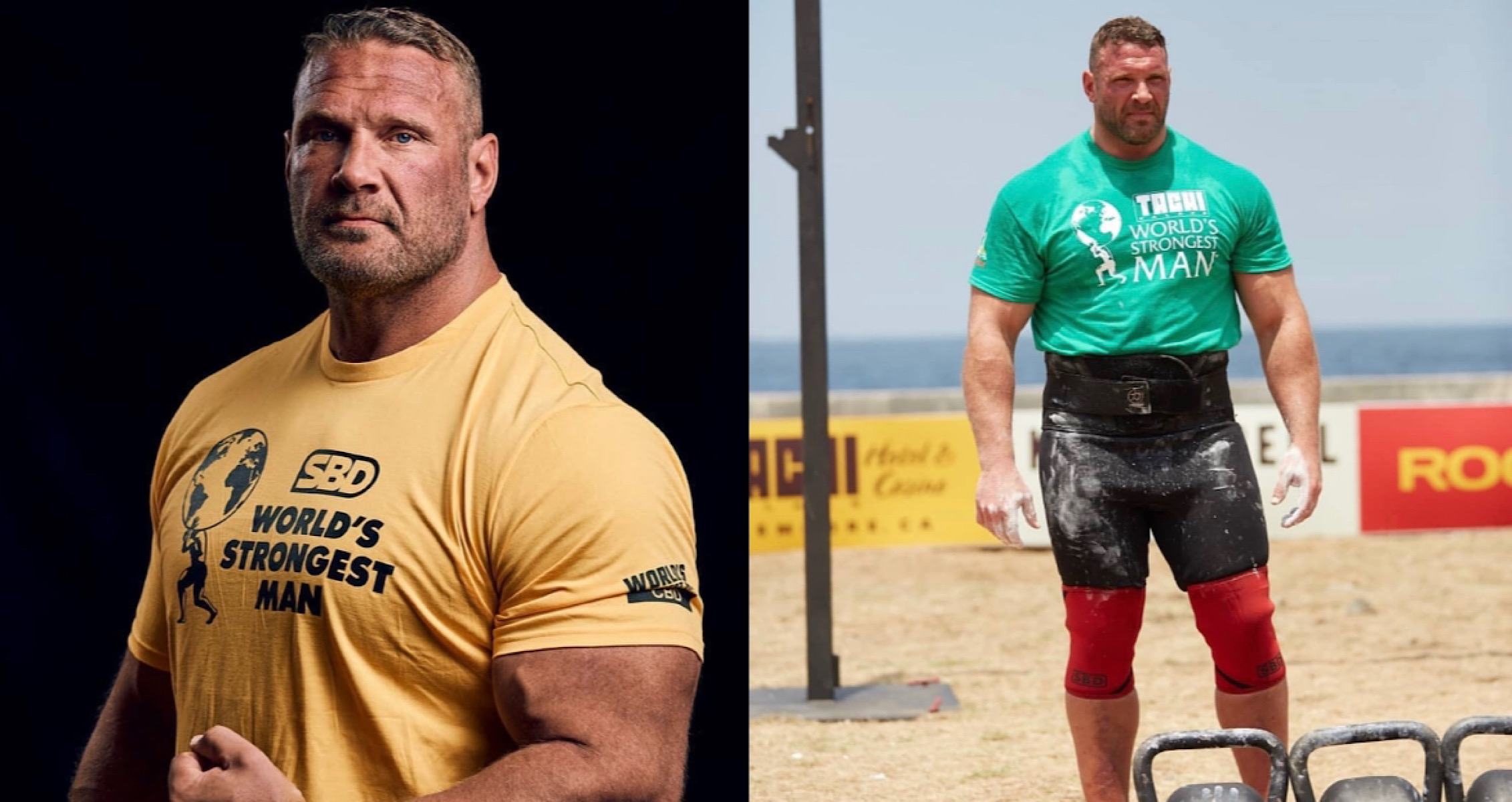
Terry Hollands is a retired British professional strongman, born on 6 June 1979 in Dartford, Kent, and one of the defining athletes of the generation that bridged the Strongman Super Series and Strongman Champions League era with the modern Giants Live circuit. The 2005 UK's Strongest Man and 2007 Britain's Strongest Man champion competed at World's Strongest Man 15 times between 2005 and 2021, reached nine consecutive finals from 2006 through 2014, and twice finished on the podium, taking third place in 2007 and 2011. He won the overall Strongman Champions League title in 2010 and the Masters World's Strongest Man title in 2019. Standing 1.98 m, Hollands became especially associated with deadlifting, truck pulls, yoke and dynamic moving events; his 435 kg deadlift in the 2011 WSM final was regarded as a world record when he completed it. The closing phase of his career was as distinctive as his rise: after weighing more than 200 kg at his heaviest, he undertook a major body-composition transformation, competed successfully in bodybuilding in 2019, and later remained active as an online coach, commentator and interviewer within the Giants Live strongman scene.
Terry Hollands belongs to the generation that carried professional strongman from the television-centred model of the late twentieth century into a far more continuous international circuit built around qualifiers, tours, leagues, specialist record events and year-round athlete visibility. Born on 6 June 1979 in Dartford, Kent, he became one of the central British figures of the period from 2005 to 2021. His historical significance does not depend on having won the open World's Strongest Man title. Instead, it rests on a remarkably broad body of evidence: 15 appearances at World's Strongest Man, nine finals, nine consecutive final qualifications from 2006 through 2014, and two podium finishes, both third places, in 2007 and 2011. He also won UK's Strongest Man in 2005, Britain's Strongest Man in 2007, the overall Strongman Champions League title in 2010, the All-American Strongman Challenge in 2011 and the Masters World's Strongest Man title in 2019. He finished second at Europe's Strongest Man in 2010 and returned to the continental podium with third place in 2017. These achievements show a career that operated successfully across several organisational eras rather than being confined to one promotion or one short competitive peak. At 1.98 metres tall and, during his heaviest strongman years, often between roughly 190 and more than 200 kilograms, Hollands looked every bit the giant associated with elite strongman. Yet the quality that repeatedly separated him from merely large athletes was movement. He was particularly effective in truck pulls, plane pulls, yoke, car walk, farmer's walk, loading medleys and deadlift variations. His 435 kg deadlift in the 2011 World's Strongest Man final was regarded as a world record at the time, while his vehicle-pulling record includes major event victories such as Truck Pull in the 2007 WSM final and Plane Pull in the 2009 final. Hollands therefore represents an important kind of strongman legacy: not the athlete remembered for a single championship season, but the elite competitor who remained dangerous for so long that several generations of opponents had to treat him as a genuine scoring threat.
His career is also useful for understanding how professional strongman itself changed. Hollands competed in the Strongman Super Series, World Strongman Cup, Strongman Champions League, Giants Live, Europe's Strongest Man, the Arnold Strongman Classic, World's Ultimate Strongman and other international events in addition to his extensive WSM record. Each system rewarded a slightly different balance of qualities. Some contests emphasised maximal static strength, others fast moving events, vehicle pulls, grip, loading or endurance. Hollands was never the absolute best in every category. Overhead pressing could cost him points, particularly when compared with historically exceptional pressers such as Žydrūnas Savickas. What made him difficult to beat was his ability to compensate. Deadlift, truck pull, yoke, carries and medleys gave him multiple routes back into a contest. The distinction matters because strongman is scored across events. A competitor does not need to win every discipline if he can avoid disastrous placings and exploit the events that fit his strengths. Hollands was capable of doing exactly that for years. His later career added another layer to the story. After spending part of his prime above 200 kg and publicly describing the health and daily-living costs associated with that bodyweight, he undertook a major transformation. By 2019 he had reduced his weight to roughly 135 kg for a bodybuilding debut, winning the Beginners class and placing second in Masters and second in Open Super Heavyweight at the 2Bros Pro Luke Sandoe Classic according to contemporary reports and athlete biographies. Later that same year he returned to strongman-specific preparation and won Masters World's Strongest Man in Daytona Beach. That sequence is one of the most unusual late-career turns among elite strongmen. It showed that his athletic identity could survive a dramatic change in body composition. After his 2021 retirement he remained visible through online coaching, commentary, interviews and Giants Live media work. The biography therefore extends beyond the last contest. Hollands became part of the sport's institutional memory, able to explain a modern competition from the perspective of someone who had competed against champions from several different eras.
Before strongman, Hollands' athletic background was defined more by dynamic sport than by the culture of maximal lifting. Public biographies and the Giants Live athlete profile describe a youth spent heavily involved in judo and rugby. Giants Live notes that he reached the Harlequins Academy system, played rugby in both England and New Zealand, and was part of the British under-21 judo setup. These details help explain a central feature of the strongman he later became. Rugby develops acceleration into contact, force application through the ground, repeated high-intensity work, balance under pressure and the ability to keep moving when another body or object is trying to stop you. Judo adds grip, positional awareness, hip control, balance and an intuitive understanding of how leverage changes when a load is not perfectly aligned. Hollands did not enter strongman as a static lifter who first had to learn how to move. Movement had been part of his sporting education. Even after his bodyweight climbed to extraordinary levels, that foundation remained visible in yoke runs, vehicle pulls, carries and medleys. He also came relatively late to serious weight training compared with many strength specialists. Giants Live and secondary biographical sources place the beginning of his dedicated gym work at around age 22, initially as a way to improve rugby performance. The emphasis was not immediately on single-repetition maximal strength. Conditioning and athletic development mattered first. This is an important contrast with the image that later defined him publicly: a near-two-metre, two-hundred-kilogram man pulling vehicles and deadlifting more than 400 kg. The extreme strongman body was constructed over time; it was not the starting point. A leg infection in 2004 disrupted his sporting activity, and accounts of his early career describe the return from that interruption as part of the shift toward strongman. When he came back to training, his size, rapidly developing strength and broad athletic background made the new discipline increasingly logical. What had been supplementary strength work for rugby became the centre of his competitive life.
That multi-sport background also helps explain Hollands' approach to event preparation. In interviews and athlete-profile material he has discussed visualisation and mentally rehearsing events. In strongman, that idea is more technical than mystical. An event is often a problem to be solved under extreme fatigue. The athlete may need to decide exactly where to place the hands, how many steps to take before changing direction, how to enter a yoke without creating swing, when to breathe during a repetition event, or how aggressively to start a truck pull without exhausting the legs before the vehicle has momentum. Visualising those details reduces the number of decisions that have to be made after the clock starts. A rugby and judo athlete is accustomed to turning physical situations into rapid sequences of choices. Hollands carried that habit into strongman. His dimensions made technical efficiency especially important. At 1.98 m, long limbs could be beneficial in some carries and pulls, but they could also increase range of motion in pressing and deadlifting depending on his proportions. To compete against the strongest men in the world he added a huge amount of total mass while trying to retain coordination. At his heaviest he moved beyond 200 kg. More bodyweight improved absolute force potential and stability, but it also created physiological costs that he would later describe publicly, including breathlessness, fatigue, excessive sweating, sleep apnoea and the burden of ordinary daily tasks. His career therefore contains both sides of elite strongman body construction: the deliberate creation of a massive body capable of surviving world-level loads, and the later deliberate dismantling of part of that mass when health, mobility and a different athletic goal became more important. Very few careers show both processes so clearly.
Hollands' rise in 2005 was unusually fast. He did not spend years on the margins of the professional circuit before becoming internationally relevant. In his first elite season he won UK's Strongest Man in Belfast. The event-by-event archive already shows characteristics that would become familiar: he won the Flag Hoist and Motorbike Hold, placed highly in the car pull and accumulated enough points across the contest to secure the title. The victory established him nationally and helped open the door to World's Strongest Man in Chengdu, China. Merely reaching WSM in the first season of a serious strongman career was notable. Hollands then proved that he belonged there. He finished third in his qualifying group and did not reach the final, but the event results were highly encouraging. He won the Truck Pull, finished second in Fingal's Fingers and second in a progressive deadlift series that reached 340 kg, completing six of the seven weights. The pattern appeared immediately: vehicle pulling and deadlift were going to be major weapons. More importantly, he handled the variety of WSM without looking like an athlete overwhelmed by unfamiliar equipment. Strongman events are not standardised in the way powerlifting lifts are. Athletes often encounter implements that differ in height, diameter, balance or friction from what they can reproduce in training. A newcomer therefore needs not only strength but rapid motor problem-solving. Hollands' background gave him that capacity. By the end of 2005 the question surrounding him had changed. He was no longer simply a large British athlete with potential. He had won a national title and an event at World's Strongest Man. Expectations rose immediately. The challenge was now whether he could turn isolated event success into consistent final qualification and eventually into a global podium.
The British context also mattered. The United Kingdom had a deep strongman tradition through figures such as Geoff Capes, Jamie Reeves and Gary Taylor, while Glenn Ross and other powerful domestic athletes shaped the early-2000s scene. Hollands appeared at a time when British strongman needed another competitor capable of remaining visible at the very highest international level. The 2005 UK's Strongest Man title supplied domestic legitimacy; WSM supplied global exposure. During this period the public image of Big Tel, and occasionally Terry “The Tank” Hollands, began to form around his enormous frame and his ability to keep moving under huge loads. Yet the body seen in early-career footage was still a work in progress. He would become heavier and stronger, especially in the deadlift, while competition experience taught him how to pace entire weekends rather than simply attack individual events. Strongman Archives credits him with 90 international contests and 13 national contests across his career. Those figures reveal the scale of the workload better than a highlight reel can. Each contest represented weeks of event-specific preparation, travel, disrupted recovery, changing implements and the constant possibility of small injuries. From 2005 onward Hollands entered a professional rhythm in which training and competition were almost inseparable. He was developing while already being tested against established world-class athletes. That is a demanding way to learn, but it also accelerated the construction of the competitive intelligence that would later become one of his greatest strengths.
The 2006 season confirmed that 2005 had not been an accident. Hollands placed third at Britain's Strongest Man and returned to World's Strongest Man in Sanya, China. This time he advanced from the heats and reached his first final, where he finished seventh. His qualifying performance again showed how well his event profile translated to WSM: he won the Farmer's Walk, Car Deadlift and Carry & Drag in his group. In the final he placed third in the Bus Pull and remained competitive in the car deadlift. These results were important because they demonstrated that Hollands could score in more than one family of events. He was not simply the truck-pull specialist. Carries, loaded movement and deadlift all produced points. International appearances also multiplied through events such as the Mohegan Sun Grand Prix and World Strongman Cup contests. The schedule itself became a form of training. Every competition exposed him to different apparatus, judging rhythms, travel conditions and opponents. By 2007 the accumulation of experience had turned into major results. Hollands won Britain's Strongest Man in Minehead with a broad performance that included event victories in Atlas Stones, Tire Flip and Farmer's Walk, plus second-place finishes in deadlift and Car Walk. That combination matters. The national title was not built on one oversized lift. It came from a contest in which he was effective across static strength, movement, loading and stones. A few months later, at the 2007 World's Strongest Man in Anaheim, California, he produced one of the finest contests of his career. Hollands finished third behind Mariusz Pudzianowski and Sebastian Wenta. In the final he won Truck Pull, finished second in Car Walk, second in the Loading Race, second in Atlas Stones and third in the Car Deadlift. It was a near-perfect map of his strongest qualities. The truck pull showed his exceptional vehicle-moving ability; the car walk and loading race displayed speed at enormous bodyweight; stones showed that he could close a contest under pressure; and deadlift ensured he was not dependent on movement alone. The bronze medal established him as a legitimate world-level podium athlete rather than simply Britain's leading contender.
The following year illustrated the volatility of strongman. Hollands finished second at Britain's Strongest Man and third at the Mohegan Sun Grand Prix, where he won the Super Yoke, but World's Strongest Man 2008 in Charleston went badly compared with the previous year's podium. He finished tenth in the final. That apparent collapse did not mean his underlying level had vanished. In qualifying he had again won Truck Pull and Atlas Stones and remained competitive in the deadlift and axle events. In the final, however, weaknesses became expensive. A zero on log press, modest points in car deadlift and Power Stairs, and middle-to-lower placings elsewhere pushed him down the table. Strongman scoring magnifies individual failures. One zero can erase the benefit of a very good event, and two poor disciplines can turn a podium-level athlete into the final-place finisher. The 2008 result also highlighted a recurring tension in Hollands' event profile. His overhead strength, while substantial in ordinary terms, was not always enough against the best pressers in the world. He therefore needed to exploit movement, pulling and deadlift events more effectively. This was not a fatal weakness because WSM rarely consisted only of pressing. It did, however, reduce the margin for error. By the end of 2008 Hollands had already collected a Britain's Strongest Man title, a WSM podium and three consecutive WSM final appearances. The next stage would be less about proving that he belonged and more about converting experience into sustained international performance across an entire season.
The years from 2009 through 2011 form the core of Hollands' mature prime. At World's Strongest Man 2009 in Malta he again advanced to the final and finished sixth. The signature moment was a victory in the Plane Pull. Vehicle pulls reward more than bodyweight. The athlete must create enough traction to overcome inertia, keep the body at an effective angle against the harness, coordinate the rope if one is used and maintain a relentless stepping rhythm after the first metres. Hollands' rugby background, large frame and years of strongman practice combined unusually well in this setting. He had also won Truck Pull in his qualifying group, reinforcing the idea that vehicle movement was a genuine specialist skill rather than a single lucky result. At the same time he became increasingly active in the Strongman Champions League. SCL demanded a different form of excellence from a one-weekend championship. The season involved repeated international travel and the accumulation of points across multiple contests. For an athlete of Hollands' size, simply remaining healthy enough to perform across the calendar was difficult. He converted that consistency into the overall 2010 championship. IronMind reported him as the 2010 SCL Champion, and season standings from the period list Hollands on 132 points, ahead of Ervin Katona and Mikhail Koklyaev. He also shared first place with Žydrūnas Savickas at the SCL Ireland stage in Limerick. The overall title is essential when evaluating his career because it rewards sustained output rather than one ideal set of events. It shows an athlete capable of repeatedly reaching the upper end of international fields even when the exact contest design changed from week to week.
The same 2010 season produced Hollands' best finish at Europe's Strongest Man, second place behind Žydrūnas Savickas. Savickas was the benchmark for static strength and overhead pressing in that period, so Hollands' ability to remain close enough through deadlift, carries and dynamic events illustrates the breadth of his game. At World's Strongest Man in Sun City he finished eighth, not a podium result but another successful final qualification. That contrast is instructive. Strongman performance cannot be represented by a single ranking carried from contest to contest. Event selection changes the athlete's competitive value. A man can be a continental runner-up in one format and eighth at WSM in another without any contradiction. Hollands' skill was surviving those changes often enough to remain relevant. His 2011 season then produced another surge. He won the All-American Strongman Challenge in Los Angeles, a significant international victory, and competed at the Arnold Strongman Classic, finishing eighth in a contest famous for brutally heavy static and unusual implements. The Arnold of that era was not a simple duplicate of WSM. It often pushed absolute load to extremes, making it particularly demanding for athletes whose best weapon was dynamic movement. Hollands was not an Arnold specialist, but competing there broadened his exposure to maximal-strength formats. Later that year, at World's Strongest Man in Wingate, North Carolina, he returned to the global podium. Brian Shaw won, Žydrūnas Savickas finished second and Hollands took third. The most famous moment was Max Deadlift. Hollands lifted 435 kg, recognised as a world record at the time. Before 450 kg and eventually 500 kg became part of strongman's later history, 435 kg represented an enormous landmark. For Hollands it was also proof of evolution. The former rugby athlete known for truck pulls and moving events had become a world-record-level deadlifter.
The 2011 bronze carries a different historical meaning from the 2007 bronze. In 2007 Hollands was still a rapidly rising athlete whose combination of mass and mobility could surprise more established opponents. By 2011 nobody was surprised. He was a veteran of multiple WSM appearances, Britain's Strongest Man champion, Strongman Champions League champion and an Arnold competitor. The sport itself had changed around him. Brian Shaw had emerged as a dominant force, Savickas remained extraordinary, and standards in deadlift and overhead pressing were climbing. Hollands had responded by becoming heavier and stronger without completely sacrificing movement. The 435 kg deadlift symbolises that development, but the podium cannot be reduced to one lift. WSM is won and lost through accumulated points. Third place requires an athlete to remain productive across a whole final. This is a recurring theme in Hollands' career: imperfect completeness. He was not the best presser in the field, not always the fastest loader and not unbeatable on stones, but he could collect enough third, fourth and fifth places while winning the right events to build a powerful overall score. For a man of his size, repeating that model over many seasons is arguably more revealing than any isolated personal best. From 2009 through 2011, each year added a different type of achievement: a WSM event victory, a league championship, a European silver medal, an international contest win and a second world podium. Together they establish the strongest multi-season phase of his career.
After the 2011 peak, Hollands entered a phase in which continuity became almost as significant as podium results. He returned to the Arnold Strongman Classic in 2012 and again finished eighth. His 456 kg Hummer Tire Deadlift from that contest remains one of the largest numbers associated with his competitive career, although the implement must be distinguished from a standard deadlift. The Hummer apparatus, bar characteristics and pulling height change the mechanical demand, so it should not be placed directly beside the 435 kg standard deadlift as though the two were identical tests. That same year Hollands finished second at Britain's Strongest Man and reached another World's Strongest Man final in Los Angeles. The 2012 WSM, however, brought a serious left-biceps injury during the natural-stone event. Strongman places the biceps in dangerous positions because objects do not behave like a barbell. Stones, sandbags, tyres and awkward implements can force the elbow and shoulder into changing angles while the athlete is already accelerating the load. A biceps tear can therefore threaten much more than one event. It affects loading, stones, pulling and any movement in which the arm has to stabilise an object away from a perfectly neutral position. Hollands still finished seventh in the final, but the injury began a long relationship with a vulnerable area that would eventually become relevant to the end of his career. Returning from such an injury requires more than tissue healing. A competitor has to rebuild trust in explosive loading patterns where complete protection is impossible. The following seasons show that Hollands managed the process successfully enough to remain a world finalist.
In 2013 Hollands finished third at Britain's Strongest Man and seventh at World's Strongest Man. The results were not career records, but they were evidence of successful reconstruction after the biceps injury. In 2014 he delivered an even more meaningful result: fifth place at World's Strongest Man in Los Angeles. It was his ninth consecutive final, a run extending from 2006 through 2014. That statistic deserves careful interpretation. Reaching a WSM final is not simply a reward for reputation. The athlete has to survive a qualifying group in which event selection, one mistake, a minor injury or an unfavourable direct battle can end the campaign. Hollands repeatedly negotiated that filter for almost a decade. By 2014 he was already over 35 and competing against the fully established Brian Shaw and a rapidly rising Hafþór Júlíus Björnsson. Yet he still finished inside the top five. That season also included third place at Giants Live Norway and third place at World's Strongest Viking. These results show that his WSM performance was not a one-contest anomaly. He remained capable of international podiums in different formats. The period illustrates a broader truth about strongman longevity: progress is not linear. An athlete can be older, carry more injury history and have a lower absolute peak in one lift while becoming more efficient at managing a whole competition. Hollands in 2014 was not necessarily stronger in every measurable way than Hollands in 2011, but he had enough technical knowledge and competitive judgement to turn his available capacities into a fifth-place WSM finish. The nine-final streak is therefore one of the strongest arguments for his historical importance.
After 2014 the pattern of Hollands' WSM career changed. His consecutive-final streak ended and later qualifying rounds became increasingly difficult. This should not be interpreted only as an individual decline. The competitive environment was changing. Brian Shaw and Hafþór Júlíus Björnsson combined exceptional size with increasingly sophisticated preparation, while Eddie Hall raised British standards in deadlifting and pressing. Strongman was becoming more professional in training methods, event replication, recovery and media attention. A veteran with a decade of accumulated injuries had to negotiate a narrowing margin between carrying enough mass for very heavy static events and staying mobile and healthy enough to score in moving disciplines. Hollands continued to qualify for WSM, but did not reach the final in 2016, 2017 or 2018. Even so, 2017 produced a significant continental result: third at Europe's Strongest Man. Nearly a decade after his first WSM podium and seven years after his European runner-up finish, he was back on a major podium. He also placed third at the SCL World Truck Pull Championships, a fitting result in one of the disciplines most closely associated with his entire career. At the same time his body began to change dramatically. Hollands has publicly described the period above 200 kg as one in which ordinary life was becoming increasingly uncomfortable. On his TH STRONG platform he has written about exhaustion, breathlessness, heavy sweating, sleep apnoea and the burden of everyday tasks. He also linked his desire for a healthier long-term future to becoming a father. That is one of the personal-life details he has made public in direct connection with his sporting choices, and it helps explain why the decision to lose weight was much more than an aesthetic project. In a sport where body mass can be an instrument of performance, choosing to become substantially lighter while still competing represented a major recalibration.
The 2018 results show that the recalibration was not immediately incompatible with elite performance. Hollands returned to the Britain's Strongest Man podium, finishing third at a much lower bodyweight than during his heaviest years. Strongman Archives records one especially striking performance: a 450 kg Super Yoke carried for 20 metres in 10.24 seconds. At approximately 147 kg in that period, he was moving more than three times his own bodyweight at speed. The performance illustrates why bodyweight reduction did not simply make him a weaker version of his old self. His relative strength and movement efficiency could improve even if some absolute lifts declined. At World's Ultimate Strongman Dubai in 2018 he finished ninth in a very strong field, pulled 430 kg from 18 inches and won the Truck Pull. More than a decade after winning Truck Pull at his first WSM and in the 2007 final, the same specialist quality remained available. Experience in a vehicle pull is not reducible to gym strength. The angle of the torso, foot rhythm, rope use, harness tension and preservation of momentum are learned skills. A younger athlete can possess a bigger deadlift and still lose seconds if he applies that strength inefficiently. Hollands had spent years learning exactly how to translate force into vehicle movement. The 2018 season therefore captures an important distinction between ageing and skill retention. His general competitive profile had changed, but a deeply practised event could remain world class. It also set the stage for the most unusual experiment of his late career: pushing the weight loss far enough to compete in bodybuilding.
If one year best demonstrates how unusual the closing phase of Terry Hollands' athletic career became, it is 2019. Early in the year he was still strong enough to win Força Bruta in Brazil, an international strongman contest in which he defeated experienced opponents and showed that the reduced-bodyweight version of himself could still win outright. Yet his physical preparation was already turning toward an objective that appears almost opposite to traditional heavyweight strongman: bodybuilding. Hollands chose not to compete at World's Strongest Man in 2019 so that he could focus on the bodybuilding project. The transformation was immense. From the years in which he had exceeded 200 kg, he eventually reached roughly 135 kg for the stage. At the 2Bros Pro Luke Sandoe Classic, contemporary reports credit him with first place in the Beginners class, second in Masters and second in Open Super Heavyweight. Giants Live likewise records a successful debut, including the beginners victory. The exact wording of the category summary varies between sources, but the central fact is clear: he did not merely step on stage as a novelty former strongman. He was competitive within the bodybuilding structure. The physiological priorities had changed almost completely. Strongman can reward additional total mass because it contributes to stability, leverage in some events and absolute force. Bodybuilding rewards muscular separation, proportion, presentation and low body fat. To move between the two, Hollands had to alter nutrition, conditioning, training volume and the psychological relationship with bodyweight. Muscle was no longer judged by what it could move but by how it appeared under stage lighting.
What makes 2019 especially remarkable is that bodybuilding did not permanently replace strongman. After the stage preparation, Hollands returned to event-specific work and won Masters World's Strongest Man in Daytona Beach. Strongman Archives and contemporary contest reports list him on 55.5 points, with event wins in Farmer's Walk, Deadlift Ladder and Power Stairs. Once again, the events almost summarise the career: loaded movement, pulling strength and a dynamic strength-endurance event. The victory showed that losing enormous bodyweight had not erased the functional base built across the previous decade and a half. He almost certainly surrendered some absolute-strength potential compared with the 190-to-200-plus-kilogram version of himself, but he regained enough strongman specificity to dominate a Masters field. This was more than a before-and-after weight-loss story. The transformation was functional. Hollands demonstrated that a strength athlete could move between different physical priorities and still retain a meaningful competitive identity. That experience later became relevant to his coaching work, which combines strength with body transformation rather than treating them as completely separate worlds. It also changed the public image of Big Tel. The man once associated with being one of the largest competitors in strongman had shown that reducing size could become an athletic objective rather than a symbol of decline.
The 2020 season proved that the Masters title and bodybuilding transformation did not mean Hollands had immediately left the Open division. In June, during the World's Ultimate Strongman Feats of Strength series, he deadlifted 420 kg. For an athlete over 40 who had dramatically reduced his bodyweight, the lift was an impressive measure of retained maximal strength. It was 15 kg below the 435 kg world-record lift of 2011, but the context was radically different: older age, lower body mass and a body that had already accumulated well over a decade of elite strongman wear. Later that year he made his fourteenth World's Strongest Man appearance. In his qualifying group he won the Deadlift and Farmer's Walk, two events that perfectly represented his historical profile. Yet he finished third in the group and did not advance to the final. The result demonstrates the severity of WSM scoring. Two event wins do not guarantee progression if enough points are lost elsewhere. It also shows why a late-career athlete cannot be understood simply through one strength number. Hollands could still beat world-level opponents in selected disciplines, but the all-event margin had narrowed. By 2020 he was no longer the newcomer learning from veterans. He had become one of the veterans against whom a younger generation could measure itself. Winning two events in that setting gave the final phase of his career competitive substance. He did not remain on the scene only because of his name.
World's Strongest Man 2021 became Hollands' final major strongman appearance and his fifteenth WSM. During a loading medley an old biceps problem was aggravated again. Hollands subsequently recognised that he no longer wanted to repeat the cycle of major rehabilitation and return. World's Strongest Man published an official retirement feature marking the end of his career after 15 appearances. He finished fourth in his group, but the placing was secondary to the wider context. The career that had begun at WSM in Chengdu in 2005 was ending on the same global stage sixteen years later. During that span strongman had changed dramatically. Deadlift and log standards had increased, Giants Live had developed a more visible qualification circuit, social media had transformed the relationship between athletes and spectators, and professional coaching and event-specific equipment had become far more sophisticated. Hollands had crossed all of those changes while remaining recognisably competitive. His retirement therefore did not follow a complete disappearance of performance. Only the previous season he had won two WSM heat events and deadlifted 420 kg. The 2021 injury acted as a threshold. At 42, after 15 WSM campaigns and a long injury history, another lengthy rehabilitation carried a different cost-benefit calculation than it would have at 30. For an athlete whose reputation had been built on durability, knowing when durability no longer meant continuing at all costs was an appropriate final decision.
Hollands' results can be read as a biomechanical map. A 1.98 m athlete weighing anywhere from roughly 150 kg to more than 200 kg appears to possess an automatic size advantage, but strongman converts size into different benefits and penalties depending on the event. In a truck pull, high body mass can improve traction and allow the athlete to load the harness aggressively without being displaced. Yet mass alone cannot win. A torso that is too upright, steps that are too long or inconsistent rope tension waste force. Hollands was able to maintain an aggressive angle, produce relatively quick steps for his size and continue applying force once the vehicle had begun moving. Repeated victories in truck and plane pulls make that conclusion evidence-based rather than a retrospective stereotype. Yoke presents a different problem. A heavy frame resting high on the back behaves like a pendulum. Every lateral oscillation can force the athlete to slow down. Tall athletes may have a long stride, but that advantage disappears if the implement starts swinging. Hollands learned to turn stride length into speed while controlling the structure, and the 450 kg yoke over 20 metres in 10.24 seconds at Britain's Strongest Man 2018 is a late-career demonstration of the skill. Farmer's walk requires grip, trunk stability, fast foot turnover and the ability to tolerate enormous cardiovascular demand. Winning Farmer's Walk in his 2020 WSM group at over 40 points to technique as much as raw grip. Loading races and medleys added the athletic qualities inherited from rugby: acceleration, deceleration, direction change and the manipulation of irregular objects while under severe fatigue. The reason his movement remained historically notable is not that he was the fastest strongman in every era. It is that a man of his extraordinary size could repeatedly convert gym strength into efficient locomotion.
Deadlift represents the more static side of the same identity. Being tall does not automatically make a conventional deadlift easy. Femur length, arm length, torso proportion and hip mobility determine the starting position and bar path. Hollands developed an efficient enough technique to pull 435 kg in competition and, according to Giants Live, 450 kg in training. He also recorded 456 kg in the Hummer Tire Deadlift and 430 kg from 18 inches. Those numbers should not be collapsed into one ranking because the events are mechanically different. The 435 kg lift in the 2011 WSM final is important as a standard competition deadlift and as a world record at the time. The 456 kg Hummer Tire Deadlift belongs to the specialised Arnold apparatus. The 430 kg 18-inch pull has a reduced range of motion. The meaningful conclusion is versatility: Hollands could transfer hip and back strength into several pulling configurations. The same requirement for context applies to his log press. Public sources list different maximums depending on whether they refer to training, a specific implement or archived contest results. Giants Live publishes a 192.4 kg training log, while Strongman Archives records 175 kg as the maximum competition result in its event database for Hollands. This profile therefore keeps 175 kg as the archive-verifiable competition record and labels 192.4 kg separately as a public training best. The aim is not to choose the largest available number. It is to preserve the distinction between evidence categories. Historical strongman data often comes from organisers, archives, athlete profiles and contemporary reporting that used different conventions. A serious profile should acknowledge those differences instead of manufacturing precision.
The personal side of Terry Hollands' biography is best handled with the same discipline as the competition record. There is little value in filling gaps with tabloid material or private family detail that does not help explain the athlete. One personal subject, however, has been discussed directly by Hollands and clearly influenced his sporting choices: the relationship between extreme bodyweight, health and fatherhood. In material published through TH STRONG, he describes life above 200 kg as increasingly burdensome. He has mentioned exhaustion, breathlessness, constant sweating, sleep apnoea and the way ordinary activities became more difficult. He has also stated that becoming a father sharpened his desire to address his health and think about a longer future. This makes the weight loss biographically important. It was not simply a performance strategy and not merely a cosmetic project. Hollands was recalculating the value of the body he had built for strongman. In elite strength sport, body mass is a tool. Additional size may improve absolute strength, stability and the ability to resist heavy moving implements. High caloric intake can support the training needed to maintain that mass. Yet the cardiovascular, respiratory and musculoskeletal systems still have to service the whole organism. The body does not exempt performance-driven mass from physiological cost. Hollands reached a point where the cost had become too high for his own priorities. The decision is significant within strongman culture because it was made publicly while he was still capable of elite results, before health monitoring and post-career weight reduction became as common a topic in strength-sport discussion as they are now. He did not present the transformation as a universal lesson. It was his solution to his circumstances. That distinction matters. The mass that later troubled him was also part of what helped him reach WSM podiums. Both realities can be true at the same time.
The transformation also changed his public identity. For more than a decade Hollands had been known through physical enormity, the Big Tel nickname and the visual spectacle of a near-two-metre man pulling vehicles. When the body is both the athlete's instrument and part of the sport's entertainment, changing it can be psychologically complicated. A lower bodyweight may be interpreted by spectators as lost strength even when health and relative performance improve. Hollands accepted that transition publicly and took it far enough to stand on a bodybuilding stage. The experience created a bridge between two cultures that are sometimes described too simplistically. Strongman prioritises what the body can do; bodybuilding prioritises how muscular development is displayed and judged. Yet both rely on resistance training, nutrition, periodisation, fatigue management and extraordinary consistency. Hollands experienced the extremes of both. That experience later became directly relevant to coaching. His current coaching site combines transformation and strength, and states that he personally handles clients while continuing to work with a small number of strongman athletes. The value of that experience is specific and practical: he has lived through several radically different phases of strength-sport body management and can draw lessons from each of them.
One of the least visible abilities in professional strongman is calendar management. Spectators see the contest, but not the logistical and physiological engineering that comes before it. In a season containing Britain's Strongest Man, Giants Live qualifiers, Strongman Champions League stages, World's Strongest Man and perhaps the Arnold Strongman Classic, there is rarely one perfect peak. The athlete has to decide where 100 percent readiness is essential, where 90 percent is acceptable, which minor injuries can be managed, which ones require a genuine reduction in load, and how much event-specific training can be performed between travel days. Hollands competed often enough that this problem became a major part of his competitive expertise. Strongman Archives credits him with 90 international contests and 13 national contests. Those 103 recorded competitions represent far more than 103 days of strain. They imply hundreds of specific sessions for yoke, farmer's walk, log, deadlift, stones, medleys and vehicle pulls, all layered on top of general strength work. Training every event heavily at once is impossible. A maximal yoke session can create enormous axial and hip fatigue; following it immediately with maximal deadlifts, heavy stones and overhead work may produce more damage than adaptation. The successful professional strongman therefore becomes a manager of competing priorities. Hollands spent more than a decade learning how to allocate effort across those priorities while still arriving at contests capable of scoring. His public comments about visualisation fit naturally into this framework. Visualisation in strongman is not simply positive thinking. It can involve rehearsing hand position, foot placement, breathing cadence, the number of steps to a platform, how to turn with a carry implement or when to accelerate during a truck pull. By solving these questions before the clock begins, the athlete reduces cognitive load under fatigue. When the heart rate is high, grip is failing and an official has just given the start signal, automatic execution becomes a competitive advantage. Years of contests gave Hollands a large internal library of such solutions. That helps explain why technical movement events remained useful to him after his absolute peak strength had begun to change.
His preparation also has to be understood within the era in which it developed. During the early and middle 2000s, strongman information did not circulate with today's speed or detail. Athletes did not have the same volume of online coaching, event tutorials, slow-motion competition footage or commercially available replica implements. Much was learned through experimentation, conversations with other competitors and whatever equipment could be fabricated or borrowed locally. Hollands emerged from that practical culture. There is no single long-term coach consistently documented in reliable public sources as the architect of his entire career, which is why this profile does not invent one for the sake of filling a field. Like most elite athletes, he used training partners, specialist advice and collaborative environments at different times, but his public competitive identity is largely that of a self-directed veteran. Self-directed does not mean isolated. Strongman is paradoxically individual and communal. The final score belongs to one athlete, but event knowledge often develops through shared equipment, training groups and the exchange of technical solutions. Over time, Hollands moved from being the athlete who had to discover how to pull a truck or stabilise a yoke into someone with enough accumulated experience to teach those processes. This is one reason the transition into coaching was coherent rather than opportunistic. A record tells you what an athlete achieved once. A long career produces a catalogue of what failed, what worked, how recovery changed with age, what kinds of preparation transferred between events and where apparently logical training created problems. That catalogue is a form of expertise separate from the trophy cabinet.
A serious strongman biography should resist turning injury into a moral test. The biceps tear in 2012, the recurrence in 2021 and the many smaller physical problems inevitable in such a long career do not prove that Hollands was somehow morally tougher than other athletes. They show that the sport exposes the body to unusually complex loads and that returning requires time, resources, patience and a tolerance for uncertainty. Strongman implements are rarely perfectly symmetrical. A natural stone can roll in the lap, a sandbag can sag, a tyre can shift during the turnover and a loading object can force the elbow into an angle the athlete did not intend. Tendons and joints therefore experience forces that are not fully represented by conventional barbell training. Hollands' 2012 biceps injury occurred while he was still operating near the highest level of the sport. His return to WSM finals in 2013 and 2014 shows that rehabilitation restored enough capacity for world-class competition, but repaired tissue and a readapted movement system do not erase injury history. As seasons accumulate, an athlete manages not only current performance but the physical memory of previous damage. The 2021 recurrence meant something different because Hollands was then 42, had 15 WSM appearances and had already completed the major competitive achievements that defined his career. At 30, surgery and a long rebuilding period may be an investment in many future seasons. At 42, after more than a decade and a half at world level, the same investment has a different meaning. Hollands' retirement demonstrates a mature version of resilience: not the refusal to stop under any circumstance, but the ability to recognise when the cost of rebuilding no longer matches the objective.
This perspective also changes how later results should be interpreted. When an athlete with two WSM podiums finishes third or fourth in a qualifying group, it is tempting to describe the result as simple decline. Athletic decline is more complicated. Maximal strength can decrease while technical efficiency improves. Bodyweight can decrease while speed increases. One event can remain excellent while another becomes progressively harder to recover from. The Hollands of 2018 was not the same biological athlete as the Hollands of 2011. He was lighter, older and carried more injury history, yet he could still move a 450 kg yoke at remarkable speed and win a Truck Pull at World's Ultimate Strongman. In 2020 he could win the Deadlift and Farmer's Walk in a WSM group without accumulating enough points elsewhere to reach the final. These facts do not fit a simple narrative of “great, then weak.” They describe a changing performance profile. Some capacities survived exceptionally well, others became more expensive, and recovery probably occupied an increasingly large part of the preparation equation. Longevity in strength sport is therefore an exercise in selective preservation. An ageing athlete does not keep every quality at its absolute peak. He attempts to preserve enough valuable qualities, and enough knowledge of how to use them, to remain competitive. Hollands managed that process for longer than most of his contemporaries.
The length of Terry Hollands' career can be measured through the names standing beside him. At his first World's Strongest Man in 2005, Mariusz Pudzianowski was in the middle of his championship era and Žydrūnas Savickas was already one of the defining strength athletes in the world. Hollands then competed through a period featuring Phil Pfister, Sebastian Wenta, Derek Poundstone, Mikhail Koklyaev and other major figures of the late-2000s international circuit. The next phase belonged increasingly to Brian Shaw, whose combination of height, mass and technical preparation helped redefine the modern heavyweight strongman. Hafþór Júlíus Björnsson then developed into another giant capable of elite movement, while Eddie Hall raised British expectations in deadlifting, pressing and ultimately championship performance. By the end of Hollands' competitive career, he was sharing WSM fields with athletes such as Tom Stoltman and a generation that had grown up with social media, specialist strongman coaching and easier access to event-specific equipment. There is no need to rank Hollands above or below those athletes in order to understand his importance. The relevant fact is that he remained competitively meaningful while standards changed around him. A deadlift that was a world record in 2011 became, within a few years, a weight surpassed by several specialists as the sport broke new barriers. Overhead standards rose, medley speed improved and event preparation became increasingly scientific. A veteran can respond to that evolution by attempting to preserve an old formula unchanged or by modifying goals, bodyweight and event strategy. Hollands did the latter. He leaned on the events where experience remained powerful, reduced bodyweight when health became a greater priority, and later embraced Masters competition without pretending it was the same category as the Open division. Adaptability is a major reason his name appears across such a long section of strongman's modern archive.
For British strongman, that continuity carries additional meaning. After historical champions such as Geoff Capes, Jamie Reeves and Gary Taylor, Britain needed athletes who could remain internationally visible, not merely occasional domestic winners. Hollands became one of the bridges between eras. His 2007 WSM podium restored a British presence among the leading finishers, and the 2011 podium proved that result had not been a one-off. When Eddie Hall began his rise toward the 2017 WSM title, Hollands was still active, providing a direct competitive link between two stages of British strongman. Later, as a veteran commentator and interviewer, he could discuss the next generation from a perspective that statistics alone cannot reproduce. This cultural continuity matters because strongman does not possess the same institutional infrastructure as many Olympic sports. Much of its history is preserved through competition archives, organisers, video footage and former athletes who remain engaged. Hollands has become part of that living memory. He is not only a name in an old results table. He continues to participate in the way the sport explains itself to new audiences.
A strongman profile can become misleading when numbers are removed from their apparatus and rules. A 435 kg deadlift, a 456 kg Hummer Tire Deadlift and a 430 kg 18-inch deadlift are not three measurements of the same capacity. The Hummer Tire Deadlift uses a specialised setup, typically with different bar flex and geometry. An 18-inch deadlift begins from a higher starting position than a standard floor pull and reduces the range of motion. A 450 kg yoke means relatively little without the distance and time, which is why Hollands' 2018 performance is recorded here as 20 metres in 10.24 seconds. Vehicle pulls are even harder to compare numerically. A nominally heavier truck can sometimes move more easily than a lighter one depending on tyre pressure, surface friction, gradient, starting inertia, rope use and weather. Strongman is a sport of implements rather than a standardised three-lift federation, and historical documentation must respect that. The 435 kg deadlift from 2011 has historical importance because it was a world record in that context and at that moment. It does not need to remain the largest lift of a later era in order to matter. Likewise, 15 WSM appearances do not mean 15 finals, which is why this profile separates the total appearances from the nine finals. The difference between a training lift and a competition result is also preserved. Giants Live lists a 450 kg training deadlift and a 192.4 kg training log, while the archived competition database supports 435 kg as his standard contest deadlift and 175 kg as the maximum archived competition log result. This distinction may look overly technical, but it is exactly what prevents a profile from turning into a collection of inflated personal records. Hollands' career does not need exaggeration. The verified version is already exceptional.
Titles need the same contextual discipline. World's Strongest Man and Masters World's Strongest Man are different competitions and should remain separate. Winning the Masters title in 2019 was a genuine and important achievement, but it should not be written as though it were identical to winning the Open WSM title. The Strongman Champions League overall title in 2010 was a season championship, different from winning one SCL stage. Hollands did both: he won the overall standings and shared first place at the Ireland stage. Britain's Strongest Man and UK's Strongest Man are likewise separate national contests, so the 2007 BSM title and 2005 UKSM title are recorded independently. These distinctions are essential for any site intended to function as a serious strongman archive. The sport is already complicated. Good documentation does not simplify it to the point of inaccuracy; it explains why different championships and records have different meanings. Hollands is an ideal athlete through whom to show that complexity because his career runs across so many systems: World's Strongest Man, Britain's Strongest Man, UK's Strongest Man, Strongman Champions League, Strongman Super Series, Giants Live, Arnold Strongman Classic, World's Ultimate Strongman and Masters competition. Read in that way, his biography doubles as a partial map of how professional strongman evolved between 2005 and 2021.
Retirement in 2021 did not mean leaving strongman. Hollands remained visible around Giants Live through interviews, broadcast work, commentary and event content. The role suits a former competitor because strongman is unusually difficult to explain entirely from the outside. A yoke run that appears simple to a casual viewer contains variables that are invisible on television: frame rigidity, the height of the crossbar, how the load swings, the surface under the athlete's feet, the exact position of the implement on the back and the fatigue left by previous events. A former WSM finalist can identify these details and translate them for an audience. Hollands has another advantage as a communicator: he competed across several generations. He can discuss Savickas and Pudzianowski from direct experience, the rise of Shaw and Björnsson as a contemporary, the British Eddie Hall era from within the national scene, and the subsequent generation from the perspective of a veteran who still understood the events physically. That chronological range turns him into a witness to the technical development of modern strongman. Coaching provided a parallel professional outlet. In 2026 his official Terry Hollands Coaching site presents him as an online transformation and strength coach. The site states that he personally works with clients and still coaches a small number of strongman athletes. The transition makes practical sense. A long competitor career accumulates solutions that are hard to acquire through theory alone: how to prepare an event that rarely appears in a commercial gym, how to manage training when contests are close together, how to modify bodyweight without losing every useful strength quality, and how to rebuild event confidence after injury. Turning those experiences into coaching is a less visible contribution than a WSM podium, but it can extend the influence of a career far beyond the athlete's own final contest.
His media work also reflects the transformation of strongman culture. During the early years of Hollands' career, many fans knew athletes primarily through edited World's Strongest Man television broadcasts shown after the competition. Access to training, recovery and ordinary athlete life was comparatively limited. By the later years of his career, YouTube, Instagram and digital promotion had completely changed that relationship. Hollands crossed both systems. He was formed in an era when reputation was built mainly by appearing on major television contests, yet he adapted to the age of interviews, social clips, coaching platforms and direct-to-fan content. Voice of Strongman TV and his Giants Live appearances belong to that transition. As an interviewer he is not entirely external to the athlete's experience. He knows what a missed deadlift after several events feels like, how qualification pressure affects strategy, how long an athlete may wait for results and how a slippery implement or a few seconds of penalty can change an entire championship. That experiential authority should still be distinguished from factual documentation. A former athlete's interpretation is an informed opinion, not automatically an objective fact. But precisely because the distinction is clear, the perspective is valuable. Hollands became a bridge between the archive and the living sport.
Terry Hollands' legacy cannot be summarised by saying that he never won the Open World's Strongest Man title. That framing removes the very features that make the career historically interesting. He competed at WSM 15 times, reached nine finals, made all nine of those finals consecutively from 2006 through 2014 and finished on the podium twice. He won important national titles in two different British championships, became overall Strongman Champions League champion, finished second and third at Europe's Strongest Man in seasons seven years apart, won the All-American Strongman Challenge and later became Masters World's Strongest Man. He won WSM events across a very long span, from vehicle pulls during his rise to Deadlift and Farmer's Walk in his 2020 qualifying group. He set a 435 kg world-record deadlift in 2011 and remained strong enough nine years later to pull 420 kg. These are the marks of a career with breadth as well as peaks. Champions define landmarks, but long-term elite veterans often define the competitive standard surrounding those landmarks. Hollands was one of those athletes. To succeed in a field containing him, a competitor could not afford to assume easy points in truck pull, yoke, deadlift or carries. A veteran capable of winning an event forces everyone else to be better because one mistake is punished immediately in the standings. That pressure is part of how generations improve. Hollands also provided continuity for British strongman between earlier national icons and the championship era that later included Eddie Hall. His WSM podiums in 2007 and 2011 kept a British athlete close to the very top of the sport during a major period of international change.
There is a subtler legacy in the image of the very large athlete who remains genuinely athletic. Modern strongman is full of enormous competitors, but size does not automatically produce speed. Hollands was an early and highly visible example of a near-two-metre, near-200-kilogram athlete who could be technically competent enough to win world-level movement events. That combination later became increasingly necessary for championship contenders. His late-career transformation added another lesson. Elite strongman bodyweight is not necessarily a permanent identity. The physique required to survive an Open WSM season may carry costs that an athlete no longer wants after priorities change. Hollands made the transition visible. He lost a huge amount of weight, continued to compete, stepped onto a bodybuilding stage, won a Masters strongman world title and eventually moved into coaching and media. The sequence gives his story relevance beyond athletes who expect to become world champions. It shows that a strength career can have several legitimate phases and that changing the objective does not erase the value of the previous one. Big Tel entered strongman as an unusually large former rugby and judo athlete discovering how far his strength could go. He left professional competition as one of the most experienced WSM participants of his generation and remained close enough to the sport that the experience did not become mere nostalgia.
Taken together, the career numbers form an unusual profile. Fifteen World's Strongest Man appearances represent more than biological longevity. They represent repeated qualification, repeated event preparation, repeated international travel and repeated exposure to the most recognisable competitive stage in the sport. Nine finals, all consecutive from 2006 to 2014, show that Hollands survived the part of WSM where many exceptionally strong athletes disappear from the championship. Two podiums, in 2007 and 2011, confirm that his best seasons placed him among genuine contenders for the leading positions rather than merely consistent finalists. Fifth place in 2014 proves that this competitiveness survived well beyond the first phase of his career. The overall Strongman Champions League title in 2010 adds a different measurement because it rewards regularity across a season. The 2005 UK's Strongest Man and 2007 Britain's Strongest Man victories establish national strength in a country with one of the deepest traditions in the sport. Second and third at Europe's Strongest Man, separated by seven years, give another measure of durability. The 2019 Masters world title belongs to a different physical phase, after the bodybuilding transformation, and proves that Hollands could reconstruct strongman-specific capacity after pursuing almost opposite body-composition priorities. Perhaps the most revealing statistic, however, is not one number but the distance between his first and last major event wins. In 2005 he won UK's Strongest Man and took Truck Pull in his WSM heat. In 2020, at 41, he was still winning Deadlift and Farmer's Walk in a World's Strongest Man group. Between those points lie fifteen years of bodyweight changes, injuries, equipment evolution, new rivals and rising performance standards. Strength records often age quickly because later generations lift more. Competitive continuity ages differently. Once an athlete has remained relevant across several eras, that fact cannot be erased by a new world record. This is why Hollands should be understood through the duration for which other competitors had to take him seriously. In 2007 a WSM champion had to outscore a podium-level Hollands. In 2011 the same was again true. In 2014 he was still fifth in the world. In 2017 he could still reach the European podium. In 2018 he could still win an elite Truck Pull and move a 450 kg yoke at speed. In 2019 he could transform for bodybuilding and then win a Masters world championship. In 2020 he could still beat much younger athletes in WSM events. That is the substance of a long career: not simply being present, but repeatedly creating situations in which the field must regard you as a competitive threat.
Seen this way, Hollands' public image becomes unusually coherent. He was not defined by one perfect season. He was defined by returning to situations in which performance had to be demonstrated again. Every new WSM qualification effectively erased much of the advantage of reputation. The truck still had to move, the yoke still had to be carried and the bar still had to leave the floor. Past results could earn respect and sometimes opportunities, but they did not place free points on the scoreboard. This distinction separates celebrity from a genuinely competitive career. Hollands eventually had both, but the second created the first. His biography therefore works as a case study in strongman itself. The sport rewards spectacular records, but reputation is built by repetition. One lift can become famous; fifteen years of relevance require an entire system of training, recovery, adaptation, bodyweight management, travel logistics, injury decisions and psychological recalibration. Hollands' system was not perfect. No long career is. It included injuries, events that exposed weaknesses, seasons in which qualification ended early and physical choices that he later changed for health reasons. Yet it was robust enough to carry him through several generations of opponents. That may be the most important achievement of the career because it connects every other one. The 435 kg deadlift, the vehicle pulls, the WSM podiums and the SCL title are not isolated miracles. They are outputs from a competitive life that kept finding ways to remain functional.
Hollands' story also illustrates why professional strongman cannot be reduced to gym personal records. The athlete must repeatedly transfer general strength into unfamiliar problems. A 400 kg deadlift does not automatically teach someone to load a stone efficiently. A huge squat does not guarantee a fast yoke because the frame introduces oscillation and the athlete must produce force while moving. Grip strength does not automatically create a great farmer's walk if foot speed and trunk stability collapse. Hollands' competitive value came from connecting these qualities. His most recognisable achievements often occurred where strength and movement overlapped. That is why the early rugby and judo background remains relevant even decades later. Athletic habits developed before strongman did not disappear when he became enormous. They were buried beneath more mass and more strength, then reappeared clearly during the lighter phase of his career. The 2018 yoke performance is an especially good example: after losing substantial bodyweight, the raw number on the implement remained huge, but the decisive characteristic was speed. Similarly, repeated vehicle-pull wins show that event mastery can survive changes in absolute strength. In a sport with so many implement variations, learning how to learn an event is itself a skill. Hollands accumulated that skill through sheer exposure. He competed in more than a hundred archived national and international contests, and each one added information about surfaces, handles, judging, pacing and recovery. This is why a career archive has value beyond nostalgia. It preserves how an athlete solved a changing set of physical problems. For coaches and later competitors, those solutions can be more informative than the headline number attached to one lift.
The national and European layers of Hollands' career are easy to understate when World's Strongest Man receives most of the public attention. Yet Britain's Strongest Man, UK's Strongest Man, Europe's Strongest Man and the touring circuits were not side projects. They were the competitive ecosystem in which a WSM athlete repeatedly proved readiness. Winning UK's Strongest Man in 2005 gave Hollands his first major national authority. Winning Britain's Strongest Man in 2007, in the same year as his first WSM podium, showed that his international rise was anchored in domestic results rather than detached from them. Later runner-up and third-place finishes in British championships demonstrate how difficult it was to retain that position as the national field evolved. The European circuit offered an even wider test. His second place at Europe's Strongest Man in 2010 came during one of the strongest phases of his career, while third place in 2017 came after years of additional mileage and in a different competitive generation. Those two European podiums, separated by seven seasons, are one of the cleanest measures of longevity in his record. Strongman Champions League adds another dimension because it rewards not just a single day of preparation but the ability to function repeatedly across an international schedule. Winning the 2010 overall championship required Hollands to keep collecting points while travelling and adapting to changing event selections. The title therefore complements rather than duplicates his WSM achievements. WSM tests whether the athlete can reach a peak and survive the championship format. A league season tests whether he can remain useful over time. Hollands' career contains evidence of both. This is also why his contest total matters. Ninety international starts in the Strongman Archives database imply exposure to an enormous variety of apparatus and competitive conditions. Some events were major championships, some qualifiers, some tour stages and some specialist contests. Together they created the technical education behind the veteran seen in later years. A strongman who survives that volume acquires a form of practical knowledge that cannot be inferred from a training log: how an implement feels after a flight, how warm-up timing changes when television production delays a start, how to conserve energy during a multi-day contest, and how quickly a small technical mistake can become a major scoring loss. Hollands' broad international record therefore helps explain why his later transition into coaching and commentary was credible. He had not experienced one narrow route through the sport. He had experienced many of its organisational forms from inside the arena.
This wider circuit perspective also explains why his career should not be judged only by whether he possessed one dominant lift. Professional strongman rewards the athlete who can adapt quickly enough to a changing menu. A competition may place maximal deadlift beside a vehicle pull, a heavy yoke beside stones, or overhead repetitions beside a loading race. Hollands' overhead was not always competitive with the very best specialists, but his event portfolio gave him alternative routes to points. In seasons when the selection contained truck pull, heavy moving events and deadlift, he could become particularly dangerous. In other seasons, pressing weakness or a poor event could push him down the standings. That volatility is not a flaw in the sport; it is part of what makes strongman distinct. The athlete is tested not against an abstract universal measure of strength but against a temporary collection of tasks. Hollands' long career provides a useful demonstration of this principle because his ranking changed with the event environment while his underlying qualities remained recognisable. The same man who could finish tenth in one WSM final could be third in another, not because his identity changed overnight but because form, health, event selection and execution intersected differently. Over many years, those fluctuations averaged into a remarkably strong overall record. This is another reason why the nine consecutive finals matter more than any single poor placement. They show that across a large number of changing event menus, Hollands repeatedly possessed enough solutions to qualify for the championship round.
The arc from national newcomer to veteran broadcaster also reveals something about professional identity in strength sport. At the beginning, Hollands' value was measured almost entirely by what happened after the whistle: distance, repetitions, time and points. As his career progressed, experience itself became a resource. Younger athletes could study his event technique, promoters could rely on a recognisable name, and audiences could connect different eras of the sport through someone who had personally occupied them. Retirement shifted the balance further. His usefulness to strongman no longer depended on carrying the heaviest implement that day. It depended on the ability to interpret what other athletes were doing and to transfer lessons accumulated over years of preparation and competition. This is a healthy form of sporting continuity because it does not require pretending that the retired athlete is still physically identical to his prime. Hollands can acknowledge the bodyweight, injuries and changing priorities that ended one phase while remaining professionally relevant in another. For an athlete whose public identity was once literally built around size, that transition is significant. The giant body was temporary; the knowledge created while using it could continue. In this sense, the post-competition phase completes rather than contradicts the earlier biography. Rugby and judo supplied the first movement vocabulary, strongman turned that vocabulary into world-level performance, bodybuilding forced a new relationship with body composition, and coaching and media converted experience into communication. The stages are different, but they form one coherent athletic life rather than a collection of unrelated reinventions.
For that reason, the most accurate summary of Hollands is not a single label such as deadlifter, vehicle-pull specialist, bodybuilder or veteran. Each label is true but incomplete. His career matters because those identities overlap. The same athlete who used mass as a competitive weapon later decided that reducing mass was necessary for the life he wanted beyond peak strongman. The same competitor who once needed to solve unfamiliar events for himself later became someone able to explain those events to clients and spectators. The same man who reached a WSM podium in 2007 was still winning WSM heat events in 2020, after the sport and his own body had changed substantially. That continuity gives the biography its shape. It is not the story of an athlete who stayed the same for sixteen years. It is the story of an athlete who changed enough to remain relevant, and eventually changed again when relevance no longer required standing behind the start line.
This profile was assembled by cross-checking several categories of source rather than relying on a single biography. Strongman Archives is the primary source for contest history, appearances, placings and event-by-event results because it provides an extensive competition database for Hollands across his career. Giants Live supplies biographical context, publicly listed records, athlete quotations and information about his continued role around the modern circuit. The 2010 Strongman Champions League overall championship is additionally confirmed by contemporary IronMind reporting. His 2021 retirement after 15 WSM appearances is documented by the official World's Strongest Man channel. Current coaching activity is taken from Terry Hollands Coaching, while his own TH STRONG material provides first-person context for the bodyweight transformation and the health-related motivations he chose to make public. Where sources differ, this profile does not hide the disagreement. The clearest example is the log press, for which public athlete profiles and archival contest databases list different maximum values depending on whether the lift was performed in training or in competition and which implement is being referenced. The record field therefore uses the archive-verifiable competition result and labels the larger published training result separately. Bodyweight also changes dramatically by year. The 155 kg value in the main physical-data field reflects contemporary profile listings, not a claim that he weighed 155 kg throughout his career. At his heaviest he was well above 190 kg and, by his own account, over 200 kg; on the bodybuilding stage he was approximately 135 kg. Personal-life material has been limited to information Hollands himself connected publicly to his sporting decisions, especially the fact that becoming a father influenced his desire to improve his long-term health. Unsupported private detail, rumour and guessed information have been deliberately excluded. The goal is breadth without false certainty: precise dates and numbers where the archive supports them, explicit context where sources differ, and no invented content where the public record is incomplete.
Giants Live — athlete biography, physical data, published performances and career context.
Iron Hall data
435 KG
Max Deadlift — competition · 2011 World's Strongest Man final; world record at the time of the lift
Verified
420 KG
Max Deadlift — WUS Feats of Strength · WUS Feats of Strength, 27 June 2020
Verified
430 KG
18-inch Deadlift · 2018 World's Ultimate Strongman Dubai
Verified
456 KG
Hummer Tire Deadlift · 2012 Arnold Strongman Classic
Verified
175 KG
Max Log Lift — competition · 2010 Strongman Champions League Finland, competition maximum recorded by Strongman Archives
Verified
173 KG
Max Axle Press · 2010 Europe's Strongest Man
Verified
450 KG
Super Yoke · 20 m in 10.24 s at 2018 Britain's Strongest Man
Verified
450 KG
Deadlift — training · Training best published by Giants Live
Verified
300 KG
Front Squat — training · Training best published by Giants Live
Verified
192.4 KG
Log Lift — training · Training best published by Giants Live
Verified
255 KG
Bench Press — training · Training best published by Giants Live
Verified
2005
The first major national title of his career, won in his debut elite season.
Champion
2005
WSM debut in Chengdu, China; he won the group Truck Pull and narrowly missed the final in his first strongman season.
3rd in group
2006
First Britain's Strongest Man podium.
3rd place
2006
First WSM final; the beginning of Hollands' run of nine consecutive finals.
7th place
2007
Won the national title with event victories in Atlas Stones, Tire Flip and Farmer's Walk.
Champion
2007
First career WSM podium, in Anaheim; won the Truck Pull and finished second in Car Walk, Loading Race and Atlas Stones.
3rd place
2008
Maintained his status as one of Britain's leading strongmen.
2nd place
2008
Strongman Super Series podium; won the Super Yoke event.
3rd place
2009
Won the Plane Pull in the final and won both Truck Pull and the deadlift series in qualifying.
6th place
2010
Best European championship placing of his career, behind Žydrūnas Savickas.
2nd place
2010
Won the SCL overall standings with 132 points after a season of repeated podiums and a stage win in Ireland.
Overall champion
2010
Shared the stage victory with Žydrūnas Savickas in Limerick.
Joint 1st place
2011
International victory in Los Angeles ahead of the Arnold/WSM season.
Champion
2011
Second career WSM podium; in the North Carolina final he deadlifted 435 kg, a world record at the time.
3rd place
2011
First of two consecutive Arnold Strongman Classic appearances in Columbus.
8th place
2012
Second career runner-up finish at Britain's Strongest Man.
2nd place
2012
Second Arnold Strongman Classic appearance; recorded a 456 kg Hummer Tire Deadlift.
8th place
2012
Reached another final, but a left-biceps tear suffered on the natural stones compromised his contest.
7th place
2013
Another national podium while rebuilding after the 2012 injury.
3rd place
2013
Eighth WSM appearance and eighth consecutive final in the run begun in 2006.
7th place
2014
Ninth consecutive WSM final, an exceptional longevity mark for the era, and his best finish after the 2007 and 2011 podiums.
5th place
2014
International podium on the Giants Live qualifying circuit.
3rd place
2014
Podium in Norway behind Hafþór Júlíus Björnsson and David Nyström.
3rd place
2017
Returned to the continental podium during the period in which he had already begun a major bodyweight reduction.
3rd place
2017
A result underlining one of his signature disciplines: vehicle pulling.
3rd place
2018
Podium in Sheffield at roughly 147 kg, far below his peak strongman bodyweight; carried a 450 kg yoke for 20 m in 10.24 s.
3rd place
2018
Recorded a 430 kg 18-inch deadlift and won the Truck Pull event.
9th place
2019
International victory in Brazil, including wins in the deadlift and medley.
Champion
2019
His bodybuilding debut, at roughly 135 kg, following a major body-composition transformation from the years in which he exceeded 200 kg.
1st Beginners; 2nd Masters; 2nd Open Super Heavyweight
2019
Masters title in Daytona Beach with 55.5 points; won the Farmer's Walk, Deadlift Ladder and Power Stairs.
Champion
2020
Won the group Deadlift and Farmer's Walk but did not advance to the final.
3rd in group
2020
A 420 kg deadlift in the WUS Feats of Strength series.
420 kg
2021
His 15th WSM appearance. A biceps re-injury during the loading medley led to his withdrawal and then the announcement that his strongman career was ending.
4th in group / injury withdrawal