
1999
Estonia’s Strongest Man
The first of the five national strongman titles listed in his career record.
Champion
Iron Archives
Five-time Estonia’s Strongest Man and four-time consecutive World’s Strongest Man finalist
Inactive athlete
Tarmo Mitt (born 22 May 1977) is one of the defining Estonian strongmen of his generation. A five-time Estonia’s Strongest Man winner and six-time Estonian powerlifting champion, he reached the World’s Strongest Man final every year from 2005 through 2008, peaking at fifth place in 2006. He finished third overall in the 2005 World Strongman Cup and second overall in 2006, while Strongman Archives records 75 international contests and 8 international wins. After his elite peak he remained active on the international and Masters circuits, and he now works as a coach at SK Jõusport in Tartu.
Tarmo Mitt occupies a distinctive place in Estonian strongman history because his career cannot be reduced to one peak season or one famous result. It stretches across several eras of the sport: the Baltic and Central European circuits that gave emerging athletes a route into international competition, the expansion of the World Strongman Cup during the 2000s, the increasingly global visibility of World’s Strongest Man, and finally a mature Masters scene in which former elite competitors could meet again at a meaningful competitive level. Across that long arc Mitt remained relevant in different ways. He was a national champion, an international contest winner, a four-time consecutive World’s Strongest Man finalist, a contender for the overall World Strongman Cup title, and later a veteran capable of returning to international victories and Masters podiums after his primary WSM years had ended. Strongman Archives credits him with 75 international contests and eight international wins between 2001 and 2019. That database does not capture the whole story, because Mitt’s own website dates his first strongman competition to 1997 and his national record begins before the international archive becomes comprehensive. His best WSM result was fifth place in 2006, following sixth in 2005. In 2007 he reached the final again but tore his biceps during the opening Loading Race and was forced out; in 2008 he returned, won his qualifying heat and finished seventh in the final. Four consecutive finals from 2005 through 2008 became one of the defining statistical signatures of his career. At the same time he finished third overall in the 2005 World Strongman Cup and second overall in 2006. IronMind reported that he entered the final 2006 stage actually leading the season standings by one point over Mariusz Pudzianowski, illustrating how close he came to winning one of the era’s major series. In Estonian terms, Mitt belongs to a generation that helped turn a relatively small country into an unusually productive strongman nation. He competed alongside Andrus Murumets and was still winning when Rauno Heinla was emerging, creating a bridge between generations. His importance also extends beyond competition. Mitt remained based in Tartu and built a long coaching career, and current SK Jõusport and Estonian Sports Register pages still list him working in strength sport. His public biography therefore connects competition, physical education, coaching and local strength culture over nearly three decades. The result is not simply the story of a very strong man who reached WSM. It is the story of an athlete who learned to survive different organizations, event formats, injuries and stages of aging, then carried that accumulated knowledge back into the training environment from which he came.
Tarmo Mitt was born on 22 May 1977 and is closely associated throughout his public life with Tartu, Estonia’s university city and an important center for strength sports. The strongest source for his early athletic history is his own professional website. Mitt writes that he began training regularly at the age of eight when he took up judo, and that he competed in the sport for ten years. This detail matters because it corrects the simplistic picture of a strongman who discovered the gym late and developed only through maximal strength work. Mitt’s first foundation was built in a combat sport where balance, coordination, grip, body positioning and the ability to generate force from imperfect angles are fundamental. Alongside wrestling and judo-related preparation he also performed strength training for physical development. Looking backward from the events in which he later excelled, the connection is persuasive. Farmer’s Walk, Atlas Stones, medleys, truck pulls and grip holds are not laboratory lifts. They require rapid adaptation, control of the center of mass, efficient footwork and the ability to keep applying force when the implement is awkward or the body is not ideally aligned. Public sources do not provide a detailed account of Mitt’s family childhood, and a responsible biography should not invent one. What can be established is that before strongman he already had roughly a decade of competitive sport behind him. By late adolescence, at an age when many athletes are still searching for a primary discipline, Mitt had already learned routine, competition pressure and the physical consequences of repeated training. Judo also offered a form of athletic education that powerlifting alone cannot supply: reacting to another body, controlling leverage, using the hips dynamically, gripping under fatigue and producing force when movement is unpredictable. Mitt later said that this broad background gave him a useful foundation when he entered rammumees, the Estonian strongman tradition. The chronology supports that interpretation. His first strongman contest came in 1997, and within a few years he had become a national champion and was appearing in international results. That development seems less mysterious when 1997 is understood not as the beginning of his athletic preparation but as the moment when more than a decade of physical education was redirected toward a new sport. This early history also helps explain one of the most persistent features of his later competitive identity: he was rarely dependent on a single event. He learned strongman as an already versatile athlete, and the sport rewarded that versatility for the next two decades.
After secondary school, Mitt’s path became even more closely connected with sport. According to his own biography, he entered the University of Tartu’s physical culture program and specialized in heavy strength sports. The current SK Jõusport coaching page identifies him as a University of Tartu physical education graduate from 2001. This was not merely an academic decoration added to an athletic résumé. It created an environment in which practical training and formal study could reinforce each other. During this period Mitt pursued bodybuilding and powerlifting, two disciplines that provided complementary tools for his future as a strongman. Bodybuilding supported muscular development, structural balance and the capacity to tolerate training volume. Powerlifting sharpened force production and technical confidence in the squat, bench press and deadlift. Mitt’s personal site identifies him as a six-time Estonian champion in powerlifting. Translation requires care here: some automated English versions of club material render the relevant Estonian term as weightlifting, but Mitt’s own Estonian page uses jõutõstmine, meaning powerlifting. That distinction matters for historical accuracy. Strongman is not simply powerlifting performed with unusual objects, yet a large reserve of basic strength makes it easier to learn carries, loading events, log work and vehicle pulls. Historical athlete profiles report personal bests of 320 kg in the squat, 225 kg in the bench press and 335 kg in the deadlift. These figures are plausible and widely repeated, but because they are not all attached to easily verifiable official meet sheets they should be presented as reported personal bests rather than certified competition records. A better-documented static performance is Mitt’s 175 kg max log at the 2006 Poland Grand Prix, where he tied Sebastian Wenta for the event victory. Taken together, the data suggest that Mitt was strong enough statically to remain competitive but was not defined by a single monstrous gym number. His value came from converting general strength into event performance. The university background later became even more relevant when he moved deeper into coaching. SK Jõusport now presents Mitt as a coach working with beginners and experienced trainees in strength and muscle development, bodybuilding, weightlifting-related training, functional work and rehabilitation-oriented exercise. The same biography therefore contains both sides of the strength profession: the athlete developing himself and the practitioner learning how to develop others. The University of Tartu period is best understood as the hinge between them, connecting the combat-sport athlete of his youth to the power athlete of the 2000s and to the coach who remains active in Tartu today.
Mitt dates his first strongman competition to 1997, when he was twenty years old. He entered the sport with a mixture of judo, general strength work, bodybuilding and powerlifting behind him, an unusually useful combination for a discipline in which excessive specialization can become a weakness. European strongman in the late 1990s was far less standardized than the modern professional scene. Implements, surfaces, distances and even event rules could vary sharply from contest to contest, and athletes had to turn general physical capacity into practical solutions with very little rehearsal. Historical records place Mitt’s first Estonia’s Strongest Man title in 1999, followed by wins in 2000 and 2001. His own website confirms a total of five Eestimaa Rammumees titles, while historical listings place the final two in 2003 and 2004. The national success was not a set of isolated good days; podium placements in the surrounding years show sustained domestic dominance. For an Estonian athlete at the turn of the millennium, national results served two purposes. They established local authority and helped build the credibility required for invitations abroad. Mitt begins appearing in Strongman Archives’ international record in 2001, finishing sixth at the IFSA Poland Grand Prix and third at Strong Riga 800. Entering an IFSA field was meaningful at the time because IFSA represented one of the central structures in professional strongman. Mitt was not arriving merely as a regional novelty. He was already capable of finishing respectably against established international athletes. In 2002 he placed second at Finland’s Strongest Barbarian; in 2003 he added third at the Strongbow Challenge, another runner-up finish in Finland and victory at Forssan Vahvin Mies, while regaining the national title in Tartu. On paper the progress looks orderly. In practice it required learning a huge vocabulary of events: frames and farmers, overhead implements, stones, objects carried for distance, vehicle pulls, power stairs and multi-part medleys. This is the stage at which Mitt’s all-round profile becomes visible. He did not build his reputation around one spectacular lift. He learned to collect points across many formats, a quality that later became crucial in the World Strongman Cup where a long series rewarded consistent placings almost as much as occasional wins. The period from 1997 through 2003 therefore marks the transformation of an already well-trained athlete into an international professional who could travel, adapt quickly and score against more experienced opposition. By the end of that process, he was ready for the season that would change the scale of his career.
Mitt’s first full international seasons matter because they show an athlete accumulating tools rather than appearing at world level fully formed. Strongman Archives records him in 2001 at the IFSA Poland Grand Prix, Strong Riga 800 and Finland’s Strongest Barbarian, with further appearances in Finland, Latvia and the wider northern European circuit over the following seasons. The geography made sense for an athlete from Tartu. Finland possessed a deep strongman culture, Latvia and Lithuania regularly produced high-level athletes and contests, and Baltic travel created opportunities to face international opposition without every competition becoming an intercontinental expedition. By 2003 the apprenticeship was producing clear results. Mitt placed third at the Strongbow Challenge in Helsinki, second at Finland’s Strongest Barbarian and first at Forssan Vahvin Mies. These contests did not have the television audience of World’s Strongest Man, but they supplied the experience elite strongman demands: multiple events compressed into one day, changing equipment, different refereeing standards, imperfect warm-ups and the pressure to execute correctly without repeated attempts. In strongman, an athlete can possess enough raw strength and still lose a large number of points through slow transitions, poor grip choices or bad energy management. Mitt’s later career suggests that he became particularly effective at avoiding those losses. The mature version can be seen in performances such as the 2007 Khanty-Mansiysk Farmer’s Walk, where he covered 40 metres with 140 kg in each hand in 19.58 seconds, or his repeated victories in Atlas Stones and truck pulls. Those performances were the visible end of years spent learning how to move awkward mass efficiently. The 2003 national title in Tartu also carried symbolic importance. Mitt had already established himself domestically, but his external results were now validating that standing against athletes from other strong strength cultures. In 2004 he would convert that maturity into multiple European Strongman Cup wins. At that point his biography stopped being simply that of a national champion traveling around neighboring countries. He was becoming part of the professional European network, a competitor whose name appeared often enough and whose results were strong enough to justify repeated invitations. Strongman rewards exposure to variety, and the early 2000s gave Mitt an enormous amount of it. By the time World’s Strongest Man finally invited him into the global television spotlight, he had already learned most of the sport’s practical language elsewhere.
If 2001 through 2003 can be described as accumulation, 2004 was the season when Tarmo Mitt became much harder to overlook. Strongman Archives records a remarkable density of World Strongman Cup Federation and European Cup appearances across Gran Canaria, Villach, Immenstadt, Mažeikiai, Pärnu, Riga, Plattling, Bad Häring, Tartu, Świnoujście, Subotica, Saratov, Moscow and Edmonton. Such a schedule tested far more than maximal strength. It required recovery, travel tolerance, injury management and the ability to remain technically sharp while events changed almost weekly. Mitt won the Mažeikiai Cup in Lithuania, the Strongman Cup in Pärnu and the European Cup stage in Saratov. He also captured his fifth Estonia’s Strongest Man title in Tartu according to his published record and reached the podium at the WSMC European Masters in Subotica. Three important European victories in one season show how his reputation was built: not through a single favorable event set, but by repeating success in different places and formats. Event archives also identify him as the Truck Pull winner at WSMC Bad Häring in 2004, an event family that remained one of his strengths all the way to his final international season, when he won the Truck Pull at the 2019 Masters World Championships. That fifteen-year continuity is unusual. Maximal strength can decline with age, but efficient harness mechanics, foot rhythm, body angle and the ability to maintain traction can remain highly competitive. In 2004, however, Mitt was still ascending and his objective was larger. The professional strongman landscape was politically and commercially fragmented, with different organizations competing for athletes and no single universal ranking determining every invitation. Repeated WSMC appearances, European Cup wins and national dominance created exactly the résumé necessary for entry into the World’s Strongest Man field. Retrospectively, 2004 looks like the transition from very good European professional to genuine world-level contender. The amount of competition he completed that year also explains why he appeared unusually seasoned when he reached Chengdu in 2005. He was not a novice encountering extreme implement variety for the first time. He had already spent years changing countries, surfaces, equipment and rules, learning how to deliver a useful performance even when the circumstances were unfamiliar. That practical depth would become one of his most valuable assets during four straight WSM finals.
The 2005 season is the point at which Mitt moved decisively from respected European competitor to internationally recognized strongman. He was almost permanently present in the World Strongman Cup. Strongman Archives lists fourth place in Belarus, second in Ireland, fifth in England, fourth in the United States, fifth in Austria, sixth in Canada, fourth in Germany and sixth at the Russian stage. Not all were podiums, but their frequency explains his third-place finish in the overall series standings. In a season championship, repeated high finishes can be as valuable as a single victory, and Mitt proved particularly suited to that kind of accumulation. The Ireland runner-up result was one of the year’s clearest peaks. The central event, however, was World’s Strongest Man in Chengdu, China. Mitt competed in Heat 5 and finished second behind Jesse Marunde, ahead of Terry Hollands, which sent him to the first WSM final of his career. He scored 34 points in the final and finished sixth overall behind champion Mariusz Pudzianowski, Marunde, Dominic Filiou, Jarek Dymek and Janne Virtanen. Sixth place mattered beyond the number itself. It showed that Mitt’s World Strongman Cup consistency translated directly to the sport’s most visible stage. He could face the best available WSM field and finish in the upper half of the final. One event from that contest became especially associated with his career: the Hercules Hold. Mitt’s personal website still features video from the 2005 WSM Hercules Hold among its representative media, and event archives identify him as the winner. Secondary historical profiles also attribute a 71.12-second performance with a reported 200 kg per side and describe it as a former world record, although nominal apparatus weights differ between sources. The safest historical conclusion is the strongest one that all sources support: he won the event and grip endurance was clearly an elite quality. More broadly, 2005 established the classic Mitt formula. He combined strong hands, efficient moving events, good stones and vehicle pulling with enough overhead and static strength to prevent large point losses. He was the type of athlete who forced opponents to perform well across the entire contest because he rarely donated easy points. By the end of the season, third overall in the World Strongman Cup and sixth at WSM placed him unequivocally among the world’s leading active strongmen. It also set up 2006, when consistency would turn into a genuine fight for a major season title.
For Tarmo Mitt, 2006 was the season in which almost every part of his competitive career reached a high level at the same time. At World’s Strongest Man in Sanya, China, he finished fifth, the best WSM placing of his career. He scored 38 points, only half a point behind Mark Felix and ahead of Sebastian Wenta, Terry Hollands, Jarek Dymek, Raivis Vidzis and Sławomir Toczek. Phil Pfister won a final remembered for his dramatic victory over Mariusz Pudzianowski, and Mitt’s position in such a field illustrates the level at which he was operating. At the same time he maintained a heavy World Strongman Cup campaign: fourth in Latvia, third in Northern Ireland, seventh in Belarus, third in Germany, fifth in Moscow and further stages in Austria, Poland and Russia. Before the last stage of the season, IronMind reported that Mitt actually led the overall standings with 41 points, one ahead of Pudzianowski. An Estonian athlete entering December at the top of a global series featuring that caliber of opposition is one of the clearest reasons to regard 2006 as his competitive peak. The final stage did not allow him to retain first place and he completed the season second overall, but the title challenge had been genuine. That year also produced one of his best-documented overhead performances. At the Poland Grand Prix in Milicz he pressed a 175 kg log and tied Sebastian Wenta for the event victory. The same contest demonstrates strongman’s unforgiving variety: Mitt was excellent at the log and competitive on stones but lost points elsewhere and finished sixth overall. That contrast explains why winning complete contests is much harder than producing one elite lift. Over a long World Strongman Cup season, however, his ability to avoid catastrophic results became a strategic advantage. The 2006 record also suggests competitive maturity. In a six- or eight-event contest, chasing absolute victory in every event can be self-defeating if the cost destroys performance later in the day. Mitt’s pattern was often to remain inside useful points, then attack events where his grip, pulling mechanics, loading speed or object skill gave him a real advantage. Fifth at World’s Strongest Man and second overall in the World Strongman Cup therefore stand together as the central summary of his prime. One result showed his level in the sport’s most prestigious single contest; the other showed that he could sustain world-class performance across an entire season.
The 2007 season is one of the most dramatic chapters of Mitt’s career because it compresses evidence of excellent form and a major injury into a very short period. He placed third at the World Strongman Cup stage in Latvia and then finished second at the Grand Prix of Khanty-Mansiysk in a strong international field. Event data preserved by Strongman Archives shows how complete he was at that point. Mitt won the Truck Pull in 35.61 seconds and won Atlas Stones by loading five stones in 22.88 seconds. In the Farmer’s Walk he carried 140 kg in each hand for 40 metres in 19.58 seconds, an average speed of roughly 2.04 metres per second. He was also second in the Log Lift and competitive in the medley. Those numbers provide a better portrait of his prime than isolated gym lifts: he could move very heavy objects quickly, win a pulling event and a stone event in the same contest, and retain enough overhead strength to remain near the top. At World’s Strongest Man in Anaheim he again qualified for the final. His heat performance was outstanding. Strongman Archives records event wins in Atlas Stones, Safe Lift and the progressive deadlift sequence, second place in the Hercules Hold and second in the medley. In other words, he entered the final in form that justified expectations of another strong overall finish. The contest changed instantly during the opening Loading Race. While trying to load the first barrel, Mitt tore his biceps and had to withdraw. Officially he finished tenth, but the placing is misleading if treated as a measure of his athletic level that season. His final was effectively over before he had a chance to reproduce the form shown in the heats and at Khanty-Mansiysk. A biceps tear is particularly serious for a strongman because the arm is involved in almost every awkward-object task: breaking stones or barrels from the floor, controlling implements, carrying with imperfect grips and stabilizing under traction. The more important part of the story is the response. Mitt did not disappear from the sport or return only ceremonially. In 2008 he would win his WSM qualifying heat, finish seventh in the final and place second at the Sweden Grand Prix. The 2007 injury therefore became a major interruption, not the end of his elite period. It also adds context to his later coaching and rehabilitation work. Without pretending that his personal recovery protocol is publicly documented, it is fair to say that he experienced the difficult process of rebuilding competition-level strength after a serious tendon-muscle injury and successfully returned to the world final.
Mitt’s 2008 return is one of the strongest pieces of evidence for the resilience of his career. On 16 August at the Sweden Grand Prix in Lysekil he finished second to Magnus Samuelsson and ahead of athletes including Derek Poundstone, Laurence Shahlaei and Richard Skog. The event numbers are especially revealing. Mitt won the Atlas Stones by loading five in 19.90 seconds, won the Keg Toss with five 15 kg kegs over a six-metre bar in 31.59 seconds and tied for second in the Safe Lift with 16 repetitions. His stone time was more than four seconds faster than the next finisher. This was not the cautious return of an athlete simply hoping to complete a contest after injury; he was once again winning events against world-class opposition. At World’s Strongest Man in Charleston, West Virginia, he confirmed the recovery. Mitt won Heat 3 with 28.5 points ahead of Terry Hollands, Kevin Nee, Elbrus Nigmatullin, Janne Virtanen and Jean-François Caron. He placed first in the Axle Press with nine repetitions and first in the Keg Toss, while finishing second in the Truck Pull, Loading Race and Atlas Stones. That spread of high placings is one of the clearest demonstrations of his all-round ability. He could score heavily in overhead work, speed events, loading and pulling without relying on one specialty. In the final he placed seventh with 30.5 points. The result did not equal his fifth place from 2006, but it achieved something that had seemed uncertain after Anaheim: he returned to the top ten in the world and completed a fourth consecutive WSM final. He loaded all five final Atlas Stones, ranging to 180 kg, in 25.89 seconds, placed fourth in the Log Lift with seven repetitions and fourth in Power Stairs. After WSM the season delivered another major victory when he won the Estonian Strongman Grand Prix in Tallinn ahead of Mikhail Koklyaev and Rauno Heinla. That result is important to the history of Estonian strength sport because Heinla would become one of the country’s most durable international stars in the following era. In 2008, however, Mitt was still capable of beating both the rising domestic generation and major international names. The comeback was therefore more than a medical success. For a period it restored him to the same competitive conversation he had occupied before the biceps tear.
After four consecutive World’s Strongest Man finals, 2009 changed Mitt’s position within the international hierarchy. Historical profiles report that he did not enter the main WSM lineup and was instead considered the first reserve, a difficult shift for an athlete who had just returned to finish seventh in the world. It would be easy to describe the year as the beginning of an uncomplicated decline, but his competition results do not support that neat story. At the Globe’s Strongest Man in Moscow in June, Mitt finished second to Mariusz Pudzianowski with 53.5 points. He won the Atlas Stones with five stones in 14.40 seconds, placed second in Truck Pull and third in both the Deadlift Hold and the medley. The stone time is particularly impressive and supports a pattern visible throughout his prime: his loading technique and transitions could turn an event into a genuine weapon. The Moscow performance proves that losing a place in the WSM lineup did not mean he had ceased to be an elite competitor. The season also contained more difficult outings, including ninth at the Romania Grand Prix in Bucharest and tenth at Giants Live Poland. National records place him on the podium in Estonia as well, but without the dominance of the early 2000s. This is the first point at which the rhythm of his career clearly changes. Mitt was no longer building every season around a permanent WSM-final identity, yet he remained capable of international podiums and event victories. That transition is central to understanding his longevity. Many athletes closely tied to one promotional circuit disappear when invitations become less frequent. Mitt instead kept competing through other organizations and regions, including World Strongman Federation contests and Eastern European cups. Rather than treating 2009 as a finish line, he rebuilt his calendar. In 2010 he would win the Belarus Strongman Cup and the Tartu Strongman Open, and in 2011 he would produce another cluster of international victories. Biographically, 2009 is therefore a threshold rather than an ending. The four-year WSM-final era closes, but the international career does not. The Moscow runner-up result is perhaps the best single piece of evidence that his competitive value remained high even as his position within the invitation structure of WSM changed.
In 2010 Mitt demonstrated that an elite career does not have to follow a single downward curve. At the Belarus Strongman Cup in Minsk, IronMind recorded him as the winner with 45 points, just one ahead of Sergej Vachinsky. Winning an international contest thirteen years after his strongman debut would already have been strong evidence of longevity, but the season added another episode that matters to his place in local sport. In November, CBFSA, working in cooperation with Tarmo Mitt, organized the Estonian Tartu Strongman Open. Mitt was not merely associated with the event; he won it, ahead of Peeter Aan and Uzbek newcomer Shamshod Sadikov. The program included Axle, Farmer’s Walk, Tire Flip, Deadlift and Super Yoke, a classic test of the major strongman qualities. For a former WSM finalist to help bring an international-style contest to Tartu and then compete in it had value beyond the trophy. A sport grows not only through medals but through people who maintain a connection between the global level and the community where they trained. Mitt was already an experienced coach, and a home event offered regional athletes exposure to different opponents and competitive standards. The 2010 season also shows the center of gravity of his career shifting. World’s Strongest Man was no longer the annual destination, but Belarus, Russia, Central Asia and the Baltic region offered enough serious events for an experienced athlete to build a meaningful schedule. That network became even more important in 2011, when Mitt won World Strongman Federation events in Uzbekistan and Belarus. Athletically, the post-2009 years likely required greater selectivity and better management of accumulated wear, even if the exact training decisions are not public. Professionally, they allowed Mitt to combine competition with coaching and a more direct role inside Tartu’s strength community. The Minsk victory and the home win were not attempts to recreate the past. They marked a second phase of his career: less centered on WSM television, but still competitive enough for international victories and increasingly connected with the transfer of experience to the people training around him.
The 2011 season can reasonably be described as Mitt’s second major international peak, even though it unfolded outside World’s Strongest Man. In March he won the Asian World Cup Strongman contest in Tashkent, the first stage of the Asian series connected with Vlad Redkin’s competition network. IronMind placed Mitt first ahead of Alexander Lapirev and Kevin Nee, who was making a notable return to competition. The win confirmed that the success of 2010 had not been an isolated late-career result. In August Mitt finished second at the WSF World Cup Latvia, then in September he won the WSF World Cup in Minsk and, two weeks later, the BelAZ Strongman Cup in Zhodzina. The BelAZ event is an especially vivid example of Eastern European strongman culture from that period: a contest held around one of the world’s great heavy-vehicle manufacturers, with industrial scale and practical strength built into the visual identity of the show. For an athlete with an excellent history in vehicle pulls and medleys, the setting suited him. Strongman Archives lists Mitt first at the Asian World Cup, second in Latvia, first in Minsk and first at BelAZ. He also finished sixth at Globe’s Strongest Man in Moscow, where the event archive records another Truck Pull victory. At 34 years old, fourteen years after his first strongman contest, he was still capable of winning multiple international competitions in the same season. That distinction separates genuine longevity from simple participation. It would already have been notable to remain on start lists after so many years; winning three significant events demonstrates that the underlying competitive level remained substantial. The season also illustrates how strongman operated before the sport became increasingly centralized around a smaller number of globally dominant brands. Parallel circuits and strong regional markets offered experienced professionals frequent opportunities across Belarus, Uzbekistan, Russia, Latvia and neighboring countries. Mitt used that geography effectively and extended his high-level career years beyond his last WSM final. His 2011 success also reinforces one of the central themes of his biography: adaptability. When the main platform changed, he did not require the same platform in order to remain competitive. He shifted organizations, opponents and travel patterns while preserving the all-round skill set that had made him successful in the World Strongman Cup years.
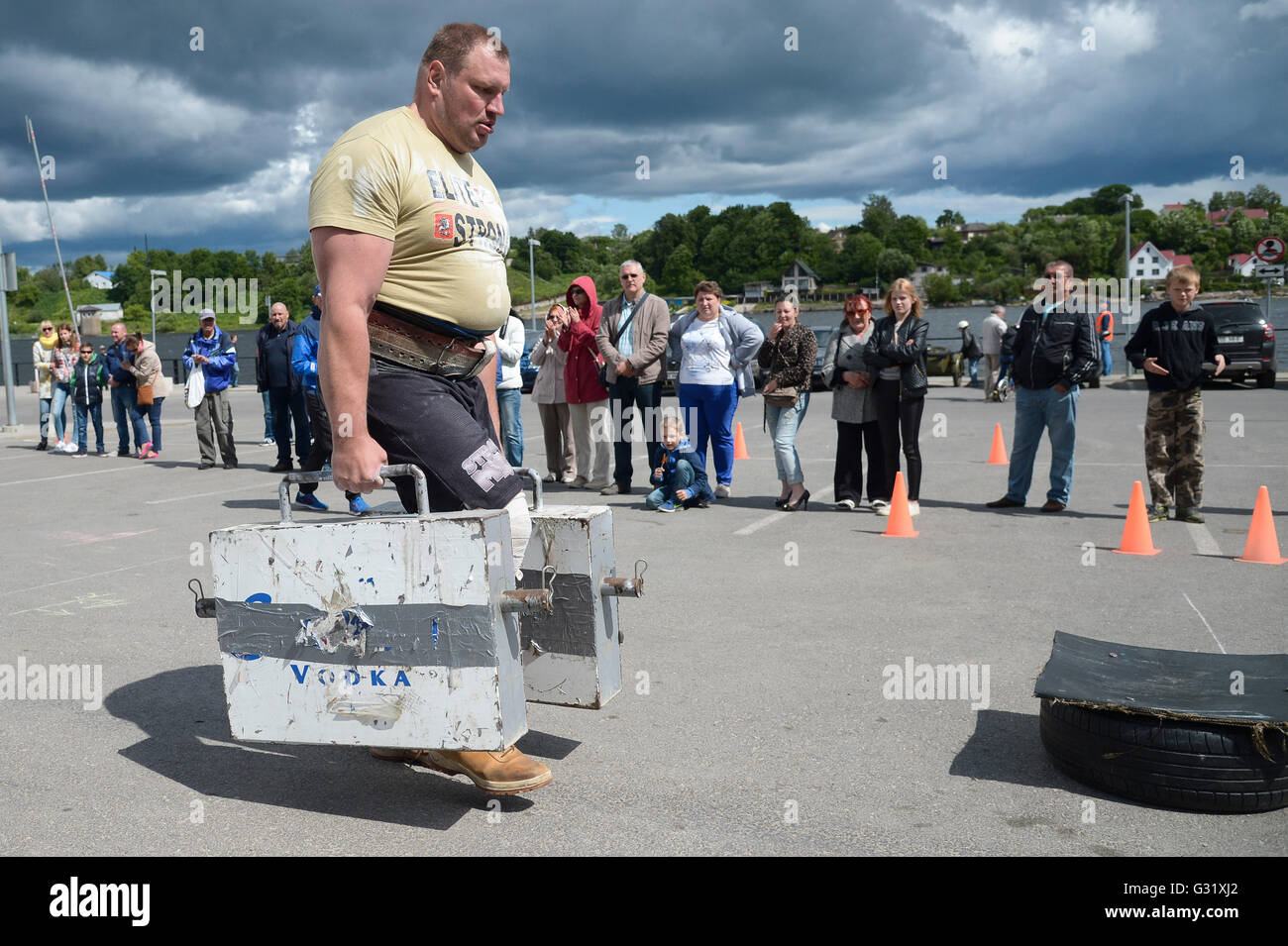
After the highly successful 2011 campaign, Mitt’s competition calendar became more fragmented but did not disappear. Strongman Archives lists him in 2012 at the WSF World Cup Uzbekistan, Elite Strongman Moscow and King of the Castle in Finland. In Moscow he finished fifth among fifteen athletes and won the Conan’s Wheel, another result supporting the view that moving events and prolonged loaded effort remained major strengths. He appears at the World Strongman Cup in Michalovce in 2013, at the WSF PROFORM Classic in 2015, and in 2016 produced one of the most significant results of his later open career: second place at the WSF World Cup India in Varanasi, behind Mark Felix and ahead of Mikhail Shivlyakov. The podium has particular value because of both the opposition and Mitt’s sporting age. He was nearly 39 and almost two decades removed from his first strongman contest. In a sport that places extraordinary stress on tendons, joints and the spine, remaining capable of an international podium after that length of time requires unusual robustness, technical efficiency and intelligent selection of effort. Press images from 2016 also show Mitt at an Estonian strongman competition in Narva carrying two 120 kg boxes, with contemporary coverage describing him as the winner. That result should not automatically be counted as a sixth Estonia’s Strongest Man national title because Mitt’s own website states a total of five Eestimaa Rammumees titles. The distinction illustrates a broader historical problem in strongman research: similar contest names, parallel promoters and incomplete local databases can create apparent contradictions. A careful profile should identify the Narva victory as a documented Estonian competition win without silently changing the athlete’s own national-title count. Across 2012–2016 the larger picture remains clear. Mitt no longer competed with the density of his World Strongman Cup years, but he retained enough ability for meaningful international results. During the same period coaching increasingly became part of the public professional identity. His current material describes a long coaching career, and SK Jõusport dates that work to 1997. The late open seasons therefore overlap with another role. Mitt was becoming both an aging professional competitor and a practitioner translating years of training, injury, travel and event experience into work with other athletes. The 2016 India podium is a useful endpoint for this phase because it shows that the transition toward coaching did not require an immediate disappearance from competition. He could still stand beside major names on an international podium nearly twenty years after beginning the sport.
Masters competition gave Mitt a final international stage on which two decades of experience could remain valuable without requiring him to face only athletes in the physical prime of their open careers. At the 2017 Ultimate Strongman Masters World Championships in Belfast, he finished second with 56.5 points behind Žydrūnas Savickas and ahead of Vidas Blekaitis. The quality of the names makes the placing significant, but the way he built the result is equally characteristic. Strongman Archives records Mitt winning the Flag Hoist, placing second in the Tire Flip, third in Atlas Stones, fourth in Duck Walk and fifth in the 130 kg Max Log Lift. He did not need to dominate every event; he reproduced the scoring pattern that had made him dangerous in the World Strongman Cup era: strong points from several sources, few disasters and enough versatility to remain in the overall contest. He returned to Belfast in 2018 and finished sixth. The program included Load & Drag, Truck Pull, Log Medley, Squat Lift and Power Stairs, and Mitt was third in Load & Drag and fourth in Truck Pull. In 2019 he finished ninth, but the contest supplied an almost cinematic final competitive detail: he won the Truck Pull in 33.38 seconds, fastest among the twelve Masters athletes. Strongman Archives treats the 26 May 2019 contest as his final listed international appearance. If that is the endpoint of his archival competitive record, the winning event is symbolically appropriate. Fifteen years earlier he was already winning truck pulls on European circuits; he won the event at Khanty-Mansiysk in 2007 and at Globe’s Strongest Man in 2011. At 42, he could still produce the best pull time in a field of experienced international veterans. The overall ninth-place finish simultaneously shows the reality of sporting age. Mitt recorded no valid lift in the Max Deadlift and placed near the bottom in the Truck Push. That mixture of limitation and excellence is more informative than a mythology of ageless invincibility. He was no longer the athlete who finished fifth at WSM in 2006, but he had retained enough event skill and conditioning to create world-class moments until the end of his international record. The 2017 Masters podium and the 2019 Truck Pull victory therefore close the competitive circle in a way that fits his entire career: through versatility, technique and longevity rather than one final maximal lift.
Viewed across hundreds of recorded event results, Mitt’s competitive profile is clearer than any simple list of gym personal bests. He was not primarily a specialist in one maximal lift. He was an all-round strongman who became especially effective when strength had to be translated into movement. Truck Pull may be the most persistent signature. Event archives identify him as the winner at WSMC Bad Häring in 2004, the Grand Prix of Khanty-Mansiysk in 2007, Globe’s Strongest Man in 2011 and the Ultimate Strongman Masters World Championships in 2019. Fifteen years separate the first and last of those event wins, an extraordinary span for the same movement family. Farmer’s Walk was another reliable strength. At Khanty-Mansiysk in 2007 he carried 140 kg per hand for 40 metres in 19.58 seconds. Atlas Stones complete the picture. Mitt won the stones at Khanty-Mansiysk, at the 2008 Sweden Grand Prix with five stones in 19.90 seconds and at the 2009 Globe’s Strongest Man with five in 14.40 seconds. He loaded all five stones in both the heat and final stages of the 2008 WSM. Such performances require more than back and hip strength. Efficient lapping, extension, platform placement, foot adjustment and the ability to preserve rhythm while fatigue accumulates are decisive. Keg Toss was another strong event: he won it at the 2008 Sweden Grand Prix with five 15 kg kegs over six metres in 31.59 seconds and also took first in his 2008 WSM heat. Grip endurance was publicly visible in the famous 2005 WSM Hercules Hold win and again in a second-place hold during the 2007 heats. Together, those results suggest a particularly useful strongman combination: powerful hands and forearms, strong hips, efficient footwork and good transitions. Relative weaknesses become more visible when contests move toward absolute maximal strength, where some rivals possessed greater static reserves. Even there, Mitt could produce high-level results, including the verified 175 kg log in 2006 and nine Axle Press repetitions in his 2008 WSM heat. His real value, however, was the sum. In a six- or eight-event competition an athlete who repeatedly finishes near the top in carries, stones and pulls can beat a specialist who wins one static lift and collapses elsewhere. Mitt’s career is a classic demonstration of that principle. Strongman is ultimately a points sport, and versatility becomes a form of strength in its own right.
Athletes from Mitt’s generation often have gym numbers and personal records that have been copied from profile to profile for years. For serious historical work, the key question is not whether those numbers are believable but whether they can be connected to a clear source. Historical profiles commonly credit Mitt with a 320 kg squat, 225 kg bench press and 335 kg deadlift. Those figures are entirely compatible with an elite strongman of his era, but they are not all attached to readily verifiable official meet sheets. They should therefore be presented as reported personal bests rather than certified competition records. By contrast, the 175 kg Max Log Lift at the 2006 Poland Grand Prix is documented in the full contest results, where Mitt tied Sebastian Wenta for the event win. His 140 kg-per-hand Farmer’s Walk over 40 metres in 19.58 seconds is indexed in Strongman Archives, as are numerous stone, pull and overhead results. This difference in evidence matters because historical strongman contains many technical grey areas. A stated implement weight may refer to the physical object, a nominal load chosen by the promoter or a mechanical system whose effective resistance is not directly comparable with a barbell. Hercules Hold machines, car deadlift frames and Viking Press levers can differ enormously. For that reason, simple cross-era comparisons should be treated cautiously. The 2005 Hercules Hold is a good example. Secondary profiles report 71.12 seconds with 200 kg per hand and describe the performance as a former world record, while archival event listings use different nominal weight conventions for that apparatus. The secure statement is that Mitt won the event; the spectacular apparatus number deserves qualification. The same methodology explains why this profile does not invent an exact bodyweight. His public sources do not provide a single sufficiently reliable number that can stand for a career lasting more than two decades, and a strongman’s bodyweight may vary substantially between seasons. An empty field is better than false precision. In Mitt’s case, the most convincing records are often not three powerlifting numbers anyway. They are repeated competition facts: four WSM finals, fifth in the world in 2006, season podiums in the World Strongman Cup, fast stone runs and truck pulls won across a fifteen-year span. Those numbers describe the athlete more accurately than an unsourced gym legend.
There is no publicly available complete training diary that would allow Mitt’s prime programming to be reconstructed with precision, and assigning him a specific methodology without evidence would be speculative. His athletic biography and current coaching description nevertheless support several careful observations. His foundation was deliberately broad: ten years of judo, strength work alongside combat training, then bodybuilding and powerlifting around his studies at the University of Tartu. That progression suggests he never separated muscle development, general strength, coordination and event practice into isolated worlds. Competition results support the same conclusion. An athlete able to score in Atlas Stones, Farmer’s Walk, Truck Pull, Axle Press and Keg Toss must train not only heavy lifting but power, conditioning, trunk stability, grip and implement technique. Longevity provides another lesson. More than twenty years separate Mitt’s 1997 debut and his last listed international appearance in 2019. In a sport with a high injury burden, that span implies the ability to modify preparation as age and injury history change. The 2007 biceps tear is the most visible injury episode, and his 2008 return shows that rehabilitation and rebuilding were successful enough for him to win a WSM heat and reach another final. SK Jõusport now describes Mitt as a coach in strength and muscle development, bodybuilding, weightlifting-related training, functional exercise and rehabilitation. The word rehabilitation is relevant, but it should not be used to invent a medical protocol that public sources do not provide. What can safely be said is that Mitt has personal experience of both elite performance and rebuilding after serious injury. For a coach, that practical experience has value that cannot be acquired from theory alone. The club also presents him working with beginners as well as experienced trainees, while its current Tartu program includes youth and older-adult groups. That points toward a broader concept of strength than elite strongman preparation alone. Across his life Mitt has encountered nearly every stage a strength athlete may face: technical formation, hypertrophy work, powerlifting, strongman specialization, international travel, major injury, comeback, age-related adaptation and Masters competition. Even without a published program, the career itself provides the professional context for the coach he is today.
The most readily verifiable part of Mitt’s current professional life is his coaching work. SK Jõusport lists him as a coach in Tartu leading group training and working on strength and muscle development for beginners and experienced athletes. The club mentions bodybuilding, weightlifting, functional training and rehabilitation among his areas, dates his coaching career to 1997 and identifies him as a University of Tartu physical education graduate from 2001. The Estonian Sports Register independently places Tarmo Mitt with MTÜ Jõusport Tartu in both powerlifting and weightlifting activities at the Riia 136A sports facility. This matters because it distinguishes current, documented professional activity from old biographical claims repeated on static athlete pages. Mitt is not simply a former champion who occasionally visits a gym. He remains institutionally connected to an active club and to organized groups of trainees. Jõusport’s current Tartu schedule includes youth groups and training for older adults, showing the broad population served by the club. It would be incorrect to assume that Mitt personally designs every program or that these sessions reproduce his old strongman preparation. What can be established is that his professional role now extends beyond a single elite-athlete profile. For a former WSM finalist, this continuity is especially valuable. Strongman creates a large body of tacit knowledge: how to position the hands on an awkward object, how to build grip, how to pace a multiple-event day, how to distinguish productive fatigue from warning signs, and how to reintroduce load after interruption. Some of this knowledge can be formalized, while some is transmitted far better through direct correction and demonstration. Mitt combines that practical history with university-level physical education and decades of coaching. His Masters career also means the experience is not frozen in the memory of 2005–2008. He had to adapt his own training to compete into his forties. In a sporting culture that often focuses on the moment of the podium, the career after the podium may be just as important. For Tartu, Mitt now represents that kind of continuity: a world-class athlete whose accumulated knowledge remained in the local strength community.
Researching Mitt’s personal life requires more restraint than researching his competitive record. Reliable public sources provide meaningful information about his city, athletic formation, university studies and coaching profession, but comparatively little verified material about family relationships or domestic life. A serious biography should not treat that absence as permission to speculate. What can be established is the depth of his connection to Tartu. A large part of his national career is tied to the city, he studied at the University of Tartu, he helped stage and then won the Tartu Strongman Open in 2010, and he currently coaches at SK Jõusport there. That continuity is probably the most significant publicly verifiable personal fact beyond his athletic history. Mitt’s own website is focused primarily on coaching, training experience and professional credentials rather than on private-life storytelling. His public identity therefore appears relatively reserved outside strength sport. This makes source discipline especially important. Aggregator pages and copied biographies sometimes repeat family claims that are not supported by primary material and in some cases do not align chronologically with publicly available dates. Such claims are excluded here. The personal story that can be documented is already substantial: a child who began judo at eight, remained in competitive judo for a decade, chose physical culture and strength sport at university, entered strongman at twenty, reached four consecutive World’s Strongest Man finals, recovered from a major biceps injury, continued winning international contests into his thirties, earned a Masters world runner-up finish at forty and kept working as a coach in the same city. That chronology reveals an unusual degree of professional continuity. It also explains why a profile does not need invented domestic detail to feel complete. In some lives, the consistency of choices says more than a collection of anecdotes. Mitt’s public identity has been built around strength sport, coaching and competition, and the relative privacy of everything outside that sphere should be respected. There is also a methodological reason for this restraint. Strongman history from the pre-social-media and early-social-media era is filled with athlete biographies assembled by copying one another, which allows an unsupported detail to become apparently authoritative simply because it appears on many pages. Repetition is not independent verification. For a profile intended to remain useful years from now, the boundary between known and unknown matters as much as the number of facts collected. Mitt’s early sport, education, professional trajectory and competitive history are richly documented. His private family life is not, and leaving it private is more accurate than manufacturing completeness.
Mitt’s legacy is best understood in the context of a country that has produced a remarkable number of strength athletes relative to its population. Estonia has repeatedly supplied international strongmen capable of winning major events, reaching world finals and becoming specialists in deadlift, grip or moving events. Mitt belongs to the generation that created much of that modern visibility. During his prime he competed in the same ecosystem as Andrus Murumets, one of the strongest and most gifted Estonian competitors of the era, while the late 2000s saw the emergence of Rauno Heinla, who would carry Estonian elite strongman presence forward for another decade and a half. Mitt’s victory at the 2008 Estonian Strongman Grand Prix ahead of Mikhail Koklyaev and Heinla can be read almost symbolically as an intersection between generations: the established WSM finalist still capable of defeating both a major international star and a younger compatriot who would become a future reference point. Statistically, Mitt’s case is straightforward. His own biography records five Eestimaa Rammumees titles and six Estonian powerlifting championships. Strongman Archives credits 75 international contests and eight wins, four WSM appearances with four finals, and a best WSM finish of fifth. He placed third overall in the 2005 World Strongman Cup and second overall in 2006, entering the last stage of that 2006 series as the points leader. Yet legacy is not only a sum of placings. Mitt competed during a fragmented era when IFSA, Strongman Super Series, World Strongman Cup, World Strongman Federation and other organizations overlapped. Athletes had to navigate changing calendars, invitations, technical standards and equipment. His results remain visible across many of those systems, which is evidence of adaptation rather than dependence on one promoter. Longevity adds another layer. From the first strongman contest he dates to 1997 to the 2019 Masters World Championships spans twenty-two years. Few careers maintain meaningful international relevance across that distance. Finally there is the local continuity of coaching, perhaps the least glamorous but most durable part of the legacy. Sport develops when international experience returns to the local training floor. Mitt did not merely represent Estonia abroad and then disappear from the system. He remained in Tartu, where his knowledge is now part of a functioning club environment. For younger athletes, that makes him more than a name in an old World’s Strongest Man table. He is part of the living transmission of Estonian strength culture. His legacy therefore has two directions: outward, through the years in which he represented Estonia on major international stages, and inward, through the decades in which accumulated experience remained available to the community that helped form him.
Reconstructing Tarmo Mitt’s career demonstrates why strongman history has to be written by overlapping several different kinds of evidence. For early personal history and athletic formation, the central source is Mitt’s own website, where he describes beginning judo at eight, competing for ten years, studying physical culture and heavy strength sports at the University of Tartu, moving through bodybuilding and powerlifting, entering his first strongman contest in 1997 and achieving his major career results. For his present professional role, the current SK Jõusport coaching page and the Estonian Sports Register provide stronger evidence than old athlete profiles: they place him in Tartu, identify his coaching activity and connect him with organized powerlifting and weightlifting work at the club. For competition chronology, Strongman Archives provides the most coherent backbone. It lists his date of birth, 1.94 m height, international activity from 2001 to 2019, 75 international contests, eight wins, four WSM appearances and finals, and a large body of event-level results. Historical World’s Strongest Man tables allow the 2005–2008 placements and heat context to be checked independently. IronMind is especially valuable for the 2010–2011 period because contemporary reports document the Belarus Strongman Cup, Tartu Strongman Open, Asian World Cup and BelAZ Strongman Cup close to the time they occurred, often with complete placings and comments from organizers. FitnessVolt provides detailed reconstructed score tables for contests such as the 2006 Poland Grand Prix, 2008 Sweden Grand Prix and Masters World Championships, and key figures can be cross-checked with Strongman Archives. Wikimedia Commons also preserves a clearly identified 2009 photograph of Mitt under a Creative Commons license, useful for visual archival context. When sources disagree, this profile follows a hierarchy: athlete or official institutional material for basic biography, contest results for placings and event performance, contemporary specialist reporting for context, and secondary summaries only when they add information that is clearly labeled as reported rather than certified. That is why the 320 kg squat, 225 kg bench press and 335 kg deadlift are stored as reported personal bests, while the 175 kg log from Poland in 2006 is treated as a verified contest performance. It is also why no exact bodyweight, personal coach or unverified social-media account has been invented merely to fill a database field. Historical completeness is not the same as filling every blank. A useful archive must preserve uncertainty rather than hiding it. Even under that conservative standard, Mitt’s documented record remains exceptionally rich: two decades of competition, four consecutive world finals, a genuine challenge for the overall World Strongman Cup title, major victories before and after his WSM peak, a Masters world podium and a professional life that continues on the training floor in Tartu. The evidence is more than sufficient to establish his place in strongman history without embellishment.
The quality of Mitt’s results becomes clearer when the opposition is considered. His prime overlapped with one of the deepest generations in strongman history. Mariusz Pudzianowski dominated much of the WSM landscape, Žydrūnas Savickas was becoming the defining static-strength figure of the era, and international fields repeatedly included Phil Pfister, Mark Felix, Terry Hollands, Jarek Dymek, Sebastian Wenta, Janne Virtanen, Magnus Samuelsson, Derek Poundstone, Andrus Murumets and Elbrus Nigmatullin. When Mitt finished fifth at World’s Strongest Man in 2006, the names around him were not secondary competitors filling out a final. They were athletes who would win major titles, set records and remain influential for years. The same is true of the World Strongman Cup, where Mitt had to collect points stage after stage against Pudzianowski and a rotating group of highly experienced Europeans. There is no need to invent personal rivalries where sources do not describe them. The sporting rivalry created by the standings is enough. Before the last 2006 World Strongman Cup stage, Mitt had 41 points and Pudzianowski 40. That simple table tells a powerful story: through consistency, the Estonian had reached the final confrontation of the season ahead of the era’s most famous strongman. Within the Baltic region, comparisons with Andrus Murumets and later Rauno Heinla provide a different perspective. Each man had a distinct competitive identity. Murumets was renowned for enormous raw power and exceptional event performances; Heinla became one of the most accomplished deadlift specialists of the following generation; Mitt built much of his success through versatility and point accumulation. Turning those differences into a simplistic ranking of the best Estonian strongman would ignore different eras, organizations and event sets. What is clear is that Mitt was one of the central links in that national continuity. He reached international podiums before the next generation’s media expansion, remained highly relevant during the Pudzianowski era, and later returned to share Masters fields with Savickas and Blekaitis. The breadth of that competitive window is part of the achievement. His résumé is not impressive because one opponent happened to be absent on one day; it is impressive because he repeatedly entered strong fields across many seasons and kept finding ways to score.
Part of Mitt’s success can be understood through the difference between being strong and knowing how to use strength on strongman implements. His results in stones, carries and pulls suggest high technical efficiency. In Atlas Stones, every lost second can come from slow foot positioning, a poor grip, an inefficient lap or an extension that fails to transfer force toward the platform. When Mitt loaded five stones in 19.90 seconds at the 2008 Sweden Grand Prix or in 14.40 seconds at the 2009 Globe’s Strongest Man, he was not merely performing five heavy lifts. He was connecting five complete technical cycles with almost no dead time. In Truck Pull, efficiency appears differently: body angle, stride length and frequency, the coordination of arms and legs and the ability to maintain tension through the harness can separate athletes whose raw strength is similar. Mitt’s Masters Truck Pull victory in 2019, more than two decades after his strongman debut, suggests that this technical skill survived better than some maximal-strength qualities. Keg Toss represents a third kind of efficiency: rapid force production and repeatable trajectory. Farmer’s Walk combines grip, posture and speed, and covering 40 metres with 140 kg in each hand in 19.58 seconds shows that Mitt was not merely carrying the weight but moving it competitively. These examples also illustrate how strongman data should be interpreted. A barbell record can be compared relatively cleanly. An implement performance only makes sense with distance, surface, shape and time attached. Mitt thrived in a sport where context matters. His judo background can be understood here not as a magical explanation but as early preparation for controlling the body under external force and reacting to imperfect positions. Powerlifting provided force reserve, bodybuilding supplied structural development and muscular capacity, and thousands of event-specific repetitions converted those qualities into contest technique. The completed profile therefore looks less like the product of one physical superpower and more like balanced athletic engineering. This balance helps explain why his best seasons were built on repeated high placings rather than a single world-record obsession, and why useful parts of his event skill remained competitive long after his absolute physical peak.
Continuity is the most useful word for summarizing Tarmo Mitt’s career. He began organized sport very young, stayed in competitive judo for a decade, moved through university study and multiple strength disciplines, entered strongman at twenty and reached international level without abandoning the professional path of coaching. He won five Eestimaa Rammumees titles, became a six-time Estonian powerlifting champion according to his own biography, built a Strongman Archives record of 75 international contests and reached four consecutive World’s Strongest Man finals. The 2006 peak, fifth at WSM and second overall in the World Strongman Cup, did not become the end of the story. After the 2007 biceps tear he returned to another world final; after leaving the WSM core he won again in Belarus, Tartu and Uzbekistan; after turning forty he reached a Masters world podium and continued winning individual events. Then the experience remained active through coaching. That sequence makes Mitt’s biography useful beyond nostalgia for 2000s strongman. It shows the difference between a career built around one result and a career built as a profession of life. In the first, the podium is the destination. In the second, the podium is one stage in a longer process that includes learning, adaptation, injury, comeback and the transfer of knowledge. Mitt clearly belongs to the second category. There is no need to exaggerate his records or invent private details to make the profile larger. The documented facts are already substantial: twenty-two years between the first strongman contest he reports and his last listed international appearance, four WSM finals, a genuine challenge for the overall World Strongman Cup title, victories across several organizations and an active professional role in Tartu. For Estonian strongman history, that is a body of work that cannot be ignored. For the wider history of the sport, Mitt remains a clear example of the complete strongman from an era before extreme specialization became increasingly common: statically strong enough, fast with implements, excellent in grip and pulling events, technically proficient on stones and above all capable of collecting points year after year. If one image best represents the career, it is not necessarily a single lift. It is the length of the road itself: from childhood judo mats to WSM platforms, from pulling enormous vehicles across Eastern European circuits to a Tartu training floor where the knowledge accumulated across those years is still being used by other people.
Iron Hall data
175 KG
Max Log Lift · 2006 Poland Grand Prix; tied for the event win with Sebastian Wenta
Verified
140 KG / HAND
Farmer’s Walk · 40 m in 19.58 s — 2007 Grand Prix of Khanty-Mansiysk
Verified
15 KG
Keg Toss · 5 kegs over 6 m in 31.59 s — 2008 Sweden Grand Prix; event winner
Verified
12.5 TONS
Truck Pull · 20 m in 35.61 s — 2007 Grand Prix of Khanty-Mansiysk; event winner
Verified
130 KG
Max Log Lift — Masters · 2017 Ultimate Strongman Masters World Championships
Verified
320 KG
Squat — reported personal record · Personal best reported by historical athlete profiles; not treated as a Strongman Archives competition record
225 KG
Bench Press — reported personal record · Personal best reported by historical athlete profiles; secondary-source figure
335 KG
Deadlift — reported personal record · Personal best reported by historical athlete profiles; secondary-source figure
1999
The first of the five national strongman titles listed in his career record.
Champion
2000
Champion
2001
Champion
2001
One of his earliest international podiums recorded by Strongman Archives.
3rd place
2002
2nd place
2003
Champion
2003
International victory in Finland.
Champion
2003
3rd place
2004
The fifth Estonia’s Strongest Man title in his published record.
Champion
2004
Champion
2004
Champion
2004
A third major European Cup-series win during the 2004 season.
Champion
2005
2nd place
2005
His first WSM final; he qualified second from his heat.
6th place
2005
His first season-long podium in the World Strongman Cup.
3rd overall
2006
The best World’s Strongest Man finish of his career.
5th place
2006
He entered the final stage of the season leading the overall standings.
2nd overall
2006
3rd place
2006
3rd place
2007
3rd place
2007
Won the Truck Pull and Atlas Stones and finished second overall.
2nd place
2007
Reached his third consecutive WSM final, but a biceps tear during the opening final event ended his contest.
10th / withdrew injured
2008
Won the Atlas Stones and Keg Toss events.
2nd place
2008
Won his qualifying heat and reached his fourth consecutive WSM final.
7th place
2008
Won ahead of Mikhail Koklyaev and Rauno Heinla.
Champion
2009
Finished second to Mariusz Pudzianowski and won the Atlas Stones.
2nd place
2010
Won with 45 points, one point ahead of Sergej Vachinsky.
Champion
2010
Organized by CBFSA in cooperation with Tarmo Mitt; Mitt won the contest.
Champion / co-organizer
2011
Won the opening stage of the Asia World Cup series.
Champion
2011
2nd place
2011
Champion
2011
Won the contest staged at the BelAZ factory in Belarus.
Champion
2016
Finished behind Mark Felix and ahead of Mikhail Shivlyakov.
2nd place
2017
Masters world runner-up behind Žydrūnas Savickas with 56.5 points.
2nd place
2018
6th place
2019
His final international appearance listed by Strongman Archives; he won the Truck Pull in 33.38 seconds.
9th place