
2010
Strongman Codlea
Urdea identifies this event as his strongman competition debut, following roughly four years of strength training.
Competition debut
Romanian strongman and author of thrillers, fantasy and nonfiction
Active athlete
Silviu Nicolae Urdea is one of the few Romanian athletes to have built a public identity in both strongman and literature. Born in Brașov on 29 January 1992, he began strength training in adolescence, identifies 2010 as his strongman competition debut and 2013 as the beginning of his international career in Reno, Nevada. He later competed in Strongman Champions League events, with documented appearances in Plovdiv, Brașov/Ghimbav and Esposende, while his athletic profile became particularly associated with the deadlift, Farmer's Walk, log lift and pulling events. Away from the arena, Urdea published four novels, ranging from the thrillers “Suflet pierdut” and “Nu mă tem” to the fantasy series “Războiul Legendelor”, and in 2026 prepared the motivational book “De la «poate cândva» la «încep azi»”. Strength and writing are not separate careers in his story, but two expressions of the same discipline: one measured in kilograms and metres, the other in pages, characters and imagined worlds.
Silviu Nicolae Urdea was born in Brașov, Romania, on January 29, 1992, and his public life has gradually come to revolve around an unusual but coherent pair of disciplines: strongman and writing. From the outside, they seem to occupy opposite ends of the spectrum. Strongman is loud, physical, immediate and measurable. It deals in steel, awkward objects, chalk, straps, breathing under load and a clock that does not care how much pain an athlete is in. Writing is quieter. It unfolds through sentences, drafts, rewrites, atmosphere and long periods in which the only visible movement is the hand across a keyboard. Yet the two worlds demand a surprisingly similar quality: endurance. One teaches a person to return to the bar, the farmers handles or the harness after failure. The other teaches a person to return to a page after a weak chapter, a rejection or a revision that forces the work to be rebuilt. Urdea’s identity makes sense when viewed through that shared idea. He is not simply a strength athlete who happened to publish books, nor merely an author with a spectacular sporting hobby. He has spent close to two decades developing both sides of the same instinct: to test a limit and keep working after the first answer is “not yet”.
His first steps in a strength gym came around the age of fourteen, approximately in 2006. He has repeatedly described a childhood fascination with lifting heavy things and with the idea of becoming stronger than the version of himself that existed the day before. Sport was not entirely foreign to his family. A Radio România Oltenia-Craiova profile noted that his father had practiced weightlifting and his mother athletics. For a tall teenager watching the world’s strongest men on television, particularly on Eurosport, strength sports offered both spectacle and direction. By eighteen, around 2010, Urdea had entered performance strongman, and he identifies a competition in Codlea as his competitive debut. The Romanian scene at that time was still small and fragmented compared with established strongman cultures in the United Kingdom, Scandinavia, the United States or parts of Central and Eastern Europe. Equipment was less accessible, competitions were fewer and an athlete often had to help explain the sport to the public before he could explain his own result.
That early environment matters because strongman does not reward specialization in a single conventional lift. It demands a broad physical vocabulary. An athlete may need to deadlift one event, carry enormous implements in the next, press a log overhead, pull a truck, load stones, walk with a yoke, hold a grip apparatus or complete a medley while exhausted. Urdea developed in a period when Romanian athletes often had to improvise equipment and learn through direct competition experience. A barbell can build the foundation, but a barbell does not teach the swing of farmers handles, the instability of a yoke or the breathing pattern of a truck pull. Each contest becomes a practical classroom. The athlete discovers which part of the back gives way first, whether the grip survives long enough, how quickly the feet can move under compression and whether technical efficiency remains intact when fatigue begins to distort movement.
A recurring element in Urdea’s interviews is the appeal of challenge itself. In a 2018 conversation with 24Fun Brașov, he recalled watching elite strongmen and asking himself why he could not attempt the same world. That interview contains a sentence that summarizes the chronology of his double career: “At 18 I started performance sport, and at 20 I started writing.” The two paths began almost at the same time. Rather than competing for identity, they became mutually reinforcing. Training provided a very concrete relationship with discipline, repetition, failure and recovery. Writing offered a space in which value was not measured by kilograms, meters, seconds or placings. In 2024, when Gazeta Sporturilor published an extended profile of him, Urdea condensed that relationship into another short phrase: “Sport and writing balanced me.” The remark is useful because it avoids the easy journalistic cliché that his two worlds are contradictory. For him, they function as counterweights.
International databases generally list Urdea at 1.93 meters and around 130 kilograms, although a 2018 local interview placed him at approximately 144 kilograms during that period. The difference is normal in strongman. Bodyweight changes with competition phase, strategy, injury, recovery and training priorities. What remains consistent is the physical type: a tall, heavy open-weight athlete built for events in which static strength must be combined with movement. His profile is not that of a lifter defined by only one exercise. His declared personal records span pressing, squatting, deadlifting, rowing and carrying. They include a 360-kilogram raw deadlift, a 320-kilogram raw squat, a 190-kilogram bench press, a 185-kilogram incline bench press, a 165-kilogram seated shoulder press, a 155-kilogram clean and press and a 150-kilogram log for two repetitions. On the moving side, he lists farmers carries exceeding 200 kilograms per hand. This range is the grammar of strongman: the body must be prepared not only to move a maximum load once, but also to travel with it, stabilize it and repeat efforts across an entire contest.
Urdea has also spoken publicly about a misconception that follows very large strength athletes, particularly in countries where strongman remains a niche sport. A massive body is often lazily associated with aggression. He has argued that the sport is almost the opposite of that stereotype. Strongman can be brutal, but the brutality is directed toward the athlete’s own limits rather than toward an opponent. There are no punches and no tactical attempts to injure another competitor. The enemy is the weight, the distance, the next clock and the athlete’s own ability to continue. That distinction is significant in his public image. It is also one reason the writer-athlete contrast has received so much attention. A man who can pull a truck or deadlift hundreds of kilograms is expected, in a shallow stereotype, to be uninterested in literature. Urdea turned that surprise into part of his public signature.
By 2026, when he describes himself as having spent roughly twenty years in sport, the separate episodes of his life form a clear line. The teenage gym, the first strongman contest, national competitions, an international debut in the United States, Strongman Champions League appearances, injuries, returns, spectacular demonstrations, television exposure and four published novels no longer look like unrelated ventures. They read as chapters in a single biography. Some athletes are remembered through one result. Urdea is more accurately understood through continuity. He remains recognizable in a photograph with farmers handles in his hands and on the cover of a novel. That double recognizability is the central feature of his profile.
Urdea’s early years in strongman unfolded in a Romanian environment that required considerable self-reliance. The sport was present, but the infrastructure was nowhere near the level of the major international scenes. For a young athlete, learning often meant borrowing ideas from powerlifting and weightlifting, constructing or adapting event equipment and using competition itself as technical education. Strongman implements are unforgiving because their awkwardness is part of the challenge. A log has diameter and a different center of mass from a barbell. A yoke compresses the athlete and swings with each step. Farmers handles can rotate and rip the hands open. Stones punish poor positioning. A vehicle pull exposes inefficient footwork immediately. Entering this sport at eighteen meant learning more than how to become strong. It meant learning how to express strength through unstable, imperfect and often unfamiliar objects.
Urdea identifies 2010 in Codlea as the start of his competition career. From there, he accumulated national appearances and developed the event literacy needed to progress. One important milestone appears in his own 2018 account, where he says that in 2013 he finished second in a contest for the title of Romania’s strongest man. The same year is independently important because he appeared at Strongman Mamaia, a competition featuring athletes such as Alexandru Arginteanu, Paul Pîrjol, Claudiu Holeleu, Vladimir Comorovschi and competitors from the Republic of Moldova. The event menu gives a vivid picture of the Romanian scene of that era: keg toss over a 5.40-meter bar, Power Stairs with 220- and 240-kilogram implements, a 180-kilogram Husafell stone combined with duck walk, car deadlift and natural stones weighing between 85 and 130 kilograms. Such a contest tests almost every part of an athlete’s development and leaves little room to hide a weakness.
For a young strongman, these national events were more valuable than abstract training theory. Each event gave feedback that a normal gym session could not. A slow pick on the farmer’s walk showed where time was being lost. A Husafell carry exposed breathing and torso limitations. Natural stones punished imperfect lap technique. Power Stairs demanded not only back and leg strength but repeated explosive positioning. The sport’s diversity forces the athlete to develop a broad body intelligence. Urdea’s later personal records suggest that he responded by building a very strong posterior chain and grip, two qualities that became visible in his better competitive performances.
The year 2013 also marks the international debut Urdea himself considers decisive. He places it in Reno, Nevada, United States. In later interviews he described the trip as an experience that changed the way he saw the sport and motivated him to continue. The importance of Reno lies partly beyond a single placing. For a Romanian athlete traveling to the United States, the difference in sporting ecosystem could be dramatic. There were more promoters, more contests, more specialized gyms and a larger audience that already understood the vocabulary of strongman. In Romania, an athlete might have to explain what a log lift was before discussing the result. In an established strength environment, the public already knew why ten meters with farmers handles could matter as much as a maximal deadlift. The trip therefore functioned as a form of confirmation: strongman could be more than a local passion.
Static strength formed the base of Urdea’s development. The central number in his deadlift profile is 360 kilograms without a suit. He also reports two repetitions with 330 kilograms, three with 320 and five with 300. On a two-plate setup he lists 360 kilograms and two repetitions at 340. From above the knee, in a partial pull, he reports five repetitions with 380 kilograms without a suit. His squat record is 320 kilograms raw. These numbers matter because strongman events are not built in isolation. A heavy yoke depends on squat-like leg and trunk strength. A farmer’s walk requires the body to stand up with a massive load before the athlete can move. Stones demand hip extension. A log press begins with a clean that is often closer to a complicated full-body pull than to a conventional shoulder exercise.
His pressing records show the same foundation: a 190-kilogram bench press, a 185-kilogram incline bench, a 165-kilogram seated shoulder press and a 155-kilogram clean and press. He lists a 150-kilogram log for two repetitions. The log is a particularly revealing implement because it demonstrates how different strongman can be from standard gym lifting. The object sits far from the body, its diameter changes the clean, breathing becomes difficult at the chest and the press requires a combination of timing, leg drive, triceps strength and balance. An athlete may own a strong bench press and still struggle with a log if technique and positioning are poor. Urdea’s ability to handle 150 kilograms for repetitions reflects years of specific overhead work, even if some international contests exposed overhead as a less consistent area compared with his pulling and carrying.
His heavy rowing numbers are equally informative. He reports four repetitions with 230 kilograms in a rack-style barbell row using straps, eight with 180 kilograms from supports without straps, four with 200 kilograms from the floor without straps and five one-arm dumbbell rows with 105 kilograms without straps. Heavy rows rarely become headline strongman events, but they help explain why an athlete can stabilize a farmers carry, hold posture under a yoke or keep a log secure on the chest. Strongman rewards an upper back that remains rigid while the rest of the body moves aggressively. Grip is even more decisive. If the hands open, the event ends regardless of how strong the legs are.
Urdea’s farmers carry numbers are among the most striking in his personal record list. He reports 202 kilograms per hand without straps for approximately six seconds, 172 kilograms per hand over ten meters and 200 kilograms per hand with straps over eighteen meters. He also lists a competition performance of 60 meters with 150 kilograms per hand. The last figure aligns with his documented 60-meter farmer’s walk at the 2018 Strongman Champions League Romania, where the distance placed him third in the event. Farmers walk is often misunderstood as a simple test of grip. In reality it is a sprint performed while the body is being pulled apart. The athlete must pick cleanly, accelerate without allowing the implements to swing, stabilize the torso and continue breathing as the hands and forearms begin to fail. Urdea’s profile suggests that this combination suited him.
His descriptions of training also fit the classic strongman cycle. In an off-season period he has spoken about training four to five times per week, emphasizing basic strength movements, then adding event-specific work and greater intensity as competition approaches. In the 2018 24Fun interview he mentioned a daily energy intake around 5,000 calories as a minimum for his needs, with an emphasis on quality foods and avoidance of excessive processed food, very fatty products and sugars. Such intake numbers should be understood in the context of a 130- to 140-kilogram athlete performing high-volume strength training. Strongman must balance mass and power against the need to move. Excess bodyweight can help certain static events but hurt carrying speed, conditioning and recovery.
Injury is inseparable from long-term strongman. Urdea’s 2016 Strongman Champions League Bulgaria appearance is the clearest example in his public record. He later explained that he was injured during the competition. The results show that he still recorded 28.33 seconds in a 160-kilogram farmer’s walk and 32.17 seconds in the front hold, but several other events produced zero scores or incomplete outcomes. In a points-based sport, a single zero can destroy a good placing; multiple zeroes make recovery in the standings almost impossible. The final result, twelfth, makes more sense when read with that context. The episode also exposes a basic truth about the sport: a competitor may look indestructible, but one irritated tendon, biceps, back, knee or ankle can turn an entire contest into damage control. Urdea’s later return to SCL competition shows that the injury did not end his involvement.
The decisive step into professional international strongman came in 2015 when Urdea entered the Strongman Champions League event in Plovdiv, Bulgaria. The field contained ten athletes and six events. The names around him included Hafthór Júlíus Björnsson, Krzysztof Radzikowski, Stoyan Todorchev, Matjaž Belšak and Ervin Katona. This was not a soft introduction. Björnsson won the competition and Radzikowski finished second. Urdea placed seventh with 18 points. Stripped of context, seventh may look modest. Restored to context, it becomes a meaningful debut for a Romanian athlete entering a global series against men who were already established at the highest levels of the sport.
The event breakdown tells more than the final table. Urdea loaded one Atlas Stone in 10.15 seconds, completed 700 degrees on Conan’s Wheel, carried the farmers implements 11.5 meters and moved the super yoke 10.2 meters. He did not score on the deadlift or log lift in that particular setup. Strongman careers are often built through exactly this kind of uneven contest. A young athlete discovers which events survive international loading and which do not. The jump from national level to a professional series is not merely a matter of adding kilograms. Equipment can be different, refereeing stricter, transitions faster and the entire competition pace more demanding.
Plovdiv 2015 also carried symbolic value for Urdea because it connected the teenager who had watched strongman on television with the reality of sharing a competition field with one of the sport’s biggest stars. In the 2018 24Fun interview he specifically mentioned competing with Hafthór Björnsson, who would later become World’s Strongest Man and gain enormous mainstream recognition through “Game of Thrones”. Encounters like this have an almost initiatory quality for athletes from smaller strength markets. You no longer see the elite through a screen. You see how they warm up, how they choose attempts, how little energy they waste and how quickly they move between technical phases of an event. The distance between admiration and participation becomes measurable.
In 2016 he returned to Plovdiv for another SCL Bulgaria event. The field expanded to twelve athletes and the event set included front hold, farmer’s walk, log lift, super yoke, Conan’s Wheel and Hercules Hold. Urdea finished twelfth with 12 points after the injury he later described. Even inside that difficult result there were competitive moments. His 28.33-second farmer’s walk with 160 kilograms earned eight points, and his 32.17-second front hold earned four. The rest of the contest collapsed around injury and zeroes. The episode is useful when interpreting strongman standings. Unlike a sport built around one final, strongman accumulates points across several unrelated tasks. A competitor can be excellent in two events and still finish last if the body fails in the others.
The 2018 Strongman Champions League Romania in Brașov and Ghimbav became the most cinematic competition of Urdea’s career. The event was connected to the local Oktoberfest celebrations and included a “chopper pull”, promoted locally as a world premiere involving the pulling of a helicopter. For Urdea, a Brașov athlete representing Romania in an international contest at home, the competition carried a different emotional weight. He was no longer traveling as an outsider to Plovdiv; the global series had arrived in his city. The final standings placed him eleventh of thirteen, but the event-by-event results contain two of the strongest competitive performances in his public record.
In the deadlift, Urdea completed seven repetitions and tied for fourth place in the event. Only the very top performers were ahead of him. In the farmer’s walk, he covered 60 meters and placed third. Those two results reveal his profile far more clearly than the overall eleventh place. Strongman rewards consistency across all events, but an athlete’s strengths can still emerge inside a lower final ranking. Seven deadlift repetitions against a field that included Aivars Šmaukstelis, Krzysztof Radzikowski, Travis Ortmayer and other experienced international athletes showed serious pulling capacity. The 60-meter farmer’s walk demonstrated movement and grip under load.
The chopper pull itself produced one of the images that followed Urdea beyond the competition table. He completed the pull in 26.46 seconds. That result was only twelfth in a fast field, but the spectacle of a strongman dragging a helicopter has a cultural power that a normal score sheet cannot reproduce. In his later Gazeta Sporturilor interview, Urdea described the mental state of such a pull as almost empty of reflection: during the effort there is no room for emotion, only the task. The feelings come afterward. That observation is characteristic of high-intensity strength events. Spectators see drama; the athlete experiences a narrow tunnel of technical cues, breath, traction and movement.
He also scored seven deadlift repetitions and 44.31 seconds in the front hold at the same 2018 contest. These performances matter because they illustrate versatility. The deadlift is dynamic strength repeated under fatigue. The front hold is essentially an endurance battle in which the shoulders and upper back burn while the object remains visually motionless. Farmer’s walk adds speed, grip and balance. Chopper pull adds traction and rhythm. One competition asked his body to solve four entirely different problems. That diversity is the core reason strongman careers cannot be understood through gym personal records alone.
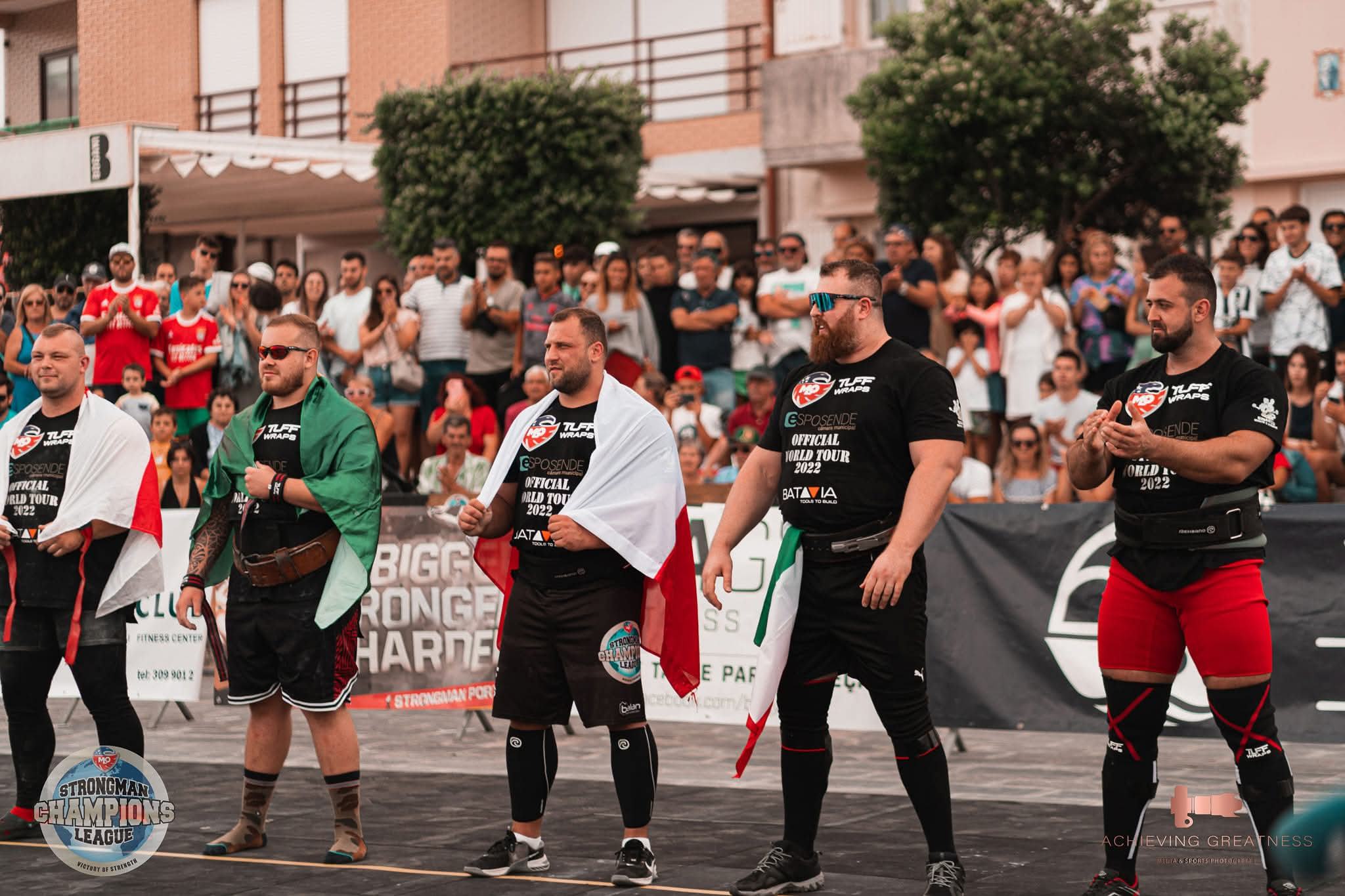
After 2018, the next international SCL appearance recorded in major databases came in 2022 at Esposende, Portugal. Urdea finished tenth of twelve with 24.5 points across five events: deadlift, frame carry, log lift, Conan’s Wheel and medley. He traveled 23.5 meters on Conan’s Wheel, good for seventh in the event, and completed four repetitions in the deadlift, also a shared seventh-place performance. The medley was less successful, with one flip recorded. Returning to an international series after several years is significant because strongman evolves quickly. Equipment standards, field depth and athlete specialization change, and the body itself is different after years of accumulated training and injuries.
The 2022 appearance also corrects a misleading impression that can come from online databases. Strongman Archives lists four international contests for Urdea between 2015 and 2022, but that does not mean he only competed four times in his life. It means those are the international competitions captured by that particular database. His actual competitive history includes national events, Strongman Mamaia appearances, demonstrations and other contests reaching back to 2010. Romanian strongman history is incompletely digitized. Many local results survive only in newspaper archives, social media posts, photographs or the memories of the athletes. A serious profile must therefore distinguish between “four recorded international SCL competitions” and “four total competitions”. The latter would be false.
National strongman remained an important part of his development. He appeared at Strongman Mamaia in 2013 and again in 2015, competing against athletes from Romania and the Republic of Moldova. He also speaks of multiple domestic events before and between the international appearances. This broader activity matters because the skills seen in SCL were built in those less documented contests. Before an athlete can carry farmers handles sixty meters against international opponents, he has to spend years learning how to pick, turn and accelerate in smaller venues. Before a helicopter pull becomes a headline, there are dozens of ordinary training sessions with sleds, ropes, harnesses and vehicles.
The contest record therefore suggests a career defined less by titles than by persistence and representation. Urdea was not a World’s Strongest Man finalist and should not be presented as one. Some low-quality online databases have attributed fictional WSM placings and exaggerated lifts to him; those claims conflict with established competition records and should be ignored. His real history is strong enough without inventions. He represented Romania in the Strongman Champions League, placed seventh in his 2015 SCL debut, returned through injury, competed at home in 2018 with excellent individual-event results and appeared again in Portugal in 2022. Accuracy makes the story more interesting, not less.
The deadlift sits at the center of Urdea’s strength identity. His declared best of 360 kilograms without a suit is the number most likely to catch attention, but the repetition work around it may be even more informative. Two repetitions at 330, three at 320 and five at 300 indicate a capacity to maintain force beyond a single maximal attempt. This matters in strongman because deadlift is frequently contested for repetitions rather than for a one-repetition maximum. A competitor who can pull one enormous weight may still lose to an athlete who can repeat a slightly lighter load under a one-minute clock. Urdea’s seven-repetition performance at SCL Romania 2018 gives competition evidence for this kind of strength endurance.
He also lists 360 kilograms on a two-plate deadlift variation and two repetitions at 340, plus five repetitions at 380 kilograms from above the knee. Partial pulls must be interpreted carefully because range of motion changes the meaning of the number, but they are a standard tool for strongmen preparing for elevated or apparatus-based deadlifts. The point is not to compare a partial pull directly with a full floor deadlift. The point is to build lockout strength, upper-back rigidity and familiarity with massive loading. Strongman event organizers frequently alter the mechanics of a pull. The athlete who only trains a standard bar from the floor may be technically strong but strategically underprepared.
The 320-kilogram raw squat provides the other major static foundation. Squat itself is not present in every strongman contest, but lower-body strength transfers almost everywhere. A yoke requires the athlete to stand up under an enormous axial load and then move. A farmer’s carry begins with a deadlift and immediately becomes a sprint. A log press needs leg drive. Atlas Stones depend on powerful extension through the hips and knees. Strong legs also protect the rest of the body by reducing the need to compensate with the lower back. For an open-weight strongman, a large squat is less a specialized goal than infrastructure.
Urdea’s pressing profile shows similar variety. He reports a 190-kilogram bench press and 185-kilogram incline bench, numbers that demonstrate substantial horizontal pressing strength. More specific to strongman are the 165-kilogram seated shoulder press, 155-kilogram clean and press and the 150-kilogram log for two repetitions. Overhead events are technically sensitive. A log must be cleaned from lap to chest, stabilized while breathing becomes restricted and then driven overhead under a clock. The implement’s diameter changes posture and makes the movement less forgiving than a standard barbell. Urdea’s 150-kilogram double is therefore an important benchmark even though international competition overhead results were more variable.
Farmer’s walk may be the event most representative of his strongman style. His self-reported best of 202 kilograms per hand without straps for roughly six seconds suggests enormous pick and grip strength. He also reports ten meters with 172 kilograms per hand and eighteen meters with 200 kilograms per hand using straps. His competition figure of sixty meters with 150 kilograms per hand corresponds to the 2018 SCL Romania result in which he placed third in the event. The farmer’s walk is a deceptive test. It looks simple because the athlete is “only walking”. In reality every part of the body is active. The grip crushes inward, the traps suspend the load, the torso resists lateral movement, the hips accelerate and the feet must remain precise enough to avoid a catastrophic swing.
The rowing records are unusual enough to deserve attention. Urdea reports four repetitions at 230 kilograms from supports using straps, eight at 180 without straps from supports, four at 200 from the floor without straps and five one-arm dumbbell rows with 105 kilograms without straps. Heavy rowing helps create the back that strongman events demand. The lats, traps, rhomboids, spinal erectors and grip musculature must work together under awkward forces. A stone is not balanced. A yoke oscillates. Farmers handles try to pull the shoulders down and outward. A truck pull demands that the upper body transmit force through a rope or harness without collapsing.
Truck pull, tire movement and chopper pull belong to a different category from gym lifts because they convert strength into traction. Urdea has spoken about pulling trucks and about demonstrations in which several strongmen tried to prevent a powerful car from moving. In the 2018 SCL Romania chopper pull, the visual object was an actual helicopter. Such events create the mythology of strongman. A 360-kilogram deadlift is impressive but abstract to a general audience that does not know the meaning of the number. A man pulling an aircraft is instantly understandable. It translates extreme strength into a picture.
Technically, vehicle pulls are complex. The first meter can be the most difficult because the athlete must overcome inertia. Body angle, shoe traction, rope technique and the timing of each step matter. Once the object begins moving, the task changes from initiation to maintaining rhythm. A lapse in cadence can allow the vehicle to slow and turn every subsequent step into a fight. The event is therefore both strength and conditioning. A powerful but poorly conditioned athlete may start violently and die halfway. A technically efficient athlete can preserve momentum. Urdea’s experience with these events added to his reputation as a strongman capable of spectacular demonstrations as well as conventional contest lifts.
Strongman also forces the athlete to accept that personal records are not always portable into competition. A 150-kilogram log in training may feel very different after a deadlift and a carry on a hot outdoor stage. A farmer’s pick can become harder when the handles are wider. An unfamiliar yoke may swing differently. A deadlift apparatus can have more flex or a different starting height. The best strongmen are not simply the strongest gym lifters; they are adaptable problem solvers. Urdea’s international results show both the strengths and the limits of that adaptability. On favorable events he could place near the front of an international field. On others he could lose substantial points.
This is why a profile built only around numbers would miss the essential character of his sporting life. The 360-kilogram deadlift, 320-kilogram squat, 150-kilogram log double and 200-plus-kilogram farmers are important, but they are snapshots. The real strongman skill lies in moving between incompatible demands. A front hold burns the shoulders without movement. A farmer’s walk demands acceleration. A deadlift requires repeated maximal tension. Stones need technique and aggression. A truck pull asks for rhythm. One contest can contain all of them. Urdea spent years developing enough breadth to stand on international platforms where that diversity was expected.
Silviu Urdea began writing seriously around the age of twenty, and the first project to become a published book was “Suflet pierdut” (“Lost Soul”). The novel appeared in 2014 through the Herg Benet/Karth publishing sphere, carries ISBN 978-606-93658-5-4 and is generally listed at 288 pages. Its premise begins with grief. Mihail, deeply in love with Emma, learns that she has died in a strange car accident. The event does not remain a simple tragedy. As he begins to investigate, a pattern of mysterious disappearances appears around the case, and the story moves toward the identity of a figure connected with a ghost-like vehicle. Together with close friends and Inspector Constantin, Mihail enters an investigation in which love, fear and violence begin to overlap.
The novel’s central question is not simply “who did it?” but what catastrophic loss does to identity. How much of a person remains stable after the future they imagined disappears in a single morning? This interest in people forced into extreme conditions becomes a recurring element in Urdea’s fiction. The forms change, but the structure returns: a character is pushed outside normal life and must respond under pressure. In “Suflet pierdut”, the pressure is grief and investigation. The book also established Urdea’s attraction to dark atmosphere and psychological instability, elements that would become even more pronounced in his second novel.
“Suflet pierdut” is important biographically because it proved that writing was not a decorative hobby. Urdea finished and published a novel while his strongman career was also developing. The timing is striking. The book arrived only a year after the international debut he places in Reno and during a period in which he was trying to move from Romanian competitions toward the professional international scene. The disciplines demanded incompatible schedules but similar persistence. Training can be skipped once and recovered. A novel abandoned at chapter eight never becomes a book. Publication required long-form commitment.
Reception was mixed, as is common with a debut, but the book established a readership and remains documented across Goodreads, Libris, Cărturești and second-hand booksellers. Goodreads lists it as one of Urdea’s four distinct works. Libris preserves the bibliographic details even when stock changes, while second-hand retailers periodically list copies. For readers looking for the book today, useful pages include https://www.libris.ro/suflet-pierdut-silviu-urdea-kar978-606-93658-5-4.html and https://www.printrecarti.ro/304070-silviu-urdea-suflet-pierdut.html. Availability naturally varies because the title is more than a decade old.
The second novel, “Nu mă tem” (“I Am Not Afraid”), published by Libris Editorial in 2016, is the work that most clearly established Urdea as a psychological-thriller writer. The book has 286 pages and ISBN 978-606-8814-11-7. Its premise is claustrophobic. Filip, an amnesiac, wakes in a room with almost no understanding of who he is or why he is there. He is controlled by Ihrin, a disturbing woman who claims to be treating him, and the atmosphere is complicated by Tăciune, her aggressive and grotesquely comic cat. The setup removes the protagonist’s ordinary sources of certainty. Memory cannot be trusted. The person offering “care” may be torturer, doctor or manipulator. Voices and fragments of recollection push the reader into the same unstable position as the character.
A review in Revista de Suspans highlighted the construction of the characters, the accessible but figurative language and, especially, the controlled distribution of mystery. The action is tied to Brașov, allowing familiar local geography to coexist with a story of confinement and psychological uncertainty. This use of place is important in Urdea’s fiction. Brașov is not merely a birthplace in the author biography; it becomes part of the emotional texture of the work. A reader who knows the city can recognize the environment while entering a narrative that makes ordinary locations feel unstable.
Commercial descriptions of “Nu mă tem” were strongly promotional. On the Libris page, writer Luca Dinulescu compared Urdea’s dark atmosphere and damaged characters to the tradition associated with Stephen King. Such comparisons should be understood as marketing and critical enthusiasm rather than objective equivalence, but they reveal the category in which the book was being positioned: psychological thriller, horror-inflected suspense and dark fiction. The novel also brought Urdea greater media exposure. In January 2017 he launched it in Craiova at the “Traian Demetrescu” Cultural House, in an event moderated by Cornel Mihai Ungureanu. The following month Radio România Oltenia-Craiova invited him to “Pulsul Zilei” to discuss both strongman and writing.
The current Libris product page remains one of the clearest places to find bibliographic details and, depending on stock, purchase the book: https://www.libris.ro/carte/nu-ma-tem-silviu-urdea/1072806. At the time of research, the title was shown as available. The same page includes editorial endorsements and a sample, making it useful both as a sales page and as a record of how the book was originally presented.
After two relatively contemporary dark novels, Urdea changed scale with “Războiul Legendelor” (“War of the Legends”), a fantasy project published in two volumes by Editura Paralela 45 in 2019. The first book, “Regele fugar” (“The Fugitive King”), carries ISBN 978-973-47-2954-8 and is listed at 248 pages. Its premise moves away from a recognizable present into an alternative world where dinosaurs never disappeared and political powers fight over territory, law and a form of potentially catastrophic magic preserved in parchments. The Regatele de Vest and Imperiul Eternității compete for control, and defeated factions face submission, exile or extinction.
The scale of the project is reflected in the cast. Names such as Amon, Aredhel Aldarion, Kinnunen, Shiva, Charlemagne, Nil and Uziwood inhabit a world structured around kingdoms, loyalties, hidden agendas and war. Urdea’s ambition here was clearly different from the tightly contained psychology of “Nu mă tem”. Fantasy requires worldbuilding: geography, political systems, history, mythology, rules and continuity across many characters. The novel represents an attempt to sustain a much larger fictional architecture.
“Regele fugar” produced sharply divided reactions. Commercial descriptions emphasized suspense and the ambition of the imagined world, while some reviews within the Romanian SF&F blog community were highly critical of prose execution, consistency and editorial polish. A serious profile should not hide that contrast. Reception is part of an author’s history. The move from a compact thriller to an epic fantasy exposes a writer to different standards and to readers with very specific expectations about worldbuilding and language. The fact that Urdea completed the two-volume project in the same year nevertheless demonstrates persistence. A difficult reception did not erase the fact that the project moved from long-term idea to finished publication.
Readers can still locate “Regele fugar” through several online catalogs. Libris preserves the product page at https://www.libris.ro/carte/razboiul-legendelor-cartea-intai-regele-fugar-silviu-urdea/10912174, although availability may change. Librescu has also listed the book for sale and, at the time of research, displayed it as in stock: https://librescu.ro/razboiul-legendelor-cartea-intai-regele-fugar-silviu-urdea. The book’s CIP information is also preserved in publisher-related PDF material, confirming the Paralela 45 edition and ISBN.
The second volume, “Deceniul Sfânt” (“The Holy Decade”), appeared in November 2019, carries ISBN 978-973-47-3078-0 and has 296 pages. It continues the conflict introduced in the first volume and moves toward the end of a decisive decade that will alter the trajectory of the imagined world. If the first book disperses characters across war, exile, loyalty and competing political structures, the second compresses the consequences. The laws, parchments, relationships and competing claims to power can no longer remain in balance. Decisions acquire civilizational stakes.
In some ways, “Războiul Legendelor” is the literary project that most closely resembles the psychology of Urdea’s sport. That is not because the books are autobiographical; they are not. The resemblance lies in structure. Strongman is a sequence of trials that force an athlete to solve one difficult problem after another. Urdea’s fantasy characters are also defined by tests, conflict, survival and decisions made when comfortable options disappear. The common theme is pressure. It is reasonable to see why a person attracted to extreme physical challenges might also be attracted to fictional worlds in which characters are repeatedly placed at the edge of their resources.
“Deceniul Sfânt” can be found through Libris at https://www.libris.ro/carte/razboiul-legendelor-cartea-a-doua-deceniul-sfant-silviu-urdea/12782661 and through Cartepedia at https://www.cartepedia.ro/carte/fictiune-literatura/literatura-contemporana/silviu-urdea/razboiul-legendelor-cartea-a-doua-deceniul-sfant-307169.html. Librăria Delfin has also listed the title as available. Stock status should always be checked directly because older Romanian fiction titles can move in and out of availability quickly.
Across the four novels, a common line can be traced despite the genre shifts. “Suflet pierdut” begins with personal catastrophe and investigation. “Nu mă tem” begins with captivity and fractured identity. “Războiul Legendelor” begins with political conflict, survival and the struggle over power. In each case, characters are pushed into circumstances where the previous order no longer functions. They must decide what to believe, whom to trust and what they are willing to sacrifice. Urdea’s fiction repeatedly looks for the point at which ordinary behavior becomes impossible.
The books also reveal his declared influences. Goodreads lists him in thriller, crime and fiction and identifies Agatha Christie and Stephen King among his influences. In interviews he has also mentioned Stephen King and Dan Brown as writers he reads or values. Influence should not be confused with imitation, but these names help explain the attraction to mystery, hidden structures, psychological threat and plot momentum. Urdea has said that he writes often at night and reads regularly, another indication that literature is part of his routine rather than merely an extension of his public image.
In 2026 his writing entered a new phase. On his Goodreads author profile he announced “De la «poate cândva» la «încep azi»” (“From ‘maybe someday’ to ‘I start today’”), a motivational book centered on transformation, responsibility and the moment when intention becomes action. The project is connected to the “ÎNCEP AZI” event scheduled at Sala Patria in Brașov on November 27, 2026. The Brașov Chamber of Commerce and Industry describes the event as an independently initiated project by Silviu Urdea bringing together sport, health, nutrition, culture, education and entertainment. The evening is planned to include the official book launch.
The move into motivational non-fiction is logical when viewed through the rest of his biography. A person who has spent years organizing life around training cycles, recovery, repeated failure and performance already possesses a vocabulary of discipline before writing a self-development book. The challenge is to convert that lived structure into useful language without turning it into empty slogans. The event’s central message, stopping the habit of postponement and beginning with a first step, is close to the logic of training itself. No one becomes a strongman through intention. The first session, the next session and the thousands after them are the actual process.
Urdea has also announced a geopolitical thriller, “Cele Șapte Chei ale Realității” (“The Seven Keys of Reality”), for the first part of 2027. According to his public author profile, the book is built around mystery, suspense and hidden truths. The title suggests a return to fiction after the motivational project, but with a broader political frame than his early psychological thrillers. If completed as announced, it would extend his bibliography beyond the four novels that currently define his published fiction. The official event page for “ÎNCEP AZI” is https://ccibv.ro/eveniment-incep-azi/, while his Goodreads author profile is https://www.goodreads.com/author/show/8368530.Silviu_Urdea.
Media coverage of Silviu Urdea has almost always been attracted by the contrast between his physical presence and his literary work. Journalists see the immediate hook: a 1.93-meter strongman with very heavy personal records who also publishes novels and discusses writers such as Stephen King, Dan Brown and Agatha Christie. At first glance the contrast is easy to sell. With more interviews, however, a deeper pattern appears. Urdea does not present the two directions as enemies. Sport structures his time, gives him an objective relationship with work and forces him to accept measurable failure. Writing creates a domain in which force is psychological and imaginative rather than physical. The two disciplines balance rather than cancel each other.
The 2024 Gazeta Sporturilor interview is one of the most important public sources on his life because it brings together the major threads: his first gym years, strongman development, truck and helicopter pulls, international contacts, books and the way he understands the relationship between sport and writing. The article’s headline itself captures his double identity. It can be read at https://www.gsp.ro/gsp-special/special/silviu-urdea-strongman-autor-poveste-759507.html. The material also provides photographic documentation and places his strongman career inside a wider life story rather than reducing him to one competition.
The 2018 24Fun Brașov interview is valuable for a different reason. It was conducted in the period around the SCL Romania event and has a more relaxed local tone. Urdea discusses training frequency, calorie intake, the 2013 trip to Reno, his 2015 SCL debut, the 2016 injury, travel and Brașov itself. He talks about the historic center, the area below Tâmpa and the strange reactions he receives when people discover that a man of his size writes books. The piece captures a younger version of the public persona, more focused on competition and discovery than on retrospective meaning. The full interview is available at https://brasov.24fun.ro/de_citit/recomandari/strongmen-de-brasov/.
Radio România Oltenia-Craiova gave the double identity national-public-radio visibility in February 2017 through the program “Pulsul Zilei”. The station introduced him as a 25-year-old strongman and writer of thriller and science-fiction/fantasy material. The page notes the athletic examples within his family and discusses both his training and writing. Most importantly, it preserves an audio link to the interview. From a historical perspective, the timing is useful because “Războiul Legendelor” had not yet been published. Listeners were hearing about the large fantasy project while it was still an upcoming work. The page is available at https://www.radiooltenia.ro/silviu-urdea-la-pulsul-zilei-de-la-strongman-la-scriitor/.
A separate Radio România Oltenia-Craiova article documented the January 2017 Craiova launch of “Nu mă tem”. It presented Urdea as both an international strength athlete and a prose writer, and noted that he was already working on the ambitious fantasy project that would later become part of “Războiul Legendelor”. Book launches matter in an author profile because they show the books entering public cultural space rather than existing only as catalog entries. Urdea was speaking with readers, signing books and discussing future writing at a time when his international strongman career was also active.
In 2020 he reached a broader entertainment audience through “Românii au talent”, Romania’s version of the Got Talent format. The official program’s YouTube channel preserves his appearance: https://www.youtube.com/watch?v=YKNj_9h7cHA. Television entertainment changes the rules of presentation. A strongman contest assumes that spectators understand the event. A talent show demands an instantly readable spectacle for people who may know nothing about strength sports. This environment therefore pushes the athlete toward visual communication. The appearance expanded his visibility beyond the strength community and reinforced the already memorable “strongman-writer” identity.
Local Brașov media played an important role during the 2018 SCL event. “Bună Ziua Brașov” promoted the helicopter pull as a world premiere and identified Urdea as the local strongman among the international competitors. In a statement connected to the event, he emphasized the promotional value of bringing major strongman athletes to Brașov and Ghimbav. Such articles provide context that result databases cannot. Strongman is often staged in public squares, streets, festival grounds and industrial spaces. The environment becomes part of the event’s identity. In Brașov, the competition was not an isolated gym meet; it was an urban spectacle connected to the city.
Urdea’s media language also changed as he grew older. Earlier interviews focus heavily on what he lifts, how he eats, where he competed and whom he met. Later coverage gives more space to balance, creativity and the meaning of continuing after years in a punishing sport. This evolution is natural. A young competitor speaks in the grammar of the next contest. An athlete who has spent more than a decade in strongman begins to speak about what remains after the contest is over. That is precisely the bridge toward the 2026 motivational project.
It is too early to discuss Urdea’s “legacy” as if the story were finished. He continues to present himself as active in sport, public projects and writing. Still, a recognizable historical position is already visible. Within modern Romanian strongman, he belongs to a generation that moved from poorly archived national contests into an internationally documented professional circuit. The line from the 2010 debut to the 2013 national runner-up result he reports, the United States trip, SCL Bulgaria 2015, SCL Bulgaria 2016, SCL Romania 2018 and SCL Portugal 2022 covers more than a decade of competitive identity.
That history is not the résumé of a world champion, and it does not need to be rewritten into one. Its value lies elsewhere: representing Romania internationally, entering the Strongman Champions League, producing high-level individual-event performances, returning after injury and helping make the sport more visible at home. The 2018 Brașov contest is especially important in that respect. It allowed a local public to see an international strongman format directly rather than through television clips. Urdea, as a Brașov athlete in the field, gave the event a local reference point.
The four novels move the profile into territory few strength athletes explore seriously. Publishing one book can be an experiment. Publishing four across two different fictional directions shows continuity. “Suflet pierdut” was the debut and introduced dark suspense. “Nu mă tem” sharpened the psychological-thriller identity and generated media attention. “Războiul Legendelor” attempted a much larger fantasy architecture and triggered polarized critical reactions. The upcoming motivational book changes the genre again, while the announced geopolitical thriller suggests a return to suspense in a broader frame.
Publication itself does not guarantee literary greatness, just as an international competition entry does not guarantee a podium. But repeated publication is still a meaningful fact. Books have ISBNs, editions, readers, reviews and a place in cultural archives. Competitions have dates, events, points and rankings. Urdea’s life is interesting precisely because both sides can be assessed independently. The athlete should not be praised as a novelist merely because he is strong, and the writer should not be inflated as an athlete merely because he has books. The documented achievements of each field are sufficient.
There is something symbolically appropriate about the fact that one of the most memorable images of his sports career is a helicopter pull while one of the recurring mechanisms in his fiction is escape from impossible circumstances. In strongman, the impossible object must be made to move. In thriller and fantasy, the impossible situation must be understood, survived or transformed. This is a literary reading of the biography rather than a claim about authorial intention, but it helps explain why the two halves of his public identity sit together so naturally.
For Romanian strongman, his contribution is also one of communication. He has spoken to local and national press, Radio România, Gazeta Sporturilor and television audiences. He has explained that extreme strength is not the same thing as aggression and has described the discipline required behind spectacular events. The public often sees the final ten or thirty seconds of a truck pull or farmer’s walk. The athlete lives through months of preparation before those seconds. By appearing in mainstream media, Urdea helped translate the sport for people who had never attended a strongman contest.
For literature, his physical identity challenges another stereotype: the assumption that writers must fit a narrow cultural image. A person can train heavy deadlifts in the afternoon and revise a chapter at night. He can care about the technical detail of a farmers turn and the pacing of a thriller. Urdea has said that he often writes at night and reads consistently. That routine matters. It shows that writing is a practice, not merely a publicity detail attached to the unusual phrase “strongman author”.
The 2026 “ÎNCEP AZI” event adds a third dimension: community building and organization. The Brașov Chamber of Commerce and Industry presents the project as independently initiated and organized by Silviu Urdea, bringing together voices from sport, health, nutrition, culture, education and entertainment. The plan includes the launch of his motivational book. This is a logical progression. For years he was the subject of interviews about combining two lives. Now he is attempting to create a platform in which multiple people can speak about action, health, learning and change.
The message of “start today” also mirrors the simplest logic of strength training. Ambition has no physical effect until the first repetition is performed. A deadlift record does not emerge from the idea of training; it emerges from thousands of sessions. A novel does not emerge from the desire to write; it appears through completed pages. Urdea’s new project turns that practical logic into a public theme. Whether the book succeeds critically will depend on the writing, but the biographical foundation of the message is authentic to the life he has lived.
As of 2026, the profile remains open. International databases record his last SCL appearance in 2022, yet he continues to define himself through sport and nearly two decades of training. The literary record includes four published novels and two announced projects for 2026 and 2027. His media footprint extends from local Brașov coverage to national sports press, public radio and mainstream television. His personal records show strength built over years, while his competition history places him within an important phase of Romanian strongman’s development.
No exaggeration is necessary. The exact story is already unusual enough: a Brașov-born athlete standing 1.93 meters tall, with a 360-kilogram deadlift and farmers carries around 200 kilograms per hand, who represented Romania in the Strongman Champions League, pulled a helicopter in competition, published four novels and continues to write. In a culture that constantly encourages people to choose one label, Silviu Nicolae Urdea chose two demanding identities and spent years proving that they could occupy the same life.
Iron Hall data
165 KG
Seated shoulder press · declared personal best
Verified
155 KG
Clean and press · declared personal best
Verified
190 KG
Bench press · declared personal best
Verified
185 KG
Incline bench press · declared personal best
Verified
360 KG
Deadlift · without deadlift suit
Verified
330 KG
Deadlift · 2 reps
Verified
320 KG
Deadlift · 3 reps
Verified
300 KG
Deadlift · 5 reps
Verified
360 KG
Two-plate deadlift · declared personal best
Verified
340 KG
Two-plate deadlift · 2 reps
Verified
380 KG
Above-knee deadlift · 5 reps, without suit
Verified
320 KG
Squat · without suit
Verified
202 KG / HAND
Farmer's Walk · without straps; approximately 6 seconds
Verified
172 KG / HAND
Farmer's Walk · 10 metres
Verified
200 KG / HAND
Farmer's Walk · 18 metres, with straps
Verified
150 KG / HAND
Competition Farmer's Walk · 60 metres
Verified
150 KG
Log lift · 2 reps
Verified
230 KG
Rack barbell row with straps · 4 reps
Verified
180 KG
Rack barbell row without straps · 8 reps
Verified
200 KG
Barbell row from floor without straps · 4 reps
Verified
105 KG
Dumbbell row without straps · 5 reps
Verified
2010
Urdea identifies this event as his strongman competition debut, following roughly four years of strength training.
Competition debut
2013
A result Urdea has described in interviews as part of his breakthrough on the Romanian scene.
2nd place
2013
Urdea considers the Reno appearance the beginning of his international strongman career.
International debut
2013
Romanian contest featuring keg toss, Power Stairs, Husafell/duck walk, car deadlift and natural stones.
Competitor
2015
Professional SCL debut. He competed in a field won by Hafþór Júlíus Björnsson across Farmer's Walk, Log Lift, Super Yoke, Deadlift, Conan's Wheel and Atlas Stones.
7th of 10
2015
Another documented appearance on the Romanian Strongman Mamaia circuit.
Competitor
2016
He returned to SCL; according to his later accounts, the contest was affected by injury.
12th of 12
2018
He placed third in the Farmer's Walk with 60 m, tied fourth in the Deadlift with 7 reps and took part in the spectacular helicopter pull.
11th of 13
2022
He returned to the SCL circuit in a contest featuring Deadlift, Frame Carry, Log Lift, Conan's Wheel and a Medley; he logged 4 deadlift reps and 23.5 m in Conan's Wheel.
10th of 12