
2014
Western Australia's Strongest Man
First regional title, per Giants Live biography.
1st
Iron Archives
The Warrior | Australian champion and elite overhead lifter
Inactive athlete
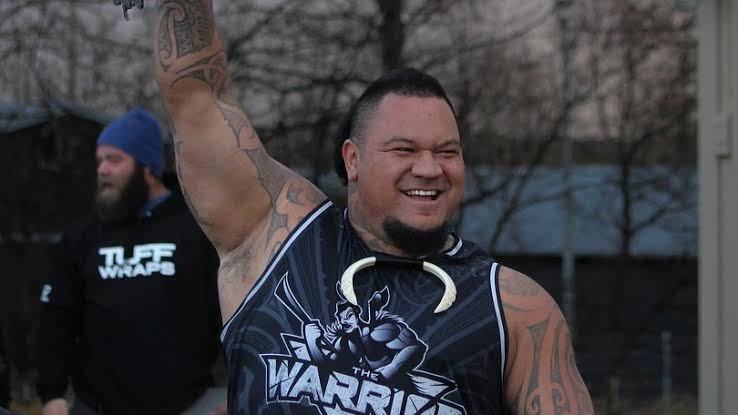
Rongo Keene (born 16 September 1987), nicknamed “The Warrior,” is a New Zealand-born Māori strongman who built his professional career in Australia. He won Australia's Strongest Man in 2016, the Lithuanian SBD World Log Lift Championships in 2019 with a 207.5-kg log press, and the 2022 Magnús Ver Magnússon Strongman Classic. A 2018 World's Strongest Man competitor, he also finished runner-up at the 2023 Arnold South America and 2023 Magnús Classic. Renowned for his overhead strength, performances of the haka and close family ties, Keene combined international strongman competition with demanding work in Western Australia's mining industry.
Rongo Keene, the strongman known as “The Warrior,” occupies a distinctive position in the modern history of strength sports. Born on 16 September 1987, raised in New Zealand and established professionally in Australia, he built a career that took him from regional competitions in Western Australia to the World's Strongest Man, Arnold events, Giants Live and the Magnús Ver Magnússon Strongman Classic. His landmark results include the 2016 Australia's Strongest Man title, victory in the Lithuanian SBD World Log Lift Championships in 2019 with a 207.5-kilogram log press, and first place at the 2022 Magnús Classic in Iceland. Those achievements are recorded by specialist results databases and the official Giants Live athlete biography. They are substantial on their own, yet they tell only part of the story. Keene also became known for his Māori identity, a demanding working life in the mining industry, the importance of family, his earlier experience as a singer and the very public process of rebuilding his life after a serious personal setback. His biography is most revealing when these dimensions are considered together instead of forcing them into a conventional sporting success story.
The distinction between the person and the sporting character matters. “The Warrior” is a memorable arena name, particularly for an athlete whose Māori cultural heritage is an important part of his public presentation. But a nickname cannot adequately describe the complexities of his life, any more than a personal best can explain the totality of a competition career. Keene has experienced periods of rapid ascent, a major interruption, returns to high-level competition, a specialist world-title victory and a later international contest triumph. In other years, he finished toward the bottom of prestigious fields. A serious profile has to retain both sides of that record. It also needs to distinguish between what an athlete has said about himself, what a promoter has reported and what competitive score sheets independently establish. Taken on those terms, Keene's achievements stand out not because every chapter was triumphant, but because significant results appeared across a long, uneven and geographically demanding career.
New Zealand reporting identifies Keene with Ngāti Pāhauwera and the Mōhaka area of Hawke's Bay. His Māori heritage is not an incidental detail in profiles written after he became famous. It is an aspect of his identity he has explicitly emphasized when explaining why international sporting representation matters to him. In interviews with Te Ao Māori News, he spoke about wanting Māori people to be visible alongside the best athletes in the world. He has also performed haka in settings watched by audiences far beyond New Zealand, including during his appearance at the 2018 World's Strongest Man. It is important, however, to avoid reducing haka to a theatrical attempt to frighten opponents. Within Māori culture, haka can have ceremonial, communal and expressive meanings extending well beyond sporting competition. Keene's public performances carry a connection to heritage, belonging and pride, not merely to the promotional requirements of an arena spectacle.
His upbringing is not exhaustively documented in publicly accessible biographical sources, and it would be irresponsible to invent detailed family scenes, schools, childhood ambitions or formative incidents. What can be established is that physical activity mattered to him before strongman. The Giants Live biography describes considerable involvement in rugby during his younger years and high-level experience in martial arts. Rugby can develop acceleration, bodily contact skills, balance, spatial awareness and the willingness to compete under physical pressure. Martial arts require discipline, coordination, body control and the ability to respond to another person's movement. These qualities do not automatically produce a successful strongman. Carrying a heavy yoke or pressing a giant dumbbell involves skills that have to be learned through specific preparation. Nevertheless, they help explain why Keene did not arrive at the weight room entirely unfamiliar with competitive exertion, contact and the psychological demands of performance.
The cultural dimension of his public identity becomes especially meaningful when considered against the international setting in which strongman operates. Competition results tend to assign one country to each athlete, often represented by a two- or three-letter code. Keene appears under Australia in specialist archives because that was the country in which he developed his professional sporting career and which he represented in a number of major contests. New Zealand journalists have continued to describe him as a Kiwi strongman and to highlight his Māori roots. These are not inherently contradictory descriptions. A person can be New Zealand-born, culturally connected to a specific iwi and publicly associated with Australia in the sporting records. The apparent simplicity of a country flag can conceal a much more involved migration story. In Keene's case, recognizing these distinctions is essential to understanding how his achievements were interpreted by different audiences across the Tasman.
One of the most unexpected details in Keene's background concerns music. According to Giants Live, he reached the finals of New Zealand Idol before becoming internationally known as a strength athlete. This stage of his life is important because it challenges the assumption that every prominent strongman followed a single path toward lifting weights from childhood. Performing as a singer involves a different kind of public scrutiny: an audience evaluates expression and presence rather than the movement of a measurable external load. It would be tempting to invent a comprehensive musical career from this one fact, but no reliable discography, long concert history or professional recording contract is established in the sources consulted. The accurate statement is that he had an important appearance in a televised singing competition. It reveals that public performance was part of his experience before the sporting arena became his primary stage.
That earlier experience offers a possible perspective on the extroverted persona audiences later encountered in his interviews and social-media appearances, although it does not prove a direct causal link. Strongman is both competitive sport and live entertainment. The crowd sees weights and results, but it also remembers distinctive personalities, dramatic entrances, recognizable gestures and athletes who know how to engage an audience. Keene's association with music, haka and humour places him among those competitors whose public identities extend beyond an objective scoring table. This should never be used to minimize his athletic credibility. On the contrary, the competitive record provides the foundation upon which the public persona developed. His story is interesting precisely because substantial athletic results coexist with an inclination toward entertainment and cultural expression.
At approximately eighteen years of age, Keene moved to Australia. Giants Live reports that he entered the workforce in the mining sector, initially as a scaffolder's labourer, and made his life in the Kalgoorlie region of Western Australia. That environment bears little resemblance to the promotional imagery of a famous international strength competition. Mining work and industrial scaffolding are associated with early starts, practical deadlines, demanding physical tasks and the need for strict attention to safety. Training for strongman while carrying out such work creates a difficult scheduling equation: physical energy spent during paid employment has to be balanced with the energy needed for progressive training, travel and recovery. Keene's career is particularly striking when the labour behind it is treated as part of the biography instead of omitted as an inconvenient background detail.
Keene has attributed some of his shoulder strength to the repetitive overhead handling of scaffolding tubes at work. This observation, recorded by Giants Live, is an explanation offered by the athlete rather than a controlled experiment. Repeated manual labour can produce useful adaptations, familiarity with awkward objects and considerable tolerance for exertion. It does not replace structured preparation for a maximum log lift, nor does it guarantee appropriate recovery. A full sporting explanation would still have to account for technique, specific overload, nervous-system adaptations, nutritional support and the ability to perform under competition conditions. What his account does illustrate is that the physical history of an athlete extends beyond the gym. Earlier sports, occupational demands and repeated movement patterns can all influence how an individual responds to subsequent strength training.
Kalgoorlie-Boulder also became a base for his business life. A 2018 Kalgoorlie Miner report described him as the owner of a scaffolding business and noted that he had worked to rebuild the enterprise after an interruption to his career. Running a business brings commitments that cannot simply be ignored for a training session. Customers, contracts and operational responsibilities continue even when a competition is approaching. The available reporting does not establish the current size, finances or ownership structure of the company, so claims about employees or income would be speculative. The important point is that Keene's public life combined professional labour, entrepreneurship and high-level sport. In an activity where even elite competitors often lack the salaries associated with major professional leagues, that combination is highly relevant to understanding the practical difficulty of building an international reputation.
The geographical setting adds another layer. Western Australia is far from many of the principal strongman competitions held in Europe and North America. Flight durations, expenses, the disruption of ordinary work and the availability of equipment can all become obstacles. It is not necessary to invent precise budgets from particular seasons to recognize these general realities. The journey from Kalgoorlie to a major international arena requires much more logistical effort than a simple change of location on a competition poster. That perspective helps explain why domestic victories and invitations abroad were important milestones. They offered proof that training conducted away from the established centres of the sport could still produce a competitor capable of standing beside internationally recognized athletes.
The turning point in Keene's sporting development was his contact with Carl Waitoa, an experienced New Zealand strongman who had competed at the 2005 World's Strongest Man. Giants Live recounts how Waitoa visited the area where Keene lived and was eventually persuaded to train him. The anecdote has the shape of an origin story, but its significance lies less in a chance encounter than in the sustained work that followed. Strongman is highly technical because the implements differ from the standardized equipment used in weightlifting and powerlifting. A newcomer may be strong in a gym and still struggle to load stones, move a yoke efficiently or coordinate a truck pull. An experienced coach can help the athlete identify weaknesses, learn event-specific technique and understand the demands of real competition.
In 2015, Keene spoke publicly about Waitoa's experience and referred to him as his coach. Early media accounts also make clear that he had begun looking beyond domestic events toward possible competitions overseas. The exact starting date of his strongman training is not perfectly uniform across the sources. Giants Live situates training with Waitoa and a first major regional victory in 2014. Contemporary reporting from 2015 used approximate descriptions of the time he had spent involved in the sport, while the local press discussed a state title won during the preceding year after a comparatively short period of preparation. It is therefore better to describe the competitive breakthrough as occurring around 2013–2014, with verifiable results from 2014, than to force every approximate recollection into an artificial exact chronology. Care with such details is a fundamental part of responsible biography.
His early success at Western Australia's Strongest Man in 2014, as described in later reports and by Giants Live, established him as more than a promising lifter. It was a title earned across the kind of varied events that define strongman. It should not be confused with Australia's Strongest Man, the national championship he won two years later. Similar names can make sporting records misleading to readers unfamiliar with the structure of competitions. A state title, a national title and an international title each represent different competitive fields and levels of scrutiny. In Keene's case, the distinction actually strengthens the story: he climbed through identifiable stages instead of appearing suddenly as an established global contender. He had to develop from a regional winner into someone capable of dealing with the depth and variety of the professional circuit.
September 2015 brought a result of particular significance. Kalgoorlie Miner reported that Keene had won the inaugural Australian Log Lifting Championship in Sydney after pressing 170 kilograms overhead. At the time he described his own body weight as approximately 135 kilograms, notably lighter than some of his competitors, who approached 160 kilograms. Body weight alone does not determine an overhead result, but the difference is worth recording because it helps place his strength in context. A successful log press depends upon creating stability, bringing the implement into a usable rack position and transferring force through the body until the weight is locked out. Relative strength, technique and coordination can become important differentiators in a field of very heavy athletes. The victory showed that Keene could lead a national specialty event before reaching the much higher records of his later career.
That same reporting mentioned a third-place finish at the New Zealand strongman championships earlier in the year, two positions above his result in the preceding edition. This was a reminder that his progress was not simply a sequence of victories. Small technical errors could matter, especially in events where the timer continues while the athlete struggles to secure a grip or stabilize an awkward object. Strongman offers little protection from a bad transition: losing the position of a stone or hesitating before lifting a sandbag can turn a possible event win into a mid-table result. Keene's comments in the press emphasized the importance of such details. His improving competition awareness, alongside the rapidly rising log numbers, was part of the development of a complete athlete rather than a specialist who relied on brute strength without any event strategy.
The next major breakthrough came in October 2015 at the Singapore Strongman Series in Changi. Te Ao Māori News documented Keene's overall victory in the Open Men's category and provided an unusually useful outline of his event results. He won keg loading, deadlift and the overhead medley, and shared first place in Atlas Stones. The result demonstrated breadth. Keg loading tests the repeated lifting and placement of awkward objects, while deadlift challenges force production and repeatability. Overhead medleys can expose an athlete to different implements in rapid succession, and Atlas Stones demand positioning, explosive hip extension and careful handling. Earning leading results across all four families of events established that Keene's capacity extended beyond a single maximum log press. Singapore became his first clearly documented international triumph in the contemporaneous sources.
Before the contest, Keene had told Te Ao Māori News that one of the planned challenges involved repetitions with a 300-kilogram deadlift within a limited time. This offers a useful glimpse of the competitive difficulty he was preparing to face. After his victory, he described the result as a reward for extensive training and a possible opening toward larger competitions. At that stage, his ambitions and those of his coach were not yet a completed road map. They were considering whether to remain focused on regional contests or investigate opportunities farther abroad, including the United States. Subsequent events would take him across several continents, but that trajectory should not be read backwards as inevitable. International competition depends not only on strength but also on invitations, financial feasibility, the ability to travel and the physical condition of the athlete when an opportunity appears.
The year is especially revealing because much of its detail comes from newspapers and Māori-language or Māori-focused reporting rather than the major statistical archive, whose main competition history for Keene begins in 2016. A reader who looks only at later international results might miss the Australian log title, the New Zealand placing and the Changi victory. This illustrates why a comprehensive sports biography needs more than one kind of source. Archive databases provide indispensable standardized rankings; local reports document early events that fall outside their scope; interviews reveal how athletes understood those events at the time. Together they describe the development of an athlete whose early success was fast but not effortless, and whose cultural identity already occupied a visible place alongside his sporting ambitions.
On 27 November 2016, Keene won Australia's Strongest Man in Melbourne. The competition records list six athletes, six events and a winning total of 29.5 points, ahead of Tyson Morrissy on 26. The details matter because this was not merely an overhead specialist winning a contest on the strength of his log press. Keene led the field in the super yoke, truck pull and car deadlift, and shared first place in the log lift with five repetitions. Across those events he displayed acceleration with weight on his back, pulling power, repeated hip extension and the ability to stabilize heavy implements overhead. His overall victory resulted from a successful distribution of performances across the competition rather than one isolated feat of maximal strength. Winning the national championship also gave him a recognisable title at a crucial moment in his development, separating him from the many regional athletes who had considerable ability but had not yet demonstrated it against a national field.
According to Strongman Archives, his yoke time was 11.02 seconds and his truck-pull result was 25.47 seconds, while he completed eleven repetitions in the car deadlift. These figures cannot be used to calculate generic personal records divorced from their apparatus, distances and equipment. A car deadlift typically has mechanical characteristics that differ from a standard barbell pull; truck pulls depend on the vehicle, course and conditions; yoke times are meaningful only in relation to the stated load and distance. Nevertheless, the event placings confirm that his strength could be expressed through different movement patterns. Keene did not win every event. His Atlas Stones placing was less impressive, underlining the competitive value of having several strong results that offset weaker disciplines. This is one of the defining features of strongman scoring: a champion can win the contest without winning each event, provided his overall consistency exceeds that of his opponents.
The national title should also be read alongside his circumstances outside sport. Keene continued to work and maintain responsibilities in Western Australia's mining and scaffolding industries. Elite strongman training requires practice with specialized objects, considerable rest between maximal efforts and sufficient recovery between sessions. Physically demanding employment may leave an athlete with less capacity to absorb additional training than somebody who can organize every day solely around sport. The problem is not simply fatigue but the coordination of competing priorities: work must continue, the household must function, and preparation for a competition has to be completed without creating unsustainable disruption. His 2016 win showed that he could manage those demands successfully during a decisive season. It did not mean they ceased to exist once the national trophy was secured.
An accurate account of Keene's career has to explain its interruption in 2017. In a report dated February 2018, Kalgoorlie Miner stated that he had been imprisoned in March 2017 after being found guilty of assault occasioning bodily harm arising from a 2015 incident outside a kebab shop in Kalgoorlie. This information concerns a public court outcome reported by an established local newspaper and forms part of the record of a well-known athlete. It should be presented without sensational embellishment. There is no basis here for imagining motives, reconstructing the encounter in cinematic detail, naming people not relevant to the sporting biography or inventing further criminal episodes. Neither a sporting championship nor a later return to competition erases a conviction, and an honest profile should not obscure it. Equally, the fact needs to be located within a larger life rather than used as the sole explanation of everything that followed.
The same article described Keene's loss of approximately 30 kilograms while in prison, based on his own account. He said that he lacked his normal nutrition and training facilities and attempted to maintain physical capacity through improvised resistance exercises, sometimes involving other people. Such activities should not be portrayed as an effective or safe training recommendation. The circumstances were restrictive and quite different from an appropriately supervised strength program. The biographical importance is that Keene experienced a dramatic loss of size and training momentum shortly after becoming Australia's strongest man. He was forced to rebuild abilities that had been developed over several years, including heavy lifting tolerance, technique, conditioning and confidence under load. From the standpoint of athletic development, losing access to equipment and regular recovery conditions can create a long interruption even when an athlete remains determined to exercise.
Following his release, Keene reported returning to his scaffolding business and resuming competition. In the February 2018 interview he described a win at Brisbane's Strongest Man only a few months after regaining his freedom and said that he was preparing for Arnold Australia. This regional result is useful but should not be confused with an event in the elite international archive. Different record-keeping organizations apply different inclusion standards; some track national and professional competitions, while local newspapers are more likely to follow regional shows. A comprehensive sporting history can include both types, provided they are clearly attributed and not counted as equivalent international championships. For Keene, the return to a local victory marked a practical stage of recovery. The more demanding test would come when he re-entered competitions with international opponents and specialized equipment that allowed little margin for weakness.
His family and training circle were central to the way he described that recovery. Kalgoorlie Miner quoted him discussing the support of people around him and the importance of having a positive team during the rebuilding process. He also spoke about visits to schools and churches where he shared lessons from his personal experience. One example involved dressing as the character Maui from the animated film Moana during a visit to children in hospital. This reported community activity should be acknowledged as a separate fact, not used to excuse his earlier conduct or to imply an entirely new and unverified public role. Athletes are sometimes presented in implausibly simple categories of heroes or villains. A professional biography can do better by documenting conduct, consequences, rehabilitation efforts and later athletic achievements without turning any one of those elements into a moral shortcut.
Giants Live describes Keene's progression toward professional competition in association with Arnold Australia and coach Warrick Brant. Its profile places particular emphasis on a 190-kilogram log press that exceeded an earlier Australian mark held by Brant. The exact dating and context of the professional qualification are described more generally in promotional biography than in the contest database, so it is prudent not to invent a precise qualifying placing. The defensible conclusion is that the 2017–2018 period established Keene as a professional-level competitor and confirmed the international potential of his overhead pressing. It was a very different competitive environment from his earlier state championships. He was now entering fields containing athletes with established world-level experience, often with greater access to specialized coaching, equipment and regular elite competition.
At Arnold Australia in March 2018, Keene finished seventh of eleven athletes. Yet the event results show him taking first place in the log lift with 190 kilograms. The apparent contradiction is useful for understanding the sport. A competitor can defeat the entire field in a signature event and still finish well outside the overall podium because the point system rewards performance across all events. For a specialist, the difference between being exceptional in one discipline and maintaining competitive placings in six is considerable. The Arnold result therefore strengthened the public perception of Keene as an outstanding overhead lifter while simultaneously showing how difficult the overall professional circuit had become. Neither aspect should be omitted. Listing only the overall placing would hide a significant feat; mentioning only the event victory would create a misleading impression of dominance across the contest.
His Arnold performance contributed to an invitation to the 2018 World's Strongest Man in Manila, Philippines. Keene competed in Group Four and placed sixth of the six athletes in that group. He did not progress to the final. The distinction matters because the title World's Strongest Man finalist is reserved for those who actually reach the final round; appearing in the qualifying groups, although a major career achievement, is not the same. The Manila competition exposed him to a field of exceptionally accomplished athletes and to the demands of one of the most closely followed events in strength sports. It also provided a setting in which he performed haka, an episode later recalled by Giants Live. A New Zealand-born Māori athlete competing on a prominent international stage under the Australian sporting designation was able to present his cultural identity directly to a global audience.
Reaching the World's Strongest Man group stage is a meaningful milestone even without an impressive placing. National success and elite international success operate at different levels of depth. A competitor who can dominate domestic opponents may encounter specialists in every discipline when a global invitation finally arrives. The heavy implements, tight schedules, travel and unfamiliar conditions can further complicate the transition. For Keene, the 2018 contest demonstrated both how far he had travelled and how much separation remained between him and the leading all-round strongmen. It is more respectful to the athlete to state the actual placing and explain the context than to replace the result with vague promotional language. Strongman is a results-driven sport, and its history is richer when achievement and limitation are recorded side by side.
Keene's outstanding specialist milestone came on 7 September 2019 at the SBD World Log Lift Championships in Panevėžys, Lithuania. He lifted 207.5 kilograms and finished first among nine competitors. The attempt was recognized as an Australian record at the time and remains prominently listed in Strongman Archives and the Giants Live biography. Several rivals reached 200 kilograms, but Keene's additional 7.5 kilograms secured the top place in that field. The terminology requires precision because there were two different events carrying closely related world log-lifting titles in 2019. The Giants Live edition in Leeds was won by Cheick “Iron Biby” Sanou, while Keene won the Lithuanian SBD event. Both results have their own records and organizers. Describing Keene as the winner of the Panevėžys competition is entirely legitimate; conflating the two championships would misstate the event history.
Comparing the 207.5 kilograms of 2019 with his documented 170-kilogram log press in 2015 shows a substantial increase in maximum performance, but it should not be treated as evidence of a particular secret training method. In between came injury risks, a serious interruption in 2017, a reduction in body mass, a return to competition and exposure to progressively stronger opponents. Without a complete training diary, it is impossible to attribute the eventual result to one rep scheme, supplement, coach intervention or technical change. What the record does establish is that Keene developed overhead strength competitive at an international level. The lift itself requires several coordinated stages: bringing the implement from the floor to the chest, establishing a stable rack position, directing the press efficiently and completing the lockout. Success is measured by the completed movement, not simply by possessing enough general strength to move a heavy object.
The following day, Keene competed at the Savickas Classic, also in Panevėžys, and finished fourth out of ten. He won the front-hold event and placed second in the overhead medley, while results in some loading and pulling events were less favourable. The two competitions, held in close succession, show both his strongest attributes and the limits of translating them into an all-round championship. Front hold emphasizes isometric endurance of the shoulders and trunk in a specific position, while log press is a dynamic maximal movement. Both depend on shoulder capacity, but they are not interchangeable tests. Strong results in both suggest useful versatility within an upper-body strength specialization. Nevertheless, a fourth-place overall finish confirms that other event performances constrained his total points. The detailed result is more informative than a generic description of him as either a champion or a mid-table competitor.
At Arnold Australia in 2019, he finished tenth among twelve athletes. This relatively low position occurred in the same general period in which he established a defining overhead record. The coexistence of those results is one of the strongest reasons to resist simplistic career narratives. The very best at one event are not necessarily the best in a complete strongman contest, where throwing, carrying, loading, deadlifting and overhead pressing may all appear within a short period. Differences in implement specifications and fatigue can change the advantage of an athlete from one weekend to another. For Keene, the log record made his specialist standing unmistakable. The wider results also showed that competition among internationally ranked strongmen remained unpredictable and demanding, and that improving one exceptional movement did not eliminate all other vulnerabilities.
The 2019 period is also a reminder that nationality and cultural belonging need careful wording. Competitive archives identify Keene as Australian, and his professional development occurred largely in Australia. Media in New Zealand continued to follow his results as a New Zealand-born Māori competitor, particularly because of his Ngāti Pāhauwera connections and public cultural representation. Both perspectives can be presented clearly without inventing formal citizenship details. The distinction matters when an Australian log record is discussed alongside a New Zealand sporting biography. Keene's career crossed national and cultural lines, and his recognition followed him in both places. His life cannot be fully represented by the single country code attached to a result sheet.
The disruptions caused by the COVID-19 pandemic changed the sporting calendar in 2020, and strongman organizers experimented with formats that could operate without an ordinary audience or shared competition venue. World's Strongest Man launched a special Snapchat Discover project called World's Strongest Man: Home Edition, presented by former world champion Eddie Hall. Participating strongmen produced creative performances using familiar or unusual objects in their home environments, and audience votes helped decide who advanced. Keene won the competition and the associated prize was advertised as 10,000 dollars. This was a notable entertainment achievement, but it was not the official 2020 World's Strongest Man championship, which Oleksii Novikov won later that year. The distinction is essential. The Home Edition did not measure identical implements, distances and loads under a standard strongman scoring system. Its entertainment and audience-participation format was part of the rules, not an overlooked technicality.
The victory demonstrated a different aspect of Keene's public appeal. He had already built a memorable identity through his tattoos, humour, approachable personality and the Māori heritage that he openly celebrated. A fan-voted online challenge places value on the presentation of a feat as well as the feat itself. That is a legitimate measure within the rules of such a format, but the outcome cannot be treated as proof that the winner had the heaviest deadlift or strongest log press among the participants. The event illustrates an important change in modern strength sport: visibility may grow through personality-led digital content while conventional competitive reputations still depend on judged results. Keene was unusually well positioned to participate in both worlds. His impressive performances with real weights supplied athletic substance, and his willingness to engage creatively with a broader audience enabled him to reach people who might never have watched a standard strongman competition.
In July 2020, an episode of the Talking Strongman podcast offered another view of his story. The programme introduced him as the Home Edition winner and described a discussion of his origins in strongman and the prison sentence that had affected his career. The podcast's importance is that these difficult subjects were being publicly addressed in a sporting context instead of omitted from his presentation. One should not attribute elaborate additional claims to the episode without independently checking the full recording, nor should the interview be mistaken for documentary evidence of details beyond those confirmed elsewhere. In combination with the 2018 Kalgoorlie Miner report, however, it establishes that Keene's comeback narrative was an active part of how he communicated with fans. His public identity was not built exclusively around the ability to lift spectacular weights. It also included his account of interruption, accountability and the effort involved in returning to elite performance.
A June 2020 interview published by Te Ao Māori News provides valuable first-person context. Keene spoke about sport in his New Zealand youth, his move to Australia and the discovery that weight training suited him. He explained why presenting Māori culture on an international stage mattered to him. He also recalled meeting Arnold Schwarzenegger and performing haka in his presence. For someone who had admired such well-known sporting figures, the encounter had clear personal meaning. Its biographical significance should not be exaggerated into an imagined coaching relationship or sponsorship arrangement. The source establishes a meeting, the performance and Keene's reaction, not a continuing professional partnership. More importantly, the episode shows a competitor taking a cultural expression that had meaning in his own community into the world of international strength sport.
Outside New Zealand, haka is most often associated with elite rugby, but it is not the property of one team or one kind of event. Its expressions and meanings vary with context and cannot be reduced to aggression for the benefit of viewers unfamiliar with Māori traditions. Keene's international performances helped connect the audiences of a largely equipment-focused sport with a living cultural identity. It is equally important not to interpret every part of his appearance on behalf of that culture without his explanation. A photograph showing Māori-style tattoos or a ceremonial adornment is not sufficient evidence to identify the meaning of every particular mark. A respectful biography records the identity and symbolism he explicitly presents while leaving unexplained private or cultural meanings alone. That approach takes both the athlete and the culture seriously.
The same interview included a striking description of food intake. Keene reported that during a demanding phase he consumed approximately 7,000 calories a day, spread across around eight meals. He described the practical burden of eating enough as extremely difficult. These were figures reported by the athlete, not verified daily nutrition logs or an individualized recommendation for others. Energy requirements in heavyweight strength sport vary with body mass, occupation, training load, recovery and personal physiology. What matters here is the lifestyle behind competition: meals must be planned, purchased and consumed, sometimes around a full workday. Rest and recovery need similar attention. For a competitor combining mining work with sport, the daily routine could be as demanding as the event itself. The figure is useful for understanding his own reported experience, not for prescribing a universal strongman diet.
After years affected by personal disruptions and a global pandemic, Keene returned to a dense international schedule in 2022. Strongman Archives lists his appearances at the Pahlavon Mahmud Strongman Grand Prix in Uzbekistan, Middle East's Strongest Man in Dubai, Strongman Champions League Bosnia in Sarajevo, the World Strongman Championships in Latvia and the Magnús Ver Magnússon Strongman Classic in Iceland. Travelling between these competitions required the management of long flights, unfamiliar time zones, new competitive surroundings and differing event equipment. A result table compresses all of this into a date, city and placing. For a working athlete based in Western Australia, the practical demands behind those short entries were considerable. The season is therefore important not only for its eventual championship but also for the return to frequent participation against international fields.
At the 2022 Pahlavon Mahmud Strongman Grand Prix in Khiva, Keene finished second among sixteen athletes. It was a valuable general podium, distinct from a single-event record. The result showed that he could still accumulate points effectively across a broad range of strongman tasks. At Middle East's Strongest Man in Dubai, he finished seventh of eighteen and produced a 380-kilogram maximum deadlift, a recorded competition personal best in Strongman Archives. He also finished second in a carrying medley involving a 140-kilogram farmer's walk and a 350-kilogram yoke, recording 14.32 seconds. These performances expand the picture beyond overhead pressing. A powerful deadlift reveals a strong posterior chain, while a fast heavy carry requires coordination and mobility under substantial load. Neither event result alone guaranteed an overall podium in a large, diverse field.
The September Strongman Champions League contest in Sarajevo offered another podium, with Keene finishing second among thirteen competitors. He won Atlas Stones, placed second in log lift and truck pull, and lost points in other events, including farmer's walk. It is a useful illustration of why an athlete should not be permanently labeled weak at a discipline based on a single competition. Stones vary greatly between contests in surface, diameter, loading height, sequence and time limit. A competitor who loses points on one occasion may win under different conditions, as Keene did in Bosnia. Similarly, a strong truck pull can coexist with a mediocre farmer's walk because the demands on grip, leverage, footwork and fatigue are not identical. The result shows that his competitive repertoire had genuinely broad elements and that his strong performances in 2022 were not confined to one signature lift.
At the World Strongman Championships in Talsi, Latvia, he placed sixth among eleven athletes. Later came the Magnús Ver Magnússon Strongman Classic, an event with a distinctively Icelandic emphasis on a range of implements, including natural stones and unusual carrying or pressing tasks. In competitions of this kind, the center of mass, grip surface and trajectory of an object can be more difficult to predict than with a standardized barbell. Athletes need general strength, but also rapid technical adaptation and efficient movement strategies. Familiarity with a heavy log will not by itself make a natural stone easy to shoulder or press overhead. The event consequently provides an interesting test of whether a competitor can translate physical capacity into different, sometimes irregular movements. In November 2022, Keene produced one of the most complete performances of his career under those conditions.
Keene won the 2022 Magnús Classic in Iceland, placing first among fourteen athletes and beating runner-up Maxime Boudreault by six points, according to Giants Live. Eythór Ingólfsson Melsted finished third. The quality of the field is relevant: Boudreault was a World's Strongest Man podium finisher, while Melsted had competed in WSM finals. Beating athletes of that standing over multiple events does not establish that Keene was universally stronger in every conceivable lift, but it does establish that his overall performance at that competition was superior. This distinction is the foundation of meaningful sports analysis. A strongman contest awards points for defined events, conducted with particular implements and judged under specific rules. Winning the competition means mastering that combination more successfully than the opposition on the day. Keene did exactly that in Iceland.
The event-by-event record reveals why he won. Keene took first in Rock Press with 138 kilograms and first in Stone to Shoulder with four repetitions in 34.16 seconds. He was second in Farmer's Walk, covering 34.77 metres, and finished among the leaders in the deadlift and log medley. His results were less impressive in some other disciplines, including parts of the natural-stone series and Húsafell Stone carry. The overall victory therefore did not come from winning everything. It resulted from collecting high placings at decisive moments, scoring consistently in other valuable events and avoiding enough severe losses to preserve the advantage. Such a scoring pattern is characteristic of successful all-round strongman competition: a competitor may be exceptional in two disciplines but still needs a sufficiently strong floor across the remaining events.
The 138-kilogram Rock Press is worth distinguishing from his 207.5-kilogram log lift. A rock used as an overhead implement is not a log or barbell. Its awkward shape, changing contact points and potentially uneven mass distribution create particular demands in the setup, grip, transfer and lockout. Recording 138 kilograms as though it were simply another log-press result would erase the technical challenge actually demonstrated. Stone to Shoulder is likewise a different skill from lifting an Atlas Stone to a fixed platform. The athlete must control an irregular object, transfer it into a stable position and meet the relevant completion standard under time pressure. By winning in both disciplines, Keene showed that his strength and coordination could be applied to natural objects, not just the more conventional implements on which his reputation had been formed.
For the broader career, the Icelandic victory created a meaningful progression of titles. The 2016 Australian championship confirmed success across national-level strongman events. The Lithuanian log title in 2019 proved specialist overhead ability against international opposition. The 2022 Magnús Classic established that he could also win a prestigious international multi-event contest, defeating athletes with strong global credentials. These achievements are not equivalent in format, field or historical meaning, and they should not be collapsed into one vague title. Together, though, they explain why Keene deserves a place in the history of the sport. His international success was not the product of a single peak or one isolated media moment. It represented different strengths demonstrated at different stages of a career marked by work, family commitments, personal disruption and renewed competition.
In 2023, Keene remained active across several international circuits. He finished second at Arnold South America in São Paulo, behind Cristian Quiroga, fifth at Strongman Champions League Holland in Ulft, eleventh at the Giants Live Strongman Classic in London and second at the Magnús Ver Magnússon Strongman Classic in Iceland. The different results capture the unpredictability of elite strongman. The second-place finish in Brazil was a valuable international podium. The Dutch event included a second-place result in Viking Press with fourteen repetitions. Giants Live represented the fulfilment of a long-held ambition but brought a difficult overall placing, while the return to Iceland produced another outstanding all-round result. One season could therefore contain both a deeply personal achievement and performances far below those of the athlete's best days.
The July appearance at the Royal Albert Hall had particular significance. In its official athlete biography, Giants Live described Keene's aspiration to compete at one of its events as something he had shared with his children. A famous London venue, a major promoter and an audience accustomed to world-class strongmen brought a new kind of recognition. The competitive result, however, was eleventh of eleven athletes. Strongman Archives lists difficult performances in the deadlift and yoke and a ninth-place event result in Nicol Stones, a carrying challenge with unconventional implements. These placements should not be disguised. A major invitation can matter to an athlete's career even when the event itself does not produce an impressive score. For Keene, that competition represented arrival on a stage he had hoped to reach, not a podium that he never earned.
He returned to better form at the 2023 Magnús Classic, finishing second of twelve behind Tristain Hoath. Keene won the log ladder, completing four lifts in 41.53 seconds, and the front hold, maintaining the position for 77.98 seconds. He also placed well in Farmer's Walk and Rock Press. The performance was significant because it followed his 2022 victory at the same series. Returning to the podium a year later offered evidence of sustained competence in the irregular, multi-event format rather than a one-off championship under unusually favourable conditions. It also reinforced the reputation of his overhead pressing and shoulder endurance. Strongman competition rewards more than pure maximum strength, and these repeated event results show how Keene's capacities could be effective in both dynamic pressing and sustained holds.
Strongman Archives documents three notable competitions in 2024: sixth at the Pahlavon Mahmud Strongman Grand Prix in Khiva, eleventh at SCL Dubai and eleventh at the Magnús Ver Magnússon Strongman Classic. At Dubai, he placed third in Hummer Pull; at the Icelandic contest he finished second in Hercules Hold with 46.47 seconds despite the low overall ranking. These event-level results matter because they show that a disappointing final placing may coexist with a strong performance in a particular discipline. They do not justify claims of a full return to championship-winning form, but neither are they evidence that his entire competitive skill set had disappeared. A long career often contains changes in strength, event-specific form and consistency that cannot be reconstructed from final points alone.
The November 2024 Magnús Classic is the latest major contest recorded in the athlete's Strongman Archives profile consulted for this biography. That date should not automatically be treated as his formal retirement. A database lists documented appearances, not every possible training session, private exhibition or regional competition. No verified public retirement statement was identified in the sources reviewed. A September 2026 sports podcast episode titled “RONGO KEENE | Kiwi strongman on his upbringing, journey & career” shows that he remained a subject of media interest, but it does not itself establish participation in a new strongman contest. For a profile updated in October 2026, the most accurate description is that the major competition record presently ends in 2024, while any formal retirement status remains unconfirmed. Future editions of this biography should be amended only as new, reliable results become available.
The Giants Live biography published around 2023 described Keene as married to Angelina and as the father of three sons, Zion, Shaq and Kaea. The information is public and relevant because Keene has repeatedly spoken about the importance of his family to his sporting journey. It should still be attributed to the time of the source rather than presented as independently verified current family status. No further private details about his children are needed. For an athlete who travelled from Western Australia to Europe, Asia and South America, family support was part of the practical reality behind international invitations. The public can appreciate that importance without inventing private conversations or making unsupported statements about how the household organized every competition trip.
His earlier involvement in visiting schools, churches and children in hospital adds another dimension to the public account of his life. In the 2018 Kalgoorlie Miner interview, he described efforts to share lessons from his experiences and to offer encouragement to others. Those reports belong alongside the documented conviction and subsequent reconstruction of his sporting career, not in place of them. Responsible biography neither romanticizes imprisonment as a necessary stage of athletic development nor pretends that later good actions can cancel a previous offence. It records what happened, identifies the source of personal claims and gives the reader room to assess the whole trajectory. Keene's story is distinctive partly because he has discussed the difficult episodes rather than presenting an uninterrupted sequence of victories.
Music and entertainment remain useful counterpoints to that athletic record. His earlier appearance as a New Zealand Idol finalist shows that strength was not his only route into public attention. Online, Giants Live noted his humorous social-media persona, including the character sometimes called Ringo, alongside clips of training and competition. The combination of a powerful physical presence, Māori cultural expression and an inclination toward humour gave his media appearances a recognisable character. Popularity cannot substitute for scored competition performances, but it helps explain why an athlete whose final placings varied so widely could still attract attention. Strongman spectators remember records, but they also remember the individuals who gave a distinctive personality to a field of exceptionally strong competitors.
Keene's most recognizable technical strength is overhead lifting. His documented progression includes 170 kilograms at an Australian log championship in 2015, 190 kilograms during an Arnold Australia event in 2018 and 207.5 kilograms at the Lithuanian SBD championships in 2019. Giants Live also credits him with a 122-kilogram Giant Circus Dumbbell lift, described as an Australian record when the profile was prepared. These results involve different equipment and should not be compared as though they were identical barbell presses. A log requires a distinct clean and press sequence; an oversized dumbbell is lifted with one arm and places major demands on asymmetric stabilization; a natural stone changes the way the implement is held and controlled. Performing well across these variations indicates considerable versatility within the overhead-strength category, but the available evidence does not reveal a complete personal training programme or any single method responsible for his results.
His maximum deadlift of 380 kilograms at the 2022 Middle East's Strongest Man is a separate verified competition result. Transport events such as yoke and Farmer's Walk add further information, especially when the load and time are documented. None of these numbers should be removed from its competitive setting and treated as a universal measurement. Car deadlifts, frame pulls and standard barbell deadlifts can differ substantially. A yoke time without the weight and distance lacks essential context, while a Farmer's Walk result depends on handle configuration, course and turns. Keene's best overall competitions demonstrate that he was not merely an athlete with strong shoulders. He could win truck pulls, deadlift variations and stone events. His weaker competitions show equally clearly that this versatility did not translate into consistent domination of elite international fields.
Keene's achievements deserve to be remembered with their proper names and distinctions intact. He was Australia's Strongest Man in 2016, appeared at the 2018 World's Strongest Man qualifying stage, won the 2019 Lithuanian SBD World Log Lift Championships with an Australian-record 207.5 kilograms and became the 2022 Magnús Classic champion. He also won a fan-voted World's Strongest Man: Home Edition project in 2020, an entertainment contest separate from the official WSM championship. Strongman Archives records a set of major international, national and single-event appearances, but it does not include every regional victory reported by local media. A sound historical profile therefore combines database results with contemporary reporting and official organiser information, while carefully separating each type of evidence.
Rongo Keene's enduring image is that of a New Zealand-born Māori competitor whose professional life was built in Western Australia and whose strength eventually carried him to major arenas across the world. He worked in the mining and scaffolding industries, ran a business, experienced a significant personal and sporting interruption, returned to competition and reached achievements that would have been difficult to predict from his early regional appearances. His biography includes the joy of victory, the discipline behind an exceptional overhead record, the visibility he brought to Māori identity and the less celebrated responsibilities and consequences of ordinary life. The most respectful record of “The Warrior” does not need to make him flawless. It needs to preserve the work, the results, the context and the human complexity of an unusual international strongman career.
The principal competition source is Strongman Archives (https://www.strongmanarchives.com/viewAthlete.php?id=217), supplemented by the official Giants Live athlete profile (https://giants-live.com/athlete/6474/) and the FitnessVolt result pages for the 2016 Australian championship (https://fitnessvolt.com/strongman/competitions/2016-australias-strongest-man/) and the 2019 Lithuanian log event (https://fitnessvolt.com/strongman/competitions/2019-sbd-world-log-lift-championships/). Early background and Māori identity are documented by Te Ao Māori News in October 2015 (https://www.teaonews.co.nz/2015/10/12/rongo-keene-on-top-of-the-world/) and June 2020 (https://www.teaonews.co.nz/2020/06/15/strongman-rongo-keene-proud-to-represent-maori-on-a-global-stage/). Kalgoorlie Miner covered his 2015 national log title (https://www.kalminer.com.au/news/goldfields/rongo-seizes-national-title-ng-ya-393412) and reported on the conviction, business and comeback in 2018 (https://www.kalminer.com.au/news/kalgoorlie-miner/strongman-rebuilds-his-life-after-setback-ng-b88746012z). A 2020 Talking Strongman interview is available at https://talkingstrongman.podbean.com/e/talking-strongman-with-rongo-keene/. Listed physical statistics vary slightly: Giants Live reports 1.86 metres and 145 kilograms; Strongman Archives reports 1.85 metres and 149 kilograms. These are profile-era figures rather than verified contemporary measurements.
Strongman Archives – Results and Records
Giants Live – Official Athlete Biography
Te Ao Māori News – Singapore 2015
Te Ao Māori News – Cultural Interview 2020
Kalgoorlie Miner – Australian Log Title 2015
Kalgoorlie Miner – Personal Comeback and Business 2018
FitnessVolt – 2016 Australia's Strongest Man
FitnessVolt – 2019 SBD World Log Lift Championships
Iron Hall data
207.5 KG
Max Log Lift · 2019 SBD World Log Lift Championships in Lithuania; Australian record at the time
Verified
122 KG
Giant Circus Dumbbell · Australian record reported by Giants Live; exact attempt details not supplied
Verified
380 KG
Max Deadlift · 2022 Middle East's Strongest Man, Dubai; competition result
Verified
138 KG
Rock Press · 2022 Magnús Classic, stone overhead event distinct from log press
Verified
170 KG
Log Lift (earlier milestone) · 2015 Australian Log Lifting Championship, Sydney; historical mark, later exceeded
Verified
2014
First regional title, per Giants Live biography.
1st
2015
Won keg loading, deadlift and overhead medley; tied first in Atlas Stones; reported by Te Ao Māori News in October 2015.
1st
2015
170 kg log lift, reported by Kalgoorlie Miner on 3 September 2015; national single-event title.
Champion
2015
Reported by Kalgoorlie Miner; an improvement of two places from the previous edition.
3rd place
2016
29.5 points, wins in yoke, truck pull and deadlift, tied first in log lift.
Champion (1/6)
2017
According to Giants Live, earned his pro card; 190 kg log lift noted as an Australian record.
Professional qualification
2018
Won the log lift event with 190 kg, according to archives.
7th of 11
2018
First and only documented WSM appearance; did not qualify for the final.
6th of 6 in heat
2019
Competed at Arnold Australia, Melbourne.
10th of 12
2019
207.5 kg; champion of the Lithuania edition, separate from Giants Live's Leeds event.
1st of 9
2019
Won front hold; second in the overhead medley.
4th of 10
2020
Fan-voted online entertainment challenge; not the official 2020 WSM championship.
Special-edition winner
2022
International podium in Uzbekistan.
2nd of 16
2022
380 kg maximum deadlift; second in the carrying medley.
7th of 18
2022
Won Atlas Stones; second in log lift and truck pull.
2nd of 13
2022
Competitor in the Latvia championship.
6th of 11
2022
Won by six points over Maxime Boudreault; event wins in Rock Press and Stone to Shoulder.
Champion (1/14)
2023
Runner-up behind Cristian Quiroga.
2nd of 10
2023
Second in Viking Press with 14 repetitions.
5th of 14
2023
Giants Live debut in London.
11th of 11
2023
Won log ladder and front hold.
2nd of 12
2024
Returned to Khiva after his 2022 podium.
6th of 15
2024
Third in Hummer Pull.
11th of 13
2024
Second in Hercules Hold (46.47 seconds).
11th of 15