
2016
UK's Strongest Woman
First national title, approximately four months after starting strongwoman training.
Champion
Iron Archives
Three-time World's Strongest Woman | The Welsh Wonder
Active athlete
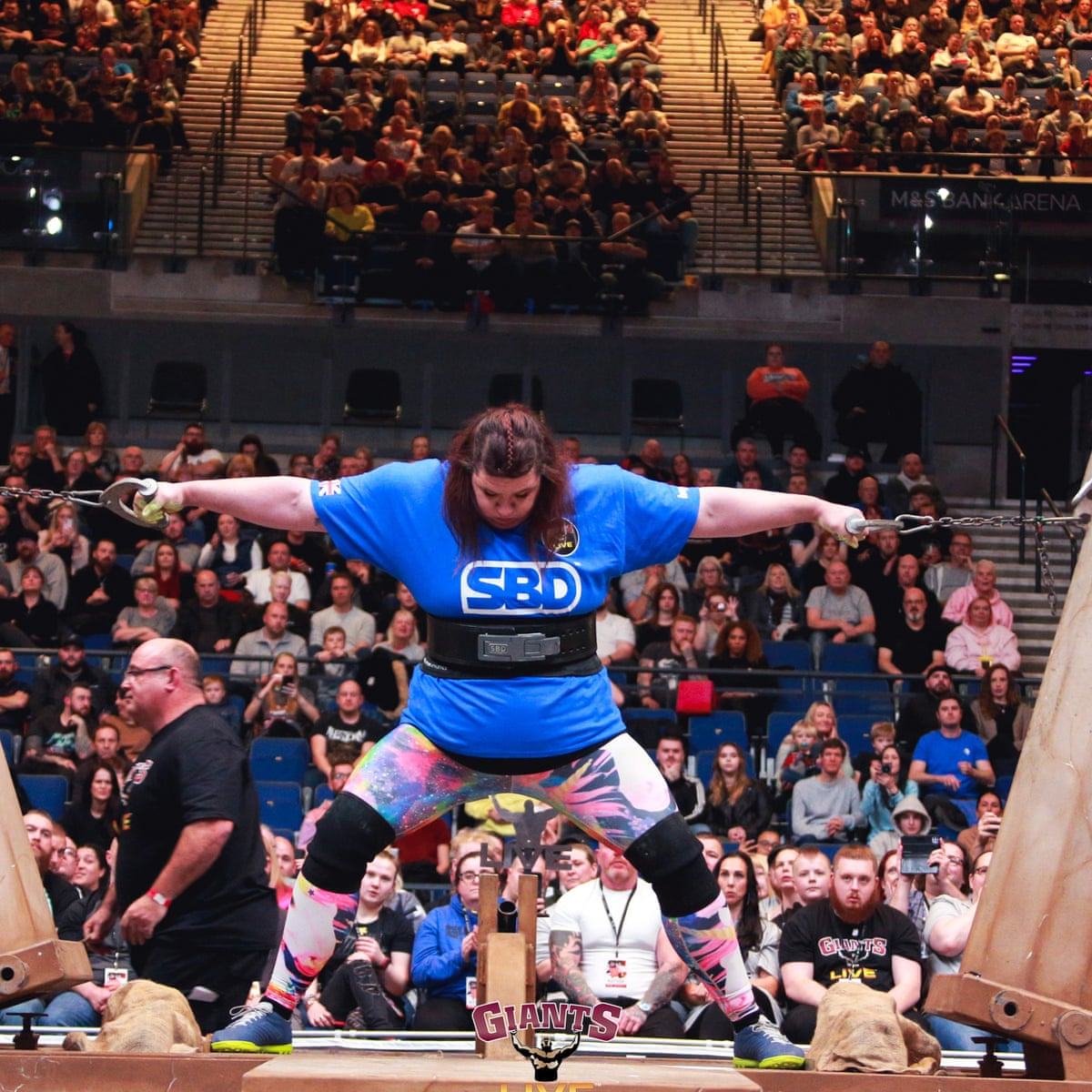
Rebecca Roberts (born 18 December 1994, Wales) is one of the most accomplished competitors in modern strongwoman, having won World's Strongest Woman in 2021, 2023 and 2024. Raised in Bangor, she transitioned from rugby and athletics into strength competition in 2016 and won UK's Strongest Woman in her first season. Her résumé includes British and European honours, two world grip-sport titles, and an Arnold Strongwoman Classic podium finish. Standing 1.93 m tall, she chiefly competes in the Open division and is recognised for carries, formidable grip, log pressing, deadlifting, and all-round consistency. Beyond the arena, she advocates for care-experienced young people, body acceptance, and mental-health awareness. She finished second at Britain's Strongest Woman in 2026.
Rebecca Roberts stands among the defining athletes of contemporary women's strength sport. Born in Wales on 18 December 1994 and raised in Bangor, she won World's Strongest Woman in 2021, 2023 and 2024. Those three titles describe only part of her achievement. Strongwoman is not a single-lift competition: competitors must move heavy implements, lift awkward objects overhead, demonstrate maximum pulling strength and remain effective when fatigue makes every step and transition more difficult. Roberts has developed an unusually broad competitive profile, distinguished by heavy carries, grip strength, overhead ability and dependable event-to-event scoring. Her climb was unusually fast, but not effortless. Approximately five years separated her introduction to competitive strongwoman from her first world title. The career that followed featured major victories, prestigious runner-up finishes and occasional results well below her usual standard. To understand Roberts as an athlete requires that full range of outcomes. It also requires recognising how women's strongwoman has changed since she made her debut in a modest national contest in 2016. Larger arenas, stronger international fields and more systematic reporting of results have transformed the competitive landscape around her.
Roberts grew up in Bangor as one of five siblings, in a family she has repeatedly described as loving before a sequence of devastating events. Her mother lived with a disability, while her father worked demanding hours to support the household. In a long interview published by The Guardian in October 2024, Rebecca remembered holidays, family rituals and a sense of security during her early childhood. Those details matter because biographies built solely around suffering can distort the person they are intended to portray. Her parents encouraged ambition and made their children feel valued. The later breakdown of family stability did not erase those earlier experiences, nor does it define every aspect of her adult identity. The sense of responsibility toward her siblings and her determination not to accept limited expectations began well before she encountered barbells or strength competitions. Like many successful athletes, she developed some of her values outside sport. Unlike the conventional story of a child identified early as a future champion, her pathway to the world stage passed through considerable family upheaval, education, other sports and years in which competitive lifting was not remotely part of the plan.
When Roberts was twelve, her mother died suddenly following heart failure. Her father's health subsequently deteriorated, and he was eventually diagnosed with Pick's disease, a form of frontotemporal dementia. Rebecca has discussed the consequences in interviews with BBC Sport Wales and The Guardian. The household lost much of its everyday structure, and responsibilities ordinarily carried by adults increasingly fell to the children. Her school life was affected, partly because she could no longer rely on the routine and resources that had previously supported the family. It is important not to turn this history into speculative medical commentary. The diagnosis and family experiences described here come from Roberts' own public statements; the article does not attempt an independent clinical assessment of her father. He eventually received residential care and died in 2023, according to her 2024 Guardian interview. Rebecca's recollections convey both grief and concern for his welfare, including efforts she made as a teenager to advocate for appropriate care. The experience appears repeatedly in her public account of why institutional support, adult encouragement and realistic opportunities matter to young people whose families become unable to care for them.
As family circumstances became untenable, Roberts and several siblings entered the care system. Placements changed, the children were separated and a stable home became difficult to establish. She has described keeping possessions ready to move and sensing that adults expected relatively little of her future. At sixteen, she began living independently with limited financial support, while remaining closely involved with her siblings. In The Guardian, she remembered organising family meals and helping a younger brother, attempting to recreate the sense of connection she had known earlier. The significance of this period lies not in presenting instability as a necessary ingredient of success, but in recognising the considerable barriers that care-experienced young people may face. Planning an education, maintaining relationships and developing a professional identity are harder when housing and day-to-day support are uncertain. Roberts resisted the idea that an acceptable outcome would be merely to avoid trouble. She wanted to study and build a future that extended beyond the narrow options sometimes offered to her. That ambition predates all the trophies and helps explain why she is willing to speak publicly about her background.
School was not consistently welcoming. Because of her size, appearance and household circumstances, Roberts experienced bullying and felt uncomfortable in physical education classes. She has recalled attempting to avoid activities in front of classmates who mocked her, despite showing athletic promise. In the summer athletics programme, she performed well in shot put and other events, and The Guardian reports that she established a Welsh junior shot-put record at fourteen. A precise throw and the relevant governing-body records were not established by the sources reviewed, so no numerical figure should be invented. This distinction illustrates an important editorial principle: an athlete's first-person recollection can be included with attribution, but it should not automatically be converted into a fully verified competition statistic. More importantly, the contrast between school sport and later strongwoman became a recurring theme of Roberts' public message. Physical characteristics for which she had been ridiculed eventually became sources of competitive ability. That change did not make the bullying harmless in retrospect. It revealed that a young person's relationship with sport depends heavily on environment, encouragement and whether they are offered activities in which their abilities can develop.
Roberts continued into higher education, studying subjects associated with forensic psychology and criminal justice in Liverpool. BBC Sport Wales reported that she was among the first care leavers in her local area to progress to university. At university she played rugby and became a team captain during her second year. Rugby developed familiarity with physical contact, teamwork, repeated efforts and the responsibility of competing within a group. Some of those qualities are relevant to strongwoman, although carrying a log, gripping an awkward frame and deadlifting heavy implements require techniques that rugby does not teach directly. Her academic and sporting life during this period is an important corrective to the idea that she moved immediately from childhood difficulties into international success. Before strength sport, she was a student building an independent life and an athlete participating in a team game. The transition into adulthood was not smooth. She later spoke publicly about sexual violence experienced while at university and a subsequent period of profound mental-health difficulty. These experiences were disclosed by Roberts herself in major interviews; they should be discussed respectfully rather than sensationalised, and they do not define her entire identity.
In conversations with journalists, Roberts has described depression, suicidal distress, withdrawal from exercise and substantial weight gain during that stage of her life. By the time she was moving toward a return to the gym, her body weight had at one point approached 190 kilograms, according to The Guardian. That figure refers to an earlier period, not to her later competition weight, which Giants Live lists at approximately 140 kilograms. Neither value should be treated as a complete measure of health, athleticism or personal worth. Public sources do not justify simplistic claims about why her weight changed or what precise treatment she required. What can be said is that her sporting life had been interrupted and that returning to regular exercise initially served a different purpose from winning world titles. Her eventual involvement in strongwoman provided an activity with clearly defined goals and a community that valued her abilities. Roberts has spoken positively about that sense of belonging. It would nevertheless be wrong to imply that lifting weights automatically replaces professional mental-health care for other people experiencing similar problems.
In May 2016, Roberts met Paul Savage, a strongman competitor who became her partner and coach. Their early work together focused on improving fitness, returning to exercise and addressing the effects of a back injury sustained during her rugby years. Savage recognised potential in her build and strength, encouraging her to try the events of strongwoman. Their relationship quickly became personal as well as athletic. Roberts later recalled that he predicted she could become the world's strongest woman within five years. It is a striking prediction because it eventually came true, but it should not be presented as a magical shortcut. The journey involved technical practice, progressive physical adaptation, travel, defeats and countless hours of work. Savage provided coaching, support and the confidence to enter competition; Roberts provided the labour and ultimately produced the performances. They became a partnership in which their shared ambition shaped daily routines and long-term plans. Understanding his contribution is essential to her biography, but it should never diminish Rebecca's own agency or reduce her successes to the judgement of the man who coached her.
In September 2016, only a few months after beginning serious strongwoman training, Roberts won UK's Strongest Woman on her first attempt. She has recalled that the event was held in a gym car park and attracted a small audience, a vivid contrast with the international arenas she would later enter. The prize was financially modest, but the achievement was transformative. Strongwoman offered a setting in which considerable body size and force production could be recognised as athletic strengths. Yet the distance between a successful national debut and sustained world-class performance remained enormous. At higher levels, rivals excelled at specific disciplines and technical errors could cost a competitor several positions. Roberts had to learn to press implements with unusual shapes, move under heavy loads, manage the demanding transitions of medleys and score consistently. Her early win demonstrated potential and competitive confidence rather than the completion of her development. It also reflected the state of women's strength sport at the time, when opportunities existed but the commercial structure and media exposure of the major contests were still comparatively limited.
During 2017 and 2018, Roberts established herself in grip sport as well as strongwoman. Giants Live credits her with two world grip titles and a series of notable grip performances. Competitive grip is a distinct branch of strength sport, testing the hand, fingers and forearms with specialised equipment and rules. Its direct relevance to strongwoman can be seen in events such as Farmer's Walk, frame carries and awkward implements that must be held securely while the athlete moves. She also earned a bronze medal at the 2017 Arnold Amateur Strongwoman World Championships in the under-82-kilogram division, according to Strongman Archives. This is an early-career result from a weight-class competition and must not be confused with her present Open-division career. Some historical summaries also refer to titles in competitions organised by the World Heavy Events Association. Such achievements belong to their own competitive categories and should not be counted as additional World's Strongest Woman Open victories. The distinction is especially important for athletes whose résumés include similarly named contests run by different organisers. Roberts was building a broad foundation, but she had not yet established dominance at the highest Open world championship.
The 2019 season helped establish her position at a much higher level. Giants Live reports victories at Europe's Strongest Woman, Wales' Strongest Woman and Britain's Strongest Woman. Later that year she made her World's Strongest Woman debut in Daytona Beach, finishing seventh out of ten. The contrast between domestic triumphs and a world placing outside the podium was instructive. A champion in one field can still encounter unfamiliar implement specifications, different scoring systems and exceptional specialist opponents elsewhere. For a multiproblem competition, a disappointing performance in just one event can undo the advantage gained from several strong events. The exact nature of the equipment also matters: an axle deadlift is not identical to a barbell deadlift, and carrying a shield is not interchangeable with running under a yoke. Roberts' results during this period suggested particular strengths in grip and dynamic carrying events, while also showing that further all-round development would be necessary. By the end of 2019, she was an established British name, but she was still pursuing the level of consistency required to win the world title.
Between 2019 and 2021, Roberts made substantial changes to her physical condition and training routine. Giants Live and The Guardian describe a weight reduction of roughly nine stone, or about 57 kilograms, from an earlier point in her journey. Roberts has associated the period with healthier routines, walking, more structured nutrition and a better relationship with her body. This should not be interpreted as a universal prescription for strength athletes: optimal body mass varies according to health, movement efficiency, recovery and event demands. In an Open strongwoman contest, speed under load can matter as much as maximum force output. Moving a car walk implement or completing a loading race requires not only strength but conditioning and skill. Roberts' progress coincided with improvements in those athletic qualities, although the public evidence does not establish an exact causal contribution for each change. The pandemic affected competition calendars and training environments, but she has also said that a slower period helped her focus on herself. The broader story is one of gradual reconstruction, in which body composition, technique, confidence and work capacity developed together.
A visible element of that reconstruction was her changing relationship with appearance. Roberts has discussed moving from hiding her body in dark clothing to competing confidently in colourful training outfits and standing openly before large audiences. She advocates an understanding of athletic bodies that is not restricted to mainstream fitness ideals. That perspective is particularly important for women's strength sport, where successful competitors can have physiques that differ substantially from commercial expectations about femininity. Roberts does not need to be presented as a universal symbol or an infallible role model. Her own experiences simply show that physical performance can offer new ways of evaluating capability and self-worth. Training also gave her a community she felt part of, something she has emphasised in interviews. Her visibility has helped broaden the public image of what a high-level female athlete can look like. These contributions sit alongside the competition results rather than replacing them. The core of her sporting legacy remains measurable performance, while her public advocacy addresses the social meaning of those achievements.
In November 2021, Roberts won World's Strongest Woman at Daytona Beach and fulfilled Savage's original five-year prediction. The title was earned through extraordinary consistency rather than a collection of event wins. Giants Live notes that she did not finish first in any of the six events. Instead, she secured two second-place finishes, three thirds and one fourth, which gave her a one-point overall margin over Olga Liashchuk. Annabelle Chapman finished third, another 2.5 points behind Liashchuk. Roberts loaded the Atlas Stones series, roughly 91 to 147 kilograms, in 28.04 seconds and took second in that event. She also performed strongly in Carry & Drag and the deadlift ladder. For students of strongwoman, the contest is a clear example of a central principle: the champion is often the athlete who avoids costly weak events, not necessarily the athlete with the most individual victories. The 2021 result marked a dramatic improvement on her seventh place in 2019 and made Roberts a Welsh world champion at the highest level of the Open women's division.
The 2022 season combined another important domestic title with events that altered Roberts' life. In April she won UK's Strongest Woman in Doncaster, but in November she finished eighth at World's Strongest Woman. Meanwhile, Paul Savage had experienced serious cardiac problems earlier in the year. He died suddenly on 4 December 2022 at the age of 36, a date Roberts confirmed in interviews with BBC Sport Wales and The Guardian. Some older sporting profiles have incorrectly placed his death in 2023. Savage had been her partner, original coach and one of the central figures in her life since 2016. Roberts subsequently continued to compete while wearing a necklace containing some of his ashes, engraved with the message 'Be strong'. She has discussed this personal memorial publicly. It is appropriate to recognise its importance without assuming that further sporting success removed the pain of bereavement. Her subsequent achievements were also the product of training, technical development, competition experience and the difficult work of sustaining a career while living with major personal loss.
In March 2023, Roberts finished second at the Arnold Strongwoman Classic in Columbus, Ohio, only 2.5 points behind Victoria Long. She won the Wheel of Pain, pushing the implement approximately 28.27 metres, and placed second in the Timber Carry. She also lifted 273 kilograms in the Elephant Bar Deadlift. These results illustrated the breadth of her abilities: fast movement with heavy objects, sustained force production and credible maximum pulling strength. She won UK's Strongest Woman in Nottingham in May, then placed second to Lucy Underdown at the OSG European Championships in London in August. The run of results mattered because it proved that Roberts could compete against leading opponents across several different formats. A runner-up finish at the Arnold is not the same title as World's Strongest Woman, but it is among the strongest international results on her résumé. The competitive landscape was increasingly dense, with several athletes capable of winning individual events and changing the overall standings. Success now required both peak strength and the strategic ability to gather points from unfamiliar and technically demanding contests.
At Britain's Strongest Woman in Doncaster on 30 September 2023, Roberts and Lucy Underdown entered the final Power Stairs event tied on points. Roberts moved the heavy implements up the steps in 29.78 seconds, beating Underdown's 33.76 seconds and securing the championship with 60.5 points. She also won the Super Yoke, confirming her advantage in dynamic carrying events. In December, at Charleston, West Virginia, she claimed her second World's Strongest Woman crown. Among the significant performances was an event victory in the Overhead Medley, complemented by strong results in carries and Atlas Stones. This was not a victory that can be understood from personal circumstance alone. It capped a demanding international season in which she consistently defeated specialist opponents in very different events. At the same time, the title carried personal significance because it came roughly a year after Savage's death. Those two dimensions should be kept together without reducing athletic achievement to a purely emotional narrative.
Roberts' 2024 calendar showed how demanding elite strongwoman had become. She finished sixth at the Arnold Strongwoman Classic in Columbus and seventh at Arnold UK in Birmingham, followed by second place at Britain's Strongest Woman in York. In August she won the OSG European Championships, also in York. One week later, at UK's Strongest Woman in Warrington, she achieved a perfect 40 out of 40 points, winning all five events: Arm-Over-Arm Pull, Max Deadlift, Log Lift, Sandbag Toss and Duck Walk. BarBend reported the result as a clean sweep, an unusual distinction even at national level. In November, she placed sixth at the Rogue Invitational in Aberdeen. The changing placements are an important part of her story. Great athletes do not maintain identical form and advantages in every competition. Equipment specifications, the relative strength of the field and the particular mix of events all influence outcomes. The standout national victory proved she was still capable of complete domination under the right conditions, while the international results reflected a more crowded and technically sophisticated field.
The Official Strongman Games in Madison, Wisconsin, supplied another defining moment in December 2024. Roberts won World's Strongest Woman with 52.5 points out of a possible 70, ahead of Jackie Osczevski on 47 and Jennifer Lyle on 46.5. She won Car Walk in 11.35 seconds, recorded two repetitions with the 109-kilogram log and completed six axle deadlift repetitions at 249 kilograms. In Atlas Stones she loaded five stones in 36.71 seconds, while her Sandbag Toss performance earned second place. The victory delivered her third Open world championship, following the 2021 and 2023 titles. That placed her alongside Donna Moore in the group of three-time winners of this particular competition, while Aneta Florczyk's four titles remained the historical benchmark. Roberts has spoken about wanting to win five world championships and move beyond that record. The aspiration should be reported accurately as a stated personal goal, not as an achievement that has already occurred. The 2024 contest confirmed that her all-round profile remained exceptional against an increasingly strong generation of athletes.
In 2025, Roberts placed fifth at the Arnold Strongwoman Classic. She nevertheless won two individual events: Timber Carry in 7.56 seconds and Carry & Drag in 29.96 seconds. At Britain's Strongest Woman in July she finished second, winning the Super Yoke, and at the November Rogue Invitational she placed seventh. Strongman Archives does not list her as a competitor in the 2025 World's Strongest Woman final, so no placing at that event should be attributed to her. Her next major recorded appearance in the sources consulted was Britain's Strongest Woman in York on 25 July 2026. Roberts finished runner-up with 41.5 points to Lucy Underdown's 46, winning Farmer's Walk in 17.65 seconds and the Dumbbell Medley with seven repetitions in 58.46 seconds. Those results offer a more useful evaluation than the label 'former world champion' might suggest. She remains capable of defeating elite competitors in particular events and scoring strongly over an entire contest. As of 9 October 2026, the available information identifies Roberts as an active strongwoman rather than a retired athlete.
Giants Live lists a 300-kilogram deadlift, a 115-kilogram log press and a single 180-kilogram Atlas Stone load among Roberts' personal bests. These figures should be read in the context of the source rather than automatically treated as internationally ratified contest records. Strongman Archives separately documents a 280-kilogram lift at the Women's World Deadlift Championships in Cardiff in 2023, a 277-kilogram Elephant Bar Deadlift at the 2025 Arnold and six repetitions with a 249-kilogram axle at the 2024 world championship. At the 2025 Arnold she also lifted 125 kilograms in The Big Jerk. Each feat is impressive, but the equipment and rules are not interchangeable. Elephant bars, axles, standard barbells and elevated or side-handled implements can produce different results. Likewise, a log press and a jerk involve distinct implements and movement strategies. A credible athlete profile should specify whether a figure represents a training best, an organiser-reported personal record or a result in a documented contest. Without that distinction, comparisons between athletes can be misleading and apparently precise record tables become unreliable.
The strongest recurring pattern in Roberts' results is her performance in moving events. Farmer's Walk, Timber Carry, Super Yoke, Shield Carry, Car Walk and Power Stairs require an unusual combination of grip strength, acceleration, balance and the capacity to maintain output while breathing heavily under load. Her height of approximately 1.93 metres affects the mechanics of some events but does not confer a universal advantage. Long strides can help on certain courses, while loading stones and pulling from lower handles impose different demands. Her experience in grip sport complements the moving events, particularly when heavy implements threaten to slip during rapid changes of direction. She is also accomplished in overhead pressing and deadlifting, although results across the years show that individual event placings can vary considerably. For Roberts, the decisive characteristic is versatility. A world championship rewards the athlete who can move from one physical challenge to the next without a disastrous weak result. Her first world title, won without a single individual event victory, may be the clearest illustration of this principle.
Alongside her athletic career, Roberts worked full time as a quality assurance analyst, as documented by Giants Live and The Guardian. At the time of those profiles she could work remotely, enabling her to fit training around professional responsibilities. Giants Live described a workload of roughly twenty training hours per week. This is a reported snapshot, not proof of her exact routine in every subsequent season. Professional work, nutrition planning, physiotherapy, travel and recovery all compete for time in a sport where prize money and sponsorship do not necessarily replace ordinary employment. Roberts has also used her public profile to discuss body acceptance, the experiences of children in care, bullying and mental health. She has shared difficult personal experiences in interviews of her own choosing and has encouraged women and girls to value what their bodies can do. None of this should be misrepresented as a claim that exercise is a substitute for professional healthcare. Her example is meaningful because strength sport offered belonging and purpose while she continued the broader work of building her life.
The public side of Roberts' career extends beyond sporting results. She has appeared in major media profiles and interviews, including BBC Sport Wales and The Guardian, that explored both the sport and the person behind the records. She has spoken about the rapid increase in the number and quality of female participants in strength gyms. Rivalries with athletes such as Lucy Underdown illustrate why the leading competitions have become harder to win: a champion must now expect world-class opposition in most of the major event families. Her victories, setbacks and public visibility belong to a wider historical development in which women's strongwoman has moved from small local gatherings toward dedicated arena events and extensive online coverage. The impact is not solely measured in medals. Young athletes can now watch women of different builds lifting extraordinary weights, pursuing strength as a serious goal and discussing their experiences without apology. Roberts remains one of the most recognisable participants in that transformation, while continuing to be judged, first and foremost, by the quality of her competitive performances.
Rebecca Roberts' three World's Strongest Woman Open titles place her among the most successful competitors in the event's history. Her career illustrates that great strongwoman performance is assembled from different qualities: static strength, moving ability, technical learning, work capacity and consistency across an event roster. The story remains ongoing in October 2026, and further titles cannot be presumed. Primary references for this profile include Giants Live, Rebecca Roberts athlete profile (https://giants-live.com/athlete/rebecca-roberts/); Strongman Archives, complete contest history (https://www.strongmanarchives.com/viewAthlete.php?id=1477); BBC Sport Wales, interview of 26 June 2023 (https://www.bbc.co.uk/sport/wales/65990073); The Guardian, profile of 24 October 2024 (https://www.theguardian.com/lifeandstyle/2024/oct/24/neglect-and-wrenching-loss-can-rebecca-roberts-survive-it-all-to-become-the-strongest-woman-in-history); Giants Live, Britain's Strongest Woman 2023 report (https://giants-live.com/news/roberts-powers-to-britains-strongest-woman-2023-victory/); BarBend, 2024 World's Strongest Woman results (https://barbend.com/news/2024-worlds-strongest-woman-results/); and Giants Live, official 2026 Britain's Strongest Woman results (https://giants-live.com/shows/britains-strongest-woman-2026/). Historical grip titles, older U82 results and titles awarded by other organisations have been kept separate from the Open world championship record.
Iron Hall data
300 KG
Deadlift · Best lift reported by Giants Live; not necessarily in competition
Verified
115 KG
Log press · Personal best listed by Giants Live
Verified
180 KG
Atlas stone · Single stone load, as listed by Giants Live
Verified
280 KG
Women's World Deadlift Championships deadlift 2023 · Contest lift in Cardiff, 2023
Verified
277 KG
Elephant Bar Deadlift, Arnold 2025 · Competition result at the 2025 Arnold Strongwoman Classic
Verified
125 KG
The Big Jerk, Arnold 2025 · Overhead lift in competition
Verified
249 KG
Axle Deadlift, World's Strongest Woman 2024 · 6 reps in competition
Verified
109 KG
Log Lift, World's Strongest Woman 2024 · 2 reps in competition
Verified
2016
First national title, approximately four months after starting strongwoman training.
Champion
2017
Columbus, Ohio; under-82 kg category.
3rd place
2017
World grip-sport title, separate from the World's Strongest Woman championship.
World champion
2018
Second world grip title, according to Giants Live.
World champion
2019
European title reported by Giants Live.
Champion
2019
Open-division world championship debut in Daytona Beach.
7th of 10
2021
Daytona Beach; first Open world title, one point ahead of Olga Liashchuk.
1st of 10
2021
Bangor, Northern Ireland; separate from the world championship.
2nd of 12
2022
Doncaster, England.
1st of 12
2022
Daytona Beach, Florida.
8th of 10
2023
Columbus, Ohio; 2.5 points behind Victoria Long.
2nd of 10
2023
Nottingham; third title in this series, according to BBC.
1st of 8
2023
London; runner-up to Lucy Underdown.
2nd of 10
2023
Doncaster; decisive Power Stairs victory.
1st of 13
2023
Charleston, West Virginia; second Open world title.
1st of 10
2024
Columbus, Ohio.
6th of 12
2024
Birmingham, United Kingdom.
7th of 9
2024
York; contest won by Lucy Underdown.
2nd of 12
2024
York; OSG European champion.
1st of 9
2024
Warrington; perfect 40/40 score, winning all five events.
1st of 8
2024
Aberdeen, Scotland.
6th of 10
2024
Madison, Wisconsin; third Open world title, 52.5 points.
1st of 10
2025
Columbus; won Timber Carry and Carry & Drag.
5th of 12
2025
York; won the Super Yoke.
2nd of 12
2025
Aberdeen, Scotland.
7th of 10
2026
York, July 25; 41.5 points, winning Farmers Walk and Dumbbell Medley.
2nd of 10