
2008
Estonia’s Strongest Man
His first major national title after entering strongman in 2000.
Champion
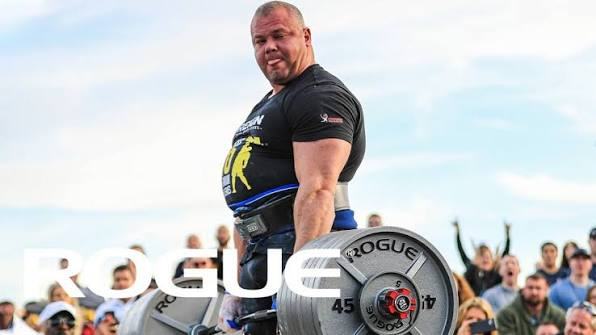
Iron Archives
Estonian deadlift master • three-time World Deadlift Championships winner
Active athlete
Rauno Heinla is an Estonian professional strongman born on 7 June 1982 in Tartu and one of the longest-tenured, most accomplished deadlift specialists in modern strongman. Active in strongman since 2000, he is a six-time Estonia’s Strongest Man champion, winner of the 2017 Arnold South America and 2018 Arnold Australia, winner of the 2014 SCL Savickas Classic and SCL Estonia, and a three-time World Deadlift Championships winner in 2019, 2022 and 2024. He set a 476 kg Masters world record in the standard strongman deadlift, a 580 kg world record in the Silver Dollar Deadlift and a 540.25 kg world record in the 18-inch deadlift. In 2020 he pulled 400 kg for six repetitions, and in 2023 he won Masters World’s Strongest Man. Strongman Archives records three World’s Strongest Man appearances and more than sixty international contests, while his career from the early 2000s into his forties has made him a defining figure in Estonian strength sport.
Rauno Heinla occupies an unusual place in modern strongman history. He is not a World’s Strongest Man champion and he did not build his reputation by dominating one entire international circuit, yet few athletes of the last two decades have turned a single event into a personal signature as clearly as Heinla has with the deadlift. Born on 7 June 1982 in Tartu, Estonia, he remained competitive long enough to face athletes who effectively belonged to different eras of the sport. He shared platforms with Tarmo Mitt, Andrus Murumets and Žydrūnas Savickas when Eastern European strongman still had a strongly regional structure, then with Brian Shaw, Hafþór Júlíus Björnsson, Martins Licis and Jean-François Caron during the global expansion of the Arnold circuit, and after 2020 he continued to compete against Oleksii Novikov, Mitchell Hooper, Trey Mitchell and a new generation of static-strength specialists. Strongman Archives records his international activity from 2004 through 2025, while Heinla himself states that he began strongman in 2000. The two timelines are not truly contradictory: the database begins with contests documented in its archive, whereas Heinla’s personal career began earlier in Estonia’s local scene. That length of service is central to understanding him. In a sport where extreme body mass, connective-tissue injuries, travel costs and systemic fatigue routinely shorten careers, Heinla remained internationally relevant after forty and produced several of his greatest lifts during that period.
His résumé captures the range of that career: six Estonia’s Strongest Man titles, victories in Strongman Champions League, wins at the 2017 Arnold South America and 2018 Arnold Australia, fourth place at the 2021 Europe’s Strongest Man, three World Deadlift Championships victories in 2019, 2022 and 2024, the 2023 Masters World’s Strongest Man title, and world-level records across several pulling geometries. A 476 kg standard strongman deadlift gave him a Masters world record in 2022; 580 kg in the Silver Dollar Deadlift is listed by the World Deadlift Council as the overall men’s world record; 540.25 kg from 18 inches was achieved in Tartu in 2023; and his six repetitions with 400 kg in the 2020 WUS Feats of Strength series became one of the defining images of his specialization. Yet Heinla’s biography is not simply the story of a man who pulls enormous barbells. Behind the numbers is an athlete formed in an Estonian strength culture that was already unusually strong, a competitor who rebuilt himself after a severe Achilles tendon injury, a family-oriented man who has kept much of his private life outside the spotlight, and in the mature stage of his career a certified personal trainer who passes on decades of accumulated experience. In his case longevity is not a statistical accident. It is the product of an athletic identity that changed with his body, his age and the sport’s evolving circuits without losing its core: the desire to become stronger and an almost technical obsession with the deadlift.
Current biographical sources place Heinla’s birth on 7 June 1982, and public Estonian sports documents also use the date 07.06.1982. An older Estonian interview once printed a different date, 6 July, a useful example of why a serious athlete profile must compare sources rather than repeat the first line it finds. His birthplace is Tartu, one of Estonia’s major educational and sporting centres. In an extensive 2014 interview Heinla recalled that his first contact with organized strength competition came very early, at around ten years old, when Margus Pärsik took him to a weightlifting competition. Before strongman he practised both powerlifting and Olympic-style weightlifting, two disciplines that gave him precisely the foundation he would later exploit. Powerlifting taught him the squat, bench press and deadlift as measurable technical skills, together with the patience required to build maximal strength. Weightlifting introduced faster extension, positioning and the principle that raw force is only useful if the implement travels through an efficient path. Strongman eventually became his main sport, but he did not enter it as someone learning to lift for the first time. His body had already been educated by barbell sports with more standardized rules and movement patterns.
Heinla says he began strongman at roughly eighteen years of age, in 2000. His first experience bore little resemblance to the modern televised arena. He has recalled weighing only about 85 kg at an early contest and being required to carry two farmer-style implements of roughly 86 kg each for 40 metres. Eventually he could no longer move both at once and finished by moving them separately. The story matters because it strips away the retrospective myth of the predestined champion. The man who would later pull 580 kg in the Silver Dollar Deadlift did not enter strongman by effortlessly lifting impossible weights. He entered an event that exceeded his current ability, improvised and completed what he could. Strongman development is full of such episodes because athletes rarely receive a standardized technical curriculum for every implement. Adaptation to failure is part of the education. Heinla was also fortunate to develop inside a country with an unusually dense strength culture. Tarmo Mitt became a World’s Strongest Man finalist, Andrus Murumets developed a fearsome reputation for raw strength and deadlifting, and Lauri Nämi became both rival and training partner. Heinla was not growing in isolation. He entered an environment where the domestic standard was already internationally meaningful, and before online coaching libraries and instant video analysis, experienced training partners were among the most important sources of knowledge.
Strongman Archives begins Heinla’s international chronology in 2004 at the Ventspils Cup in Latvia, where he placed sixth. Podiums followed at the 2006 Dobele and Ventspils Cups, and in 2008 he appears on the podium of the Estonian Strongman Grand Prix. These were not yet the results of a global star, but they show the bridge from local strongman into the Baltic international scene. For an Estonian athlete of that period, Latvia, Lithuania and Finland offered a natural pathway. The contests were geographically accessible while still being strong enough to expose weaknesses that domestic competition could hide. Heinla needed years before his name became a regular feature in major international fields. By 2009 a sixth-place finish at the Ultimate Strongman Championships in Brisbane showed how far the geography of his career had expanded. Travelling to Australia for strongman at a time when the sport offered far less money and infrastructure than it does today was a significant commitment. In 2010 he finished second at the East Finland Challenge. These stages are easy to overlook once a career is summarized by championships and records, but strongman is learned through repeated exposure to unfamiliar objects, surfaces and rules: a yoke that oscillates differently, a thicker farmer handle, a stone with less grip, a truck whose rolling resistance cannot be recreated exactly in training.
During these years the athletic profile that would define Heinla also became clearer. He was not one of the heaviest men in international fields. In the 2014 interview he described himself as one of the lighter athletes in Strongman Champions League, where many rivals weighed roughly 145 to 185 kg. His own bodyweight has varied across his career, with contemporary sources usually placing him somewhere around 135–144 kg, entirely normal for an Open athlete whose mass changes with the season. At about 1.83 m, he is relatively compact for heavyweight strongman. That creates both advantages and disadvantages. A lower centre of mass and shorter pulling geometry can help in some deadlift situations and with certain objects, while long-stride speed events, some yoke and carry formats, and implements designed around very tall athletes may be more costly. Heinla learned that his route to success could not depend on being the biggest person in the contest. He had to be technically efficient and maximize events where his anthropometry and strength interacted favourably. The deadlift became the clearest expression of that strategy, but stones and several overhead formats remained genuine weapons, as shown by repeated event wins throughout his record.
One of the most important breaks in Heinla’s sporting biography did not occur at a world final but at a local contest in Kõrveküla. In his 2014 interview he described a severe Achilles tendon injury as the worst moment of his career. The tendon in his right leg ruptured while he was pushing a tractor. His account of what followed is disturbing: an initially estimated recovery of roughly half a year became complicated, the leg swelled and an infection developed. Heinla stated that the problem was not recognized in time and that at one stage a substantial section of tendon judged to be dead tissue was removed. According to his account, a very thin remaining portion ultimately made functional recovery possible. These medical details should be understood as the athlete’s own description rather than as an independent medical assessment. What is beyond dispute is the sporting consequence. An Achilles rupture is a major threat to a strongman who must accelerate under a yoke, pull vehicles, load stones and transfer force through the entire posterior chain. Every forceful step under hundreds of kilograms becomes a negotiation with tissue that has already failed once.
Heinla returned after extensive rehabilitation and again reached international level, but he said the leg never became completely ordinary. Even something as simple as playing football with his child could leave it painful afterward. The contrast is instructive: being able to execute a controlled maximal lift does not mean the body tolerates every everyday activity equally well. More importantly, the injury appears to have influenced how he thought about contest selection. In the same interview he argued that once an athlete reaches world level, entering every small contest can become an unnecessary risk. Strongman does not take place on perfectly standardized equipment. A local implement may be damaged, the surface unpredictable, or a spectacle-driven event may combine speed and load in a dangerous way. Heinla learned that lesson brutally. His later longevity should be read partly through this experience. He continued to compete often, but he became more aware of the balance between reward and risk, and in the second half of his career he increasingly gravitated toward major contests and events that rewarded static strength. The fact that he could still pull 476 kg, 540 kg from 18 inches and 580 kg on the Silver Dollar after forty demonstrates not the absence of injuries but the ability to build performance around them.
The first major domestic landmark came in 2008 when Heinla won Estonia’s Strongest Man. In a small country with a disproportionately strong history in the sport, the title was far from ceremonial. Tarmo Mitt and Andrus Murumets had established serious international standards, making the national championship a genuine test. By 2014 Heinla had reached four titles and publicly discussed his ambition to equal Mitt and Murumets, who had five each. In 2015 he went beyond them by claiming a sixth championship, a result ERR reported as a national record. The circumstances reveal something about his competitive psychology. Only a week earlier he had competed in a Strongman Champions League event in Finland and finished third against a strong international field. He arrived at the Estonian championship fatigued and, according to his own account, ill with a fever. Yet he rejected the idea of withdrawing because the sixth title had become a personal objective. The battle with Markus Männik remained extremely close. After deadlift, carries and pulling, the points were tight and the final stone-loading event became decisive. Heinla won the event and the championship by 63 points to 62.
The six-title record matters not only statistically but because of the way Heinla remained connected to the Estonian scene after becoming an international athlete. Many competitors who reach Giants Live or Arnold level drastically reduce domestic appearances because the prize money, visibility and recovery trade-offs are less favourable. For a period, Heinla continued to treat the national title as meaningful. His relationship with the local strength community also remained visible through training, competitions in and around Tartu, and later his coaching work. Estonia’s sports registry connects his activity with Rammukoobas, a Tartu strength-sport facility associated with powerlifting and related disciplines. His contemporary profile is therefore not that of an athlete who permanently left the system that produced him. Estonia remained his base even as the competition calendar took him to Australia, South Africa, Brazil, the United States, the Middle East and Britain. That continuity helps explain why records achieved in Tartu or Viljandi carried special weight. For a man with dozens of international competitions, some of the biggest lifts of his life were still produced at home in front of the community that had watched him develop.
In 2011 Heinla’s career made its first unmistakable jump onto the world stage through Giants Live Finland. He finished third in a ten-man field, a result he later described as one of the happiest moments of his career because it earned qualification to World’s Strongest Man. Giants Live was already functioning as one of the principal gateways to WSM, so a podium meant more than a trophy. It granted access to the contest that still defined the public image of the sport. At the 2011 World’s Strongest Man in the United States, Heinla was placed in a difficult qualifying group and finished fifth of six, missing the final. Viewed from the perspective of his later records, that placement can look modest, but the context is crucial. An athlete coming from the Baltic circuit had arrived on the same stage as men already familiar with the WSM environment. Qualification confirmed that Heinla’s strength had travelled beyond regional boundaries. It also exposed the gap between being extremely good in Northern and Eastern Europe and collecting enough points in a WSM format, where complete event coverage matters more than dominance in one lift.
That first WSM appearance remained his only one for more than a decade, an unusual fact for an athlete who would win Arnold regional contests and become one of the world’s best deadlifters. There is no single explanation. Qualification systems, invitations, schedules and event profiles changed from year to year, while Heinla spent large parts of his career in Strongman Champions League and the Arnold circuit rather than exclusively following the Giants Live route. His strongest event profile also did not always match the requirements of WSM qualification. Strongman Archives ultimately records only three World’s Strongest Man appearances: 2011, 2023 and 2024. In 2023 he reached third in his group, his best qualifying-stage finish, while in 2024 he again missed the final. The relationship between Heinla and WSM is therefore one of the great oddities of his résumé: an athlete with world records, Arnold wins, a European top-four finish and World Deadlift Championships titles never reached a WSM final. That does not invalidate his career. It illustrates how fragmented elite strongman can be. Unlike a sport with one world championship and one ranking ladder, strongman can produce a historically important specialist or circuit champion whose WSM record reflects only part of the athlete he became.
The 2014 season is one of the decisive turning points in Heinla’s career. He was already an experienced international competitor, but he had not yet accumulated the kind of victory that moved an athlete from dangerous contender to proven closer. In Strongman Champions League he opened the year with fifth at Giants Live Norway and later finished third at SCL Finland in Vaasa. The Estonian interview from that summer captures a period of unusual confidence. Heinla said he believed he was in the best shape of his life and that his goal was no longer simply to participate but to approach the very top of the world. At the Savickas Classic in Vilnius in October, the ambition became a result. The contest featured eight events and twelve athletes, and Heinla won with 77.5 points ahead of Vidas Blekaitis and Matjaž Belšak. It was not a victory created by one deadlift masking a poor evening elsewhere. The format included sled pull, super yoke, front hold, stone over bar, tractor pull, overhead medley, shield carry and a medley. That variety is precisely why the win matters when evaluating Heinla. It demonstrates that the later label of “deadlift specialist” should not be projected backward onto every stage of his career.
Two weeks later Heinla won SCL Estonia in Tallinn, giving him two major Strongman Champions League victories in October 2014. The double changed his status on the circuit. Podiums had shown that he could keep pace; now he had shown that he could control a full contest. His overhead strength at the time was good enough to win or challenge pressing events, and stones remained one of his strongest disciplines. In the 2014 interview, when asked which events he preferred, Heinla named deadlift for repetitions, stone lifting and the squat. Modern audiences often associate him almost entirely with pulling, but he still understood himself as a broader athlete whose strongest qualities were events combining raw force with rhythm. Strongman Champions League also demanded heavy travel in that era, often with short recovery windows. Athletes had to decide how much to compete and how much to protect training blocks. Heinla experienced both sides of that equation. He valued international exposure, but after the Achilles injury he had become more aware that every start carries a cost. The 2014 season was one of those periods when health, volume and form aligned well enough to produce several important results in rapid succession.
In 2015 Heinla added two very different milestones. Domestically he captured his sixth Estonia’s Strongest Man title, moving beyond the five championships won by Tarmo Mitt and Andrus Murumets. Internationally he gained entry to Europe’s Strongest Man after an episode that says almost everything about his deadlift reputation. Organizers asked prospective entrants to demonstrate on video, under witnessed conditions, that they could pull at least 400 kg. Heinla performed a 440 kg deadlift while training partner Lauri Nämi observed, and ERR reported that the lift secured his invitation to Leeds. Europe’s Strongest Man 2015 occurred during a transitional moment in deadlift history, when the race toward 500 kg was becoming almost mythic. Heinla finished tenth overall at ESM but third at the World Deadlift Championships held within that environment. The contrast is instructive. In a full contest points are distributed across carries, overhead work, stones, pulls and other disciplines. In a deadlift championship Heinla’s profile immediately became far more valuable. The same athlete could be tenth over an entire show and among the three best in the world in one lift.
The 2015–2016 period marks his transition toward a career increasingly built across global circuits. Heinla remained visible in Strongman Champions League while entering the Arnold Pro Strongman World Series. In 2016 he finished fifth at Arnold Africa and Arnold Asia and sixth at Arnold Europe. Those are not championship results, but they show important consistency in a circuit attracting athletes from several continents, where each stop could offer qualification opportunities or points toward the Arnold Strongman Classic. For an athlete from a small media market, repeatable results mattered. Heinla was not marketed through an outsized television persona or a manufactured rivalry. His currency was performance. The years after the Achilles injury also proved that the comeback had not been temporary. He could again survive international travel, recover between contests and accumulate placements without the leg forcing him out of the sport. That set the stage for 2017 and 2018, the seasons that produced the most important full-contest victories of his career.
On 22 April 2017 Heinla won Arnold South America in São Paulo. Strongman Archives and modern result databases place him ahead of Jerry Pritchett and Mateusz Kieliszkowski, two opponents who perfectly represent the level of that era. Pritchett was already one of America’s premier deadlifters, while Kieliszkowski would soon become one of the most spectacular all-round strongmen in the world. Beating them made the Brazilian victory more than a regional line on a résumé. It proved that Heinla could win an Arnold Open contest rather than merely take a specialist event. During the same season he placed fourth at Arnold Australia and third at Arnold Africa. The sequence demonstrates that São Paulo was not a one-day anomaly. Within a few months Heinla transferred performance across Australia, Brazil and South Africa, with different climates, time zones and equipment. That adaptability is often underestimated in professional strongman. Intercontinental travel alters sleep, food, hydration and training rhythm; local implements are not identical; and athletes may compete with incomplete information about exactly how a yoke or bar will behave.
The 2017 victory also strengthened Heinla’s relationship with the Arnold system. Unlike WSM, where his appearances were rare, the Arnold circuit became the stage on which his international career was most visible for several years. Arnold formats often rewarded extreme static strength while still demanding enough movement to expose incomplete athletes. That balance suited Heinla better than many qualifying structures. By then his deadlift had moved into the highest tier of the sport, yet he could still collect strong points on log, stones and other events. It is also worth noting that Heinla was not an athlete who peaked unusually young. He was 34 in 2017, a normal prime age for many heavy strongmen but already carrying nearly two decades of strength training and the legacy of a major Achilles injury. His most extraordinary deadlift records were still ahead. The Brazilian win belongs in the middle of his story, not at its end: it captures an athlete experienced enough to manage a contest tactically but still far from the ceiling of his pulling strength.
In March 2018 Heinla won Arnold Australia in Melbourne with 56 points, ten clear of Jean-François Caron and ahead of Martins Licis, Matjaž Belšak, Trey Mitchell and Dimitar Savatinov. The quality of the field makes the contest one of the strongest arguments for Heinla’s versatility. Caron was an exceptionally consistent veteran and elite deadlifter; Licis would win World’s Strongest Man the following year; Mitchell would later become a two-time Shaw Classic champion. Beating all of them across a six-event contest cannot be explained by one specialization. Heinla scored well enough throughout the format to create a huge overall margin. The victory also secured his route into the main Arnold Strongman Classic. Later in 2018 he placed third at Arnold South America and fourth at Arnold Africa, again confirming that Melbourne was not an isolated peak. Anyone who evaluates Heinla exclusively through deadlift records misses this phase in which he was one of the most efficient overall athletes on the Arnold qualifying circuit.
At the 2018 Arnold Strongman Classic in Columbus, Heinla finished eighth. The main Arnold contest operated at a different level from the qualifiers, with events designed to probe absolute limits and a field made almost entirely of men capable of winning world-class shows. For Heinla, simply reaching that stage validated his place in the elite group. The same season also produced a deadlift result that foreshadowed the direction of his later career. At 2018 Summermania he pulled 505 kg from 18 inches and won the event. Five years later he would push that family of lifts to 540.25 kg. The progression illustrates how an athlete can become increasingly specialized without immediately abandoning full contests. From 2017 through 2019 Heinla still pursued high overall placings, but it was becoming obvious that his deadlift was separating from the rest of his profile. That separation eventually gave him something resembling a second career inside the first: even when age, recovery or moving events became more difficult, he remained valuable to the biggest promoters because very few people on earth could pull what he could.
The 2019 season is one of the densest on Heinla’s résumé. At the Arnold Strongman Classic in Columbus he finished sixth, his best placing at the main contest. That year Strongman Archives and athlete profiles credit him with a 431.5 kg Elephant Bar Deadlift, a remarkable pull on a setup that behaves very differently from a standard bar. The Rogue Elephant Bar is longer and more flexible, so plates leave the floor progressively as the bar bends. That changes when the athlete experiences the full load and increases the demand for control near lockout. At Arnold Australia 2019, Heinla finished third and produced another cluster of notable results: a 500 kg 14-inch frame deadlift, a 192.5 kg max log and an Atlas Stones event victory. The combination says something important about him. Although the deadlift was becoming increasingly dominant, stones had not disappeared from his arsenal and his log remained internationally respectable. At other Arnold stops in 2019 he again reached podium positions and collected event wins in deadlift and arm-over-arm pulling.
At World’s Ultimate Strongman Dubai 2019, Heinla finished fifth of fourteen and won the max deadlift with 450 kg. The overall result matters because it came in a world-level Open contest rather than a single-lift show. He converted his strongest event into enough advantage to stay inside the overall top five even when moving events were less favourable. That same year he would secure his first World Deadlift Championships title, shared with Jerry Pritchett. Together these performances permanently changed how the public viewed him. He was no longer simply a reliable Estonian strongman or an Arnold regional winner. He was now one of the men any promoter had to consider when staging an extreme deadlift event. In strongman reputation has a practical consequence: invitations to single-lift spectacles depend on an athlete’s ability to make record attempts credible. Heinla had become exactly that athlete. When his name appeared on a start list, 450, 470 or even 500 kg no longer functioned as marketing decoration. They were plausible outcomes.
Explaining Rauno Heinla’s deadlift as simply “back strength” misses the complexity of elite pulling. Once the bar moves beyond 450 kg, the difference between a very strong athlete and one who can reproduce world-level performance is the entire system: start position, pressure management, tolerance to spinal and hip loading, use of belt and suit where rules permit, bar path, synchronization of knee and hip extension, strap-assisted grip, and above all the ability to preserve mechanics under fatigue. Heinla has shown unusual efficiency in both maximal and repetition work. Six repetitions with 400 kg in 2020 and nine repetitions with 360 kg on an axle at Europe’s Strongest Man 2021 demonstrate that he is not merely an athlete capable of one enormous neural effort before performance collapses. He can recycle tension, reset quickly and retain a sufficiently efficient path to repeat loads that are close to maximal for most elite strongmen. His compact anthropometry helps in some phases, but it does not explain the performance by itself. There are many 1.83 m athletes who never approach these numbers. Geometry only becomes an advantage when supported by decades of specific adaptation.
Another defining feature is the variety of pulling configurations Heinla mastered. A standard bar starts near nine inches and demands enormous force from the bottom. The Elephant Bar introduces substantial flex and instability. An axle is stiffer and alters the feel of the break from the floor. An 18-inch deadlift shortens the range and shifts more emphasis toward lockout strength, permitting loads beyond 500 kg. The Silver Dollar Deadlift has its own geometry and bar behaviour, which is why Heinla’s 580 kg record cannot be compared kilogram-for-kilogram with a standard deadlift. His distinction lies in excelling across all these families without confusing their standards. Every record needs the implement and start height attached to it. Internet culture sometimes collapses the numbers into a single ladder, where 580 would automatically look “better” than 501 or 510. Technically that comparison is false. What can be said with confidence is that Heinla produced elite results in multiple versions of the same fundamental task, and that adaptability separates him from specialists who dominate only one setup.
The 2019 World Deadlift Championships, staged within Giants Live Wembley, gave Heinla his first world title in the event that had already shaped his reputation. He shared the championship with American Jerry Pritchett. Ties in a maximal strongman deadlift do not diminish the achievement; they reflect the competition format, where predetermined jumps can leave several athletes with the same highest successful weight if none completes the next attempt. For Heinla the shared victory was also symbolically important. Pritchett was one of the most respected deadlifters of his generation and, like the Estonian, had built a large part of his sporting identity around pulling. Sharing a world title with him placed Heinla officially inside an extremely small group. From that point, discussions about the premier deadlifters of the era had to include Heinla not merely because of training videos but because of a championship result. The broader Wembley contest again exposed the central tension of his mature career: as the deadlift became increasingly extraordinary, the gap between that event and some moving disciplines became more visible.
The 2019 championship also changed the scale of future objectives. Eddie Hall’s 500 kg deadlift in 2016 had redrawn the psychological boundary of the sport, and Hafþór Björnsson would lift 501 kg in 2020. From there, promoters and athletes increasingly talked about 505 kg and beyond. Heinla entered that conversation less through theatrical predictions than through a sequence of lifts that showed reserve: 450 kg in competition, 460 kg and more in training, and eventually repetition sets that were near-maximal for most rivals. Even when he did not convert that potential into the Open standard-bar world record, his presence influenced the credibility of World Deadlift Championships lineups. Promoters needed athletes who could clear the early stages with confidence and remain relevant when the bar approached the 470–500 kg range. Heinla was one of them. In the following years he would prove that this capacity could be maintained and even expanded after turning forty, shifting the conversation from the Open record alone toward Masters records and the broader question of how long a pulling specialist could remain at the edge of human performance.
The year 2020 disrupted the normal strongman calendar but also created unusual competitive experiments. World’s Ultimate Strongman ran its Feats of Strength series, with athletes performing monitored and broadcast attempts while ordinary arena events were heavily restricted. For Heinla the format became the stage for one of the most memorable performances of his career: 400 kg for six deadlift repetitions. Four hundred kilograms is a threshold few strongmen can treat as a repetition weight at all. At that load every complete cycle requires not only enough strength to break the bar from the floor but also the ability to return to a position that permits another safe and efficient pull before technique decays. Heinla completed six repetitions and set the world record for the format. The official video became one of the most widely circulated pieces of evidence for his extraordinary work capacity. Unlike a one-repetition maximum, which can be prepared for as a single peak effort, a six-rep set with 400 kg exposes maximal strength, local endurance, technique and psychological tolerance simultaneously.
The 2020 performance is also essential when comparing Heinla with other great strongman deadlifters. Eddie Hall and Hafþór Björnsson defined an era through absolute maximums of 500 and 501 kg; Benedikt Magnússon remains a historic reference for raw pulling; Jerry Pritchett, Adam Bishop, Graham Hicks, Ivan Makarov and later Mitchell Hooper, Trey Mitchell and others built their own elite profiles. Heinla stands out through breadth. He did not own the Open standard-bar record, but he combined extremely heavy floor pulls with monstrous repetition strength and world-class elevated deadlifts. In a sport without one standardized deadlift setup, that versatility matters. It explains why his name remains central to discussions about the best pullers even when another athlete owns the largest single standard-bar number. A strongman deadlifter is not simply the person with the biggest figure in one column. He is the athlete who can translate pulling strength to flex bars, axles, frames, repetitions, ladders and different start heights. Heinla built one of the most coherent modern résumés across that entire spectrum.
At the 2021 Europe’s Strongest Man, Heinla produced one of the most complete performances of the mature phase of his career. He finished fourth overall, his best result in the competition, against a field containing younger athletes highly adapted to the Giants Live format. The central moment was the 360 kg axle deadlift for repetitions. Heinla completed nine reps and won the event ahead of Graham Hicks, Oleksii Novikov and the rest of the field. An axle behaves differently from a conventional deadlift bar. It is stiffer, so the athlete feels the full load earlier, and fast repetitions demand a fine balance between resetting position and saving time. Heinla treated 360 kg as a working weight in conditions where many elite strongmen were fighting for only a few repetitions. He was also highly competitive on Atlas Stones, completing the 100–180 kg series in 21.20 seconds, another reminder that stones remained a meaningful strength well into the later years of his career.
Fourth place at Europe’s Strongest Man is perhaps the clearest evidence against reducing Heinla to a single-event specialist. Missing the podium by a relatively small margin in a complete contest requires points across several disciplines. It also demonstrates how experience can compensate for part of the athletic decline associated with age. At 39, Heinla no longer needed to discover how every implement behaved. He knew where he could take risks and where limiting damage was the smarter choice. Strongman is a points sport rather than a collection of independent personal records. Sometimes finishing sixth in a poor event is more valuable than forcing an attempt that produces an injury and zero points. Heinla had accumulated hundreds of those decisions. During the same season he placed second at Força Bruta and competed at WUS Dubai, Siberian Power Show and Giants Live World Open. The volume shows that his body could still tolerate a global calendar despite age and old injuries. That resilience would be tested in a paradoxical 2022 season containing both withdrawals and historic records.
Heinla was named to the 2022 World’s Strongest Man field but could not turn the invitation into a completed appearance, withdrawing amid health problems reported by strength-sport media as gastrointestinal issues. The episode is a useful reminder that elite strongman preparation is not reducible to strength. An athlete weighing well over 130 kg, travelling internationally, manipulating food and hydration and preparing to compete across several days can be compromised by any problem that interferes with energy intake or fluid balance. For Heinla the withdrawal was especially frustrating because his deadlift training indicated enormous form. In June, however, he answered with a performance that went directly into the event’s record books. At the Estonian Silver Dollar Deadlift Championships in Viljandi he pulled 580 kg, establishing a world record for the configuration. The World Deadlift Council continues to list 580 kg as the men’s overall Silver Dollar Deadlift record. Because the implement begins from an elevated position and produces much more bar flex than a conventional deadlift, the figure cannot be compared directly with a standard pull from the floor. Within its own discipline, however, 580 kg remains an exceptional benchmark.
The Viljandi record captures one of the central paradoxes of Heinla’s career: several of his greatest lifts arrived during periods when full-contest results were not perfect. That is a natural consequence of specialization. Preparing for an extreme deadlift record can require training volume and intensity that reduce speed, pressing readiness or recovery for a five- or six-event contest. An athlete must decide what he is trying to optimize. After more than two decades in the sport, Heinla had earned the freedom to choose objectives more selectively. The 580 kg record provided a clear answer: every season no longer had to be judged solely by overall contest placings. He could produce historically important performances within the discipline in which experience had become an increasingly valuable advantage. That did not mean abandoning full strongman. During the same year he finished sixth at Giants Live World Open, sixth at the World Tour Finals, third at Arnold UK and second at Masters World’s Strongest Man. But the centre of gravity had shifted. Deadlift was no longer only his best event; it was the platform through which he could extend his elite relevance beyond the usual age limits of Open strongman.
On 6 August 2022 in Cardiff’s Motorpoint Arena, Rauno Heinla produced the lift that became the central image of his standard-bar career: 476 kg. The World Deadlift Championships opened Giants Live World Open, and the bar rapidly entered territory that only a handful of athletes in history had reached. Heinla had turned forty two months earlier. By pulling 476 kg he did more than win the championship. He raised the Masters world record by roughly forty kilograms over the previous benchmark associated with Mikhail Shivlyakov. Giants Live emphasized the scale of the jump. At the time, 476 kg also stood among the heaviest strongman deadlifts ever completed from the floor. More importantly, the lift did not look like an act of desperation. Heinla later indicated that he did not consider 476 kg his absolute limit, but judged a larger Open-record attempt to carry an unnecessary injury risk. The statement offers a clear window into his sporting maturity. A younger athlete may feel compelled to chase the largest number available; a veteran who has already endured a catastrophic tendon injury and decades of competition understands that success can also mean stopping once the objective has been achieved.
The 476 kg pull remains a complex historical benchmark. Open records continued to advance after 2022, with later athletes moving beyond the numbers that dominated the conversation when Heinla won his title. That does not reduce the achievement. Masters classification adds another dimension: maintaining extreme force production after forty while carrying accumulated connective-tissue wear and slower recovery. As of 2026, the World Deadlift Council still lists 476 kg as the overall Masters standard deadlift world record. The lift is therefore not merely historical but current within its category. It also came only months after Heinla’s WSM withdrawal and shortly after the Silver Dollar world record. Instead of allowing health problems to define the season, he turned 2022 into one of the strongest years of his career. He later finished third at Arnold UK and won the deadlift there as well, showing that Cardiff had not been a one-night peak.
After Cardiff, Heinla continued to compete in the Open division. At Arnold UK 2022 he finished third in a fourteen-man field, one of the strongest overall placings of his late career. He won the deadlift and showed that his best event could still be converted into a full-contest podium. In October he placed sixth at the Giants Live World Tour Finals, and in November he entered Masters World’s Strongest Man. Masters strongman should not be understood as an easy retirement category. Fields include former WSM finalists, national champions and athletes who still possess Open-level numbers in individual events. In 2022 Žydrūnas Savickas won the title and Heinla finished second. The Estonian won events including the dumbbell medley and car walk, showing that entry into Masters did not mean abandoning dynamic strongman. The division instead gave his accumulated experience a setting where it could be measured against athletes of comparable age.
The runner-up finish created a clear objective for the following year. Heinla did not treat Masters competition as a ceremonial extension of his career but as a title worth pursuing. That attitude says much about his competitive identity. Having already won Arnold qualifiers, SCL contests and a World Deadlift Championship, he could have used the 40-plus division merely to remain visible. Instead he entered to win. At the same time he did not abandon Open competition. This overlap between divisions became a defining feature of 2022–2025. Heinla could be a single-event specialist at a World Deadlift Championships one weekend, an Open competitor at Europe’s Strongest Man on another, and a Masters title contender at the end of the year. Each format demanded a different allocation of training resources. A one-repetition-max deadlift requires exposure to very high intensity and neural recovery; a full Masters contest requires conditioning and implement practice; an Open ESM demands the ability to survive younger athletes’ speed. Remaining relevant in all three environments is one of the clearest expressions of his longevity.
In 2023 Rauno Heinla returned to a completed World’s Strongest Man campaign for the first time in twelve years. He was drawn into Group Four and finished third of six, the best qualifying-group result of his career. He did not advance to the final, but the contrast with 2011 was enormous. His first appearance had come as an athlete who had just earned entry through a Giants Live Finland podium; in 2023 he arrived as the Masters deadlift world-record holder and reigning World Deadlift Championships winner. He finished second in the Loading Race within his group, an important performance for someone whose later-career reputation centred on static strength. The result illustrates one of strongman’s enduring truths: experience can preserve technical competitiveness even after pure speed begins to decline. Heinla understood implement handling, how to remove unnecessary steps and how to control breathing under awkward loads. WSM, however, rewards the absence of weak events, and at forty even a few lost positions in the wrong discipline can become impossible to recover.
Never reaching a WSM final remains one of the conspicuous absences on Heinla’s résumé, but the 2023 performance changes how that absence should be interpreted. This was not an athlete incapable of belonging at WSM level. At more than forty years old, after two decades of contests and significant injuries, he finished third in his group. The rest of the season reinforces the point. In January he had already placed second at Australia’s Strongest International, where he won the Max Atlas Stone with 220 kg. Later he would set an 18-inch deadlift world record, finish second at the World Strongman Championships and win Masters World’s Strongest Man. Taken as a whole, 2023 may be regarded as one of the most complete seasons of his mature career. He combined Open competition, record attempts and Masters success without allowing any one of them to erase the others.
On 22 July 2023, at Tartu Rammumees ja Rammunaine, Heinla pulled 540.25 kg from 18 inches. Estonian public broadcaster ERR documented the performance as a world record above the previous mark associated with Oleksii Novikov. The contest carried special meaning because it took place in Heinla’s home city before a large local crowd. Heinla said the organization allowed him to focus completely on the attempt and that the spectators’ support provided a real advantage. Technically, an 18-inch deadlift starts with the bar much higher than the standard version, removing much of the initial range and shifting a larger share of the challenge toward the upper pull and lockout. Absolute loads rise dramatically. The result cannot be converted into an exact standard-deadlift equivalent and should not be compared linearly with 476 kg from the floor. Within its own discipline, however, 540.25 kg is an extraordinary demonstration of top-end pulling strength.
The Tartu record also fits the narrative of Heinla’s career almost perfectly. Nearly a decade earlier he had joked in an interview that many of his trophies no longer fitted at home and were stored at the Kõrveküla gym. In 2023, after years spent on stages across the world, one of his greatest lifts returned to his city of origin. Global strongman tends to concentrate attention in Britain, the United States and the largest Arnold festivals, but world records do not emerge only from the commercial centres of the sport. For one day Tartu became the centre of international deadlifting. For Estonia’s strength community, that means more than a number. A young athlete can see a record set on a local platform by someone formed inside the same national system and understand that world-class performance is not abstract. Heinla increasingly used that position as a coach as well, converting personal experience into knowledge for younger competitors.
The autumn of 2023 confirmed that the season was not only about the Tartu record. In October, at the World Strongman Championships in Talsi, Latvia, Heinla finished second in a twelve-man field. Strongman Archives records an event win on Natural Stones, further evidence that his relationship with stone lifting remained strong deep into his career. Competitions outside the most heavily marketed brands can be overlooked in international narratives, but they matter to a complete profile. Heinla spent two decades competing across multiple networks, not only in televised British or American events. The Baltic and continental European circuit was always part of his athletic identity. Second place in Latvia at 41 years old adds another example of an athlete still capable of accumulating points across a multi-event format.
In December, at Masters World’s Strongest Man, Heinla completed the step he had missed in 2022 and won the title. The event results show a far more varied performance than the deadlift-specialist label might suggest: first in the Deadlift Ladder, first in the Overhead Medley, first in Atlas Stones and second in the Sandbag Toss. He did not dominate every event, and the Carry Medley cost him substantial points, but that is precisely where mature competition management becomes visible. Championships are not won through perfection; they are won by maximizing strong events and limiting damage in weaker ones. Heinla accumulated enough points for the title. The victory also closes a striking arc that began with the severe Achilles injury. An athlete whose leg function had once been placed in doubt became a world Masters champion through a contest containing carries, loading, throwing, pressing, deadlifting and stones. His longevity was not merely the ability to remain in the gym. It was competitive longevity.
In 2024 Heinla continued in the Open division. He finished seventh at Europe’s Strongest Man and returned to World’s Strongest Man for the third appearance of his career. His group in Myrtle Beach included younger, highly mobile opponents, and he finished outside the final. The important context is that at nearly 42 he was still being invited to and competing in the sport’s most famous contest. The WSM appearance did not produce the final he had pursued, but it did not define the season. In September, at Las Vegas, World Deadlift Championships delivered a result far closer to his core identity. Heinla pulled 470 kg, and the title was shared among him, Mitchell Hooper, Ivan Makarov and Trey Mitchell, all stopping at the same highest successful weight.
The shared 2024 victory gave Heinla his third World Deadlift Championships title after 2019 and 2022. His official website now describes him as a three-time Deadlift World Champion, and competition records support those three editions as wins or shared wins. The fact that the third title arrived at 42 is remarkable even in a sport where static-strength specialists can often remain competitive longer than speed-based athletes. Recovery between heavy exposures becomes a central variable at that age, while connective-tissue risk grows. Heinla compensated through experience and the ability to choose when to push. A 470 kg pull was not a personal record, but championship strategy does not require lifting more than the field. The economy of the decision matters. After more than twenty years in strongman, Heinla could continue to expand his résumé without forcing a new absolute maximum every time he stepped onto a platform.
The 2025 season is one of the clearest measures of Heinla’s longevity. At Europe’s Strongest Man, aged 42, he again finished seventh. The overall placement tells only part of the story. In the axle deadlift he completed eight repetitions and won the event against a twelve-man European field. On Atlas Stones he finished third, loading the 120–200 kg series in 28.44 seconds. Other events, particularly carry-and-drag work, shield carry and the overhead medley, cost enough points to make an overall podium impossible. The distribution is almost a miniature portrait of his late career: pulling strength and stone technique remained elite, while prolonged moving events and high-volume overhead work became harder to monetize in the standings.
In July 2025 at Eisenhart in Germany, Heinla pulled 460 kg in the max deadlift and finished second overall. In September at the World Deadlift Championships in Birmingham, he lifted 440 kg and tied for seventh in a contest won by Hafþór Björnsson with 510 kg. The drop from 470–476 kg to 440 kg on one night should not be read automatically as a linear decline. Maximal deadlifting is highly dependent on daily form, attempt selection, the surrounding calendar and physical condition. Only weeks earlier, 460 kg had demonstrated that Heinla remained in territory very few athletes ever reach. Strongman Archives currently ends his indexed competition chronology in 2025, while his personal website and coaching activity still present him as an active athlete rather than a retired one. With no formal retirement announcement located, active remains the most accurate status as of late September 2026.
In his 2014 interview Heinla described the base of his preparation in simple terms: ordinary strength training combined with strongman-specific work at least once a week and more often during competition season. He emphasized that each event has its own technical tricks and that raw strength alone is insufficient. The same idea remains central to his contemporary coaching. On RaunoHeinla.com, programs are presented as individualized plans built around goals, equipment, schedule, fatigue tolerance and video feedback. For competitive athletes the services include periodization, attempt selection, technical analysis and contest support. That structure reflects what a long strongman career teaches. There is no single template. An athlete with access to log, yoke, stones and farmer handles must be programmed differently from one training only with a barbell and rack. A novice learning positions needs different priorities from an advanced competitor whose main problem is fatigue management.
According to his RH Superior site, Heinla holds an IntensivePT Personal Trainer EQF Level 4 certification. Certification does not convert every training opinion into universal scientific evidence, but it demonstrates that his coaching activity is formalized rather than being an informal service offered only on reputation. Testimonials published on his platform include Estonian athletes who credit his programming with national titles, log-lift podiums and junior progress. Because those testimonials are hosted on his own site, they should be read as client accounts rather than independent studies. Even so, they reveal how Heinla works: video review, technical correction, weekly blocks and adjustment to athlete response. The philosophy is consistent with the way he prolonged his own career. After two decades, progress rarely comes from adding random volume. It comes from selecting the stimulus that still produces adaptation and removing costs that no longer do.
Public information about Rauno Heinla’s personal life is relatively limited, and that boundary deserves to be respected. His official profile states that he has a daughter, Marie Heinla. In the 2014 Estonian interview he described himself as an ordinary family man who spent considerable time with loved ones and had little interest in party life. At the time he spoke with satisfaction about completing a house on which he had worked for roughly two years. He also mentioned that the consequences of the Achilles injury meant that something as ordinary as playing football with his child could produce pain afterward. These details are enough to show that his identity has never been limited to competition without turning his family into a subject of investigation. There is no editorial justification for filling gaps with assumptions about relationships, marriage or other private matters that the athlete has not chosen to make public.
That discretion contrasts with the current era of strongman, in which many athletes convert everyday life into continuous content. Heinla is present on Instagram, YouTube and other platforms, but his public communication remains focused largely on training, lifting, contests and coaching. The RH Superior brand and personal website extend that professional identity without turning family life into a media product. For a biographical profile, that is information in itself: the public figure has chosen a boundary around what he offers the public. Respecting that boundary makes the profile more accurate rather than less complete. Family orientation may also help explain some choices Heinla described earlier in his career. In 2014 he said that although strongman had given him opportunities to travel, he remained strongly connected to home and family. His later international schedule expanded dramatically, but Tartu continued to function as the centre of gravity of his career.
Modern result databases allow a colder look at Heinla’s competitive profile. Secondary statistical summaries identify deadlift as his strongest event family and farmer-style moving events as one of the weaker areas by average placing. Strongman Archives supports the same broad picture through individual results: Heinla repeatedly wins or reaches podium positions in deadlift, scores well on stones and can produce strong pressing results, but more often loses points on farmer’s walk, yoke or very fast carry combinations. The profile changed over time. In younger and middle career phases he could compensate movement more effectively; after forty, the gaps between event families became more pronounced. Europe’s Strongest Man 2025 provides a clean example. He won the axle deadlift and placed third on stones but finished much lower in shield carry and carry-and-drag. It is almost a compressed radiograph of the late-career athlete.
Stones deserve particular attention. Heinla said as early as 2014 that stone lifting was among his favourite events. In 2019 he won Atlas Stones at Arnold Australia; in 2021 he completed the ESM series in 21.20 seconds; in 2023 he lifted a 220 kg stone to win Max Atlas Stone in Australia and won stones at Masters World’s Strongest Man; in 2025 he was third on the ESM stone series. The continuity shows that his technical identity was never reduced to a barbell. Stones require hip extension, arm and torso strength, but also a sequence unlike conventional deadlifting: lap, reposition, extension and load. It is biomechanically logical that a great deadlifter may possess useful qualities for stones, but excellence is not automatic. Many world-class pullers are inefficient on spherical objects. Heinla was not.
Estonia has produced a remarkable number of elite strongmen relative to its population. Tarmo Mitt, Andrus Murumets, Lauri Nämi and others built, before and alongside Heinla, a tradition that made domestic contests far more than a regional curiosity. Heinla added two distinctive elements to that tradition: a record six national championships and exceptional international longevity. If Murumets is remembered for raw power and pulling ability, and Mitt for repeated World’s Strongest Man finals, Heinla became the figure who carried Estonian strength culture into the era of online record attempts, modern Giants Live and the post-2020 global circuit. His lifts are documented instantly, analysed frame by frame and compared with athletes on other continents. Yet the root remains local: Tartu, Estonian gyms, training partners and domestic competitions.
Historically, Heinla cannot be ranked as a deadlifter through one record alone. The Open standard-bar world record belonged to other athletes at different points, and by 2026 the largest figures had moved beyond the thresholds that dominated conversation when Heinla won his first title. But his record includes 476 kg standard in Masters, 470 kg at 42 for a shared world title, 580 kg Silver Dollar, 540.25 kg from 18 inches, 500 kg frame from 14 inches, 431.5 kg Elephant Bar, 400 kg for six repetitions and 360 kg for nine on an axle. That diversity is the central argument. Heinla was not merely the man of one bar, one start height or one ruleset. He translated pulling strength across configurations. That is why his name remains relevant even as absolute records continue to rise.
Reconstructing Rauno Heinla’s career requires comparison across several kinds of sources. Strongman Archives provides the most coherent competition and event chronology, but begins its documented international activity in 2004, whereas Heinla’s own site states that he began strongman in 2000. Giants Live provides biographical context, competition history and World Deadlift Championships reporting, although some older profile figures can remain unchanged after later records are set. ERR and other Estonian publications are essential for national titles, interviews and the Tartu world record. The World Deadlift Council confirms, as of 2026, the 580 kg Silver Dollar record and the 476 kg Masters standard record. RaunoHeinla.com and RH Superior document the coaching business, certification and personal details the athlete has chosen to publish. Secondary result databases were used as cross-checks, while competition records and primary sources were preferred where figures differed.
As of late September 2026, the most accurate description of Heinla is an active athlete, even though the main databases consulted currently list his latest major competition results in 2025. No formal retirement announcement was found, and his own website continues to frame him through current athletic and deadlift goals. At 44, any new season would extend rather than establish his legacy. That legacy is already secure: six national titles, Arnold and SCL victories, three World Deadlift Championships, a Masters World’s Strongest Man crown and records across multiple deadlift variations. Yet perhaps the most important achievement is not one trophy. Heinla demonstrated that a strongman can evolve from complete competitor into specialist without the transformation representing decline. He converted experience, anthropometry and the limits of an aging body into a niche in which he continued to improve after the age when many athletes retire. In a sport built around objects that appear impossible to lift, Rauno Heinla’s story is ultimately about something less spectacular and more difficult to achieve: continuity.
Heinla’s longevity deserves analysis separate from his trophy list because strongman produces a kind of wear unlike most other strength sports. A powerlifter can organize the year around a small number of standardized movements and relatively predictable peaks. A strongman must translate the same strength base into dozens of objects, grips and ranges of motion: yoke, farmer’s handles, stones, log, axle, frame, sleds, vehicles, sandbags, shields, holds and multiple deadlift geometries. Every implement adds not only muscular stress but uncertainty. A slippery surface changes footwork under a yoke; handle diameter changes grip; a worn stone changes tacky strategy; a flexible bar changes deadlift timing. Repeating those uncertainties across more than twenty years makes the ability to remain healthy enough to compete an achievement in itself. Heinla certainly did not avoid injury, and the Achilles rupture proves the opposite. What distinguishes him is the way he continued after injury, accepting that a mature body should not be trained simply as an older copy of the younger one.
After forty, recovery becomes an explicit part of programming rather than merely the time between sessions. For an Open strongman, high body mass imposes a permanent load on joints, cardiovascular demand and sleep, while maximal lifting carries neural and connective-tissue costs that experience cannot erase. Heinla appears to have responded through selection. Not every contest is mandatory, not every attempt needs to be taken to failure, and one successful record may be more valuable than an additional attempt with disproportionate risk. His decision to stop at 476 kg in 2022, despite believing that more might have been physically available, is the clearest example. Sporting maturity is not the absence of ambition but the ability to calculate its cost. This logic also helps explain how Heinla could alternate between Open, Masters and single-lift events. Instead of requiring the body to be simultaneously its fastest, most conditioned and strongest version, he shifted emphasis according to the objective. The result was a career in which age changed the distribution of qualities without eliminating international relevance.
The huge numbers of strongman can create the illusion of a perfectly mathematical hierarchy, but the sport does not work that way. A 476 kg deadlift from the floor, a 580 kg Silver Dollar Deadlift, a 500 kg frame pull from 14 inches and a 540.25 kg deadlift from 18 inches are four different performances even though all use hip and knee extension to move a load. Starting height dramatically changes range of motion; bar flex changes when the full load leaves the floor; the position of the plates relative to the body can alter the centre of mass; deadlift suits and straps may be permitted in one ruleset and restricted in another. That is why this VladimirStrongman profile retains the qualifier for every record rather than presenting the numbers as directly interchangeable. Heinla is more interesting precisely because his repertoire crosses those configurations. There is no need to pretend that a 580 kg Silver Dollar pull is the same as a 580 kg standard deadlift in order to understand how rare it is. The record has value within its own discipline, where competitors work under the same geometry.
Repetition records require the same care. A 400 kg set of six cannot be converted through a simple formula into a reliable theoretical one-repetition maximum because strongman may use straps, suits and different reset or touch-and-go rules, while fatigue accumulates in event-specific ways. The value of the performance is different: it proves that 400 kg sat sufficiently below Heinla’s ceiling for him to manipulate it repeatedly. Nine repetitions with 360 kg on an axle make the same point on a stiffer implement. For the history of the sport, this type of achievement can sometimes be more informative than a single record attempt. A one-rep maximum shows the highest point reached on one day; a heavy repetition set reveals the relationship between maximum strength, technique and specific endurance. Heinla’s dossier is unusual because it contains both. He can be studied as an extreme maximalist and as an athlete capable of extraordinary high-load volume, and that dual identity explains why his reputation extends beyond one position in an all-time table.
Heinla’s coaching work is a logical continuation of such a long career. Strongman is one of the sports in which tacit knowledge matters enormously. Many details never fit neatly into a manual: how aggressively to accelerate a yoke without amplifying its swing, how far to stand from an Atlas stone, when to change tacky, where a belt should sit for an axle, how much warm-up is enough before an extreme deadlift, or how to select an attempt when the contest bar feels different from the one used in training. Heinla accumulated such information across dozens of countries and hundreds of events. When he offers video analysis and individualized programming, the value is not simply that he himself was strong. It comes from the library of situations he has lived through: wins, misses, injuries, travel, recovery and adaptation to different equipment. That is the difference between copying a champion’s workout and receiving feedback from someone who can explain why that workout must change for another body.
In Estonia, Heinla’s role also has a cultural dimension. A country with a small population does not produce successive generations of world-class strongmen through genetic luck or the isolated appearance of exceptional individuals alone. It needs gyms, implements, local contests, people who know how to build and repair equipment, referees, promoters and older athletes willing to transmit knowledge. Heinla was first a beneficiary of that network, developing in an environment where Mitt, Murumets and other strongmen were accessible examples. In the current stage of his life he has become one of the people helping keep the network functional. Rammukoobas and his coaching activity are not merely profile details; they demonstrate how sporting culture reproduces itself. A world record may inspire, but infrastructure turns inspiration into practice. For Heinla’s long-term legacy, the fact that an Estonian junior can now receive feedback from a three-time World Deadlift Championships winner may eventually matter as much as another trophy.
Viewed from a distance, Heinla’s career can be divided into four broad acts. The first, roughly 2000–2010, is the formation period: powerlifting and weightlifting in the background, local and Baltic competitions, the Achilles rupture and reconstruction. The second, 2011–2016, is the true arrival on the international circuit: a Giants Live podium, World’s Strongest Man debut, Strongman Champions League appearances, the two SCL victories of 2014, a sixth national title and entry into the Arnold system. The third, 2017–2020, is his maturity as a complete strongman: Arnold South America, Arnold Australia, two appearances in Columbus, a top-five finish at World’s Ultimate Strongman and the first World Deadlift Championships title. During this act the transformation also becomes visible. Deadlift stops being merely a good event and becomes the main reason Heinla is recognized globally. The six repetitions with 400 kg in 2020 function as a symbolic threshold between the complete contest athlete and the historical specialist.
The fourth act, from 2021 through 2025, may be the most interesting because convention suggests it should have been the period of decline. Instead Heinla finishes fourth at Europe’s Strongest Man, sets the 580 kg Silver Dollar record, wins the World Deadlift Championships with a 476 kg Masters world record, returns to WSM after twelve years, pulls 540.25 kg from 18 inches, wins Masters World’s Strongest Man and adds a third World Deadlift Championships title. Even in 2025 he wins the deadlift event at Europe’s Strongest Man and pulls 460 kg in Germany. His overall athletic profile is no longer identical to the one that won Arnold Australia in 2018, and that should be stated without romanticizing age: speed and several dynamic events became more expensive. But this is precisely what gives the final act its value. Heinla did not try to imitate youth. He rebuilt his profile around qualities that could remain exceptional and turned the passage of time from an absolute opponent into a strategic problem. More than any single record, that is the signature of his career.
Heinla’s powerlifting roots can also be followed through result databases independent of strongman. OpenPowerlifting preserves an entry from the 2005 Estonian Powerlifting Championships in the junior 100 kg class, where he is credited with a 220 kg squat, 167.5 kg bench press, 285 kg deadlift and 672.5 kg total. Those figures are dramatically smaller than the records for which he later became famous, and that is precisely why they are biographically valuable. They show the distance travelled. A 285 kg competition deadlift in the developmental phase and a 476 kg strongman deadlift at forty belong to the same athlete but are separated by nearly two decades of adaptation. His official biography also states that Heinla later pulled more than 400 kg sumo before he became internationally famous in strongman. Sumo and conventional deadlifting are not identical movements: stance width, hip and knee angles, effective range of motion and muscular emphasis change. Strongman forced him to become exceptionally capable primarily in conventional pulling because that is the dominant or required style in major competitions. Building very high strength in both styles suggests more than a narrow specialization. It reflects a sophisticated understanding of how his own body produces force from the floor.
The evolution of Heinla’s deadlift must also be understood through a change in the problem itself. In powerlifting, the deadlift is the third of three lifts, performed in a standardized environment with defined bar, platform and commands. In strongman, what looks like the same movement may arrive after four exhausting events, use an axle, frame or Elephant Bar, be contested for a maximum, repetitions or a ladder, and permit straps and a suit. Excellence therefore means learning not one lift but a family of related problems. Heinla converted his powerlifting foundation into an adaptive system. When the bar flexed, he needed to maintain tension while the plates progressively left the floor; when the bar was rigid, force had to arrive immediately; when the start height was elevated, lockout became dominant; when the event demanded repetitions, breathing and resetting became almost as important as peak strength. This transition explains why his records do not look like the product of one unusually favourable setup. He learned the governing principle of the movement well enough to translate it across rules and implements that changed from promoter to promoter.
There is a broader lesson in that progression. Sports biographies tend to compress developmental years into a sentence and then spend pages on records. In reality, the 285 kg junior competition pull, the first awkward strongman objects, years on the Baltic circuit and countless sessions with Lauri Nämi created the infrastructure for what audiences later saw in Cardiff or Viljandi. Extreme strength does not arrive as a late revelation. It is built from thousands of repetitions that never enter a database, from small positional changes, periods when progress stalls and returns after injury. When Heinla pulls 476 kg at forty, the image is spectacular precisely because two decades of preparation disappear behind a few seconds of visible effort. His profile should therefore be read not merely as a gallery of records but as a study in accumulation. His rarest achievement may be the continuity itself: remaining in the process long enough for experience to keep becoming measurable strength.
In Heinla’s case, using World’s Strongest Man as the only measure would produce a distorted picture. WSM is the sport’s best-known contest and reaching its final carries enormous historical value, but professional strongman has never operated like a single league with one ranking and one mandatory route. During the years in which Heinla matured, Strongman Champions League offered an extensive European and international calendar, the Arnold system rewarded a somewhat different strength profile, Giants Live controlled an important share of WSM qualification, and later World’s Ultimate Strongman, Rogue and single-lift events created additional elite stages. Heinla moved between these ecosystems in an unusually broad way. He never reached a WSM final, but he beat elite fields at Arnold Australia, won in South America, reached the podium at Arnold UK, finished fourth at Europe’s Strongest Man and became a three-time World Deadlift Championships winner. Those achievements are not imaginary substitutes for a WSM final; they are real performances produced under different competitive structures. A fair evaluation does not require minimizing what his résumé lacks. It requires refusing to let one absence erase two decades of documented achievement. Strongman history is full of specialists, circuit champions and athletes whose best format was not the one most familiar to television audiences. Heinla is one of the clearest examples. His career shows that excellence in strongman is multidimensional: a man can be historically important because of longevity, because he transformed one event, because he won internationally across different promoters, because he represented a small strength nation for decades, and because he remained capable of world-record force after forty. World’s Strongest Man remains part of the story, including the frustration of never reaching the final, but it is not the whole story. That distinction is necessary to understand both Heinla and the fragmented, evolving sport in which he competed.
Iron Hall data
476 KG
Max Deadlift — standard bar · 2022 World Deadlift Championships; Masters world record
Verified
580 KG
Silver Dollar Deadlift · World record; Viljandi, Estonia, 2022
Verified
540.25 KG
18-inch Deadlift · World record set in Tartu in 2023
Verified
400 KG
Deadlift for repetitions · 6 repetitions; 2020 WUS Feats of Strength; world record performance
Verified
360 KG
Axle Deadlift for repetitions · 9 reps at 2021 Europe’s Strongest Man; benchmark record later equalled
Verified
500 KG
14-inch Frame Deadlift · 2019 Arnold Australia
Verified
431.5 KG
Elephant Bar Deadlift · 2019 Arnold Strongman Classic
Verified
192.5 KG
Max Log Lift · 2019 Arnold Australia
Verified
181.4 KG
Axle Press · 2 repetitions; competition best published by Giants Live
Verified
220 KG
Max Atlas Stone · 2023 Australia’s Strongest International; event winner
Verified
360 KG
Raw Squat — training · Training best published by Giants Live
Verified
240 KG
Raw Bench Press — training · Training best published by Giants Live
Verified
2008
His first major national title after entering strongman in 2000.
Champion
2011
International podium that earned him qualification to the 2011 World’s Strongest Man.
3rd place
2014
Strongman Champions League victory in Vilnius with 77.5 points.
Champion
2014
His second major SCL victory of the 2014 season.
Champion
2015
Became the first Estonian to win six national strongman titles.
Champion — 6th title
2017
Arnold Pro Strongman World Series victory in São Paulo.
Champion
2018
Won in Melbourne over a field including Jean-François Caron and Martins Licis.
Champion
2018
His first appearance at the main Arnold Strongman Classic in Columbus.
8th place
2019
His best overall finish at the Arnold Strongman Classic in Columbus.
6th place
2019
Shared the World Deadlift Championships title with Jerry Pritchett.
Joint champion
2019
Top-five finish in a major international open contest; won the max deadlift event.
5th place
2020
One of the defining performances behind his reputation as a world-class deadlift specialist.
World record: 6 reps
2021
His best overall Europe’s Strongest Man finish; won the 360 kg deadlift event with 9 reps.
4th place
2022
580 kg, Silver Dollar Deadlift world record.
Champion / world record
2022
476 kg, winning the title and setting a new Masters world record.
Champion
2022
Major Open-category podium; won the deadlift event.
3rd place
2022
Masters runner-up behind Žydrūnas Savickas.
2nd place
2023
Won the Max Atlas Stone with 220 kg.
2nd place
2023
540.25 kg in Tartu, surpassing Oleksii Novikov’s previous mark.
18-inch deadlift world record
2023
Runner-up in Talsi, Latvia.
2nd place
2023
Won the Masters title after finishing runner-up in 2022.
Champion
2024
470 kg in Las Vegas; shared the title with Mitchell Hooper, Ivan Makarov and Trey Mitchell.
Joint champion
2024
Continued competing in the Open division at age 41.
7th place
2025
Won the axle deadlift event and finished third on Atlas Stones.
7th place
2025
Pulled 460 kg in the max deadlift.
2nd place