2023
Mike Strongman regional championship
Regional title attributed to Flores by Mexican press and biographical profiles; complete results were not available in the international databases reviewed.
1st place — reported by secondary sources
Iron Archives
Tayzon · 2026 World Deadlift Champion and 511 kg all-time deadlift world-record holder
Active athlete
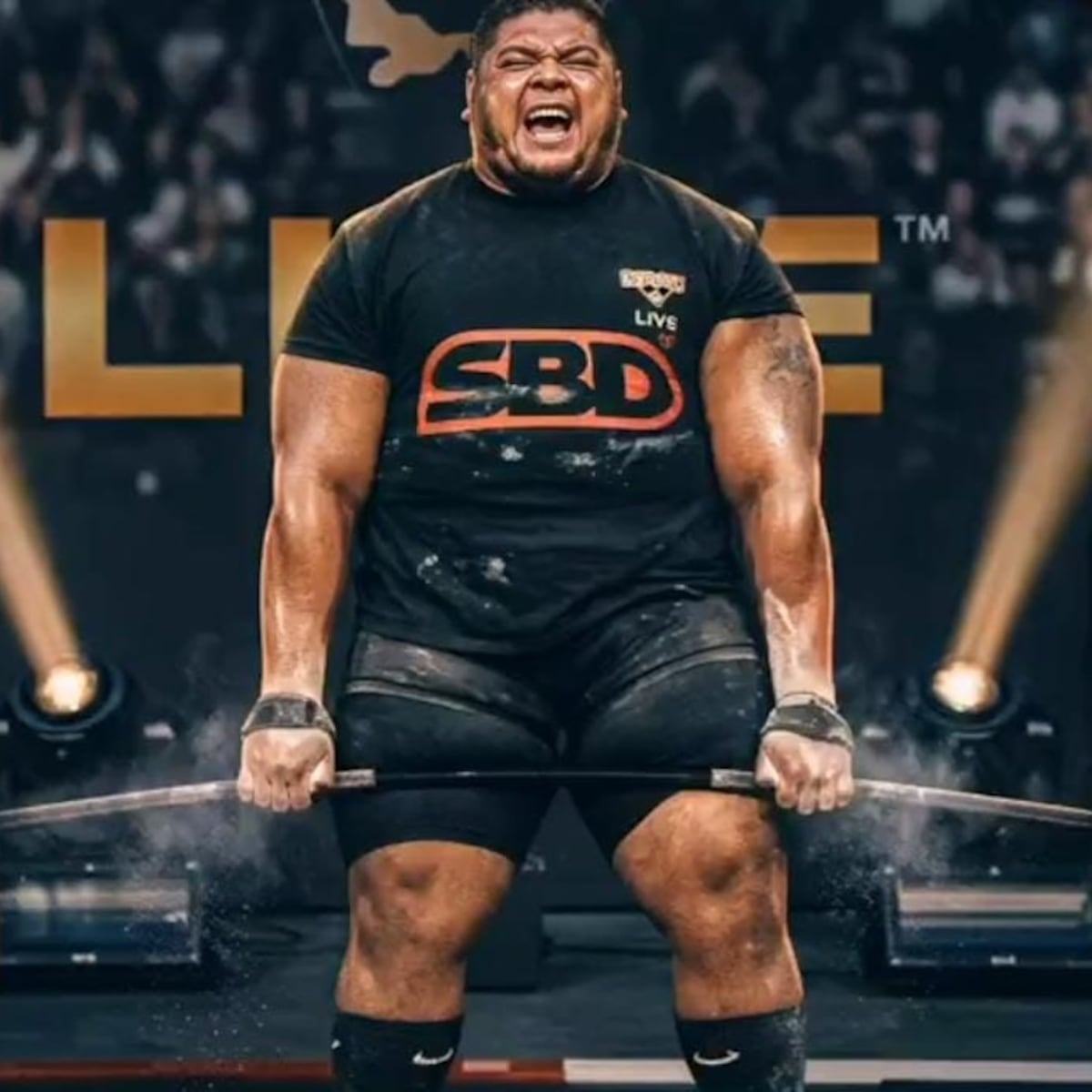
Raúl Abraham Flores Castro, known in strongman as “Tayzon,” is a Mexican strength athlete from Ciudad Victoria, Tamaulipas, who entered strength-sport history on 5 September 2026 in Birmingham. At the Giants Live World Deadlift Championships, Flores pulled 511 kg, surpassing Hafþór Júlíus Björnsson’s 510 kg world record from 2025 by one kilogram. At only 26 years old, he became World Deadlift Champion and the author of the heaviest standard deadlift completed in strongman competition. His international rise includes reaching the 2025 Arnold Strongman Pro/Am final, where he finished eighth after strong showings in the deadlift and yoke, a joint fourth place at the 2025 World Deadlift Championships with 453.5 kg, and his first full Giants Live contest at the 2026 Strongman Open. The nickname “Tayzon” comes from his late dog, whose death became, according to Flores’s own public account, a major motivation for entering the gym and for a promise that he would make the name famous around the world.
One kilogram that changed the record book. On 5 September 2026, inside Birmingham’s Utilita Arena, Raúl Abraham Flores Castro entered one of the smallest categories in strength sport: athletes who have physically moved the absolute benchmark of a discipline. At the Giants Live World Deadlift Championships, the Mexican strongman known as “Tayzon” pulled 511 kg and surpassed by one kilogram the 510 kg world record Hafþór Júlíus Björnsson had set one year earlier. The significance lies not only in the number, but in the context. Flores was 26 years old, still early in his visible international career, and did not arrive with the global résumé of the men who had previously owned the record. In September 2025, at his first World Deadlift Championships, he had lifted 453.5 kg and finished joint fourth. In less than twelve months, the distance between what he had officially demonstrated onstage and the new world record became extraordinary. Giants Live recorded 511 kg as the new all-time standard strongman deadlift world record, with the down signal given by four-time World’s Strongest Man Magnús Ver Magnússon, one of the sport’s most respected officials. The bar left the floor with convincing speed, slowed dramatically around the knees and thighs, and then continued upward until Flores reached the lockout accepted by the referee. He did not win the full Strongman Open that evening, finishing 11th of 12 overall, but he did win the event that carried its own world championship and became World Deadlift Champion. That distinction must remain precise: Flores is not a World’s Strongest Man champion and he did not win the 2026 Strongman Open. He is the 2026 World Deadlift Champion and, as of this profile update on 27 September 2026, the holder of the 511 kg world record. For Mexican strength-sport history, precision does not reduce the achievement. It makes the achievement more defensible.
Identity, origins and physical data. Mexican reporting gives his full name as Raúl Abraham Flores Castro. He was born on 9 May 2000 in Ciudad Victoria, the capital of Tamaulipas in north-eastern Mexico. Giants Live lists him at 1.75 m and approximately 165 kg, and this profile uses those measurements as its primary reference because they come from the official promoter for whom he competed at world level. Other databases are not perfectly aligned. Strongman Archives lists 1.78 m, while FitnessVolt has published 1.74 m. A difference of a few centimetres may result from measurements taken at different times, rounding, footwear or simple transcription errors, so this archive does not manufacture a controversy around the discrepancy. It records the range and adopts 1.75 m as the official Giants Live value. His bodyweight of roughly 165 kg is considerably more consistent across the major sources. Flores competes in Open/Super Heavyweight strongman, without an upper weight limit. His build is unusual when compared with the public image of previous deadlift record holders. Eddie Hall and Hafþór Björnsson reached their historic pulls with very different frames, while Björnsson in particular stands over two metres tall. Flores is substantially shorter, massively built and compact. That does not automatically make height an advantage. Deadlift mechanics depend on arm length, femur length, torso proportions, mobility, hip position, gripping method, force production and technique. Without published anthropometric measurements it would be irresponsible to claim specific lever advantages from photographs alone. What can be said is that his public lifting footage shows an athlete who creates enormous trunk rigidity, keeps the bar close and can continue producing force after bar speed falls sharply. The official Giants Live profile therefore establishes the stable public framework: Mexico, 1.75 m, 165 kg, born 9 May 2000, competitor at the Strongman Open and World Deadlift Championships. The rest of his biography is reconstructed from Mexican media, competition databases and Flores’s own public statements, with discrepancies identified rather than hidden.
The story behind “Tayzon.” Flores’s arena name is not, as the sound might encourage people to assume, primarily a reference to Mike Tyson. Tayzon was the name of his dog, an animal Flores has discussed publicly with unusual emotional weight for a sports biography. Accounts carried by Claro Sports and UnoTV describe Tayzon as a companion through roughly eleven years of Flores’s childhood and education, spanning primary school, secondary school, high school and the beginning of university life. The dog’s death became a turning point. Flores has said that the loss helped push him into the gym and gave shape to a promise that he would make the name “Tayzon” famous around the world. In a sports industry where nicknames are often built after success as marketing devices, Flores’s story works in the opposite direction. The name existed before international recognition and was linked to a personal relationship rather than to a trophy. After the 511 kg record in Birmingham, Giants Live reported Flores showing a tattoo of his late dog and explaining the origin of the nickname, tightening the connection between the achievement and the private motivation he had chosen to make public. It is easy to turn such material into a simplified legend in which grief automatically produces greatness. A responsible biography should resist that. We can document only what Flores himself has said: Tayzon played an important role in his life, the dog’s death contributed to his move toward the gym, and the nickname and promise became part of his sporting identity. Years later, when the name “Tayzon” was announced in a British arena immediately after the heaviest accepted standard strongman deadlift in history, the promise acquired a literal dimension. The world knew the name. For Flores, 511 kg was therefore both a measurable sporting result and the public fulfilment of a story that had begun before the international strongman community knew who he was.
Public personal life and education. Information about Flores’s family and private life remains limited, which is normal for an athlete who entered major international attention only recently. This profile does not fill the gaps with guesses. Mexican media connect him with the Universidad de Seguridad y Justicia de Tamaulipas in Ciudad Victoria, and several biographical pieces report that he studied there. The information is treated as a reported local biographical detail rather than as a claim independently verified through public academic records. On social media and in reporting around the 2026 record attempt, Flores has expressed gratitude toward his family and his partner. That public acknowledgement is relevant to his support network, but it is not an invitation to catalogue private relationship details unrelated to sport. What is well documented is the importance of practical support. In a local interview after the 2025 Arnold Strongman Pro/Am, Flores thanked Jaime Enríquez and Richard, associated with WFitness México, for helping cover needs and expenses related to the trip. Public posts during 2026 also show associations or acknowledgements involving WFitness México, World Gym México, Pharlabs Premium, ProSupps México and other accounts in his training ecosystem. Those tags should not automatically be converted into claims about current commercial contracts, nor do they establish an official coach. For that reason, this profile marks his coach as not publicly confirmed and describes WFitness/World Gym México only as publicly associated training venues. Mexican reporting around the 511 kg record also offered snapshots of his routine, including very long preparation days, high food intake and deliberate sleep. Infobae reported that some preparation days could extend toward seven hours when all components were included; other publications cited roughly eight hours of sleep and intake reaching around 6,000 calories during heavy phases. These numbers describe a record-focused period, not a permanent medical or nutritional prescription. The safe conclusion is simpler: by 2026, Flores’s life had become increasingly structured around professional strength performance.
Entering strongman. Multiple Mexican sources place Flores’s beginning in strongman around 2021. Strongman Archives, by contrast, starts his international record in 2025. This is a difference in scope rather than necessarily a contradiction. The database focuses on competitions that meet its archival criteria and does not claim to capture every regional contest in Mexico. Local media and biographical profiles credit Flores with victories at a regional Mike Strongman championship in 2023 and 2024. Complete result sheets and full fields for those competitions are not readily available in the international databases reviewed for this profile, so those achievements are stored as secondary-source reports rather than reconstructed with invented detail. Even without a complete local archive, the 2021-2024 phase matters. It explains why his appearance in Columbus was not his first encounter with strongman implements. By the time he reached the Arnold stage, he had necessarily accumulated experience with logs, axles, yokes, deadlifts, loading and moving events. Strongman is technically demanding precisely because every object changes the problem. A powerful barbell lifter can lose heavily on a yoke if the implement cannot be stabilized. A good powerlifter can fail the log because the clean is inefficient. A world-class deadlifter can struggle on stones because grip, rhythm and conditioning become limiting. Flores’s 2025 Arnold results show that his formative years had already produced two internationally competitive qualities: pulling strength and yoke speed. At the same time, several other events left him behind the best finalists. That imbalance becomes one of the defining themes of his early career. By September 2026 he is the heaviest standard deadlifter in strongman history by official kilogram, but he is not yet an all-around world champion. Both statements can be true, and the tension between them is what makes his development compelling.
A note on sources and a powerlifting attribution this profile does not confirm. Online searches surface a 2020 USPA meet featuring an athlete named Raul Flores at roughly 77 kg bodyweight, with a 187.5 kg squat, 102.5 kg bench press and 212.5 kg deadlift. At first glance it looks like an irresistible origin story: a relatively light young powerlifter who would eventually pull 511 kg. The problem is that the associated OpenPowerlifting entry lists an age inconsistent with the strongman’s official date of birth. Raúl Abraham Flores Castro, born on 9 May 2000, would have been 20 in November 2020, while the powerlifting record identifies the athlete as 22. The shared name and age discrepancy make the identity link uncertain. VladimirStrongman therefore does not treat that meet as a verified result belonging to the Mexican strongman. This is a useful example of responsible archival work. A dramatic story can become false simply by joining two people who share a name. By contrast, Flores’s Arnold Pro/Am, World Deadlift Championships and Giants Live results can be securely linked through official rosters, photography, video and specialized databases. The same caution applies to training lifts. The 504.04 kg pull from 2026 is documented on video and reported by strength media, but it remains a training performance and is not presented as a competition record. The official record is 511 kg. In an era when clips travel faster than refereed result sheets, the distinction between ‘lifted’, ‘lifted in training’, ‘lifted in an exhibition’ and ‘set a world record in competition’ is essential. Flores’s verified career is already extraordinary enough without merging identities or turning every gym clip into a title.
Local support and the construction of an international career. The route from Mexican regional strongman to major European and North American stages is materially different from the route available to an athlete based near the traditional centres of the sport in Britain, Iceland or the United States. Flights, visas, accommodation, entry costs, food, equipment and recovery can turn a qualification into a financial project. That is why Flores’s comments after the 2025 Arnold matter. He spoke publicly about the support he received from people around WFitness México and named Jaime Enríquez and Richard as individuals who helped cover needs and expenses. There is no need to romanticize the detail. Strength sports, particularly before an athlete becomes commercially valuable, often operate through networks of gyms, small sponsors, friends, family and local communities. In Flores’s case, that infrastructure helped convert regional results into an appearance at the Arnold Strongman Pro/Am in Columbus, one of the sport’s most visible development platforms. In 2026 posts, WFitness México and World Gym México appear repeatedly, while additional brands are tagged in his content. Some may represent sponsorships, others collaborations or acknowledgements. Without public contracts, this profile does not assign precise commercial status. What is clear is that Flores did not emerge in isolation. After the world record, Mexican media attention expanded rapidly, taking him from specialist strength pages into general national coverage. La Jornada, AS México, UnoTV, Claro Sports and Infobae all reported either the record or the story behind it. For strongman, that transition matters. A country can produce very strong athletes without the public learning their names; an absolute world record creates an immediate bridge. Flores therefore became not only a competitor but also a point of entry for Mexican audiences into a sport that traditionally receives far less coverage than football, boxing or Olympic disciplines.
The 2025 Arnold Strongman Pro/Am, where the name left the regional circuit. In March 2025 in Columbus, Ohio, Flores entered the Arnold Strongman Pro/Am, a competition that sits between elite amateur development and access to professional strongman. A local interview published by La Expresión after the contest provides an important correction to information later repeated inaccurately elsewhere. Flores explained that after the first day he was in the top five of a field of roughly thirty athletes and that eight advanced to the final. He thus became the first Mexican publicly reported to reach that final format. Some later biographical articles collapsed ‘top five after day one’ into a supposed fifth-place final result. The published tables from BarBend, FitnessVolt and Strongman Archives are clear: Flores finished eighth of eight finalists with 16 points. That does not diminish the achievement. Reaching the final was itself a major threshold, and the event distribution explains why he attracted attention. In the Max Log Lift he made 162 kg and placed eighth. In the 408 kg Trap Bar Deadlift he completed six repetitions and placed third. In the 408 kg Super Yoke he covered 18 metres in 13.53 seconds, again third. In the 147 kg Axle Press he made three repetitions and placed seventh, while in the Keg Load his recorded heaviest load was 159 kg, eighth. The results form an almost diagnostic profile of the athlete at that moment: outstanding pulling strength and unexpectedly strong heavy-yoke movement, but clear distance from the best finalists in overhead and loading. For a coach, that kind of final can reveal more than a local victory. It shows what happens when an athlete’s strengths are placed directly against an international field on standardized implements and under major-event pressure. For Flores, Columbus was less a conclusion than a map. The deadlift was already the weapon. The rest of strongman still needed to catch up.
What the Arnold events revealed. Flores’s two third-place finishes in the Trap Bar Deadlift and Super Yoke matter more than a simple results list suggests. Six repetitions with a 408 kg trap bar test not only maximal strength but the ability to repeat extension under fatigue, breathe against extreme abdominal pressure and preserve position as bar speed deteriorates. For an athlete who would become the standard deadlift world-record holder, the performance confirms that his pulling base was not built exclusively around a single maximal repetition. The 408 kg yoke, carried 18 metres in 13.53 seconds, points toward a second quality: converting strength into movement. Yoke punishes hesitation. The crossbar loads the body axially, the frame oscillates, and every step can amplify instability if rhythm is lost. Third place among international finalists indicates genuine potential in moving events. By contrast, the 162 kg log, three repetitions on the 147 kg axle and eighth place in the Keg Load exposed areas where the gap to elite all-around strongman remained substantial. Overhead strongman is not simply a test of shoulders and triceps. A log must be cleaned efficiently, rolled, stabilized and driven overhead; an axle creates a more difficult clean, and repetition formats introduce conditioning. Loading requires acceleration, grip on awkward objects and fast transitions. For a 165 kg athlete, the energetic cost is significant. Flores’s later path can therefore be understood as a temporary specialization choice. Rather than bringing every weakness to championship level at once, he pushed his already exceptional deadlift toward the absolute boundary. The strategy produced a world record in 2026. But the same night’s Strongman Open results showed that the original diagnosis from Columbus had not disappeared. Flores remains, for now, an athlete of contrasts: strong enough in one movement to exceed the entire documented history of the discipline, yet still developing several of the qualities that decide an overall strongman title.
The 2025 World Deadlift Championships, first contact with the absolute frontier. On 6 September 2025 in Birmingham, Flores entered the World Deadlift Championships in an edition dominated by Hafþór Björnsson’s attempt to extend the all-time record beyond 505 kg. Strongman Archives credits Flores with 453.5 kg and joint fourth place. To an audience acclimatized to the extreme numbers of modern strongman, 453.5 kg can look like an intermediate step. In reality, the 1,000-pound threshold, approximately 453.6 kg, remains one of the hardest landmarks in strength sport. Very few humans have exceeded it in a strongman-style deadlift under competition conditions. At 25, Flores had therefore entered a club that changed his status from interesting Arnold finalist to globally relevant deadlift specialist. The contest also had educational value. Björnsson lifted 510 kg and moved the world record; the other specialists made visible the gulf between an elite pull and a record pull. The difference between 453.5 and 510 kg cannot be treated as merely adding plates. At this level, every few kilograms demand disproportionately difficult adaptation: tissues that tolerate greater tension, technique that remains coherent close to absolute capacity, recovery, body mass, confidence and attempt selection in which one failed pull can compromise weeks of preparation. Flores’s later official increase of 57.5 kg within roughly one year is therefore the central fact of his rise. Public information is not sufficient to reconstruct every training block, and a serious profile should not invent percentages, sets, pharmacology or coaching decisions. What can be documented is the outcome: 453.5 kg in September 2025, then much heavier training footage in 2026, culminating in 504.04 kg before his return to Birmingham. The progression was not linear in the simplistic sense. It was the visible result of a career becoming increasingly focused on one target: 511 kg.
The 1,000-pound threshold and the change in status. Certain numbers in strongman acquire symbolic value beyond their mathematical difference from the kilogram below them. A 1,000-pound deadlift is one such threshold. For decades, 400 kg had already represented elite territory; as equipment, training methods, athlete selection and professionalization advanced, 1,000 lb became the next psychological frontier. Flores effectively crossed it in competition with 453.5 kg in 2025. It was neither the world record nor a unique podium position, but it was enough to make his name relevant to future World Deadlift Championships invitations. Mexican media reported that results at this level helped create subsequent opportunities. In a sport where major appearances depend on qualifications, invitations and proven performances, a 1,000-pound pull is a more persuasive credential than any promise. The 2025 season therefore produced two complementary confirmations. The Arnold showed that Flores could reach an international all-around final. Birmingham showed that his deadlift could sit among the strongest specialists on the planet. From that point, the road to 511 no longer looks as though it emerged from nowhere, even if the speed of improvement remains extraordinary. It is equally important that a strongman deadlift should not be confused with powerlifting records. Rules differ. Strongman events may allow straps, deadlift suits and execution standards that are not identical to raw powerlifting federations. Powerlifting requires the bar to be held without straps and uses different equipment and command standards. Flores’s 511 kg is the recognized World Deadlift Championships strongman standard, not a powerlifting world record. The distinction is technical but essential. Strength sport contains multiple disciplines, and the same movement name does not imply identical rules. The value of 511 kg does not require the categories to be blurred.
Preparing for 2026. After the 2025 appearance, Flores began publishing and appearing in training sessions that made his record ambition increasingly explicit. FitnessVolt documented a 504.04 kg training pull in August 2026. The footage spread rapidly through strength-sport communities because it came dangerously close to Björnsson’s official 510 kg world record. In the associated public post, Flores identified 511 kg as the target for Birmingham. It was not a vague plan to ‘see what happens’, but a precise declaration: one kilogram beyond the record. Mexican reporting around this preparation described very long training days, high food intake and a lifestyle organized around recovery. Infobae reported that some preparation days could approach seven hours when all components were included and described Flores as having reached a point where he could live professionally from the discipline. Other outlets referred to roughly six-hour workdays in certain phases, food intake reaching around 6,000 calories and approximately eight hours of sleep. These figures should be understood as journalistic snapshots of a record-focused phase rather than a 365-day prescription. A world-record deadlift is not built simply by spending more hours in the gym. At 500 kg, excessive volume can be as destructive as insufficient volume. The nervous system, spinal erectors, hamstrings, adductors, hips, tendons and grip-related structures all require an extremely narrow balance between exposure and recovery. Flores has not publicly released a full program, so this profile does not reverse-engineer one from fragments. What the public evidence does show is increasing specificity, exposure to very heavy singles, use of World Deadlift Championships equipment and bodyweight maintained around 165 kg. The 504.04 kg gym pull was not an official record, but it made one point unmistakable: 511 kg was not merely promotional language. He had already trained within a handful of kilograms of history.
The unofficial 504.04 kg pull that changed expectations. Strength sport always contains tension between what an athlete demonstrates in training and what can be validated in competition. A filmed lift may be genuine, impressive and technically convincing, yet without official plate verification, refereeing and the exact competition rules it does not automatically become a record. Flores’s profile preserves that distinction: 504.04 kg is stored as an unofficial training performance, while 511 kg is the verified world record. Even so, the 504 kg footage had enormous influence on public expectations. Before it appeared, the gap between his 453.5 kg competition result and a 511 kg target looked almost absurd. Once Flores had locked out more than 500 kg in preparation, the discussion shifted from ‘could he ever get there?’ to ‘can he reproduce and exceed this under competition lights?’. That psychological shift matters for the athlete and the field. Maximal deadlift attempts are rare because their recovery cost is enormous. Elite lifters cannot test a world record every week without paying through fatigue, injury risk or lost form. A 504 kg pull shortly before the contest suggested that the training structure had judged recovery to Birmingham possible and that some reserve remained. We do not know every internal detail and interpretation should remain modest. What is certain is that the public plan worked. Flores did not arrive for a symbolic shot. He arrived with a declared number and with evidence that he had already lifted close to it. Moments like this are relatively rare in record history: the athlete names the target, the community watches him approach it in training, and the competition then confirms the scenario. Anticipation did not make the Birmingham record less dramatic. It made the completion of the plan more remarkable.
Flores’s biomechanics and why stature alone does not explain the record. At approximately 1.75 m and 165 kg, Flores has an extremely compact height-to-mass profile. In the deadlift, a thick torso and high muscular mass can contribute to the rigidity needed to transmit force, while arm, femur and torso proportions can shorten or lengthen the effective bar path. Without published anthropometric measurements, however, it is not responsible to claim that he has unusually long arms or a specific femur-to-torso ratio based on photographs. What can be analyzed is public execution. Flores sets the bar close, creates tension before breakaway and uses his body mass to preserve position as the bar passes the knees. At 511 kg, the critical phase came after the initial pull when bar speed dropped dramatically. Instead of losing the position completely, he continued extending and drove the hips through until the lockout was accepted. The capacity to produce force during a repetition that lasts a long time is different from an explosive pull at 80 percent. It requires tolerance for extreme tension and the ability to keep moving when the bar appears almost stationary. In strongman, straps reduce grip as the limiting factor and allow the posterior chain to be tested closer to its absolute capacity. A deadlift suit and belt also provide mechanical and proprioceptive assistance, but they do not lift the bar for the athlete. They are part of the event’s legal equipment. Flores is therefore a useful case against single-cause explanations. He does not lift 511 because he is short, because he uses straps or because he wears a suit. He lifts 511 because body mass, structure, neural adaptation, technique, legal equipment, preparation and tolerance for maximal effort converged on one competition day. Anthropometry creates possibilities; training turns them into kilograms.
Equipment and the World Deadlift Championships standard. For spectators coming from powerlifting, the image of a strongman using straps and a deadlift suit can create confusion. The World Deadlift Championships is a strongman contest, and its rules permit equipment that would not be allowed in a raw powerlifting federation. Flores used a belt, straps and a purpose-built suit in line with the event standard. The bar and plates are configured for maximal strongman deadlifting, and the referee judges the required finish before giving the down command. Some strongman formats tolerate a more aggressive finish around the thighs than powerlifting, although the exact standard belongs to each event. The crucial point is that athletes are judged within the same rules. Flores’s 511 kg does not administratively compete with IPF, WRPF or other powerlifting records; it belongs to its own discipline. The same principle is why Elephant Bar, axle deadlift, 18-inch deadlift and Hummer Tire Deadlift records are kept separate. A different bar, starting height, flex, plate diameter or equipment can materially change the task. This profile therefore describes 511 kg as the all-time standard strongman deadlift world record and 504.04 kg as an unofficial training benchmark. The terminology avoids both diminishing and exaggerating the achievement. Within Flores’s discipline, 511 is the current summit. Under another ruleset, the comparison must be rebuilt from the beginning. That distinction has become increasingly important because the deadlift is now a media product of its own. Audiences see the number and immediately compare it with Eddie Hall, Hafþór, sumo powerlifters or equipped records. Historical accuracy requires keeping each bar in the right lineage. Flores stands in the modern World Deadlift Championships line: Eddie Hall’s 500 kg in 2016, Björnsson’s 501 kg in 2020, then 505 and 510 kg in 2025, followed by Flores at 511 kg in 2026.
Birmingham, 5 September 2026, before the decisive attempt. The evening had an almost perfect dramatic structure. Björnsson returned to the arena where he had set 510 kg one year earlier, while Flores arrived after publishing the 504.04 kg training pull and stating clearly that he wanted 511. Giants Live reported that the Mexican moved through a comfortable 470 kg attempt before jumping to the record. Björnsson reached 480 kg and chose not to continue the record race, with a knee issue and the goal of winning the full Strongman Open influencing the decision. That choice matters because it removes the false image of a conventional head-to-head duel in which both men climbed the same ladder kilogram by kilogram. Flores did not need to answer a heavier Thor attempt that day. The existing record was already 510, and the task was simple in theory and brutal in practice: one more kilogram. When the bar broke from the floor, the initial speed was convincing enough that the arena could see the lift was possible. Then it slowed. The bar appeared almost to stall through the upper range, and Flores continued extending. At weights of this scale, perception of time changes. A few seconds feel much longer because any stop can mean the attempt is over. When hips and knees reached the position accepted by the referee, Magnús Ver Magnússon gave the down signal. The record was valid. What happened next joined two stories that had previously travelled separately: the technical performance and the name Tayzon. Giants Live reported Flores showing the tattoo of his dog and explaining its significance. In one sequence, a statistical result acquired the biography behind it. The 511 kg lift became a world record, Flores’s first World Deadlift Championships title and the moment the athlete from Ciudad Victoria entered global strongman history.
The 2026 Strongman Open, a world record inside a full contest. After 511 kg, Flores could not simply leave the arena. The World Deadlift Championships was integrated into the Strongman Open, meaning the maximal pull was only the first stage of a multi-event evening. Strongman Archives credits him with 20 points and 11th place out of 12 overall. The event-by-event data are revealing. In Max Deadlift, 511 kg gave him first place. On Atlas Stones he completed one stone in 58.76 seconds and finished tenth. In the Dumbbell Press he registered no valid repetitions and placed 11th. In Titan’s Toss he completed two implements in 23.21 seconds and was 11th. In Load & Push he reached 18.25 metres, placing tenth. Viewed without context, those numbers can appear harsh for a man who had just become a world-record holder. Viewed correctly, they demonstrate why all-around strongman is a different sport from a deadlift championship. The opening event had consumed enormous physical and emotional resources, while the remaining tests demanded precisely the qualities that had not been the centre of his record cycle: overhead dumbbell skill, throwing, fast loading, stone coordination and movement under fatigue. There is no reason to minimize 11th place and no reason to use it to minimize the record. The results measure different capabilities. On the same night Hafþór Björnsson chose 480 kg in the deadlift, below his personal best, specifically preserving enough for the overall contest, which he won. Flores made the opposite strategic choice: his night was built around 511 kg, and he achieved the defining result of his career. That contrast captures one of strongman’s most interesting truths. To become the best in the world at a single event, an athlete may sacrifice points elsewhere; to win the overall show, a veteran may deliberately abandon a record attempt. Flores’s September 2026 profile sits directly inside that tension.
Deadlift specialist or developing all-around strongman? At present, the accurate answer is both. Flores owns a record that places him above every other documented athlete in the standard strongman deadlift, yet his overall résumé remains short. Strongman Archives lists only two complete international strongman contests for him through September 2026: the 2025 Arnold Strongman Pro/Am and the 2026 Giants Live Strongman Open, plus two World Deadlift Championships single-event appearances. At the Arnold he finished eighth of the eight finalists; at the Strongman Open he finished 11th of 12. Those numbers are not a sentence on his potential. They are a photograph of an athlete whose international development advanced much faster in one quality than in the rest of the repertoire. Strongman history contains specialists who later became complete contenders and others who remained defined by one extraordinary event. At 26, Flores has time for either path. If the goal becomes winning major all-around competitions, overhead, stones, loading, throwing and conditioning will need to close the gap with his deadlift. The 2025 Arnold suggests the yoke can become a genuine second weapon, while six repetitions with the 408 kg trap bar demonstrate work capacity in pulling. By contrast, zero repetitions on the dumbbell in 2026 show how brutally specific another implement can be. A complete strongman is not the sum of gym personal records. It is the ability to lose as few points as possible across five or six different biomechanical problems in one day. Flores’s next phase will reveal whether 511 kg is the peak of a specialization or the foundation of a broader competitive identity. This profile does not predict the answer. It records the present: world-record deadlifter, Arnold finalist, Giants Live athlete and all-around competitor still in development.
The historical line from 500 to 511 kg. To understand Flores’s record, the modern progression of the absolute benchmark must be followed carefully. In 2016 at the World Deadlift Championships, Eddie Hall became the first man to lift 500 kg in a major strongman setting. The number changed the sport’s vocabulary. A weight long treated as impossible had become the reference point for the next generation. In 2020, Hafþór Júlíus Björnsson lifted 501 kg in a refereed WUS Feats of Strength event staged at his gym in Reykjavík. The circumstances generated debate about the difference between a conventional multi-athlete competition and a special record event, but the lift entered the major strongman record lists. In 2025 Björnsson moved the limit to 505 kg at the Eisenhart Black Deadlift Championships and then to 510 kg at the World Deadlift Championships in Birmingham. One year later Flores added one more kilogram. Superficially, progress from 500 to 511 over a decade may look small. That is exactly what reveals how close the elite operates to biological limits. A 2.2 percent increase in a movement already above half a tonne is enormous. Every new kilogram must travel through the same range, and technical errors that might be recoverable at 300 kg become catastrophic. Flores did not revolutionize the record with a twenty-kilogram leap. He did what happens at a genuine performance frontier: took a benchmark owned by a historic champion and moved it exactly far enough to rewrite the list. 511 does not make 510 less impressive, and 510 does not diminish the importance of Hall’s 500. Each number belongs to its phase. Flores now belongs in the same succession, and even if his record is eventually broken, history will still contain the fact that he was the first man to establish 511 kg as the standard.
What the record means in Mexico. Strongman does not have the same media infrastructure in Mexico as football, boxing or major Olympic sports, and before Flores the country did not have a figure associated in the international public mind with the absolute record in one of strongman’s signature events. After Birmingham, mainstream Mexican outlets responded quickly. La Jornada published his full name, his origin in Ciudad Victoria and the 511 kg result. AS México, UnoTV, Claro Sports and Infobae explained who he was and revisited the Tayzon story, his preparation and his route to the record. Some headlines used phrases equivalent to ‘the strongest man in the world’, attractive journalistic shorthand but technically imprecise. Strongman has a contest called World’s Strongest Man, and Flores has not won it. The accurate claim is that, as of 27 September 2026, he owns the heaviest recognized standard deadlift in strongman and is the reigning World Deadlift Champion. Precision allows Mexican audiences to understand the true scale of the achievement without relying on slogans. The record may also have consequences beyond Flores’s own career. Visibility for a domestic athlete in a niche sport can create role models, encourage gyms to acquire strongman implements and give regional organizers a tangible international reference. There are not yet enough data to measure such an effect in Mexico, but the mechanism is familiar from other countries. Once a local athlete reaches a major world stage, the sport becomes culturally closer. For young Mexican strength athletes, the world-record deadlift is no longer only an imported image from Britain, Iceland or the United States. It belongs, for now, to an athlete from Tamaulipas who moved through regional competition, reached an Arnold final and then pulled 511 kg in Birmingham.
From travel expenses to a professional life in strength sport. One of the clearest transformations in Flores’s path is the economic status of his activity. In 2025 he publicly discussed the support needed to cover the cost of an international Arnold appearance. In 2026, Infobae described him as having reached the point where he could make his living from the discipline. The distance between those two images is significant. Strongman does not provide fixed salaries for most competitors comparable with league sports. Income can come from prize money, sponsorships, collaborations, online content, appearances, coaching or related work. For a Mexican athlete travelling regularly to the United States or Europe, expenses can consume a substantial part of that income. A world record changes negotiating power. A man who owns 511 kg is no longer merely another entrant; he is a name a promoter can place on a poster. This profile, however, does not invent contract values or earnings that are not public. Brands appearing in tagged posts demonstrate public relationships, not the financial terms behind them. The safe conclusion is that international success transformed strongman from an expensive competitive pursuit into the centre of Flores’s professional life. The training hours described in media reports, the food, travel and recovery required by record preparation are difficult to sustain without an infrastructure. WFitness México, World Gym México and other entities appear around his public sporting ecosystem, and the people he thanked after the Arnold show that support existed before the world record created broader notoriety. In that sense, 511 kg is also the visible result of a network, even though only one athlete held the bar.
Social media and the construction of an identity without separating the man from the record. Flores’s public Instagram account, `@tayzonstrongman`, became the principal channel through which many followers saw his progress before Birmingham. The 504.04 kg training pull circulated there or through media drawing from his account, and Flores made the 511 kg target explicit. On TikTok he uses the identity `@tayzonstrong`. Digital presence matters in modern strongman because the sport no longer depends only on seasonal television broadcasts. An athlete can build an audience between contests, and every heavy training set can become part of the story leading to the next event. Flores used that mechanism effectively. The public watched him approach the record before the record existed. At the same time, his posts preserve personal elements under his own control, including thanks to family and his partner and references to Tayzon. A biographical archive should respect that boundary. A public acknowledgement of a partner does not justify investigating private relationship details; a tattoo does not authorize speculation about psychological state. The relevant information is what Flores himself has chosen to connect to performance: the support of people close to him and the memory of his dog. Social media also functions as a primary sporting document. Video can confirm that a training lift occurred and show equipment and progression. Even then, editorial discipline is necessary. The kilogram number in a caption does not carry the same status as a refereed result. That is why this profile separates verified records from training benchmarks. As Flores becomes more visible, the difference will become increasingly important, because every heavy attempt will be redistributed by pages that may strip away context.
Relative strength and body mass. At approximately 165 kg bodyweight, a 511 kg pull equals roughly 3.10 times bodyweight. The ratio is not the criterion by which the absolute record is awarded and should not be used to declare one athlete universally stronger than another. Open strongman rewards the weight moved, not a coefficient. Still, the ratio adds context. Deadlifts above 500 kg have often been associated with athletes competing at extraordinarily high bodyweights. Flores demonstrates that 165 kg, itself enormous by ordinary standards, can support a pull above half a tonne when structure and preparation are exceptional. The case may influence how coaches think about the relationship between mass and performance. Adding bodyweight is not free. More mass can increase stability and muscular potential, but it can also damage conditioning, mobility and speed events. For an athlete who wants to become a more complete strongman, optimization does not necessarily mean maximizing scale weight. Flores must balance two goals that may pull in different directions: keeping a deadlift capable of defending or extending the world record and developing the qualities needed for dumbbell, stones, loading and throwing. If mass rises aggressively for another record cycle, moving events may become even more difficult. If it falls too far, maximal pulling reserve may suffer. We do not have access to his future program and this profile does not prescribe the answer. The trade-off itself, however, will define the next stage of his career. The 511 kg record demonstrates how effectively he can optimize a peak; the Strongman Open standings reveal the possible cost of specialization in a multidimensional sport.
The psychology of a record attempt without mythology. Strength athletes often describe maximal attempts through the language of fear, aggression or entering a special mental state, and audiences are tempted to turn those expressions into definitive psychological explanations. There are not enough in-depth interviews with Flores to construct a serious psychological profile, and it would be inappropriate to infer mental traits from one deadlift. What can be analyzed is observable behavior. He announced 511 kg in advance, published a lift close to the record and entered the contest with a precise target. That sequence suggests a high degree of commitment to the goal and tolerance for public pressure. Once an athlete names the number, every subsequent training session is judged against that promise. In Birmingham, the slow upper phase of the 511 kg attempt required continued effort while the body was under extreme strain. Persisting through that phase is not evidence of some mysterious personality type. It is an athletic skill: maintaining execution under maximal stress. The Tayzon story provides a personal motivation Flores has articulated himself, but it should not be used to mechanically explain every kilogram. Grief can motivate someone to enter a gym; only years of physical adaptation can produce a 511 kg deadlift. The emotional and physiological levels can coexist without one replacing the other. Respecting the athlete means resisting the temptation to turn a personal loss into a cliché. Flores’s record has an emotional story, but it is first and foremost the result of measurable physical preparation and an execution accepted by officials.
What it means to move from 453.5 to 511 kg. The official difference between Flores’s 2025 and 2026 World Deadlift Championships results is 57.5 kg. The increase is so large that it requires careful context. A competition result does not necessarily represent the exact maximum an athlete could have lifted that day; attempt selection, standings and preparation influence the final number. Likewise, annual progress cannot be assigned to a single exercise or one change. Public sources around Flores suggest increasing specialization, improving training infrastructure and a professional life more fully organized around strength sport. They do not provide enough evidence to isolate the contributions of technique, body mass, programming or equipment. What can be observed is the combined effect. The 453.5 kg result in 2025 proved that he could reach the 1,000-pound zone. The 504.04 kg training pull in 2026 showed that maximal strength had moved dramatically. The 511 kg competition lift proved the improvement could be reproduced under refereeing. That sequence is more informative than the simplified statement that he ‘added 57.5 kg in one year’. It gives three levels of evidence: the previous contest, the preparation signal and the final validation. For sports historians, the stages matter because records are often reconstructed after the fact from clips and incomplete reports. Flores’s recent path is unusually well documented. Specialist databases preserve his Arnold and World Deadlift Championship results, FitnessVolt documented the 504.04 kg preparation lift, and Giants Live published both his athlete profile and the official account of the record. The density of independent material makes 511 kg not only spectacular but comparatively easy to verify.
Maximal training as an annual project. Reporting in 2026 described Flores’s preparation in language that can sound excessive to the general public: days extending to six or seven hours, large amounts of food and a routine centred on recovery. In elite sport, however, ‘seven hours of training’ does not necessarily mean seven continuous hours of heavy deadlifting. A day can contain warm-up, mobility, activation, long rest intervals between working sets, accessories, recovery work, travel and technical practice. Without Flores’s exact logbook it is more responsible to preserve the language of the source than to manufacture a program. What exercise science does make clear is that a maximal deadlift imposes severe neuromuscular and tissue stress. The closer a load is to an athlete’s limit, the more carefully exposure frequency must be controlled. A world record is not built by attempting the world record every session. Submaximal volume, technical work, variations and accessory training typically create the foundation from which rare extreme attempts can be tolerated, but Flores has not published his full programming and this profile does not assign specific methods to an unconfirmed coach. The `coach` field therefore remains explicitly marked as not publicly confirmed. That absence is preferable to inventing a professional relationship because someone appears in a video. As Flores becomes more prominent, the structure of his team may become easier to document. Until then, the record belongs to the athlete and the publicly acknowledged ecosystem around him, without extending credit or responsibility to unnamed individuals.
Nutrition, sleep and recovery: what can and cannot be said. Mexican outlets reported around the record that Flores’s food intake could reach roughly 6,000 calories during some phases and that he aimed for around eight hours of sleep. For a 165 kg athlete in a maximal-strength block, energy intake can be extremely high, but the precise requirement changes with activity, body composition and the goal of the phase. Turning a press-reported figure into a recommendation for other athletes would be irresponsible. The same applies to sleep: eight hours is a reported benchmark, not proof of an identical routine every night. Biographically, the important point is the priority given to recovery. Muscle capable of contributing to a 511 kg pull is not built during the lift itself; it is built through cycles of stress and repair between sessions. Food must support body mass, glycogen and tissue recovery, while sleep influences performance, stress response and the capacity to tolerate training. Strongman adds another complication: extremely high food intake can itself become a burden when an athlete must move quickly in yoke, loading or stones. What serves a deadlift-record cycle may not be identical to what serves an all-around contest. Flores is at a career stage where those priorities may evolve. If the next target is an even larger deadlift, mass retention and specificity may dominate. If the target becomes overall placing, conditioning and tolerance for multiple events may change the program and even the optimal bodyweight. This profile prescribes neither choice. It documents that 2026 was built around a clear priority and that the public routine described by media reflected that priority.
Documented personal records beyond 511 kg. The profile database preserves results that help describe Flores before the world record. At the 2025 Arnold Strongman Pro/Am he lifted 162 kg in the Max Log Lift. In the Trap Bar Deadlift he completed six repetitions with 408 kg. In the Super Yoke he carried 408 kg over 18 metres in 13.53 seconds. In the Axle Press he completed three repetitions with 147 kg, and in the Keg Load he reached 159 kg. These figures come from the published BarBend results and align with Strongman Archives. At the 2025 World Deadlift Championships, 453.5 kg remains the previous verified competition benchmark. In 2026, 504.04 kg is stored separately as a training lift and marked unofficial, while 511 kg is verified through Giants Live and the competition result. This structure in the Records field is deliberate. A personal record is not necessarily a world record, and a gym result should not receive the same label as a refereed one. In events such as yoke, the kilogram number without distance and time is almost meaningless, so the qualifier preserves 18 metres and 13.53 seconds. In the trap-bar event, six repetitions matter as much as the load. On the axle, three repetitions fundamentally change the nature of the result compared with a single. That granularity makes the profile useful for future updates. If Flores improves the log, yoke or other events, the new result can be compared against a clear benchmark rather than a vague description such as ‘good at carries’. In strongman, where implements change frequently, context is part of the record.
Major documented results through September 2026. The confirmed international chronology remains surprisingly short. March 2025: Arnold Strongman Pro/Am, finalist, eighth of eight, 16 points. September 2025: World Deadlift Championships, joint fourth, 453.5 kg. September 2026: World Deadlift Championships, first place, 511 kg world record. The same evening: Giants Live Strongman Open, 11th of 12, 20 points. Before those appearances, Mexican sources credit Flores with regional Mike Strongman titles in 2023 and 2024, which is why they appear in the achievement section with the explicit label ‘reported by secondary sources’. This approach avoids two opposite errors: deleting his local career because global databases do not archive it, or presenting every local detail as verified to the same standard as a Giants Live result. A living profile should be able to grow. If official result sheets for the regional competitions become available, the classification can be upgraded. If additional 2021-2024 contests are documented reliably, they can be added. At present there is no reason to fill the years with speculative events. The ascent is already remarkable through the few certain landmarks. In roughly a year and a half of visible international competition, Flores moved from last place in an Arnold final to the world record in one of the sport’s most famous events. The small volume of all-around competition makes the next several years unusually important for interpreting his career. A single future season could broaden the label of ‘specialist’ dramatically, or reinforce a legacy built primarily around the deadlift.
How the comparison with Hafþór Björnsson should be read. Flores surpassed Björnsson’s deadlift record, not Björnsson’s entire strongman career. The 2026 contest itself shows exactly why comparisons must be limited to the correct criterion. Flores pulled 511 kg and won the World Deadlift Championships. Björnsson stopped at 480 kg and then won the Strongman Open. In all-around résumé, Thor owns a World’s Strongest Man title, multiple Arnold Strongman Classic and Europe’s Strongest Man championships and dozens of international victories; Flores is just beginning. In the standard deadlift, however, the current record belongs to the Mexican. Those statements do not conflict. Strength sport benefits from this precision because it prevents every record from becoming a universal declaration about ‘who is stronger’. Strength is specific to an event, a ruleset and a moment. Flores was better at the 511 kg objective that evening and established an historic benchmark. Björnsson was better across the sum of Strongman Open events. This profile does not need a global verdict. Flores’s achievement is more interesting when stated accurately: a relatively new international competitor took the absolute deadlift record from one of the most decorated strongmen of his generation. If Flores later builds a much broader all-around résumé, comparisons can expand. Until then, 511 kg should be allowed to mean exactly what it means, without being forced to prove anything about stones, log, yoke or titles he has not yet won.
What comes next, without turning possibilities into predictions. At 26, Flores is young for a sport in which many athletes reach their all-around peak only after years of implement-specific experience. That observation does not guarantee development. Strongman carries a high injury rate, and 500-plus-kilogram deadlifts impose extreme stress on the body. But age and limited international mileage leave multiple options. One path is defending the record: preparing for 512, 515 or another number if a rival moves the benchmark. Another is becoming a more complete overall competitor, which would require investment in overhead, stones, loading, throwing and conditioning. The paths can overlap, but not without trade-offs. A maximal-record cycle can reduce the time and recovery available for technical events, while a dense all-around calendar can make it difficult to preserve the freshness required for an absolute deadlift. In the public sources reviewed through 27 September 2026, Flores has not announced a complete schedule that resolves the direction. This profile therefore does not project future titles or kilograms. What is worth watching is the distribution of progress. If log and dumbbell rise, stones become faster and the yoke remains a weapon, the specialist profile may broaden quickly. If the deadlift continues to dominate preparation, Flores can still build a memorable career as an event specialist. Modern strongman has room for both identities: overall champions and athletes who move the limits of individual events. The 511 kg record has already secured Flores a place in the second category.
Data quality control. This profile uses Giants Live as the primary source for date of birth, height, bodyweight, the Strongman Open appearance and the 511 kg world record. Strongman Archives is used for detailed competition results, placings and event values. BarBend confirms the 2025 Arnold Strongman Pro/Am results and gives exact implement weights. FitnessVolt documents the 504.04 kg training lift and additional context, while official competition figures are cross-checked against the archive where possible. Mexican reporting, including La Jornada, UnoTV, Claro Sports, Infobae, AS México and La Expresión, is used for Flores’s full name, Ciudad Victoria origin, reported education, the Tayzon story, local support and personal statements. Where those outlets simplify or misstate a placing, official result tables take priority. The clearest example is the 2025 Arnold: Flores was top five after the first qualifying day but eighth in the final group of eight. Another is height, where public sources range from 1.74 to 1.78 m; this profile adopts the official Giants Live value of 1.75 m and records the discrepancy. Finally, the 2020 OpenPowerlifting result belonging to an athlete named Raul Flores is not included as confirmed because the listed age conflicts with Flores’s official birth date. These decisions are part of the biography. An archive is not merely a container of numbers; it must also communicate how certain each number is.
Principal sources consulted for this edition of the profile. Giants Live: the official Raul Flores athlete profile and the report ‘Thor retains Open title as Flores pulls 511kg’, published after the 2026 Strongman Open and World Deadlift Championships, at giants-live.com. Strongman Archives: athlete profile ID 2997, including the 2025 Arnold Strongman Pro/Am, 2025 and 2026 World Deadlift Championships and 2026 Strongman Open, at strongmanarchives.com. BarBend: ‘2025 Arnold Strongman Pro/Am Results’, providing the final table and event-by-event results, at barbend.com. FitnessVolt: reporting on the 504.04 kg training pull in preparation for the 2026 World Deadlift Championships and competition pages, at fitnessvolt.com. La Jornada: the 6 September 2026 report identifying Raúl Abraham Flores Castro, his origin and the Birmingham world record, at jornada.com.mx. UnoTV and Claro Sports: features on the origin of the Tayzon nickname, his late dog and his route into training, at unotv.com and clarosports.com. La Expresión: the March 2025 interview after the Arnold in which Flores describes reaching the final and the support he received from Mexico, at laexpresion.com.mx. Infobae México: reporting on training, professionalization and the routine surrounding the world-record phase, at infobae.com. AS México: coverage of the world record and his Mexican background, at as.com. Flores’s public accounts, Instagram `@tayzonstrongman` and TikTok `@tayzonstrong`, are used only for information he chose to make public. No single source is treated as infallible; information was cross-checked and official organizers or result tables take priority where conflicts occur.
A biography that is still at the beginning. Long archive profiles are usually reserved for veterans with dozens or hundreds of competitions. Raúl Flores is the inverse exception: few international appearances, but one result so large that the archive must already treat him historically. According to Mexican reporting, the strongman path began around 2021. In 2023 and 2024 he won regional competitions reported by local media. In March 2025 he reached the Arnold Strongman Pro/Am final and learned, in direct competition, the distance between his strongest qualities and the complete repertoire demanded at elite level. In September that year he pulled 453.5 kg at the World Deadlift Championships. One year later he returned to Birmingham after a 504.04 kg training lift, asked for 511 kg and made it. On the same evening he finished only 11th in the complete Strongman Open, a detail that keeps the story honest and, paradoxically, makes it more interesting. Flores is not the finished, flawless figure that retrospective legend can create. He is an athlete with one quality already developed to the world frontier and many others still under construction. His public life contains the same contrasts: an arena name born from the loss of a dog, a local support network that helped him reach international contests, and then a British stage on which the promise to make the name Tayzon known became literal. As of 27 September 2026, the biography cannot have a definitive ending. It can only have a clear checkpoint: Raúl Abraham ‘Tayzon’ Flores Castro, 26 years old, from Ciudad Victoria, Mexico, approximately 1.75 m and 165 kg, 2026 World Deadlift Champion, 511 kg world-record holder and one of the most intriguing works in progress in international strongman.
Mexican strongman before and after Flores. To understand why the 511 kg record generated so much attention, the national context matters. Mexico has a long culture of strength sports, from Olympic weightlifting and powerlifting to bodybuilding and regional strength contests, but professional strongman has not had the same continuous media presence or international competition network seen in Britain, Iceland, Poland or the United States. That does not mean a lack of strong athletes. It means lower visibility and a more difficult path to global promoters. Flores emerged at a moment when social media shortens that distance. A clip of 450 or 500 kg does not require national television to reach international organizers; it can circulate directly through the strength community. The Arnold Strongman Pro/Am then provides a formal platform, and the World Deadlift Championships a stage for specialists. His path illustrates a changing geography of strongman. An athlete no longer needs to come from a country with decades of televised tradition to enter the global conversation quickly. Local infrastructure, however, remains decisive. Without gyms that tolerate strongman implements, people willing to help with costs and regional contests in which technique can be tested, social media alone does not create a world-record holder. Flores’s reported regional victories in 2023 and 2024, WFitness support and Arnold appearance form the chain between Ciudad Victoria and Birmingham. In retrospect, 511 kg may become a reference point for the development of Mexican strongman: not the beginning of the sport in the country, but the moment a Mexican athlete owned an absolute benchmark that the international community had to recognize.
The deadlift in phases, from the floor to lockout. A technical analysis of the 511 kg pull must avoid certainty that video cannot provide, but the general sequence can be described. The first phase is building tension before the bar leaves the floor. At extreme loads, jerking against the bar without preloading the system can disturb position and waste energy. Flores fixes his body, connects to the bar through straps and begins the pull from a position in which hips and torso must rise in coordination. The second phase is breakaway and movement toward the knees. At 511 kg the bar moved well enough initially for the attempt to look possible. The third phase, above the knees, became the critical point. Bar speed fell dramatically and Flores had to continue extending the hips without losing control. In strongman this upper range often decides record deadlifts, because the acceleration available from the floor has disappeared and the musculature must keep producing force close to an isometric condition. The final phase is lockout and the referee’s down signal. To a spectator it may look as though the lift is effectively complete once the bar passes the knees; at world-record loads those final centimetres may be the most expensive. Flores’s record is technically interesting because it was not a perfectly fast pull. It displayed the capacity to survive the slow point. That suggests a combination of hip extension strength, trunk rigidity and tolerance for maximal strain. It should not be mistaken for a beginner’s technique model. World records are limit performances in which form adapts to the athlete and the rules. The real lesson is not ‘copy this motion’. It is how specific every centimetre becomes once the bar exceeds half a tonne.
The yoke as a possible second signature event. Beyond the deadlift, Flores’s most promising international result remains the 408 kg Super Yoke at the 2025 Arnold: 18 metres in 13.53 seconds, third place. The performance deserves to be kept separate from his pulling record because it demands a different profile. Under a yoke, the athlete must accept enormous axial compression, stabilize the frame within the first few steps and then accelerate without allowing oscillation to grow. A compact athlete may gain certain stability advantages, but centre of mass, stride length, bar position and start technique matter enormously. Flores showed he can move more than 400 kg at competitive speed, not merely produce force in a near-static position. If that quality survives or improves, the yoke could become the event that connects his deadlift specialization to a more complete strongman identity. In an overall contest, a second top event has enormous scoring value. An athlete who can win a deadlift and consistently finish top three in the yoke begins with a points package that allows more tolerance for average results elsewhere. The limitation is that one performance does not establish a permanent trend. The 2026 Strongman Open did not include a directly comparable yoke that could measure progression, and the public result set is too small to declare it a definitive specialty. This profile therefore treats the Arnold result as an indicator rather than a verdict. In future contests, moving events will be among the most useful measures of whether Flores is expanding beyond his record lift.
Overhead strength, the gap between raw force and specificity. A 162 kg Max Log Lift and three repetitions on a 147 kg axle at the 2025 Arnold are serious results in ordinary strength terms, but modest relative to elite Open strongman. In 2026, zero repetitions in the Strongman Open Dumbbell Press confirmed that overhead remains one of the clearest development areas. The reasons could be numerous and should not be guessed: clean technique, mobility, shoulder stability, triceps strength, implement experience or simply the training priority given to deadlift. What is certain is that transfer from deadlift to overhead is not direct. An exceptional posterior chain does not automatically create a 200 kg log, and grip strong enough to remain attached to 511 kg through straps does not teach the body to stabilize a giant dumbbell overhead. If Flores wants to become an overall contender, technical economy will matter. In repetition events every inefficient clean steals energy from the press; on the dumbbell, shoulder positioning, dip timing and line of drive can matter as much as raw strength. A deadlift-specialization cycle may reduce exposure to those skills, while even a minor shoulder or elbow problem could alter progression. This profile does not know Flores’s medical history and does not invent explanations. It records the measurable gap between world-record pulling and the available overhead results. In a future push toward overall podiums, reducing that gap might produce more points than adding another kilogram to a deadlift in which Flores already ranks first.
Stones and loading, the alphabet of awkward objects. Atlas Stones are among the events that separate strongman most clearly from standard-bar strength sports. At the 2026 Strongman Open, Flores completed one stone in 58.76 seconds, placing near the bottom of the field. It would be wrong to extrapolate too much from one evening, particularly after a 511 kg deadlift, but the result demonstrates how much event-specific technique can separate even an extraordinarily strong athlete from the best loaders. A stone has no handles. It must be broken from the floor, secured against the body, lapped, re-gripped and extended toward the platform. Diameter, surface, tacky rules, platform height and stone order all alter the problem. Loading events have a similar logic. Flores’s 159 kg Keg Load at the Arnold shows enough strength to handle the object, but eighth place indicates that speed and transition were weaker than those of the other finalists. At world level, the difference between good and excellent can be a few seconds created not by more maximal strength but by one fewer step, a better grip and a cleaner line. These events may represent the largest visible technical reserve in Flores’s profile. His deadlift is already at the frontier, where every new kilogram costs enormously. Meaningful progress on stones or loading may be more accessible through experience, though nothing is guaranteed. All-around strongman is often won not by turning every event into a record, but by eliminating 10th- and 12th-place finishes. From that perspective, a clean stone series could eventually be more strategically valuable than two more kilograms on a bar where Flores is already number one.
The physical risk of the frontier. A 511 kg deadlift is not only a demonstration of capability. It is exposure to forces very few bodies ever experience. Any discussion of Flores’s future should include that reality without alarmism. Elite strength sports carry risks to muscles, tendons, ligaments and joints, and maximal attempts reduce the margin for error. We have no basis to assign injuries or diagnoses to Flores that he has not made public. We can say that a long career will depend on load management, contest selection and recovery. A world record also creates external pressure. Audiences immediately ask for 512, 515 or 520. For the athlete, however, the smartest decision may sometimes be not to answer. Björnsson provided an example in the same 2026 contest by stopping at 480 kg while managing a knee issue and pursuing the overall title. Flores will likely face his own moments in which the sporting value of declining an attempt is greater than the spectacle of taking it. A responsible profile celebrates not only the courage to add plates but also the importance of longevity. The 511 kg lift has already secured historical status. Any future increase is an addition, not a debt owed to the audience.
Media language and the problem of absolute titles. After the record, multiple outlets searched for the simplest phrase available to general readers and landed on versions of ‘the Mexican is the strongest man in the world’. The mechanism is understandable: 511 kg is the heaviest standard deadlift, and ‘strongman’ naturally invites that translation. An archive, however, must keep an event record separate from the World’s Strongest Man title. As of September 2026, Flores has not won World’s Strongest Man and did not win the Strongman Open. Using ‘world’s strongest man’ as a generic description can become a historical error over time, particularly when search engines detach the phrase from context. This profile therefore uses exact labels: ‘2026 World Deadlift Champion’, ‘511 kg world-record holder’ and ‘Mexican strongman’. The same terminological discipline is applied to Björnsson, whose 510 kg remains a personal best and former world record rather than the current mark. In a sport with multiple promoters, disciplines and implement variations, words are part of the statistics. A loosely written headline today can become a copied source tomorrow. Flores does not need inflated superlatives. The verified fact of 511 kg is already large enough.
The archival value of 511 kg. Records have two lives. The first is contemporary: the arena, the crowd reaction, the clips, interviews and the immediate question of who will break it. The second begins after the record is no longer the record. If someone eventually lifts 512 kg or more, 511 will not become irrelevant. It will remain a link in the progression of the event and proof that on 5 September 2026 a 26-year-old Mexican athlete was the man who moved the line. That second life is why an extensive profile is justified. Good archives are not built only around current records. They preserve the context explaining why a number mattered when it happened. For Flores, that context includes Ciudad Victoria, the dog Tayzon, late entry into international visibility, eighth place at the Arnold, 453.5 kg in 2025, 504.04 kg in training and the jump to 511 under refereeing. It also includes 11th place at the Strongman Open, because real history is richer than an image of an invincible champion. If ten years from now Flores has dozens of contests and additional titles, this chapter will be the beginning of a long career. If 511 remains the supreme defining moment, its historical value does not shrink. In either scenario the record existed and belonged to him. The role of an archive is to preserve exactly that: not merely how much was lifted, but who the athlete was, where he came from, what he had done before and what the moment meant to the sport.
The sporting portrait at the end of September 2026. If every data point in this profile is compressed into one picture, Raúl Flores occupies a rare position: he is simultaneously very early in his international career and already permanently part of the history of one event. He does not yet have the competitive volume of a veteran, an all-around résumé that places him beside the great multi-event champions, or enough seasons for any claim about longevity. What he does have is something most athletes never obtain: a verified absolute world record, set on a major stage and inside a well-documented historical progression. That combination means his profile will require unusually careful updating. Every new contest will carry disproportionate weight. A major overhead improvement could change the technical picture; a strong stones result could show that awkward-object experience is developing; another elite yoke performance could confirm that the Arnold result was not isolated; a new deadlift attempt could move the record again or reveal the limits of the current cycle. New biographical information should be filtered by the same rule used here: primary sources and organizers before aggregators, official results before headlines, the athlete’s own public statements before speculation. That is why three social fields remain intentionally empty in this edition. No official Facebook page, official YouTube channel or personal website was identified with enough confidence to link without risk of misattribution. Leaving a field empty is more professional than attaching another person’s account. The same principle applies to coaching, where public evidence does not currently support naming a definitive coach. Instagram, TikTok and Strongman Archives are documented; the existing profile and hero images are preserved; and every major record or result carries the context required to interpret it. As of 27 September 2026, the central story needs little ornament. Raúl Abraham ‘Tayzon’ Flores Castro took a personal story rooted in Ciudad Victoria, moved through regional competition and an Arnold final, entered the 1,000-pound club, pulled more than 500 kg in training and then did exactly what he had publicly said he would attempt. He called for 511 kg, completed the lift under refereeing and became the man who moved the standard strongman deadlift frontier forward by one kilogram. The rest of the career is still unwritten, which may be the most important fact of all.
Editorial note for future updates. Because Flores’s international record is expanding quickly, dates matter as much as numbers. This edition is frozen to information verified through 27 September 2026. Any later attempt at 515 kg, additional Giants Live appearance, new sponsor, coach announcement or all-around result should be added as a new dated development rather than silently rewritten into the earlier chronology. That approach preserves the evolution of the athlete instead of making the biography appear as though every later fact had always been known. For a career moving this fast, versioned accuracy is part of the story.
Iron Hall data
511 KG
Standard deadlift — all-time world record · 2026 World Deadlift Championships, Birmingham; world record set on 5 September 2026
Verified
504.04 KG
Standard deadlift — training · Training lift before the 2026 World Deadlift Championships; unofficial training performance
453.5 KG
Standard deadlift — 2025 World Deadlift Championships · Joint 4th place, Birmingham, 6 September 2025
Verified
162 KG
Max Log Lift · 2025 Arnold Strongman Pro/Am
Verified
408 KG
Trap Bar Deadlift · 6 reps, 3rd in the event, 2025 Arnold Strongman Pro/Am
Verified
408 KG
Super Yoke · 18 m in 13.53 s, 3rd in the event, 2025 Arnold Strongman Pro/Am
Verified
147 KG
Axle Press for reps · 3 reps, 2025 Arnold Strongman Pro/Am
Verified
159 KG
Keg Load — heaviest load · 2025 Arnold Strongman Pro/Am
Verified
2023
Regional title attributed to Flores by Mexican press and biographical profiles; complete results were not available in the international databases reviewed.
1st place — reported by secondary sources
2024
Reported second consecutive regional title before Flores’s international breakthrough in 2025.
1st place — reported by secondary sources
2025
Columbus, Ohio. 162 kg log, 6 reps on the 408 kg trap-bar deadlift, 408 kg yoke in 13.53 s over 18 m, 3 reps with a 147 kg axle and a 159 kg Keg Load.
8th of 8 in the final, 16 points
2025
Birmingham, England. His first World Deadlift Championships appearance, in a contest won by Hafþór Júlíus Björnsson with 510 kg.
Joint 4th — 453.5 kg
2026
Utilita Arena Birmingham, 5 September 2026. Flores surpassed Björnsson’s 510 kg world record from 2025 and won his first World Deadlift Championships title.
1st place — 511 kg world record
2026
Flores’s first full Giants Live contest. He won the max-deadlift event with the 511 kg world record and gained experience across the remaining events against an elite international field.
11th of 12 — 20 points