
1998
World's Strongest Man
Exceptional WSM final debut in Tangier, Morocco; finished second in the Húsafell Stone.
4th place
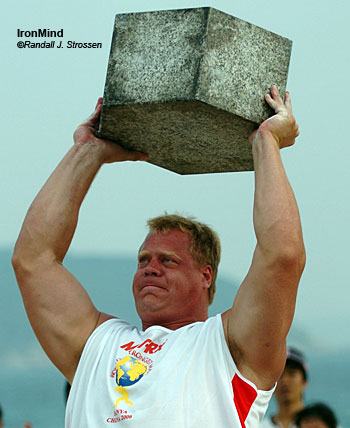
Iron Archives
2006 World's Strongest Man — the American champion who ended a 24-year title drought
Retired athlete
Phil Pfister is a retired American professional strongman, born on May 15, 1971 and closely associated with Charleston, West Virginia. Standing 1.98 m tall, Pfister competed at the highest international level from 1998 through 2010 and became World's Strongest Man in 2006 in Sanya, China. The victory was historic: no American had won WSM since Bill Kazmaier's third title in 1982. In the 2006 final, Pfister turned an unremarkable opening into one of the competition's most dramatic comebacks, winning five straight events — Rock Press, Fingal's Fingers, Bus Pull, Car Walk and Atlas Stones — to overtake defending champion Mariusz Pudzianowski. His wider record shows that the title was not an isolated peak: he finished fourth at WSM in 1998, 2001, 2007 and 2008, fifth in 2000 and seventh in 2009, placed third at the inaugural Arnold Strongman Classic in 2002, and won the 2005 IFSA Pan-American Championships. Strongman Archives credits him with 42 documented contests, including 34 international competitions, as well as eight WSM appearances, seven finals and one victory. Away from competition, Pfister worked as a Charleston firefighter from 1999; local reporting from the week of his world title noted that he was back on duty only days after becoming World's Strongest Man. He later worked in community development and moved into television and strongman commentary. Athletically, his profile was built around exceptional structural strength, grip, moving power and unusual mobility for a 1.98 m open-weight athlete, qualities that made him particularly dangerous in vehicle pulls, Fingal's Fingers, carries and stone events.
Some victories matter because they add a trophy to an athlete's record. Others alter the story of an entire country within a sport. Phil Pfister's triumph at the 2006 World's Strongest Man belongs to the second category. When the American from Charleston, West Virginia won the final in Sanya, China, the United States had not produced a WSM champion since Bill Kazmaier secured his third consecutive title in 1982. Twenty-four years had passed. During that span, the center of gravity of elite strongman shifted heavily toward Scandinavia, Central and Eastern Europe, with champions such as Jón Páll Sigmarsson, Magnús Ver Magnússon, Magnus Samuelsson, Jouko Ahola, Janne Virtanen, Svend Karlsen and later Mariusz Pudzianowski defining the televised era. Pfister did not arrive in 2006 as an unknown who simply caught a perfect week. He had already placed fourth at World's Strongest Man in 1998 and 2001, fifth in 2000, stood on the podium at the inaugural Arnold Strongman Classic in 2002, and won the IFSA Pan-American Championships in 2005. His world title was the point where years of international-level ability, a more deliberate training system and one of the most extraordinary sequences of event victories in WSM history converged.
Strongman Archives documents Pfister's competitive career from 1998 through 2010, with 42 recorded contests: 34 international, five national and three regional appearances, producing five overall victories in the database. At World's Strongest Man he made eight appearances, reached seven finals and won once. Those numbers give important perspective. Pfister was not a one-season champion. He operated near the top of the sport for more than a decade, across changing federations, rule sets, equipment and generations of opponents. Standing 1.98 meters tall and generally competing in the open heavyweight class at roughly 160 to 170 kilograms during major portions of his prime, he combined long levers, formidable grip, excellent moving strength and unusual mobility for an athlete of his size. He repeatedly scored well in truck pulls, farmer's walks, Fingal's Fingers, Conan's Wheel, Hercules Hold, Atlas Stones and car-walk or yoke-style events. His profile was not that of a pure static-strength specialist. Heavy deadlift variations and some squat machines could cost him points relative to the strongest specialists, but he often recovered those points when strength had to be converted into speed, balance, coordination and event-specific endurance. That all-round structure became decisive in China in 2006.
Phil Pfister was born on May 15, 1971 and became publicly identified with Charleston, West Virginia, the city that would become inseparable from his athletic story. Public biographical sources commonly list Charleston as his birthplace, while local reporting and contemporary strength-sport coverage consistently describe him as Charleston's strongman. Reliable public information about his childhood, education and earliest years is comparatively limited, and a responsible biography should not fill those gaps with unsupported anecdotes. His professional path, however, is well documented. In 1999 Pfister became a firefighter in Charleston. An Associated Press report carried by ESPN immediately after his 2006 world title noted that he had been a firefighter since 1999 and returned to duty only days after the ten-day competition in Sanya ended. The contrast was striking: the newly crowned World's Strongest Man was back working a public-service shift almost immediately after returning from China. In an era when professional strongman rarely guaranteed financial independence for American competitors, Pfister maintained the dual identity of international athlete and working professional for much of his rise.
West Virginia reporting after the 2006 victory also provides one of the clearest pictures of his training environment. FireRescue1, drawing on local coverage, described a makeshift gym Pfister used in the deteriorating former Thomas Jefferson High School building in Charleston. Hallways became lanes for tire flips and other strongman movements, and the impact of heavy weights could damage the floor. The image matters not because hardship should be romanticized, but because it shows what American strongman infrastructure often looked like before specialized gyms, standardized implements and online programming became widespread. Athletes frequently had to build their own environment around whatever space and equipment could be found. Brandon Walters, a trainer at the Charleston YMCA, was quoted in local reporting saying that he had trained with Pfister and watched him develop over the years. That local network, together with the physical culture of firefighting and access to unconventional objects, formed the background to a career that would eventually reach strongman's largest stages.
The year 1998 marks the first major, well-documented milestone of Pfister's elite career. At World's Strongest Man in Tangier, Morocco, he reached the final and finished fourth. For a debut WSM appearance, the result was exceptional and immediately established him as a credible future podium contender. Detailed results preserved by Strongman Archives show an athlete who could collect points across very different events: fourth in a medley, fourth in Conan's Wheel, fifth in the Max Log Lift with 120 kilograms, fifth in the Power Stairs, fourth in the Car Flip, second in the Húsafell Stone with a distance of 70.3 meters, eighth in the Truck Pull and fifth in the Farmer's Walk. Raw weights from the late 1990s should not be compared mechanically with modern records because implements, surfaces and rules have changed substantially. Placement within the contemporary field is more meaningful. What the 1998 result already revealed was a recurring feature of Pfister's career: long limbs that could be difficult in certain static lifts became powerful tools in carries, stones and events where stride length and reach mattered.
Only weeks after WSM, Pfister reinforced the impression at the 1998 Strongest Man Alive contest in St. Louis, finishing second overall. He won the Deadlift Hold by maintaining 250 kilograms for 74.75 seconds and also won the Truck Pull. He placed second in the Arm-over-Arm Pull, Crucifix Hold and Atlas Stones and third in the Max Dumbbell with 84 kilograms. Historical record compilations have sometimes described that deadlift hold as a world record for the period. Record standardization in older strongman is imperfect, but the performance remains an excellent illustration of the grip and static endurance that would later make Pfister dangerous in Hercules Hold, pulling events and heavy carries. His first documented international season therefore established an important theme: he entered elite strongman at a high level almost immediately. The following years were not about proving he belonged. They were about finding a way to turn repeated finalist-level performances into a world championship.
Through 1999 and 2000, Pfister became increasingly embedded in the international circuit. He placed sixth at the 1999 IFSA Finland Grand Prix and fifth in the 2000 edition. The event results already reveal useful technical patterns: he won the Viking Press at both editions and added a Crucifix Hold victory in 2000. At the 2000 Beauty and the Beast contest in Hawaii he finished fourth overall and won the Trolley Pull, moving an apparatus of roughly 13,000 kilograms over 25 meters in 24.97 seconds. That same year he won the Great Lakes Strongman Challenge and the Azalea Strongman Challenge, finished second at America's Strongest Man, American Hercules and the American Showdown, then placed fifth at World's Strongest Man in Sun City. In the South African final he was second in Fingal's Fingers, the Truck Pull and the Farmer's Walk, but lost significant points in the Super Yoke and several more static events. The pattern was becoming clear: in moving, pulling and grip-intensive events he could beat almost anyone, but a world title required him to reduce losses in the events that did not naturally suit his mechanics.
The 2001 season was one of the busiest of his career. Pfister finished third at North America's Strongest Man and second at Beauty and the Beast, America's Strongest Man, American Hercules and USA vs. The World. At Beauty and the Beast he recorded a 240-kilogram deadlift hold for 91.50 seconds and threw a 20-kilogram keg over 5.18 meters. At World's Strongest Man in Victoria Falls, Zambia, he won the Hercules Hold, Arm-over-Arm Pull, Fingal's Fingers and Atlas Stones in his qualifying group, then finished fourth in the final for the second time. He won Conan's Wheel and the Farmer's Walk and took third in the Log Lift and Atlas Stones, but lost decisive ground in the Squat Lift and Carry & Flip. That WSM is remembered in his personal mythology for another reason. Later accounts repeatedly recall that during the 2001 contest Pfister declared that he would be the man to return the World's Strongest Man title to the United States. At the time, the statement could be read as competitive confidence. Five years later, it would be remembered as a fulfilled prediction.
In 2002, elite strongman gained a new major contest inside the Arnold Sports Festival in Columbus, Ohio. The Arnold Strongman Classic was designed around exceptionally heavy implements and maximum-strength challenges, often placing less emphasis on the extended running and endurance that had characterized many WSM formats. Pfister competed at the inaugural edition and finished third behind Mark Henry and Svend Karlsen. He won the Timber Carry and took third in the Hummer Push, while a 324-kilogram max deadlift limited his point total. The podium is important when evaluating him historically. His 2006 WSM championship is often associated with speed in the Car Walk, excellent Atlas Stone technique and domination of dynamic events, but third place at the first Arnold demonstrates that he could also survive a format intentionally constructed around brutal absolute strength. In the same period, he won the 2002 Azalea Strongman Challenge with victories in the Truck Pull, medley and Log Lift.
Pfister's relationship with the Arnold Strongman Classic continued almost until the end of his career. He placed sixth in 2003, fourth in 2006 and 2007, seventh in 2008, fifth in 2009 and seventh in 2010. The series provides an unusually useful technical record because several events remained recognizable from year to year. At the 2006 Arnold he won the Dumbbell Press with six repetitions and took third in the Weight Throw. Randall Strossen of IronMind saw the dumbbell performance as evidence that Pfister had the tools to win World's Strongest Man later that year. In 2009, at age 37, Pfister finished second in both the Dumbbell Press and Manhood Stones and loaded a 240-kilogram stone over a four-foot bar. By contrast, the Hummer Tire Deadlift repeatedly showed where the best pure deadlifters could gain points on him: he recorded 393 kilograms in 2006, 384 in 2007, 398 in 2008, 396 in 2009 and 394 in 2010. Those were enormous absolute lifts, but in Arnold fields containing some of the greatest deadlifters of the era they often produced mid-table points rather than victories.
Pfister continued collecting major podiums in 2003. He was second at the Viking Challenge, second at America's Strongest Man and third at the X-Treme Strongman Championships. The America's Strongest Man results in St. Louis are particularly revealing: first in the Hercules Hold, first in Conan's Wheel, second in the Wheelbarrow Carry, second in Atlas Stones and second in the Axle Press. At the X-Treme Strongman Championships in Atlanta he registered 497 kilograms on the contest's Max Squat apparatus, won the Hercules Hold and finished on the overall podium. His 2003 World's Strongest Man campaign was more frustrating. He finished third in a qualifying group from which only two athletes advanced. Even there, he won Atlas Stones and placed second in the Tire Flip and Farmer's Walk. The elimination demonstrates the severity of older WSM qualifying formats: even an athlete who had twice finished fourth in the world could miss the final because a few events went badly inside one small group.
In 2004 he was again runner-up at America's Strongest Man, this time behind Van Hatfield. IronMind reporting from the period highlighted a Farmer's Walk in which Pfister handled implements of roughly 350 pounds per hand through turns, a configuration demanding not just grip but control, cornering and repeated acceleration. The 2005 season then delivered one of his most important victories before WSM gold: the IFSA Pan-American Championships in São Paulo. Pfister won with 87 points ahead of Travis Ortmayer, Karl Gillingham and Mark Felix. Contemporary and archival results show him taking six of the eight events, including the Wheelbarrow Carry, Shield Carry, Conan's Wheel, Apollon's Wheels and Log Lift, with second place in Atlas Stones. At the 2005 IFSA Strongman World Championships in Quebec City he finished sixth among 16 athletes, placing second in the Farmer's Walk and Conan's Wheel and third in Apollon's Wheels. Those IFSA performances matter because they show that Pfister could defeat deep international fields during a period when elite strongman was fragmented among rival organizations and championship structures.
One of the best-documented elements behind Pfister's rise to the world title is his work with Nick Osborne. In the summer of 2006, IronMind reported that Pfister was driving from West Virginia to Columbus, Ohio each week to spend several hours training with Osborne, returning for another long session the following day before traveling home. It was a major commitment of time for an athlete who had built much of his earlier career in comparatively improvised conditions. In July 2006 Pfister said he had returned to a bodyweight of approximately 350 pounds and was making World's Strongest Man his central target. Training materials released after the victory described Osborne's system as broader than a traditional strength routine built only around squats, deadlifts and presses. The preparation sought to blend strength with agility, speed, coordination and movement patterns that would transfer directly to strongman events. In retrospect, those qualities were exactly what separated the 2006 champion from rivals who might have possessed greater static numbers but could not convert strength into time, distance and efficient execution as consistently.
After winning the title, Pfister also explained why he had begun reducing the number of contests he entered. In a March 2007 IronMind interview he argued that two competitions per year could be enough. After five or six years of competing six to eight times annually, it had become increasingly difficult to build new strength while constantly traveling, recovering and peaking for another show. He viewed the Arnold Strongman Classic and World's Strongest Man as the two central targets, separated enough on the calendar to permit long training blocks. Today, such periodization is normal among elite strongmen, but it was less common in an era when many competitors accumulated experience and income through near-continuous contest schedules. Pfister's strategy was essentially to exchange competitive volume for the quality of the peak. In 2006, that tradeoff worked almost perfectly.
The 2006 World's Strongest Man took place in Sanya, China, under difficult conditions that included heat, humidity and periods of rain that affected event execution. Pfister did not dominate qualifying from beginning to end. Strongman Archives shows him winning the Loading Race, Farmer's Walk and Fingal's Fingers in his group but placing only fourth in the Car Walk and Deadlift. He advanced safely enough, however, into a final centered on defending champion Mariusz Pudzianowski, already a three-time WSM winner and one of the most complete strength-and-speed athletes in the sport's history. The final opened with the Car Deadlift and Power Stairs. Pfister placed fourth in the deadlift with 12 repetitions and sixth in the Power Stairs. After two events he did not resemble the likely champion. The next five events created the defining sequence of his career.
The third event, commonly described as the Rock Press or Overhead Stone Lift, required athletes to press increasingly heavy irregular stones overhead. Pfister completed all four stones, culminating at roughly 133 kilograms, in 83.27 seconds. No other finalist managed more than two. The margin was so dramatic that contemporary IronMind coverage treated Pfister as existing in a separate category on the event. That victory changed the emotional and mathematical shape of the final. On Fingal's Fingers, Pfister flipped all five implements in 31.92 seconds and won again, a performance reported at the time as a world record for the configuration. Pudzianowski dropped valuable points. In the Bus Pull, contested slightly uphill on a course no finalist could complete, Pfister dragged the vehicle roughly 12 to 15 centimeters farther than the Pole and secured a third consecutive event victory. A Pudzianowski lead that had been 7.5 points at the start of the day was reduced to only 1.5.
The Car Walk looked, on paper, like the point where the American comeback might finally stop. Pfister had struggled with the apparatus in qualifying, whereas Pudzianowski was famous for his speed in moving events. IronMind reported that the Pole set a very fast time, and many observers assumed Pfister would surrender ground. The American prepared in an unusual way, walking the course with a barbell of roughly 140 kilograms across his shoulders. During his run, the front of the car initially dipped, but Pfister stabilized the implement and accelerated enough to win the event in 26.88 seconds. It was his fourth consecutive victory. The overall gap had been reduced to half a point. The world championship would be decided on Atlas Stones, with Pfister and Pudzianowski paired against one another at the end.
The final on the stones became one of the canonical images of World's Strongest Man. Both men were fast stone loaders. Pudzianowski gained a slight advantage through the early stones, but at the final platform Pfister used a more diagonal relationship to the loading surface, reducing extra foot movement before extension. Strongman Archives credits Pfister with all five stones in 25.72 seconds and the event win. The final standings gave him 61 points, compared with 57.5 for Pudzianowski and 45 for Don Pope. The numbers alone cannot fully express the nature of the comeback. Pfister had won the final five events consecutively: Rock Press, Fingal's Fingers, Bus Pull, Car Walk and Atlas Stones. A final that opened with fourth and sixth place in the first two disciplines ended as a demonstration of adaptation, event intelligence, conditioning and execution under extreme pressure.
The victory immediately resonated in American media. The Associated Press described the story of the 35-year-old firefighter who had become the first American in 24 years to win World's Strongest Man. Local reporting emphasized that he returned to work very quickly after coming home from China. FireRescue1 noted that he had been competing in strength sports for roughly eight years and that, before the final, he was viewed as a legitimate contender rather than a prohibitive favorite. The win also carried a larger symbolic meaning for American strongman. The United States continued to produce capable finalists throughout the preceding decades, yet the main trophy repeatedly left for Europe. Pfister demonstrated that an American athlete could again win against a field shaped by the European strongman systems of the period. Derek Poundstone would soon come close to the title, and Brian Shaw would later establish another era of American success. From that perspective, 2006 forms a bridge between the Kazmaier era and the Shaw era, with Pfister standing at the center of the transition.
After the world title, attention around Pfister increased substantially. IronMind described him in the summer of 2007 as a champion still making the roughly three-hour drive to Columbus to train with Nick Osborne. Pfister said his aim was to defend the title and that the next stage of preparation continued to combine strength, agility, speed and athleticism. He wanted to be slightly leaner than in 2006, not for appearance but to move more efficiently. At the 2007 Arnold Strongman Classic he finished fourth, placing second in the Dumbbell Press, third in the Super Yoke and fourth in the Timber Carry. At World's Strongest Man in Anaheim he reached another final and again finished fourth. He was third in Fingal's Fingers and the Safe Lift, fourth in Atlas Stones and the Loading Race, but gave up important points in the deadlift. Mariusz Pudzianowski reclaimed the championship, followed by Sebastian Wenta and Terry Hollands.
Fourth place was not the result a defending champion wanted, yet it confirmed something essential: Pfister had not disappeared after one perfect peak. At age 36, in a sport where injuries and accumulated tissue stress can rapidly shorten careers, he remained one of the four best finalists in the world. His qualifying performance was arguably even more impressive than the final placing. He won the Hercules Hold, Fingal's Fingers and medley, placed second in the Safe Lift and controlled his route into the final. The period also marks the point at which his public identity expanded beyond competition. The WSM title generated talk-show and game-show appearances, promotional work and motivational speaking. Pfister was gradually becoming a media personality and ambassador for strongman while still pursuing elite competitive goals.
Pfister's professional life changed during 2007 and 2008. IronMind reported in October 2007 that he had left the Charleston Fire Department for a corporate-development position with Chesapeake Energy. In 2008 he was publicly identified as a Community Development Coordinator for the company. The role placed him at an interesting intersection of sport, business and civic projects. During the same period, Pfister advocated for a major drug-tested strongman contest and became involved in the organization of America's Strongest Man. IronMind described him as a long-time supporter of testing and quoted his argument that major sponsors expected such standards. Whatever position one takes in the broader debate about testing systems in strongman, the initiative shows that Pfister was trying to shape the infrastructure and public presentation of the sport rather than simply compete inside it.
His most visible organizational contribution that year was his important role in bringing the 2008 World's Strongest Man to Charleston. IronMind explicitly described Pfister as instrumental in securing the competition for his hometown. The event used several locations around the area and drew support from local government, businesses and the wider community. For Pfister, having WSM arrive in West Virginia only two years after his championship turned personal success into a civic event. State and city officials participated in opening activities, and Pfister naturally became one of the central faces of the week. Athletically, the field was formidable. Pudzianowski was pursuing a record fifth title, Derek Poundstone was emerging as a major championship threat, Dave Ostlund was in excellent form and the new generation of American strongmen was becoming progressively stronger.
Pfister finished fourth at the 2008 World's Strongest Man in Charleston, the fourth time in his career that he occupied that position. He won the Car Walk in 13.12 seconds, placed second in the Plane Pull and Fingal's Fingers and fourth in the Power Stairs. In qualifying he had won the Axle Press, Truck Pull and Loading Race and placed second in the Squat Ladder and Keg Toss. At age 37, he was still operating very close to the podium. The final's deadlift and log events, however, cost valuable points. Pudzianowski won, Poundstone finished second, Dave Ostlund third and Pfister fourth. For the West Virginia audience, missing the podium did not reduce his importance to the event. He was not merely one of the competitors; he was a major reason the competition had come to Charleston in the first place.
Pfister continued to follow a selective but extremely high-level schedule in 2009. At the Arnold Strongman Classic he finished fifth overall, placing second in the Dumbbell Press with nine repetitions and second in the Manhood Stones, where he loaded a 240-kilogram stone. The latter became one of the most frequently cited heavy-object performances of his career. In June he entered Fortissimus in Montmagny, Canada, a contest designed as a punishing test of broad strength and endurance through an unusually large number of heavy disciplines. Pfister finished sixth among 14 athletes and placed second in Atlas Stones, fourth in the Farmer's Walk and fifth in the Loading Race. He registered 909 kilograms in the Back Lift and loaded three natural stones in a difficult series. The ability to tolerate that type of contest at age 38 says as much about his durability as any single lift.
The 2009 World's Strongest Man in Malta became his last WSM final. His qualifying performance, however, was one of the most dominant group-stage runs of his career. Pfister won the Truck Pull, Carry & Drag, Car Walk, Dumbbell Press and Atlas Stones, five of the six events in his group. The only major weakness in that heat was the deadlift ladder. In the final, the level of opposition and accumulated years were more apparent. He finished seventh, with mid-table results in the Farmer's Walk, Plane Pull, Axle Press and Arm-over-Arm Pull and no repetitions in the Car Deadlift. Even so, the qualifying sweep showed that the athletic engine that had made him champion had not vanished. He returned for the 2010 Arnold Strongman Classic and finished seventh. Strongman Archives lists that contest as the last appearance in its database, closing his documented competitive span at 1998–2010.
A close reading of Pfister's results reveals a more sophisticated athlete than the generic description of a very large, very strong man. At almost two meters tall, he naturally possessed useful leverages in events such as Fingal's Fingers, where height and reach can reduce some of the disadvantage of initiating each implement. The same long limbs can be costly in deadlifting, and Arnold results confirm that the deadlift was not always his strongest event relative to elite specialists. Pfister compensated with grip, the ability to sustain force under tension and excellent efficiency with objects that had to be moved through space. Farmer's Walk, Truck Pull, Car Walk, Húsafell Stone, Hercules Hold and Conan's Wheel repeatedly appear among his best event finishes. He was fast and technically confident on Atlas Stones, good enough to decide the 2006 world title against Pudzianowski on that event. Overhead, he was not the absolute record-holder of his generation, but he could produce exceptional competitive peaks, from the Arnold 2006 Dumbbell Press victory to the Rock Press demolition in the WSM final.
Adaptability was another defining strength. The 2006 Car Walk provides the clearest example. An event that had gone poorly in qualifying did not become a fixed verdict on what he could do. Pfister adjusted the warm-up, setup and rhythm, then won the very discipline many observers considered Pudzianowski's decisive advantage. In the Bus Pull, a margin measured in centimeters came in an event no athlete could finish, meaning small differences in technique and the ability to preserve motion as speed disappeared were enormously valuable. On the last Atlas Stone, a more diagonal body position relative to the platform reduced unnecessary footwork and saved fractions of a second. Strongman is publicly dominated by spectacular weights, but championship outcomes are often decided by details of mechanics, pacing, transitions and decision-making. Pfister's best competitions illustrate that reality extremely well.
Public information about Phil Pfister's private life should be handled with restraint. Charleston-area reporting in 2006 referred to his then-wife Michele and their son Wyatt. Later biographical sources also describe him as a father and continue to associate him with West Virginia. A responsible editorial profile can preserve those historical details in their dated context without converting old reporting into assumptions about his present-day personal circumstances. His public activity is much better documented. After the WSM victory, Pfister appeared on television programs and undertook motivational speaking. On April 17, 2008 he appeared on Are You Smarter Than a 5th Grader?, and contemporary as well as later coverage records that he won $25,000. Secondary biographical sources also credit him with a minor role in the Tony Jaa film The Protector and an appearance on Airline. These appearances reflected the unusual marketability of a world champion who could communicate comfortably outside the strength-sport niche.
By 2008, IronMind and West Virginia business media identified Pfister as a Community Development Coordinator with Chesapeake Energy. He appeared in public discussions about the state's economic and energy development and used his profile in civic and promotional settings. The transition is relevant to understanding his post-title identity: firefighter, world champion, corporate community-development representative, contest organizer and public speaker. After his competitive career wound down, multiple biographical sources also credit him with working as a television commentator on World's Strongest Man broadcasts, including ESPN2 coverage alongside established strongman figures such as Bill Kazmaier. The role was a natural extension of his experience. Few commentators could explain both the physical problem inside an event and the psychological pressure of entering the last discipline with a world title mathematically alive.
Phil Pfister's place in American strongman history can be underestimated if judged only by the number of World's Strongest Man titles. He has one, whereas Bill Kazmaier and Brian Shaw built multi-title dynasties. Context makes Pfister's single championship exceptional. Between 1982 and 2006, no American won World's Strongest Man. The United States remained important to strength sports, hosted major contests and produced excellent athletes, but the sport's central trophy repeatedly went to Europe. Pfister interrupted that sequence. More importantly, he did it in a direct competitive battle with Mariusz Pudzianowski, arguably the most dominant WSM-format athlete of the first decade of the 2000s. The championship did not come because the primary rival withdrew or because the field collapsed. Pfister had to recover from a significant points deficit and then win five consecutive events under championship pressure.
Symbolically, Pfister connects three American periods. Behind him stands Kazmaier, the last U.S. champion before the drought. Around him is the international generation of Pudzianowski, Žydrūnas Savickas, Vasyl Virastyuk, Svend Karlsen, Magnus Samuelsson and the other leading names of 1998–2010. Ahead of him came Poundstone and, most importantly, Brian Shaw, who would restore sustained American dominance at WSM. Pfister's fourth-place finishes in both 2007 and 2008 are important because they demonstrate that the 2006 title was not a statistical accident. He belonged to the elite. At the same time, his championship showed a new American generation that the drought could be broken. In that sense, 2006 was not only a personal peak but a reopening of possibility for U.S. strongman.
His legacy is also visible in the way he promoted West Virginia as a home for strongman. World's Strongest Man 2008 in Charleston was not simply another stop on an international calendar. Contemporary IronMind coverage credited Pfister with playing an important role in bringing the production to his city. The event brought athletes, television crews and global exposure into the community and linked the champion's identity directly to the place where he had worked and trained. Later community truck-pull projects in West Virginia continued to seek his expertise and invoke his world title. That continuity matters. A championship can remain in statistical archives, but an athlete who contributes to events, promotion and community projects leaves a footprint that extends beyond the result sheet.
Pfister's strength numbers require context because strongman implements, pickup heights and rules vary substantially from contest to contest. Among the best-documented performances are 497 kilograms in the Max Squat apparatus used at the 2003 X-Treme Strongman Championships, 398 kilograms in the Hummer Tire Deadlift at the 2008 Arnold Strongman Classic, a 240-kilogram Manhood Stone over a four-foot bar at the 2009 Arnold, and 160 kilograms in the Max Log Lift at the 2005 IFSA World Championships. He completed four repetitions with 155 kilograms on Apollon's Wheels at the 2005 Pan-American Championships. In grip and static endurance he held 250 kilograms without straps for 74.75 seconds in the 1998 Deadlift Hold and 240 kilograms for 91.50 seconds at Beauty and the Beast in 2001. In Hawaii he also threw a 20-kilogram keg over 5.18 meters in consecutive editions and, in 2000, pulled a trolley of roughly 13 metric tons over 25 meters in 24.97 seconds.
Yet Pfister's most representative 'records' may not be the largest raw lifts. At WSM 2006 he completed Fingal's Fingers in 31.92 seconds, a time presented as a record for the configuration. He completed all four Rock Press stones, up to approximately 133 kilograms, in a final where nobody else passed two. He won the Car Walk in 26.88 seconds under the pressure of a fast mark from Pudzianowski and loaded five Atlas Stones in 25.72 seconds in the duel that decided the championship. Those performances express his athletic identity more accurately than a single deadlift figure: a strongman capable of solving very different mechanical problems quickly, with awkward objects, under maximal competitive stress.
This profile was built by cross-referencing several types of source. Strongman Archives provides the primary statistical framework for Pfister's competition chronology, placings and event-level results, including historical performances whose apparatus-specific nature is important to preserve. World's Strongest Man's official historical results were used to verify championship placings. Contemporary IronMind reporting from 2006–2008 is central to the account of the Sanya final, the work with Nick Osborne, the Car Walk comeback, the Bus Pull margin, the training philosophy and Pfister's organizational role around later contests. An Associated Press report carried by ESPN and Charleston-area material reproduced by FireRescue1 support the firefighting history, his rapid return to duty after the world title and details about the local training environment. IronMind and West Virginia Executive were used for his Chesapeake Energy role, community-development work and involvement in bringing WSM to Charleston. Media appearances were cross-checked against contemporary and retrospective reporting. Where information about private life is sparse or based on older reports, this profile deliberately avoids presenting historical details as claims about his current circumstances.
Taken as a whole, Phil Pfister is one of the decisive figures in early twenty-first-century American strongman. He was not the most prolific champion of his generation and he was not the greatest specialist in one isolated lift. He was the athlete who achieved what no American had managed for 24 years. He finished fourth at World's Strongest Man four times, stood on the Arnold podium, won major international contests and remained competitive deep into his thirties. Above all, Sanya fixed his image in strongman history: five consecutive event victories, a Car Walk win that contradicted expectations, a Bus Pull decided by centimeters and a final stone loaded quickly enough to turn a promise made years earlier into reality. There are few moments in World's Strongest Man history in which an entire career can be compressed into one competitive sequence. For Phil Pfister, that sequence is 2006.
Iron Hall data
240 KG
Manhood Stone / Max Atlas Stone · 2009 Arnold Strongman Classic; loaded over a 4 ft bar
Verified
497 KG
Max Squat — strongman apparatus · 2003 X-Treme Strongman Championships
Verified
398 KG
Hummer Tire Deadlift · 2008 Arnold Strongman Classic
Verified
160 KG
Max Log Lift — competition · 2005 IFSA Strongman World Championships
Verified
155 KG
Apollon's Wheels · 4 reps, 2005 IFSA Pan-American Championships
Verified
250 KG
Deadlift Hold without straps · 74.75 seconds, 1998 Strongest Man Alive
Verified
240 KG
Deadlift Hold without straps · 91.50 seconds, 2001 Beauty and the Beast
Verified
13 TONS
Trolley Pull · 13,000 kg over 25 m in 24.97 seconds, 2000 Beauty and the Beast
Verified
20 KG
Keg Toss · Over 5.18 m; achieved at the 2000 and 2001 Beauty and the Beast
Verified
133 KG
Rock Press · Completed the 103–133 kg series and won the event at 2006 WSM
Verified
1998
Exceptional WSM final debut in Tangier, Morocco; finished second in the Húsafell Stone.
4th place
1998
Won the Deadlift Hold and Truck Pull and placed second in the Arm-over-Arm Pull, Crucifix Hold and Atlas Stones.
2nd place
2000
One of the first documented victories of his professional strongman career.
Champion
2000
Regional victory in Norfolk, Virginia.
Champion
2000
Sun City final; second in Fingal's Fingers, Truck Pull and Farmer's Walk.
5th place
2001
His second fourth-place WSM finish; won the Conan's Wheel and Farmer's Walk in the final.
4th place
2001
Runner-up in a 30-athlete contest; included a 240 kg Deadlift Hold for 91.50 seconds.
2nd place
2002
Podium at the inaugural edition behind Mark Henry and Svend Karlsen; won the Timber Carry.
3rd place
2002
Won the Truck Pull, medley and Log Lift.
Champion
2003
American runner-up; event wins in Hercules Hold and Conan's Wheel.
2nd place
2003
Podium in Atlanta; 497 kg Max Squat and an event win in the Hercules Hold.
3rd place
2004
His fourth America's Strongest Man runner-up finish between 2000 and 2004.
2nd place
2005
Major victory in São Paulo with 87 points; won six of the eight events.
Champion
2005
IFSA world final in Quebec City; second in the Farmer's Walk and Conan's Wheel.
6th place
2006
Won the Dumbbell Press and entered the WSM season as one of the leading American all-round strongmen.
4th place
2006
The defining title of his career: 61 points and five consecutive event wins in the final, ending with Atlas Stones.
Champion
2007
Defended his elite status in Anaheim; third in Fingal's Fingers and the Safe Lift.
4th place
2008
A home-state final in Charleston, West Virginia; won the Car Walk and placed second in the Plane Pull and Fingal's Fingers.
4th place
2008
Runner-up at the memorial contest in Sequim, Washington.
2nd place
2009
Second in the Dumbbell Press and Manhood Stones; loaded the 240 kg stone.
5th place
2009
Competed in the exceptionally heavy Montmagny format; second in Atlas Stones.
6th place
2009
His final WSM final; in qualifying he won five of the six events in his group.
7th place
2010
The final contest recorded by Strongman Archives, closing his documented 1998–2010 competitive span.
7th place