
2017
Ukraine’s Strongest Man
Earliest Open national result in the Strongman Archives career chronology.
5th place
Iron Archives
2023 Europe’s Strongest Man • 4th at 2026 World’s Strongest Man
Active athlete
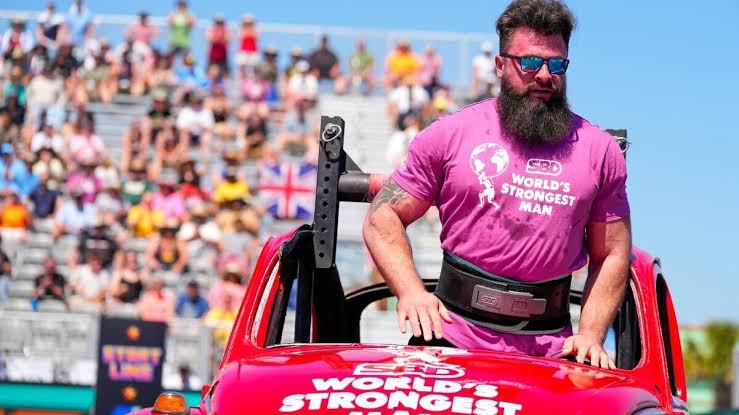
Pavlo Kordiyaka is a Ukrainian professional strongman from Lviv and one of the most athletic Open-class competitors of the current generation. The 2023 Europe’s Strongest Man and 2021 Official Strongman Games champion progressed from sixth at the 2023 World’s Strongest Man and eighth in both 2024 and 2025 to a career-best fourth place at WSM 2026. In the same 2026 season he finished second at Europe’s Strongest Man, fourth at the Giants Live Strongman Classic, won SCL Poland and, on 26 September, won Summit of Strength in Rotherham. At 1.95 m and roughly 132–140 kg depending on season and source, he is known for speed, mobility, overhead strength, medleys, loading and carrying events; Conan’s Wheel has become a signature event, including a 1035° performance at the 2024 Strongman Classic. Away from the arena, he has university training in physical rehabilitation/therapy, has worked in the field, and came to strongman after a broad multisport childhood that included football, acrobatics, dance and combat sports.
Pavlo Kordiyaka, strength built in motion. Modern Open strongman is often imagined through enormous body mass, half-ton deadlifts and the idea that every extra kilogram is an advantage. Kordiyaka reached the world elite through a less conventional formula. At roughly 1.95 m and a bodyweight that has moved between about 132 and 140 kg in public sources and across different seasons, the Ukrainian from Lviv is comparatively light for the level at which he competes. What he gives away to some rivals in absolute mass he recovers through speed, mobility, coordination, fast transitions under load and an overhead repertoire capable of winning points against much heavier athletes. As of this profile update on 28 September 2026, his résumé includes the 2023 Europe’s Strongest Man title, victory at the 2021 Official Strongman Games, the 2020 Ukraine’s Strongest Man championship, wins on the Strongman Champions League circuit, the 2022 Marijampolė International title and a career-best fourth place at the 2026 World’s Strongest Man. Only two days before this update, on 26 September 2026, he won the Summit of Strength in Rotherham, England, confirming that this is not a retrospective on a finished career but a portrait of an athlete still actively adding to it. His World’s Strongest Man progression is particularly revealing. He failed to advance from his group in 2022, reached his first final and finished sixth in 2023, placed eighth in both 2024 and 2025, then moved to fourth in 2026. The path was not linear. There were contests in which the deadlift cost him major points, seasons in which accumulated fatigue blunted his best events, and performances where the final placing looked much worse than the quality of individual event results. That irregularity is precisely why Kordiyaka is more interesting than a medal list. He is an athlete who has built competitiveness through intelligent specialization, technical adaptation and a view of strongman in which athleticism matters almost as much as raw force. Giants Live has long emphasized how unusually mobile he is for his size, while Strongman Archives documents the hard numbers: a 200 kg log, 200 kg axle press, 132 kg circus dumbbell, 363 kg competition deadlift and 435 kg 18-inch deadlift. None of those figures alone makes him the absolute leader of the discipline, but together they describe a broad competitor. In strongman, where one bad event can erase the work of several excellent ones, breadth is often more valuable than a single spectacular lift.
Lviv, family and a childhood that did not point inevitably toward strongman. Kordiyaka was born on 2 July 1995 in Lviv, western Ukraine. Ukrainian interviews describe a very active childhood, but not one designed inside a professional sporting family or a system that had mapped out elite strength competition from an early age. He has spoken about a physically strong father, a mother who had done gymnastics as a child, and family stories about a tall, robust great-grandfather capable of handling heavy sacks. These are family recollections rather than evidence for a simplistic genetic explanation, but they help show how physical work and strength were understood in his background: ordinary realities rather than theatrical qualities. Kordiyaka does not describe himself as a child who dreamed only of barbells. The opposite is closer to the truth. He experimented widely, and that variety is one of the keys to his later competitive style. Movement remained constant through school, and Ukrainian sources connect him with School No. 99 in Lviv. Much later, already an established elite athlete, he would work in an educational setting, another sign that his professional identity was never completely reduced to competitions. His parents appear repeatedly in interviews. In 2019 he said his father had initially been skeptical about the possibility of a serious strongman career, while his mother was consistently supportive. Once the results became substantial, that skepticism turned into acceptance and support. After winning Europe’s Strongest Man in 2023, Kordiyaka recalled that one of the first important calls he made was to his mother. The detail matters because it does not sound manufactured for branding. After one of the largest victories of his career, his instinct was to share the result with family. At the same time, Kordiyaka’s public profile remains relatively restrained. He will discuss family, relationships and domestic life when asked, but he has not built his career on continuous exposure of the people around him. This biography therefore separates verifiable public information from speculation. It does not fill gaps in his private life with assumptions simply because a ‘complete’ profile is being written. In an era when social media can turn an athlete into a permanent reality-show character, Kordiyaka remains closer to a professional who allows the audience to see training, competition, food and fragments of routine while leaving significant areas undocumented. That boundary is part of an accurate biography, not an absence to be repaired.
Football, acrobatics, dance and combat sports: the movement vocabulary that existed before strength became the main language. If one chapter helps explain why Kordiyaka moves differently from many heavyweight strongmen, it is his multisport childhood and adolescence. Across Ukrainian interviews and international profiles he has listed football, acrobatics, ballroom dance, table tennis, boxing, Muay Thai, wrestling and mixed martial arts. He did not pursue all of them to the same level or for the same length of time. Football was one of the earliest and longest experiences. Kordiyaka has said that he entered the youth structure associated with Karpaty and played as a goalkeeper from childhood into his teenage years. Goalkeeping demands reaction speed, lateral movement, spatial awareness and explosive force from awkward positions. None of these transfers mechanically into strongman, but together they build a rich motor base. Acrobatics followed, then several years of ballroom dancing. The image of a future 140 kg strongman spending serious time dancing may sound like an amusing biographical footnote, but it is actually highly relevant. Foot positioning, balance, rhythm, control of the center of mass and coordination between the torso and lower body all return in altered form during medleys, loading races and carrying events. Later he moved into combat sports. He boxed, trained Muay Thai and became involved in MMA seriously enough to consider competition. In a long 2019 interview he mentioned that his brother Ihor had achieved success in MMA, making the environment familiar rather than exotic. Kordiyaka later said that he stepped away from striking sports partly because he disliked the effects of repeated blows on how he felt cognitively and on his memory. That is his own account, not a retrospective medical diagnosis. The decision still marks a turning point. A young athlete who could have continued down a combat-sport path chose instead a field where risk took a different form and progress could be measured in objects, distance, time and load. When he finally entered strongman, then, he was not a motor novice. His body had spent years running, jumping, landing, reacting, striking, evading and dancing. That history helps explain why mobility remained an asset even after major weight gain. Kordiyaka is not fast despite being large. To some extent he is fast because complex movement was trained long before maximal strength became the priority. Strongman eventually gave all those earlier qualities a new environment. The implements were heavier, the costs of mistakes larger and the arena completely different, but the athlete underneath had already learned how to organize his body under changing demands.
University and profession: physical rehabilitation before strongman became a viable career. After school, Kordiyaka studied at the institution now known as the Ivan Bobersky Lviv State University of Physical Culture, following a health and rehabilitation path that later centered on physical rehabilitation or therapy. Ukrainian sources use slightly different names for faculties and stages of his education, but the central point is consistent: his academic background is in rehabilitation rather than in a generic elite-sport program. The choice became practical. During the years when strongman could not provide stable income, Kordiyaka worked as a massage therapist, trainer and rehabilitation specialist. In 2017 he worked as a physiotherapist with FC Lviv, an experience he described as professionally valuable but difficult to combine with his own athletic development because of travel and scheduling. At other times he worked privately and in gym environments. Much later, after becoming a European champion and a World’s Strongest Man finalist, he continued to talk about the importance of having competence outside competitive sport. A local interview even described him working in a school setting in Lviv, an unexpected detail for an internationally known strongman but one consistent with his belief that an athlete should not reach the end of a finite sporting career without a second professional identity. Education in rehabilitation did not make him immune to injury. Strongman still exposes the body to extreme loads, and Kordiyaka has dealt publicly with back and shoulder issues and periods in which training had to be reorganized. The advantage appears more clearly in the language he uses to discuss his body. In recent interviews he talks about medical monitoring, mobility, massage, sauna, walking, sleep, load management and movements such as the reverse hyperextension for back comfort. In 2024, describing his own system to Torokhtiy Media, he emphasized that a serious strongman needs a team rather than willpower alone: a coach, nutritional expertise and qualified medical support. Some of his personal views on supplements or testing frequency are his own practices and should not be turned into universal medical advice. What matters biographically is the systems mentality. Kordiyaka moved from a stage in which he largely managed himself to a career in which preparation functions as an interdisciplinary project. His rehabilitation education is therefore more than a decorative line in a résumé. It is one of the lenses through which he interprets training, recovery and the idea that high performance must be managed rather than merely attacked.
Finding strongman: why the beginning can legitimately be dated to 2012, 2013 or 2014. Public profiles often say that Pavlo Kordiyaka entered strongman at eighteen, placing the beginning around 2013–2014. A Ukrainian interview published in 2026 gives a more detailed version in his own words. In 2012, after receiving his first university scholarship, he bought a membership at Olimp Gym in Lviv. There he met athletes training strongman and became interested in the combination of strength, unusual implements and competition. Other local interviews say that in 2013 the gym hosted a junior regional event or championship and that, when one participant did not appear, Kordiyaka was asked to step in almost by accident. He finished last. Instead of treating the result as proof that he did not belong, he left wanting to learn the sport. The apparent contradiction in dates is therefore mostly a matter of definition. 2012 can refer to entering Olimp and beginning to train around strongmen; 2013 to the improvised first competition; 2014 to more structured national competition. VladimirStrongman uses 2013 as the beginning of competitive activity while explicitly noting that his exposure and training environment began in 2012. At Olimp he met brothers Oleg and Orest Pylypiak, names Kordiyaka has repeatedly identified as important in his early development. Oleg in particular provided some of the first structured guidance. International promoter biographies often simplify the story by saying that former World’s Strongest Man champion Vasyl Virastyuk introduced Kordiyaka to strongman. That claim appears in Giants Live material and international media, while Kordiyaka’s longer personal interviews describe the daily mechanism more concretely: Olimp Gym and the local strongman community in Lviv. The two versions do not necessarily cancel each other. Virastyuk is a foundational figure in modern Ukrainian strongman and an obvious cultural reference point, while the hands-on gym environment came from local athletes. Around the same period Kordiyaka also tested Olympic weightlifting. In a 2019 interview he said that after a short period of specialized work he reached a significant Ukrainian sport classification around the 105 kg class. The story suggests how quickly he adapted to strength training, but weightlifting did not replace strongman. Strongman offered something closer to his temperament: variety, problem solving, changing implements and a competitive structure in which speed and athleticism could matter alongside maximal force. The last-place junior entrant was therefore not an unsuccessful beginning. It became the cleanest possible starting point for a career that, roughly a decade later, would produce a European champion.
The apprenticeship years: from weight classes to the Open division. Kordiyaka’s earliest seasons are harder to reconstruct than his Giants Live career because local results were not archived with the same density as major international contests. Ukrainian biographical sources say that in 2014 and 2015 he competed at national championships in the under-110 kg class. That detail matters because it shows how dramatically his body changed. Strongman Archives now lists him around 140 kg, and other promoter material has placed him closer to 132–135 kg, but the young Kordiyaka entered strength sport with a substantially lighter frame. He has said that he gained roughly 20 kg during his first serious year of strength-focused training, a rapid transformation from a multisport body toward the physique required for heavy implements. The Open results become clearer from 2017, when Strongman Archives records fifth place at Ukraine’s Strongest Man. In 2018 he moved to second. At this stage he was not yet the international arena athlete familiar to British crowds. He was a highly promising Ukrainian strongman learning the difference between being strong in a gym and managing a complete contest. Strongman demands qualities that often pull in opposite directions: maximal strength, repetitions at high intensity, sprinting under load, grip, lactate tolerance, awkward-object technique and the ability to adapt to implements that may never feel identical to the versions used in training. Kordiyaka began to separate himself in the areas where his earlier athletic background became useful: moving events, loading and overhead work. Deadlift, by contrast, would remain a relative problem even after he reached the world elite. Calling a 360-plus-kilogram pull a ‘weakness’ sounds absurd outside strongman. At World’s Strongest Man, however, elite deadlift specialists can move 450 kg or more in certain variations, and the difference between fifth and tenth in one event can erase an entire contest’s worth of good work. In the apprenticeship years, that international comparison was still ahead. The immediate priorities were experience, gaining mass without losing mobility, building implement technique and learning how his body reacted to dense competition calendars. One advantage survived the weight gain: Kordiyaka did not abandon conditioning. As he became heavier, he continued training the ability to move. When he later faced Open athletes thirty or forty kilograms heavier than himself, that choice became strategic rather than aesthetic. A smaller body is only an advantage if it can make the same implements move faster. Kordiyaka gradually built a style around exactly that trade.
2019, when the border between national promise and international relevance began to disappear. Kordiyaka entered the year with documented Open experience and a need to test himself beyond Ukraine. He competed at the Arnold Amateur Strongman World Championships, where Strongman Archives places him ninth. For a developing athlete, Arnold offered something the placing alone cannot show: exposure to different judging standards, event structures and athletes produced by different national systems. He again finished second at Ukraine’s Strongest Man, confirming that he had become one of the country’s leading Open competitors. The clearest international breakthrough came with victory at the Pahlavon Mahmud Strongman Grand Prix in Uzbekistan, recorded in modern statistical archives as one of his important early wins abroad. Other Ukrainian material from the period also points to success in log-lifting competition, suggesting that overhead strength was already becoming one of his defining assets. At the same time, life as a strongman was not yet financially comfortable. In a long 2019 interview with 24TV, Kordiyaka described a reality familiar to many athletes outside the British and North American markets: travel was expensive, prize money uncertain and training had to be combined with work. He even discussed turning down bodyguard work, preferring employment that gave him more control over time and remained connected to rehabilitation, massage and training. Programming was still largely self-directed, but he actively sought advice from more experienced strongmen. Two names recur in his account: Volodymyr Reksha, an important Ukrainian strongman of the preceding generation, and Oleksii Novikov, who would become World’s Strongest Man in 2020. The relationship with Novikov became central to Kordiyaka’s public story. They were training partners, peers, sources of information for each other and, inevitably, rivals once they shared major international stages. Before British coverage framed Kordiyaka as an athlete capable of beating Novikov, both belonged to the same Ukrainian strength ecosystem, where one athlete’s success expanded the logistical and symbolic path for others. The year 2019 was therefore more than a collection of results. It was when Kordiyaka began to understand that he could exist professionally outside Ukraine and that his quicker, more technical style could work against heavier opposition. It also sharpened a recurring problem: international strongman rewards experience, but gaining experience requires travel, money and enough recovery to keep the body functioning. Every invitation was an opportunity, yet every opportunity consumed resources. That tension would become more important as his invitations became bigger.
2020 and 2021: national champion, physical setbacks and the leap through the Official Strongman Games. In 2020 Kordiyaka won Ukraine’s Strongest Man after back-to-back runner-up finishes. The title arrived during a period in which the international calendar was disrupted, and it functioned as confirmation that the national apprenticeship phase had reached its conclusion. He no longer needed to prove merely that he belonged near the top in Ukraine. The next question was whether he could turn that level into access to the global professional circuit. The 2021 season contained both strong results and signs of how costly frequent competition can become. Kordiyaka finished second at the Savickas Classic and second at Middle East’s Strongest Man, while also adding a Marijampolė podium. His eighth-place result at Ukraine’s Strongest Man stands out sharply beside those performances and appears in biographical accounts alongside physical problems. Back and shoulder issues are mentioned at several points in his interviews. He has discussed episodes of lower-back discomfort associated with fatigue and imperfect technique, an important reminder that professional education in rehabilitation does not make an athlete immune to the mistakes he might recognize in others. The defining result of the year was the Official Strongman Games. Kordiyaka won the 2021 contest, earning one of the most important titles of his early international career and a major step toward World’s Strongest Man. OSG occupies a special position in the sport. For many athletes it is the intersection between high-level national strongman and the global ecosystem, large enough to expose weaknesses and connected enough to change the quality of future invitations. For Kordiyaka the victory validated the same qualities that would later become familiar: efficient movement, strong overhead work, solid capacity across events and enough athleticism to avoid giving away easy points in dynamic disciplines. It also helped reveal a problem he later acknowledged more clearly: the temptation to compete too often. Early in an international career, every show means experience, visibility and possible income. At World’s Strongest Man level, the same frequency can undermine peak performance. In his 2024 interview with Torokhtiy Media, Kordiyaka explained that he and coach Stanislav Matvienko had moved toward choosing fewer major targets and building event-specific cycles around them. That lesson did not emerge from theory. Seasons like 2021 taught it. Victory at OSG opened a door, but once the door led toward WSM the standard changed. It was no longer enough to be ready to compete. He had to learn how to decide when to be at his absolute best.
2022, the first World’s Strongest Man and the unforgiving logic of the qualifying groups. Kordiyaka entered WSM for the first time in a season in which he had already established himself as an international winner. It was also a season in which the lives and training conditions of Ukrainian athletes changed fundamentally after Russia’s full-scale invasion began in February. From a purely sporting perspective, Kordiyaka had a strong year: fourth at Europe’s Strongest Man, victory at Marijampolė International and several international appearances. WSM showed how ruthless the group format can be. He finished third in his heat and did not advance to the final. For an athlete whose strengths are distributed across many events, a short qualification can be dangerous. One mistake or one unfavorable discipline carries more weight than it would in a longer ten-man final. The result was not a failure of development so much as an introduction to a new competitive requirement: he needed enough consistency to survive the group before his broader athletic profile could matter over a final. The season also strengthened his relationship with Giants Live. Fourth at Europe’s Strongest Man and fifth at the World Tour Finals put him repeatedly in front of British arena audiences, where strongman culture is especially loud and personality becomes part of the show. Kordiyaka is not a theatrical extrovert in the traditional sense. His public presence is comparatively controlled, but the combination of athletic build, mobility, technical lifts and a recognizable smile made him popular quickly. British fans later gave him the nicknames ‘Handsome Pavlo’ and ‘Adonis,’ labels he referenced with humor in a Ukrainian interview. Beyond spectacle, 2022 made external pressure on preparation impossible to separate from the career. Kordiyaka continued to live and train in Lviv. Materials published in early 2023 described power cuts, reduced heating in the gym, cold showers and air-raid alerts. These accounts should not be romanticized as if war were a training tool. They mean something simpler: professional routine had to be produced in an unstable environment. Kordiyaka still traveled, competed and improved, but the baseline assumptions of elite preparation were no longer stable. The 2022 WSM elimination therefore became both a sporting lesson and a starting point for the following year. He knew what the groups demanded, knew where he lost points and had come close enough to the European podium that a major title no longer looked unrealistic.
Europe’s Strongest Man 2023: the contest that changed his status. On 2 April 2023, at First Direct Arena in Leeds, Kordiyaka produced the performance that remains the central title of his career. Europe’s Strongest Man is one of Giants Live’s flagship competitions, and the 2023 field was strong enough that victory could not be explained by a weak lineup. Among the leading rivals was Oleksii Novikov, Kordiyaka’s friend and compatriot and the 2020 World’s Strongest Man. Kordiyaka began perfectly by winning the Log Ladder, an event tailored to the combination of overhead strength and transition speed that defines him. He then won Load & Push before turning Conan’s Wheel into the signature moment of the evening. The apparatus punishes much more than the legs. The load compresses the torso, the arms and biceps fight to secure position, breathing becomes difficult and every step has to be maintained while fatigue changes posture. Novikov produced a huge distance. Kordiyaka entered knowing that the mark would win most editions of the event. He reached 1009 degrees of rotation, surpassing the existing world record. In a detailed Sport24 interview after the contest he described specific preparation, including using a yoke set lower to reproduce aspects of the posture and training long walking sets, sometimes around 100 metres. He also explained a strategically mature detail: once his team told him he had broken the record and secured what he needed, he stopped even though he felt capable of continuing. Strongman is not a laboratory test of one quality. Energy spent after the points are secured is energy unavailable later. Kordiyaka finished second on the Atlas Stones and ended the contest with 57.5 points, four ahead of Novikov. He had won three of the five events. For spectators the story almost wrote itself: the next Ukrainian challenger had beaten the world champion. For the athletes the relationship was more complicated. They knew each other, had trained together and belonged to the same strength culture. Kordiyaka later suggested that the victory helped him step out of Novikov’s shadow and be viewed as an athlete with a separate identity. That shift mattered. From this point he was no longer a promising Ukrainian who might upset a favorite. He was the reigning European champion, and every future field had to treat him as part of the central competitive calculation.
World’s Strongest Man 2023: a first final and proof that the European title was not an isolated peak. Only weeks after winning in Leeds, Kordiyaka arrived at WSM with a completely different status from the previous year. He was no longer the newcomer trying to survive a group. He was Europe’s Strongest Man, and that label creates its own pressure. He advanced through qualifying and entered the two-day final, where the format immediately exposes the difference between great events and weak ones. On the Max Dumbbell he lifted 132 kg and placed third, confirming elite unilateral overhead strength. On Fingal’s Fingers and the Bus Pull he remained competitive, using speed, stride length and conditioning effectively. Deadlift cost him points, and the Shield Carry did not provide the same advantage as his best events. He finished sixth overall. Sixth in a first WSM final matters for two reasons. First, it moved Kordiyaka into the smaller group of athletes who could not merely receive an invitation but reliably challenge for a final. Second, it gave him a precise competitive diagnosis. To reach the podium he did not need to become a completely different athlete. He needed to reduce the damage in deadlift and selected grip or static-strength events so that wins and podiums elsewhere would carry greater value. That is one of strongman’s defining contradictions. Kordiyaka can put 200 kg overhead and move massive implements faster than athletes twenty or thirty kilograms heavier, yet those abilities remain only components of a points system. A specialist can recover in one deadlift event what another competitor built through two excellent moving events. Kordiyaka’s later strategy did not appear to be an attempt to rebuild himself as a 180 kg deadlift specialist. Instead, the aim was to raise the floor of the weakness while keeping the ceiling of his best events high. WSM 2023 showed that the strategy was plausible. He finished ahead of larger athletes with greater static numbers because his event distribution was broad enough to survive the final. He also finished behind athletes who could combine extreme strength with fewer weak points. For a man who had missed the final only a year earlier, sixth place confirmed that Europe’s Strongest Man had marked the beginning of a new tier in his career, not the accidental summit of the previous one.
The second half of 2023: podiums, a 200 kg log and the consolidation of a name that no longer required another athlete for context. Kordiyaka continued competing at a high frequency after World’s Strongest Man. He won the Strongman Champions League event in Cyprus and finished third at the World Strongman Championships. At the Giants Live World Tour Finals he placed fourth and pressed a 200 kg log, the mark Strongman Archives lists as his competition best in the discipline. For a strongman who generally competes around 135–140 kg, the lift is more than a large number. A successful log press at that level requires a fast and efficient clean, secure rack position, leg drive, timing and enough trunk stability to transfer force through an awkward implement. Kordiyaka’s overhead work rarely looks like a slow powerlifting movement adapted to a log. It is athletic, with the entire body contributing. He also competed at the Magnús Ver Magnússon Classic in 2023, where specialist profiles record a long Húsafell carry and a fifth-place overall finish. By this point the calendar itself had become a problem to solve. Every invitation brought experience, visibility and money, but each also demanded travel and recovery. Kordiyaka began learning that elite status changes the central question. Early in a career the question is, ‘Where can I compete?’ Later it becomes, ‘Which contest deserves peak condition?’ His interviews from the following year show that this lesson affected planning with coach Stanislav Matvienko. The team moved toward greater specificity and more selective targets. In 2023, however, the emphasis remained on accumulation. He had won the European title, reached his first WSM final, won an SCL show, earned more international podiums and established benchmark overhead performances. Success also changed his public visibility. Giants Live’s arena culture rewards recognizable personalities, and British fans adopted him quickly. In Ukrainian interviews he laughed about being called ‘Handsome Pavlo’ or ‘Adonis’ in Britain. Those nicknames are minor beside competitive results, but they reveal a transition in public identity. Kordiyaka was no longer known only to database users and dedicated stream viewers. He had become a recognizable figure in the live circuit, with an aesthetic, a national story and a style of competition audiences could identify within seconds.
Training during wartime and the public meaning of representing Ukraine. Kordiyaka’s international career from 2022 onward cannot be described fully without the conditions in which he continued to live and train in Lviv. This is biographical context, not a political conclusion. In interviews with The Barbell, LVIV.MEDIA, Sport24 and Ukrainian outlets, he described practical effects of the war on routine: air-raid alerts, power cuts, limited heating in the gym, disrupted sleep and the psychological pressure of following events while friends and members of his wider community were directly affected. Before Europe’s Strongest Man 2023 he said that sleep had sometimes fallen to five or six hours and that an old back problem returned during a preparation period in which he managed very few serious deadlift sessions. He described receiving medical treatment to manage the problem and continue preparing. This biography does not turn competing through pain or insufficient sleep into advice. Those decisions belong to the athlete and his medical team, and they cannot be generalized safely. They do explain why some seasons cannot be read only through program design. Kordiyaka has also spoken publicly about representing Ukraine on international stages and using his visibility to keep attention on his country. The flag he carried after winning Europe’s Strongest Man in 2023 had that meaning for him. In 2025, after setting a Guinness World Record in Italy, he told LB.ua that international visibility was one reason he accepted the project. He also criticized situations in which media producers did not want discussion of the war. These are Kordiyaka’s stated positions and are presented as such rather than adopted as editorial judgments. He has similarly discussed whether he would compete in events alongside Russian athletes under certain circumstances. Again, those are his public views in a disputed political and sporting context. The verifiable biographical fact is that his major results from 2023 through 2026 were produced while his home and long-term training base remained connected to Lviv. Continuing to compete internationally does not mean the environment had no effect. His own interviews describe the opposite. For sporting history, this will likely remain one of the distinctive features of the Ukrainian strongman generation that includes both Kordiyaka and Novikov: world-class performances produced during a period in which the normal logistics of elite preparation could not simply be assumed.
2024, a season of contrasts: from overreaching to a Royal Albert Hall podium. After the near-ideal rise of 2023, the following season demonstrated how difficult it is to maintain a straight upward curve. Kordiyaka finished ninth at Europe’s Strongest Man, far below the title he had won a year earlier. Only a few weeks later he reached another World’s Strongest Man final and placed eighth. In an interview with Torokhtiy Media after WSM, he analyzed the period without searching for dramatic excuses. He had tried to prepare for Europe’s Strongest Man and World’s Strongest Man together because the event demands overlapped enough to make the plan appear efficient. Instead, he said he arrived overtrained. With only a short recovery window between the competitions, the team reduced work sharply and tried to restore readiness. WSM 2024 was not devoid of high points. Kordiyaka pressed 200 kg in the Max Axle, one of his listed competition records, and won Conan’s Wheel in the final. Eighth overall again showed the central structural issue: exceptional individual events could not always compensate for deeper losses elsewhere. His best response came at the Giants Live Strongman Classic at Royal Albert Hall. Kordiyaka finished third, one of the most significant podiums of his career outside the European title. He pressed 195 kg in the axle event and placed second there. On Conan’s Wheel he travelled 1035 degrees, improving on the famous 1009-degree performance from 2023 and winning the event again. The circle had become his territory. The biomechanics summarize his competitive identity: enough arm and upper-body strength to secure position, a trunk able to maintain tension, legs that keep moving after heavier men begin to stall, and unusual tolerance for the breathing restriction imposed by the implement. The latter part of 2024 was tougher. At Brian Shaw’s Strongest Man on Earth contest he finished fifteenth, and he placed ninth at both the World Tour Finals and Rogue Invitational. Yet at Rogue he deadlifted 363 kg, the conventional competition maximum currently listed by Strongman Archives. That detail matters because it shows progress in his traditional weakness even inside a disappointing overall result. The season did not reproduce 2023, but it may have been more important for long-term programming. Kordiyaka learned that peak form cannot be ordered for every weekend and that a busy calendar is not the same thing as a well-designed career.
The training system: from self-programming to competition-specific cycles under Stanislav Matvienko. Early in his career Kordiyaka designed much of his own training, asked stronger or more experienced athletes for advice and learned through exposure to contests. By 2024 he was explicit that the system had changed. He was working under coach Stanislav Matvienko and training blocks were being built around target competitions. The weekly structure he described sounds simple at first: four main strength sessions, each centered on a principal lift or event and followed by accessory work, plus two days focused on conditioning, cardio, recovery and mobility. Elite preparation is not defined by the number of days, however, but by specificity. Every major strongman contest arrives with particular implements, distances, heights and rules. A log ladder creates different fatigue from a max log. An axle cleaned from the floor demands a different strategy. A farmer’s walk with a turn is not the same event as a straight sprint. Conan’s Wheel cannot be duplicated perfectly with an ordinary barbell. Kordiyaka and Matvienko began designing cycles around those differences. Preparation for the 2023 Conan’s Wheel is an excellent example. Instead of needing an exact copy of the apparatus, they used a yoke positioned to reproduce aspects of the posture and trained long walking efforts to build tolerance. His relationship with deadlift is equally revealing. Kordiyaka openly calls it his weak event and, paradoxically, one of his favorite exercises. Rather than avoiding it, he treats it as a permanent technical and strength problem. He has singled out reverse hyperextensions as useful in his own warm-up and back-management routine. Progress to a 363 kg conventional competition deadlift and 435 kg at 18 inches does not make him a specialist on the level of the biggest pullers, but it changes the points equation. Strategically, he does not need to win a deadlift if he can move from the bottom of the field toward the middle and then win a carry, overhead event or medley. Another major change has been contest selection. Kordiyaka said in 2024 that experience taught him to identify two or three major targets and cycle intensity around them. The real calendar can still become crowded, but the principle is clear: performance is built through the alternation of stimulus, recovery and event specificity, not by simply adding more work. For an explosive athlete, excessive fatigue can be as damaging as insufficient strength because speed is one of the qualities he cannot afford to lose.
Nutrition, bodyweight and recovery: the part of strongman that can feel like a second full-time job. Kordiyaka frequently discusses how difficult it is for him to maintain and increase body mass. Before the 2024 World’s Strongest Man he reported a bodyweight of about 139.8 kg, which he described at the time as the highest of his career. Giants Live has listed him in other periods around 132–135 kg, while World’s Strongest Man material in 2026 placed him around 309 lb, almost exactly 140 kg. Those variations are normal for an active athlete and explain why VladimirStrongman uses 140 kg as a current reference rather than pretending bodyweight is a permanent identity. In a 2024 interview, Kordiyaka said that he finds weight gain difficult and spoke about an aspirational range as high as 150–155 kg. Two years later his nutrition sounded more structured. In a May 2026 interview he described working with a nutrition specialist and reported an average daily intake around 5,700 kcal, including roughly 760 g of carbohydrate, 350 g of protein and 160 g of fat. These are the athlete’s stated values for a professional strongman around 140 kg and should not be interpreted as recommendations for the general public. Earlier 2024 material described even higher-calorie days, sometimes around the 8,000 kcal range, with very large amounts of rice, meat, eggs, vegetables and other energy-dense foods. Kordiyaka has called eating ‘a separate job,’ a phrase that captures a basic reality of heavyweight strength sport. When appetite does not naturally match expenditure, meals become part of the training schedule. He has also described off-season periods in which rules are relaxed, pizza, burgers or sweets are allowed and the monotony of contest preparation is reduced. Recovery is treated with similar seriousness. In 2024 he said that he aimed for eight to nine hours of sleep at night and, when possible, additional sleep during the day. In 2026 he described around eight and a half hours at night plus a shorter daytime nap. Massage, sauna, walking, mobility work and contrasting hot and cold exposure appear repeatedly in his routine. Again, personal practice and universal evidence must be separated. A method used by Kordiyaka inside an individualized system is not automatically appropriate for every reader. Biographically, the details show how far the career evolved. The student who bought a gym membership with scholarship money and entered a contest almost by accident eventually built a daily system in which food, sleep and recovery were managed with the same seriousness as the weights.
Technical profile: where Kordiyaka wins points and why. Modern strongman can be understood as a portfolio of abilities. Kordiyaka is not the absolute best athlete in every category, but his combination is unusual. Overhead strength is the first pillar. The 200 kg log at the 2023 World Tour Finals and 200 kg axle at the 2024 World’s Strongest Man demonstrate elite pressing power. The 132 kg circus dumbbell from the 2023 WSM final proves that the force transfers to unilateral overhead work, where balance and coordination become much more demanding. His 230 kg Flintstone-style press at WSM 2025 completes the picture: he can use leg drive and whole-body timing to move a very heavy bar from an unconventional position. The second pillar is movement with implements. Farmer’s walks, shield carries, yokes, loading races and medleys reward an athlete who wastes little time during transitions. At 1.95 m Kordiyaka has a long stride, while his comparatively lower bodyweight allows rapid acceleration. The advantage is not free. A lighter athlete must stabilize the same absolute implement with less mass, and extremely heavy moving events can expose that difference. Kordiyaka compensates through position and rhythm. The third pillar is Conan’s Wheel. The 1009-degree world-record performance in 2023 followed by 1035 degrees at the 2024 Strongman Classic turned the event into a signature. His leverages, conditioning and tolerance for trunk compression align unusually well there. The fourth pillar is variety. In tosses and throwing events his earlier athletic background helps coordinate hip extension, arms and trajectory. On Atlas Stones he is fast and technically solid, although he does not dominate the event the way a specialist such as Tom Stoltman can. The relative weakness is deadlift. Kordiyaka has named it himself, and WSM results repeatedly confirm the cost. In the 2026 final, for example, the max deadlift produced no successful lift at the competition’s selected weights, leaving him last in the event and taking away points that mattered in the podium race. That is the clearest illustration of the difference between fourth overall and a medal. The 435 kg 18-inch pull in 2025 and 363 kg conventional pull at Rogue 2024 show genuine progress, however. Strategically, the goal does not need to be becoming the world’s best deadlifter. If Kordiyaka can reduce a last-place event to a mid-pack result, his moving and overhead events can do the rest. This architecture is what makes him compelling. Rather than rebuilding his body around the model of the heaviest opponent, he continues trying to extract the maximum possible performance from his own athletic identity.
2025: a Guinness record, another WSM final and a season that mixed genuine progress with the appearance of stagnation. On 31 January 2025, on the set of Lo Show Dei Record in Milan, Kordiyaka established the Guinness World Record for the fastest time to lift five increasing-weight logs: 37.68 seconds. Guinness records that he did not complete the course on the first attempt and secured the record on the second. The challenge is different from a conventional strongman title, but it fits his abilities almost perfectly: repeated overhead lifting, fast transitions and the capacity to reproduce technique under fatigue. In a later interview with LB.ua, Kordiyaka said that isolated records interest him less than competitive titles, but that the television project also offered international visibility. In the spring he returned to Europe’s Strongest Man and finished fifth, a clear improvement on the previous year’s ninth. World’s Strongest Man then produced his third consecutive final. In qualifying, Kordiyaka again showed why he is dangerous in dynamic formats, winning both the Loading Race and the Overhead Medley in his group and doing enough elsewhere to advance. The final was more difficult. He placed fifth in Carry & Hoist. In the 18-inch max deadlift he reached 435 kg, the best listed result of his career in that variation, yet the number was enough only for a tie for eighth in an event won at 500 kg by Trey Mitchell. Few comparisons illustrate the scale of elite strongman more efficiently. Kordiyaka then placed ninth in the Hercules Hold, losing more ground. The response came in the Flintstone Press, where 230 kg tied him for third, another demonstration that overhead strength could pull him back toward the middle of the contest. On Atlas Stones he loaded four and placed sixth in the event. Overall he finished eighth, the same placing as in 2024. The table can make the season look static, but the internal performance tells a more complicated story. His elevated deadlift was stronger, the overhead repertoire remained elite and reaching the final had become almost routine. Later, at the Strongman Classic, he finished eleventh, one of his weaker Giants Live results. If 2023 had been the breakthrough and 2024 the recalibration, 2025 was the year in which enough evidence accumulated to show exactly where the next improvement had to occur. That improvement arrived in 2026, when another eighth place was replaced by fourth.
2026: the best World’s Strongest Man result of his career. The season opened with a strong signal at Europe’s Strongest Man, where Kordiyaka finished second. He did not reclaim the title from 2023, but the runner-up result confirmed a return to European podium form. World’s Strongest Man 2026 then changed the ceiling of the career. In his qualifying group, Kordiyaka began by winning the Stone Medley, followed with second place in the Truck Pull and second in the Squat for Repetitions with fourteen reps, then placed third in the Overhead Medley and fourth in Carry & Climb. The distribution is almost a definition of Kordiyaka at his best: no collapse, high points everywhere and a win in an event that rewards fast object handling. He won the group and reached the final without relying on a final-event rescue. In the final, the familiar vulnerability returned. On the Max Deadlift he did not register a successful lift at the selected competition weights, placing last and surrendering a large amount of podium margin. Across the rest of the final he competed at medal level. He was third in Flip & Carry, fourth in Titan’s Toss, fourth on Atlas Stones and fifth in the Max Log after reaching 191 kg. When the points were totaled, Kordiyaka finished fourth overall. Mitchell Hooper won the title, with the remaining podium positions filled ahead of Kordiyaka, who stood as the next athlete in the table. Fourth is his career-best WSM result and can be interpreted in two ways at once. Optimistically, it proves that an athlete around 140 kg can reach the edge of the global podium through mobility, overhead strength and consistent moving-event performance. Critically, it shows how one deadlift event can still define his upper limit. Kordiyaka himself described fourth as a good result while acknowledging the obvious: he remained one place away from the podium. In interviews he tends not to frame future goals as theatrical guarantees. He says his task is to produce his best possible result. That wording fits the stage of his career. After four consecutive finals with placements of sixth, eighth, eighth and fourth, the question is no longer whether he can reach the final. It is whether he can turn a profile with one clear structural weakness into a points total good enough for the top three.
From World’s Strongest Man to autumn 2026: proof that the season did not end in April. After finishing fourth in the world, Kordiyaka returned to the Giants Live stage for the Strongman Classic on 4 July 2026 and again placed fourth. The result strengthened the impression of a more stable year than the two seasons before it. This was not merely one peak at WSM but the ability to stay near the podium in different formats. In August he entered Strongman Champions League Poland in Niechorze and won the contest with 53 points in the published standings, adding another SCL victory to his 2023 Cyprus title. In September he finished sixth at the European Strongman Cup in Panevėžys, Lithuania, a more modest result, before traveling to England for Summit of Strength. The 26 September contest in Rotherham featured five events: Overhead Medley, Farmer’s Walk, deadlift, Shield Carry and Atlas Stones. The lineup was particularly revealing for Kordiyaka because it combined exactly the dynamic disciplines he prefers with the deadlift that can disrupt his scoring. Strongman Archives lists him as the Men’s Open champion. As of 28 September 2026, that victory is the most recent confirmed result of his career and one reason this profile extends beyond the familiar WSM narrative. The public calendar shows that the season is still scheduled to continue. Giants Live lists Kordiyaka for the World Tour Finals and World Log Lift Challenge on 17 October in Glasgow, while the Rogue Invitational roster includes him for the Aberdeen contest later in October. Future entries are invitations and announced appearances, not completed results, and this biography treats them accordingly. They nevertheless clarify his current career state. Kordiyaka is not easing toward retirement. At thirty-one, with five WSM appearances and four finals in current statistical records, he has enough experience to understand the cost of an overloaded calendar while still being young enough in strongman terms to improve major lifts. The 2026 season therefore looks like a synthesis of his career: a European podium, career-best WSM, strong Giants Live placing, an SCL win and another international title, mixed with a contest in which he finished only sixth. Kordiyaka remains highly sensitive to event selection. When a show rewards movement, overhead strength, loading and work capacity, he can beat almost anyone. When extreme deadlift performance carries decisive weight, the margin tightens. That unresolved tension is the engine of the next phase.
Public personal life: family, relationships, cats, gaming and an identity that does not end at the gym door. With active athletes, the temptation in a ‘complete’ biography is to turn every social-media fragment into permanent fact. Kordiyaka’s record is a good example of why chronology and restraint matter. Sources from 2023 and 2024 referred to Khrystyna Kordiyaka as his wife, and she appeared in audiovisual material about his life and career. In a local interview from that period, Kordiyaka described domestic life in very ordinary terms: cooking, cleaning and resting together, with no rigid division of household work into male and female roles. He said they did not have children and lived with two cats. A 2025 interview, however, used the past tense when he discussed the relationship and stated that he currently prepared his own meals, ordered food or ate out. Without a current public confirmation, this biography does not state a marital status for 2026. That is not a trivial editorial choice. A relationship being public in one year does not authorize an encyclopedia to assume it remained unchanged. Beyond that issue, Kordiyaka has spoken more consistently about simple ways of switching off from sport. Video games recur often. In one Ukrainian interview he said that on rest days he played Call of Duty because it helped stop the constant cycle of thinking about training and contests. In other conversations he mentioned a console more generally as a useful distraction during preparation. He has also expressed an interest in cars and automotive culture. Cooking is less a lifestyle hobby than a practical necessity. Strongman-level food volume makes meal preparation part of daily infrastructure, and Kordiyaka has emphasized that he does not consider his diet a partner’s obligation. The relationship with his parents is more consistently documented. His mother appears as a key early supporter and the person he contacted after major success. His father, initially more skeptical of strongman as a career, later supported the path as the results made its seriousness impossible to ignore. These details humanize the athlete without turning private life into spectacle. Kordiyaka appears comfortable discussing routine, work, food, gaming and family support, yet he has not built a commercial identity around exposing intimate relationships. A responsible profile can therefore be detailed without pretending to know the parts of his life he has chosen not to document publicly.
Work, money and the professionalization of a sport that does not guarantee financial security. Elite strongman is more visible than it was two decades ago, but it does not operate like football or major North American leagues with standardized salaries. Income can combine prize money, sponsorship, appearance fees, brand contracts, online content and work outside the sport. Kordiyaka discussed that instability before he became a European champion. Travel was expensive, prize money was uncertain and a poor contest could represent financial loss rather than merely lost points. His education as a rehabilitation professional, work as a massage therapist and trainer, and experience with FC Lviv gave him a professional safety net that many strength athletes do not possess. As his sporting profile grew, commercial partnerships became more visible, including relationships with strength-equipment and sports-nutrition brands. This biography does not estimate his wealth and does not reproduce unverified ‘net worth’ claims from aggregator sites. Financial circumstances change rapidly and are especially difficult to verify for an athlete whose income comes from several streams. More interesting is his philosophy of durability. In a 2024 interview Kordiyaka said that he did not want to reach the end of his sporting career without skills and direction outside strongman. He discussed the possibility of retiring around age thirty-five, but plans are not contracts with the future. At thirty-one in September 2026, he is producing the best WSM result of his life, so any exact retirement date would be premature. Another component of professionalization is personal branding. In Britain the ‘Handsome Pavlo’ and ‘Adonis’ nicknames emerged organically from audience reaction, while his athletic build makes him visually distinct from some much heavier Open competitors. On Instagram and YouTube he shares training, lifts, preparation and pieces of competitive life. Yet the commercial persona has not completely replaced his professional identity in rehabilitation. In interviews he still speaks about physical therapy as something he knows and can do. That combination may become important after competition: practical experience from repeated WSM finals plus formal education in recovery and direct work with athletes. For now, strongman remains the central occupation. But the decision to preserve a second professional identity is significant in a sport where one severe injury can alter both income and long-term plans in a single moment.
Kordiyaka’s place in Ukrainian and global strongman. Ukraine has produced an unusually rich modern strength tradition relative to the size of its domestic strongman circuit. Vasyl Virastyuk won World’s Strongest Man in 2004 and the IFSA World Championships in 2007, establishing an international image of Ukrainian strongman excellence. Oleksii Novikov became World’s Strongest Man in 2020 and one of the most versatile competitors of his generation. Kordiyaka therefore developed beside two enormous reference points. Early international profiles often introduced him through Virastyuk or through his friendship and training relationship with Novikov. The 2023 Europe’s Strongest Man victory changed that grammar. From that moment Kordiyaka held a major title entirely in his own name and had directly beaten Novikov in one of Europe’s biggest competitions. There is no need to invent hostility between them. Interviews portray Novikov as a peer, friend and source of advice even when both are chasing the same points. Globally, Kordiyaka raises an interesting question about the evolution of the sport. During the era in which Brian Shaw and Hafþór Júlíus Björnsson combined enormous mass with extraordinary static strength and sufficient athleticism, it seemed logical that the next generation would become even heavier. Kordiyaka, Mitchell Hooper, Oleksii Novikov and others have shown that efficiency, conditioning and movement can offset some of that mass advantage in the right formats. Kordiyaka is one of the clearest visual examples. He is not a light athlete in normal terms; 140 kg is enormous. He is light only relative to Open rivals who may weigh 160–190 kg. Reaching fourth at WSM 2026 without being a dominant deadlifter demonstrates how valuable a strong distribution of dynamic abilities can be. His legacy cannot yet be finalized. He is a European champion, Official Strongman Games champion, repeated WSM finalist, Guinness record holder and the author of memorable Conan’s Wheel and overhead performances. A World’s Strongest Man podium is still missing, which matters precisely because fourth place in 2026 brought it so close. If he reaches that podium, the center of the career story will shift again. If he does not, the existing résumé still represents one of the most substantial Ukrainian strongman careers of the post-Virastyuk era. The only accurate assessment in 2026 is an open one: Kordiyaka already has a legacy, but he remains capable of rewriting it.
Sources, methodology and the limits of the profile. This biography was built by cross-checking statistical databases against direct interviews and promoter profiles because no single source type is sufficient for an active athlete. Strongman Archives provides the main competitive chronology, World’s Strongest Man and Europe’s Strongest Man placements, Giants Live and SCL results, and listed competition personal records. The official Giants Live athlete profile contributes biographical detail, event identity, selected results and verified social channels. Guinness World Records confirms the 37.68-second record for lifting five increasing-weight logs in Milan on 31 January 2025. The 2024 Torokhtiy Media interview documents Kordiyaka’s weekly training structure, work with coach Stanislav Matvienko, his description of deadlift as a weakness, the overtraining problem in the 2024 ESM–WSM cycle, nutrition and recovery practices. Ukrainian interviews published by 24TV, LVIV.MEDIA, Sport24, LMN, KP.UA and LB.ua provide most of the material on childhood, university, rehabilitation work, the Olimp Gym beginnings, family, everyday life, wartime preparation and the way Kordiyaka describes his own ambitions. Health Oddity adds multisport background and further context from Lviv. Where sources differ, the contradiction is preserved rather than hidden. The beginning of his strongman path appears as 2012, 2013 or 2014 depending on whether ‘start’ means joining Olimp, entering the first contest or beginning organized national competition. Bodyweight ranges from roughly 132 to 140 kg in public records and higher in his stated aspirational targets; this profile uses 140 kg as a current WSM/Strongman Archives reference, not a permanent value. On personal life, 2023–2024 sources described a marriage, while a 2025 interview used past-tense language when discussing the relationship, so no current marital status is asserted. Statements about training, diet, supplementation, recovery or medical treatment are presented as Kordiyaka’s own practices rather than recommendations. Statements about the war in Ukraine or disputes within sporting organizations are attributed to him when they are contested and are not adopted as editorial conclusions. The profile is current through his Summit of Strength victory on 26 September 2026. Competitions announced for October 2026 are described only as scheduled appearances, never as results. Core sources consulted include StrongmanArchives.com; Giants-Live.com/athlete/pavlo-kordiyaka; the Guinness World Records page ‘Fastest time to lift five logs (increasing weight)’; Torokhtiy.com’s 2024 Pavlo Kordiyaka interview; 24tv.ua; lviv.media; Sport24 interview material; lmn.in.ua; kp.ua; lb.ua; Health Oddity Podcast; and official World’s Strongest Man results material. The biography is an original editorial synthesis rather than a reproduction of any source.
Discipline rather than motivation. In recent interviews Kordiyaka repeatedly returns to the difference between temporary enthusiasm and routines that can be repeated when enthusiasm disappears. In a 2026 conversation he framed the idea simply: motivation cannot be the foundation of a professional athlete because there are days when the body and mind feel ready for anything and others when poor sleep, stress, travel or the monotony of eating makes training unattractive. The plan still has to be executed with enough consistency that form is not dependent on mood. The idea becomes more meaningful when placed beside his biography. Kordiyaka did not grow inside a system in which every developmental stage was designed around a future world title. He changed sports, worked, studied, entered strongman almost by accident and finished last at his first event. Years later, after becoming European champion, consistency did not become easier. The work expanded: more food, more travel, more media obligations, medical monitoring, recovery, contracts, expectations and the analysis of every competitive error. Discipline, in that sense, is not a motivational slogan but the invisible infrastructure between contests. Kordiyaka has described the social sacrifices concretely, including family gatherings or ordinary events missed because preparation controlled his schedule, and days in which food still had to be consumed when appetite did not cooperate. For the audience, strongman is compressed into the minutes when an athlete presses a log or runs with a yoke. For the athlete, those minutes are the short part. Repetition is the long part. Kordiyaka applies similar logic to competition psychology. After poor results he has generally avoided turning external explanations into absolute excuses. Following 2024, for example, he said that he had arrived overtrained and that combining ESM and WSM preparation had not worked as intended, but the explanation became a programming problem to solve rather than a permanent alibi. After fourth place at WSM 2026, he could treat the result as both a major success and evidence that a podium was still missing. That ability to hold satisfaction and dissatisfaction together is common among athletes who remain elite for years. Too much satisfaction can stop improvement; too much dissatisfaction makes realistic analysis impossible. Kordiyaka’s public language suggests a preference for process goals: a better event, a more specific training cycle, smarter contest selection and the best available result rather than theatrical guarantees about becoming World’s Strongest Man. The ambition clearly exists. The public promise does not have to. In a sport where the announced event lineup can dramatically change the competitive landscape, focusing on controllable variables may be one of his most useful psychological tools.
Injuries, pain and limits: the part of a career that record tables compress into empty space. Through 2026 Kordiyaka has not suffered a publicly documented catastrophic rupture that removed him from the sport for a year or two, but that does not mean the career has been physically smooth. Interviews from several periods mention his back and shoulder. In earlier accounts he connected some lower-back episodes with accumulated fatigue and imperfect technique. Before Europe’s Strongest Man 2023, an old back problem returned at a particularly difficult moment, during preparation already affected by reduced sleep and stress. He said he had completed very few heavy deadlift sessions and received medical treatment in order to manage the issue and compete. Winning the title does not turn the decision into universal advice. Professional sport always involves a negotiation between risk, objective and timing, and only the medical team actually examining an athlete can evaluate the situation properly. Kordiyaka appears to have become more systematic partly because of those experiences. In his 2024 Torokhtiy interview he said that he monitors tendons and other structures when discomfort appears and undergoes broader health checks and laboratory work as part of preparation. The type and frequency he described are personal practice, not a medical protocol recommended here. What matters biographically is that prevention entered the program with the same seriousness as lifting. Reverse hyperextensions, mobility, recovery sessions and reductions in volume before contests are described as maintenance work rather than glamorous performance tools. Deadlift is where the tension between ambition and protecting the body becomes clearest. Because it is his relative weakness, the obvious temptation would be to increase training volume aggressively. Yet the history of back discomfort makes that solution potentially self-defeating. Progress to 363 kg conventional and 435 kg from eighteen inches had to be achieved without destroying the ability to perform all the other events. Strongman punishes excessive specialization. If an athlete adds twenty kilograms to a deadlift while losing speed, overhead performance or physical resilience, the competitive balance can become worse. Kordiyaka therefore kept conditioning and mobility inside strength-focused periods. His athletic build is useful only while he remains athletic. This is also why the 2024 idea of pushing bodyweight toward 150–155 kg should not be interpreted as a simple mass race. By 2026 official competition listings were still around 140 kg, and his best WSM placing came without turning into a 160 kg super-heavyweight. Preserving movement may have been more valuable than reaching an arbitrary scale number. From that perspective, Kordiyaka’s injuries and recurring discomfort are not merely negative interruptions. They helped force a more mature understanding of training dosage and long-term performance.
Community, children and the responsibility that comes with visibility. Before international results gave Kordiyaka a large platform, he participated in local demonstrations and activities in which strength also had a social function. In his 2019 interview he spoke about events for children, including orphans and children with disabilities, where strongman athletes could turn the spectacular objects of the sport into community entertainment. There is not enough public documentation to construct a formal permanent charity program around those episodes, and this biography does not claim one exists. They matter because they show the relationship between Ukrainian strongman and local communities before Kordiyaka became a full international professional. Strength sports have a particular advantage in that context: they are visually legible. A child does not need to understand a scoring system to be impressed by someone flipping a tire, pressing a log or pulling a vehicle. Kordiyaka sometimes used that spectacle for local events and later used the larger international platform to speak about his country. The 2025 Guinness World Record fits the same broader category of visibility. Kordiyaka has said that he values contest titles more than isolated records, but the televised record gave him access to an audience different from the Giants Live crowd. For a professional athlete, those appearances are simultaneously branding, opportunity and a communication responsibility. Kordiyaka does not present himself as a full-time activist and should not be rewritten into one. His public interventions are primarily those of a Ukrainian athlete interpreting his role during a difficult historical period. His physical-therapy background and documented educational work also show that his interaction with other people is not confined to cameras and podiums. In several interviews he has stressed that sport has a finite duration and that it matters to remain competent elsewhere. For young strongmen, the useful lesson is not to copy his diet, bodyweight or exact training plan. It is that elite competition can be pursued without completely abandoning education and a profession. Kordiyaka entered strongman while at university, not instead of university. He worked while competing and continued speaking about rehabilitation as a professional identity even after becoming a WSM finalist. In an industry where an injury can end a season or career abruptly, that double construction may be one of the most pragmatic decisions he made. Strength created visibility; education created an identity capable of surviving the day when there is no next contest.
Final portrait, 28 September 2026. Pavlo Kordiyaka is thirty-one years old and occupies a rare point in a strongman career: experienced enough to have encountered almost every competitive scenario, yet still at an age where major personal records and placings can improve. Current statistical records give him five World’s Strongest Man appearances, four finals and a best finish of fourth. He has won Europe’s Strongest Man, the Official Strongman Games, Ukraine’s Strongest Man, Strongman Champions League events and independent international contests. He has stood on a Giants Live Strongman Classic podium and set a Guinness World Record. The numbers do not fully explain why he is memorable. Kordiyaka represents a version of strongman in which movement has not been sacrificed for body mass. He is strong enough for a 200 kg log and 200 kg axle, fast enough for world-class medleys and durable enough to turn Conan’s Wheel into a signature event. At the same time, the deadlift repeatedly reminds him that strongman does not permit selective perfection. His 2026 WSM result is almost a miniature of the entire career: high-level performances through most of the final, a severe loss in deadlift and fourth place overall, which can be read simultaneously as a major success and as the precise distance to the next step. His biography also extends beyond competition. The child who moved through football, dance, acrobatics and combat sports became a rehabilitation student, physiotherapist, trainer and eventually a professional strongman. The athlete who finished last at his first contest became Europe’s Strongest Man. The young professional who once discussed the financial strain of international travel is now invited to the sport’s largest arenas. And the competitor once introduced mainly through his proximity to Novikov now owns major titles, records and a relationship with the audience entirely his own. There is no final chapter yet. The Summit of Strength victory achieved only two days before this profile update is the strongest argument against writing one. More competitions are announced for October, and if health and event selection cooperate, another attempt at a World’s Strongest Man podium remains plausible as a sporting objective, not a prediction. The most accurate definition of Kordiyaka is therefore not ‘the 2023 European champion,’ as if one season froze his identity. He is an active competitor who turned athleticism into a weapon in a sport of giants, learned to manage weaknesses without abandoning strengths and is still discovering how close that formula can take him to the absolute top.
The competitive chronology, read as development rather than inventory. From a distance Kordiyaka’s career falls into four clear phases. The first is national accumulation: fifth at Ukraine’s Strongest Man in 2017, runner-up finishes in 2018 and 2019, then the national title in 2020. The second is international access: Arnold Amateur in 2019, victory at the Pahlavon Mahmud Grand Prix, podiums at the Savickas Classic, Middle East’s Strongest Man and Marijampolė, followed by the 2021 Official Strongman Games title. The third is entry into the main global circuit: fourth at Europe’s Strongest Man in 2022, the first WSM appearance, victory at Marijampolė and then the complete transformation of 2023 through the European title, first WSM final, SCL Cyprus victory, World Strongman Championships podium and the 200 kg log at the World Tour Finals. The fourth phase is maturity: 2024–2026, when Kordiyaka is no longer trying to prove that he belongs in the elite but trying to convert an established profile into a world podium. In 2024 he combined eighth at WSM and third at the Strongman Classic with modest results at Strongest Man on Earth, the World Tour Finals and Rogue. In 2025 he again finished eighth at WSM but pulled 435 kg from eighteen inches, pressed 230 kg in the Flintstone event and added the Guinness log-ladder record. In 2026 he returned to second at Europe’s Strongest Man, climbed to fourth at WSM, placed fourth at the Strongman Classic and won both SCL Poland and Summit of Strength. This progression explains why total career victories cannot be used alone to judge a strongman. Some athletes accumulate many titles in regional fields; others repeatedly compete against the best ten or fifteen men in the world, where sixth place can be more difficult than winning a weaker show. Kordiyaka has both types of evidence: genuine titles and an increasing density of major finals. The chronology also demonstrates that progress is not a straight line. Two consecutive eighth-place WSM finishes in 2024 and 2025 could look like stagnation in isolation; fourth in 2026 reveals that adjustments were accumulating underneath. Likewise, the 2024 Strongman Classic podium did not prevent poor results later that season. Strongman is too event-dependent for clean conclusions from one table. Kordiyaka’s statistical profile therefore has to be read alongside individual performances: 200 kg log, 200 kg axle, 132 kg dumbbell, 230 kg Flintstone press, 1035 degrees on Conan’s Wheel, 363 kg conventional deadlift and 435 kg from eighteen inches. Each number describes one capacity; the overall placing describes how successfully those capacities were combined during a particular weekend. Through September 2026, the highest-level direction remains upward even though the route has never been smooth.
Bodyweight, leverage and the ‘lighter heavyweight’ question. One of the easiest ways to misunderstand Kordiyaka is to treat the different bodyweights published by Giants Live, World’s Strongest Man, Strongman Archives and interview sources as errors that need to be forced into one permanent number. They are better understood as snapshots. Giants Live has listed him around 132–133 kg in some periods; interviews around the 2024 World’s Strongest Man placed him close to 140 kg; current statistical and WSM-era references can place him around 140 kg. He has also spoken about wanting to become substantially heavier, at one stage mentioning 150–155 kg as a possible ideal. The crucial fact is not which single number is ‘true.’ The crucial fact is that Kordiyaka has spent most of his elite career lighter than many Open rivals and has had to solve the sport accordingly. Additional mass can improve stability, absolute pressing and pulling potential, but it also carries costs in oxygen demand, recovery, heat management, speed and the simple task of moving one’s own body between implements. Kordiyaka’s career is a long experiment in where that trade-off becomes optimal. The evidence through 2026 suggests that he does not need to resemble the heaviest men in strongman to challenge them. At Europe’s Strongest Man 2023 he won three events through a combination of pressing, speed and work capacity. At the 2024 Strongman Classic he placed third while moving the Conan’s Wheel through 1035 degrees. At WSM 2026 he won a complex Stone Medley in qualifying, placed second in the Truck Pull and squat, and then reached fourth overall in the final despite a disastrous deadlift event. Those results make his own public belief understandable: success at the highest level does not necessarily require a 200 kg bodyweight or a 500 kg deadlift. That belief is not a universal law. Event selection matters enormously, and a contest built around very heavy static pulls will favor a different body. But Kordiyaka demonstrates that the sport has more than one viable architecture. His long limbs can create challenges in some pulls while helping stride length and reach in moving events. A relatively leaner frame can make loading and transitions quicker, provided the athlete has enough absolute strength to control the implements. His overhead technique converts lower-body power efficiently enough to produce lifts that would be exceptional even among much heavier men. The strategic question is therefore not ‘How heavy can Pavlo become?’ but ‘At what bodyweight does additional strength stop being worth the loss of the qualities that make Pavlo competitive?’ The fourth-place WSM result in 2026 is the strongest evidence available so far. It was achieved with the athletic model largely intact. That does not prove he should never gain more weight, and it does not settle how future event sets will reward him. It does suggest that his route toward a world podium is more likely to come from marginal improvements in deadlift, grip and static consistency than from abandoning the movement identity that brought him close in the first place. In that sense, Kordiyaka’s bodyweight is not merely a statistic for an athlete card. It is one of the central strategic variables of his entire career.
Iron Hall data
363 KG
Deadlift — competition maximum · 2024 Rogue Invitational
Verified
435 KG
18-inch Deadlift · 2025 World’s Strongest Man
Verified
200 KG
Log Lift — competition maximum · 2023 Giants Live World Tour Finals
Verified
200 KG
Axle Press — competition maximum · 2024 World’s Strongest Man
Verified
132 KG
Circus Dumbbell · 2023 World’s Strongest Man; 3rd in the max event
Verified
230 KG
Flintstone Barbell / behind-the-neck press · 2025 World’s Strongest Man; tied 3rd in the event
Verified
300 KG
Conan’s Wheel / Basque Circle · 1035° rotation, 2024 Giants Live Strongman Classic
Verified
2017
Earliest Open national result in the Strongman Archives career chronology.
5th place
2018
First major national podium in the international statistical record.
2nd place
2019
World-level appearance on the Arnold Amateur circuit.
9th place
2019
Second consecutive national podium.
2nd place
2019
Important international victory during his breakthrough period.
Champion
2020
Ukraine’s national Open strongman title.
Champion
2021
International podium at a contest associated with Žydrūnas Savickas.
2nd place
2021
One of the results preceding his Official Strongman Games breakthrough.
2nd place
2021
Major victory and one of the defining titles of his international rise.
Champion
2022
High-level Giants Live European Championship result.
4th place
2022
WSM debut; missed the final after the qualifying stage.
3rd in heat
2022
International victory in Lithuania.
Champion
2023
Career-defining title: event wins in the Log Ladder, Load & Push and Conan’s Wheel; 1009° on Conan’s Wheel, a world record at the time.
Champion
2023
First WSM final; 3rd in the Max Dumbbell with 132 kg.
6th place
2023
Victory on the Strongman Champions League circuit.
Champion
2023
International podium in the second half of the season.
3rd place
2023
Pressed a 200 kg log, one of his benchmark competition lifts.
4th place
2024
Below his previous season’s level; he later described the closely spaced ESM–WSM cycle as contributing to overtraining.
9th place
2024
Second WSM final; 200 kg in the Max Axle and an event win on Conan’s Wheel.
8th place
2024
Royal Albert Hall podium; won Conan’s Wheel with 1035° and placed second in the Axle Press with 195 kg.
3rd place
2024
Appearance at Brian Shaw’s elite invitational.
15th place
2024
Set his listed competition deadlift best of 363 kg at this contest.
9th place
2025
37.68 seconds to lift five increasing-weight logs, achieved in Milan on 31 January 2025.
World record
2025
Returned to the European top five.
5th place
2025
Third WSM final; 435 kg in the 18-inch deadlift and 230 kg in the Flintstone Press.
8th place
2025
A variable post-WSM result in the Giants Live season.
11th place
2026
European runner-up, confirming a return to major-podium contention.
2nd place
2026
Career-best WSM result; won his qualifying group and finished the final one place off the podium.
4th place
2026
Another top-four finish at a major Giants Live contest.
4th place
2026
SCL victory in Niechorze with 53 points in the published standings.
Champion
2026
Appearance at the Panevėžys, Lithuania contest.
6th place
2026
Won the Men’s Open contest on 26 September 2026, his latest confirmed victory at the time of this profile update.
Champion