
2019
U82 World's Strongest Woman
Daytona Beach; documented world-level debut.
6th of 10
Iron Archives
Three-time U82 kg World's Strongest Woman
Active athlete
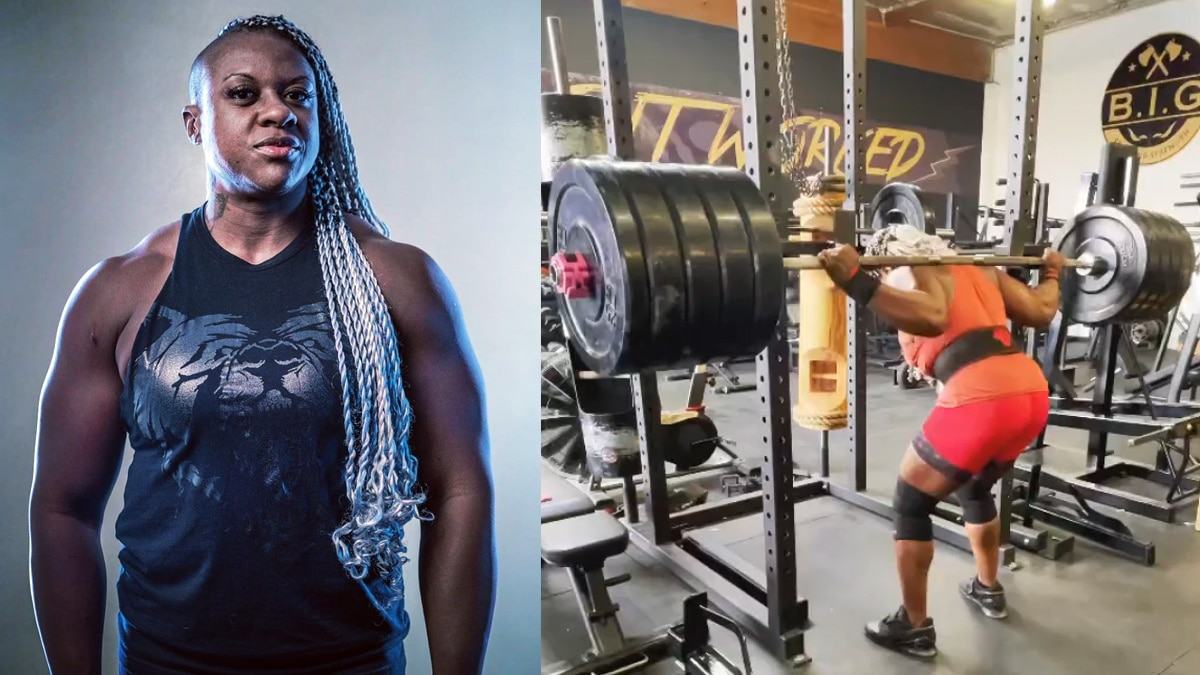
Nadia “Storm” Stowers (born March 17, 1992) is an American professional strongwoman and three-time U82 kg World's Strongest Woman (2021, 2022, 2024). Known for extraordinary static strength and overhead pressing, she has recorded historical U82 performances of 130.6 kg in the log lift, 299.4 kg in the axle deadlift and 97.52 kg in the block press. Her Open-class podiums include the 2024 Arnold UK, Shaw Classic and America's Strongest Woman. She secured her third U82 title with a decisive Atlas Stones comeback despite sustaining an Achilles injury during the final. She also coaches through STORM Coaching and advocates wider participation by women in strength sports.
Nadia “Storm” Stowers occupies a distinctive place in the modern history of professional strongwoman. Born on March 17, 1992, and associated with Fontana, California, the American athlete has won the U82 kg World's Strongest Woman title three times, in 2021, 2022 and 2024. The number matters beyond the simple fact of repeated victory: the competition's published historical record identifies her as the most successful titleholder in the U82 series through the documented 2025 edition. In a discipline where equipment, event selection and competitive demands vary substantially from one championship to the next, three titles won in separate seasons reveal an unusual combination of maximal strength, endurance, experience and resilience.
Her professional identity, however, cannot be reduced to medals. Stowers is an accomplished deadlifter and overhead presser, a coach working with clients at different stages of physical development, and an advocate for greater participation by women in strength sports. She progressed from working out primarily to change her body to competing internationally, from a sixth-place finish at her first documented world championship to winning that event, and from weight-class dominance to Open-division podiums. Understanding her career requires careful distinctions: an U82 title is not an Open title, a gym personal best is not automatically an official competition record, and a lift made with specialized equipment must be described in its proper context.
Verified public information about Stowers's childhood and early education is limited. Giants Live records her date of birth, a height of approximately 1.65 metres and a competitive weight around 82 kilograms. Its athlete profile associates her with Fontana, California, where she developed her coaching and fitness career. The available reference material does not provide a complete account of her family relationships, academic institutions or private domestic life. A responsible biography should acknowledge those gaps rather than create an appealing but unsupported personal narrative.
One well-documented detail is particularly striking: she had not played organized sports before discovering strength training. During high school, she spent about three years in a marching band, playing clarinet and tenor saxophone. She has described that experience as physically exhausting, even though it was not preparation for competitive lifting. The contrast is instructive. A person may eventually become one of the strongest competitors in the world without having followed the conventional route through youth athletics or a structured sports academy.
In her own account of the transition, Stowers says that she originally joined a gym to lose weight. She was not pursuing a championship, an international ranking or a world record. She attended a commercial gym, 24 Hour Fitness, and progressed from barbell-oriented group classes toward lifting heavier weights. Her objective resembled that of countless beginners: personal change rather than sporting achievement. The absence of a predetermined competitive ambition is what makes the opening chapter of her story relatable. Her later success grew from discovering an activity that gave those initial workouts a different purpose.
The beginning of her strength journey also illustrates the difference between improving fitness and deliberately preparing for a competition. General exercise can provide structure and personal satisfaction without a sporting destination. Strongwoman, by contrast, requires a competitor to prepare for measurable tasks, technical standards and the scrutiny of other athletes. Stowers did not make that distinction at the outset. She encountered it through a meeting that helped redirect her efforts toward a field in which her abilities would eventually become extraordinary.
During her first year of lifting, Stowers entered a Spartan race with friends from her gym. There she met Jacob Finerty, a strongman athlete who would become her coach. Finerty jokingly asked what she was training to be strong for. Nadia has recalled that the question affected her because she had no satisfying answer. Until then, lifting weights had been a method of changing herself. The encounter introduced the idea that strength could also be developed for a specific challenge and assessed against a competitive standard.
Finerty invited her to watch him compete in strongman. What she saw immediately appealed to her: the effort, determination, competitive drive and variety of events. The appeal was not exclusively the size of the weights. It was the sight of athletes solving complicated physical tasks in a charged competitive atmosphere. Strongman events could involve logs, axle bars, enormous dumbbells, vehicles, frames, sandbags, stones and objects that could not be lifted or transported exactly like an ordinary barbell. Stowers realized that she wanted to take part.
Finerty's mentorship became one of the constants in her career. Giants Live credits him with helping transform a commercial-gym enthusiast into a world champion. In a 2024 interview with BarBend, Stowers explained that he planned her training according to the events scheduled for her next competition and how her body felt on a particular day. This is a practical approach in a sport whose event demands can change dramatically: preparing for a contest dominated by static lifting is different from preparing for a series of carries, loading events and timed races.
Her training environment became B.I.G. Speed and Strength, a gym closely associated with Finerty. Public athlete profiles have also described Stowers as a gym manager and personal coach working there. The collaboration is not evidence of an effortless rise or a single secret training formula. Its importance lies in continuity, progressive skill development and the opportunity to evaluate performance across different competitive formats. This long-term relationship offered a framework in which strengths could be refined and weaknesses addressed from one season to the next.
The competition database Strongman Archives lists Stowers at the 2019 U82 World's Strongest Woman contest in Daytona Beach, Florida, where she finished sixth among ten athletes. In hindsight, sixth place may look modest compared with three subsequent championships. At the time, however, participation at that level exposed her directly to the best competitors in her division. It represented the beginning of a measurable international career, not the final judgment on her abilities.
Event-level records reveal a mixed performance. She completed five axle-press repetitions and three at the Viking Press, showed promise in the Farmer's Walk, and placed lower in the Power Stairs and Deadlift Ladder. The balance of results matters because competitive strongwoman is rarely decided by a single demonstration of maximal strength. Athletes must manage transitions, event-specific technical requirements, short time limits and accumulated fatigue over several days. One missed rep or a slow transition can cost multiple places on an overall leaderboard.
Her debut therefore provides useful evidence of development. It showed enough potential to justify continuing and enough weaker areas to provide direction. The international competitive environment would require not only stronger lifts but also better efficiency under pressure. Rather than retroactively describing the 2019 performance as inevitable greatness, it is more accurate to view it as the first stage in an unusually rapid rise.
The COVID-19 pandemic then disrupted strength-sport schedules and limited competitive opportunities. For developing athletes, cancellations meant more than missed prize opportunities. They removed chances to test preparation in a controlled contest, learn under official judging and pursue qualification pathways. Stowers continued developing her static strength during this interrupted period. When international competitions resumed, she was no longer simply a promising newcomer; her pressing and pulling numbers had placed her among the most formidable women in her weight class.
The 2021 season marked her breakthrough. At the Rainier Classic Pro-Am in Federal Way, Washington, she finished third out of nine in the Open women's division. The placing mattered because it tested her against competitors who were not constrained by the U82 weight limit. In September she competed at World's Ultimate Strongwoman in Dubai, finishing eighth of eight overall in Open competition. That result was difficult, but she still took third in the log-lift event with five repetitions, demonstrating that her overhead strength could remain competitive beyond her primary weight class.
The year also brought widely discussed records. Giants Live credits her with an U82 log lift of 117.93 kilograms and a block press of 97.52 kilograms at Clash on the Coast. At the October Static Monsters event, it reports a 130.6-kilogram log and a 299.4-kilogram axle deadlift. Those performances are historical markers within specific categories, implements and rules. An axle deadlift does not automatically correspond to a conventional powerlifting deadlift; likewise, an implement-specific record should not be presented as an all-category world record without the necessary qualification.
Her defining moment came in November at the U82 World's Strongest Woman championship in Daytona Beach. Stowers took first place ahead of Canada's Hannah Brock and Germany's Sandra Bradley. The event-by-event results explain the margin of her success. She won the log event with nine repetitions, took the Car Walk in 12.65 seconds, and completed a five-bar deadlift ladder from 166 to 240 kilograms in 19.57 seconds. She also loaded all six Atlas Stones, finishing with a 136-kilogram stone, in 33.86 seconds for second place in that event.
These were not isolated feats performed without competitive pressure. They were points accumulated across the programme, proving that her remarkable static strength could translate into a winning all-around result. The victory changed her position within the sport. She was no longer an outsider moving through the ranks but a champion against whom future U82 contenders would measure themselves. Her “Storm” nickname began to correspond with a clearly recognizable competitive identity.
Animal Pak, one of the brands that has featured her, describes Stowers as the first African-American woman to win a strongwoman world title. That statement is attributed to the sponsor's athlete profile rather than presented as an independently established claim across every historical federation and championship. The distinction matters in a sport with multiple organizing bodies and title structures, but the broader significance is clear: her career offers an important example of representation at the highest level.
By 2022, Stowers could no longer arrive as a surprise. Rivals knew her formidable pressing and deadlifting capacity, and championships would demand a more complete set of skills. At the April Clash on the Coast in Hilton Head Island, South Carolina, she finished third of eight behind Canada's Melissa Peacock and Samantha Belliveau. The podium was a strong international result, but it also underscored that one or two extraordinary lifts are not enough to guarantee victory across an entire contest.
Her return to U82 World's Strongest Woman in Daytona Beach in November was decisive. She defended the title, becoming champion for the second successive year. Strongman Archives records an event win in the dumbbell medley after she completed four implements weighing from 41 to 68 kilograms. She also won the axle deadlift for repetitions, completing eleven reps, and took first in the Farmer's Walk with a time of 19.94 seconds. Second-place performances in Atlas Stones and Sandbag to Shoulder added important points, and she completed fifteen Viking Press repetitions.
The variety of these results is central to assessing her development. Stowers remained famous for static strength, but she secured the championship through efficient work in a timed carrying event, a multiple-implement press, and demanding repetitions. Her 2022 performance demonstrated adaptability alongside raw power. Winning twice consecutively also showed that the 2021 championship had not been merely a perfect day. She had established a high level that could be reproduced when her strongest rivals were ready for her.
Some public commercial biographies additionally describe national America's Strongest Woman titles associated with 2021 and 2022. These claims require careful interpretation. The archived Open competition for those years was won by Victoria Long. Thus, the accolades in Stowers's promotional profiles should be understood as referencing a particular division or a different competitive context, not as proof that she won the Open championships recorded under Victoria Long's name. An accurate athlete profile needs this distinction rather than an inflated list of titles.
The 2023 U82 World's Strongest Woman championship in Charleston, West Virginia, interrupted Stowers's winning streak. She finished second of ten, with Erin Murray taking the title. In the context of her own exceptional standards, losing the crown was disappointing. In broader competitive terms, however, a further world podium after two consecutive titles confirmed continued excellence.
Her results reveal a particularly instructive competition. Stowers won the sandbag toss, clearing all six bags in 23.34 seconds. She won the Deadlift Ladder, completing five implements from 184 to 254 kilograms in 25.53 seconds, and finished first in both Carry Medley and Overhead Medley. In the latter event, she handled an axle, dumbbell, yoke and block press, completing four implements in 41.09 seconds. Four event wins represent a striking achievement in a field of ten.
Yet the championship was decided by total points, not by counting the number of events won. Relatively weaker placings in Atlas Stones and Load & Drag prevented her from retaining the title. The result offers a useful explanation of strongwoman scoring: a large loss of points in one event can outweigh several victories, especially when the field is tightly packed. For Stowers, 2023 exposed the continuing importance of overall consistency and provided clear areas for targeted preparation.
The season should not be described solely as the year she lost. It reinforced the scale of her performance in the deadlift, pressing and mixed-event disciplines, while establishing Erin Murray as a serious challenger in a competitive U82 field. Those rivalries are part of the division's development. A champion's legacy is more meaningful when understood alongside equally committed opponents who force standards to rise.
The 2024 season provided one of the most complete pictures of Stowers as an athlete. In March, on her thirty-second birthday, she finished third among nine women at Arnold UK Strongwoman in Birmingham, England. The event was contested in the Open division. Her performances included eight deadlift repetitions, two reps with the 122-kilogram American Oak log and third place in the Farmer's Walk for distance. A podium without the protection of the U82 limit was a substantial demonstration of competitive strength beyond her normal class.
In August, at the Shaw Classic Open in Loveland, Colorado, she finished third of ten. The contest included a Hummer Tire Deadlift, in which Stowers reached 318 kilograms and shared the event win with Jennifer Lyle. She also won the Dumbbell Press event and placed second in the log lift. These results showed her ability to contend for event wins among substantially heavier competitors. The 318-kilogram performance must nevertheless be identified by its apparatus: a Hummer Tire Deadlift has a different setup and movement characteristics from a conventional deadlift at standard height.
She returned to a major Open podium at America's Strongest Woman in Las Vegas in October, taking second behind Olga Liashchuk. Nadia won the Deadlift Ladder, completing implements from 197 to 247 kilograms in 17.03 seconds, and the Log Lift with five reps at 102 kilograms. She was also second in the Yoke and Sandbag Toss events. Though she did not win the overall title, her placing established her as an important competitor in the category and made her performance in the final major contest of the year especially compelling.
December brought U82 World's Strongest Woman to Madison, Wisconsin. Stowers opened with a commanding log-lift victory, pressing 95 kilograms five times. She then won the axle deadlift event by performing seven repetitions with 231 kilograms, a result significantly ahead of most of the field. Those performances illustrated why she entered the championship as one of the favorites. What followed transformed a strong campaign into a dramatic recovery story.
During the fourth event, a medley involving a 90-kilogram sandbag, a 102-kilogram sandbag and a sled push, she sustained a partial tear of her right Achilles tendon, according to the detailed Fitness Volt report. The injury compromised her mobility and severely affected the event placing. It is important not to romanticize continuing high-intensity exertion after a tendon injury: doing so can carry significant medical risks and is not a model that recreational lifters should imitate.
Stowers nevertheless continued the competition. In the Sandbag Toss, she was the only athlete to clear the full series of six bags weighing 11 to 18 kilograms over a four-metre bar, finishing in 31.18 seconds. She then held the Wrecking Ball apparatus for 118.25 seconds, taking third in that event. Sabrina Retzer was accumulating enough points to threaten the title, however, and Stowers approached the final event with the overall standings still in doubt.
The Atlas Stones finale required six stones ranging from 79 to 136 kilograms. Stowers completed the series in 40.56 seconds, the fastest time of the event. Retzer finished in 43.65 seconds, and the margin was enough for Nadia to overturn the standings. Stowers won her third U82 world championship with 56 points, just 1.5 ahead of Retzer. The victory did not demonstrate that injury makes an athlete invulnerable. It demonstrated the significance of technical proficiency, competitive concentration and the ability to maximize an opportunity when a championship comes down to a final event.
In 2025, Stowers appeared at some of the sport's major Open events. She finished eleventh of twelve at the Arnold Strongwoman Classic in Columbus, Ohio. The result contrasts with her 2024 podiums, but also illustrates the demanding variety and depth of the Arnold field. Strongman Archives lists a 200-kilogram attempt in the Elephant Bar Max Deadlift event. That contest-specific result should not be mistaken for the athlete's lifetime conventional deadlift personal best, which is a different category of information.
At America's Strongest Woman in Las Vegas in October, Nadia placed fourth of nine. She was second in a medley combining a 227-kilogram frame carry with repetitions on a 54-kilogram dumbbell, and also second in Vertical Lift. The loading race and deadlift ladder yielded fewer points. Such variations are normal in a sport where changing apparatus and movement demands can significantly alter relative rankings.
In November, Strongman Archives records her fifth of nine at World's Strongest Woman Open in Arlington, Texas. She performed two repetitions on a 113-kilogram log for third place in that event and also placed third in the Frame Carry. Her dumbbell-ladder and natural-stone scores were competitive in the middle of the field, while the Deadlift Ladder and Sandbag Steeplechase cost more points. The overall finish offered another marker of her shift toward competing with the strongest women regardless of bodyweight category.
The available archived international record extends through 2025. That does not by itself establish retirement, inactivity or any definitive statement about future plans. Her athlete status should be treated as active unless a reliable later statement indicates otherwise. Equally, the absence of a particular 2026 result in a source cannot be converted into an unsupported claim about every competition she may or may not have entered.
An appreciation of Nadia Stowers's achievements begins with the distinctive demands of the 82-kilogram division. An U82 championship is not a simplified version of an Open contest. The relationship between body mass, movement speed, grip demands and the prescribed apparatus changes the available competitive strategies. Each athlete must develop enough strength to complete the heaviest tasks while retaining the mobility and efficiency needed for carrying and loading events. As implements become heavier, energy expenditure and the cost of mistakes increase. Outstanding one-rep strength is important, but the final leaderboard places those feats alongside performances testing entirely different physical abilities.
U82 finals may contain fewer competitors than some mainstream sports events, yet the standard is exceptionally demanding. The documented world finals of 2021, 2022, 2023 and 2024 featured ten women each. An event win can generate a substantial advantage, but a ninth- or tenth-place finish elsewhere can eliminate much of that lead. Champions must therefore decide when risk is justified. In a deadlift ladder, completing the next bar may produce critical points. In a loading medley, pushing beyond the sustainable pace can lead to wasted time or an unfinished distance.
Stowers's career exemplifies this competitive tension. She has demonstrated the ability to win several events at the same competition, but an overall victory has never been automatic. In 2023, four event wins brought her second place rather than the championship. In 2024, an injury disrupted an entire event, forcing her to recover points through exceptional results afterward. Together these championships explain the tactical character of strongwoman more effectively than a collection of trophy photographs could.
The log is among the events through which Nadia built her reputation. On the surface, the objective is straightforward: raise a heavy cylindrical implement from the floor to a secured overhead position. The execution is far more complex. It combines leg and trunk strength, balance with an awkward implement, positioning of the neutral-grip handles and efficient extension during the press. A maximal single demands a different strategy from a timed set of repeated lifts. In competition, the speed and economy of every transition may matter as much as the greatest load an athlete can press once.
Nadia's results allow both types of performance to be examined. The historical 130.6-kilogram mark reported at Static Monsters in 2021 illustrates her upper-end capability with a heavy log. Nine winning repetitions at the 2021 U82 world championship demonstrate a different skill: repeating technically demanding lifts under a time limit. In the 2024 Madison final, five repetitions at 95 kilograms won the opening event. At the October 2024 America's Strongest Woman Open, five reps with 102 kilograms secured another event win against a heavier field.
These performances show why comparing log weights alone can be misleading. The size of the apparatus, time limits, starting positions and scoring rules can reorder the field. Stowers has demonstrated the ability to move between heavy attempts and repeated work. At the 2025 Open World's Strongest Woman final, two repetitions at 113 kilograms earned third place in the log. That does not represent a simple mathematical decline from a historical maximum: the apparatus, overall event demands and competitive circumstances were different.
The axle deadlift is central to Stowers's record. The 299.4-kilogram figure reported for Static Monsters 2021 concerns a specialized lifting implement and should not be presented as an ordinary powerlifting deadlift performed under standardized conventional rules. Bar thickness, start height, loading arrangement and competition procedures can affect the physical challenge. These differences are not footnotes: they are part of the meaning of the result.
One of her most informative performances may instead be the seven reps with 231 kilograms recorded at the December 2024 U82 world championship. That result demonstrates more than the ability to lift a heavy weight. It shows the capacity to reproduce an efficient pulling movement while under considerable fatigue. Her eleven repetitions in the 2022 U82 axle event provide similar evidence. A spectacular single lift may attract attention, but performing heavy repetitions within a time limit is a separate competitive skill.
A Deadlift Ladder adds another layer. The competitor moves between bars with progressively increasing loads, trying to complete the sequence as quickly as possible. In 2021, Stowers completed five lifts from 166 to 240 kilograms in 19.57 seconds. In 2023, she finished five lifts from 184 to 254 kilograms in 25.53 seconds. At America's Strongest Woman Open in 2024, she completed four loads from 197 to 247 kilograms in 17.03 seconds. These are different event designs and cannot be compared using time alone, but together they document a major strength sustained across several seasons.
Farmer's Walk, Yoke, Car Walk and Frame Carry test abilities that cannot be reduced to deadlift strength. The initial pick-up is only the beginning. The athlete must accelerate, control implement movement, maintain position and avoid unnecessary drops. Handle shape, distance, turns and rules regarding setting the weight down influence performance. A remarkable deadlift does not guarantee a comparable placing when carrying a heavy frame over distance.
At the 2021 U82 world championship, Stowers won the Car Walk in 12.65 seconds. A year later, she won the Farmer's Walk in 19.94 seconds. Yet at the 2024 U82 final, a Car Walk time of 34.21 seconds was enough for only fifth place. Seen without context, these results may appear inconsistent. In reality, apparatus specifications, competitor development and event conditions can alter the meaning of a time. The appropriate comparison is within each contest rather than a casual ranking of numbers from different years.
The 2024 Shaw Classic provides another useful example. Nadia finished sixth in the Farmer's Walk, seventh in Power Stairs and eighth in a medley involving sandbags and a sled, even while dominating other events in the same competition. Her third-place finish overall depended on offsetting weaker moving-event results with substantial points from specialist strengths. Those contrasts belong in a serious athlete profile. They explain the competitor's characteristic strengths and challenges instead of presenting podium positions as isolated achievements.
A strongwoman dumbbell is not an ordinary gym dumbbell made heavier. Its shape, diameter, length and mass distribution can substantially affect the lifting path. Overhead execution requires unusually demanding unilateral stabilization, and the athlete must decide when to drive aggressively and when to adjust the implement. Block press poses different challenges: the object may be difficult to grip, position or balance, creating a technical problem quite unlike using a barbell.
Stowers's record justifies her reputation in these disciplines. Giants Live reports a 97.52-kilogram block press in 2021 and a 77-kilogram circus dumbbell. At the 2022 U82 world championship, she won a four-implement dumbbell medley with weights ranging from 41 to 68 kilograms. At the 2023 championship, she won the Overhead Medley by completing four distinct implements. She also won the Dumbbell Press event at the 2024 Shaw Classic Open. This is a repeated pattern over several years rather than a single exceptional attempt.
Importantly, “overhead pressing” is not one uniform skill. An axle can support very heavy loading but may require a difficult clean to the shoulders. A log changes leverage and implement positioning. A giant dumbbell demands unilateral control. A block introduces unfamiliar gripping surfaces. Training for each requires distinct technical sequences. Stowers's ability to perform well across several such implements helps explain her place as a recognized specialist in the international community.
Atlas Stones have a special symbolic place in strongman and strongwoman. They demand posterior-chain power, precise arm placement, control of a large smooth object and rapid extension during the loading phase. They are not merely heavy weights; they are difficult objects to secure against the body and maneuver efficiently. A progressive stone run tests technique on the lighter implements and maximal capability at the heavy end of the series.
In 2021, Stowers finished second in the U82 world-final Atlas Stones with six stones, reaching 136 kilograms, in 33.86 seconds. She finished second again in 2022, completing the series in 36.53 seconds. In 2023, she finished the full run in 41.31 seconds but placed only sixth. The comparison demonstrates an important point: completing the same general task may bring very different points depending on how quickly the other competitors perform it. Absolute completion matters, but a championship is awarded according to relative results.
The 2024 final concentrated that lesson into a dramatic sequence. With the overall title threatened after her injury in the medley, Nadia needed to beat Sabrina Retzer on the stones. Her time of 40.56 seconds led the event, roughly three seconds ahead of Retzer. The advantage secured the overall title by just 1.5 points. The performance does not make the injury trivial or justify continuing to train through serious pain. It shows how precise execution in one final event can change a championship decided by cumulative scoring.
Viewed chronologically, the 2024 season had an unusual structure. March brought an Arnold UK Open podium. August brought another Open podium at the Shaw Classic, including 318 kilograms on the Hummer Tire Deadlift. October ended with second place at America's Strongest Woman Open. December returned her to the U82 category, where she reclaimed the world title. The sequence reflects an ambitious approach: pursuing major competitions with greater absolute lifting demands while maintaining the ambition to lead her primary division.
Open events create comparisons that cannot occur in a weight-restricted field. There were contests in which Stowers's static strength matched or exceeded that of substantially heavier athletes. There were also events in which movement speed, distance and handling heavy objects under fatigue reduced her advantage. The resulting picture is more informative than claiming she automatically dominated Open. She was a specialist capable of winning Open events and challenging for overall podium positions when the programme allowed her greatest qualities to shine.
The season also reveals the variety of required preparation. A competition centered partly on Hummer Tire Deadlift needs different technical exposure from one involving sandbags, a Car Walk and Atlas Stones. Building competitive readiness for changing demands requires alterations in training emphasis and careful fatigue management. Her full training calendar is not publicly documented, so it cannot be reconstructed with confidence. Nevertheless, her contest results clearly demonstrate the range of physical tasks she was able to address successfully within a single year.
Her Open competitions in 2025 illustrate how difficult it is to maintain a leading overall position among athletes with very different physical profiles. At Arnold Strongwoman Classic, Stowers placed eleventh among twelve competitors. Detailed records include events where she scored relatively few points alongside a fifth-place result in the Overhead Medley. A single overall position cannot tell the full story of her overhead capability or predict what she might achieve under a different event programme.
October's America's Strongest Woman produced fourth place and a different distribution of results. The event combining a 227-kilogram frame with a 54-kilogram dumbbell was a second-place finish, as was Vertical Lift. The loading race and Deadlift Ladder produced lower placings. Those variations should not be explained through speculation about motivation, health or preparation, since reliable sources do not establish the reasons. They are contest outcomes that demonstrate the many interacting factors within this sport.
At the November World's Strongest Woman Open, Stowers recorded 26.45 seconds in the Frame Carry for third place and two reps with the 113-kilogram log, also for third. She completed three implements in the Dumbbell Ladder and two natural stones. By contrast, the Deadlift Ladder result was two of four bars. Her fifth-place overall finish according to Strongman Archives confirms that she remained competitive at an exceptionally high level, even though the performance was less dominant than her U82 championship campaigns.
Comparisons across seasons should begin with a simple question: are we discussing the same implement, event rules and competitive division? In 2019, Stowers placed sixth at U82 Worlds. In 2021 she won that championship, and in 2022 she defended it. In 2023 she finished behind Erin Murray despite winning four individual events. In 2024 she reached several Open podiums before returning to first place at U82 Worlds. In 2025, her Open results ranged from eleventh at Arnold to fourth or fifth in other leading competitions.
This chronology does not support a simplistic narrative in which every season brings automatic improvement in every event. Development in strongwoman is uneven. Some qualities improve through greater maximal strength, others through technical repetition, while moving events are sensitive to the athlete's condition and the specific apparatus. Opponents also develop. A time or weight that secured first place in one year may earn fewer points later if the field becomes stronger or faster.
This unevenness makes Stowers's sporting history more compelling. It is not merely the story of one world record exceeding all previous measurements. It is the record of a competitor who experienced being an outsider, a contender, a defending champion, a runner-up and a returning champion. She has also experienced Open event wins alongside modest overall placings. These are genuine elements of high-performance sport and deserve inclusion in a serious profile.
The sixth-place result at U82 Worlds in 2019 represented early exposure to world-class competition. In 2021, the Rainier Classic podium and Dubai Open appearance showed that Nadia was willing to challenge herself beyond her principal division before winning her first U82 title. That same year's Daytona Beach victory and the historical log, axle and block performances established her international standing. The earlier steps in her local qualification pathway are not fully documented, however, and should not be filled in through assumptions.
The 2022 title defense gave the first world championship greater historical weight. Third place at Clash on the Coast also demonstrated that other leading U82 women could defeat her and that a champion's reputation offers no guaranteed points. The 2023 runner-up finish, despite four event wins, added a clear lesson about scoring balance. Each season provided not just new numbers but competitive experiences likely to influence how an athlete might prioritize future preparation.
In 2024, three major Open podiums and a return to the top of U82 made the season unusually successful. The December title was settled narrowly, after an injury, by victory on the final event. In 2025, her Open itinerary produced results that were less spectacular but meaningful in the context of her ambitions. This is not an uninterrupted ascent. It is the history of a competitor who repeatedly changed the scale of her challenges, won, lost and continued to test her abilities.
Moving from a restricted weight class into Open creates substantial challenges. Contest organizers may select implements appropriate for athletes of significantly greater body mass. Being lighter can provide advantages in certain fast movements, but it cannot remove the difficulty of initially lifting a very heavy frame or loading object. Likewise, an elite overhead press may contribute substantial points without fully compensating for deficits in distance-based events.
Stowers offers an example of meaningful adaptation, not universal dominance. She won pressing and deadlift events against Open competitors and took third at Arnold UK and Shaw Classic. Yet she also finished eleventh at Arnold in 2025. These outcomes do not contradict each other. They reveal that event selection, technique and consistency can change an overall placing dramatically. Athletic performance needs to be judged in context instead of through a competitor's reputation alone.
For future weight-class athletes, her path suggests that ambitions may extend beyond the division in which someone first excels, without guaranteeing a podium every time. Her 2024 Open achievements are important in their own right; the 2025 results illustrate the genuine difficulty of competing at that level. Together they form a credible and complex record in which both victories and challenging performances contribute to understanding the athlete.
STORM Coaching extends Stowers's story beyond the arena. Her business presents its purpose as developing strength, confidence and individual capability. The website advertises programmes for fat loss, body recomposition, bodybuilding, powerlifting and strongman, alongside nutrition guidance adapted to the client's lifestyle. For a beginner, the desired outcome is not necessarily qualification for a world final. It may be to establish a practical set of goals and gradually develop the competence to achieve them.
Stowers's lack of an organized athletic background before weight training gives this message particular resonance. She understands the initial uncertainty of a person who feels intimidated by a gym or by the language of strength training. Rather than assuming every client already knows how to train, her public story can help illustrate the process of building skills from basic movements. That said, Nadia's personal achievements must not be confused with guaranteed results for her clients. Individual responses depend on many circumstances and vary widely.
Her public position on body image complements the coaching message. The emphasis is placed on ability, autonomy and the satisfaction of improving, not on one narrowly defined appearance. This is particularly relevant to strongwoman, where athletes visibly strain, fight for leverage and express the physical difficulty of lifting unusual objects. Stowers encourages attention to what a person can accomplish instead of how polished the effort looks to outside observers.
Reconstructing strongwoman history is more complicated than reporting results in sports with perfectly standardized equipment. Several organizers and title series coexist; weight-class definitions may vary; event formats are regularly adapted. The name of a championship does not automatically establish that an athlete won its Open category. Similarly, the phrase “world record” needs a particular implement, class and historical moment before it becomes meaningful.
That is why Stowers's numbers are preserved with their contexts: 130.6 kilograms on the log at Static Monsters 2021, 299.4 kilograms on the axle deadlift, 97.52 kilograms in block press, 318 kilograms on the Hummer Tire Deadlift at Shaw Classic 2024, seven reps with 231 kilograms on the axle in 2024, and two reps with the 122-kilogram American Oak at Arnold UK 2024. Some are historical records, others verified event results, and some are performances reported in athlete profiles. They should not all be described as present-day all-category world records.
The same editorial discipline applies to personal details. Her school-band experience, Spartan-race meeting with Jacob Finerty, relationship with training and development as a coach provide enough information to portray a person behind the medals. There is no need to assign unverified relationships, children, academic qualifications or domestic events to Stowers simply to make a profile feel complete. A complete journalistic account documents available facts and clearly marks the limits of what can be established.
Stowers's legacy will be associated with three U82 world titles, but it also represents a wider change in how female strength athletes are perceived. Someone who began lifting to change her body found a sporting identity in a discipline that evaluates what the body can do. That transformation is visible in her coaching work. The lesson is not that elite success comes quickly or without sacrifices, but that an ordinary beginning does not exclude the possibility of extraordinary progress.
Her interviews, competition results and professional activity show an athlete for whom competition and the transmission of experience complement each other. As a competitor she has helped establish demanding standards in a growing weight class. As a coach she presents strength training as a means of building confidence and individual progress. Neither role requires an invented private narrative. The documented achievements already demonstrate that strength can become both measurable sporting excellence and an instrument of personal development.
Stowers's strength achievements are best understood through the implements used. Giants Live lists a 130.6-kilogram log lift, a 299.4-kilogram axle deadlift and a 97.52-kilogram block press among her historical U82 performances. It also reports a 128-kilogram axle press and a 77-kilogram circus dumbbell lift. These figures convey considerable strength, but their event labels should remain attached to them. Changing the implement, grip, bar diameter or range of motion can fundamentally change the task.
The same profile separately identifies gym-training figures: 265 kilograms in the deadlift, 211 kilograms in the squat, 327 kilograms in the yoke carry and approximately 137.5 kilograms per hand in Farmer's Walk. Such marks may be excellent indications of capability, yet they do not all carry the same level of competition verification or follow identical technical rules. Presenting gym lifts as official records would mislead readers about both her achievements and the sport itself.
The 318-kilogram Hummer Tire Deadlift at the 2024 Shaw Classic is a useful case study. It was an authentic contest performance and gave her a shared event victory. It was not equivalent to performing a conventional deadlift from standard competition height. Likewise, her seven repetitions at 231 kilograms in the 2024 U82 axle deadlift event are evidence of extraordinary work capacity, but are not a one-repetition maximum. Accuracy in this sport depends on preserving such distinctions rather than combining every impressive number under a generic record label.
Relative strength is especially relevant for an athlete whose primary division is capped at 82 kilograms. Ratios of lifted weight to bodyweight can help illustrate her ability, but they cannot substitute for examining event difficulty, technique or equipment. Her greatest achievement was never simply having a large number on a bar. It was her ability to accumulate points across overhead lifts, pulling events, carries, loading tasks and timed tests, often while competing against athletes who had different physical advantages.
In her 2024 BarBend interview, Stowers described a training approach guided by specific competition demands and daily readiness. Jacob Finerty organizes sessions, while the priorities reflect upcoming events and weaknesses requiring improvement. Rather than repeatedly working on skills she already performs well, Nadia prefers to dedicate attention to unfamiliar events or movements where improvement could generate additional contest points.
This principle has considerable practical value. A strongwoman athlete cannot train every possible event at maximal intensity every week. Heavy overhead lifting, deadlifting, carrying and loading all impose demanding recovery costs. Improving an already excellent lift by a marginal amount may be less useful than turning a last-place event into a mid-table result. Her competitive experience in 2023, where four event victories did not secure the overall championship, demonstrates why that distinction matters.
Stowers has also helped explain to a wider audience how strongman differs from powerlifting. In an Animal Pak collaboration with world-class powerlifter John Haack, she discussed the importance of speed, endurance and athleticism. Squatting and deadlifting form part of strongman preparation, but competition often requires moving heavy objects rapidly or repeating demanding efforts under fatigue. The objective is not merely to move the heaviest possible bar once under standardized conditions.
Public sources do not contain enough detail to reconstruct her complete weekly training schedule or every percentage and set prescribed by her coach. Claiming that she follows a particular fixed routine without her actual programme would be speculation. What is supported is a method built around event specificity, assessment of weaknesses, flexible responses to fatigue and the long-term development of skills across a demanding competitive calendar.
Competing in U82 events means taking bodyweight into account alongside performance. Stowers has described a nutritional challenge that may surprise observers: she does not always have a strong appetite and sometimes finds eating enough food difficult. Speaking to BarBend in 2024, she explained that she deliberately seeks sufficient calories, particularly before demanding training days, and described using substantial carbohydrate-rich meals to support upcoming workloads.
This is a personal account, not a universal diet prescription. An elite strength athlete's energy needs and competition demands differ from those of a recreational lifter or sedentary person. The public record does not provide a reliable day-by-day food diary, fixed macronutrient targets or enough information to reconstruct changes in her bodyweight between seasons. Her comments do, however, establish that she treats nutrition as part of preparation rather than merely an issue of appearance.
The Achilles injury sustained in December 2024 adds an important recovery dimension to her career. A January 2025 episode of The Strong Casuals podcast specifically introduced a discussion about competing and recovering after the torn tendon. Beyond that public description, it would be irresponsible to claim knowledge of treatments, rehabilitation protocols or the precise date of complete healing. Her competitive appearances in 2025 confirm a return to major events, but they do not establish the absence of pain or medical limitations.
Outside the competitive arena, Nadia has developed a career in coaching and fitness management. Giants Live and Nordic Training Gear describe her as a gym manager and personal trainer at B.I.G. Speed and Strength. Her own STORM Coaching website promotes individualized training for strength, body recomposition, bodybuilding, powerlifting and strongman. The services also address nutrition, confidence, accountability and the development of a sustainable training mindset.
This professional range reflects her personal story. Someone who began lifting to lose weight before discovering competitive strength may bring a particularly practical perspective to clients who do not initially identify as athletes. Her site presents programmes suitable for beginners as well as competitors, emphasizing that the training schedule needs to fit the client's experience and availability. The underlying message is not that everyone needs to become a champion, but that meaningful physical improvement can be made through organized work.
Testimonials on her website describe clients progressing in body composition, strength, competition participation and self-confidence. They are promotional accounts published by her business, not independent scientific evaluations, and should be interpreted accordingly. They nonetheless reveal the themes around which she has built her coaching identity: helping people become stronger, giving them confidence in their abilities, and encouraging a healthier relationship with their bodies.
Managing clients and competing internationally require different kinds of skill. The athlete must make rapid decisions under pressure; the coach needs to explain, listen, adjust expectations and build programmes that remain effective over time. The publicly documented aspects of her career show engagement in both roles. However, there is insufficient reliable information to reconstruct every employment contract, certification or professional milestone, so those details should not be invented.
A complete athlete biography should not turn the absence of private information into license to speculate. The most clearly documented personal elements in Stowers's case are her early relationship with exercise, her years in a school marching band, the Spartan-race meeting with Finerty, and the psychological transformation she describes after discovering strength sports. The consulted reference materials do not reliably establish details about her parents, partner, children or household. Those areas are therefore left unasserted.
Her arena name “Storm” became the public brand connecting competition and coaching. On Instagram she is known as @nadiastowers_bigstorm, where her athletic work and professional projects are visible. She has also been featured by Animal Pak in its athlete programme and in educational collaborations. Such partnerships expand the reach of a discipline that traditionally receives less mainstream exposure than many established sports.
A major part of her public message concerns the future of women's strength competitions. In her BarBend interview, Nadia expressed concern about the limited number of new female athletes entering high-level contests despite improving opportunities. She identified fear as one obstacle, including anxiety about heavy weights, effort and how women appear while exerting themselves in competition. Her position challenges the assumption that athletic effort should be visually polished or compatible with narrow standards of femininity.
She has argued that confidence gained from discovering what the body can do matters more than external judgments about appearance. This attitude is especially credible given her own trajectory from recreational weight-loss training to world championships. She does not need to suggest that every woman should aim to lift hundreds of kilograms. The stronger message is that opportunities to experience strength, competence and competition should not be rejected because of embarrassment or assumptions about what a woman should look like.
As documented through October 2026, Stowers's principal competitive achievements include three U82 world titles in 2021, 2022 and 2024 and a runner-up finish in 2023. She has also taken Open podiums at the 2024 Arnold UK, Shaw Classic and America's Strongest Woman, with additional Open appearances at Arnold Strongwoman Classic and World's Strongest Woman in 2025. This record is substantial without attributing championships she did not win or treating every archived lift as a current world record.
Exceptional static strength remains her most recognizable sporting characteristic. The log, axle, block and deadlift have repeatedly placed her among the leading athletes in the weight class, while a 318-kilogram Hummer Tire Deadlift showed her ability to contend in a specialized Open event. Yet the 2024 U82 championship illustrates that her legacy extends beyond numbers. Losing ground after an Achilles injury and regaining the lead with a decisive Atlas Stones performance offers a compelling example of the tactical and psychological dimensions of championship competition.
Her professional contribution is broader still. Through coaching, public interviews and her willingness to discuss the barriers faced by women in strength sports, she has helped present strongwoman as a discipline that rewards athletic development rather than conformity to conventional expectations. She embodies a route to elite performance that began outside organized youth sport and grew through mentorship, sustained training and repeated competition.
Stowers belongs to a generation that has increased the visibility and technical standard of strongwoman. Her career demonstrates that a weight class need not define the full extent of an athlete's competitive ambitions. An accurate assessment requires neither inflated claims nor invented personal stories. The verified championships, performances, coaching work and public advocacy already provide the substance of an exceptional modern strength-sport career.
This biography distinguishes U82 championships from Open results, contest lifts from training personal bests, and historical event-specific records from the current world-record status of a lift. Primary competition data and event performances have been checked against Strongman Archives; the history of U82 championship wins is independently corroborated by Fitness Volt's contest-series database. Giants Live, Animal Pak, Nordic Training Gear and Stowers's own STORM Coaching website provide biographical and professional information. Statements concerning her preparation and the future of women's strength sports are drawn from the July 2024 BarBend interview. The December 2024 Achilles injury is documented in Fitness Volt's championship reporting, while the January 2025 Strong Casuals episode announces a discussion of her recovery. Information reflects sources consulted in October 2026.
Strongman Archives: Nadia Stowers (results and events)
Giants Live: athlete profile and reported records
Fitness Volt: U82 championship history
Fitness Volt: 2024 U82 championship and injury
Animal Pak: athlete profile, background and accolades
STORM Coaching: first-person account and professional services
Nordic Training Gear: biographical profile
The Strong Casuals: January 2025 recovery discussion
BarBend: 2024 Shaw Classic Open results
Iron Hall data
130.6 KG
Log lift · 2021 Static Monsters, historic U82 mark; not the Open world record.
Verified
299.4 KG
Axle deadlift · 2021 Static Monsters, U82 category; different implement from conventional deadlift.
Verified
97.52 KG
Block press · 2021 Clash on the Coast, U82 mark reported by Giants Live.
Verified
128 KG
Axle press · Lift reported by Giants Live; check the exact implement and verification at source.
Verified
77 KG
Circus dumbbell · Lift listed by Giants Live, not presented as current Open record.
Verified
318 KG
Hummer Tire Deadlift · 2024 Shaw Classic Open, tied event win; not conventional deadlift.
Verified
122 KG
American Oak log · Two reps at Arnold UK 2024, Open event.
Verified
231 KG
Axle deadlift for reps · Seven reps at the 2024 U82 World's Strongest Woman.
Verified
136 KG
Atlas Stones, top stone · Final stone in six-stone series at 2024 U82 WSW, series finished in 40.56 seconds.
Verified
211 KG
Squat, training · Training lift reported by Giants Live; not a contest result.
Verified
265 KG
Deadlift, training · Training figure from Giants Live athlete profile.
Verified
137.5 KG / HAND
Farmers Walk, training · Per-hand training weight; distance unspecified.
Verified
327 KG
Yoke carry, training · Figure from Giants Live with no distance or time specified.
Verified
2019
Daytona Beach; documented world-level debut.
6th of 10
2021
Open podium in Federal Way, Washington.
3rd of 9
2021
Dubai; third in the log event with five reps.
8th of 8
2021
Daytona Beach; wins in log, car walk and deadlift ladder.
Champion, 1st of 10
2022
Behind Melissa Peacock and Samantha Belliveau.
3rd of 8
2022
Second straight title; event wins in dumbbell medley, axle deadlift and farmers.
Champion, 1st of 10
2023
Charleston; four event wins, second overall to Erin Murray.
Runner-up, 2nd of 10
2024
Birmingham; two reps with the 122-kg American Oak.
3rd of 9
2024
318-kg Hummer Tire Deadlift, shared event win with Jennifer Lyle; dumbbell press event win.
3rd of 10
2024
Las Vegas; second to Olga Liashchuk.
Runner-up, 2nd of 5
2024
Madison; third title, 56 points, 1.5 ahead of Sabrina Retzer after decisive Atlas Stones comeback.
Champion, 1st of 10
2025
Columbus, Ohio; appearance in the Open competition.
11th of 12
2025
Las Vegas; second in medley and vertical lift.
4th of 9
2025
Arlington, Texas; third in frame carry and log lift per Strongman Archives.
5th of 9