2014
Arnold Amateur Strongman World Championships
Columbus, Ohio, USA. The victory that launched his professional strongman career.
1st of 10
Iron Archives
The Terminator · two-time World's Strongest Man runner-up and one of the most athletic strongmen of the modern era
Active athlete
Mateusz Kieliszkowski is a Polish professional strongman, two-time World's Strongest Man runner-up in 2018 and 2019, 2019 World's Ultimate Strongman champion, Arnold Strongman Europe and Arnold Strongman Africa winner, multiple Giants Live champion and five-time Poland's Strongest Man. At 1.95 m and roughly 150 kg, he is renowned for exceptional speed in moving events, overhead strength, stone-to-shoulder ability and world-class performances in the Cyr Dumbbell, Car Walk and Timber/Frame Carry. Serious triceps and knee injuries interrupted his prime, but his 2023-2025 comeback returned him to the podium at the Arnold, Rogue Invitational and Europe's Strongest Man.
Mateusz Kieliszkowski is one of the athletes who changed the visual language of the super-heavyweight strongman. At roughly 1.95 metres and 150 kilograms, the Polish athlete became famous not simply for absolute strength but for the speed with which he can move a yoke, frame, car or irregular object. The nickname “The Terminator”, used by Giants Live, fits a career built around almost mechanical efficiency in moving events: short rapid steps, transitions with very little wasted time, excellent control of his centre of mass and a rare ability to reproduce force without looking increasingly cumbersome as the event continues. At the same time, Kieliszkowski developed into one of the finest heavy-dumbbell pressers of his generation and one of the most spectacular stone-to-shoulder athletes the sport has seen. A two-time World's Strongest Man runner-up in 2018 and 2019, the 2019 World's Ultimate Strongman champion and a multiple winner across Arnold and Giants Live contests, he is routinely included in discussions about the greatest strongmen never to have won World's Strongest Man. That phrase is not merely sentimental. His results show an athlete capable of dominating individual events and winning elite contests, while serious triceps and knee injuries fragmented precisely the years in which his competitive ceiling appeared highest.
Kieliszkowski was born on 12 August 1993 in Poland and is associated in biographical sources with the Maszewo area and the village of Chlebów. His story did not begin inside a national high-performance centre or a sophisticated strength academy. Before strongman became a profession, he worked around the family environment, including activities connected with his father's lumber business. That background matters not because manual labour should be romanticised, but because it helps explain an early familiarity with heavy, awkward objects and forms of effort that do not resemble the perfect geometry of an Olympic barbell. Strongman rewards exactly this ability to solve physical problems when the object refuses to cooperate: logs, stones, frames, sandbags, vehicles and implements with unpredictable centres of mass. In Polish interviews, Kieliszkowski described a youth in which his strength increased quickly without a predetermined path toward professional sport. His family gradually became part of the infrastructure behind his development, helping to build and modify training equipment. Instead of a strict separation between daily life and athletic preparation, he created his own ecosystem of work, workshop, yard space, fabricated implements and eventually a home strongman gym designed around the specific demands of competition.
His first serious contact with weight training came during adolescence. Polish sources place him at around fifteen when gym training became consistent, and a school teacher is mentioned among the people who encouraged him to develop his physical ability. Progress was rapid. By around eighteen, Kieliszkowski was already describing deadlifts approaching 300 kilograms, a remarkable figure for a teenager who had not grown up inside a professional powerlifting system. More important, however, is that his strength was never expressed only through the three classical barbell lifts. From the beginning, his profile appeared better suited to events in which force had to be combined with balance, acceleration and coordination. That difference later became the signature of his career: he could lose points in the deadlift to the greatest specialists of his generation and then recover brutally in a carry, dumbbell, medley or stone event. Early training footage also shows a culture of heavy repetition rather than one-off exhibition lifts: squats with 320 kilograms for five reps, very heavy farmer's walks, push presses and log lifts performed in sets. He was not simply an athlete who could produce one spectacular maximum. He could repeat enormous efforts, recover quickly and turn strength into work capacity, a quality that would become decisive in multi-event competitions.
The transition into strongman followed an almost traditional pattern for the sport: someone saw enough raw ability to suggest that he enter a contest. Kieliszkowski has recalled that a friend persuaded him to compete in an amateur show even though the other athletes were larger and more experienced. He won. The result did more than confirm unusual strength; it revealed the discipline that best matched his instincts. Strongman allowed him to turn almost any object into an athletic problem. After that beginning he started fabricating or adapting equipment at home. His family supported the process, and the practical experience around workshops and metalwork made it possible to build implements that would otherwise have been expensive or difficult to obtain. The period left a permanent mark on the way he prepares. Instead of relying only on standardised gym equipment, Kieliszkowski developed an instinct for the mechanics of an object: where it should be gripped, how far it should be tilted, when to accelerate and when to conserve energy. Years later, when he was winning frame, car-walk, stone and eccentric-dumbbell events in front of packed arenas, that apparently improvised rural training environment looked less like a limitation and more like an efficient education in applied biomechanics. His home setup became a place where competition problems could be rebuilt, tested and solved long before contest day.
In 2013, Kieliszkowski won Polish competitions that opened the route toward the international amateur stage, and in 2014 he reached the Arnold Amateur Strongman World Championships in Columbus, Ohio. For a very young athlete from a small Polish community, moving from home-built implements to one of the most prestigious stages in strength sport could have been overwhelming. Instead, he won the contest. Strongman Archives records him first out of ten in the 2014 edition. The victory marked the threshold between promise and professional status: from that point, his name belonged in the same competitive ecosystem as athletes who already made their living from strongman and had years of international experience. The Arnold Amateur also matters because it foreshadowed his unusually strong relationship with the Arnold family of contests. Over the following decade Columbus and the Arnold qualifiers became recurring landmarks of his career, with repeated podiums in Ohio and victories in Africa and Europe. His style was especially compatible with the Arnold philosophy, where implements are often exceptionally heavy, unusual and technically demanding enough that raw static strength alone cannot guarantee success. Kieliszkowski might concede points in the deadlift and then recover them through Timber Carry, dumbbell, Wheel of Pain or a natural-stone event, turning the contest into a study of contrasting physical qualities.
The 2015 season proved that the amateur championship had not been a one-off. In his first appearance at the professional Arnold Strongman Classic in Columbus, Kieliszkowski finished third. He was already standing on the podium at one of the hardest contests in the world during an era shaped by names such as Brian Shaw, Žydrūnas Savickas and Hafþór Björnsson. The same year he won the WSF PROFORM Classic in Tashkent, the Central European Strongman Cup and Poland's Strongest Man. The national title was the first of five consecutive championships, running through 2019. That sequence matters when placing him inside Polish strength history. Poland did not need a strongman tradition to be invented; Mariusz Pudzianowski had already set an almost absurd national benchmark. Kieliszkowski did not attempt to reproduce Pudzianowski's exact model. He became a champion with a different physical identity: taller, extraordinarily explosive, exceptional with objects loaded to the shoulder and unusually gifted in unilateral pressing. In 2015 he was still building the static strength needed to win every possible elite format, but he could already beat established champions whenever speed and technique mattered. The Arnold podium made it impossible for the international scene to treat him as a novelty. He had arrived as a permanent factor in the standings.
By 2016, Kieliszkowski's calendar had become genuinely global. He finished fourth at the Arnold Strongman Classic, second at Arnold Africa, fourth at Europe's Strongest Man and second at Arnold Europe. He retained Poland's Strongest Man and closed the year with victory in Brazil at the Força Bruta contest staged under the 2017 edition title. The most important threshold, however, was World's Strongest Man. In Botswana he reached his first final and finished seventh out of ten. In retrospect seventh can look modest beside the two silver medals that followed, but it proved that the Polish athlete could survive the WSM format: qualifying groups, heat, multiple competition days, changing implements and the pressure of a global production. World's Strongest Man does not reward a single afternoon of peak performance. It demands management of fatigue, minor injuries and unfamiliar event details across a long week. For Kieliszkowski, 2016 was the season in which specialist potential became the profile of a complete finalist. At the same time, the central competitive theme of his career was becoming clear. His level in carries, overhead events and awkward objects could be the best in the field, while maximal deadlift against the world's greatest pullers could cost him enough points to alter the entire standings.
The 2017 season accelerated Kieliszkowski's transformation from a dependable finalist into a genuine contender for major titles. He won Arnold Africa and reached the podium at Arnold South America, then finished sixth in the World's Strongest Man final in Gaborone. Rogue highlights his Plane Pull victory at that WSM, an event that summarises his athletic strengths almost perfectly: body position, cadence, the ability to apply horizontal force and a high tolerance for severe short-duration effort. During the same period, unilateral pressing became a world-class weapon. He established a Cyr Dumbbell record at 141.5 kilograms, foreshadowing even heavier dumbbells in later seasons. On the Giants Live circuit he finished second at Summermania and the Viking Apocalypse, while in Poland he won a third consecutive national championship. The results displayed a consistency that was increasingly difficult to dismiss. Even when Kieliszkowski did not win the overall contest, he was usually close enough to the podium for one event to decide everything. Tactically, 2017 also exposed the cost of points lost in static events. When an athlete can win a Plane Pull or a Dumbbell Press, eighth place in a deadlift is not simply a weak event; it can be the exact difference between a podium and the middle of an elite field. That arithmetic would follow him for years.
What separates Kieliszkowski from many elite strongmen is not only the list of records but the way performance is produced. In carrying events he appears to reduce every movement to what is strictly necessary. He does not lift an implement higher than required, does not overstride and rarely wastes time on dramatic repositioning. For an athlete of roughly 150 kilograms, his step frequency remains exceptionally high. In strongman biomechanics that is a rare combination: greater mass increases force potential but usually penalises acceleration and raises the energy cost of locomotion. Kieliszkowski found an unusually effective compromise. The torso remains compact, the hips come under the load quickly, and the arms and shoulder girdle function as stabilisers rather than brakes. In stone-to-shoulder, the essential quality is transition: floor pick, lap, violent hip extension and rotation toward the shoulder must connect as one sequence. In the dumbbell, positioning the implement on the shoulder and transferring force from the legs into the arm matter as much as triceps strength. Kieliszkowski excels at precisely these interfaces between phases. That is why events that look chaotic to a spectator often reveal the most order in his technique. He turns awkward objects into repeatable movement patterns and saves fractions of a second until they become entire contest points.
In 2018, Kieliszkowski moved permanently into the centre of the sport. At World's Strongest Man in Manila he finished second behind Hafþór Björnsson. He was no longer an outsider capable of stealing an event; he was an athlete capable of constructing an entire contest around his strengths. During the same season he took third at Europe's Strongest Man, second at Arnold South America and won Poland's Strongest Man for a fourth consecutive year. The autumn produced one of the defining victories of his career: the Giants Live World Tour Finals in Manchester. There, his Atlas Stones speed became one of the most replayed performances in the strongman community. Giants Live lists five stones completed in 16.09 seconds, a performance presented at the time as a record. His record-breaking profile expanded further in 2018 through a 150-kilogram Circus Dumbbell and the Odd Haugen Tombstone to Shoulder, where a roughly 186-kilogram object was shouldered five times inside 150 seconds. At World's Ultimate Strongman Dubai he finished third and recorded a 430-kilogram 18-inch deadlift. The complete picture was now obvious: Kieliszkowski possessed elite static strength, but he became truly destructive when the weight had to move, travel, be loaded, be shouldered or be pressed with an unstable implement.
If two images had to explain Kieliszkowski's career quickly, one would show a huge dumbbell locked out overhead in one hand and the other a massive stone being rotated onto his shoulder. The Cyr and Circus Dumbbells require far more than a powerful triceps. The implement is wide, the centre of mass sits far away from the wrist, and the rack position challenges the shoulder, torso and breathing mechanics. Kieliszkowski learned to turn the legs and hips into a launching system for the dumbbell, then finish the lift with remarkably efficient stabilisation. Records at 141.5 kilograms and later 145 kilograms in the Cyr Dumbbell, together with 150 kilograms in the Circus Dumbbell, established his reputation. Stone-to-shoulder applies the same logic of force transfer in a different shape. A stone has no handle, its surface demands adaptation, and the athlete must create friction, control rotation and identify the precise moment when the object can cross the shoulder line. His competition performance with the roughly 186-kilogram Tombstone and a reported 217-kilogram natural-stone training best show how far he took the specialisation. For Kieliszkowski the stone is rarely a slow ceremonial finish to a competition. It is an opportunity to take back large numbers of points from athletes who may have outpulled him earlier in the day.
The 2019 season can be regarded as the peak of the first great phase of Kieliszkowski's career. He began with second at Arnold Strongman USA and third at the Arnold Strongman Classic in Columbus. He finished second at Europe's Strongest Man and at Arnold South America and Arnold Africa before travelling to Florida for World's Strongest Man. In the final he again finished second, this time behind Martins Licis. Consecutive WSM silver medals removed any possibility that 2018 had been a favourable accident. In the same year he won Giants Live Wembley, SCL Finland, the Giants Live World Tour Finals, Arnold Europe and World's Ultimate Strongman Dubai. Very few athletes can combine a WSM podium with victories across so many different formats in one season. WSM demands adaptability and consistency; Giants Live often rewards fast, television-friendly events; Arnold contests may introduce brutally heavy implements; WUS combined maximal strength with dynamic work. Kieliszkowski was competitive everywhere. At Europe's Strongest Man he also lifted 214 kilograms in the log, his best known competition mark, while in Dubai he pulled 420 kilograms on a standard deadlift. Even his principal relative weakness had reached a level that almost no strength athlete outside the world elite will ever experience.
The 2019 World's Ultimate Strongman contest in Dubai occupies a central place in Kieliszkowski's résumé because it removes one of the simplifications sometimes attached to his career: the idea that he was only ever an almost-champion. In Dubai he won an international contest featuring fourteen elite athletes and a format diverse enough that the title cannot be reduced to one specialised event. Strongman Archives records his 420-kilogram competition deadlift there, while the overall result came from limiting losses in the less favourable event and extracting maximum points from the areas in which he was dominant. This is the essential mathematics of strongman. An athlete does not need to win everything; he needs to turn strengths into victories and weaknesses into survivable losses. For Kieliszkowski that equation worked in Dubai. The title also matters when evaluating his historical standing. World's Strongest Man remains the trophy with the greatest public recognition, but World's Ultimate Strongman gathered a meaningful share of the global elite during that period and operated as a major international championship. Whenever his career is reduced to the sentence “he never won WSM,” the 2019 WUS victory is the corrective. Kieliszkowski already demonstrated that he could be the best athlete across a world-class multi-event contest rather than merely a specialist collecting individual wins.
A serious biography has to discuss Kieliszkowski's deadlift without turning it into a caricature. For an ordinary person, or even for an advanced powerlifter, a 420-kilogram deadlift is monstrous. In the global strongman era of Hafþór Björnsson, Brian Shaw, Eddie Hall, Jerry Pritchett and JF Caron, however, 420 kilograms could mean a middle placing or a severe points loss in a maximal pull. That is the scale on which Kieliszkowski's “weakness” must be understood. He was not weak at deadlift; he was less exceptional there than he was almost everywhere else. The issue became strategic because deadlift appears frequently at major contests and can take many forms: standard bar, axle, Elephant Bar, repetitions or elevated pulls. A modest result in one event could erase two victories elsewhere. At the 2020 Arnold Strongman Classic, for example, Kieliszkowski won four of six events and still did not win the contest because the points lost on the deadlift were large enough to matter. That disproportion makes his career fascinating tactically. Few athletes demonstrate more clearly that strongman is not simply a competition to determine who can lift the greatest absolute weight. It is a championship in distributing strength, speed, endurance, technique and resilience across radically different mechanical problems.
The 2020 Arnold Strongman Classic may explain both Kieliszkowski's greatness and his competitive limitation better than any other contest. He finished second behind Hafþór Björnsson, yet won four of the six events. On the Wheel of Pain he conquered a device designed to turn every step into a negotiation with inertia. In the Cyr Dumbbell he pressed 145 kilograms, a world-record performance at the time. In the Timber Carry he carried roughly 400 kilograms up the ramp in 7.00 seconds, an extraordinary demonstration of speed under a load most people could not imagine breaking from the floor. In the Trial by Stone he was first again, confirming his superiority with natural objects. And yet the deadlift created a deficit that four event victories could not completely erase. Historically, this is one of those rare performances in which second place tells almost as much about an athlete as a championship. Kieliszkowski was not consistently the second-best athlete in Columbus. In most of the events he was the best in the world, sometimes by an obvious margin. The final standings emerged from the structure of the contest and one relative area of vulnerability. That is why the 2020 season appeared to be the moment before a possible WSM title. His strengths were at full maturity and his weak event had improved enough to make overall victory seem realistic.
At the moment Kieliszkowski seemed closest to converting podiums into sustained domination, his body intervened. A serious triceps injury required surgery in 2020 and removed him from major contests, including World's Strongest Man. For an athlete whose competitive identity depends so heavily on pressing, the triceps is not a peripheral structure. It is the final link in the log, axle, dumbbell and many overhead medleys. Rehabilitation therefore means more than tissue healing. It requires rebuilding confidence under loads where a small hesitation can alter the entire movement. At 180 to 200 kilograms overhead, an athlete cannot simply “protect” the repaired arm without changing technique elsewhere. The injury also carried a historical cost that cannot be measured directly. Strongman peak windows are not unlimited, and 2020-2022 coincided with the age at which Kieliszkowski should theoretically have been producing his greatest combination of strength, speed and experience. Instead of accumulating finals and title attempts, he accumulated months of rehabilitation. That absence helps explain why his raw WSM appearance count is smaller than those of several other major athletes from the era. It was not a lack of competitive qualification. It was the loss of seasons in which his body would not permit him to reach the start line healthy enough to express the abilities that had made him a two-time runner-up.
The 2021 comeback showed that triceps surgery had not erased the qualities that made Kieliszkowski special. At World's Ultimate Strongman Dubai, the contest he had won two years earlier, he finished second. He then placed fourth out of ten at the Rogue Invitational as strongman became a central part of that event. Context matters. Kieliszkowski was not returning through a small regional contest; he stepped directly back into fields containing athletes who had continued developing while he was absent. Tom Stoltman had become World's Strongest Man, Martins Licis was returning to form in his own right, and Rogue and WUS were selecting from the global elite. Kieliszkowski demonstrated that he could immediately return to the edge of the podium. The season also revealed how difficult it is to rebuild every quality of a strongman simultaneously after surgery. Overhead strength may return at one pace, moving speed at another, while connective-tissue tolerance for repeated events can lag behind both. Strongman offers no luxury of one competitive movement. The athlete must press, pull, carry, run and lift stones inside one or two days. The 2021 comeback was convincing, but the body had not finished negotiating with years of accumulated wear. It was a return to relevance rather than a clean reset to the uninterrupted trajectory imagined after the 2020 Arnold.
After the triceps problem, the knees became the next major barrier. Kieliszkowski missed important competitions and spoke publicly about procedures and rehabilitation, while Rogue summarises the 2021-2022 period as another injury episode that interrupted continuity. For his particular athletic profile, healthy knees may be even more important than they are for a more static strongman. Car Walk, yoke, frame carry, Wheel of Pain, loading medleys and the dip used in heavy dumbbell pressing all require repeated knee flexion and extension under enormous force. A knee that cannot tolerate acceleration does not limit one event; it attacks the entire competitive advantage. This creates one of the ironies of his career. The quality that separated him from opponents, the ability to move exceptionally fast with very heavy objects, also exposed the joints to repeated mechanical stress. During 2022, instead of another assault on World's Strongest Man, Kieliszkowski remained largely outside the major stages. Historical evaluation should not convert missing seasons into hypothetical titles. No one can know what he would have won. What can be acknowledged is the context: two seasons inside what should have been an athlete's late-twenties prime were spent more in reconstruction than in competition, removing opportunities that can never be recovered from the calendar.
In March 2023, Kieliszkowski returned to the Arnold Strongman Classic after three years away and finished second. The result carried major symbolic weight. After operations, uncertainty and long periods without competition rhythm, he could once again beat almost the entire field at one of the hardest contests in the world. World's Strongest Man in April was more difficult. He finished fourth in his group and failed to reach the final, the first group-stage elimination of his WSM career. That result showed that reclaiming a podium at one contest does not automatically restore stability across every format. In the autumn, however, the Rogue Invitational provided another demonstration of his class. Kieliszkowski finished third out of ten, his first Rogue podium, while continuing to excel in the dynamic and technical events that suit him. The 2023 season was therefore more meaningful than a simple average placing suggests. It proved that the elite athlete had not disappeared and that, when the event selection allowed his strengths to surface, he could return immediately beside the best in the world. At the same time, the contrast between Arnold, WSM and Rogue revealed the fragility of form after years of surgery. His ceiling remained enormous, but reaching it became more dependent on health, timing and contest architecture.
In 2024, Kieliszkowski again demonstrated that the Arnold Strongman Classic remains one of his natural territories. After a difficult opening day, he recovered dramatically and finished second out of eleven athletes. The result extended an extraordinary relationship with Columbus: podiums in 2015, 2019, 2020, 2023 and 2024, plus other finishes close to the medals. There are few careers in which second place at the Arnold can begin to look almost routine. Late in the season he travelled to Iceland for the Magnús Ver Magnússon Strongman Classic and won the contest in a field of fifteen athletes. The format suited his profile, using classic strongman ideas, natural objects, carries and situations where adaptation matters as much as a gym number. The victory mattered psychologically as well as statistically. After years in which every comeback was judged through the question “can he still win?”, 2024 delivered a simple answer: yes. He was not merely a veteran collecting respectable places through experience. He could still finish first across a long international contest against younger athletes with fewer accumulated injuries. The Icelandic victory also brought his career back toward the roots of the sport, away from the clean geometry of maximal barbell lifting and toward exactly the awkward objects that had always made him look most natural.
The 2025 season opened with clear evidence that Kieliszkowski could still shape major standings. At Europe's Strongest Man he finished third out of twelve. More revealing than the bronze medal was the way he earned it: he won the Carry & Drag and the Overhead Medley, two events that look almost designed for his biomechanical profile. At the Siberian Power Show in Krasnoyarsk he went further and won the overall contest in a field of twelve. He took first in the Medley, Axle Press and Sandbag Toss, second in the Dumbbell Ladder and Stone to Shoulder, and again absorbed a more modest deadlift result. The competition functions almost as a miniature of his entire career: dominate mobility and overhead work, limit the damage in pulling and build enough advantage to win. The Siberian victory was one of the strongest late-career demonstrations that his style did not depend solely on youth. More than a decade after the 2014 Arnold Amateur title, the same fundamental qualities could still win an international contest, now filtered through much greater experience. Route selection, breathing management, grip economy and an understanding of scoring had become as important as pure explosiveness. Kieliszkowski was no longer simply the young athlete who moved impossibly fast; he had become an expert at deciding when that speed had to be used.
Not every comeback was triumphant. At the 2025 World's Strongest Man, Kieliszkowski finished last in his five-man group and did not advance to the final. At the Giants Live Strongman Classic in London he placed ninth out of twelve, and at the World Tour Finals in Glasgow he finished thirteenth. Those results belong in a complete profile because a serious biography cannot be built as a collage of victories. They show the cumulative cost of a career in which the triceps, knees and other physical problems required repeated reconstruction. Yet the same season contains a European bronze medal and victory at the Siberian Power Show. The contradiction says something essential about the late phase of his career: the ceiling remains exceptionally high, but the ability to reproduce that ceiling under every format and on every weekend is no longer the same as it was from 2018 through 2020. A contest rich in overhead work, carries and stones can reactivate the dominant version of Kieliszkowski. A format centred on deadlift or on movements that irritate vulnerable structures can produce a much harsher result. Historically, this variation does not reduce the height of his peak. It makes him easier to understand as a real athlete rather than a statistical character whose abilities are assumed to remain constant across time.
The Car Walk and Timber or Frame Carry records may be the purest expression of Kieliszkowski's athletic identity. Giants Live credits him with a 450-kilogram Car Walk over 20 metres in 10.00 seconds, while at the 2020 Arnold he covered the Timber Carry ramp with roughly 400 kilograms in just 7.00 seconds. Those numbers are difficult to visualise without context. Four hundred and fifty kilograms is roughly three times his bodyweight, distributed through a frame that compresses the body axially and tries to alter the athlete's line with every step. The secret is not simply strong legs. The initial pick has to be completed without consuming excessive energy, then the load must be stabilised inside the fraction of a second in which the movement changes from “lifting” to “running.” If the first step is too long, the frame swings; if it is too short, acceleration disappears. Kieliszkowski treats this moment almost like a launch. The torso locks, the feet cycle quickly beneath the centre of mass and step frequency remains high. In a sport filled with images of athletes slowly wrestling gravity, some of his most spectacular moments came from the opposite visual impression: an object far too heavy to move appears to travel far too quickly. That paradox is the essence of his moving-event greatness.
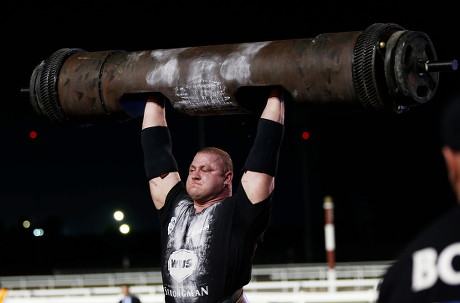
Kieliszkowski is more than a dumbbell specialist. A 214-kilogram competition log, a 195-kilogram axle and published training sets with 190 kilograms for repetitions show a very serious bilateral pressing base. The dumbbell nevertheless became the implement with which he is most immediately identified. There is a technical reason. His anatomy and movement style favour aggressive use of the legs and torso to project the implement, while his unilateral stability is exceptional. In the Cyr Dumbbell the globe rests high on the shoulder, the thick handle and wide ends create an awkward rack position, and the athlete must maintain the wrist while finding a stable point against the shoulder. The dip and drive then require ankle, knee and hip extension to occur as one violent sequence. Kieliszkowski minimises the transition between the dip and upward drive, preserving implement speed. His 145-kilogram record performance in 2020 is impressive not only because of the weight but because of the finish. After nearly 150 kilograms has been accelerated with one arm, the athlete must stop rotation and present a controlled lockout to the referee. This combination of explosion and technical order explains why overhead medleys remained events in which he could take maximum points even after major injuries. The movement is spectacular, but the spectacle is produced by precision rather than chaos.
In strongman, stones are the test in which the perfect barbell disappears and the athlete is left in contact with an object that does not want to be lifted. Kieliszkowski excelled in traditional Atlas Stones, stone-to-shoulder and natural stones. The five-stone run in 16.09 seconds at the 2018 Giants Live World Tour Finals became a benchmark for speed. At Arnold, Rogue and contests influenced by Icelandic traditions, his ability to take the object directly to the shoulder separated him even more clearly. The roughly 186-kilogram Odd Haugen Tombstone for five repetitions is a demonstration of repeated strength rather than a single maximum. In training he also published a natural stone of around 217 kilograms to the shoulder. Technically, stones allow him to use precisely the kinetic chain in which he is strongest: crushing grip and compression, violent hip extension, rapid repositioning and dynamic stabilisation. His background with fabricated or improvised training objects also appears to have created genuine adaptability. When the surface is wet, a stone contains an unexpected edge or the centre of mass is asymmetric, an athlete who depends on one rigid technique can lose valuable seconds. Kieliszkowski seems able to solve the object while it is moving. That capacity is difficult to measure in a gym, yet it is one of the reasons natural-object events repeatedly became point-scoring opportunities rather than sources of uncertainty.
His YouTube channel and public home-gym material preserve one of the most authentic traits of Kieliszkowski's career: success did not make him dependent on a luxurious training infrastructure. Preparation remained practical and centred on implements. Strongman training requires the replication of situations that an ordinary commercial gym cannot easily provide. The athlete needs logs with different diameters, axles, frames, stones, sandbags, platforms, carry implements and enough open space to run with hundreds of kilograms without negotiating with a reception desk. Kieliszkowski's family and team built, modified and maintained equipment for those purposes. That ability turns preparation into a process of prototyping. If a contest announces an unusual implement, a similar object can be built, its balance can be tested and grip or height can be modified until the movement becomes familiar. His method therefore resembles empirical engineering more than a search for the perfect exercise on paper. Lift the object, identify where energy is being lost, change one detail and repeat. For an athlete whose advantage comes from economy of movement, hundreds of specific repetitions on realistic implements are enormously valuable. The home gym is not scenery for social media. It is the laboratory in which his competition technique was developed, repaired after injury and repeatedly adapted to new contest formats.
Every major Polish strongman is inevitably compared with Mariusz Pudzianowski, the five-time World's Strongest Man champion and one of the athletes who defined strongman's mass-television era. The comparison becomes a trap when it reduces two very different careers to one question: who was better? Kieliszkowski emerged in an era with different weight standards, different circuits and far greater specialisation among competitors. He continued the Polish tradition of the fast, well-conditioned strongman but built it into a distinct form. Five consecutive Poland's Strongest Man titles establish national dominance, while victories at Arnold Africa, Arnold Europe, Giants Live and World's Ultimate Strongman demonstrate international transfer. If Pudzianowski made famous the image of a strongman who could move almost like a much lighter athlete, Kieliszkowski carried the same idea into a world in which the implements and absolute weights had become even more brutal. His specialisation in the dumbbell and stone-to-shoulder also separates him clearly from his predecessor. The Polish legacy is therefore not a copy of an earlier golden era. It is a continuation through mutation: the same obsession with speed, efficiency and competitive work capacity, applied to a modern 150-kilogram athlete who must survive fields containing deadlifters capable of well over 450 kilograms.
The label “one of the greatest strongmen never to win World's Strongest Man” contains truth, but it should not become his entire biography. Two consecutive runner-up finishes and the level shown at the 2020 Arnold describe an athlete with WSM-champion quality, yet the résumé is much wider: World's Ultimate Strongman, Arnold Africa, Arnold Europe, Giants Live Wembley, two World Tour Finals, the Magnús Ver Magnússon Classic, the Siberian Power Show and five national titles. He set records in dumbbell pressing, moving events and stone lifting and returned to major podiums after surgeries that could have ended an elite career. As of September 2026, with no public retirement announcement located and competition activity documented through 2025, this profile treats him as active. Even if the WSM trophy remains absent, the legacy is already clear: Kieliszkowski showed that strength is not only how much weight can be lifted, but how quickly an impossible object can be made to move.
Iron Hall data
420 KG
Standard deadlift — competition personal best · 2019 World's Ultimate Strongman Dubai
Verified
430 KG
18-inch deadlift · 2018 World's Ultimate Strongman Dubai
Verified
376 KG
Hummer Tire Deadlift · 2015 Arnold Strongman Classic
Verified
214 KG
Max Log Lift · 2019 Europe's Strongest Man / World Log Lift Championships; competition personal best
Verified
195 KG
Max Axle Press · 2018 Giants Live World Tour Finals
Verified
145 KG
Cyr Dumbbell Press · 2020 Arnold Strongman Classic; world record at the time
Verified
150 KG
Circus Dumbbell Press · Competition world record in 2018
Verified
186 KG
Odd Haugen Tombstone to Shoulder · 5 repetitions in 150 seconds; world record
Verified
217 KG
Natural stone to shoulder — training · Published training personal best
Verified
450 KG
Car Walk / Bushman Walk · 20 m in 10.00 seconds; world-record performance
Verified
400 KG
Timber Carry / Frame Carry · 2020 Arnold Strongman Classic; 10.7 m up the ramp in 7.00 seconds
Verified
185 KG / HAND
Farmer's Walk — training · Per hand, documented training lift
Verified
710 KG
Bale Tote · 2017 Arnold Strongman Classic; bale-tote carry
Verified
550 KG
Super Yoke — heavy implement in medley · 2019 Arnold Africa; second yoke in the event, 10 m
Verified
200 KG / HAND
Hercules Hold · 200 kg per hand; 49.64 seconds at 2019 World's Strongest Man
Verified
200 KG
Standard-bar Overhead Press · 2018 World's Strongest Man
Verified
195 KG
Austrian Oak / Log for repetitions · 2 repetitions at the 2019 Arnold Strongman Classic
Verified
320 KG
Squat — training · 5 repetitions, documented training set in 2016
Verified
200 KG
Push Press — training · 2 repetitions, documented training lift
Verified
190 KG
Log Lift — training for repetitions · 3 repetitions, published training best
Verified
190 KG
Axle Press — training for repetitions · 2 repetitions, published training best
Verified
127 KG
Cyr Dumbbell — training for repetitions · 3 repetitions, published training best
Verified
2014
Columbus, Ohio, USA. The victory that launched his professional strongman career.
1st of 10
2015
Columbus, Ohio. His first professional Arnold Strongman Classic podium.
3rd of 10
2015
Tashkent, Uzbekistan. International victory in his first full professional season.
1st of 14
2015
Augustów, Poland. First of five consecutive national titles.
1st of 11
2015
Liptovský Mikuláš, Slovakia.
1st of 8
2016
Columbus, Ohio, USA.
4th of 10
2016
Sandton, South Africa.
2nd of 11
2016
Leeds, England.
4th of 10
2016
Gdańsk, Poland. Second consecutive national title.
1st of 4
2016
Kasane, Botswana. His first World's Strongest Man final.
7th of 10
2016
Barcelona, Spain.
2nd of 10
2016
Santos, Brazil. Held in December 2016 under the 2017 edition title.
1st of 4
2017
Columbus, Ohio, USA.
4th of 10
2017
Melbourne, Australia.
5th of 8
2017
São Paulo, Brazil.
3rd of 8
2017
Sandton, South Africa. One of his first major Arnold-series victories.
1st of 11
2017
Gaborone, Botswana. Won the Plane Pull and established himself as a future podium contender.
6th of 10
2017
Southampton, England.
2nd of 10
2017
Odense, Denmark.
2nd of 10
2017
Gdańsk, Poland. Third consecutive national title.
1st of 3
2017
Reda, Poland.
1st of 8
2018
Columbus, Ohio, USA.
4th of 10
2018
Leeds, England.
3rd of 10
2018
São Paulo, Brazil.
2nd of 11
2018
Manila, Philippines. First of two consecutive World's Strongest Man runner-up finishes.
2nd of 10
2018
Southampton, England.
2nd of 12
2018
Opole, Poland.
1st of 7
2018
Warwick, Canada.
4th of 12
2018
Gdańsk, Poland. Fourth consecutive national title.
1st of 12
2018
Manchester, England. Major Giants Live victory; his Atlas Stones run became one of the defining images of his career.
1st of 11
2018
Dubai, United Arab Emirates.
3rd of 12
2019
Santa Monica, California, USA.
2nd of 9
2019
Columbus, Ohio, USA.
3rd of 10
2019
Leeds, England.
2nd of 9
2019
São Paulo, Brazil.
2nd of 9
2019
Sandton, South Africa.
2nd of 13
2019
Bradenton, Florida, USA. Second consecutive World's Strongest Man runner-up finish.
2nd of 10
2019
London, England. Giants Live victory in a major arena show.
1st of 10
2019
Inowrocław, Poland. Fifth consecutive national title.
1st of 10
2019
Joensuu, Finland.
1st of 14
2019
Manchester, England. Second consecutive World Tour Finals victory.
1st of 13
2019
Barcelona, Spain. Champion in a large international field.
1st of 18
2019
Dubai, United Arab Emirates. One of the most important victories of his career.
1st of 14
2020
Cotia, Brazil.
2nd of 4
2020
Columbus, Ohio, USA. Won four of six events, including Wheel of Pain, Cyr Dumbbell, Timber Carry and Trial by Stone.
2nd of 10
2021
Dubai, United Arab Emirates. Major comeback after triceps surgery.
2nd of 10
2021
Round Rock, Texas, USA.
4th of 10
2023
Columbus, Ohio, USA. Podium comeback after another long injury-disrupted period.
2nd of 10
2023
Myrtle Beach, South Carolina, USA. Did not advance to the final.
4th of 6
2023
Austin/Round Rock, Texas, USA. First Rogue Invitational podium.
3rd of 10
2024
Columbus, Ohio, USA. Strong second-day comeback to another runner-up finish.
2nd of 11
2024
Iceland. Victory in a contest built around classic strongman and natural-object events.
1st of 15
2025
Leeds, England. Won the Carry & Drag and Overhead Medley.
3rd of 12
2025
Krasnoyarsk, Russia. Overall win with event victories in the Medley, Axle Press and Sandbag Toss.
1st of 12
2025
Sacramento, California, USA. Did not advance to the final.
5th of 5
2025
Royal Albert Hall, London, England.
9th of 12
2025
Glasgow, Scotland. A result reflecting the physical difficulties of the season.
13th of 13
2018
Held within Europe's Strongest Man. Recorded a 175 kg Max Log Lift.
Competed — 175 kg
2019
Leeds, England. Competition log personal best, tied with other athletes at 214 kg.
Tied 2nd — 214 kg
2019
Giants Live single-event deadlift championship; 400 kg.
Tied 9th — 400 kg
2025
Held within the Giants Live World Tour Finals; 180 kg Max Log Lift.
180 kg