
2007
Austrian Summer Giants — Qualification / first strongman season
The first major strongman season documented in biographical sources, marking Wildauer's entry into the Austrian Giants circuit.
Qualifier winner; 5th at the national final
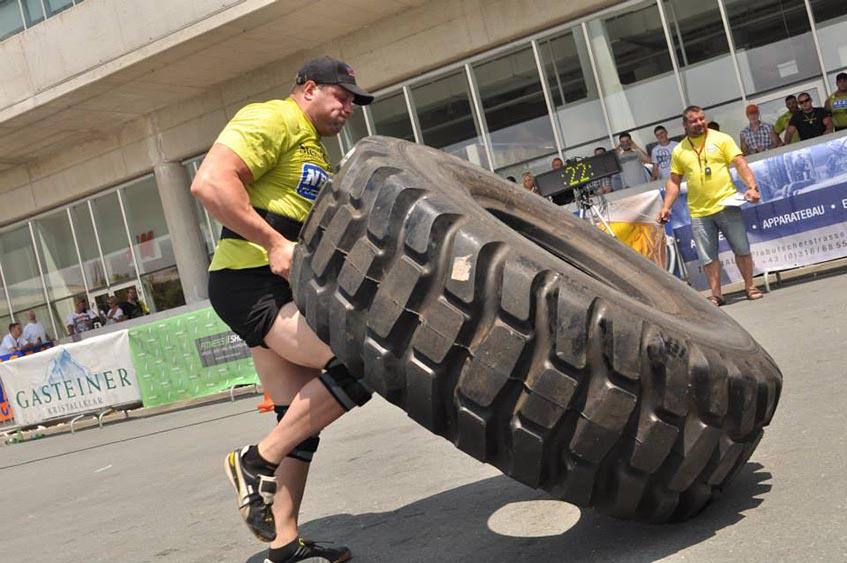
Iron Archives
2014 Strongman Champions League champion and one of his generation's standout deadlifters
Retired athlete
Martin Marco Peter Wildauer is a retired Austrian strongman from Tyrol, born on 27 November 1987 and widely known on the international circuit as “The Deadlift Kid.” After an early background in kickboxing and powerlifting, he entered strongman in 2007 and, under the guidance of German strongman legend Heinz Ollesch, developed into a world-class competitor. Strongman Archives records 66 international contests with four wins, eight national appearances with six victories, and five World's Strongest Man appearances, including a 12th-place finish in the 2014 WSM final. The defining season of his career was 2014, when he won the overall Strongman Champions League title, captured SCL Portugal, collected several SCL podiums, reached the WSM final, and pulled 435 kg at the inaugural World Deadlift Championships. He also won Giants Live Finland in 2011, European Giants in 2016, and six Austria's Strongest Man titles in the Strongman Archives database. His competitive identity centered on deadlifting, Bavarian stonelifting, frame carries, Atlas Stones and pulling events. Away from competition, public interviews describe him as a graduate of an industrial-engineering technical school in Innsbruck and a municipal employee in Langkampfen, including work in the local construction department.
Martin Wildauer, Tyrolean strength in the Strongman Champions League generation. Martin Marco Peter Wildauer was born on 27 November 1987 in Kufstein, Tyrol, Austria, and became one of the most significant Austrian strongmen of the period when the sport expanded internationally through the late 2000s and 2010s. To fans of the circuit he became closely associated with the nickname “The Deadlift Kid,” a name that captured one of his most obvious gifts: the ability to turn deadlifting into an event in which he could reliably collect major points. Yet his career was far broader than one lift. Strongman Archives records 66 international contests between 2008 and 2017, four international victories, eight national appearances with six wins, and five appearances at World's Strongest Man. In 2014 he reached the WSM final for the first and only time, finishing 12th, while in the same season he won the overall Strongman Champions League championship. That title is the central achievement of his career because it was not an isolated victory produced by one favorable weekend. It was earned through repeated performances across a long tour, with different implements, climates, travel demands and world-class opponents. His résumé also includes victory at Giants Live Finland in 2011, the European Giants title in 2016, repeated SCL podiums, and a 435 kg deadlift at the 2014 World Deadlift Championships. If his career is judged only through World's Strongest Man, where he never reached the podium, its true scale is easy to underestimate. Wildauer was a circuit athlete, a specialist in consistency and brutally heavy events, able to remain relevant for almost a decade in an era populated by Žydrūnas Savickas, Brian Shaw, Hafþór Júlíus Björnsson, Mikhail Koklyaev, Laurence Shahlaei and many other elite competitors. His story is therefore best understood as that of an athlete who reached the highest level through adaptation, durability and exceptional pulling strength rather than through one brief flash of fame.
Kufstein, Langkampfen and a distinctly Tyrolean identity. Biographical sources connect Wildauer with Kufstein as his birthplace and Langkampfen as the community in which he grew up, lived and worked during his peak competitive years. That geography matters. European strongman of the period was not built exclusively inside huge specialist training centers with full multidisciplinary teams. For many athletes, elite performance had to coexist with an ordinary job, long drives to places where event equipment was available, and training schedules fitted around real life. In a 2015 interview, Wildauer said that he had been born and raised in the Langkampfen area and was still living there at the time. Austrian local media also described him as an employee of the municipality of Langkampfen, including administrative work connected with the construction department. This is very different from the modern image of a full-time professional athlete whose entire day is organized around recovery and training. Wildauer worked what he described as a normal working week and then placed squats, deadlifts, presses and strongman events around it. That double identity, municipal employee and man capable of pulling more than 400 kg, is one of the most revealing elements of his biography. Tyrol also provided a cultural setting that fitted some of his most distinctive strength events. The Bavarian Stonelift, for example, was not merely an exotic implement added to a modern contest; it belonged to an older Alpine and Bavarian strength tradition. Wildauer became exceptional at it, setting a world-record performance with 350 kg in 2009 as reported by IronMind. His athletic identity therefore remained rooted in a regional strength culture even as his competition calendar expanded from Austria and Germany to Serbia, Finland, Britain, Malaysia, Brazil, South Africa and Asia. The combination of a local foundation and global itinerary captures an important feature of Wildauer's generation: the sport was internationalizing rapidly, but many of its athletes still trained and lived in very local, practical ecosystems.
An athletic childhood and kickboxing. Wildauer did not begin inside a powerlifting gym with strongman as his single destination. In retrospective interviews he described starting kickboxing at around ten years old and practicing the sport through early adolescence. He competed regionally and nationally, and some biographical accounts credit him with several Tyrolean championships and a national title in his category. The precise medal count is less important than the role this period played in shaping him. Kickboxing demands coordination, technical discipline, tolerance for fatigue and the ability to function under competitive pressure. Strongman later required an entirely different expression of physical force, but the habit of turning training into a repetitive, competitive process was already present. Around the age of twelve, according to his own recollections reproduced in interviews, his father provided him with his first weights and basic training equipment. The detail is useful not because it creates a myth of a predestined child, but because it shows that his relationship with strength work began before formal powerlifting. Arnold Schwarzenegger appears repeatedly in accounts of Wildauer's early inspiration. For a young Austrian interested in strength and muscularity, Schwarzenegger's cultural presence was almost unavoidable, but Wildauer soon realized that classical bodybuilding was not the direction that best suited him. He was more interested in objective progression measured in kilograms than in appearance alone. As the weights increased, that preference became an athletic identity. What began as supplementary training and curiosity gradually took over the center of his program. The transition was not instantaneous. There was a period of exploration between combat sports, general weight training and bodybuilding before powerlifting first offered him a clear system in which his talent could be measured. This early variety also helps explain why Wildauer later appeared comfortable adapting his training. From the beginning, his sporting life was not one straight path but a sequence of practical transitions.
Discovering maximal strength through powerlifting. As a teenager Wildauer began training more seriously in a gym and quickly noticed that his progress in the basic barbell lifts was unusual. In one retrospective interview he recalled that at roughly fifteen years old and about 75 kg bodyweight he could work with 140 kg in the deadlift, and that after only a few months of focused training he reached 200 kg. Such numbers come from his own biographical recollection rather than archived meet results, so they should be treated accordingly, but they fit the broader trajectory of his career. He entered powerlifting, and secondary career summaries mention more than forty Austrian age- or weight-class records. More important than the exact total is what powerlifting taught him technically. The deadlift, squat and bench press built the chassis onto which strongman would later add unstable objects, difficult grips, moving events and awkward positions. Wildauer later explained that deadlifts and squats remained central to his training even when contests demanded trucks, stones, yokes and medleys. At around eighteen he met Austrian powerlifter Wolfgang Kriechbaum, whom he has mentioned as an important influence during the early phase of his strength career. Training around a more experienced lifter exposed him to higher standards and a more structured strength culture. Powerlifting also supplied what became his competitive signature: confidence in his posterior chain and an ability to generate enormous force from the floor. In strongman the deadlift rarely appears in only one form. It can be a standard bar, axle, car apparatus, elevated pull, ladder, repetition event or maximum. Wildauer proved valuable because his base strength transferred across these variations. “The Deadlift Kid” was therefore not simply a marketing nickname invented after one famous performance. It described a pattern visible from his teens onward. Pulling heavy objects was the most natural language of strength for him, and powerlifting gave that language grammar before strongman taught him how to use it in a much wider world of implements.
Education and professional life away from competition. A crucial part of Wildauer's biography is that his rise in strongman did not require him to abandon a civilian career entirely. In the extensive interview published in 2015, he said he had graduated from a technical school in Innsbruck with an industrial-engineering orientation. He later worked for the local administration in Langkampfen, including in an office connected with construction, combining desk work with some field activity. Austrian local press described him as a municipal clerk or case officer, while another report referred to him as an employee of the Bauamt, the construction office. These descriptions should not be inflated into a professional title more grandiose than the available evidence supports. What they clearly establish is that Wildauer maintained stable technical-administrative employment while competing at elite level. A 2015 article about municipal digital projects portrayed him returning to ordinary office responsibilities after his sporting success of the previous season. That continuity is revealing. Strongman Champions League could require travel to several countries in one year, each trip carrying the costs of transport, recovery and event-specific preparation. Combining such a calendar with a roughly forty-hour work week forced compromises. Wildauer explicitly said that he did not always train on fixed days. Employment and daily obligations required flexibility, so sessions were organized around available windows rather than an idealized schedule. Seen from the current era, when many leading strongmen earn through sponsorships, social media, coaching and full-time sport, his model feels almost handcrafted: work, gym, drive to event equipment, compete abroad, return to the office. That context makes the achievements of 2014 even more significant. His SCL championship was not constructed in a perfectly controlled performance laboratory. It emerged from an imperfect but sustainable balance between sport and normal life. This practical reality appears repeatedly in his interviews and helps explain his philosophy. He wanted enough structure to improve, but enough flexibility that strongman could remain part of his life rather than consume every other component of it.
Entering strongman in 2007. Wildauer has described his transition toward strongman as a natural consequence of powerlifting no longer satisfying all of his competitive curiosity. On television he had seen athletes moving stones, logs, vehicles and objects that bore little resemblance to a calibrated barbell. The spectacle appealed to him, but so did the technical problem. At around nineteen years old, in 2007, he entered a qualifier for the Austrian Summer Giants. Biographical chronologies state that he won the qualifier and later finished fifth at the national final. For a newcomer, that was enough to prove that powerlifting strength could be transferred, but the conversion was not automatic. A powerful deadlifter can lose badly in a farmer's walk if grip and speed are undeveloped. A strong squatter can struggle under a yoke if the oscillation is uncontrolled. A strong presser can miss a log if the clean is inefficient. Wildauer had to learn a new alphabet of strength. During this period Heinz Ollesch became the decisive mentor. Ollesch was one of Germany's best-known strongmen of the previous generation and had competed at World's Strongest Man. Wildauer later said in interviews that Ollesch discovered him and helped advance his career, while IronMind was already describing the German as his coach by 2009. The relationship was practical, not merely symbolic. For event training, Wildauer traveled to Rosenheim in Germany, where Ollesch had the implements and expertise required. The journey itself reveals how different the sport's infrastructure was from ordinary gym training. A powerlifter can reproduce almost everything with a rack, bench and bar. A strongman needs stones, yokes, frames, logs, axles, tires, ropes and sometimes vehicles. Ollesch gave Wildauer both access and accumulated knowledge. Only a few years after his first qualifier, this combination would take him to World's Strongest Man. The speed of that progression is remarkable, but it was built on years of general and powerlifting strength that preceded his strongman debut.
Early titles and the construction of a complete competitor, 2008. In his second serious strongman season, Wildauer began converting potential into victories. Public career chronologies credit him with winning the Austrian Winter Giants, while Strongman Archives starts tracking his competitive record systematically from 2008. The distinction between “active since 2007” and “archive span 2008–2017” is important: a database is not a complete biography and begins where documented results become available. This profile therefore retains 2007 as his entry into strongman but uses 2008 as the beginning of the main statistical record. During these early seasons Wildauer expanded his repertoire far beyond the three powerlifting movements. Loaded carries gradually became a strength, as did stones. He learned contest pacing, where perfect warm-ups are rare and where the order of events can turn a familiar weight into a different problem after several hours of fatigue. Strongman education also includes points strategy. Sometimes an athlete does not need an event win if he can avoid a disastrous placing; at other times the overall standings require a risk. Wildauer eventually became especially effective in a tour format such as SCL because he could gather points from many different events. In 2008 he was not yet the man who would pull 435 kg, but the foundations of the later profile were already visible: a powerful deadlift, adaptability and a high tolerance for frequent competition. The sport was also beginning to give him a distinct public identity. “The Deadlift Kid” suited an athlete who was still very young compared with many experienced rivals. Elite strongman often rewards late physical maturity, with many champions peaking after thirty. Wildauer was entering major competition before twenty-two. That precocity meant that only two years after his first domestic qualifier, he would be standing against the strongest men in the world. The leap was enormous, and it accelerated every part of his education.
The 2009 breakthrough: FIBO, Strongman Champions League and the Bavarian Stonelift. The year 2009 was Wildauer's true transition from Austrian prospect to international competitor. At FIBO Strongman ClassX, an important event in the European strength ecosystem, he finished second behind American Travis Ortmayer. The result opened the route into Strongman Champions League. At the Serbia stage he finished fifth overall and won the car deadlift, immediately reinforcing his reputation as a puller. In Finland he continued to score strongly, while domestically he became Austria's Strongest Man. The same year also produced one of the most distinctive achievements of his career: a world record in the Bavarian Stonelift. IronMind reported the progressive attempts and recorded Wildauer lifting the 350 kg stone to 94 centimeters. Later Austrian sources described the same performance as roughly 100 centimeters. The small discrepancy demonstrates why historical records should preserve the original source instead of pretending to impossible precision. What is not disputed is the 350 kg implement and the fact that the performance was presented at the time as a world record. The Bavarian Stonelift is a peculiar event. The athlete stands on a platform and raises a huge block vertically through a handle or chain, with the distance becoming part of the result. It is not a standard deadlift, yet it demands tremendous posterior-chain strength and the ability to initiate force from an awkward position. In other words, it was almost designed for Wildauer's qualities. Heinz Ollesch spoke publicly about the performance, making their coach-athlete relationship visible in specialist media. At twenty-one, Wildauer was no longer merely the young Austrian who pulled hard. He had an SCL event win, a FIBO podium, a national title and a world-record performance in a traditional strength event. The next step followed in the same year: an invitation to World's Strongest Man, where the scale of the challenge would rise dramatically.
World's Strongest Man debut, 2009. Wildauer's first WSM appearance came in a group almost absurdly difficult for a newcomer. Strongman Archives places him in Group 2 alongside, among others, Žydrūnas Savickas and Brian Shaw, two athletes who would eventually accumulate eight World's Strongest Man titles between them. For Wildauer, merely standing in the same qualifying group represented a brutal change in scale. WSM used a group format in which athletes outside the qualifying positions were eliminated before the televised final. Wildauer finished fifth of six and did not advance. Read without context, the result can seem modest. In context, it marks the arrival of a twenty-one-year-old Austrian into a world field where absolute strength, experience and tactical knowledge were operating at another level. WSM did not test only maximum lifts. Events could involve moving, overhead strength, stones, vehicles and medleys where a technical mistake costing a few seconds could destroy the points table. For an athlete still learning the full language of implements, the experience was valuable even without a final. More importantly, Wildauer was not a one-time participant. He returned in 2011, 2012, 2013 and 2014, becoming more competitive each time. In three consecutive editions from 2011 through 2013, he finished third in his group, repeatedly coming close to qualification. That progression suggests genuine maturation: from the debutant trapped in a group dominated by future champions to an athlete who could win events and pressure the final qualifying positions. WSM 2009 was therefore more than a line in his résumé. It gave him a precise measurement of the distance between national success and the absolute top of the sport. The next several years were about reducing that distance, especially by turning the deadlift into a major competitive weapon while improving moving and loading events enough that they no longer erased the points gained through static strength.
Injuries, patience and returning to competition. Wildauer's career did not follow a clean upward line. IronMind reported in 2011 that he was returning after a serious pectoral injury suffered in the preceding period. In a sport where pressing, truck pulling, yoke carrying and even deadlift positioning load the shoulder girdle heavily, such an injury can alter not only one season but an athlete's entire movement strategy. Later, other physical setbacks appeared, including an Achilles tendon injury before his 2015 return and a hamstring problem that Wildauer described after attempting 446 kg in the deadlift in 2014. Public sources do not always provide complete medical diagnoses, and a responsible profile should not convert sporting recollections into a clinical record. What can be observed clearly is the pattern of returns. Wildauer continued competing after episodes that could have ended the career of an athlete dependent on explosive force. His training philosophy, described in interviews, included substantial breaks after a season, sometimes six to twelve weeks, specifically to recover physically and mentally. He did not describe strongman as an obligation to be maintained at any cost. He needed it to remain enjoyable and motivating. That attitude may sound unusual in a culture that often glorifies constant training, but almost a decade at a high international level suggests its practical value. Periods away from heavy work allowed him to return with motivation instead of grinding continuously. His flexible schedule also reduced the psychological pressure of fixed training days. When employment, travel or recovery demanded changes, the plan changed. That is not the same as lacking discipline. For a full-time worker traveling through Europe to compete, discipline meant maintaining long-term direction rather than obeying the same sheet every week. Injury is one of the quiet themes running beneath strongman history. In Wildauer's case, injuries did not disappear; they were absorbed into a career that repeatedly rebuilt itself and continued producing elite results.
Giants Live Finland 2011, international validation. If 2009 was the year Wildauer entered the major stage, 2011 was the year he proved he could win an important international contest. Strongman Archives and contemporary IronMind coverage record him as the winner of Giants Live Finland. He won the loading race, the deadlift for repetitions and the tire flip, while finishing second in the truck pull. The structure of the victory matters: it was not a contest won merely because organizers happened to program a deadlift suited to him. Wildauer collected maximum points in three very different tasks, one based on loading and movement, one on repeated static pulling, and one on explosive conditioning with a tire. IronMind described the deadlift apparatus at roughly 343 kg, which he lifted for ten repetitions. The victory confirmed his return after the pectoral problem and earned him a route back to World's Strongest Man. Finland displayed exactly the kind of profile demanded by Giants Live: enough static power to dominate a heavy deadlift, but enough mobility not to surrender huge points in races. That balance would become even more important during his 2014 championship season. Giants Live was already a major qualification and visibility pathway for WSM, so the win carried both sporting and strategic weight. For Austria it also confirmed that Wildauer was no longer simply the champion of a relatively small national scene. He could beat an international field and do so in a contest where each event required a different solution. When his career is summarized only through the SCL title and the 435 kg deadlift, the Finland victory can be overlooked. It deserves to be treated as one of his defining days. It was the contest in which “The Deadlift Kid” demonstrated that he was, in the fullest competitive sense, a complete strongman capable of winning the overall standings rather than merely the event that matched his nickname.
World's Strongest Man 2011 and domestic dominance. After winning Giants Live Finland, Wildauer returned to WSM and made a clear jump from his 2009 debut. Strongman Archives places him third in his qualifying group. He did not reach the final, but the competitive distance had narrowed dramatically. The group format of the period could be unforgiving. An athlete might win one or two events and still miss qualification if another event exposed a weakness and produced a low placing. For Wildauer, every WSM therefore became a lesson in minimizing losses. In parallel, he won Austria's Strongest Man in 2011. The event archive shows him taking multiple event wins and establishing an increasingly clear gap between his international level and much of the domestic field. That created an interesting sporting paradox. At home he could be the benchmark and favorite; at WSM he still had to fight for the final qualifying places against athletes with enormous experience and resources. Elite strongman constantly changes the scale in this way. A national champion can arrive at the world stage and suddenly discover that every point has to be fought for. Wildauer navigated that difference for several seasons. The year also strengthened the link between his deadlift ability and public identity. At a time when Žydrūnas Savickas was setting the standard for overhead power and Brian Shaw was developing into an exceptionally complete giant, Wildauer needed a weapon of his own. Pulling was that weapon. Yet his overall results show that he understood the danger of becoming too specialized. To finish third in a WSM group, one event is not enough. An athlete must survive overhead work, carries, loading, stones and whatever new variations organizers introduce. The Giants Live victory and WSM performance together proved that the adaptation begun in 2007 had matured. He remained a deadlift specialist, but specialization now sat inside a broad enough strongman skill set to make him internationally dangerous.
The 2012 season and another near miss at WSM. Wildauer continued to combine Strongman Champions League appearances with national competition and World's Strongest Man. He again won Austria's Strongest Man, and at WSM he finished third in his group for the second consecutive year. Strongman Archives preserves two event wins that are particularly revealing: the deadlift for repetitions and the arm-over-arm pull. The first was predictable for his profile; the second showed how his pulling strength transferred to a dynamic task where grip, rhythm and the ability to maintain tension matter as much as a maximal single. Winning two events in a WSM group and still missing the final illustrates the harsh mathematics of the format. Strongman is a ranking sport, not a collection of personal records. An athlete can be world-class at one movement and lose the contest through a carry or stone event. For Wildauer, 2012 was another step in broadening his competitive base. Good results also appeared at FIBO and other European contests, and his name had become stable on international start lists. Physically he generally competed around 145 kg at roughly 1.90 m, enormous in ordinary life but not extreme in a field that included athletes approaching or exceeding 180 kg. That gave him an interesting compromise. He did not always possess the sheer inertial advantage of the biggest competitors in purely static tasks, but he could often move more efficiently. In the deadlift he compensated through technique and extraordinary posterior-chain strength. The profile that would later thrive in SCL was becoming clear: heavy enough for enormous implements, mobile enough for fast stages and conditioned enough for a dense competition calendar. The 2012 season did not deliver the WSM final he wanted, but it reinforced a new reality. Wildauer was no longer a surprise entry. He had become one of the athletes organizers and rivals had to account for whenever a field was announced.
2013, consolidation before the peak. In 2013 Wildauer again won Austria's Strongest Man and reached the podium at Strongman Champions League Serbia, where Strongman Archives lists him second overall. He won the car deadlift and the weight throw, an interesting pairing of his traditional specialty with an explosive throwing event. At World's Strongest Man he finished third in his group for the third consecutive edition. He again won the deadlift but remained just outside the final. Psychologically, such a run could be deeply frustrating: strong enough to defeat elite rivals in individual events, consistent enough to stay in the qualification battle, yet three times in a row on the wrong side of the final threshold. Instead of fading after these near misses, Wildauer entered 2014 and produced the best season of his career. The repeated frustration may have clarified exactly where points needed to be protected. From 2013 onward, his results show increasing maturity in tour strategy. Wildauer did not have to win every event to remain near the top overall. He could use the deadlift to accelerate his points total, limit losses in pressing or carries, and recover at stones or another favorable event. That logic is essential in a championship made of multiple stages. Strongman Champions League rewarded not only peak shape on one weekend, but also availability, travel tolerance and the ability to reproduce good performances. For an athlete with a full-time job, that demand was even more severe. Every trip had to fit around work, and minor injuries had to be managed without the luxury of a long period devoted only to sport. The 2013 season therefore functioned as accumulation. Wildauer already had WSM experience, national titles, a Giants Live victory and SCL podiums. What he lacked was a season-long international championship that could gather those qualities into one major result. One year later, that title arrived.
World's Strongest Man 2014, finally reaching the final. Wildauer's fifth WSM appearance broke the sequence of group-stage eliminations. In qualifying, Strongman Archives records victories in Atlas Stones and the deadlift ladder, whose heaviest step reached 370 kg, along with strong finishes in Fingal's Fingers and the car walk. That collection says a great deal about the 2014 version of Wildauer. He was no longer merely the man who won the deadlift. He could take first in stones, one of the sport's most technical and exhausting events, and remain near the top on moving implements. Qualification for the final was the reward after three consecutive third-place group finishes. In the final, Wildauer finished twelfth. The placing can look anticlimactic after such strong qualifying, but a WSM final creates a new layer of cumulative fatigue, denser opposition and sometimes less favorable events. The key historical point is that he entered the small group of Austrian strongmen to reach the final stage of the sport's most famous contest. In the same year, performances elsewhere show that his overall shape was exceptional. He pulled 400 kg raw at the Eisenhart Challenge, 435 kg at the World Deadlift Championships, won SCL Portugal and accumulated podium after podium across Strongman Champions League. WSM 2014 must therefore be read as one piece of a much larger season rather than the sole verdict on his quality. Had he produced a higher placing in the final, his name would probably be more familiar to casual fans today. But strongman history exists beyond WSM. For Wildauer, reaching the final confirmed that the progress begun with his 2009 debut had been real: five appearances, several near misses, and eventually the threshold crossed. It was not an overnight transformation. It was the accumulated result of years spent reducing the number of points lost in the wrong events.
The 400 kg raw deadlift and the road to 435 kg. In the spring of 2014, Wildauer competed at the Eisenhart Challenge in Germany, a strength contest that included a deadlift presented in a format closer to powerlifting. Results published by the organizers credit him with the best men's deadlift of the contest at 400 kg, while later reports emphasize that it was performed without a deadlift suit and without straps. For his profile, this mattered. Strongman rules and equipment vary between contests, and a car-deadlift apparatus cannot be compared directly with a standard bar. The 400 kg result provided a simple anchor showing that Wildauer possessed elite pulling strength in a relatively conventional setup. A few months later, at the World Deadlift Championships held alongside Europe's Strongest Man, he reached 435 kg and finished third. The lift became one of the most frequently cited numbers of his career and was reported in period sources as an Austrian national record. In a later interview Wildauer recalled attempting 446 kg and suffering a hamstring problem during the effort. The episode shows how narrow the margin becomes at such loads. Between a record and an injury there may be only one attempt. The 435 kg result did not appear from nowhere. It was the outcome of a decade that began with teenage powerlifting, continued through car deadlifts and repetition events, and matured through repeated exposure to rivals who kept moving the standard upward. World strongman deadlifting was accelerating rapidly during the same period. Crossing 400 kg was no longer enough to guarantee victory, and specialists were pushing the event toward numbers that would have seemed extraordinary only a few years earlier. Wildauer was part of that wave. He never held the absolute world record, but 435 kg placed him firmly in the international elite and transformed “The Deadlift Kid” from a memorable nickname into a statistically justified description.
Strongman Champions League 2014, the anatomy of a championship season. The overall SCL title is the best key to understanding Martin Wildauer as an athlete. Strongman Champions League was a tour of events held in different countries, with accumulated points and substantial variation in implements. Winning the overall championship meant being available, healthy enough for long enough, and repeatedly competitive. Wildauer produced an exceptionally dense season. He reached podiums at stages in Germany, Serbia, Latvia, Portugal, Croatia, Poland, Romania and Estonia, and he won the overall contest in Portugal. Strongman Archives shows event victories there in the tire flip, frame carry and car deadlift, three tasks demanding very different qualities. In Romania he dominated the deadlift and Atlas Stones; in Estonia he won the Power Stairs; in Hungary he produced one of the best documented frame-carry performances of his career. These results explain the mechanics of the championship. Wildauer was not necessarily the most dominant athlete at every stage, but almost every contest gave him two or three events in which he could attack the top while his versatility kept the damage limited elsewhere. The tour rewarded that statistical resilience. The title also came in an era of exceptionally strong European competition. SCL fields included WSM veterans and national specialists capable of winning individual events on any given day. Repeated travel created a type of fatigue that a single championship cannot reproduce. An athlete is not preparing for six events but for months of competition. Wildauer had to manage World's Strongest Man, the World Deadlift Championships and the SCL season in the same year. When he was recognized as the 2014 Strongman Champions League overall champion, the title summarized his defining quality better than any other result: continuity. He was not simply the man capable of one monstrous pull. He was the athlete who could reproduce enough high-level performances, often enough and in enough places, to finish ahead over an entire championship campaign.
SCL Portugal and winning through versatility. The 2014 Portugal stage deserves separate attention because it functions almost like a laboratory for Wildauer's competitive profile. Strongman Archives records him as the overall winner and shows event victories in the tire flip, frame carry and car deadlift. If he had been exclusively a static-strength specialist, that combination would have been unlikely. The tire flip demands repeated explosiveness, coordination and movement economy. The frame carry demands grip, axial stiffness and speed under load. The car deadlift rewards posterior-chain power and repetition strength. Wildauer could move between all three without losing the foundation of his identity as a deadlifter. That transferability was one reason training under Heinz Ollesch mattered. During event sessions in Rosenheim, strongman implements were not novelty accessories but a second technical education. Wildauer learned to express basic strength in situations where balance, body position and timing could completely change the difficulty. In a frame carry, for example, an athlete may have enough grip to hold the implement but still lose seconds if the steps are too short or the frame begins to swing. In a tire flip, the arms cannot turn the initial drive into a curl; the hips and legs must create the force while the hands transition efficiently. Wildauer was not always celebrated as a movement technician in the way some faster athletes were, yet his results show functional technique built for scoring points. During a long season, efficiency also matters for recovery. Every unnecessary second and every failed attempt adds fatigue. Portugal was one of those contests in which the pieces aligned: maximal strength, conditioning and implement experience. The victory produced crucial championship points and demonstrated that “The Deadlift Kid” described only the most spectacular part of a broader arsenal.
Romania, Estonia and the events that reveal contest endurance. At SCL Romania in 2014, Strongman Archives records a 370 kg deadlift-for-repetitions event in which Wildauer and Marius Lalas reached ten repetitions and shared first place. Ten repetitions with a load that would be an unimaginable maximum for almost any human being demand a different kind of strength from a single at 435 kg. Metabolic fatigue accumulates, the athlete must rebuild tension before every pull, and technique has to survive as speed decreases. At the same stage Wildauer also won Atlas Stones, showing that the end of a contest did not completely erase his explosive ability. In Estonia he won the Power Stairs with implements of 225, 250 and 275 kg, completing fifteen total steps in 39.44 seconds. Power Stairs combine a short deadlift, movement under tension and precise placement. The implement has to be raised only high enough to clear the step, then advanced and repeated without wasting energy. The heaviest implement, 275 kg, does not tell the whole story; repeating the sequence after the previous objects is what makes the event savage. Results like these explain why Wildauer could survive a season-long championship. His high static strength gave him a large reserve. A contest weight that represented a higher percentage of another athlete's maximum cost relatively less for him, leaving more capacity for speed and repetitions. This is one of strongman's hidden advantages of maximal strength. A huge gym lift is not merely a trophy; it can reduce the relative cost of every competition repetition. Wildauer used that reserve effectively. As 2014 progressed, he did not merely remain present. He continued winning events late in contests and late in the year. The ability to produce force after fatigue had accumulated explains the SCL championship more clearly than any isolated personal best.
Frame Carry and moving-event records. Among Wildauer's notable performances is a 300 kg frame carry over 40 meters in 14.91 seconds at SCL Hungary 2014, a result presented in record compilations as a world-class performance and supported by the Strongman Archives event result. In a sport where casual attention often gravitates toward deadlift and log numbers, loaded carries reveal a great deal about an athlete. A 300 kg frame is not simply “a deadlift that you walk with.” The initial pick must immediately become acceleration, and every step transmits force through the grip, shoulders, trunk and hips. If the frame oscillates, energy is wasted laterally instead of moving the athlete forward. If steps are too long, stability suffers; if they are too short, time disappears. At roughly 145 kg bodyweight, Wildauer was heavy enough to be stable but was not a 180–200 kg giant able to rely on extreme mass. His speed with the frame therefore points to an excellent combination of strength and mobility. The event also completes the picture of the deadlifter. Grip strength, thoracic rigidity and hip extension are relatives of deadlifting, but the expression becomes far more dynamic. Wildauer was effective in exactly these transfer events. Super yoke later became another valuable source of points. At European Giants 2016 he won the yoke, confirming that his moving-event competence was not merely a feature of one exceptional season. Historical performance numbers require context. Times cannot be compared perfectly between contests if distance, surface, frame dimensions and rules differ. Yet within the same event, first place is unambiguous. Wildauer was not simply fast “for a deadlifter.” On his best days, he was one of the fastest athletes in the field while carrying extremely heavy objects.
The Bavarian Stonelift, tradition and record keeping. Of all the events associated with Martin Wildauer, the Bavarian Stonelift has the strongest connection to his geographic identity. The discipline comes from Bavarian and Alpine strength traditions and involves vertically lifting a massive stone or block, with the height of the lift forming part of the result. In 2009 IronMind documented Wildauer's progression to 350 kg and reported a 94-centimeter lift as a new world record. Later Austrian media rounded or recorded the same performance at 100 centimeters. Rather than selecting one version arbitrarily, this profile preserves both reports: 350 kg is common to them, while the measured distance differs slightly by source. Transparency is more useful than false precision. Wildauer returned several times to traditional stonelifting contests in Munich, including after his Achilles injury, and in 2015 he again won at the Löwenbräukeller Starkbierfest. The event meant more than an unusual record. It allowed him to compete inside an older regional strength format with rules and atmosphere distinct from SCL or WSM, while expressing his greatest physical strength in a very pure way. Technically, stonelifting rewards an athlete capable of generating enormous force from the bottom and maintaining an efficient line of pull over a relatively short distance. The 350 kg load is below his maximal barbell deadlift, but the implement mechanics and body position make direct comparison meaningless. The performance should be judged inside its own discipline, where it represented a world standard. Traditional records matter in a strongman biography because they reveal how broad the sport really is. World's Strongest Man is only one arena. Around it exist regional strength cultures, festivals, historical implements and events that predate modern television. Wildauer was one of the athletes of his generation who could move from a WSM final and global circuit to a Bavarian traditional strength event without either identity feeling artificial.
How he trained: flexible structure, simple foundations, real implements. In interviews, Wildauer described a training model that sounds surprisingly straightforward for the level at which he competed. He did not always use fixed training days and did not insist on a rigid program that ignored employment or personal life. He generally described training around three times per week, using deadlifts, squats and pressing movements as the foundation and adding specific strongman events as needed. For event training he traveled to Rosenheim, where Heinz Ollesch had the implements and the experience required. The approach reflects two principles. The first is specificity. Atlas Stones cannot be learned only through rows, and yoke walking cannot be mastered only through squats. The implement has its own technique and must be practiced. The second is economy. When time and recovery are limited, basic exercises must provide the greatest possible transfer. Wildauer did not appear to seek complexity for its own sake. Base strength was built through large compound movements, and competition-specific demands were layered on through event sessions. He also said he did not perform separate endurance training in the conventional sense. Much of his conditioning came from strongman itself and from general activity. For a 145 kg athlete this can be a pragmatic decision: large volumes of running may create orthopedic stress without replicating the demands of a sixty- to ninety-second medley. Yet he also mentioned swimming and cycling among his leisure activities, suggesting that aerobic movement was not absent from his life. His method should not be copied mechanically by another athlete. It worked within the context of his body, powerlifting background, employment and competition schedule. The transferable lesson is adaptation. Wildauer did not attempt to live according to somebody else's ideal plan. He built preparation around what he had to do, the events he expected to face and the resources he could access. That pragmatic model was sufficient to produce a season-long international championship.
Nutrition, bodyweight and recovery. Public profiles generally list Wildauer around 145 kg at approximately 1.90 m, although any strongman's bodyweight fluctuates across a season. In the 2015 interview he described eating roughly 4,000–5,000 calories during preparation and competition periods and closer to 3,000 calories in the off-season. He did not present nutrition as an obsessively calculated formula. His emphasis was on eating enough, choosing a varied and generally healthy diet, and allowing meal frequency to change with circumstances. That approach fits the broader pattern of his training philosophy: clear enough rules to serve the goal, but not a structure so rigid that ordinary life becomes impossible. For an athlete of his size, energy intake must support not only training but tissue repair, nervous-system recovery and maintenance of mass. At the same time, being heavier is not automatically beneficial. Carries, loading races and hot outdoor contests punish unnecessary mass. Wildauer remained in a relatively moderate range for an open strongman of his era, which may have helped him combine very high static strength with respectable mobility. Recovery occupied a central place in his own explanations. He spoke about taking six to twelve weeks away from heavy, specific training after a season, sometimes stepping back substantially enough that he could regain the desire to train. In a sports culture where “no days off” is often marketed as virtue, this is almost countercultural. Strongman, however, is not merely a muscular test. Tendons, joints and the nervous system are subjected to enormous loads, and an SCL season can compress many contests into a short span. Wildauer had learned through injury that performance cannot be separated from the ability to recover. Time away from maximal loading was not the opposite of work. It was one of the conditions that made future work possible.
Competition psychology. In a 2014 ORF Tirol feature, Wildauer emphasized the importance of the mind and the idea that competition could draw more from him than he felt able to access in ordinary training. In strongman that distinction matters enormously. Training builds capacity, while competition adds a crowd, a clock, rivals, start order and the arithmetic of points. Some athletes lose performance under that load; others find resources the gym does not reveal. Wildauer's results suggest that he belonged to the latter group. A ten-repetition deadlift at 370 kg in an SCL contest cannot be explained only by a high one-repetition maximum. Repeated pulls demand tolerance for discomfort and the ability to continue as every lockout slows. In Power Stairs or an arm-over-arm pull, the same psychological dimension appears through rhythm. An athlete who slows down in anticipation of pain loses seconds; one who attacks without control may exhaust himself before the line. Wildauer spoke about ambition, but also about patience. His advice to beginners emphasized learning technique, building an individual plan and paying attention to the body's signals. That combination of aggression in competition and caution in long-term development is more sophisticated than the stereotype of a strongman solving every problem through willpower. Willpower without management can produce one spectacular attempt and an injury. Management without the ability to risk can produce an athlete who is always prepared but never decisive. Wildauer experienced both sides. The reported 446 kg attempt in 2014, after successfully pulling 435 kg, illustrates the risk. His long post-season breaks illustrate control. The SCL championship shows that in his best year the balance worked. His competitive psychology was not built around theatrical speeches. It was the ability to switch the engine fully on when points mattered and then switch it off long enough after a season that the engine was still there next year.
2015, returning after an Achilles injury. Following the exceptional 2014 campaign, Wildauer could not continue in a perfectly straight line. Reports surrounding the Bavarian Stonelift state that he was returning in 2015 after an Achilles tendon injury. For a strongman, the Achilles is involved almost everywhere: accelerating with a yoke or frame, driving in a truck pull, stabilizing under a log, climbing Power Stairs and extending through stone loads. An injury there immediately changes the athlete's relationship with dynamic events. Wildauer returned in a symbolically appropriate setting by winning the traditional stonelifting contest at the Löwenbräukeller Starkbierfest in Munich. Whether by design or coincidence, the event allowed him to express enormous pulling strength while minimizing the repeated running and acceleration found in many moving events. During the year he also reappeared in Strongman Champions League, although 2015 did not reproduce the dominance of the previous season. This period matters because it separates the “golden year” from the second half of his career. Many athletes who reach a peak and then suffer a major injury never return to comparable relevance. Wildauer would produce in 2016 one of his strongest campaigns after 2014, with international podiums, a European Giants victory and strong results across the Arnold circuit. The 2015 return was the bridge. It showed that accumulated experience allowed him to rebuild without relying on the perfect conditions of one season. It also reminds us that a résumé should not be read only as a sequence of placings. Between two lines in a database can exist months of rehabilitation, technical modification and uncertainty about whether a tendon will again tolerate hundreds of kilograms. Strongman Archives can record the final position, but biography has to restore some of the human cost behind the result. For Wildauer, 2015 was less about accumulating trophies than about regaining the ability to compete.
2016, a second major period of form. The 2016 season demonstrated that Wildauer was not a champion frozen in the memory of 2014. At Força Bruta in Rio de Janeiro he finished second. At Arnold Africa he placed fourth overall and won the max deadlift with 420 kg. At Arnold Asia he lifted 440 kg in an 18-inch deadlift, finishing third in that event. In Europe he won European Giants in Spielberg, Austria, where Strongman Archives credits him with victories in stone over bar, car deadlift and super yoke, plus second place in the truck pull. This may be the best late-career demonstration of his versatility: stones, deadlift, yoke and pulling inside the same contest. In Strongman Champions League he finished second in Serbia and second in England. At the Romania stage in Sibiu he was third overall and won both the deadlift and log lift. He also won Austria's Strongest Man, the fifth of the six national victories recorded for him by Strongman Archives. At the SCL World Finals he finished fifth. For an athlete returning from Achilles problems and carrying almost a decade of strongman competition, the volume of high-level results is impressive. The season also shows how his profile had evolved. Maximal pulling remained a weapon, but it was not the only one. Winning the log event in Romania shows overhead strength capable of beating an international field, while the yoke victory at European Giants confirms mobility under heavy load. Experience also allowed him to navigate dramatically different formats, from Arnold contests that often favored extremely heavy implements to SCL stages where repetitions and conditioning could matter more. If 2014 was the championship season, 2016 was the longevity season. It proved that the competitive identity built over the previous years could survive injury, adaptation and a changing generation of rivals.
European Giants and the Austrian strongman scene. Wildauer's 2016 European Giants victory carries additional significance because the contest took place in Spielberg, Austria. Winning in front of a home audience after years of international travel transformed the result into a moment of national representation. Modern Austrian strongman has not produced the same density of champions as Iceland, Lithuania, Britain or the United States. An athlete capable of repeatedly reaching WSM and winning global tour events therefore became particularly important for the sport's visibility inside Austria. Wildauer spoke publicly about wanting strongman to become better known in his country. His national titles contributed to that role. Strongman Archives credits him with six Austria's Strongest Man victories: 2009, 2011, 2012, 2013, 2016 and 2017. Other historical lists sometimes use different conventions or include Austrian events with similar names, so this profile preserves the six wins documented in the primary database rather than forcing conflicting lists together. What is clear is his domestic dominance over a long period. In 2017, Wildauer finished second at European Giants, showing that even in his final documented season he could reach an international podium. For Austrian audiences there was a revealing contrast. At home he represented the highest standard; at WSM, even an athlete of his level could spend years fighting just to reach the final. That difference illustrates the extraordinary global standard of elite strongman. His presence also gave local athletes a tangible example. They did not have to look only to Iceland or America for proof that a professional-level strongman could emerge. A man from Tyrol, working in local administration and traveling across the German border to train events in Rosenheim, could win an international championship. That form of legacy is difficult to quantify, but for a small sport it can matter as much as another line on a results table.
2017 and the close of the elite career. Strongman Archives ends Wildauer's active span in 2017. That year he was runner-up at European Giants and again won Austria's Strongest Man, his sixth national victory in the database. Appearances also include contests such as Viking Apocalypse and the World Truck Pull, suggesting that he did not retire through one ceremonial announcement or after a final WSM appearance. Instead, he appears to have moved gradually out of the full international rhythm. This is common in strongman. The sport does not always provide contracts or seasons that define an official retirement day. An athlete competes less frequently, priorities change, recovery becomes more expensive, and eventually the archives stop recording major appearances. Contemporary profiles in 2026 describe Wildauer as retired, while the 2008–2017 competition span in Strongman Archives supports the absence of later elite results. Calling him retired does not imply that he stopped training or caring about strength sport. It means the documented competitive career ended. Retrospectively, the conclusion was worthy of a champion: an international podium and a national title rather than a complete collapse in form. The body, however, had accumulated more than a decade of powerlifting and strongman, multiple injuries and dozens of contests. Strongman Archives counts 66 international appearances and eight national contests, without necessarily capturing every local show, exhibition or traditional strength event. That density explains the cumulative cost. Every contest is more than the official day. It includes preparation, travel, warm-up loads and recovery. For Wildauer, who also maintained a civilian professional life, the total load was considerable. The 2017 season should therefore be understood not as the disappearance of an athlete, but as the logical closing of a period in which a regional strength talent had successfully carried himself to the world stage.
Personal life, within the limits of what he made public. Sources on Martin Wildauer are much richer in competition results than in intimate details, and that boundary deserves respect. In a 2015 interview he said that away from training and work he spent time with his then girlfriend and family and enjoyed swimming and cycling. These statements describe that moment and should not be converted into claims about his current relationship status. An Austrian feature from the same period included unusually specific domestic details: he enjoyed woodworking, had made a jewelry box for his partner at the time, and had worked with his father to build a home for the family's hamster, named “Wuzl.” Such anecdotes may look trivial beside a 435 kg deadlift, but they prevent biography from reducing a person to tonnage. Wildauer's public image was never that of a celebrity aggressively commercializing private life. There are not enough reliable sources to fill fields responsibly about a present spouse, children or current relationships, so this profile does not invent them. What can be said is that during his peak years he attempted to maintain an ordinary Tyrolean life: municipal employment, family, hobbies and sport. That normality contrasts dramatically with the scale of the objects he moved in competition. It may also explain the pragmatic tone of his interviews. He did not describe strongman as a total identity that erased everything else. It was a passion pursued at a very high level but integrated into a life. The same attitude appears in his long off-season breaks and refusal to force every week into a rigid template. Sustainability was not a coaching slogan for him. It was a practical requirement. He had to be capable of returning to the office in Langkampfen after spending the weekend carrying frames, moving vehicles or loading stones in another country.
The legacy of Martin Wildauer. His place in strongman history is not defined by a World's Strongest Man title, which he did not win, or by an absolute deadlift world record, which he never held. It is defined by the combination of international level, duration and regional identity. He competed at WSM five times, reached the final in 2014, became the overall Strongman Champions League champion in the same year, won Giants Live Finland, won European Giants and collected multiple Austrian titles. He pulled 435 kg in a world deadlift championship, carried a 300 kg frame over 40 meters at elite speed and lifted 350 kg in the Bavarian Stonelift at world-record standard. More importantly, he achieved those things while maintaining civilian employment and while the strongman infrastructure available to him required travel for event-specific training. He represented a European form of professionalism from an era when being “professional” did not necessarily mean earning one's entire income from the sport. His relationship with Heinz Ollesch connected two generations, while his SCL appearances contributed to a period when the circuit brought strongman to an expanding list of countries. For Austria, Wildauer remains a reference point. Internationally, he is an example of an athlete whom the WSM final standings alone cannot describe accurately. If we look only at twelfth place in the 2014 final, we miss the SCL championship, the dozens of podium-quality performances and his dominance in certain events. If we look only at deadlift, we miss the frame carry, stones and yoke. If we look only at numbers, we miss the man returning to municipal work in Langkampfen. The complete biography appears only when those layers are placed together. Wildauer was not a single-season star. He was a durable component of elite European strongman for almost a decade, and in 2014 he proved that durability could become a championship.
How the numbers and sources should be read. Strongman is a difficult sport to archive perfectly. Contest names change, some events simultaneously serve as qualifiers for other competitions, implement weights may be approximate, and contemporary reports can disagree slightly on distances or loads. Wildauer's record contains several clear examples. The 2009 Bavarian Stonelift appears in IronMind as 350 kg lifted to 94 centimeters, while later publications use 100 centimeters. Some historical lists of Austrian champions use names or editions categorized differently by Strongman Archives. Training figures such as a 380 kg squat, 210 kg raw bench press or 200 kg Atlas Stone for repetitions come from secondary biographical sources and are not equivalent to verified competition records. For that reason, this profile separates confirmed contest performances from publicly reported training values. For career statistics, Strongman Archives is used as the primary framework: 66 international contests, four international wins, eight national contests with six victories, five WSM appearances and one final. For professional and personal context, period interviews and Austrian reports provide the principal material. IronMind is especially valuable for contemporary reports from 2009 through 2014, while the Eisenhart Challenge results provide direct documentation of the 400 kg raw deadlift. This method does not eliminate every uncertainty, but it makes uncertainty visible. A serious historical profile should not turn every table on the internet into absolute truth. Its task is to reconstruct the career as faithfully as possible, indicate when sources do not align perfectly and avoid filling gaps with assumptions. In Wildauer's case, the broad picture is documented strongly enough to remain stable despite minor variations: an elite Austrian strongman, exceptional in the deadlift, highly competitive across the SCL tour and capable of turning a locally built career into a major international championship.
Sources and editorial conclusion. This profile reconstruction relies primarily on Strongman Archives for contest chronology, placings, individual events and loads; on contemporary IronMind reporting for the Bavarian Stonelift, Giants Live Finland, FIBO and episodes from Strongman Champions League; on ORF Tirol for regional context, employment and statements from the 2014 season; on a long-form interview published in 2015 and reproduced in strength-sport media for childhood, kickboxing, powerlifting, education, training, nutrition, hobbies and competition philosophy; on the published Eisenhart Challenge results for the 400 kg raw deadlift; and on Austrian local material for his professional activity in Langkampfen. Secondary sources are used only where they add details absent from the principal archives, and training lifts are labeled accordingly. Seen as a whole, Martin Wildauer represents a type of strongman essential to the history of the sport: the major-circuit athlete who did not necessarily become a global celebrity, but without whom an era's competitive landscape cannot be understood. He was an opponent for champions, a reference point for Austria and a consistent presence during a decade in which strongman internationalized rapidly. The nickname “The Deadlift Kid” captures the beginning of the story, but not the end. The young lifter who pulled extraordinary weights became a complete competitor, won Giants Live, reached the World's Strongest Man final and conquered the Strongman Champions League season. In a sport rightly obsessed with records, his contribution can also be measured another way: how often he managed to be good enough, across enough events, in enough countries, to remain relevant. The answer is almost a decade. The 2014 season remains the clearest signature: a WSM final, a 435 kg deadlift, wins and podiums across the continent, and finally the overall SCL championship. That is the outline of a career worth preserving not merely in results tables, but in the narrative archive of European strongman.
Beyond his own results: the Austrian federation and promoting strongman. An important addition to Wildauer's legacy comes from more recent Austrian sources. The Höpperger Truck Pull Challenge, which inducted him into its Hall of Fame and presented him in 2025 with an honorary award for sporting achievement and the promotion of strength sports, credits Wildauer with founding the Austrian Strongman Federation in 2014, describing it as Austria's first official strongman federation. The same source states that he played a decisive role in bringing a major Strongman Champions League stage to Austria. This changes the perspective on his peak season. The year 2014 was not only the year in which he won the overall SCL championship and reached the World's Strongest Man final; it was also a period in which he attempted to build infrastructure for the sport in his own country. A video interview published by Sport Österreich in 2026 still presents him discussing the goal of making strongman better known in Austria and explaining that success depends on more than brute strength: preparation, condition on the day, equipment, circumstances and the small element of luck that no elite athlete can fully control. In a relatively small sport, institutional contribution can matter as much as medals. Competitions require organizers, rules, referees, implements, partners and continuity. Wildauer therefore moved, at least in part, from being only a participant to helping construct the ecosystem around the athletes. The 2025 honor should not be read as a new competitive result, but as retrospective recognition of that contribution. It confirms that the marks left by his career in Austria remained visible after he stepped away from elite competition. Seen in this light, the 2014 SCL title becomes doubly symbolic: he proved that an Austrian could win a global strongman circuit while also using the visibility created by his success to help give Austrian strongman a more durable structure. That completes the picture of Martin Wildauer not only as an elite competitor, but also as an advocate for the discipline that shaped his sporting adulthood.
Iron Hall data
435 KG
Max Deadlift · 2014 World Deadlift Championships / Europe's Strongest Man; 3rd in the deadlift championship
Verified
440 KG
18-inch Deadlift · 2016 Arnold Asia; 3rd in the event
Verified
400 KG
Raw Deadlift · 2014 Eisenhart Challenge; no deadlift suit or straps, best men's deadlift of the contest
Verified
370 KG
Deadlift for Reps · 10 reps, 2014 SCL Romania; tied for 1st in the event
Verified
170 KG
Max Log Lift · 2014 SCL FIBO; highest verified value in Strongman Archives
Verified
150 KG
Axle Press for Reps · 7 reps, 2014 SCL Poland; performance reported in biographical sources
350 KG
Bavarian Stonelift · Former world record; IronMind reported 350 kg to 94 cm in 2009, while later sources published 100 cm
Verified
300 KG
Frame Carry · 40 m in 14.91 s, 2014 SCL Hungary
Verified
275 KG
Power Stairs · Heaviest implement in the 225–250–275 kg sequence; 15 steps in 39.44 s at 2014 SCL Estonia
Verified
16 TONS
Arm-over-arm Truck Pull · 20 m in 49.13 s, 2014 SCL World Finals
Verified
380 KG
Training Squat · Publicly reported training lift; not a competition result verified by Strongman Archives
210 KG
Training Raw Bench Press · Publicly reported training lift
200 KG
Training Atlas Stone · Reported as 4 reps over an approximately 4 ft bar; training performance
2007
The first major strongman season documented in biographical sources, marking Wildauer's entry into the Austrian Giants circuit.
Qualifier winner; 5th at the national final
2008
One of the first major strongman titles recorded in his biographical career summaries.
Champion
2009
Finished behind Travis Ortmayer; the result opened the door to the Strongman Champions League circuit.
2nd place
2009
The first of six national victories recorded by Strongman Archives.
Champion
2009
World's Strongest Man debut in a group that included Žydrūnas Savickas and Brian Shaw.
5th in group
2011
Major international win and qualification for 2011 World's Strongest Man; won the deadlift, tire flip and loading race events.
Champion
2011
Dominated most events in the national contest according to the event archive.
Champion
2011
Narrowly missed the final while confirming his status as an elite international competitor.
3rd in group
2012
Third national title recorded by Strongman Archives.
Champion
2012
Won the deadlift and arm-over-arm pull in his group but again narrowly missed the final.
3rd in group
2013
One of the most dominant national-title performances of his career, including wins across numerous events.
Champion
2013
Major SCL podium; won the car deadlift and weight throw events.
2nd place
2013
Again won the group deadlift and finished just outside the final qualifying positions.
3rd in group
2014
His only WSM final; in qualifying he won his group's Atlas Stones and deadlift events.
12th in final
2014
Tour win during his championship season; won tire flip, frame carry and car deadlift.
Champion
2014
One of the defining performances of his career and a central reason for the “Deadlift Kid” reputation.
3rd place — 435 kg
2014
Won the season-long overall championship after a campaign packed with podium finishes across Europe and the global tour.
Overall Champion
2015
Returned from an Achilles tendon injury and won the traditional Munich stonelifting contest.
Champion
2016
International podium in Rio de Janeiro.
2nd place
2016
Won in Spielberg, Austria, taking event wins in stone over bar, car deadlift and super yoke.
Champion
2016
Won the max deadlift event with 420 kg.
4th place
2016
Won the car deadlift and finished on the podium in a strong SCL field.
2nd place
2016
Runner-up in Guildford with a particularly strong overhead-medley performance.
2nd place
2016
Fifth national title recorded by Strongman Archives.
Champion
2016
Podium in Sibiu with event wins in the deadlift and log lift.
3rd place
2017
Runner-up in Spielberg during the final season of his elite career.
2nd place
2017
Sixth national title in the Strongman Archives database and the final major documented win of his career.
Champion
2014
The Höpperger Truck Pull Challenge Hall of Fame credits Wildauer with founding Austria's first official strongman federation in 2014 and helping bring the SCL stage to Austria.
Founder
2025
Honor recognizing his sporting achievements and contribution to promoting strongman and strength sports in Austria.
Honorary award