
2004
England’s Strongest Man
One of the first major results of his strongman career.
3rd place
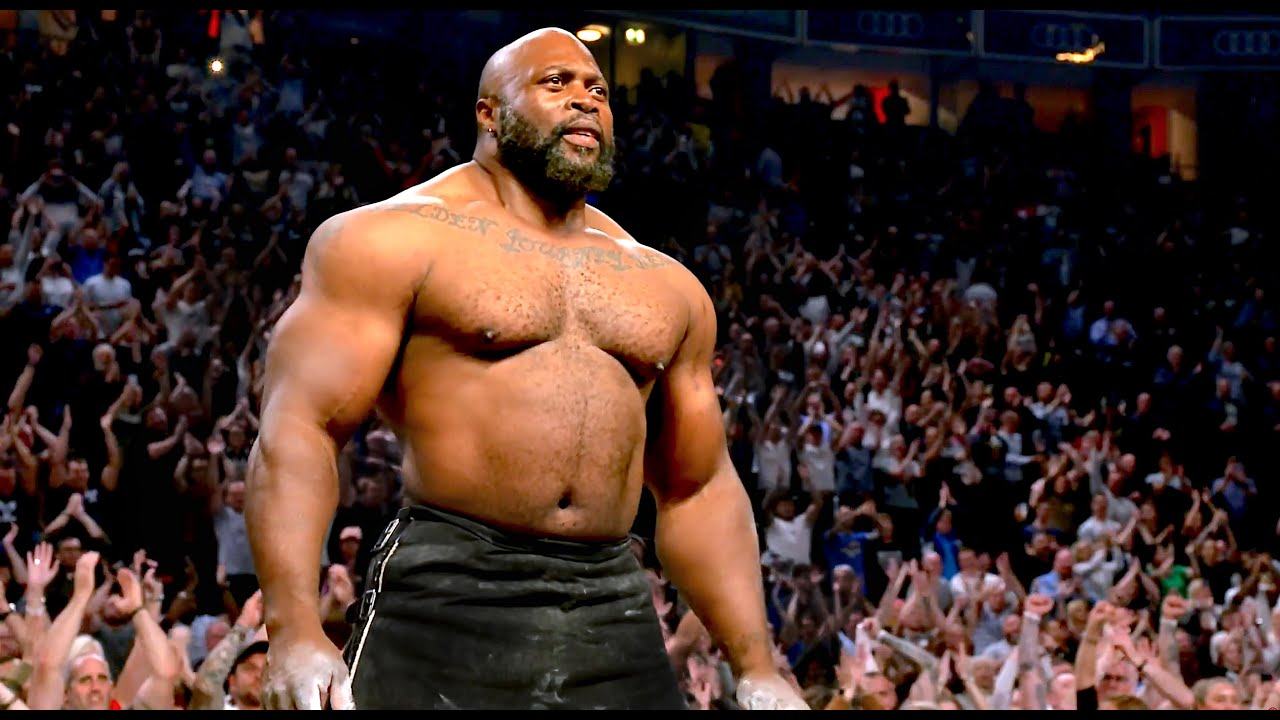
Iron Archives
“The Miracle Man” — a legend of longevity, grip strength and deadlifting
Active athlete
Mark Felix is a Grenadian-born British strongman, born on 17 April 1966 in St. George’s, Grenada, who settled in Lancashire and became one of the defining endurance figures of modern strongman. He did not begin serious weight training until roughly age 26–27, after years working aboard Carnival Cruise Lines, and first entered strongman in 2002. He debuted at World’s Strongest Man in 2004 and eventually reached a record 18 appearances, three finals and a career-best fourth place in 2006. Felix is celebrated above all for extraordinary grip strength and deadlifting: a 420 kg standard deadlift, 509 kg Hummer Tire Deadlift, 515 kg Silver Dollar Deadlift, 146.75 kg Rolling Thunder lift and record-setting performances in the Hercules Hold, Dinnie Stones and Wrecking Ball Hold. His major titles include the 2005 IFSA British Championships, 2015 Ultimate Strongman Masters World Championships, 2016 WSF World Cup India and three consecutive Masters 50+ World’s Strongest Man crowns from 2022 through 2024. Although he ended his World’s Strongest Man career in 2023, he has continued competing in Masters competition and special appearances through 2025 and 2026.
Mark Felix occupies an almost singular position in modern strongman history. He was never crowned World’s Strongest Man, nor did he build his reputation through a decade of overall contest domination. Instead, his career became extraordinary through the combination of three things that rarely coexist: a late entry into elite strength sport, exceptional competitive longevity and a level of grip strength that produced records across several distinct disciplines. Born on 17 April 1966 in St. George’s, Grenada, Felix later settled in Lancashire and represented Great Britain at the highest level. For much of his elite career he also continued working as a plasterer, a physically demanding trade that existed alongside the training and travel required by professional strongman. Strongman Archives records more than a hundred international appearances and a career stretching from the mid-2000s into Masters competition in the 2020s. Most famously, Felix accumulated a record 18 appearances at World’s Strongest Man, reached three finals and finished fourth in 2006, the best WSM placing of his career. Yet those standings tell only part of the story. He remained capable of winning deadlift and holding events beyond age fifty, set major grip records, became the oldest athlete to compete at WSM and continued competing after closing his WSM chapter in 2023.
The nickname “The Miracle Man” therefore feels less like promotional decoration than a description of how his career has been perceived. Strongman is usually unforgiving of accumulated mileage. Heavy spinal loading, overhead work, moving events, awkward objects and repeated maximal efforts reduce the competitive window for many athletes. Felix entered the sport at an age when numerous professionals already have ten or fifteen years of strength training behind them, then remained relevant long enough to compete across several generations. He shared contests with Mariusz Pudzianowski, Žydrūnas Savickas and Phil Pfister, later faced Brian Shaw, Hafþór Júlíus Björnsson and Eddie Hall, and still appeared at World’s Strongest Man in the era of Oleksii Novikov, Tom Stoltman and Mitchell Hooper. His biography is therefore also a compressed history of professional strongman since the early 2000s. He competed through the IFSA split, World Strongman Cup, Giants Live, Strongman Champions League, Arnold events, World’s Strongest Man and Official Strongman Games. Longevity in his case was not merely attendance. The measurable performances remained elite: a 420 kg competition deadlift, a 509 kg Hummer Tire Deadlift in the Strongman Archives database, a 515 kg Silver Dollar Deadlift, a 146.75 kg Rolling Thunder lift, a 92.37-second Hercules Hold and a 140.49-second Wrecking Ball Hold.
Felix’s story began far from specialist gyms, sports-science departments or the professional infrastructure that now surrounds elite strongman. Giants Live features about his life describe a difficult childhood in Grenada. He grew up in a very large family, one of thirteen siblings, and his mother died when he was about two years old. The household was tied to agricultural work and limited resources, and Felix has described an upbringing in which physical responsibilities arrived early. Later biographical interviews have spoken about periods without electricity or running water, walking to school barefoot and completing daily work around the home before sport had any formal role in his life. Recent podcast material has added memories of spearfishing, climbing trees, hunting and helping with building work while still young. Those experiences should not be romanticized as a secret strength program. They were part of the social and economic environment in which he grew up. Still, they matter when examining the work ethic that became visible later. Effort was not introduced to Felix by a coach. Long before barbells and television competitions, labor and physical self-reliance were already normal features of everyday life.
An older interview also quotes Felix describing his father as an exceptionally strong farmer and suggesting that unusual physical strength was visible within the family even without organized sport. The same family narrative contains another recurring theme: longevity. Giants Live has reported that Felix’s grandmother lived to 106, and he has occasionally referred to family history when discussing his own ability to remain strong with age. Such observations need careful framing. There is no public genetic analysis that establishes a simple causal link between his relatives and his athletic durability, and no serious account should reduce two decades of elite performance to heredity. The public record instead points to several interacting factors: a favorable structure for grip, exceptionally large hands, a high tolerance for physical work, decades of continuous activity, pragmatic programming and a willingness to keep learning. Family remained important after Grenada as well. Interviews describe Felix as a family man, married and the father of three children. He once explained that family life was effectively his main hobby because physical work, eating and training sessions that could last three or four hours left little space for much else.
Felix did not come through youth weightlifting, powerlifting or an academy system. In a detailed interview about his longevity, he said that serious weight training began in 1993 while he was working for Carnival Cruise Lines as a bartender. The setting was almost the opposite of a modern performance center. He trained in an improvised crew gym built from pieces of equipment that had been removed from passenger facilities or otherwise became available below deck. When the ship reached port and his work schedule allowed it, he sought out local gyms and continued training. That origin helps explain the self-directed character of his development. Felix learned by doing, by watching other lifters, by experimenting with available equipment and by absorbing useful ideas whenever he encountered them. Years later he would describe strongman as a sport in which athletes constantly learn from one another, rather than attributing his entire career to a single piece of advice. His beginnings fit that philosophy perfectly. There was no complete manual waiting for him. He assembled one over time.
By 1996 Felix was competing in natural bodybuilding while representing Grenada, and he continued in that direction after establishing himself in Britain. Public sources are not fully consistent about the exact chronology of his move. Giants Live has published the version that he moved to England at age 23, while a later interview attributed to Felix states that he moved to the United Kingdom with his wife in 1997. Because 1997 would have placed him around age 31, both statements cannot be literally correct as written. A source-aware biography should not hide that contradiction by choosing whichever date looks convenient. What can be stated safely is that he settled in Lancashire during adulthood, continued bodybuilding and temporarily stepped back from competition when work and the birth of his first son demanded attention. Bodybuilding gave him a foundation of muscular development and dietary discipline, but aesthetics never became the activity for which the wider strength world knew him. His defining career emerged only when he discovered that his raw physical qualities translated even better to a sport in which symmetry did not matter and success was measured by moving, carrying, holding and lifting brutally heavy objects.
Felix has said that his first strongman contest came in 2002 when he stepped in as a replacement for a friend. Other biographical material places the effective beginning of his strongman career in 2003, at roughly 37 years old, while Strongman Archives starts its documented international record in 2004. These dates can be reconciled without forcing one to cancel the others: 2002 represents the initial local introduction, 2003 the point at which strongman became a serious competitive direction, and 2004 the beginning of the internationally archived phase. The speed of progress remains remarkable under any version. In 2004 Felix placed third at England’s Strongest Man and received the opportunity to compete at World’s Strongest Man in Nassau. He did not reach the final, but appearing at WSM so soon after discovering the sport confirmed that his base strength was already extraordinary. In 2005 he continued developing within the IFSA ecosystem during one of the most politically fragmented periods in strongman history. He was runner-up at the IFSA version of England’s Strongest Man and then won the IFSA British Championships, with historical reports crediting him with event victories in the deadlift, Farmer’s Walk and Atlas Stones.
The 2005 British title established the competitive template that would follow him for years. Deadlifting and loaded carries were already obvious weapons, and his Atlas Stone performance showed that he was not merely a static specialist. Overhead pressing, by contrast, would never become his defining strength, and that imbalance influenced many later contest standings. Strongman rewards breadth. An athlete can win a deadlift and still lose enough points on log, axle or technical medleys to fall short of the overall podium. Felix’s career is an unusually clear study of that arithmetic. At event level he could be the strongest man in the field. Across a complete competition he had to compensate for events that suited him less. During these early elite years, his working life remained equally unusual. Rather than immediately becoming a full-time professional athlete, Felix continued working as a plasterer. An interview from the period describes days spent at physical work until late afternoon, followed by food and then three or four hours of training. What would normally be treated as a recovery problem became his routine for years.
World’s Strongest Man 2006 in Sanya, China remains the central reference point when discussing Mark Felix’s best overall championship performance. Phil Pfister won the title, Mariusz Pudzianowski finished second, Don Pope third and Felix fourth. For an athlete who had entered strongman only a few years earlier and was approaching forty, the result was exceptional. Giants Live specifically highlights the deadlift for repetitions, where Felix completed 16 reps and tied Pudzianowski for the event victory. That event captures the kind of strength that would make Felix famous. He was not limited to a single maximal pull. He could repeat heavy work under fatigue and competitive pressure. This mattered because strongman deadlifting appears in many forms: standard bar, axle, car deadlift, silver dollar, elevated pull, frame, repetitions or maximum. Felix gradually became proficient at transferring the same posterior-chain strength and hand security across this family of events.
Fourth place in 2006 did not lead to a WSM title, but neither should it be treated as an isolated spike. Felix returned to the final in 2007 and finished seventh, while collecting important placements at Britain’s Strongest Man, the Strongman Super Series and other international competitions. He was runner-up at Britain’s Strongest Man in both 2006 and 2007 and placed third at the 2007 Mohegan Sun Grand Prix. The second half of the 2000s was the period in which a relatively recent newcomer became a permanent member of the elite field. He did not win every show, but he was good enough in his preferred events to remain dangerous against almost anyone. Beneath the overall placings, something even more important to his eventual legacy was becoming apparent. The grip-strength world was beginning to recognize that Felix’s hands were not merely visually enormous. They were capable of measurable performances that exceeded existing standards.
In 2007 IronMind reported that Felix was preparing to attack the Rolling Thunder record, a one-hand deadlift performed with a thick rotating handle. His wife, Denny, had purchased a handle for training, and the early reports already described unusually large lifts. At the beginning of 2008 Felix converted that promise into an official result. At Mohegan Sun he lifted 301 lb, approximately 136.5 kg, becoming the first athlete to officially break the symbolic 300 lb barrier on the Version 1 implement. He won the Rolling Thunder World Championships in 2008 and successfully defended the title in 2009. This was not simply a footnote to his strongman career. Grip sport has its own standards, implements, rules and record culture, and Felix entered that world as a genuine reference-level performer rather than a celebrity guest.
In 2012 he pushed the Rolling Thunder mark still higher. IronMind officially recorded 146.75 kg, or 323.5 lb, at the Bodypower Expo in Birmingham on the implement version used at the time. Because Rolling Thunder hardware has existed in multiple generations, modern record lists may separate performances by handle version. That context matters. It is more accurate to preserve the equipment history than to pretend that every number belongs to an identical implement. Felix also won the Vice Grip Viking Challenge in 2011 and 2012. At the 2012 edition, IronMind credited him with the inaugural Captains of Crush Silver Bullet Hold record of 43.25 seconds using a No. 3 gripper. These results show why the title “Grip King” cannot be reduced to the televised Hercules Hold. Felix excelled in dynamic and static gripping, on rotating handles, grippers, thick objects and strongman implements. Hand size clearly helped: Giants Live has published a hand span of roughly 13 inches, about 33 cm. Yet hand size alone does not hold a heavy implement for ninety seconds. His record profile also reflects finger strength, thumb strength, wrist stability, forearm endurance, technical positioning and a remarkable tolerance for discomfort.
If grip is Felix’s signature, the deadlift is the language through which he expressed strength most often. Strongman Archives credits him with a 420 kg standard-bar competition best achieved on the European and World Deadlift Championship circuit. At the 2013 Arnold Strongman Classic he pulled 509 kg in the Hummer Tire Deadlift. Giants Live publishes a slightly different figure, 511.5 kg, an example of how databases can diverge through conversion, configuration or historical rounding. For statistical consistency, this profile uses the Strongman Archives figure while noting the discrepancy rather than silently merging the two. At UK’s Strongest Man in 2021 Felix completed a 515 kg Silver Dollar Deadlift, an elevated variation with a shorter range of motion than a pull from the floor. At Fortissimus in 2009 he produced 13 repetitions with 400 kg in an elevated axle deadlift of roughly 18 inches, a performance later cited as an event record. In 2013 at Europe’s Strongest Man he completed 16 repetitions on a side-handle car deadlift with a reported loading around 380 kg.
Those numbers are not mechanically interchangeable. A Silver Dollar Deadlift begins higher, a Hummer Tire Deadlift uses a long flexible bar with different leverage, and a car deadlift changes the pivot point and resistance curve. That variety is precisely why Felix’s profile is so impressive. He was not a one-bar specialist. He could create and maintain tension across a broad family of pulls. His grip gave him an additional advantage when straps were absent or when the event finished with a static hold, but elite deadlifting requires much more than strong hands: spinal erectors, hip extension, hamstrings, trunk pressure, positioning and a high tolerance for axial loading all matter. Felix has publicly reported training lifts around 405 kg without straps, a 350 kg squat and a bench press around 240 kg. These are training figures, not powerlifting competition records, so they should be labeled accordingly. Even with that caveat they demonstrate that his body was not built around one isolated gift. The grip was exceptional, but it sat on top of world-class absolute strength.
In 2010 Felix finished third at Europe’s Strongest Man and third at Giants Live London. Around the same period he added strong results at contests such as the Jón Páll Sigmarsson Classic and the All-American Strongman Challenge. At the Arnold Strongman Classic, historically one of the heaviest static-strength contests in the sport, he placed sixth in 2011 and again in 2013. The Arnold format naturally offered events favorable to a world-class deadlifter, but pressing could restrict his overall ceiling. Strongman Archives records a 165 kg axle press at Giants Live London in 2011 and a 243 kg Manhood Stone at the Arnold that same year. Those performances are useful correctives to the simplistic idea that Felix was only “the man with the giant hands.” He was capable of moving an enormous stone and producing respectable overhead strength. The distinction is relative: his pressing weakness was a weakness compared with the very best overhead athletes in the world, not compared with ordinary strength standards.
This phase also involved injuries and changes in training. Historical reports mention a right biceps tear at the 2008 World’s Strongest Man, and another setback affected his route to WSM in 2012. At different points he experimented with longer conditioning sessions and circuits that combined running, axle clean and press, stone carries, yoke and sandbags. Contemporary reactions from other strongmen reflected how unconventional some of this work looked, because most strongman events are anaerobic efforts lasting well under a minute. Felix was never especially dogmatic about methodology. He tested approaches, retained what helped and adjusted training to the body he had at that stage of his career. That willingness to change is one of the more reasonable explanations for his longevity. He did not insist on being exactly the same athlete at fifty that he had been at forty. Instead, he tried to preserve his dominant qualities, protect vulnerable areas and stay complete enough to remain competitive.
The 2015 season is one of the strongest pieces of evidence that Felix’s career did not simply decline after 2006. At 49 he returned to the World’s Strongest Man final and finished eighth in Putrajaya against a field containing Brian Shaw, Žydrūnas Savickas, Hafþór Björnsson and Eddie Hall. He was runner-up at Britain’s Strongest Man, third at Europe’s Strongest Man and second at the Giants Live Viking Challenge. During the same year he won the Ultimate Strongman Masters World Championships in Belfast. That mixture of Open and Masters results is essential to understanding the period. Felix did not leave elite Open competition in order to dominate an easier category. For years he competed across both levels, using Masters contests as an extension of his schedule rather than a retreat from the main circuit. At Britain’s Strongest Man in 2015 he also produced a 160 kg log lift, the principal competition benchmark listed for his log press.
In 2016 Felix won the WSF World Cup India in Varanasi against a thirteen-athlete international field, finishing ahead of Tarmo Mitt and Mikhail Shivlyakov. He was again second at Britain’s Strongest Man, second at the Giants Live North American Open and runner-up in major Masters competition. He also pulled 420 kg at the World Deadlift Championships / Europe’s Strongest Man circuit, demonstrating that at fifty he could still produce a deadlift firmly inside world-class territory. By this point Felix had also become a crowd favorite because of the contrast between his calm manner and the violence of the weights he moved. He did not cultivate an aggressive stage persona or turn every attempt into a long performance before the lift. The spectacle came from the mismatch between his understated behavior and the object leaving the ground.
In the later part of his career the Hercules Hold transformed Felix from a respected grip specialist into a viral strongman phenomenon. The Giants Live setup typically uses two huge pillar structures, roughly 200 kg each, attached through chains and handles at the athlete’s sides. The competitor does not lift the structures in the traditional sense. He prevents them from falling outward, while the arms, shoulders and entire body are pulled apart under constant tension. Pain builds quickly, turning the event into a contest of fingers, connective tissue, position and concentration. Felix repeatedly improved his own mark, eventually reaching 92.37 seconds at Europe’s Strongest Man in 2020. Giants Live has continued to present that performance as a reference record on its configuration. Videos of Felix in the Hercules Hold have accumulated enormous audiences and introduced casual viewers to the striking idea that an athlete in his fifties could dominate an event against men twenty years younger.
Also in 2020, at Rogue Record Breakers, Felix held replica Dinnie Stones with a combined mass of approximately 333 kg for 31.40 seconds, a performance treated as a world record at the time. The Dinnie Stones carry special cultural weight in strength history because of their connection to Scottish tradition and Donald Dinnie. For Felix, success on the event proved that his hand strength transferred to yet another implement, one using metal rings and a different loading sensation from Rolling Thunder or Hercules Hold. When an athlete excels in only one grip event, highly specific adaptation can explain much of the result. When the same athlete performs at an elite level on Rolling Thunder, Silver Bullet, Dinnie Stones, Hercules Hold, static bar holds and thick-handle carries, the profile becomes broader. Felix possesses one of the most complete combinations of hand strength and grip endurance documented in professional strongman.
In 2021 Felix completed a 515 kg Silver Dollar Deadlift at UK’s Strongest Man. The elevated starting position means it should not be treated as biomechanically equivalent to a 515 kg pull from the floor, but the load remains enormous and illustrates his ability to work with extreme overloads. In 2022 at World’s Strongest Man in Sacramento he added another hold record: 140.49 seconds on the Wrecking Ball Hold with an implement reported at roughly 228 kg. The World’s Strongest Man records page subsequently listed the mark as the world record for the event. Meanwhile his WSM appearance count continued to rise. After debuting in 2004, Felix returned across numerous editions, sometimes narrowly missing the final and sometimes finishing lower in his heat, but regularly producing a memorable deadlift or grip performance. Eventually, the continuity became a record in its own right.
At the 2023 World’s Strongest Man in Myrtle Beach, Felix made his eighteenth appearance, the highest total recorded for an athlete in the contest’s history. Strongman Archives lists him at 57 years and 3 days, making him the oldest WSM competitor and surpassing the previous age benchmark associated with Odd Haugen. Felix did not reach the final, but the meaning of his presence extended beyond the heat standings. The event marked the end of his World’s Strongest Man career. During the same competition, Felix and Brian Shaw received the KNAACK Tools of the Strongman Award, an athlete-voted recognition of work ethic and conduct. For a competitor whose reputation had been built on consistency, understatement and years of combining manual labor with elite sport, the award fitted the larger biography unusually well. Crucially, he was not retiring from all strength competition. He was closing one chapter: WSM.
After fifty, Felix became increasingly visible in Masters competition, but the chronology is much richer than a simple retirement epilogue. He had already won the Ultimate Strongman Masters World Championships in 2015 and finished runner-up in 2016 and 2018. From 2022 through 2024 he won the Masters 50+ World’s Strongest Man division at Official Strongman Games three consecutive times. The 2024 edition in Madison, Wisconsin was particularly convincing. Reports credit him with 72.5 points and four event victories across seven events. He won the Car Walk, won an axle deadlift with 11 repetitions at roughly 290 kg, won the Sandbag Toss and won Atlas Stones. He also placed second on the medley and Wrecking Ball Hold and third on the log. At 58, the resulting performance profile was remarkably complete. He was not simply winning the hold that audiences expected him to dominate. He was taking moving events, repetition deadlifting and stones as well.
Strongman Archives records Felix at the 2025 M50+ OSG European Championships in York, where he finished second overall behind Richard Birchmore and ahead of Žydrūnas Savickas. Felix won the Super Yoke and deadlift events, completing 14 repetitions on a 260 kg axle, and placed second on the log with eight repetitions. That result demonstrates why “retired” requires qualification when applied to him. Retirement from the regular Open international circuit or from World’s Strongest Man did not mean retirement from competition. In 2026 promotional material again placed Felix around major events and special appearances. As of September 2026, “active in Masters and special events” is therefore a more precise description than fully retired, even though some databases and articles use retirement language when referring specifically to his WSM career.
Felix is commonly listed around 1.93 m tall and approximately 140 kg, though bodyweight naturally changed across more than two decades of competition. His hands are the anatomical detail that appears most consistently in profiles. Giants Live has cited a span of about 13 inches, approximately 33 cm, while IronMind was already commenting on the extraordinary size of his hands in the 2000s. Size matters in gripping because a larger hand can close more effectively around thick handles, distribute pressure across more contact area and alter finger angles. But dimensions alone cannot explain the records. A large hand without sufficient finger flexion strength, thumb opposition, wrist stability and forearm endurance does not maintain a Hercules Hold for more than ninety seconds. Felix’s performances also represent neural, technical and connective-tissue adaptation accumulated through decades of work and training.
Felix himself has commented on the apparent durability of grip strength with age, suggesting in interviews that grip can remain exceptionally strong if a person stays active and continues training it. That should be understood as an athlete’s observation rather than a universal physiological law. What can be stated with confidence is that Felix supplied an extraordinary case study: several of his most famous holding records came after he turned fifty. Instead of his signature quality fading with age, grip became even more central to his public identity. Early in the career he was often described as an elite deadlifter with unusually strong hands. Later he became the athlete everyone expected to beat in a holding event, regardless of the age printed beside his name.
Felix has often been described as someone who trains simply and heavily, but interviews across the years reveal more variety than that shorthand suggests. Older material includes periods of low-repetition work after progressive warm-ups, while later accounts describe higher-volume phases, heavy days, static strength, isolation work, loaded carries, conditioning and specific grip training. In a 2020 interview he described training five or six days per week and alternating volume with heavier sessions. That diversification makes sense for an athlete required to remain functional across dozens of event types. Strongman punishes extreme specialization. A program that maximizes the deadlift but destroys yoke speed, shoulder health or the ability to breathe through a loading medley can be a poor program for the overall scoreboard.
Overhead pressing was one of the most obvious weaknesses in Felix’s elite profile. Official Strongman material from 2021 documented work with MST Systems aimed at turning the log press from a liability into a more competitive event. The accompanying description credited the block with a substantial improvement and, just as importantly, renewed technical confidence. This episode reveals another quality behind his longevity: low methodological ego. After nearly two decades in the sport and already beyond fifty, Felix accepted the need to rebuild an event that audiences regarded as a permanent weakness. For performance athletes, that detail is more useful than any slogan about age. Adaptation is not merely the decision to keep lifting heavy. It also means admitting when mobility, technique, timing or a motor pattern must be reconstructed.
One of the most distinctive facts about Felix is that plastering remained a real part of his sporting life. Giants Live and multiple interviews describe him doing construction work in Lancashire while competing at World’s Strongest Man level. As top-level strongman professionalized through sponsorship, specialist coaching, media work and increasingly managed recovery, Felix retained something of the older model: go to work, finish the day and then train. Physical labor should not be romanticized as an automatic advantage. It adds fatigue, uses recovery capacity and reduces the time available for sleep, mobility and treatment. That is exactly why his ability to combine the two for so long is unusual. Felix has also said that work helped him psychologically by keeping his mind away from the emotional highs and lows of competition.
Public sources describe him as married to Denny and the father of three children. IronMind published comments from Denny on several occasions about his training and record attempts, including the early Rolling Thunder period. Felix has identified family as a major source of support and once described family life as his principal hobby. His public dietary comments have generally been practical rather than theatrical. At different points he has described regular meals every two or three hours, simple breakfasts such as Weetabix and milk, extra protein when traveling and a preference for eating sensibly rather than presenting an exotic nutritional doctrine. As with any athlete whose interviews span more than twenty years, these accounts should be read as snapshots from specific periods, not as evidence that one rigid menu was followed every day from 2004 to 2026.
There is no need to speculate about Felix’s private psychology in order to describe a visible competitive style. Video, interviews and promoter profiles consistently show an understated athlete, economical with gestures and rarely dependent on theatrical intensity. Giants Live has described him as unassuming, and peers have repeatedly emphasized the quiet way he goes about work. In grip events that calm becomes part of the spectacle. The body appears relatively still while the clock advances and other competitors fail. On deadlifts his approach is also usually direct rather than ritual-heavy. Calm behavior should not be confused with low intensity. Felix built much of his career in events where pain tolerance and concentration are decisive. In the final seconds of a ninety-second hold, every additional second is an active negotiation between burning forearms, slipping fingers and the decision to maintain position.
Across interviews Felix has returned to simple themes: stay active, continue trying to improve and do not automatically treat age as an explanation for decline. Those comments matter more when read alongside his behavior than as generic motivation. He did not merely repeat that age was “just a number.” He kept entering Open contests after fifty, kept doing physical work, accepted new coaching and repeatedly tested his strongest quality in public. At the same time, his biography should never be converted into an argument that anyone can reproduce his longevity by attitude alone. Felix is an outlier. The more realistic lesson is that age-related limits in strength sport are influenced by structure, injury history, recovery, event selection, motivation, skill and adaptability as well as chronological age.
Evaluating Felix accurately requires avoiding both understatement and mythology. His strongest events were genuinely exceptional: maximal and repetition deadlifts, grip, static holds, challenging-handle carries and, during many periods, stones and frame work. In some of these disciplines he could beat world champions outright. The most consistent limitation was overhead strength relative to the absolute elite, especially in an era containing Savickas, Hall, Shaw and other extraordinary pressers. Certain technical moving events and medleys could also cost points. World’s Strongest Man is not won by possessing the best single event. It is won by minimizing weak events across an entire final. Felix’s signature strengths were so dramatic that they dominate public memory, but the scoreboard punishes even two or three low finishes.
His fourth place in 2006 shows how close the overall package could come when the event selection and his form aligned. Finals in 2007 and 2015 demonstrate that the result was not an accident. Yet comparisons with multiple WSM champions must be made across the full event profile. Savickas could win overhead events while remaining formidable on the deadlift. Pudzianowski combined exceptional movement speed with sufficient static strength. Shaw and Björnsson built extremely complete packages around massive frames. Felix was more specialized. But that specialization reached such a high level that it produced records surviving generational changes. Strongman history has room for both forms of greatness: the athlete who collects overall titles and the athlete who permanently moves the standard of an individual discipline.
The record of eighteen World’s Strongest Man appearances is the statistic most easily understood by a general audience, but Felix’s legacy is broader. He demonstrated that an athlete can enter strongman late and still reach the world elite, that grip strength can become a discipline with its own identity, and that a strongman career does not automatically end in the early forties. He connected the television strongman culture of the 2000s with the social-media era in which a Hercules Hold clip can reach tens of millions of viewers. He competed across Europe, North America, Asia, Africa and other regions, surviving changes in rules, promoters, equipment and competitive formats. His career contains several overlapping identities: Open international strongman, deadlift specialist, elite grip athlete, Masters champion and special-event attraction.
By 2026, with Felix approaching sixty, the fact that his name still appears around major strongman promotions says much about his impact. Audiences are not interested only through nostalgia. They watch because the possibility of another exceptional grip performance still feels plausible. That may be the most accurate summary of the career. Felix took one obvious natural advantage, enormous hands and unusual grip potential, developed it into a highly refined competitive skill, combined it with elite deadlifting and preserved the broader physical system well enough to use it for more than two decades. “The Miracle Man” is a dramatic nickname, but the actual history is built less from miracles than from continuity.
This profile is built by cross-checking Strongman Archives, Giants Live, World’s Strongest Man, IronMind, Official Strongman, press interviews and podcast appearances by Mark Felix. Strongman Archives is used as the principal statistical base for contest totals, WSM appearances and many event results because it offers consistent athlete-to-athlete structure. Giants Live is used for biography, circuit records, physical data and competitive context. IronMind is the primary authority for the Rolling Thunder and Silver Bullet material, while World’s Strongest Man is used for official WSM record material. Personal history and early-career details rely on interviews in which Felix or people close to him are quoted directly. Where sources disagree, the profile states the discrepancy rather than concealing it. The clearest examples are the exact year of his move to Britain, slightly different converted values for the Hummer Tire Deadlift, and his current status, which can be labeled “retired” in reference to WSM/Open competition even though he has continued in Masters and special appearances.
Key source families include the Mark Felix athlete record in Strongman Archives; the Mark Felix profile and feature articles published by Giants Live; the World’s Strongest Man world-records archive; IronMind’s historical reporting on Rolling Thunder, the Vice Grip Viking Challenge and Silver Bullet; Official Strongman training and Masters coverage; long-form interviews about Felix’s longevity and working life; reports from the 2024 Masters 50+ World’s Strongest Man; and podcast conversations that add context about Grenada, cruise-ship work and the years before strongman. Statistical fields and current status are updated through September 2026. Events announced for October 2026 are treated only as scheduled appearances and are not counted as completed achievements before they actually occur.
Iron Hall data
420 KG
Max Deadlift — competition · Achieved on the international circuit; recorded at Europe’s Strongest Man / World Deadlift Championships
Verified
509 KG
Hummer Tire Deadlift · 2013 Arnold Strongman Classic
Verified
515 KG
Silver Dollar Deadlift · 2021 UK’s Strongest Man; elevated deadlift
Verified
160 KG
Max Log Lift · 2015 World Log Lift Championships / Britain’s Strongest Man
Verified
165 KG
Max Axle Press · 2011 Giants Live London
Verified
146.75 KG
Rolling Thunder · Official world record set at the 2012 Bodypower Expo on the implement version used at the time
Verified
200 KG / HAND
Hercules Hold · Two approximately 200 kg pillars; 92.37 seconds at 2020 Europe’s Strongest Man
Verified
228 KG
Wrecking Ball Hold · 140.49 seconds at the 2022 World’s Strongest Man
Verified
333 KG
Rogue Replica Dinnie Stones Hold · 31.40 seconds at 2020 Rogue Record Breakers; former world record
Verified
243 KG
Manhood Stone / Max Atlas Stone · 2011 Arnold Strongman Classic, over an approximately 4 ft bar
Verified
400 KG
18-inch Axle Deadlift — for reps · 13 repetitions at 2009 Fortissimus
Verified
380 KG
Car Deadlift — for reps · 16 repetitions at 2013 Europe’s Strongest Man; side handles
Verified
330 KG
Deadlift Static Hold · 58.00 seconds without straps, 2008 Mohegan Sun Grand Prix
Verified
78 KG / HAND
Double Thomas Inch Dumbbell Farmers Walk · 39.03 m with 78 kg in each hand in 2024
Verified
227 KG
Apollon’s Axle Deadlift — double overhand · 2016 Ultimate Strongman Masters
Verified
350 KG
Squat — training · Publicly reported training best
Verified
240 KG
Bench Press — training · Publicly reported training best
Verified
405 KG
Deadlift without straps — training · Publicly reported training best without straps
Verified
2004
One of the first major results of his strongman career.
3rd place
2004
First WSM appearance, in Nassau, Bahamas.
Debut / qualifying round
2005
Major national title; won multiple events including deadlift, Farmer’s Walk and Atlas Stones.
Champion
2006
2nd place
2006
Career-best WSM finish; tied for the deadlift-for-reps win after 16 repetitions.
4th place
2007
2nd place
2007
Second consecutive WSM final.
7th place
2007
3rd place
2008
Broke the 300 lb barrier and set a 301 lb record on the V1 handle.
Champion
2008
4th place
2009
Successfully defended his grip world title.
Champion
2009
2nd place
2009
International victory in Accrington, England.
Champion
2010
3rd place
2010
3rd place
2011
6th place
2011
Major grip-sport title.
Champion
2012
Won again and set the inaugural 43.25-second Silver Bullet record.
Champion
2012
Official record set at the Bodypower Expo in Birmingham.
146.75 kg
2013
Recorded a 509 kg Hummer Tire Deadlift.
6th place
2015
2nd place
2015
Third and final WSM final of his career.
8th place
2015
3rd place
2015
Masters world title in Belfast.
Champion
2016
Victory in Varanasi against a 13-athlete international field.
Champion
2016
2nd place
2016
2nd place
2016
2nd place
2018
2nd place
2019
3rd place
2020
92.37 seconds after repeatedly improving his own record.
World record
2020
Held 333 kg for 31.40 seconds.
World record at the time
2022
First of three consecutive titles.
Champion
2022
140.49 seconds with approximately 228 kg.
World record
2023
Became the oldest WSM competitor at 57 years and 3 days.
18th and final WSM appearance
2023
Champion
2023
Athlete-voted recognition for work ethic at WSM; also awarded to Brian Shaw.
Special award
2024
Third consecutive title; four event wins in the final.
Champion
2024
Continued competing in the Open division at age 58.
9th place
2025
Won the yoke and deadlift events; 14 reps on the 260 kg axle deadlift.
2nd place