2009
U105 Strongman World Championships, Kyiv
Third of 12. IronMind published the official podium for the December 2009 under-105 kg world contest.
3rd / under-105 kg world bronze
Lithuanian champion, Strongman Champions League winner and world team champion
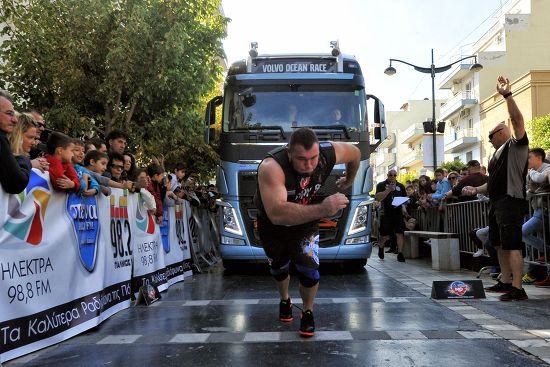
Marius Lalas is a Lithuanian professional strongman, born on 23 December 1985, known for combining substantial static strength with efficiency in loaded moving events. The brother of fellow strongmen Vytautas and Mantas Lalas, he competed in both the under-105 kg division, taking world bronze in 2009, and the Open class. He won the 2015 Strongman Champions League Austria and Savickas Classic contests, competed at the 2018 World's Strongest Man, shared the 2018 World Team Strongman title with Vytautas, and won Lithuania's Strongest Man in 2019. His notable events include Shield Carry, Super Yoke and loading medleys. Away from competition, he is associated with Top Performance Fitness in Kilkenny, Ireland. Strongman Archives documents appearances from 2008 to 2023; later contest activity was not confirmed in the sources reviewed.
Marius Lalas belongs to the Lithuanian strongman generation that helped connect an unusually deep national competition system with the Strongman Champions League, Giants Live, and Europe's major strength arenas. Born on 23 December 1985 according to Strongman Archives, he is known for winning two SCL competitions in 2015, competing at the 2018 World's Strongest Man, sharing the 2018 World Team Strongman title with his brother Vytautas, and becoming Lithuania's Strongest Man in 2019. At approximately 1.78 metres and around 132 kilograms in the Open division, he was comparatively compact alongside many international opponents. Those physical measurements, however, reveal only part of the story. Earlier in his career he was internationally competitive in the under-105 kg division, taking world bronze in 2009, before producing significant performances in unrestricted competition. His documented strengths include shield carrying, the super yoke, loading races and demanding deadlift events.
A complete account of Lalas's career needs to follow several connected but distinct stories. The first is his sporting progression from regional Lithuanian events and under-105 kg championships to international Open competitions. The second is the development of an effective competition profile built around moving events while retaining sufficient static strength to score well across varied formats. The third is his family background: Vytautas Lalas, an Arnold Strongman Classic winner and World's Strongest Man runner-up, and their younger brother Mantas have their own histories in strength sports. The fourth is his professional activity away from international contest platforms, including his association with Top Performance Fitness in Kilkenny, Ireland. These themes belong together, but Marius's results should never be conflated with those of his brothers. Their 2018 team victory is a shared achievement precisely because their individual records remain separate.
Lithuanian local reporting provides valuable background to a family whose members became prominent in strength sports. In a 2019 interview published by Būdas, Adelė Lalienė, the athletes' mother, discussed the family's four children: daughter Brigita and sons Vytautas, Marius, and Mantas. Their family roots are in the Mažeikiai and Laižuva area of north-western Lithuania. She described the emotional importance of seeing her sons return from abroad for competitions and family visits. The article reported that Vytautas and Marius had settled in Ireland, whereas Mantas was still closely connected to the family home in Lithuania. These details help place Marius within a genuine family story of migration, sport, and continued personal ties. They do not, however, provide a complete account of his childhood or establish the precise date on which he moved from Lithuania to Ireland.
An earlier family article, published by Santarvė in 2013 and subsequently circulated more widely, described the importance of work and discipline in the household. Their mother reflected on how the brothers combined sporting ambitions with practical occupations. In that dated interview, she also stated that Vytautas and Marius neither smoked nor drank alcohol. This can be reported as a family statement made in 2013, not presented as an independently verified description of the men's current personal habits. Such distinctions are central to responsible biography. Unlike competition results, family recollections supply context from a particular person's perspective at a particular moment. They are valuable for understanding the environment in which the athlete developed, but they must not become a licence to invent intimate details, motivations, or conversations that were never made public.
According to the 2013 Lithuanian family report, both Marius and Vytautas completed studies at Klaipėda University while developing occupations outside professional competition. At the time, Vytautas was reported to be based in Ireland, whereas Marius remained in Klaipėda and was involved in a sports club. This matters chronologically because Marius's later Irish business activity should not be projected backward over every phase of his career. A subsequent family interview in 2019 stated that both brothers had established themselves in Ireland. Public Irish company records identify Lalas Brothers Limited, incorporated on 22 September 2014 and associated with Top Performance Fitness in Kilkenny. Together, these independent sources show professional activity across Lithuania and Ireland. They do not establish Marius's precise academic specialisation, the day of his relocation, his personal shareholding, or the internal allocation of duties within the business.
The relationship between a training facility and a strongman's professional life is worth examining without resorting to unsupported assumptions. A facility associated with competitive strength athletes can provide access to robust equipment, regular practice, and a community familiar with demanding resistance exercise. Public reviews and accounts about Top Performance Fitness identify both Marius and Vytautas as directly involved with the club and its members. Such customer statements confirm an ongoing public association, although they are personal experiences rather than an independent business audit. For Marius, the broader point is that competition and practical work in the fitness industry developed alongside each other. Prize money and competition appearances were not the only publicly visible dimensions of his career. His professional story also includes managing the everyday realities of sport and fitness outside the international arena.
Strongman Archives records competitive appearances for Marius Lalas beginning in 2008. In 2009 his schedule already included two different competitive contexts: Lithuanian Open events and international under-105 kg contests. That distinction matters. A performance achieved in a weight-limited division cannot simply be reclassified as an Open performance because the athlete subsequently gained bodyweight. Conversely, results in an Open field should be judged by the competitors and equipment present at that specific event, not by the weight restrictions of an earlier stage of the same athlete's career. In the summer of 2009, IronMind's reporting identified Marius among the notable performers in under-105 kg strength competitions. The contemporary coverage gives this early phase a firmer historical basis than retrospective assumptions about when he first became strong or how quickly he developed.
At the 2009 World Record Breakers competition in Finland, IronMind credited Lalas with a notable under-105 kg Atlas Stones record. The series consisted of five stones weighing approximately 100, 120, 140, 160, and 180 kilograms, moved under an event-specific arrangement and loaded to a 120-centimetre platform. His reported time was 26.31 seconds. The technical details are important: this is not interchangeable with a maximum single-stone lift, an unlimited Open division result, or a modern series employing different carry distances and platform heights. Within its proper context, however, it is an exceptional early indication of the skill that would continue to appear in his loading performances. Handling stones efficiently requires an effective pick, a controlled transfer of the load, precise positioning and the ability to maintain speed as fatigue accumulates.
In December 2009, Marius finished third at the under-105 kg World Strongman Championship in Kyiv. IronMind's contemporary results placed Vitaliy Gerasimov first on 70 points, Mykhailo Melnikov second on 68, and Lalas third on 64. The programme contained seven events and required athletes to demonstrate pulling power, pressing ability, moving strength, endurance and technical loading skills. A world podium in such a contest was an important achievement in its own right, not merely a preliminary chapter before Open competition. It also shows that Marius had reached an international competitive level well before the two SCL titles that later drew wider attention. Any accurate career summary should therefore include both the weight-limited podium and the much later Open results.
Marius continued to develop through Lithuania's demanding domestic competition system. Strongman Archives lists sixth place at the 2010 Lithuania's Strongest Man final, fifth in 2011, fourth in 2013 and national runner-up status in 2014. In parallel, he took part in a substantial number of regional stages, recording podium finishes across different Lithuanian towns. Those events are easy to overlook in biographies concentrating exclusively on the best-known international stages, but they formed a practical foundation for athletes preparing to compete across diverse equipment and scoring formats. A domestic contest could offer a yoke race, a pulling event, stones, a log lift and an unusual implement on the same afternoon. Such repetition gave Marius experience beyond the more predictable movement patterns of standard barbell strength competition.
Open competition did not simply mean lifting bigger weights. It required him to develop a competition profile capable of producing points against physically larger opponents and specialists in different events. His results increasingly demonstrated efficient moving strength, strong deadlift performances for repetitions, and an ability to handle unconventional implements. They also revealed normal limitations: one event could produce an excellent placing while another prevented him from reaching the overall podium. This is the defining challenge of strongman. A contest rewards cumulative performance, not a hypothetical ranking of raw strength. The national results between 2010 and 2014 therefore show the gradual preparation for his later victories much more accurately than a story in which an unknown athlete suddenly emerged at the top of an international circuit.
The 2012 Strongman Champions League event in Vladivostok provided one of Marius's first notable Open international podiums. He finished third behind Mikhail Koklyaev and Johannes Årsjö. Contemporary IronMind coverage recorded sixteen repetitions in the car deadlift and a win in the four-keg loading race, completed in approximately 27.5 seconds. This combination of repetitive pulling strength and fast object handling helps explain his later success. It does not establish that he was equally proficient in every event on the programme; rather, it identifies strengths that were beginning to recur across seasons. The Russian podium also matters historically because it placed Marius against established international athletes, expanding his experience beyond domestic competition and the earlier under-105 kg field.
Results from Lithuanian stages in the same period provide additional technical context. His recorded efforts included a 110.54-metre Shield Carry and competitive car deadlift and loading performances, although equipment and regulations varied between contests. These numbers should never be treated as direct equivalents to a standard powerlifting deadlift, an absolute carrying world record or a promise of an identical performance on a different day. They do demonstrate the range of demands Marius was learning to manage. The year also brought exceptional visibility to the broader Lalas family because Vytautas finished runner-up at World's Strongest Man. Marius's own third place in Russia and domestic performances remain distinct achievements; their value does not depend on being attributed to his better-known brother.
During 2013, Lalas continued to compete across Lithuanian regional events, including contests in Gargždai and Telšiai. Recorded performances from the period include a 160 kg maximum log lift in one Lithuanian competition and a 150 kg axle press in another. These are historical contest results, not proof that they represented his all-time gym maximums. The repeated domestic appearances are themselves important. They provided varied equipment, different competitors, regular technical exposure and a setting in which consistency mattered as much as occasional exceptional lifts. His international profile was developing within this broader competitive routine rather than separately from it.
The 2014 season brought stronger international results. Marius finished second at SCL Finland, fifth at SCL Holland, fourth at SCL Romania, ninth at Savickas Classic and second at Lithuania's Strongest Man. At the Finnish event, IronMind reported that Hafþór Björnsson won with 58 points, Lalas followed with 55 and Rauno Heinla finished on 53.5. In the 350 kg deadlift for repetitions, Marius shared the event lead with Heinla and Jean-François Caron after each completed eight repetitions. He also performed competitively in a frame-carry and sandbag-loading combination, finishing close to Björnsson's time. These details describe an athlete capable of challenging international opponents both in heavy pulling and in the dynamic events that would become particularly closely associated with his name.
One of the defining individual performances of Marius's career came at the 2014 Savickas Classic in Vilnius. According to contemporary IronMind reporting, he carried a 185 kg shield for 122.75 metres, setting what the publication described at the time as a world record for the event. The date qualifier is essential: an achievement reported as a record in 2014 should not automatically be presented as the standing record in 2026. The performance itself remains significant. Shield Carry combines an awkward initial pick, sustained trunk tension, substantial breathing restrictions and the need to keep moving despite mounting fatigue. Lalas covered a remarkable distance with an object heavy enough to make both posture and momentum critical. Although he finished ninth overall at that Savickas Classic, his shield performance was a prominent result in the history of that particular event.
Marius also has a direct connection with Romanian strongman history. On 20 September 2014, he contested Strongman Champions League Romania in Sibiu and finished fourth overall. His recorded results included a win in the deadlift for repetitions and second place in Atlas Stones, loading four stones from a series reaching 190 kg in 15.56 seconds. The programme also included frame carry, log lift, front hold and bus pull. The variety explains why a competitor could lead individual events without necessarily winning the entire contest. That same broader season had already seen Marius take the Lithuanian national runner-up position and score strongly in shield carrying and farmer's walk. His Sibiu appearance remains a useful reference point for audiences following connections between Lithuanian and Romanian strength competitions.
On 12 September 2015, Marius Lalas won Strongman Champions League Austria in Kufstein with 74 points, narrowly defeating Poland's Krzysztof Radzikowski, who accumulated 73.5. The margin tells the story of a multi-event competition in which each placing could change the final outcome. Lalas won the super yoke in 12.14 seconds and the loading race, placing four 100 kg kegs in 26.61 seconds. He was second in arm-over-arm pull with 38.73 seconds and collected enough further points in deadlift, dumbbell press and farmer's walk to protect his lead. Rather than relying on a single outstanding effort, his title came from combining event victories in his established areas with adequately competitive performances everywhere else. It was a major individual international success against a sizeable field.
The Austrian win was the high point of a longer sequence, not his first competition of the year. In January he had finished fourth at SCL Norway, a winter event whose natural-stone and loading programme created additional difficulties in snow and ice. IronMind's account discussed a combined farmer's walk, natural stone and log loading challenge, describing the difficulty of completing the course under those conditions. Moving from a fourth-place winter finish to a major title later in the season required continued competition exposure. The Austrian contest also demonstrated the practical value of a consistent scoring profile. The athlete who won the greatest number of visually spectacular individual moments was not automatically guaranteed the overall title; the final total of 74 to 73.5 was determined by the sum of all six events.
Just a few weeks after Kufstein, Marius recorded another important international victory on home soil. On 4 October 2015, he won the SCL Savickas Classic in Vilnius with 66 points, ahead of Grzegorz Szymański and Jean-François Caron. A major title in Lithuania carried a particular sporting significance because it brought international competitors into the country's established strength environment. Lalas won the super yoke, Shield Carry and Loading Race, and placed second in the overhead medley. He carried the shield for 103.9 metres and completed four implements in the overhead event, including 105 kg dumbbell lifts, in a time of 27.31 seconds. The result was a comprehensive victory earned across the programme. It did not constitute another world record, nor does it mean that Marius led every event. It illustrated how reliably his strongest disciplines could contribute to overall success when supported by competent performances in the remaining tests.
The same weekend brought an instructive contrast. Marius competed at the MHP World Log Lift Championships in Vilnius, lifting 170 kg and finishing eighth. Winning an all-round strongman contest did not make him the strongest specialist in a single maximum-overhead event, and the two results should not be merged. His season subsequently culminated in participation at the Strongman Champions League World Finals in Turkey in December. IronMind described the final as drawing ten selected competitors from a circuit of fifteen international stages, and Lalas finished sixth overall. His year therefore included two SCL titles, specialist competition exposure and a place at the circuit's final. It remains the strongest single season in his documented individual international record, while his later career would add major team and national victories of different kinds.
After the success of 2015, Marius remained competitive within Strongman Champions League. On 11 June 2016 he took third place at SCL Holland in a field of fourteen athletes. Recorded performances included loading five Atlas Stones in 36.15 seconds and completing nine repetitions in dumbbell press, good enough for second in that particular event. These details complicate the notion that he was exclusively a moving-event specialist. He could score well at stones, overhead pressing and other tests, although any comparison of repetitions depends on the exact implement, time limit and regulations used. Competition reports are most useful when they preserve these specifics rather than transforming isolated numbers into unexplained personal records.
At the 2016 Europe's Strongest Man contest in Leeds, Lalas completed a 420 kg maximum deadlift. He then placed third in the frame carry, but an injury interrupted his participation before the end of the contest. The official overall table lists him ninth. That placing describes the published classification, but it does not represent a full five-event performance because he could not finish the programme. The sources reviewed are sufficient to report his deadlift, frame result and competition withdrawal, but not to establish the injury's precise clinical diagnosis or a complete rehabilitation timeline. Responsible sporting biography records what happened in the contest without building a speculative medical narrative around an athlete's health.
Marius's only World's Strongest Man appearance documented by Strongman Archives came in 2018, when the competition was held in the Philippines. His qualifying group featured Hafþór Júlíus Björnsson, Matjaž Belšak, Laurence Shahlaei, Peiman Maheripour and Rob Kearney. Björnsson ultimately won that year's overall title, which provides useful context for the strength of the group. Lalas scored competitively at Circle of Strength and in the squat series, completing seven loads ranging from 270 to 360 kg in 28.92 seconds and taking second in the group on the squat event. He also produced a strong arm-over-arm pull performance. These results show that he could challenge celebrated Open athletes in specific tests, but qualifying for the final required more than accumulating several impressive individual placings.
The 2018 qualifying format sent each group's leader directly into the final. The athletes placed second and third then contested a direct Atlas Stones challenge to decide the remaining finalist. Marius reached this decisive head-to-head against Matjaž Belšak. The published results record five completed stones for Belšak and three for Lalas, ending Marius's attempt to reach the final. He therefore finished third in his heat and was not a World's Strongest Man finalist. That distinction is vital in a factual athlete database: competing at WSM, reaching the qualifying stones duel and appearing in the final are three separate achievements. His performance deserves accurate recognition without an inflated final placement or an invented second WSM appearance.
Later in 2018, Marius and Vytautas achieved a major collective result at the Ultimate Strongman World Team Championships in Britain. They won the world team title against an international field that included Martins Licis and Trey Mitchell, as well as Phil Roberts and Tom Stoltman. A contemporary report by Starting Strongman described difficult weather and a programme demanding genuine cooperation rather than two independent performances added together. The events included carrying a Husafell-style stone, lifting a two-man log, completing car deadlifts for repetitions and additional holding or moving tasks. Two-athlete formats pose unusual challenges. Competitors must coordinate transitions, anticipate each other's tempo, share tasks efficiently and adapt their technique to the limitations and strengths of their partner. The Lalas brothers' win therefore belongs in a separate category from either man's individual titles.
In the car deadlift, the two brothers completed a combined thirty-one repetitions, equalling the mark reported for the Hadge brothers at that event. The final standings confirmed victory for the Lithuanian pair ahead of several established combinations. Shared family experience may have supported their coordination, but it would be speculative to assert that they followed identical training programmes or that every decision in the competition had been rehearsed in advance. What can be verified is the event outcome and their participation as a team. For Marius, the title added a world-level collective accomplishment to an individual record already containing a world under-105 kg medal and multiple SCL results.
On 28 September 2019, Marius became Lithuania's Strongest Man in Marijampolė with a total of 61 points. Martynas Brusokas followed on 51, while Marius's brother Mantas placed third on 47. This result had both sporting and family significance: two Lalas brothers reached the same national podium, with Marius taking the title after more than a decade of documented competition. It was not his first important success, since his under-105 kg world podium, international SCL wins and WSM appearance had already established a substantial career. The national victory was instead another stage of that longer progression and a particularly clear demonstration of his competitiveness in a full domestic Open championship.
The detailed results show why his 2019 victory was convincing. He won an overhead medley involving three repetitions with a 140 kg axle and three with a 150 kg log, completing all six lifts in 39.06 seconds. He also won the sandbag toss, sending five bags from a 12.5–22.5 kg series over the target in 15.35 seconds. Further points came from second places in loading race, a 300 kg squat for three repetitions and front hold, plus third in tractor pull. A yoke, duck walk and tire flip medley produced a less impressive result. The championship was therefore not the product of flawless dominance in every discipline. Marius accumulated points across very different movement patterns and converted his event victories into a sufficiently large overall margin.
On 4 September 2021, Marius returned to Europe's Strongest Man in Leeds, finishing joint fifth overall with 28 points. His signature achievement was winning the 200 kg Shield Carry with a distance of 54.2 metres. Giants Live shared footage of the performance, and the recorded event results confirm the weight, distance and placing. The win carried historical continuity because Lalas had produced a reported world record in the same general event family in 2014, carrying 185 kg for 122.75 metres. These performances must not be compared as though they occurred under identical conditions. The implement weights differed, the competitive field had changed, and different contest regulations can alter pacing and technique. They do, however, establish that the same broad athletic strength remained evident across widely separated seasons.
His remaining 2021 results offer an equally important picture of variation. Lalas finished third in deadlift for repetitions, fourth in Car Walk and seventh in Atlas Stones after completing five stones in 24.76 seconds. At maximum log lift he recorded no successful attempt under the event's rules. His eventual overall position reflects that uneven distribution of points. The Shield Carry victory and strong pulling and moving placings partly compensated for the lost points overhead, but they could not automatically produce a general podium. The result is a useful case study for readers learning how strongman championships reward combined performance. It also confirms that, years after his international SCL titles, Marius remained capable of winning an event at a major European competition.
Marius finished eighth at the 2022 Europe's Strongest Man. That edition included maximum log lift, a deadlift ladder, carry and drag, power stairs and Atlas Stones. Archived performances record 170 kg in the log lift, four completed weights in a five-lift deadlift ladder rising from 300 to 400 kg, and a 32.67-second time on Power Stairs. The 170 kg result is a confirmed competition lift; it should not be presented as conclusive evidence of his highest-ever training lift. Similarly, completing four implements on a timed deadlift ladder is not the same measurement as a single maximum deadlift. Those distinctions help preserve the technical usefulness of a records database and prevent impressive but incompatible figures from being placed side by side without context.
Strongman Archives then lists him as winner of a Lithuanian federation stage held at Mažeikiai on 3 June 2023. He won the super yoke, took second in deadlift, log lift and tractor pull, and finished third in frame carry against a field of ten athletes. This is the latest competition appearance found in the archive used for the present profile. It is not proof of an official retirement, nor does it guarantee the absence of unrecorded later events. Accordingly, the career interval is described as documented appearances from 2008 to 2023 rather than a definitive start and retirement period. Future verified results, should they become available, can be added without rewriting the interpretation of the earlier career.
The detailed results across Marius's career support a recurring observation: he repeatedly excelled at events involving carrying heavy objects or moving implements quickly. Super Yoke, Shield Carry, Farmer's Walk and Loading Race appear regularly among the tests in which he won or collected significant points. He won the yoke and loading events at the 2014 SCL Holland contest and produced his historic shield distance later that season. His two international titles in 2015 depended substantially on carrying and loading victories. Years later, the 200 kg shield win at Europe's Strongest Man 2021 showed that this general strength remained part of his competitive identity. These conclusions are drawn from results rather than attributed to a personal statement by the athlete. Public contest records reveal outcomes, but they do not supply a complete psychological portrait or a precise training methodology.
His heavy pulling results are equally relevant. Eight repetitions with 350 kg in Finland in 2014, a 420 kg maximum deadlift in Leeds in 2016, and repeated competitive placings in deadlift events demonstrate substantial static strength in addition to moving ability. Overhead events display a more variable pattern: a successful mixed-implement medley at the 2019 Lithuanian championship, documented 170 kg log lifts, and an unsuccessful maximum-log event in the 2021 European contest. It would be misleading to describe him as unbeatable in every moving event or uniformly poor at every overhead challenge. Strongman performance is affected by the exact implement, fatigue, event order, training emphasis and regulations. The documented results support a balanced profile with especially repeatable strengths in loaded movement and sufficient static strength to win complete international competitions.
The super yoke is not merely a demonstration of the ability to stand beneath a heavy weight. An athlete must pick up the frame, limit oscillation, stabilise the trunk and accelerate along a set course without losing direction or balance. Shield Carry changes the loading pattern by placing a large object in front of the torso, increasing the importance of grip position, breathing control and an efficient walking rhythm. A loading race adds fast transitions between running, picking up implements and depositing them onto a platform. These requirements explain why an athlete with the highest barbell deadlift does not automatically win every moving event. Marius's results show that he repeatedly performed well in these demanding tasks. They do not establish exactly which assistance exercises, coaching methods or weekly routines he preferred without a verifiable training log.
Context is essential when comparing his best-known results. The reported 122.75 metres with a 185 kg shield in 2014 and the 54.2 metres with a 200 kg shield in 2021 used different event loads. His 2014 400 kg yoke time of 9.63 seconds over twenty metres belongs to a specific competition with its own frame construction, course and timing method. None of these figures can reliably be extrapolated to every competition employing a similar nominal weight. Starting technique, surface characteristics, centre of mass and the stability of an implement can dramatically change difficulty. Preserving those details does not diminish the achievement; it makes it possible for future readers, athletes and historians to understand what the results actually describe.
Marius's connection to Ireland is supported by several publicly available records rather than by a single unsourced biographical claim. Lithuanian reporting placed him in Klaipėda in 2013, when he was involved in a sports club. In a 2019 family interview, his mother reported that both Marius and Vytautas had by then settled in Ireland. Irish company information identifies Lalas Brothers Limited as a business incorporated on 22 September 2014 and associated with Top Performance Fitness in Kilkenny. The combination of these sources establishes a professional trajectory across two countries, but it does not reveal the exact day of his move or all the internal details of the company. It would be inappropriate to speculate about private finances, personal wealth, the number of employees or the division of ownership without specific verified documentation.
Public reviews and information about Top Performance Fitness describe both brothers as closely involved with the facility and its members. Customer reviews are subjective accounts rather than formal assessments, but they help confirm a publicly visible professional association. The gym represents a practical link between Marius's international sporting history and work in the fitness industry. Competitive strength experience can inform everyday coaching and the selection of suitable equipment, but this profile does not attribute a particular training doctrine or list of certifications to him without appropriate documentation. The important biographical point is his continued involvement in a strength-training environment outside the narrow calendar of international competitions.
Public interest in a prominent athlete's personal life is understandable, but an extensive biography should not fill every missing detail with conjecture. There are genuine family sources for Marius: his mother, Adelė Lalienė, has spoken in Lithuanian newspapers about her children, their relationship with home and the occasions when competition brought the brothers back from abroad. These reports establish the existence of the four siblings and provide glimpses of family priorities, migration and the interaction between employment and sport. They are not equivalent to a complete autobiography. They do not justify inventing childhood episodes, assigning private motives, naming unconfirmed partners or presenting current family arrangements as though they had been recently verified.
The 2013 family report stated that both older brothers had studied at Klaipėda University and developed occupations beyond competition. It did not supply enough information to confirm Marius's exact degree, specialisation or graduation year. Their mother also described their habits at the time, statements that should not be presented as independently verified descriptions of the present. The same report disclosed that Marius had a young son in 2013 and had met his future wife in Ireland during an earlier period of working there with his brother. These details have an identifiable public source and date. They do not justify publishing the child's name, extrapolating his present circumstances or assuming that the family's arrangements in 2013 remain unchanged today. Respecting those distinctions allows an ambitious biography to include genuine personal context without treating private life as an invitation to speculate.
The Lithuanian strongman scene developed a dense national and regional competition structure in which athletes could test themselves across many venues and event combinations. The international visibility of competitors such as Žydrūnas Savickas and Vytautas Lalas also drew attention to the country as an important environment for strength sport. This background matters to Marius's history, but it would be speculative to assume that every successful Lithuanian athlete trained under Savickas or adopted an identical technique. What is documented is Marius's repeated participation in that national system, his appearance at competitions bearing the Savickas name and his later capacity to defeat strong international fields. A culture of regular contest exposure can be described from the schedules without inventing a personal mentorship relationship.
Regional events were not incidental footnotes to his career. They account for a substantial portion of the documented appearances during seasons when he also travelled to major international competitions. Arguably the clearest illustration is his regional win at Mažeikiai in 2023, long after the SCL titles of 2015 and the 2019 national championship. However, a regional stage win is not the same as winning the national final, and the archive records each result under its own competition category. The distinction also applies to the family record: Mantas's national podium in 2019 was a separate individual result, while the shared international victory with Vytautas in 2018 genuinely belongs to two athletes. Preserving these separate identities makes the history more accurate and more useful for readers.
One of the distinctive features of Marius Lalas's career is the variety of divisions and competition systems in which he succeeded. In the late 2000s, the under-105 kg category offered an international pathway with a defined bodyweight limit. His 2009 world bronze demonstrates meaningful competitive achievement in that format. Later, Open events posed different physical and strategic demands. The field could include much heavier athletes, and the programme might favour maximal static strength in one competition and moving speed in another. This trajectory was not a simple linear increase in lifting numbers. It involved adaptation from weight-limited international contests to national and regional Open events, then to the SCL circuit, a World's Strongest Man qualifying group and elite team competition. Each step involved its own selection process, competitive standard and apparatus.
There are three common mistakes when interpreting an athlete's results across divisions. First, the bodyweight recorded during later Open competition should not be retroactively assigned to performances achieved below the 105 kg limit. Second, different versions of the same named event should not be compared without accounting for the implements, distances and rules used. Third, national titles, regional stage wins, international championships and single-event records should not be treated as equivalent categories merely because each can be described as a victory. The distinction is especially useful for Marius. His under-105 kg world medal, international SCL titles, WSM appearance, team world championship and Lithuanian Open title represent different kinds of sporting success, each with independently verifiable context.
The diversity also reflects the unusually variable nature of strongman equipment. A calendar may include vehicles, stones, shields, frames, logs, tractors, sacks and unfamiliar implements, with considerable differences between organisers. An athlete needs more than a high maximum on a standard barbell: unfamiliar apparatus must be assessed and handled quickly, often after several exhausting events. Marius's repeated strong placings in yoke and loading suggest effective transfer of general strength into these dynamic tasks. That conclusion remains grounded in competition performance. It does not entitle a biographer to reconstruct an exact weekly training split, diet, coaching relationship or supplementation protocol that Marius has not independently documented in a reliable source.
Strongman championships are decided by accumulating points across different events, rather than by identifying the greatest single lift in the field. Marius's 2015 Austrian title is an especially clear demonstration of the principle. He won with 74 points, only half a point ahead of Krzysztof Radzikowski. Victories in the yoke and loading race, combined with second in arm-over-arm pull and additional points elsewhere, produced the final margin. A missed object, a slow transition or a small difference in event placing could have changed the result. The title thus reflected a reliable all-round competitive performance in addition to exceptional proficiency in particular disciplines. Reading the contest in this way is more informative than either highlighting only his event victories or describing the outcome as a vague demonstration of raw power.
At the Savickas Classic just weeks later, his 66-point victory was more comfortable and again drew heavily on carrying and loading. By contrast, at World's Strongest Man 2018, good performances in multiple qualifying events did not guarantee a place in the final because the format required a decisive Atlas Stones duel. Comparing these episodes reveals the importance of competition design. A standard points-accumulation system can reward consistent versatility across the entire schedule, while an elimination event can decide progression through one specific task at a specific moment. Neither format erases the performances that preceded it. They answer different competitive questions, and an accurate biography must make clear whether a result represents an event placing, an overall position or advancement to a subsequent round.
Even point totals require contextual interpretation. Ties may lead to shared placings or intermediate points under a contest's rules. The number of athletes changes between competitions, and a national championship may use a different set of events from an international SCL stage. Consequently, the 61 points with which Lalas won the 2019 Lithuanian title cannot simply be ranked arithmetically against the 66 points from his 2015 Savickas Classic victory. A better approach preserves the event title, date, field size, total points and individual results wherever available. The same principle applies when two competitors achieve identical numbers of repetitions with different implements. Context turns a statistical record into useful history and prevents a reader from interpreting superficially similar numbers as directly comparable.
The headline numbers associated with Marius require clear labels. His 420 kg deadlift is a documented maximum competition result from Europe's Strongest Man 2016. Eight repetitions at 350 kg belong to a deadlift-for-repetitions event at SCL Finland 2014. The 170 kg log lift appears in recorded international competition, but its presence in available archives does not prove he never lifted more in training. Likewise, a 155 kg axle press reported by a secondary statistics database should be distinguished from results cross-checked with original contest reports. A professional athlete profile gains little by inserting an unverified bench press, squat or gym lifting claim merely to fill every box. Events with original reporting or clearly identifiable competition records provide a stronger foundation.
Carrying records require two measurements. The 2014 Shield Carry combined a 185 kg implement with a distance of 122.75 metres, while the 2021 European win paired 200 kg with 54.2 metres. The 2014 yoke result likewise combined a 400 kg frame with a twenty-metre course and a specific completion time. In a structured database where the numeric record field is designed for kilograms or tonnes, distance belongs in a descriptive qualifier rather than being entered as though it were another weight. This modelling choice is not simply administrative. It prevents later displays, comparisons and automated summaries from turning a carrying distance into a fabricated strength record. Accurate measurement is one of the foundations of preserving strongman's complicated event history.
Looking at his early years separately reveals a gradual progression. The first regional appearances recorded by Strongman Archives date to 2008; there is no reason to portray him as an already established international Open star at that point. In 2009, the under-105 kg world bronze and the notable Atlas Stones series reported by IronMind offered evidence of two complementary strengths: consistency across a full championship and effective execution in a demanding technical event. During the same broad period, Lithuanian Open competitions gave him additional exposure to heavier athletes and varied equipment. The transition between divisions should therefore not be imagined as an instantaneous switch after which every earlier result ceased to matter. A period of overlapping competitive experiences allowed him to develop his strength and event repertoire under different conditions.
In 2010 and 2011, national final placings and regional podium results show further consolidation within Lithuania's domestic structure. By 2012, his international third place in Russia added experience against established Open competitors, accompanied by good car deadlift performance and the fastest keg-loading result at that contest. During 2013, national and regional entries continued to document his presence, along with overhead results involving logs and axle bars. No single event adequately represents the entire period. The more accurate historical picture is one of repeated practice in contest conditions, gradual expansion of physical and technical ability, and increasing exposure to international opponents. This background is essential to understanding why his two SCL victories in 2015 were achievements built on years of experience rather than isolated accidents.
The 2014 schedule was especially instructive: second at SCL Finland, fifth in Holland, fourth at Sibiu, ninth at Savickas Classic and second in the Lithuanian national championship. In the middle of that competitive year, he produced a reported shield-carry world record over 122.75 metres while finishing only ninth overall at the event where it occurred. That contrast illustrates the difference between a landmark individual performance and a complete contest result. It also helps explain the shape of his subsequent season. In 2015, the carrying and loading proficiency already visible in the preceding years was combined with more consistently productive results across entire competition programmes, enabling him to turn event-winning potential into general titles.
The 2015 season concentrated the most prominent individual international wins in Marius's career. Titles in Austria and at the Savickas Classic were followed by a place at the Strongman Champions League World Finals. In 2016, a Dutch SCL podium and a 420 kg deadlift demonstrated continued competitiveness, although the injury at Europe's Strongest Man interrupted what might otherwise have been a complete championship performance. Two years later, the World's Strongest Man qualification and the world team title with Vytautas added very different experiences. At WSM, he faced celebrated opponents in individual competition and narrowly missed advancement after the decisive stone duel. In the team championship, cooperation between the brothers produced a victory against other strong international pairings. Combining these outcomes into an undifferentiated total of major titles would obscure the distinct demands of each.
The 2019 Lithuania's Strongest Man title established another major landmark, this time in a complete domestic Open championship. At Europe's Strongest Man in 2021, Lalas showed that his shield-carry ability remained visible against a new set of opponents by winning the 200 kg event. The 2022 European appearance and the regional win documented in 2023 extended the known competition interval. These later results do not suggest a career without fluctuations. There were finishes outside the podium, individual events that did not go as planned and at least one contest interrupted by injury. The enduring feature is the length of time over which Marius continued to appear in different competition systems while retaining the ability to produce significant performances in his established specialties.
The name Lalas became widely recognisable in strength sport through more than one individual career. Vytautas achieved major international success, Marius built his own record across weight divisions, and Mantas continued the family's presence in Lithuanian strength competitions. Public material released under the Lalas Brothers identity shows the brothers discussing training, demonstrating strength and engaging an audience beyond the formal competition platform. Such media activity can be significant for a sport whose history has often been recorded through a mixture of contest results, photographs, video and specialist journalism. However, a lift performed in an online video is not automatically an official contest record, and content creation alone does not verify participation in a particular later competition season.
The shared family story must not erase individual achievement. Vytautas's runner-up finish at World's Strongest Man in 2012 and Arnold Strongman Classic victory in 2013 are his own accomplishments. Marius owns his under-105 kg world podium, individual SCL wins, WSM qualifying appearance and Lithuanian national title. Mantas's national podium in 2019 is another separate result. The 2018 world team championship is the genuine exception: Marius and Vytautas were teammates and the victory rightfully belongs to both. A careful athlete database keeps these records distinct while allowing the reader to appreciate the wider family contribution to the sport. That approach celebrates shared history without creating misleading individual statistics.
Strongman Archives is the central statistical reference for this biography. At the time consulted, it recorded 23 international appearances with three victories, six national contests with one victory, eleven regional entries with one victory and four single-event competitions. These are totals within a specialist archive, not a guaranteed inventory of every local contest in which Marius ever took part. Other platforms, including FitnessVolt, use different selections of events and may report different totals. The present profile therefore emphasises dated contest results, documented event outcomes and original reporting where available, instead of treating a single database aggregate as an exhaustive record of his sporting life. When a statistical source cannot confirm an anecdote, it is more accurate to identify the limit than to turn a plausible story into an asserted fact.
One important discrepancy concerns his birth year. Strongman Archives lists 23 December 1985, whereas a Giants Live athlete page uses the same day and month but gives 1995. The established competition timeline, including appearances in 2008 and a world under-105 kg medal in 2009, is consistent with the former year, which is provisionally used here. This editorial decision does not substitute for direct confirmation from the athlete or an official document, so the difference is disclosed rather than concealed. Other limitations concern his precise current competitive status, long-term individual coach, educational specialisation and private family arrangements. None should be filled by transferring details from Vytautas or by assuming that an account with a similar name is an authenticated personal channel.
The research combines different types of evidence. Strongman Archives provides dated results and event tables. IronMind offers contemporary reporting on the under-105 kg competitions, SCL stages, Savickas Classic and specialist lifting events. Giants Live supplies organiser information and footage for European competitions. Starting Strongman documents the 2018 team championship. FitnessVolt provides a useful secondary cross-check of selected competition records. Lithuanian publications Būdas and Santarvė supply dated family interviews, while public company records and Top Performance Fitness material illuminate the professional context in Ireland. Each source has a distinct role. Contest reports are suitable for results; family interviews are suitable for attributed recollections; business listings confirm commercial associations. None, taken alone, can reconstruct every aspect of a private person's life.
A closer comparison of Marius's 2014 international contests explains the next stage of his development. SCL Finland offered a high-level field with relatively narrow differences in overall points. Lalas completed eight repetitions in the 350 kg deadlift and shared the event victory with Rauno Heinla and Jean-François Caron. He collected 55 points overall, three behind winner Hafþór Björnsson. This shows an athlete who did not take the general title but who could produce an event-winning result against internationally established competitors in a demanding heavy-pulling test. It indicates exceptional ability to perform repeated efforts with a heavy implement under that contest's rules. It should not, however, be used as a simple mathematical substitute for a documented one-repetition maximum.
The Dutch stage presented a different pattern. Contemporary IronMind coverage recorded event victories for Lalas in yoke and loading, together with a strong stones performance, yet his overall placing was fifth. Such a contrast is surprising only if individual event wins are mistakenly treated as a guarantee of a podium finish. In reality, points lost in other disciplines can completely change the final classification. The same principle appeared at Sibiu, where Marius won the deadlift for repetitions and finished second in Atlas Stones while placing fourth overall. The results form a precise picture: he could win important individual events across several countries against different opponents, even while his overall results varied. The following season would show his ability to translate those recurring strengths into more consistent winning point totals.
Savickas Classic 2014 made the same lesson still clearer. The 185 kg shield and 122.75-metre distance became a notable historical result for Lalas, but he finished ninth in the overall competition. Reporting only ninth place would conceal an outstanding event performance. Reporting only the shield record would wrongly suggest uninterrupted domination across the entire contest. Reading both facts together reveals an athlete with a particularly strong technical specialty and a variable overall outcome. That comparison is the proper foundation for understanding his 2015 progress rather than retrospectively rewriting every earlier competition as a triumph.
The Norwegian Strongman Champions League stage in January 2015 was not a conventional indoor strength competition. Contemporary coverage described winter conditions in which athletes had to manipulate natural stones, logs and other implements while managing difficult surfaces. A combined farmer's walk and loading medley illustrated how the environment can affect performance. Marius placed fourth overall: a solid result, but not a podium. Even an athlete who regularly excels in moving events must respond to surface traction, grip demands and changes in how difficult objects are picked up and controlled. Those are general characteristics of the event, supported by contemporary reports, rather than invented claims about what Lalas personally thought or felt in the middle of the competition.
At Kufstein in September, the half-point victory demanded a different kind of consistency. Winning two events was not enough by itself; Marius still had to remain competitive elsewhere and avoid losing points through incomplete efforts. In October at Vilnius, the more decisive overall victory confirmed that Austria had not been an isolated statistical outcome. In December, the SCL circuit's final introduced another selected international field, and Lalas finished sixth. Taken together, these four competitions describe a year involving different environments, different line-ups and outcomes ranging from fourth place to two major titles. It is more accurate to understand 2015 as a sequence of adaptation and competitive development than to reduce it to photographs of two trophies.
The MHP World Log Lift Championships, held over the same weekend as Savickas Classic, add another useful comparison. Marius lifted 170 kg and placed eighth in a specialist maximum-overhead competition. In an all-round strongman event involving yoke, medleys, deadlift and loading, each discipline contributes only part of the total score. In a single-event championship, the demands of that discipline determine the entire ranking. This distinction explains how Lalas could win Savickas Classic while placing lower at the world log lift event without there being any contradiction. A complete sporting analysis must establish what each contest was designed to measure before comparing an athlete's results.
The 2018 World's Strongest Man heats offer a useful illustration of how conventional points accumulation can be combined with elimination. Marius competed in a group containing Hafþór Júlíus Björnsson, Matjaž Belšak, Laurence Shahlaei, Peiman Maheripour and Rob Kearney. His second-place performances in Circle of Strength and a 28.92-second squat series demonstrated genuine competitiveness in multiple events. His overall distribution of placings, however, was not uniformly strong, and the loading-and-carry element did not yield the same advantage as his best tests. Anyone examining the results must recognise that these events measured different things: a timed sequence of increasingly heavy squat loads, performance on a special rotating apparatus, pulling distance, loading speed and other event-specific measures. The group total combined these otherwise incompatible outcomes through the championship's point system.
The final Atlas Stones head-to-head introduced another layer. After the preliminary events, the group winner qualified directly while the second- and third-placed athletes had to compete for the remaining place. Marius faced Matjaž Belšak, who completed five stones compared with Lalas's three. That single contest decided his elimination. It is tempting to reduce the entire week to the decisive duel, but doing so would conceal useful information about his preceding performances. It would be equally misleading to use those earlier good results to imply that he reached a final in which he never competed. The correct historical description is that he reached the decisive qualifying challenge and finished third in his heat.
The appearance had significance beyond simply listing his name in WSM's entrant records. Marius brought experience from a weight-limited world podium, repeated Lithuanian contests and international SCL titles into a highly selective global competition. He challenged the eventual champion in several events and reached the last qualifying obstacle before losing to an opponent better placed in that particular stones duel. His participation illustrates both the value and the limitations of a well-established competition specialty. Carrying prowess, heavy pulling and consistent international results can take an athlete into an elite field, but advancement in a specific year's format may depend on a different discipline at exactly the decisive moment.
After the 2018 team championship and the 2019 Lithuanian title, Marius remained visible in international competition, even though he did not repeat his two 2015 individual SCL titles. His 2021 European result illustrates that later phase. He won the 200 kg Shield Carry over 54.2 metres, took third in the deadlift for repetitions and collected points in Car Walk and Atlas Stones. The failure to complete a valid maximum log lift substantially affected his overall total. Technically, the numbers document continuing proficiency in moving and pulling events alongside greater variation between different disciplines. That is a more accurate description than treating one event victory as domination of the full championship or assuming that an overall placing captures every individual performance.
The 2022 Europe's Strongest Man programme simultaneously tested static strength, loading and the speed of transitions between implements. Four completed weights in the deadlift ladder, a 170 kg log lift and a recorded Power Stairs time show an athlete still completing demanding international contests. His eighth-place overall classification should be read alongside, not instead of, those individual efforts. The field contained competitors with different specialties, and the scoring system reflected the entire event sequence. The present biography does not speculate that the variation was necessarily caused by age, an unverified medical issue or an undocumented change in training. It reports the performances and their competition context, preserving the distinction between measurable sporting outcomes and explanations that would require additional evidence.
The Lithuanian federation stage at Mažeikiai in 2023 closes the currently documented Strongman Archives interval. Marius won the yoke, finished second in deadlift, log lift and tractor pull, and placed third in frame carry. After many years of travelling to international competitions, this result represented another appearance in the domestic circuit where his experience had developed. It must not automatically be called the final contest of his life or described as a formal farewell: such statements would require a direct announcement or further supporting records. For a profile designed to remain accurate and updateable, the appropriate wording is his latest appearance identified in the reviewed sources, not a definitive retirement date.
Atlas Stones occupy an interesting place in Marius's history precisely because his results do not follow a single straightforward pattern. In the under-105 kg division in 2009, the World Record Breakers series required him to handle five stones from 100 to 180 kg, carried for progressively shorter distances before loading. IronMind credited him with a notable time of 26.31 seconds. At Sibiu in 2014, he placed second in the stones and collected important overall points. At World's Strongest Man 2018, however, the same broad event family became the elimination challenge that prevented him from reaching the final. In 2021, he again loaded all five stones at Europe's Strongest Man, taking 24.76 seconds without winning the event. This progression does not describe an ability that inexplicably vanished and returned. Different stones series involve different weights, carrying distances, platform heights, tactics and scoring systems, so they should be assessed within their individual competition contexts.
Overhead lifting adds another important distinction. Marius's confirmed 170 kg lifts at the 2015 World Log Lift Championships and the 2022 European event establish results in maximum-weight competition. The overhead medley he won at the 2019 Lithuanian championship measured something else: three repetitions with a 140 kg axle followed by three with a 150 kg log, performed against the clock. That combination tested pressing ability, efficient transitions between different implements and the capacity to recover quickly between heavy efforts. In 2021, at the same major European competition where he won Shield Carry, Lalas did not record a successful maximum log lift. Without complete event footage, specific refereeing explanations and reliable information about his preparation at that time, attributing the outcome to a precise cause would be speculative. What the record actually establishes is substantial variation in overhead performance between formats and competition dates.
The deadlift illustrates the same problem of comparability. In Finland in 2014, Marius shared the event lead with eight repetitions at 350 kg. At Leeds in 2016, he completed a single 420 kg lift in a maximum-weight contest. At the 2022 European championship, he finished four progressive lifts in a timed ladder ranging from 300 to 400 kg. Although all three tests belong to the deadlift family, one measures repetition capacity at a fixed load, another maximal force on a particular attempt and the third speed and the ability to complete a succession of heavy efforts. Some strongman variants also use different bars, machine constructions or pulling heights. It would be misleading to combine these outcomes into one unexplained personal record or to claim that any of them determines the others with mathematical certainty.
Together, these events show why strongman statistics require unusually rich context. A height of 178 centimetres and the approximate competition weight of 132 kilograms published in archives are useful physical reference points, but they cannot explain the performances on their own. Mechanical advantages depend on limb proportions, the position of the implement, surface conditions and technical experience, not all of which are independently documented for Lalas. Broad comparisons with much heavier or taller competitors therefore remain limited. The most valuable facts are dated, well-described attempts: the precise object used, the number of completed repetitions, the distance covered, the event placing and the competition in which the result occurred. Those details turn a biography into a research resource rather than a collection of impressive but poorly defined numbers.
Marius Lalas followed a competitive path that crossed most of the major levels of strongman available to his generation: regional and national competition, a world championship below 105 kilograms, major international Open circuits, a World's Strongest Man qualifying group and an international team championship. His best-known numbers describe different forms of athletic ability. The 420 kg deadlift records competition-level maximum pulling strength; eight repetitions with 350 kg illustrate repeated effort under a heavy load; and both the historic Shield Carry distance and the 2021 European event win document an enduring proficiency in carrying awkward objects. His complete SCL victories in 2015 show that these strengths could be combined with a sufficiently broad range of abilities to win entire competitions rather than isolated events alone.
His family and professional background complete the public record. The sporting involvement of brothers Vytautas and Mantas, the team world title he shared with Vytautas and the brothers' association with Top Performance Fitness in Ireland demonstrate continuity beyond a single competition calendar. A responsible profile must nevertheless acknowledge the boundaries of the archive: published sources disagree about his birth year, and the last result currently documented in 2023 does not establish a formal retirement. New original score sheets, direct confirmation from Marius and photographs with clear usage rights could improve this profile further. Until then, dated contest results, attributed public family statements and verifiable sources provide a substantial account without turning uncertainty into spectacle.
IronMind, 13 December 2009: official results from the under-105 kg World Strongman Championship.
IronMind, 3 August 2009: World Record Breakers and Marius's under-105 kg Atlas Stones series.
IronMind: 2014 SCL Finland, the runner-up finish and eight repetitions in the 350 kg deadlift.
Būdas, 12 May 2019: interview with Adelė Lalienė on the family and her sons' connection to Ireland.
Santarvė, 2013: reporting on the Lalas family, education and professional activities at the time.
FitnessVolt: secondary statistical reference for selected competition results and lifts.
Top Performance Fitness, Kilkenny: public information on the gym and the brothers' involvement.
Iron Hall data
420 KG
Maximum Deadlift (competition) · 2016 Europe's Strongest Man / World Deadlift Championships; documented lift
Verified
170 KG
Maximum Competition Log Lift · 2015 World Log Lift Championships; same recorded result at 2022 Europe's Strongest Man
Verified
155 KG
Maximum Axle Press · 2009 Lithuania's Strongest Man; FitnessVolt database figure, original score sheet not independently checked
185 KG
Shield Carry, record distance · 122.75 m at 2014 Savickas Classic; described as a world record at the time by IronMind
Verified
200 KG
200 kg Shield Carry · 54.2 m; event winner at 2021 Europe's Strongest Man
Verified
400 KG
Super Yoke · 20 m in 9.63 seconds at 2014 Savickas Classic; event weight per IronMind
Verified
150 KG
Log Lift in overhead medley · 3 reps on 150 kg log, plus 3 reps on 140 kg axle, en route to his 2019 national title
Verified
300 KG
Squat for Reps · 3 reps at 2019 Lithuania's Strongest Man; competition result, not an all-time personal maximum
Verified
350 KG
Deadlift for Reps · 8 reps at 2014 SCL Finland, tied for first place in the event
Verified
105 KG
Competition Dumbbell in Overhead Medley · Two lifts within the overhead medley at 2015 SCL Savickas Classic; not an all-time one-rep maximum
Verified
2009
Third of 12. IronMind published the official podium for the December 2009 under-105 kg world contest.
3rd / under-105 kg world bronze
2012
International podium, including an event win in keg loading.
3rd
2014
55 points behind Hafþór Björnsson; tied for first in 350 kg deadlift for reps with eight repetitions.
2nd
2014
National runner-up in Pakruojis with Shield Carry and Farmer's Walk event wins.
2nd
2014
122.75 m carrying a 185 kg shield; reported as a world record by IronMind.
World record reported at the time
2014
Won the deadlift for reps event and finished second in Atlas Stones.
4th
2015
Won in Kufstein on 74 points, ahead of Krzysztof Radzikowski (73.5); won yoke and loading.
Champion
2015
Vilnius title with 66 points, winning yoke, shield carry and loading race.
Champion
2015
170 kg at the international log lift contest held in Vilnius.
8th
2015
Qualified for the SCL finals in Turkey following two major series victories that season.
6th
2016
International podium in the Netherlands.
3rd
2016
420 kg deadlift and third place in the frame carry, followed by injury and withdrawal.
9th overall; injured after second event
2018
His only documented WSM appearance; reached the decisive Atlas Stones qualifier but lost to Matjaž Belšak.
3rd in qualifying group
2018
Won alongside brother Vytautas, ahead of the Martins Licis–Trey Mitchell pairing.
World team champion
2019
Won in Marijampolė with 61 points, ahead of Martynas Brusokas and Mantas Lalas.
National champion
2021
28 points; won the 200 kg Shield Carry with 54.2 m.
Joint 5th
2022
170 kg log lift; completed four of five weights on the 300–400 kg deadlift ladder.
8th
2023
A documented stage win on 3 June 2023; won the yoke and placed second in deadlift, log and tractor pull.
1st