
1985
Iceland's Strongest Man
The inaugural edition and the beginning of his archived strongman career; Jón Páll Sigmarsson won.
3rd place
Iron Archives
4× World's Strongest Man • European powerlifting champion • Icelandic strength icon
Retired athlete
Magnús Ver Magnússon is one of the defining champions of modern strongman. He won World's Strongest Man in 1991, 1994, 1995 and 1996 after building an elite powerlifting foundation and becoming European champion in the 125 kg class. Known for an unusually complete blend of static strength, speed, technique and conditioning, the Icelander remained deeply involved after his competitive career as a referee, coach, promoter and mentor. Jakaból — the “Nest of Giants” — and the Magnús Ver Magnússon Classic continue his direct link between Icelandic strength tradition and the sport's future.
Magnús Ver Magnússon holds a distinctive place in strength-sport history because his career cannot be reduced to four World's Strongest Man titles, however important those championships are. The Icelander emerged when international strongman still sat on the border between televised spectacle, traditional tests of strength and sporting experiment. Events changed frequently, implements were rarely standardized, and competitors did not always have the opportunity to reproduce in training the exact apparatus they would meet on contest day. In that environment Magnús stood out as an unusually complete athlete. He was strong enough to win heavy squat and deadlift events, fast enough to excel in loading races and moving events, technically capable on stones and awkward objects, and sufficiently conditioned to remain dangerous throughout long multi-event contests. Strongman Archives credits him with 56 international contests and 13 victories, seven World's Strongest Man appearances, six finals and four titles. Those numbers demonstrate consistency but do not fully explain the nature of his dominance. From 1991 through 1996, every WSM final he entered ended with Magnús in either first or second place. He won on his debut in 1991, finished runner-up in 1992 and 1993, then assembled three consecutive championships in 1994, 1995 and 1996. That sequence defines him not merely as a champion who caught one perfect season, but as one of the athletes who established what elite all-round strongman performance looked like.
His importance becomes even clearer in the Icelandic context. Before him, Jón Páll Sigmarsson had transformed Icelandic strongman into an international phenomenon, combining immense strength with explosive charisma and a natural instinct for performance. After Jón Páll's premature death in 1993, Magnús became the central figure in a sporting continuity that could easily have fractured. He did not attempt to imitate his predecessor's temperament. His public style was more controlled and his competitive manner more economical. That difference mattered. It showed that Icelandic strength culture could produce more than one model of greatness. Later generations including Benedikt Magnússon, Stefán Sölvi Pétursson and Hafþór Júlíus Björnsson grew inside a culture in which Magnús was not simply a name in old footage but part of the infrastructure. After elite competition he became a referee, coach, organizer, mentor and promoter. He revived the name Jakaból for a gym devoted to powerlifting, strongman and combat sports, worked around major international competitions, and developed the Magnús Ver Magnússon Classic, deliberately shaped by Icelandic terrain and strength traditions. His biography therefore has two equally important halves. The first is the story of the athlete who won four WSM titles. The second is the story of the man who stayed close enough to the sport to turn personal prestige into a working platform for other people.
Magnús Ver Magnússon was born on 23 April 1963 in Egilsstaðir, eastern Iceland. Icelandic biographical material connects his early life with the eastern part of the country, including Seyðisfjörður and physical work in a rural environment. That detail should not be romanticized into a magical explanation for later athletic success, but it is relevant to understanding his relationship with effort. In Iceland during the second half of the twentieth century, physical strength still had an obvious practical role in farming, fishing, construction and everyday labor, while the culture preserved a living memory of strong men, testing stones and feats of strength. Magnús grew up in a setting where being strong did not belong exclusively to a gym. Before he became a powerlifter or strongman, the body was an instrument for work and sport. He later described a youth that included football, basketball, shot put and discus. Those sports built qualities that are easy to recognize in contest footage from the 1990s: coordination, mobility, acceleration with heavy objects and good spatial awareness. Strongman of that era demanded exactly that mixture. An athlete could be enormously powerful on a barbell and still lose heavily in loading races, carries, pulls or awkward-object events. Magnús entered strength sport with a broader motor education than lifting alone.
In later interviews Magnús repeatedly emphasized athletic movement and intelligent training. He recalled being able, at roughly 120 kg bodyweight, to run 100 meters around the eleven-second mark. Whether treated as a precise timed statistic or as a recollection of his athletic capacity, the statement illustrates how he understood himself: not merely as a large man whose job was to move weight, but as an athlete who needed to remain fast inside a large body. In modern strongman, where competitors can train daily on yokes, logs, sandbags, Atlas stones and an entire commercial ecosystem of specialized equipment, that philosophy seems obvious. During his development it was much harder to execute. Magnús has explained that much of his preparation took place in a conventional gym because many contest-specific implements simply were not permanently available. Farmer's walks could be approximated with very heavy dumbbells, while other events had to be simulated through general strength exercises. Sometimes the first real encounter with an implement came at the contest itself. That limitation created a special form of adaptability. The athlete had to understand an object's center of mass, discover an efficient grip, find the right body angle and regulate pace within only a few attempts. For Magnús, solving those problems became one of the defining themes of his career and, decades later, one of the main differences he identified between his generation and today's strongmen.
Before television audiences knew him as a World's Strongest Man champion, Magnús already had a serious powerlifting career. Iceland's KRAFT results database tracks his competitions back to 1984, when he was lifting around the 90 kg class. The progression is remarkable both for the increase in body mass and for the speed at which his totals developed. At the 1984 Icelandic championships the database records a 225 kg squat, 112.5 kg bench press and 220 kg deadlift for a 557.5 kg total. By 1985 he was competing around 100 to 110 kg and reached the podium at the IPF Junior World Championships, taking third in the 110 kg class. In 1986 he again placed third at the European junior championships, while continuing to win domestically and raise his total. By 1987, at roughly 120 kg bodyweight, he had moved beyond 900 kg total. In 1988 he totaled 943 kg at the national championships. The progression reveals methodical construction rather than sudden emergence. The squat became his defining lift: 365.5 kg in 1987, 380.5 kg in 1988, 385 kg at the 1989 Icelandic championships and ultimately 400 kg in 1991. For a future strongman, such a foundation was exceptionally useful. Heavy squatting builds knee and hip extension, axial-load tolerance, trunk stability and confidence under weights that compress the entire body. All of those qualities would later appear in WSM events involving cars, frames, platforms and specially built apparatus.
The year 1989 marked his move from promising lifter to continental-level force. Iceland's official results database lists him first at that year's EPF European Powerlifting Championships in the 125 kg class with a 355 kg squat, 205 kg bench press and 325 kg deadlift for an 885 kg total. Earlier that year he had won the Icelandic championships with 960.5 kg. In 1990 he finished third at the European championship. Then 1991 produced one of the strongest combinations of standardized lifting and strongman success in his career. At the Icelandic championships on 2 March, weighing 125 kg, he recorded a 400 kg squat, 245 kg bench and 370.5 kg deadlift for 1,015.5 kg total. Two months later he won the EPF European title in the 125 kg class with 380, 227.5 and 355 kg, totaling 962.5 kg. These numbers matter because they separate mythology from documented performance. Magnús was not merely a strongman who could move huge loads in unusual settings. He was a verified international powerlifter experienced with standardized judging and strict attempts. That technical discipline helped in strongman without confining him. Many exceptional powerlifters struggle to transfer barbell strength to unstable objects, running or endurance events. Magnús made the transfer because he had preserved broader athletic qualities. Powerlifting became the foundation beneath a much wider expression of strength.
Strongman Archives dates the beginning of Magnús's strongman career to 1985, the inaugural Iceland's Strongest Man. He finished third behind Jón Páll Sigmarsson and Hjalti Árnason, returned in third in 1986 and 1987, and moved to second in 1988. That apprenticeship matters. He was not yet the man who dominated the world, and domestically he was learning in perhaps the hardest school available, alongside Jón Páll, already a world champion and one of the most charismatic figures the sport had produced. For a younger athlete, proximity to that standard could be intimidating or formative. In Magnús's case it appears to have become a constant measure of what elite performance required. In 1989 he earned his first major archived national strongman victory at Aflraunameistari Íslands. At the same time, powerlifting had given him an independent identity. He was not simply 'the next Jón Páll' in the sense of a copy. He was a different type of athlete, less theatrical, exceptionally sound on the barbell and almost minimalist in competitive movement. Contest footage often shows an athlete who wastes little motion. That approach suited events in which energy had to be rationed over many disciplines and sometimes many days. Strongman in the late 1980s and early 1990s could move from Power Stairs and stone lifting to vehicle pulls, holds, throws and one-off television apparatus. Magnús learned to compete strategically rather than treating every second as a performance of aggression.
The relationship between Jón Páll's generation and Magnús's rise is sometimes reduced to a neat succession. The sporting reality was more complex. While Jón Páll was already a global star, Magnús was building results simultaneously in powerlifting and strongman, with Icelandic contests forcing the country's best strength athletes into repeated direct competition. That environment gave domestic podiums unusual value. Iceland was small, but the density of high-level strength talent was extraordinary. Magnús accumulated experience without immediately carrying the burden of being the country's central star. By the time he reached World's Strongest Man, he had years of competition, a gradually built strength base and repeated exposure to unfamiliar events. That maturity helps explain why his 1991 WSM debut did not look like a beginner's debut. He was new to much of the global television audience, not to competitive pressure. Behind the image of a sudden revelation were years of third and second places in Iceland, powerlifting championships and gym culture where every result was measured against athletes who had already achieved international success. When the world-level opportunity arrived, Magnús did not need to learn how to compete. He needed to apply skills he already possessed on a larger stage.
World's Strongest Man 1991 in Tenerife was the point at which Magnús moved from the circle of strength-sport specialists into the memory of an international television audience. Strongman Archives lists him as champion of an eight-man final. The event data shows the kind of athlete he already was. He won the 18-inch deadlift with 420 kg, won a 130 kg barrel lift, and took first in the loading event. In other words, he produced maximum points in a static pulling test, an unconventional overhead event and a dynamic moving discipline. That distribution is almost a definition of the complete strongman. Winning WSM on debut was especially significant because the competition did not reward specialization. A contender could lose an entire championship through one major weakness: grip, speed, pressing, pulling, conditioning or unfamiliarity with a strange object. Magnús was not necessarily the absolute best in the world in every individual quality, but he had very few areas in which he could be destroyed on points. At 28, with international powerlifting experience and years of Icelandic strongman behind him, he was mature enough to manage the format yet young enough to retain speed and recovery. The 1991 title was therefore more than an unexpected result. It showed that his athletic profile was almost ideally matched to the problem that strongman competition was designed to create.
The success also coincided with the peak of his powerlifting career. During the same year he had won the EPF European championship in the 125 kg class, while his 1,015.5 kg national-championship total gave him a large reserve of raw strength to convert into strongman events. Few WSM champions have produced such a direct overlap between standardized lifting and generalist strength performance in one season. That dual identity is essential to evaluating him. Magnús did not abandon strict technique for television spectacle. He used the discipline of powerlifting to build a very large strength engine, then layered the skills of awkward-object competition on top. In the same broad period he also won World Viking Challenge, confirming that WSM was not an isolated accident. From then on opponents could no longer treat him as an unknown. The following years became harder precisely because every organizer and rival knew that the Icelander could score heavily across almost any event selection. His career was no longer the story of a surprise appearance, but the harder problem of whether a champion could remain relevant while the sport, the field and expectations changed.
The 1992 World's Strongest Man final was held in Reykjavík, turning the title defense into an event with unusual emotional weight for Icelandic strength sport. Magnús finished second. In a biography built only around victories, runner-up can look like interruption. In a career analysis, 1992 matters precisely because it shows he remained at the center of the championship fight even when he did not win. Strongman Archives records event victories for him in the plane pull, a 130 kg rock press and loading, while he lifted 452.5 kg in the contest's max-deadlift configuration and placed second in that event. Again, the range is broad: pulling power, overhead strength on a natural object, loading speed and brute force. The result suggests that second place did not come from a collapse in form but from a contest in which small differences in the points table determined the winner. Magnús also won a major Icelandic title in 1992. Historical records from this period can be complicated because competition names, series and championship designations did not remain consistent across later databases. A responsible profile therefore distinguishes concrete event results from retrospective title totals instead of forcing every old competition into a modern taxonomy.
In 1993 Magnús again finished runner-up at World's Strongest Man, this time in Orange, France. Two consecutive second places can look like stagnation only if what followed is ignored. In reality they formed a bridge to the most dominant sequence of his career. He continued winning elsewhere in 1993, including World Viking Challenge, King of the Stones in Reykjavík and Iceland's Strongest Viking. He remained strong enough to contend globally while still adjusting weaknesses. The year also brought tragedy to Icelandic strength culture with Jón Páll Sigmarsson's death at only 32. Its sporting and human weight cannot be separated completely from Magnús's context. Iceland lost the champion who had turned strongman into an internationally recognizable national expression. Magnús, already a WSM champion and twice runner-up, inevitably became the leading bearer of that tradition. Rather than being consumed by comparison, the following season produced the only answer an athlete can truly control: performance. Beginning in 1994, Magnús won three consecutive WSM titles, moving his status from major champion to defining figure of the decade.
World's Strongest Man 1994 in Sun City, South Africa, opened the sequence that would permanently define Magnús's record. He won the final and reclaimed the championship after two runner-up seasons. Strongman Archives preserves details that show how he built the victory. He won the Atlas Stones, loading five stones in 29 seconds, and won the Car Walk, an event combining trunk strength, stride, balance and tolerance for an enormous moving load. In the 18-inch deadlift he lifted 430 kg and placed second. Once again, his advantage was not concentrated in one movement. If an event favored legs and back, he was competitive. If it required speed with an object, he was competitive. If it demanded stone technique, he could win. For points strategy this is a devastating profile because rivals have few opportunities to create a major gap. Experience from three previous WSM finals also gave him a fine understanding of contest management. Strongman does not always require winning every event. Avoiding disastrous placements and recognizing exactly which events can swing the scoreboard is often more important. Magnús had become very good at that arithmetic under fatigue.
The 1994 title also demonstrated maturity in an era radically different from today. Modern competitors can film every set, study technique frame by frame, find implement dimensions online and order close replicas. Magnús and his peers worked with far less information and much more limited logistics. Some apparatus was built specifically for television, and event-specific preparation could not be assumed. Competitive advantage therefore came partly from physical literacy, the ability to read an object on first contact. A slippery stone, a car mounted differently on a frame, a thicker handle or an unfamiliar loading platform could alter technique completely. Magnús was exceptionally good at translating gym qualities into a solution for an unknown task. The 1994 championship confirmed that he was not simply the winner of one favorable edition in 1991. At 31, in a sport where injuries and accumulated wear arrive quickly, he had entered a peak phase in which experience and physical capacity overlapped almost perfectly. The next two seasons would turn that phase into a dynasty.
If one season must be chosen to display the full breadth of Magnús Ver Magnússon, 1995 is the obvious candidate. He won World's Strongest Man in the Bahamas, but the world title was only the center of a year that also brought major international victories including Strongest Man on Earth, World Muscle Power Classic and the Manfred Höberl Classic. In the WSM final, one performance closely associated with his name is the 437.5 kg squat on the event-specific apparatus. The number must be interpreted correctly. It was not a standardized powerlifting squat in a conventional rack, and it cannot be compared directly with IPF records because the machine geometry, load distribution and movement standard were different. Yet within the context of that WSM event it demonstrates extraordinary lower-body strength and comfort under enormous load. He also won the caber toss, a discipline requiring explosiveness, coordination and a sense of trajectory rather than mass alone. The contrast is what makes the season so representative. In the same contest an athlete could be asked to solve a near-maximal strength problem and then an event closer to traditional throwing athletics. Magnús moved between them without changing identity. He was an elite powerlifter who had learned to move like a strongman, and a strongman who had never lost the biomechanical discipline of powerlifting.
The 1995 Strongest Man on Earth gives another technical reference point, his archived 160 kg maximum log lift. By the standards of the 2020s, when world-class overhead specialists frequently exceed 200 kg, the number can appear modest. Direct comparison would be anachronistic. Log specialization was far less developed, training implements were less accessible, and competitors did not routinely build long cycles around identical equipment. More importantly, the WSM championship was not decided by one maximal press but by survival and scoring across a changing set of events. Magnús won because he was not dependent on receiving a favorable discipline. World Muscle Power Classic and the Manfred Höberl Classic confirmed the same quality under other event configurations. When an athlete wins several major competitions in one season with different selections of tests, the case for all-round ability becomes stronger than any isolated record. In that sense 1995 was the complete demonstration. He had enough static strength to score heavily in squats and pulls, sufficient overhead ability, excellent stone and loading skill, and the conditioning to convert movement into points. He did not dominate through a single weapon. He dominated through the absence of a catastrophic weakness, a property often more valuable in strongman than one extraordinary record.
In 1996 Magnús won World's Strongest Man for the fourth time and for the third consecutive year. A three-title streak has special meaning in a sport where the event list can change radically from one edition to the next. It is not enough to reach one peak of strength. An athlete must repeatedly survive months of preparation, travel, qualification or selection, accumulated microtrauma and adaptation to different objects, then produce a peak performance inside the television window. Strongman Archives gives him a 410 kg contest squat from the 1996 WSM group and a 370 kg standard deadlift in the final. Those figures coexisted with demands of speed, carrying, grip and pressing. At 33, Magnús was no longer the athlete who had surprised the field on debut. He was the man every rival studied and wanted to beat. That changes the psychology of competition. A repeat champion enters every event with a target on his back, while challengers can take greater risks because he is the reference point in the standings. Winning three successive editions despite that pressure and variability requires more than peak physical output. It requires durable judgment.
The fourth title also closed a symbolic loop in Icelandic strongman. Jón Páll Sigmarsson had won World's Strongest Man four times; Magnús now reached the same total by a different route and with a different competitive temperament. Iceland, tiny in population compared with major sporting nations, had produced two men with four WSM crowns in a relatively short span. That created an almost unbelievable national standard. The next generation did not merely hear folklore about strong people. It had recent, filmed and measurable examples. More importantly, Magnús did not later treat that inheritance as a private museum. After retirement he worked directly with athletes, referees and organizers so that the knowledge accumulated during these years continued to circulate. In 1996 all of that was still ahead. At the time he was simply the reigning world champion with four titles, two runner-up finishes and a six-year sequence in which every WSM final ended on the top two steps. That degree of consistency cannot be explained by one favorable season or one particular event list. It requires repeated adaptation.
Magnús returned to World's Strongest Man in 1997 but did not reach the final, placing third in his group. For a four-time champion, elimination could be read as the beginning of decline, yet the rest of the season shows a more nuanced reality. Strongman Archives records him as winner of World Strongman Challenge and European Hercules, while he finished second at Europe's Strongest Man. His exit from WSM therefore did not mean an immediate loss of international level. Instead it marked the point at which the center of gravity of his career began to move away from one global championship toward a broader calendar. Strongman in the 1990s did not have today's unified visibility. Different promotions, regional contests and television events overlapped, sometimes with similar names and changing status. An athlete could remain among the world's best without appearing in the WSM final. Magnús continued competing within that fragmented ecosystem. In 1998 he was again runner-up at Europe's Strongest Man, and in subsequent years appeared in contests across North America, the Caribbean and Europe while maintaining a substantial presence in Icelandic events.
This late phase matters because it reveals his relationship with the sport beyond the televised peak. Many champions leave soon after they can no longer contend for first at the highest level. Magnús stayed active for years after 1997. Strongman Archives extends his career through 2007 and lists 56 international, 17 national and five regional contests. Some later results are modest compared with the title years, but that makes the biography more credible rather than less. The champion does not vanish at the moment dominance ends. In 1999 he finished second at the Michigan Renaissance Fair; in 2001 he competed at the Azalea Strongman Challenge and Caribbean World Strongman Challenge; in 2005 he entered the IFSA Holland Grand Prix against a younger and increasingly specialized generation. Such longevity requires motivation different from obsession with a single supreme trophy. Competition becomes part of identity, a way to remain connected with the community and a continuing personal test. Magnús's later transition into organizing and refereeing was therefore not an abrupt break. It grew naturally from the years in which he still competed while already carrying the experience and authority of a veteran.
Magnús's domestic results after his global championship peak are sometimes treated as footnotes, but they say a great deal about his longevity. Strongman Archives lists him as Iceland's Strongest Viking champion in 2000, 2001, 2002, 2003, 2004 and 2005 after earlier victories in 1993, 1994 and 1995. It records Iceland's Strongest Man victories in 2001 and 2004 within its chronology, as well as wins at Suðurnesjatröllið and Uppsveitarvíkingurinn. Some historical summaries credit him with eight Iceland's Strongest Man titles, while modern databases that separate certain Icelandic competitions and naming conventions differently may display a lower number. The discrepancy does not necessarily mean that one source is acting in bad faith. Icelandic strength sport has at times used combined events, alternate championship names and qualification structures that later archivists categorized in different ways. A rigorous profile should preserve both layers: acknowledge the traditional historical total while using concrete archived results when describing a specific year. What is not disputed is the extraordinary duration. More than two decades separate his podium at the inaugural 1985 national contest and the final strongman competition recorded for him in 2007.
At the 2005 Iceland's Strongest Viking, already past 42, Magnús was not making a ceremonial appearance. Strongman Archives shows him winning the contest and several individual events, including the truck pull, Hercules Hold, a 390 kg elevated deadlift, a 123 kg maximum stone press and the loading race. At the 2004 edition he had won the Hercules Hold and a 400 kg elevated deadlift while also performing strongly in throws and moving events. Even in his final archived contest, Iceland's Strongest Viking 2007, he deadlifted 370 kg and placed second in that event. Those performances matter because they show that his strength base remained formidable long after his WSM years. They also help explain why he later carried credibility as a coach and referee. His authority did not come only from old trophies but from prolonged embodied experience of real events. He knew what a difficult lockout feels like, how a change in handle diameter alters a pull, how balance disappears under a yoke and how quickly fatigue accumulates through a medley. For judging and coaching, that practical memory is invaluable. A rulebook can describe the standard, but a former champion also recognizes the mechanics of reaching the limit.
Magnús generally competed around 120 to 130 kg at roughly 1.90 m, large dimensions by ordinary standards but not extreme in modern open strongman. Contemporary champions can exceed 170 or even 180 kg during peak phases. Producing world-class results at a lower body mass shaped his style. He could not always rely on inertia and sheer bulk against heavier opponents, so technical efficiency and speed became multipliers. In loading races, every unnecessary step cost time. On stones, hip position and the point of contact could compensate for size differences. In car walks or farmer's walks, rhythm and trunk stability converted gym strength into distance. Yet his documented powerlifting results show that he was not simply a quick, relatively light strongman. A 400 kg squat and a powerlifting total above one metric ton at 125 kg in 1991 gave him an enormous reserve of absolute strength. Strongman Archives lists a 512.5 kg 18-inch deadlift from 1989, a 410 kg strongman squat from the 1996 WSM group, a 370 kg standard deadlift in the 1996 final and a 160 kg log in 1995. These results came from different event configurations and must remain in context, but together they describe the same reality: he possessed enough maximum strength to remain dangerous before speed and technique were added to the equation.
Another defining quality was transfer. Magnús has explained that his generation did not have every strongman implement available in training. Today, if a competitor knows a log ladder is coming, it is often possible to reproduce close dimensions and weights. During the 1980s and 1990s, an athlete might need to build an approximation or rely on general exercises. That made his powerlifting, athletics and team-sport background especially valuable. Squats developed the lower-body engine, deadlifts built pulling strength, presses supported the shoulder girdle, and running and multidirectional sport preserved the ability to organize the body quickly in space. When a new object appeared, Magnús had enough high-quality physical components to assemble a solution. This helps explain success across events as different as Atlas Stones, plane pull, rock press, loading, caber toss, car walk and deadlift. It also explains why historical strongmen should not be judged only by modern raw records. Strongman is not a collection of gym numbers. It is a test of transferring physical qualities into a specific and sometimes unfamiliar problem. Magnús was one of the era's most effective problem-solvers.
A long interview with fitness MANAGEMENT offers one of the clearest windows into how Magnús thought about preparation. He stated that he did not have a permanent coach and largely designed his own training, experimenting to determine what worked. He also said that he did not rigidly repeat the same weekly schedule. Instead, exercises and loading changed, often across a roughly two-week rhythm. In modern terminology this resembles autoregulation: volume and intensity are adjusted according to readiness, fatigue and response rather than obeyed regardless of condition. Magnús has advised against going to an absolute maximum constantly in training. His preference for somewhat lighter loads and more repetitions made practical sense in a sport with a very high injury cost. If every week becomes a record test, tissues and the nervous system lose room to adapt. The athlete needs to arrive at competition with resources rather than merely with proof that he was strong in the gym. His message was pragmatic: keep a small reserve, build capacity and use the maximum when it matters. That philosophy sounds strikingly contemporary even though it was formed before concepts such as RPE, readiness scoring or velocity-based training became common language in strongman.
Magnús also described a large training workload, often five or six days per week and sessions lasting from two to four hours depending on the phase. Those numbers should not be copied mechanically by another athlete; context, training age and individual tolerance matter. The underlying principle is more useful. General capacity was built through repeated exposure rather than only through occasional maximal sets. During his competitive years he combined the classic powerlifting movements with improvised strongman preparation and a continuing concern for movement quality. After retirement he kept training squat, bench and deadlift with lower volume and intensity appropriate to his age and goals. That continuity says a great deal about his relationship with strength. The gym was not only a means to win titles but a long-term practice. In more recent public remarks he has returned to the same idea: he still trains and still treats strength as an ordinary part of life. For a man whose public image was built on extremes, perhaps the most transferable lesson is moderation. Not every session must be a demonstration. Consistency, technique and the ability to remain healthy long enough to accumulate years of work are what turn talent into a career.
Magnús competed while international strongman was becoming more professional but still retained much of the experimental character of its early decades. His rivals were not built from one template. Gary Taylor brought an enormous background in strength and Olympic lifting; Gerrit Badenhorst was a powerlifter and strongman of exceptional static strength; Riku Kiri combined barbell power with a massive frame and strong event technique; Manfred Höberl became famous for size and pressing power; Ted van der Parre, Jouko Ahola and later Magnus Samuelsson represented other combinations of height, athleticism and specialization. Every field therefore created a different equation. When an event list favored static power, Magnús needed to limit losses to the biggest pullers and pressers. When speed and loading mattered, he could convert mobility into points. These rivalries should not be artificially rewritten as personal feuds where sources do not support that interpretation. They were first of all competitive rivalries created by scoreboards. The diversity of those opponents makes six consecutive WSM podiums even more meaningful. Magnús did not dominate an era in which everyone had the same build and training method. He dominated a field of contrasting styles where the event selection could shift the advantage from one athlete type to another.
The era also carried risks that modern statistics can hide. Safety standards, surfaces, warm-up structures, recovery support and access to sports medicine were not equivalent to today's major circuits. Some events were designed for television impact before their biomechanics had been refined through years of use. A competitor might move from a vehicle pull to a maximal lift and then to a running event with awkward objects, exposing tendons and the spine to very different forms of stress. In that context, Magnús's longevity becomes an achievement of its own. He crossed the 1980s, the entire 1990s and a significant part of the 2000s, adapting not only to rivals but to the evolution of the sport. In the late years of his career, strongman was already becoming more specialized and younger athletes had access to more equipment and information. Magnús no longer possessed the competitive advantages of his peak, yet he still won Icelandic events and individual disciplines. Historical evaluation should therefore ask not merely whether his numbers match modern champions, but how effectively he exploited the resources and conditions of his own period. Athletic performance always exists in context, and Magnús pushed his context remarkably close to its limits.
In April 2009 IronMind reported that Magnús had launched a new gym in Reykjavík focused on powerlifting, strongman and boxing. The choice of the name Jakaból was deliberate rather than decorative marketing. Magnús explained that the old Jakaból had been associated with Icelandic strength-sport roots and athletes such as Jón Páll Sigmarsson and Hjalti Árnason, who had trained in a space provided by the city. Reviving the name was a statement of continuity. He had accumulated strongman equipment over the years and wanted a place where that tradition could remain practical rather than purely commemorative. The idea of a 'Nest of Giants' fits the role the gym would play. A museum preserves objects from the past; a living gym produces new athletes. At Jakaból, competitors can see and use implements, receive feedback and enter a culture in which history remains physically present. Magnús therefore converted the symbolic capital of four WSM titles into useful infrastructure. Locations and organizational arrangements have changed over time, while the current Classic Series site presents Jakaból in Kópavogur as the Nest of Giants and home base of Magnús. For international visitors it has also become a cultural destination where Icelandic strongman can be encountered in its training environment.
Jakaból's role in his biography is larger than gym ownership. It shows the transition from athlete to custodian of a tradition. In strength sports, knowledge is often transmitted informally: how to warm up before stones, how to fix a grip on an awkward object, when to reduce volume, how to handle fear before a maximal attempt. Part of that knowledge does not fit neatly inside a written program. It moves through demonstration, observation and conversation. A former champion with decades of experience can accelerate an athlete's learning not because he possesses a secret formula but because he has seen hundreds of related situations. Magnús has used that experience in seminars, coaching and international appearances. Official seminar descriptions emphasize his career, training methods, questions and practical work. That is a natural extension of his self-coached background. Rather than present one rigid doctrine, he can explain principles through which an athlete finds an individual solution. In a sense, Jakaból is the institutional version of his competitive philosophy: the foundation is simple, the objects are real, feedback is direct and adaptation matters more than decoration.
After his peak competitive period, Magnús became one of the recognizable refereeing figures in international strongman. In a 2020 fitness MANAGEMENT interview he was presented as a senior or head referee at World's Strongest Man and the Arnold Strongman Classic, alongside involvement with World's Strongest Disabled Man. To the audience, a referee may appear for only a few seconds, raising or lowering an arm, approving a repetition or stopping an attempt. To the athlete, that decision can mean points, records and sometimes a title. Magnús's experience as a former competitor gives him a rare perspective: he understands both the need for a clear standard and the physical reality of being at the limit under an enormous load. In more recent public comments he has acknowledged the difficulty of judging, noting that decisions are made in seconds and can look different on later review. That admission matters because it rejects the myth of the infallible referee. Good officiating does not mean absence of error. It means consistency, transparency and a willingness to improve. Strongman makes this particularly difficult because the standards change with the event. A log lockout is not the same visual problem as a deadlift finish, and a stone secured on a platform follows a different logic from a yoke crossing a line.
A former champion of Magnús's stature also provides institutional memory. Strongman expanded from a television production with relatively few major contests into an ecosystem of leagues, qualifiers, federations, online coverage and professionals planning full seasons. As a sport grows, memory becomes more important. New rules must solve contemporary problems without forgetting why certain events exist in the first place. Magnús has experienced very different phases, from improvised-looking implements to modern standardized arenas. That allows him to see the continuity between spectacle and competition. An event must be understandable for spectators while remaining fair to athletes; it should create drama without becoming arbitrary. In refereeing and consulting roles, his reputation has functioned as a bridge between generations. Even when fans dispute a call, which is inevitable in a visual-standards sport, his authority does not rest only on four titles but on decades of exposure to the same problems from different positions: athlete, organizer, coach and judge.
Magnús did not stop at refereeing. Across official event material he has been described as a coach, commentator, promoter and organizer, and his influence in Iceland is visible in competitions he has directly developed or supported. This matters because a sport survives through more than champions. It needs gyms, promoters, officials, mentors, people who secure locations, move equipment, search for sponsors and persuade athletes to enter. That work is far less glamorous than lifting a stone in a WSM final, but without it there is no next generation. Magnús could use his reputation to open doors, yet organizing remains practical labor. In Iceland, where weather, distance and logistics can transform an outdoor contest into a genuine challenge, his experience as a competitor offered a clear advantage. He knew what makes an event memorable and what makes it needlessly dangerous. He understood recovery between attempts and the importance of making the objective clear to spectators. As a coach, the same experience encourages a focus on transfer rather than merely impressive gym numbers. A movement has limited value if it does not improve the athlete's ability to solve the contest task.
One idea that repeatedly appears in his public training philosophy is intellectual independence. Being largely self-coached does not mean that he rejects coaching. It suggests a particular model of coaching in which the athlete learns to observe, understand and adjust. Magnús experimented during a period with far fewer publicly accessible scientific resources. What he can pass to a modern athlete is therefore not necessarily the exact program he used in 1995, which would in any case be context-dependent, but the decision process. When should intensity rise? When should it fall? How much should an event be simulated? When is general strength more valuable than specificity? How can athletic movement be preserved while body mass increases? Those questions remain relevant. His continued training after elite retirement also gives him experience with a problem strength sport sometimes neglects: how to remain strong after no longer needing to be the strongest.
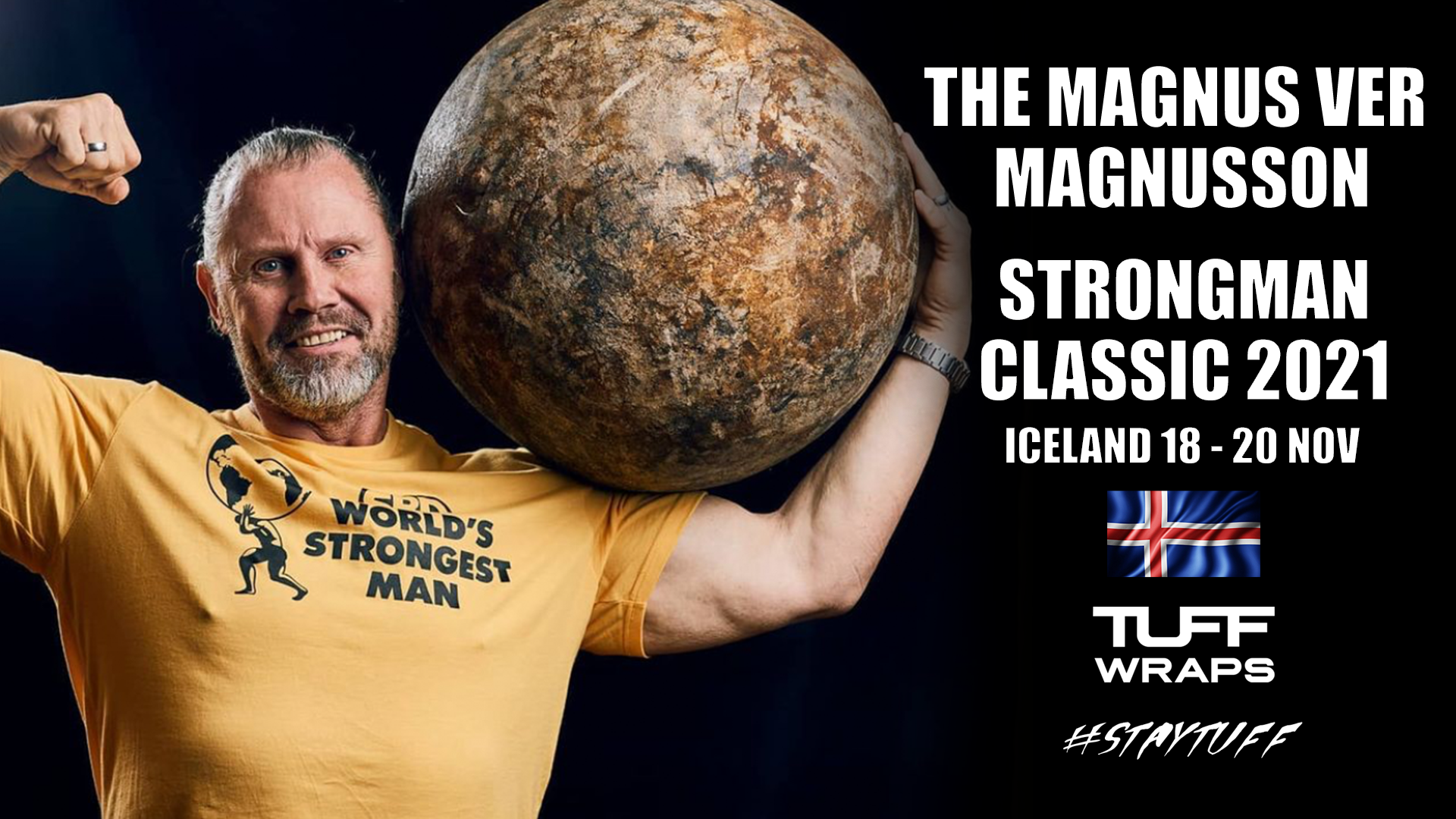
In 2021 Magnús founded the competition that carries his name, the Magnús Ver Magnússon Classic. In his own public explanations, the intention was to create a distinctly Icelandic strongman contest, held outdoors and built around events closer to the raw traditions of strength than a fully standardized arena package. Weather is not automatically treated as an organizational failure but, within reasonable safety limits, as part of the test. Later editions have featured stone press, Hercules Hold, Húsafell stone carry, yoke and farmer's combinations, sandbag toss, stone medleys, hand-over-hand pulling, elevated deadlifts and log medleys. The selection is not decorative nostalgia. It reflects the qualities Magnús valued in his own career: strength, grip, speed, object technique and the ability to function when conditions are imperfect. The contest has grown into a series with international qualifiers, and the official website lists multiple qualifying routes for the 2026 season. That turns a namesake event into a development platform. Athletes do not come only to celebrate a champion from the past; they compete for real opportunities within a contemporary circuit.
The Classic Series may be the clearest expression of how Magnús understands legacy. Instead of building an event where history appears only on banners, he recreates some of the symbolic conditions of old strongman for new athletes. Stones, wind, terrain, large objects and the need to improvise become active parts of competition. Yet the series exists inside a modern world of streaming, qualification systems, partners and professional season planning. The result combines tradition with contemporary structure. Rongo Keene won the 2022 edition and Tristan Hoath won in 2023, while the 2024 and 2025 editions were listed and promoted through Official Strongman, showing the event's integration into the international network. For Magnús this is a different type of victory from the 1990s. A champion controls only his own performance. A successful promoter creates conditions in which other people can perform. His name may attract attention, but the series' long-term value will depend on whether it continues to produce meaningful competitive experiences, opportunities and stories for athletes who were not yet born when he won his first WSM.
A less widely known part of Magnús's work is his involvement with adaptive strongman, discussed in interviews under the World's Strongest Disabled Man name and later developed through international competitive structures. Magnús has explained that the initiative grew from Iceland around people already working with disabled adults and children who saw the possibility of creating an adapted strength format. His role included judging, promotion and visibility. The current Classic Series material on adaptive strongman highlights his contribution alongside other organizers in expanding the discipline toward international stages, including exposure in the Arnold environment. The significance goes beyond charity. High-level adaptive sport requires rules, classifications, equipment and judging criteria that make competition meaningful without erasing functional differences between athletes. That is a difficult problem of sporting design. The experience of someone who watched strongman evolve from near-improvised events into a global sport is useful precisely because he understands that rules are constructed tools and can be improved.
There is also a philosophical continuity between adaptive strongman and the way Magnús has spoken about strength. At its core, strongman asks what the body can do with the problem placed in front of it. Objects are imperfect, leverages differ and terrain changes. In adaptive competition that logic becomes even more explicit because implements and standards must be designed so that the performance is difficult yet relevant to a particular functional category. A four-time WSM champion adds public legitimacy, but the deeper value is treating the discipline as authentic sport rather than symbolic exhibition. In that sense, Magnús's post-competitive activity expands the definition of his legacy. It is not only about preserving old records, but about using accumulated authority to widen access to meaningful competition.
Magnús has kept his private life far less exposed than athletes who built careers in the social-media era. Public biographical sources describe him as married, a father of two daughters and a grandfather. In recent appearances he has spoken simply about spending time with his wife, children and grandson, continuing to train, and enjoying motorcycles or bicycles. Those details are sufficient to outline the person without turning family into an inventory. A responsible profile should keep private life proportional to what the individual has chosen to make public. What is clear is the continuity between professional identity and routine. Even after elite retirement, training remained present and everyday life continued to intersect with the gym, competitions and the strength community. There is no rigid division between the 'former champion' and the present-day man. The titles belong to history, but the sport remains an environment in which he lives and works.
In a public 2026 question-and-answer session, Magnús described retirement as gradual. He stopped pursuing World's Strongest Man but continued with Icelandic contests, demonstrations and eventually organization. That description corrects the cinematic image of an athlete closing the door in a single day. For elite competitors, retirement often means renegotiating both the body and social status. Weights that once defined a successful day must be reduced, applause disappears and a routine built over years no longer serves the same target. Magnús managed the transition through continuity. He stayed near the bar but changed intensity; stayed near competition but changed position; stayed near younger athletes but increasingly as mentor. That model does not eliminate the difficulty of retirement, but it gives it structure. In his case experience became a long second career rather than a closed chapter.
Magnús Ver Magnússon's sporting legacy can be described on four levels. The first is the record itself: four World's Strongest Man titles, two runner-up finishes and a body of international and national victories that permanently places him in the championship's history. The second is technical: an athlete who demonstrated that elite static strength could coexist with speed, conditioning and adaptation to awkward objects. The third is cultural continuity: he carried forward an Icelandic tradition already made famous by Jón Páll Sigmarsson and kept it visible during a critical period. The fourth is infrastructure created after his peak: Jakaból, coaching, refereeing, promotion, adaptive strongman and the Magnús Classic Series. Together, these explain why his influence remains relevant even when absolute records have moved on. Modern strongman is heavier, more specialized and more professional, but its central problems are still familiar. The athlete must turn general strength into performance on an object, recover between events, accept an event list he does not fully control and make decisions while fatigued. Magnús was exceptional precisely at that conversion process.
Cross-era comparison requires caution. A 160 kg log from 1995 cannot simply be placed beside 220-plus-kilogram modern records and used as a verdict on relative quality. Today's athletes have standardized implements, information, nutrition, programming and a much larger professional base; earlier champions helped build the culture that made that development possible. At the same time, the past should not be romanticized. Magnús himself has acknowledged the advantages available to the present generation and the differences in event training. A mature reading of his career does not need to claim that he would automatically win a modern contest. It is enough to observe how thoroughly he solved the sporting problem of his own era and how effectively he transferred that knowledge afterward. Four WSM titles are facts. Six podiums in six finals are facts. A 1,015.5 kg powerlifting total at 125 kg is an archived fact. The larger reputation grows from how those facts connect and from the sport's long-term response to them.
This profile was built by comparing several types of sources. Strongman Archives was treated as the primary statistical reference for strongman chronology, contest placings and archived event performances, especially Magnús Ver Magnússon's individual athlete page and its linked contest records. Powerlifting numbers were checked against KRAFT, the Icelandic results database that records meets, weight classes, bodyweights and the three competition lifts. Statements about his training, self-coached approach, frequency, autoregulation and refereeing roles draw on his interview with fitness MANAGEMENT. The 2009 launch of the modern Jakaból and his explanation of the name and its connection with Icelandic strength roots were checked against IronMind's contemporary report. Current information on the Classic Series and adaptive competition was drawn from the official Magnús Ver Magnússon Classic platform and Official Strongman. General biographical information was cross-checked against public secondary sources, and where databases disagree this profile avoids turning one archival convention into an absolute historical certainty.
Several historical discrepancies deserve to remain visible. The number of Iceland's Strongest Man titles credited to Magnús varies depending on how certain Icelandic championships, combined events and alternate competition names are categorized. Some historical summaries credit him with eight, while modern result databases separate events differently and can produce lower totals. The names and status of some European contests from the 1990s are likewise not uniform across archives. This profile therefore prefers specific years and placings that can be tied to an individual result while noting traditional career totals separately. Strongman squat and deadlift figures are also presented with event context when known because a WSM squat on specialized apparatus is not biomechanically or regulatorily identical to a powerlifting squat. Precision does not reduce the achievement. It makes it understandable. Magnús needs no inflated number or uncontrolled legend: the documented career is already extraordinary, an elite European powerlifter who became four-time World's Strongest Man and remained in the sport long enough to help shape the generations that followed.
Viewed in detail, the KRAFT database reveals one of the most striking bodyweight and strength progressions in Icelandic powerlifting of the 1980s. Magnús appears in 1984 at 90 kg bodyweight with a 557.5 kg total. During 1985, around the 100 to 110 kg categories, his totals climbed from roughly 600 kg toward 683 kg, and he earned bronze at the IPF Junior World Championships. In 1986 he moved beyond 700 kg and reached the European junior podium. One year later, around 120 kg, he totaled 915.5 kg at the Icelandic championships and 940 kg in another meet. In 1988 he reached 943 kg, and in 1989, 960.5 kg. That curve represents more than added body mass. It shows technical development across all three powerlifts. The squat became the centerpiece, but bench press and deadlift developed enough to keep the total competitive at European level. By 1991, 1,015.5 kg at 125 kg bodyweight represented the mature form of the project. For strongman, the value of this progression is that Magnús learned for years how to build strength without skipping stages. When he reached WSM, he was not dependent on a rapid transformation or one exceptional block of training. He had nearly a decade of structural adaptation, platform experience and heavy work behind him.
His later bench-press results add another interesting dimension. In 2004, already over 40 and weighing close to 130 kg, KRAFT records a 275 kg bench in a full powerlifting meet and 272.5 kg at a separate bench championship. Those numbers came long after his WSM peak and suggest that upper-body pressing strength remained extremely high as his strongman career approached its end. At the 2004 Icelandic powerlifting championships he produced a 353.5 kg squat, 275 kg bench and 300 kg deadlift for 928.5 kg total. It was no longer the 1991 total, but the age context makes it remarkable. The result also highlights an important feature of his training identity: he never completely abandoned standardized strength disciplines after becoming famous in strongman. Powerlifting remained a base language. For contemporary coaches this continuity is instructive. Specificity matters, but foundational movements can remain the skeleton of a program across decades if intensity and volume are adapted. Strongman adds objects and situations; squat, press and deadlift remain efficient tools for maintaining general capacity.
Overall placings alone hide the mechanism of Magnús's victories. The WSM event results preserved by Strongman Archives make a more granular reading possible. In 1991, wins in the 18-inch deadlift, barrel lift and loading displayed his distribution of qualities. In 1992, a final he did not win, he still took first in plane pull, rock press and loading and placed second in max deadlift. In 1994, Atlas Stones and Car Walk generated decisive points while the elevated deadlift kept him close to the top. In 1995, squat and caber toss again exposed the contrast between static and explosive ability. A generalist champion does not need identical superiority in every event; he needs a favorable scoring map. If an athlete has three events he can win, several more where he can reliably finish in the top three, and very few in which he falls near the bottom, the championship becomes statistically plausible even against specialists with greater ability in one isolated movement. Magnús excelled at this economy of points.
That perspective also changes the meaning of the phrase 'strongest man.' World's Strongest Man does not measure one definition of strength, and Magnús was built for that ambiguity. Maximal force is only one component. There is repeated strength, explosiveness, grip, tolerance of metabolic fatigue, the ability to breathe under load, rapid short-step running, coordination around oversized objects and stability in nonstandard positions. Added to those is contest intelligence: when to chase the fastest time, when to accept third place, and when one extra repetition will cost more energy than the points are worth before the next event. Not all those decisions survive in an archive. The consistency of Magnús's results suggests that he managed them extremely well. Six consecutive WSM finals ending only in first or second place cannot be produced by brute force without strategy. They require an athlete capable of turning resources into points.
In Iceland, stone lifting carries cultural meaning older than televised strongman. Testing stones historically offered a practical way to demonstrate physical capacity in communities where heavy work mattered. Modern strongman turned that tradition into Atlas Stones, natural stones, stone press and multiple stone medleys, but the central idea remains recognizable: the object is not designed for the athlete's comfort. Magnús produced excellent results in this family of events. He won King of the Stones in 1993, won Atlas Stones in the 1994 WSM final and remained competitive in natural-stone and stone-press events late in his career. For a powerlifter, stones are a serious test of transfer because a barbell offers constant diameter, predictable center of mass and symmetrical grip. The stone removes those advantages. Its shape must be read, the trunk must remain rigid while the arms work in compromised positions, and small errors in lap or extension cost time. Magnús's success on stones demonstrates how completely he moved beyond platform specialization.
That affinity also explains why events he later promoted repeatedly returned to stones and natural objects. In the Magnús Classic, the Húsafell stone, stone press and stone medleys are not tourist decoration but a philosophy of testing. A natural object forces the competitor to care about surface, temperature, moisture and balance. In a climate-controlled arena those variables can be minimized; in the Icelandic landscape they return. Magnús has supported the idea that weather can be part of the experience, bringing strongman back toward its roots as a practical demonstration of strength. Modern organization, however, must draw a line between difficulty and unnecessary danger. Here his experience as both veteran competitor and referee becomes especially useful. Tradition does not mean reproducing every old condition uncritically. It means preserving the character of the test in a form that can still be judged and repeated.
Magnús's career argues against the idea that strongman must choose between static power and athletic movement. In reality they multiply each other. A yoke becomes faster when an athlete's legs are strong enough that the contest load represents a smaller fraction of maximum capacity. A loading race becomes more efficient when picking each object does not consume nearly the entire strength reserve. Conversely, a huge deadlift does not guarantee a championship if the athlete loses large amounts of points in every moving event. Magnús possessed enough static strength to make many contest weights submaximal and enough athleticism to use that reserve quickly. His competition weight around 120 to 130 kg matters in this context. It was sufficient for stability and force but did not eliminate speed. There is no universal ideal strongman weight, yet for his physiology and era the compromise worked exceptionally well.
The lesson remains relevant even though average elite body mass has increased. The most complete modern strongmen still invest in conditioning, mobility and technique precisely to convert size into performance. Magnús reached the same practical conclusion before the sport possessed today's methodological vocabulary. His background in football, basketball and throwing athletics gave him a movement base that powerlifting did not erase. For younger athletes, that path suggests that premature specialization is not automatically advantageous. A broad period of athletic development can create abilities that become difficult to build later, after mass and loading rise. Strongman requires a powerful body, but also a body that knows how to organize itself.
No career lasting more than two decades in strongman is free of wear, even if public archives do not document every injury Magnús experienced. For that reason, it is more responsible not to construct a medical history from rumor or scattered anecdotes. His own stated principles are more useful: avoid permanent maximal attempts, leave a small reserve, vary the program and take additional rest when fatigue demands it. Those ideas make biomechanical sense in a sport built on very heavy loads and irregular movement. Tendons and joints need time, and an athlete who turns every training session into a contest consumes the margin too quickly. Magnús's longevity, from his first listed powerlifting and strongman contests in 1984-1985 through 2007, suggests that autoregulation was more than retrospective language. Enough stress was managed for him to remain functional at a very high level for a very long time.
That does not mean his methods should be idealized or copied literally. Modern recovery science, physiotherapy and monitoring provide tools he did not have. His history instead demonstrates the value of internal feedback. An experienced athlete learns the difference between normal discomfort and a warning signal, between productive fatigue and fatigue that degrades technique. In an era without readiness applications and wearable sensors, Magnús had to interpret those signals directly. Modern autoregulation can add data, but the objective remains the same: adapt the program to the organism rather than forcing the organism through a program regardless of response. For a long career, that relationship matters more than one perfect training week.
World's Strongest Man has always been both competition and television product. Magnús became globally known in an era when audiences discovered athletes through edited broadcasts rather than daily posts. That difference shaped his public image. Viewers saw several contest days assembled into a compact narrative: introductions, spectacular events, standings and reactions. There was no continuous access to training, family life or ordinary routines. His personality was therefore transmitted mainly through behavior inside the arena: calm, focus and economical movement. In contrast with Jón Páll's theatrical expressiveness, Magnús's reserve became recognizable in its own way. Not every champion needs the same showmanship to become memorable. Sometimes repeated performance constructs character more powerfully than a slogan.
Later documentaries, seminars, interviews and online appearances added dimensions the old WSM broadcasts could not show. Audiences could see the coach, referee and veteran willing to discuss mistakes and limitations. That second image does not replace the first; it completes it. The controlled champion of the 1990s becomes the experienced figure who explains why maximal lifting is unnecessary in every training session and how difficult it is to judge a repetition in real time. For historians of the sport, those testimonies are valuable because they humanize archive footage. They reveal processes behind performance and reduce the temptation to turn champions into mythological figures without uncertainty or adjustment.
Magnús's success cannot be fully separated from the Icelandic ecosystem. The country has produced a disproportionate number of champions and record holders relative to population. Simplistic explanations based on genetics or 'Vikings' are inadequate. Culture is more important: clubs where strong athletes meet, public visibility of strength contests, transmission of tradition, access to mentors and the fact that a young Icelander can see a world-class model at close range. Jón Páll created one of the first global images, Magnús continued the line and helped build infrastructure, and later generations inherited a national story in which international strongman success was imaginable. Jakaból is a concrete network effect. When multiple strong athletes train in the same place, the everyday standard rises. A weight that appears impossible in an ordinary gym becomes familiar when someone lifts it only a few meters away.
Magnús therefore became not only a product of the system but one of its builders. He organized, officiated, opened training space and lent legitimacy to new initiatives. That mechanism matters for any country trying to develop strongman. Individual talent may produce one champion, but without local competitions, equipment and mentors it is difficult to produce generations. Iceland's history shows how success can become institution. A WSM title inspires; a gym and a competition circuit create opportunities. Magnús has contributed to both.
The question of whether Magnús would defeat today's champions is attractive but cannot be resolved rigorously. An athlete's body is partly the result of the training environment available to him. If Magnús had been born forty years later, he would have had different implements, methods, information and probably a different competition bodyweight. If a modern champion were transported to 1991, some advantages created by current equipment familiarity and data would disappear. Direct comparison of raw numbers produces entertainment more readily than historical science. A better method is to evaluate relative dominance, versatility, longevity and the ability to answer the format of one's own era. On those criteria Magnús has an exceptional record without requiring impossible hypothetical matchups.
Modern data can also help correct legend. Not every number repeated in the strength community is exact, and some results were produced on apparatus or under rules unlike today's. This profile therefore separates standardized powerlifting from strongman, identifies apparatus context where relevant and avoids calling a performance a world record without a clear basis. Respect for a champion does not require exaggeration. Precision protects legacy. Once it is documented that Magnús squatted 400 kg and totaled 1,015.5 kg in a 125 kg powerlifting contest, there is no need for an unverified number to prove that he was extraordinarily strong.
Magnús's career offers several durable principles. First, build a genuine base before chasing extreme specificity. Powerlifting gave him a reserve of strength that could be expressed across dozens of events. Second, preserve athleticism. Speed, coordination and conditioning are not accessories but methods through which strength becomes useful. Third, train adaptability. A contest rarely matches practice perfectly, and the ability to find a technical solution quickly can be worth major points. Fourth, do not confuse training with permanent testing. Magnús has emphasized repetitions, submaximal work and leaving something in reserve. Fifth, think in terms of longevity. A career is not created only by the best season, but by the years in which the athlete can continue working.
There is also a lesson about identity. Magnús did not remain trapped inside the 1996 version of himself. He accepted the transition from champion to veteran competitor, then to referee, coach and promoter. For elite athletes that flexibility can be as important as physical adaptability. The competitive career inevitably ends, while accumulated competence can remain useful for decades. When it is shared, a champion's experience becomes a community resource. Jakaból and the Classic Series are concrete examples. They show that legacy is not only what is engraved on a trophy, but what continues to function after the trophy has been placed on a shelf.
In 2026, more than three decades after his first World's Strongest Man title, Magnús's name remains active within the sport. The official Magnús Ver Magnússon Classic Series site presents a 2026 season with international qualifying events, while Jakaból continues to be promoted as the Nest of Giants. He appears in seminars, interviews and strongman projects, maintaining a direct relationship with the current generation. This may be the clearest difference between historical celebrity and living legacy. A famous name can survive in archive footage without affecting present practice. Magnús still influences which events are organized, how athletes are judged, where people train and what cultural stories are passed to new competitors.
For a contemporary profile, that means his biography cannot be closed in 1996 or even 2007. The championship period is over, but his role in strongman continues. The fact that an athlete born in 1963 can remain relevant to a competition circuit in 2026 demonstrates how far sporting competence can extend beyond personal performance. Magnús Ver Magnússon is simultaneously part of WSM history and an active participant in modern strongman infrastructure. That double position makes him especially valuable to Iron Hall: not only an archived champion, but a living link between the televised origins of the sport and the global network that exists today.
When Magnús's career is viewed at full length, an essential distinction appears between record and influence. The record can be summarized in a table: four World's Strongest Man titles, two runner-up finishes, 13 archived international strongman victories, national and regional championships, and a powerlifting career that produced European titles and a total above one metric ton. Influence is harder to place in columns. It can be seen in the expectations he helped establish for a complete strongman. An athlete around 130 kg could be exceptionally powerful on a barbell without surrendering speed. A powerlifter could win on stones, loading and vehicle pulls if he learned to transfer strength. A champion could survive runner-up seasons without losing his competitive identity, then return and win three titles in a row. A veteran could continue competing after the global peak without later modest results erasing earlier greatness. And after retirement, a former champion could remain relevant not through nostalgia but through work: gym ownership, officiating, coaching, organizing and building new competitions. This continuity may be the deepest characteristic of Magnús Ver Magnússon. His strength did not exist in one frozen moment; it was repeatedly converted from one form into another.
For strongman history he also represents a transition point between the almost artisanal sport of the 1980s and today's professional ecosystem. He competed when some events seemed designed for a single television shoot and remained involved long enough to see athletes gain specialized coaches, physiotherapists, nutrition support, event programming, replica implements and instant footage of rivals. He watched audiences move from television schedules and tapes to streaming and social media; strongman expand from a handful of major contests into dense international calendars; judging and safety standards become public debates; and adaptive strongman begin developing its own championship structure. Magnús found a role in each stage. When he could no longer be the man lifting the object, he became the man designing the test, explaining the standard, preparing the athlete or opening the gym door. For that reason his place in Iron Archives is not simply a memorial to a four-time champion. It is a case study in how an athlete can gradually become part of the institution of a sport.
Ultimately, Magnús Ver Magnússon is difficult to reduce to one adjective. He was not merely 'technical' because his brute strength is documented. He was not merely 'athletic' because the loads he handled would have been impressive in specialized strength competition. He was not merely 'consistent' because his career included periods of genuine domination. He was not only 'a man of his era' because his post-retirement activity continues to connect him with the present. Perhaps the most accurate description is complete strongman in the original sense: an athlete who could be placed in front of a strength problem very different from the previous one and, unusually often, find an efficient way to solve it. Four world titles made that capacity visible. The decades of activity that followed showed that his understanding of strength sport was deeper than the ability to win. That is why his name at Jakaból, in the referee's position or on the Magnús Classic Series does more than provide a famous signature. It acts as a line of continuity through Icelandic and international strongman.
The most useful way to understand Magnús may be to treat completeness, rather than any single lift, as the central theme of his career. Strongman rewards the athlete who can repeatedly convert several physical qualities into adequate or exceptional scores. A specialist may be unbeatable in one event and still lose a championship because the remaining disciplines expose weaknesses. Magnús built the opposite profile. His documented powerlifting proved that maximum strength was real rather than assumed. His WSM event wins showed that this strength survived contact with awkward objects. His loading and moving results demonstrated that body mass had not destroyed acceleration. Stone performances revealed tactile skill and positional awareness. Pulling events demanded whole-body endurance, while long contests tested recovery and emotional control. None of those abilities existed in isolation. The value came from their interaction. A 400 kg squat mattered because it made a heavy carry less maximal. Speed mattered because it allowed him to exploit that reserve. Technique mattered because it reduced the energy wasted on an unfamiliar object. Conditioning mattered because good technique becomes difficult to preserve when breathing and heart rate deteriorate. His competitive intelligence tied those elements together by deciding where energy should be spent. This systems-level view of performance helps explain why Magnús remained so difficult to remove from the top of a scoreboard across changing event selections.
That completeness also helps explain why his career remains useful to study in a modern sport that has outgrown many of the raw numbers from his era. Records are designed to be broken, and strongman has become far more specialized. Logs are heavier, deadlifts have climbed, athletes practice exact implements and professional support has improved. Yet the championship problem has not disappeared. A modern contender still has to balance maximum strength against speed, body mass against conditioning, specificity against general capacity and aggression against recovery. The tools are more sophisticated, but the trade-offs remain recognizable. Magnús's career offers a historical example of solving those trade-offs unusually well. It also offers a warning against reducing preparation to the most visible event. His own generation often lacked specific equipment, forcing broad adaptation. Modern athletes have the opposite risk: so much specific equipment and information that they can become trapped inside narrow preparation. The lesson is not to abandon specificity, but to keep the general engine large enough that specificity has something to express. That principle links his 1991 debut, his 1994-1996 championship run, the late Icelandic victories and his later coaching philosophy.
For that reason, Magnús Ver Magnússon's profile is best read as more than a retrospective celebration. It is a record of how strongman itself changed and how one athlete kept changing with it. He began when the sport offered limited access to implements and sparse international infrastructure. He reached the top through a mixture of standardized powerlifting strength and improvisational event skill. He remained competitive while larger and more specialized athletes entered the field. He then moved into roles that strongman increasingly needed as it professionalized: knowledgeable referees, experienced coaches, reliable promoters and people able to connect history with new competitive formats. The modern Jakaból, adaptive strongman work and Classic Series are not separate footnotes after the 'real' career. They are the continuation of the same underlying ability that made him successful as an athlete: identify the problem in front of you, understand the tools available and build a workable solution. During the 1990s the problem was how to score more points than the strongest men in the world. In later decades it became how to preserve, teach and extend a sport that had given him his public identity. In both cases, adaptation was the method.
Iron Hall data
370 KG
Standard deadlift — strongman competition best · 1996 World's Strongest Man Final; competition best catalogued by Strongman Archives
Verified
512.5 KG
18-inch Deadlift · 1989 Aflraunameistari Íslands; archived competition best
Verified
160 KG
Max Log Lift · 1995 Strongest Man on Earth
Verified
410 KG
Max Squat — strongman · 1996 World's Strongest Man group; archived strongman competition best
Verified
437.5 KG
Squat — WSM event result · 1995 World's Strongest Man; result on the event-specific WSM apparatus, not directly comparable with a powerlifting squat
Verified
400 KG
Squat — powerlifting · 1991 Icelandic Powerlifting Championships, 125 kg class
Verified
275 KG
Bench Press — powerlifting · 2004 Icelandic Powerlifting Championships, 125+ kg class
Verified
370.5 KG
Deadlift — powerlifting · 1991 Icelandic Powerlifting Championships, 125 kg class
Verified
1015.5 KG
Powerlifting Total · 1991 Icelandic Championships, 125 kg class: 400 / 245 / 370.5 kg
Verified
1985
The inaugural edition and the beginning of his archived strongman career; Jón Páll Sigmarsson won.
3rd place
1985
An early international powerlifting podium.
3rd place, 110 kg
1989
European title recorded in Iceland's official powerlifting results database.
1st place, 125 kg
1989
His first major national strongman title in the Strongman Archives chronology.
Champion
1991
380 kg squat, 227.5 kg bench press, 355 kg deadlift, 962.5 kg total.
1st place, 125 kg
1991
Won World's Strongest Man on his first appearance, in Tenerife.
Champion
1991
One of the international victories in his breakthrough season.
Champion
1992
Final held in Reykjavík; he defended his title to the end against one of the era's strongest fields.
Runner-up
1992
National title recorded by Strongman Archives.
Champion
1993
Second consecutive WSM runner-up finish, in Orange, France.
Runner-up
1993
International victory before his dominant mid-1990s run.
Champion
1993
Victory in Reykjavík in a contest rooted in stone-lifting tradition.
Champion
1993
Champion
1994
Second WSM title, in Sun City, South Africa; the start of three consecutive victories.
Champion
1994
Champion
1995
Third WSM title; among his event wins was the squat with 437.5 kg on the competition apparatus.
Champion
1995
Major international victory during one of the strongest seasons of his career.
Champion
1995
Champion
1995
Champion
1995
Champion
1996
Fourth WSM title and third consecutive championship, completing his dominant 1994–1996 run.
Champion
1997
International victory after his WSM championship run.
Champion
1997
Champion
1997
Runner-up
1998
Runner-up
2000
Champion
2001
Champion
2001
Champion
2001
Champion
2002
Champion
2003
Champion
2004
Champion
2004
Champion
2004
Notable return to powerlifting: 353.5 kg squat, 275 kg bench press and 300 kg deadlift.
1st place, 125+ kg
2005
At more than 42 years old he won the contest and several events, including elevated deadlift, Hercules Hold and Stone Press.
Champion
2007
His final archived strongman contest in Strongman Archives; he still deadlifted 370 kg.
6th place