
2007
Britain's Strongest Man
Early national breakthrough after winning the Midlands qualifier; a biceps tear on the tire flip ended his final.
Finalist / withdrew after injury
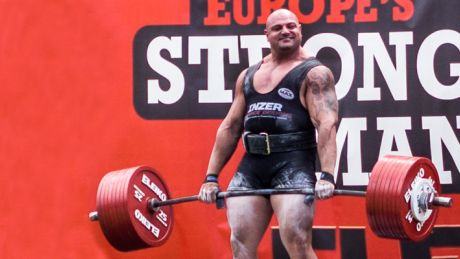
Iron Archives
“Big Loz” — 2016 Europe's Strongest Man, two-time Britain's Strongest Man and a leading modern strongman voice
Retired athlete
Laurence Christiaan David Shahlaei, universally known in strongman as “Big Loz”, is a retired English professional strongman, strength coach, analyst and commentator, born on 25 December 1982 in Cheltenham, Gloucestershire. He began competing in 2005, while Strongman Archives records an international career from 2007 to 2021 comprising 57 international contests and eight wins, 11 World's Strongest Man appearances, five finals and a best finish of fourth in 2011. His major titles include Britain's Strongest Man in 2012 and 2013, Europe's Strongest Man in 2016, the 2016 Ultimate Strongman World Championships, UK's Strongest Man in 2017 and the 2018 Giants Live North American Open. Renowned for exceptional yoke and frame-carry speed, elite deadlifting and broad contest versatility, Shahlaei also endured a remarkable series of injuries involving the biceps, quadriceps, lat, triceps and Achilles tendon. After stepping away from full-time competition, he expanded his influence through coaching, the Big Loz Official media platform with his wife Liz and high-level commentary, becoming one of the most recognizable analytical voices in modern strongman.
Laurence Shahlaei, the complete profile of “Big Loz”. In modern British strongman, Laurence Christiaan David Shahlaei occupies a distinctive position because his career cannot be reduced to one title, one record or even one professional identity. He competed at the highest level during an era that included Žydrūnas Savickas, Brian Shaw, Hafþór Júlíus Björnsson, Eddie Hall, Terry Hollands, Mark Felix and, toward the end of his competitive life, the generation led by the Stoltman brothers. He won Britain's Strongest Man twice, Europe's Strongest Man in 2016, UK's Strongest Man in 2017, the Ultimate Strongman World Championships in 2016 and the Giants Live North American Open in 2018. He appeared at World's Strongest Man eleven times according to Strongman Archives, reached five finals and produced a career-best fourth place in 2011. Those numbers alone would make him a major figure in British strength sport. Yet the second half of the story is equally important. After full-time competition, Shahlaei became a coach, analyst, commentator and content creator, building Big Loz Official with his wife Liz and helping translate elite strongman for a new digital audience. His competitive career was repeatedly interrupted by major injuries involving the biceps, quadriceps, lat, triceps and Achilles tendon. Instead of creating a neat upward line, those injuries turned his career into a sequence of advances, physical breakdowns, rehabilitation and reinvention. That makes his achievements more instructive, not less. The athlete who ran with enormous yokes and frames eventually became the coach explaining why foot speed, brace, implement balance and contest strategy matter. The competitor who learned the sport through television and direct contact with veterans later became one of the people preserving its history online. Shahlaei's biography is therefore best understood as three overlapping careers: the elite strongman, the survivor of an unusually punishing sport, and the educator who converted experience into coaching and media.
Origins, family background and identity. Shahlaei was born on 25 December 1982 in Cheltenham, Gloucestershire, England. Public biographies give his full name as Laurence Christiaan David Shahlaei. His father is of Iranian origin, from Kermanshah, while his mother is English and from Newcastle upon Tyne. He attended Balcarras School and later lived in Stroud before his adult life and professional work became strongly associated with Swindon, Wiltshire. In strength sport he became universally known as “Big Loz”, an uncomplicated nickname built around the familiar shortening of Laurence and the obvious scale of a heavyweight strongman. His own website also uses “The Warrior”, but Big Loz became the name used by fans, promoters, fellow athletes and media. Giants Live lists him at 1.88 metres and around 160 kilograms, while bodyweight figures in other sources vary depending on season and date. That is entirely normal in open-weight strongman. Body mass changes across competition peaks, injury rehabilitation, conditioning blocks and retirement. Shahlaei competed in the Open division, where there is no upper bodyweight limit and where size only becomes useful when it can be converted into force, speed and durability. His physique was particularly well suited to heavy moving events. A thick torso, powerful legs, a low and stable centre of mass and the ability to create whole-body stiffness allowed him to accelerate under loads that would immobilise most trained lifters. That physical architecture mattered in yoke, frame carry and car walk, events that became central to his reputation. Yet size alone explains very little. Strongman history is full of enormous athletes who could not move efficiently or reproduce strength across a six-event contest. Shahlaei's distinction was that he could combine heavyweight mass with surprisingly quick footwork. His identity as an athlete therefore developed around a useful contradiction: he looked built for static strength, but some of his most dangerous performances came when the contest demanded movement.
The childhood image that made strength look possible. Shahlaei did not grow up inside an organised weightlifting dynasty. His fascination with strongman came largely through television, at a time when World's Strongest Man was one of the few ways a young British viewer could regularly see elite strength sport. In later interviews he recalled the image of O.D. Wilson pulling a truck and the sense that the athletes on screen looked almost like real-world superheroes. In another interview he described watching World's Strongest Man around Christmas 2004, seeing the leading competitors of the time and deciding that he wanted to try the sport himself. He joined a gym in January and by the summer was already entering competition. His early inspirations included Žydrūnas Savickas and Vasyl Virastyuk, two athletes who represented the kind of complete strongman profile that Shahlaei would later pursue. This was still an era before the information environment of modern strength sport. There were no daily training breakdowns from every professional, no endless archive of event technique and far fewer coaches specialising in strongman. Athletes learned from television, magazines, local competitors, training visits and trial and error. Shahlaei later credited people such as Dave Beattie, Nick McKinless and Phil Learney as important sources of advice. That pattern is significant because it became part of his own coaching philosophy. He did not emerge from one rigid system. He collected useful information from different environments and learned to distinguish principles from individual preference. Strongman itself encourages that approach because its events resist complete standardisation. The dimensions of a log can change. A yoke may swing differently. Stones vary in diameter and surface. Trucks, frames and loading objects behave differently from one promoter to another. An athlete who learns only one exact movement pattern is vulnerable. Shahlaei's development was therefore a process of building adaptable strength. The fascination that began with television quickly became a practical education in awkward objects, imperfect conditions and the need to solve problems under fatigue.
The first contest in 2005. Shahlaei began competing in strongman in 2005. In interviews he has described entering a novice show with more than thirty athletes and finishing eighth despite having little or no specific experience with the implements before the contest. He has also spoken about how naturally heavy pulling came to him in those first months of training, including unusually high-volume deadlifting for someone with limited time in the gym. Such stories are useful when treated carefully. They suggest exceptional early strength potential, but they should not be turned into a simplistic claim that elite strongman was inevitable. Natural response to training is only one part of the equation. Technique, durability, recovery, competitive judgement and years of exposure matter enormously. What the first contest clearly demonstrated was that Shahlaei could transfer general strength to unfamiliar tasks quickly enough to compete with people who had more event experience. That result gave him a direction. Strongman is an unusually honest introduction to the limits of gym strength. A barbell moves in a controlled path. A tyre does not. A farmer's implement tries to pull the athlete out of position. A truck pull turns force production into locomotion. A stone is deliberately awkward. The novice who enters such a contest learns immediately that raw numbers are only the beginning. Shahlaei responded by seeking stronger training partners, more experienced athletes and regional competitions. Within roughly two years he had progressed from novice-level competition to the Midlands qualifying route and Britain's Strongest Man. The speed of that rise reveals obvious talent, but also a willingness to compete before conditions felt perfect. That decision accelerated his technical development because every contest exposed a new weakness. It also introduced a pattern he would later question: competing very frequently. Years later, when asked what he would tell his younger self, Shahlaei said he would compete less and focus more carefully on the major shows. The lesson came from experience. Competition teaches quickly, but every contest also spends recovery resources that the body cannot replace indefinitely.
2007, Britain's Strongest Man and the first major injury. After rapid progress through regional competition, Shahlaei reached Britain's Strongest Man in 2007. For an athlete with only a few years in the sport, qualification to the national final was already a major step. The contest also introduced the theme that would repeatedly shape his career: serious injury arriving during periods of upward momentum. On the tyre flip, Shahlaei tore a biceps and was forced out. For a strongman, a biceps injury is not confined to one movement. It affects stones, loading, tyre flip, rows, deadlift stabilisation, carries and any event where the arm must secure an object under heavy tension. Rehabilitation therefore involves more than simply restoring elbow flexion. The athlete must rebuild trust in the injured tissue under awkward positions. Shahlaei returned strongly enough to finish fourth at Britain's Strongest Man in 2008, demonstrating that the setback had not ended his progression. Yet the 2007 injury became the first entry in a much longer medical history. Strongman in that period was particularly unforgiving. Contest calendars could be dense, equipment varied significantly and recovery infrastructure was not as integrated as it became for later professionals. Athletes often competed through pain because invitations, qualifying opportunities and prize money could determine whether a career continued. Shahlaei would later experience tears to the quadriceps, lat and triceps, followed by an Achilles rupture. Seen in isolation, each injury looks like misfortune. Seen together, they reveal the physical cost of remaining internationally competitive across a decade in a sport that combines maximal loading with speed. The importance of the 2007 biceps tear is therefore not that it makes the story dramatic. It establishes the central challenge Shahlaei would face: how to keep improving when the body repeatedly changes the terms of the problem. His career was never built on uninterrupted health. It was built on repeated reconstruction.
2008 and the first World's Strongest Man appearance. Shahlaei returned from the biceps injury to finish fourth at Britain's Strongest Man in 2008 and earned his first opportunity at World's Strongest Man, held in Charleston, West Virginia. Strongman Archives records him as fourth in his group, outside the final. The result was nevertheless a critical part of his education. Reaching WSM changes the competitive environment completely. The weights are heavier, the athletes are more efficient, travel becomes part of performance and television production can alter the rhythm of the day. Warm-ups may happen far earlier than expected. Events can be delayed. Implements are unfamiliar. The athlete must recover not only between events but across several days while remaining mentally ready. Shahlaei later described missing the final on debut as motivation rather than discouragement. That response fits the technical direction of his career. He began identifying the difference between being a strong national athlete and being a complete international competitor. At WSM, a single weak event can remove an athlete from the final even if he is world class elsewhere. A great deadlift cannot fully compensate for a disastrous loading race. A fast yoke does not erase a zero on overhead. Shahlaei's development from 2008 onward was largely about reducing those vulnerabilities. Moving events were already becoming a natural strength, but he also built elite pulling power and sufficiently strong pressing to remain competitive across different formats. The first WSM did not produce a headline result, yet it gave him the map of the level he needed to reach. From that point the goal was no longer merely to qualify for World's Strongest Man. It was to become efficient enough across the entire event list to remain there until the final day.
2009, a major national title and the first WSM final. Shahlaei's progression became unmistakable in 2009. He won England's Strongest Man, strengthening his position within a British scene that already contained established international competitors. Later that year he returned to World's Strongest Man in Valletta, Malta, advanced through qualifying and reached the final for the first time. Strongman Archives lists him ninth overall. On paper, ninth place can look unremarkable to anyone focused only on champions. In context, it represented entry into one of the smallest and most demanding groups in strength sport: WSM finalists. The field around him included athletes from a generation shaped by Žydrūnas Savickas, Mariusz Pudzianowski, Brian Shaw and other internationally experienced strongmen. Simply reaching the final meant surviving qualifying events against athletes who were national champions in their own countries. The season also reinforced Shahlaei's identity as a competitor who could score in moving events without being dependent on them. That distinction matters. Many strongmen develop one spectacular event and become dangerous only when the contest suits it. Shahlaei was moving toward a profile in which speed under load, deadlifting, repetition strength and enough overhead ability could combine into useful overall scores. Winning England's Strongest Man gave him domestic legitimacy; reaching the WSM final gave him international legitimacy. The transition from promising athlete to established professional was essentially complete. From 2009 onward, rivals could no longer treat him as someone simply pleased to be invited. He had shown that he belonged in the final and that his ceiling was still rising. The next question was how high the all-around score could go.
2010, international volume and the construction of a complete event profile. Strongman Archives records a dense season that included second place at Giants Live Ukraine, third at the Viking Power Challenge, fourth at Giants Live Turkey and third at the Sweden Grand Prix. At World's Strongest Man in Sun City, South Africa, Shahlaei finished third in his group and did not advance to the final. The contrast between strong results across the international circuit and missing the WSM final shows how unforgiving group qualification can be. One poor event or an unfavourable event mix can erase months of good form. Technically, 2010 produced important benchmarks. At Giants Live Turkey he pressed a 205 kg axle, one of the largest documented overhead performances of his career. At Giants Live Ukraine he won events including deadlift for repetitions and Viking press, while also scoring well on yoke. In Sweden he again won the Super Yoke. Those results reveal the two event families that increasingly defined him: moving events and repeatable strength. A strongman who can win yoke but also score highly on deadlift and pressing is difficult to remove from the top half of a contest. Shahlaei was becoming exactly that kind of athlete. The problem was workload. International strongman rewarded athletes who accepted invitations, because each contest brought experience, visibility, qualification opportunities and income. But every appearance also created connective-tissue fatigue, travel stress and incomplete recovery. Shahlaei later said that if he could advise his younger self he would compete less and prioritise the biggest shows. The 2010 season helps explain that conclusion. Competitive repetition accelerated his education, but the body was accumulating costs that would become visible in later years. Elite strongman always contains this contradiction. To become good at competing, an athlete must compete. To remain good for many years, he must know when not to compete. Shahlaei learned the second lesson much later than the first.
2011, the season that established Shahlaei among the world's best. If one year best represents his absolute competitive ceiling, 2011 is the clearest candidate. Shahlaei won Strongman Champions League South Africa and SCL Holland, finished second at Giants Live London, later took second at the Jón Páll Sigmarsson Classic and, most importantly, placed fourth at World's Strongest Man in Wingate, North Carolina. The event results behind those placings show extraordinary versatility. In South Africa he won the log lift with 185 kg, farmer's walk, deadlift and truck pull. At Giants Live London he pulled 430 kg in the max deadlift and won farmer's walk. At SCL Holland he scored maximum points in events including loading race, log lift and truck pull. This was not the profile of an athlete surviving through one speciality. He could attack pressing, pulling, carrying and conditioning events within the same season. At WSM, fourth place came behind Brian Shaw, Žydrūnas Savickas and Terry Hollands, placing Shahlaei immediately outside the podium in a field filled with historically significant competitors. It remains his best finish at World's Strongest Man and one of the strongest pieces of evidence for how close he came to the highest tier of the sport. Importantly, the WSM result was not a statistical accident. The entire season was strong. That context matters because one unusually favourable event list can sometimes create a surprising placing. Shahlaei's 2011 results instead show a sustained period of elite form. His moving events were world class, the deadlift had reached enormous numbers, and his overhead was good enough to win international events. Later injuries make the season feel even more important. It provides a clear view of what his competitive profile looked like when enough physical systems were functioning at the same time. There is no responsible way to claim he would inevitably have become WSM champion without the setbacks that followed, but 2011 demonstrates that a podium was not a fantasy. He was already one place away.
What the 2011 WSM result reveals about his style. Overall placings are useful, but event mechanics explain why Shahlaei could compete with much larger or more celebrated rivals. His best moving performances came from an unusual combination of mass, stiffness and foot speed. A yoke or frame is not simply a weight that happens to move. Every step creates oscillation. The athlete must control the implement while producing forward acceleration, and the heavier the implement becomes, the more expensive small technical errors are. Shahlaei was particularly good at turning the first few steps into momentum without allowing the load to swing excessively. That quality also reduced time under load. Finishing a carry quickly is not only faster on the stopwatch; it can leave the athlete less fatigued for the next event. At the same time, his deadlift was strong enough to keep him competitive when contests shifted toward static power. A 430 kg competition pull at Giants Live London demonstrated that he could no longer be described merely as a fast mover. Overhead was not his defining event in the same era as Savickas, but a 185 kg log and 205 kg axle were still elite lifts. The result was a relatively balanced score profile. Shahlaei might not win every static event, but he could avoid the catastrophic losses that destroy an overall placing, then make up ground in carries, pulls and medleys. Fourth at WSM in 2011 is therefore more than a career-best number. It is a snapshot of a mature all-round strongman whose strongest qualities interacted efficiently. The years that followed would repeatedly disrupt that balance through injury. For that reason, 2011 remains the cleanest demonstration of his competitive architecture.
2012, an enormous competition schedule and the first Britain's Strongest Man title. Shahlaei carried his 2011 form into a remarkably busy 2012 season. He finished second at the World Strongman Federation World Championship in Abu Dhabi, seventh at the Arnold Strongman Classic in Columbus, second at SCL Lapland, second at SCL FIBO, then won Britain's Strongest Man and Giants Live Finland. At Europe's Strongest Man he finished third. The range of contests itself is revealing. The Arnold in Columbus was built around brutally heavy static and awkward-strength events, while SCL and Giants Live often demanded more running, repetition work and general athleticism. Shahlaei was competitive across both styles. At Giants Live Finland he won the Super Yoke, Viking Press and Truck Pull, an almost perfect summary of his combination of movement and repeatable power. At Europe's Strongest Man he won frame carry and pulled 410 kg in the deadlift while finishing third overall. Yet the season also exposed the danger of competitive volume. He dealt with shoulder trouble during the broader circuit, and the accumulation of travel, max-effort lifting and repeated event preparation began to carry a substantial physical price. Years later, his advice to compete less makes particular sense when viewed against 2012. On paper, the schedule looks glorious: podiums, a national title, a Giants Live victory and an Arnold appearance. From the body's perspective it was a succession of high-stress peaks with little true off-season. Strongman careers are often shaped by this economic and athletic tension. Invitations create opportunity and income, but each one spends recovery. Shahlaei's willingness to compete made him experienced very quickly. It may also have contributed to the injury pattern that repeatedly interrupted his prime.
Back-to-back Britain's Strongest Man titles in 2012 and 2013. Winning Britain's Strongest Man carries particular weight because Britain has repeatedly produced finalists and champions on the world stage. Shahlaei won the title in 2012 and defended it in 2013, establishing himself as the leading British all-rounder of that immediate period. The 2013 results are especially useful because Strongman Archives preserves the event detail. He won the log lift and max deadlift, reaching 433 kg in the latter, finished second in Atlas Stones and the loading race and remained strong in Super Yoke. The profile is important. Earlier in his career, moving speed had been the first thing observers noticed. By 2013 his deadlift had become an elite international weapon and his pressing was strong enough to win national events. He was no longer a mover who survived static strength. He was a complete heavyweight who could score across the card. The titles also came during a period of extraordinary depth in British strongman. Terry Hollands remained internationally established, Mark Felix was still highly competitive, and Eddie Hall was rising rapidly toward his own peak. Shahlaei did not win in an empty domestic era. He had to beat athletes capable of performing at WSM level. Yet the second national title was followed by another major physical setback. At World's Strongest Man 2013 in Sanya, China, Shahlaei suffered a quadriceps tear during the squat in qualifying. The timing was brutal. He entered the contest as Britain's champion with a 433 kg deadlift and years of WSM experience, but the injury removed any chance to convert that domestic form into another world-final result. This pattern would recur throughout his career: evidence of elite form immediately followed by a physical interruption. It is one reason a simple list of final placings understates how competitive he could be when healthy.
The 2013 quadriceps tear and the problem of rebuilding speed. A serious quadriceps injury is particularly disruptive for a strongman whose identity depends on moving quickly under load. The quadriceps contribute to squatting, yoke, stones, truck pull, loading, deadlift initiation and nearly every event involving knee extension or force absorption. Rehabilitation is therefore not just a matter of restoring muscle size. The athlete must regain confidence in rapid loading. A healed leg can still move cautiously because the nervous system remembers the moment of injury. For Shahlaei, this had special significance. His advantage in yoke and carries came from willingness to accelerate. Any subconscious braking reduces that advantage. The 2013 WSM injury therefore threatened more than one event. It threatened the movement quality that made him distinctive. He returned nevertheless, and the following season demonstrated that his static strength had remained extraordinary. The deeper lesson is that elite strongman careers are rarely linear. A training graph can show increasing numbers while the athlete's actual movement options shrink or change. An injured athlete may become stronger in one area while protecting another, which can shift stress elsewhere and contribute to future problems. Shahlaei's later injury history cannot be reduced to one simple causal chain, but repeated rehabilitation inevitably altered how he trained and moved. His continued competitiveness shows a high degree of adaptation. Rather than expecting the post-injury body to behave exactly like the pre-injury one, he found ways to rebuild enough speed and strength to return to major finals and eventually win Europe's Strongest Man. That ability to adapt is as central to his career as any single record.
2014, a WSM final, a 435 kg deadlift and another major tear. Shahlaei returned from the quadriceps injury strongly enough to reach the 2014 World's Strongest Man final in Los Angeles, where he finished tenth overall. In qualifying he still showed the qualities that had defined his rise, winning the Super Yoke and progressive deadlift in his group and producing a solid truck-pull result. Later in the season, the World Deadlift Championships held alongside Europe's Strongest Man produced one of the defining numbers of his career: 435 kg. Strongman Archives lists it as his best standard strongman max deadlift. At the time it placed him among the very strongest pullers in the sport. The achievement was immediately followed by another physical setback. On a heavier attempt, Shahlaei suffered a severe lat tear and could not continue normally. The latissimus dorsi is heavily involved in maintaining bar position, connecting the upper body to the pelvis and stabilising many strongman movements. A serious tear therefore affects far more than pulling. Log clean, stones, rows, carries and even bracing can change. The sequence captures the paradox of elite strength sport: the same capacity that allows an athlete to approach historic weights also places tissue under stresses that can end a season in seconds. Shahlaei's 435 kg deadlift remains a major record in his personal history, but its context matters. It was not an isolated gym lift performed when fresh. It was a competition attempt produced by an athlete who had already accumulated years of damage and who was still pushing the limits of what his body could tolerate. The injury that followed shaped the next stage of his career, but it did not end it. Two years later he would win the most prestigious title of his life.
2015 and the triceps tear at World's Strongest Man. Shahlaei recovered sufficiently from the lat injury to return to World's Strongest Man in Putrajaya, Malaysia, but the contest brought another serious setback. During the Norse Hammers in qualifying he tore a triceps and was forced out of the remaining events. For an athlete who had already dealt with major injuries to the biceps, quadriceps and lat, the triceps tear represented more than another isolated problem. Elite strength rehabilitation accumulates. A repaired structure can alter technique, protective movement can shift stress to another area and confidence under maximal load must be rebuilt repeatedly. The triceps is essential to log, axle, dumbbell and Viking press, but it also stabilises the arm in carries and loading. A rupture therefore changes a large portion of the event menu. The public version of an injury story is usually compressed into two images: the athlete getting hurt and the athlete returning. Between those images are months of restricted training, physiotherapy, boring repetitions, reduced range of motion, swelling, scar management and the psychological discomfort of using weights that feel trivial compared with previous bests. Shahlaei had to live that process multiple times. The significance of 2015 becomes clearer only when placed beside 2016. A year after leaving WSM injured, he produced the strongest title-winning season of his career. That transition says more about his professional discipline than any motivational slogan could. Rehabilitation did not make him invulnerable and it did not erase the earlier injuries. It simply restored enough function for him to compete intelligently again.
2016, the comeback season and the Europe's Strongest Man title. After years of interruptions, 2016 could easily have become a rebuilding season. Instead, it became the year of Shahlaei's most prestigious victory. He finished third at Britain's Strongest Man and then, on 9 July 2016 in the First Direct Arena in Leeds, won Europe's Strongest Man. The field included defending champion Hafþór Júlíus Björnsson, already one of the dominant athletes of the decade. Shahlaei did not win through one miraculous event. He won through the exact all-round profile he had spent a decade building. Strongman Archives records victories in the Car Walk at 11.05 seconds and Frame Carry at 10.10 seconds, second place in the Max Deadlift with 420 kg and a complete five-stone Atlas run. The contest is almost a textbook example of how Big Loz operated at his best. He attacked the moving events where his advantage was largest, remained near the top in deadlift and avoided a damaging result on stones. Europe's Strongest Man was more than another trophy. It validated years of rehabilitation and demonstrated that the injuries had not removed his ability to beat the international elite. British media understandably framed the result around defeating Björnsson, whose Game of Thrones fame made him recognisable far outside strength sport, but the sporting importance was more precise: Shahlaei had become continental champion against a high-level field. For a competitor who had repeatedly reached major finals without taking the central title, the Leeds victory became the defining trophy on his résumé.
Why the 2016 European title defines him technically. The event distribution in Leeds reveals the logic of Shahlaei's best contests. Car Walk and Frame Carry rewarded his ability to create whole-body stiffness and then move rapidly under extreme load. The 420 kg deadlift gave him near-maximum points without requiring him to win the event outright. The stones were strong enough to close the contest without surrendering the advantage built elsewhere. This is the mathematics of an all-round champion. Strongman is scored by placing, not by aesthetic impression. Winning a favourite event by ten seconds does not create ten extra points, so the athlete must also prevent large losses in less favourable events. Shahlaei was particularly effective when the contest allowed his moving strength to create wins while his static power remained close to the leaders. The same year also showed how variable strongman can be. At World's Strongest Man he won the squat and truck pull in his qualifying group and reached the final, yet finished tenth there. The difference between European champion and tenth at WSM is not a contradiction. Event order, recovery, surface, implement choice, old injuries and field composition all change the score. Later in 2016 he won the Ultimate Strongman World Championships in Newcastle upon Tyne, taking event victories in the max deadlift and Super Yoke. The season therefore included two major titles and another WSM final. It also proved that 2011 had not been his only true peak. Fourth at WSM in 2011 showed his highest world placing; 2016 showed the contest maturity of a veteran who understood exactly how to turn strengths into an overall championship.
2017, second in Britain, seventh at WSM and champion of the United Kingdom. Shahlaei entered 2017 as the reigning European champion and an established veteran. At Britain's Strongest Man he finished runner-up in a contest that included one of the clearest examples of his moving-event speed: a 450 kg Super Yoke over 20 metres in 10.10 seconds, good enough for the event win. At World's Strongest Man in Botswana he reached his fifth final and finished seventh overall. That would become his last WSM final, although not the end of his ability to win major contests. Later in the year he captured UK's Strongest Man with a broad collection of event victories. Strongman Archives records wins in Tug of War, a medley, the Silver Dollar Deadlift at 425 kg and Dumbbell Press for eight repetitions. Winning pulling, moving, elevated deadlifting and overhead work in the same competition demonstrates how far his profile had evolved since the early years. He was no longer a quick heavyweight with promising static strength. He was a mature contest athlete who could score across multiple physiological demands. The 2017 season also marked a subtle transition. Shahlaei was still a WSM top-ten athlete, but strongman itself was changing quickly. Eddie Hall was reaching his peak, Hafþór Björnsson was moving toward his, and younger athletes were entering with increasingly specialised support teams and more sophisticated programming. Big Loz had survived long enough to compete across generations. That longevity later became one of the foundations of his value as an analyst and coach because he had experienced different eras of equipment, event design and athlete preparation directly.
2018, one of the strongest late-career campaigns. At thirty-five, Shahlaei was still capable of winning high-level international contests. The clearest example came at the Giants Live North American Open in Martinsville, Indiana, where he won the overall title. Strongman Archives records event victories in Atlas Stones, Super Yoke and Max Deadlift at 400 kg, while he also completed four repetitions with a 100 kg dumbbell. The win matters because it was not created by carries alone. Stones, yoke, deadlift and overhead all contributed to the score. At World's Strongest Man he finished fourth in his group and missed the final, but the rest of the year confirmed that his competitive level remained high. He placed third at UK's Strongest Man, won the Burn Showdown in the Faroe Islands with event victories including stones, Hercules Hold and frame carry, and finished fifth at World's Ultimate Strongman Dubai. In Dubai he pulled 460 kg from an 18-inch height, one of the biggest documented numbers of his career. An elevated deadlift cannot be compared directly with a conventional pull from the floor because range of motion and starting angles are different, but 460 kg still demonstrates enormous posterior-chain strength. The broader significance of 2018 is maturity. Shahlaei was competing with a body that had already been through multiple major injuries and a decade of international loading, yet he remained capable of adapting technique and managing points well enough to beat elite fields. The season showed that the end of regular WSM finals did not mean the end of world-class performance.
2019, the Achilles rupture that changed the direction of his career. World's Strongest Man in Bradenton, Florida, became the major turning point of Shahlaei's late competitive life. During the yoke in qualifying he ruptured his Achilles tendon. The irony was severe: one of the events most closely associated with his career became the site of the injury that effectively ended his full-time WSM cycle. The Achilles transmits force between the calf complex and the foot and is essential to walking, running, acceleration and stabilisation. For a 160 kg strongman asked to sprint beneath hundreds of kilograms, a rupture is catastrophic. Rehabilitation normally requires protection of the repaired tendon, gradual restoration of ankle motion, rebuilding calf strength, recovering single-leg control and only much later returning to explosive loaded movement. Shahlaei was thirty-six and already carried a long history of muscle and tendon injuries. The question was no longer simply whether he could recover enough to train. It was whether rebuilding once again for a complete international strongman season was worth the physical cost. He did not treat the rupture as an immediate full stop. He continued training, documented recovery and stayed deeply involved in the sport. But the injury accelerated a transition that had already begun. Coaching, online content and commentary became increasingly central. The identity of Big Loz started shifting from the man proving what he could do with the implement to the man explaining what the implement demanded.
Achilles rehabilitation, the pandemic and the 2021 comeback. Shahlaei approached the Achilles injury as a long rehabilitation project rather than a short interruption. The process required rebuilding basic movement before any serious return to strongman-specific speed. The COVID-19 pandemic then disrupted the international competition calendar in 2020. For Shahlaei, the period was both an obstacle and an accidental extension of recovery time. When Giants Live brought the Strongman Classic to the Royal Albert Hall in 2021, he returned to a major contest and finished seventh out of eleven athletes. Strongman Archives lists the show as his final international strongman competition. The meaning of the result goes beyond seventh place. Shahlaei's previous WSM appearance had ended with his Achilles failing under yoke. Returning to a major arena and completing a contest allowed him to close the competitive chapter through performance rather than injury. Giants Live later celebrated his retirement with retrospective material, while Shahlaei described stepping away from full-time competition. The distinction matters because retirement in strength sport rarely means abandoning heavy lifting. He continued training, powerlifting-related work, demonstrations, coaching and media. What ended was the annual cycle of preparing his body for WSM and Giants Live at maximum risk. The comeback gave the story a cleaner ending: he had rebuilt the tendon well enough to stand on a major strongman stage again, then redirected his energy toward a career that would keep him inside the sport without requiring the same physical price.
Career statistics and what they can and cannot tell us. Strongman Archives credits Shahlaei with 57 international contests and eight international victories, along with ten national contests and three national wins in its database. At World's Strongest Man it records eleven appearances, five finals and a best finish of fourth. Those numbers clearly identify him as one of the major long-term professionals of his generation, but strongman statistics require more context than statistics in fully standardised sports. Regional contests can be missing from archives. Event names change. Promoters merge or disappear. Two competitions may use an event with the same name but entirely different equipment. Even the definition of an appearance can vary when an athlete withdraws through injury. For that reason, the pattern matters more than the total alone. Shahlaei won across SCL, Giants Live, Ultimate Strongman and British national formats. He reached five WSM finals, became European champion and continued winning international contests more than a decade after his novice debut. His event victories were spread across yoke, frame, car walk, deadlift, log, truck pull, Viking press, stones and medleys. This breadth is important because strongman punishes narrow specialists. One zero can destroy an overall result. Shahlaei often succeeded by combining wins in his best moving events with high enough placings elsewhere to keep the total stable. When injuries reduced speed or pressing, the overall score changed sharply. Statistics therefore form the skeleton of his career. The real biography is the interaction between those numbers and the changing condition of the athlete who produced them.
The technical signature: yoke, car walk and frame carry. If one family of events defines Shahlaei's competitive identity, it is heavy carries. To a casual spectator, yoke walk can look almost primitive: stand beneath a frame, lift it and walk. In reality it is one of strongman's most technically unforgiving events. The load compresses the body axially, every step creates oscillation and small lateral errors become expensive as the weight rises. A 450 kg yoke can turn a few centimetres of poor balance into a complete stop. Shahlaei was exceptionally good at creating brace quickly, establishing the first steps without hesitation and maintaining high step frequency while keeping the implement relatively quiet. His 450 kg over 20 metres in 10.10 seconds at Britain's Strongest Man 2017 remains a spectacular example. At Europe's Strongest Man 2016, the 11.05-second Car Walk and 10.10-second Frame Carry gave him critical wins. These performances required more than leg strength. They demanded thoracic and lumbar stiffness, hip stability, breathing control, grip and the willingness to tolerate extreme compression without slowing unnecessarily. Frame carry adds another major limit because the hands must maintain control while the load swings. Shahlaei learned to adjust stride and torso position rapidly to different implements. That technical economy had a strategic benefit. Finishing a carry quickly means less time under load, which can preserve energy for the rest of the contest. His speed was therefore not merely entertaining. It was a form of energy management.
Deadlift strength from the floor, from height and on specialised implements. Although moving events created the most recognisable image of Big Loz, his deadlift became a genuine world-level weapon. Strongman Archives lists 435 kg at the 2014 World Deadlift Championships as his best standard strongman max deadlift. He had already pulled 430 kg at Giants Live London in 2011 and won Britain's Strongest Man 2013 max deadlift with 433 kg. At World's Ultimate Strongman Dubai in 2018 he reached 460 kg on an 18-inch deadlift, while the 2012 Arnold Strongman Classic produced a 451 kg Hummer Tire Deadlift. These numbers should never be collapsed into one personal record because the implements are mechanically different. A conventional pull from the floor, an elevated pull and a Hummer Tire bar involve different ranges of motion, bar flex and starting positions. Taken together, however, they show exceptional posterior-chain strength and an ability to adapt to implement-specific timing. Strongman deadlift may involve straps, suits, flexible bars, elevated handles, cars or frames. The athlete must understand not only how hard to pull but when the implement actually begins to move. Shahlaei accumulated that knowledge through years of competition. The event was also dangerous for him. After his successful 435 kg pull in 2014, a heavier attempt contributed to the lat tear that disrupted the season. His deadlifting therefore illustrates both sides of maximal strength: the capacity to enter elite territory and the narrowing margin between achievement and tissue failure.
Overhead strength in an era of extraordinary pressers. Shahlaei is not primarily remembered as an overhead specialist, yet his documented numbers are elite by any ordinary standard. Strongman Archives records a 205 kg axle press at Giants Live Turkey in 2010 and a 185 kg log lift at SCL South Africa in 2011, where he won the event. He won Dumbbell Press for eight repetitions at UK's Strongest Man 2017 and completed four reps with a 100 kg dumbbell at the 2018 Giants Live North American Open. Part of the reason overhead never became his defining public identity is the era in which he competed. Žydrūnas Savickas transformed log lifting, while other rivals developed extraordinary pressing numbers. In that environment, a lift that would headline most national competitions could produce only middle-to-high points internationally. Shahlaei's response was strategic. He did not need to become the greatest log presser in the field if he could remain competitive there and then win yoke, frame or pulling events. His injury history also complicated pressing. Biceps, shoulder problems, lat and triceps all affect the clean or press directly or through stabilisation. Returning to high overhead numbers after those injuries required technical adjustment. Axle, log, dumbbell and Viking press are not interchangeable movements. Each asks different questions of the clean, rack position, leg drive and lockout. Shahlaei was competent enough across all of them to prevent overhead from becoming a permanent scoring disaster, and at times he could win outright.
Squat, Atlas Stones, medleys and conditioning at heavyweight body mass. Strongman is not powerlifting with unusual props. The sport repeatedly asks athletes to reproduce submaximal force under fatigue, transition between implements and keep technical quality while breathing extremely hard. Shahlaei demonstrated that capacity across many seasons. At World's Strongest Man 2017 he completed twelve repetitions with a 317.5 kg Giant Barbell Squat, and at WSM 2016 he won the squat event in his qualifying group. In medleys, his background in carries and loading allowed him to reduce wasted transitions. At the 2018 Giants Live North American Open he won Atlas Stones, and later that year at Burn Showdown he again took first in stones. A five-stone series is not won only by being capable of lifting the final stone. The early stones must be handled quickly enough to preserve time and energy. Shahlaei had accumulated enough event practice to make those movements compact. Conditioning is especially important at 150 to 160 kg bodyweight. A loading race or truck pull can drive heart rate extremely high and compromise recovery for the next event. Shahlaei's ability to remain competitive across six-event shows demonstrated that his engine was functional, not merely his maximal strength. That quality also explains wins in Truck Pull and Viking Press. Strength that cannot be repeated under fatigue is only partially useful in strongman. Big Loz developed the ability to make heavy strength available after other heavy work had already been done.
Injury as a structural theme rather than a footnote. A career containing serious injuries to the biceps, quadriceps, lat, triceps and Achilles cannot treat those incidents as isolated anecdotes. They become part of the sporting structure. Shahlaei rarely enjoyed a long, uninterrupted linear progression. His body repeatedly had to relearn familiar tasks with altered tissue, altered confidence and altered load distribution. Injury also creates memory. When a biceps tears on a tyre flip, the next tyre is no longer purely mechanical. When an Achilles ruptures under yoke, future acceleration carries information the athlete did not previously possess. Shahlaei discussed his injuries publicly without turning them into mythology. Some were inherent risks of the sport, while the wider pattern also sits beside his later admission that he would have chosen fewer competitions as a younger athlete. The mature lesson is not that pain should be ignored because he kept returning. It is the opposite: recovery, load management and selective competition are fundamental performance skills. He returned after the biceps injury to reach WSM, after the quadriceps tear to pull 435 kg, after the lat and triceps injuries to become Europe's Strongest Man, and after the Achilles rupture to complete the 2021 Strongman Classic. Those comebacks demonstrate persistence, but they also demonstrate the cost of repeatedly operating near the limit.
Training philosophy: pragmatism, specificity and learning from multiple sources. Shahlaei has never presented his career as the product of one secret method. In interviews he has credited different experienced figures for advice and has consistently approached strongman as a sport requiring several overlapping qualities. There is no single programme that perfectly prepares log, yoke, stones, deadlift, truck pull and medley. An athlete needs maximal strength, muscle mass, implement technique, conditioning, speed and recovery, with the emphasis changing as the contest approaches. Early in his career Shahlaei learned rapidly by competing. Later, injury forced greater sophistication. A hard session could no longer be judged only by the top weight achieved. Its cost to the next several days mattered just as much. That experience became useful when he moved into coaching. A coach who has personally rebuilt after major tears is likely to be sensitive to the difference between productive discomfort and badly calculated risk. Shahlaei has also emphasised specificity. Squats and deadlifts help build a yoke athlete, but they do not teach the athlete how a yoke swings. Posterior-chain work supports stones, but the lap and extension pattern must still be practised. This practical specificity appears constantly in his media analysis. He often explains why a theoretically stronger athlete can lose an event through inefficient execution. His own career gives that argument credibility because many of his best event wins came not from being the only athlete capable of moving the load, but from moving it more efficiently.
Nutrition, bodyweight and the everyday cost of being a heavyweight strongman. During his competitive peak, profiles of Shahlaei described daily food intake in the region of seven to eight thousand calories, spread across numerous meals. The memorable part of such reporting is the amount of food, but the more important point is the logistics behind it. A 150 to 160 kg athlete training several times per week on maximal and near-maximal events has an enormous recovery requirement. Eating enough becomes a job. Meals must be distributed so that digestion does not interfere with training, hydration must remain high and international travel makes familiar foods difficult to maintain. The popular stereotype that strongmen simply eat anything is therefore incomplete. Maintaining very high body mass while still moving efficiently requires organisation. Shahlaei also experienced the ordinary inconveniences of living in a body built for open-weight strength. Flights, seats, clothing, sleep, mobility and family activities are all different at 160 kg. Retirement from full-time strongman changes more than the training calendar. It also removes the obligation to maintain maximum competition mass, eat continuously and accept chronic soreness as part of normal life. That transition matters when considering his post-competitive career. Coaching and media allowed him to remain inside strength sport without requiring every decision in the day to serve a WSM body. The food stories around Big Loz therefore offer a useful window into the hidden labour of strongman. The spectacular part happens for sixty seconds in the arena. The body that makes those sixty seconds possible has to be fed, moved and recovered every day.
Powerlifting as a second measure of strength. Although strongman was Shahlaei's primary sport, he also competed in powerlifting, and OpenPowerlifting provides a useful record of verified competition lifts. The database lists a 380 kg squat, 227.5 kg bench press, 385 kg deadlift and a best total of 960 kg in GPC-GB competition. At the 2015 British Championships he won the 140+ kg class with a 380 kg squat, 200 kg bench and 370 kg deadlift for a 950 kg total. Other appearances placed him in both 140 kg and 140+ kg categories. These results demonstrate that his strength was not dependent solely on unusual strongman implements. He had an enormous barbell base. They also illustrate why records must be labelled carefully. A 385 kg powerlifting deadlift and a 435 kg strongman deadlift are not contradictory. Equipment rules, straps, suits, bars, commands and competition standards differ. Strongman may use flexible deadlift bars and usually allows straps, while powerlifting standardises the lift according to federation rules. The VladimirStrongman profile therefore keeps the numbers separate rather than presenting one as the 'true' lift and the other as secondary. Powerlifting also offered Shahlaei a form of competition with more controllable variables than a full strongman show. There is no sprinting with a yoke, no loading race after five events and fewer unpredictable implements. For a veteran with a long injury history, that structure can provide a more sustainable way to remain competitive while still testing maximal strength.
From athlete to coach: turning experience into a system. Shahlaei began developing professional personal-training and coaching work before his strongman retirement, and his current official site places coaching at the centre of his professional identity. The difference between being a great athlete and a great coach is fundamental. Pulling 435 kg does not automatically teach someone how to programme another athlete's deadlift. Coaching requires observation, communication, fatigue management and the ability to individualise. Shahlaei nevertheless brought an unusually large practical library to the role. He had competed against multiple generations of champions, prepared almost every common strongman event, rehabilitated several major injuries and crossed into powerlifting. Team Loz could therefore draw on experience that was broad rather than theoretical. His official coaching platform describes him as a world-class strength and conditioning coach and states that he has coached more than ten world champions across strength disciplines. Publicly associated clients include Mitchell Hooper, Andrea Thompson, Bobby Thompson and Dave Walsh. Each athlete presents different strengths and constraints, which is important. Mature coaching does not try to reproduce the coach's own body or style in every client. It asks what this athlete needs for this contest. Shahlaei's own career, with its mixture of exceptional moving ability, improving static strength and repeated injury, gave him a particularly practical understanding of that question.
Team Loz and the logic of contest coaching. Shahlaei's official site presents Team Loz through achievements across Giants Live, Arnold, Rogue, World's Strongest Man and other strength disciplines. Those achievements belong first to the athletes who performed them, not to the coach, but they show the level at which Shahlaei's programming has been used. His particular value is contest thinking. Strongman is decided on points, and the most impressive individual lift is not necessarily the best route to the overall result. A coach must identify which weak event can improve enough to justify training resources, which strengths only need maintenance and where further loading creates more injury risk than scoring benefit. Sometimes turning an athlete's tenth-place event into sixth is more valuable than turning a second-place speciality into first. Shahlaei speaks frequently in those terms because his own career taught him how narrow the margins can be. He has also experienced the consequences of too much competition and too much maximal exposure. That gives his coaching an additional layer: preparation must produce performance without spending the athlete faster than the calendar requires. Working with athletes such as Mitchell Hooper also placed Team Loz inside the most modern version of the sport, where recovery, sports science, data and media pressure are far more developed than when Shahlaei started. The coach therefore became a bridge between eras, carrying the practical lessons of the 2000s into a more professionalised environment.
Big Loz Official and the partnership with Liz. One of Shahlaei's most important post-competitive projects is Big Loz Official, developed with his wife Liz. The channel treats strongman simultaneously as sport, community and subject for serious analysis. Laurence contributes the perspective of athlete and coach, while Liz is an active conversational partner, interviewer and organiser of the public-facing format. The result has helped change how fans consume strength sport. Instead of receiving only a final leaderboard, viewers can hear discussions about event selection, tactical decisions, injuries, judging, promotion, preparation and the human dynamics behind a contest. Guests include strongmen, strongwomen, promoters and other figures from the wider strength world. The timing of the project was ideal. Strongman was moving from an environment dominated by delayed television coverage into one built around livestreams, YouTube, Instagram, podcasts and immediate reaction. A former WSM finalist capable of explaining why an athlete failed rather than simply announcing that he failed had obvious value. Liz also helps prevent the conversation from becoming an athlete talking only to other athletes in technical shorthand. Their dynamic gives the channel a broader rhythm and creates space for the questions a knowledgeable fan might ask. There is a satisfying historical symmetry in this. Shahlaei learned much of strongman's mythology through occasional television broadcasts and direct conversations with experienced competitors. Two decades later, he helps produce the continuous archive and explanation that his own generation did not have.
Commentary, analysis and translating elite strongman for spectators. Beyond his own channel, Shahlaei has worked as a commentator and analyst around strength events, including the period when online competitions and live digital coverage became increasingly important. A BarBend interview about his move into media reflected that he did not view analysis as a lesser substitute for competing. It was another way of remaining professionally inside strongman. His advantage as a commentator is embodied knowledge. A spectator sees a yoke slow down; Shahlaei can notice that the athlete's hand position changed, the frame began oscillating, stride length increased or one side is being protected. On deadlift he can distinguish difficulty off the floor from lockout weakness. On stones he can identify a poor lap position or an inefficient hand placement. Such translation matters because strongman uses unfamiliar equipment. Fans need a vocabulary for what they are seeing. Shahlaei also understands the invisible contest environment: warm-up timing, call order, long delays, difficulty eating between events, travel fatigue and last-minute changes. That experience often produces a more empathetic form of criticism. An athlete can make a tactical mistake without the analysis becoming a personal attack. In a young professional sport, this type of commentary is cultural infrastructure. Competitions create the action; knowledgeable analysts help the audience retain and understand it.
Personal life, family and the limits of responsible biography. Public sources describe Shahlaei as married to Elizabeth “Liz” Mason and as a father of three. More recent interviews refer to ordinary family routines, including school runs before coaching, filming and training begin. Laurence and Liz are publicly visible together through Big Loz Official, but professional visibility does not mean that every available detail about their family needs to be amplified. Some online profiles list the children's names. VladimirStrongman deliberately keeps the focus on information the family uses publicly in a professional context and avoids unnecessary detail about minors. That distinction matters in modern biography. The internet makes personal information easy to aggregate, but availability is not the same as relevance. What does matter to the sporting story is the interaction between family life and elite strongman. Maintaining a 160 kg competition body requires meals, sleep, physiotherapy, travel and long training sessions. International competition removes the athlete from home, and serious injury can shift practical burdens onto a partner. After stepping away from full-time competition, Shahlaei described a routine closer to normal family life even though strength sport remained his profession. Liz became not merely the spouse of a former athlete but an active partner in their media work. That partnership helped make retirement a continuation rather than a disappearance. The family did not sit outside the second career. It became part of the infrastructure that allowed the second career to exist.
Television, film and appearances outside competition. Shahlaei's size and approachable public personality also brought opportunities beyond strongman. Biographical sources credit him with a minor appearance in the 2007 film The Golden Compass, at a time when his competitive career was just beginning to become visible. In 2011 he appeared on the British television programme Deal or No Deal, won £20,000 and produced a suitably memorable strongman moment by lifting presenter Noel Edmonds. These episodes are not central to his sporting value, but they illustrate how strongmen have often been used in popular culture. Their bodies are unusual enough to create instant spectacle. Shahlaei's later career complicates that stereotype in a useful way. The audience that may first see an exceptionally large man can then encounter a thoughtful communicator discussing programming, event design, injury and sport history. This mirrors a wider change in strongman itself. For decades, many British viewers encountered the sport as holiday television featuring trucks, stones and giant personalities. Digital media allowed the athletes to become more fully understood as professionals. Shahlaei has worked in both worlds. He understands the traditional visual spectacle and the detailed long-form conversation that modern fans increasingly expect.
His place in the British strongman tradition. Britain has one of the deepest strongman histories of any country, from Geoff Capes and Jamie Reeves through Gary Taylor, Terry Hollands, Mark Felix, Eddie Hall and the later generation led by Tom and Luke Stoltman. Shahlaei belongs to the bridge between the established professionals of the 2000s and the increasingly professionalised sport of the 2010s. There is no need to create a subjective all-time ranking to understand his importance. The documented record is substantial: two Britain's Strongest Man titles, Europe's Strongest Man, UK's Strongest Man, the Ultimate Strongman World Championships, five WSM finals and fourth place at WSM in 2011. He competed directly across several generational shifts. He was a rival of Hollands and Felix, shared the British scene with Hall's rise and was still active as the next generation emerged. That longevity gives him unusually broad comparative experience. He knows how equipment, contest standards, athlete support and media expectations changed because he lived through those changes rather than studying them later. For younger fans who first encounter him as a commentator, the archive can be surprising. The calm analyst explaining why a yoke went wrong is the same athlete who moved 450 kg at remarkable speed and defeated Hafþór Björnsson for the European title. That dual identity strengthens his historical value.
Influence on the way modern fans understand strongman. Traditional sports have long used retired players as analysts. Strongman reached that stage of media maturity later, and Shahlaei is one of the clearest examples of the transition. His authority does not come only from being a former champion. It comes from a willingness to explain. Spectacular images may attract viewers, but understanding helps retain them. Why does an athlete choose one deadlift jump instead of another? Why can a stone series collapse after a heavy pull? Why does the apparently stronger athlete lose a medley? How does start order affect strategy? Big Loz Official has turned questions like these into regular content. Shahlaei's coaching relationships with active athletes also require transparency and judgement. Analysis must remain useful without revealing confidential information. More broadly, the channel contributes to historical preservation. Strongman statistics are fragmented compared with those of major league sports. Interviews with veterans, discussions of old contests and explanations of obsolete implements capture information that might otherwise disappear. Databases preserve the score. Former athletes preserve the texture. Shahlaei operates at the intersection of both forms of memory.
Source method and why some numbers require qualification. This profile combines Strongman Archives for results and implements, Giants Live for athlete data and circuit material, Laurence Shahlaei's official sites and Team Loz platforms for current coaching work, OpenPowerlifting for powerlifting results, and interviews and editorial profiles for career origins and public family context. The sources do not always align perfectly. Bodyweight changes by season. Some pages count WSM appearances differently when an athlete withdraws. Popular summaries may describe a deadlift record without identifying the implement. The profile therefore keeps separate categories. The 435 kg lift is the documented standard strongman max deadlift from 2014. The 460 kg performance is an 18-inch deadlift. The 451 kg figure is a Hummer Tire Deadlift. They are not interchangeable versions of the same record. Powerlifting numbers are also separated because the rules differ. Injury details are included only where they are consistently documented through results, interviews or reliable public accounts. Private life is handled more conservatively. The purpose of a long biography is not to fill every available space with speculation. It is to create enough context that verified facts become meaningful. Shahlaei's career needs little embellishment. The titles, injuries, comebacks and second career already provide a dense historical record.
The legacy of Laurence Shahlaei. Seen as a whole, his career is not the story of one medal but of relevance in three successive forms. First came the athlete. From a novice contest in 2005 to his final major strongman appearance in 2021, he won Europe's Strongest Man, two Britain's Strongest Man titles, UK's Strongest Man, the Ultimate Strongman World Championships and major Giants Live and SCL events, while reaching five World's Strongest Man finals. He developed a recognisable competitive style built around fast heavy carries, elite deadlifting and broad event competence. Second came the survivor. Biceps, quadriceps, lat, triceps and Achilles injuries repeatedly forced the body to be rebuilt, yet each major setback was followed by a serious attempt to return. Third came the educator. Once the body no longer needed to be the central instrument of his profession, accumulated experience became the product: coaching, analysis, commentary, interviews and Big Loz Official alongside Liz. Shahlaei never won World's Strongest Man, and his importance does not require pretending otherwise. Fourth place in 2011, the European title in 2016 and the rest of the documented record describe his competitive level accurately. His broader legacy is richer than any one placing. He experienced nearly every side of professional strongman and remained close enough to the sport afterward to help the next generation understand what is actually happening when the arena lights come on and hundreds of kilograms begin to move.
A bridge between two eras of professional strongman. Shahlaei began in a period when many athletes had to build much of their own infrastructure, search for specialised equipment, compete frequently for experience and income, and learn through direct contact with older competitors. By the time he stepped away from full-time competition, elite strongman had become far more professionalised. Video analysis, specialist physiotherapy, structured nutrition, digital coaching, social media, live broadcasts and larger support teams were increasingly normal. Shahlaei experienced both environments directly. That makes his perspective particularly useful because he does not need to romanticise the older era or dismiss the newer one. He understands what athletes gained from constant hands-on improvisation, but he also understands the damage that can come from excessive competition and poor recovery planning. His second career has allowed lessons from the first environment to be applied inside the second. Coaching athletes in the modern circuit means using better information without losing the practical adaptability that strongman still demands. Equipment remains inconsistent. Weather changes. Promoters adjust events. A technically perfect plan can still meet an imperfect implement. Shahlaei's career taught him that athletes need systems robust enough to survive those surprises.
Contest intelligence as a form of strength. One of the most useful ways to understand Shahlaei is to separate gym strength from competitive intelligence. A strongman contest rewards the athlete who produces the best total score under a specific sequence of events, not necessarily the athlete with the largest isolated gym numbers. Shahlaei became increasingly skilled at understanding that distinction. On events where his advantage was clear, particularly heavy carries, the goal was to convert technical superiority into maximum points without wasting more energy than necessary. On less favourable events, the goal was often damage limitation rather than heroics. That sounds obvious, but elite athletes frequently lose overall position by chasing an unnecessary event win, taking an overly aggressive weight jump or spending too much energy early. Shahlaei's later analysis repeatedly returns to this scoreboard logic because his own career was shaped by it. The 2016 European title is the cleanest example: dominant moving-event results, an excellent deadlift and sufficient performance elsewhere produced the championship. This type of contest intelligence also informs his coaching. Athletes do not train for an abstract concept called strength. They train for the points available on a particular weekend, with a particular event list and a finite ability to recover.
The importance of technical language in a visually dramatic sport. Strongman is easy to watch and surprisingly difficult to explain well. A truck being pulled is immediately understandable as spectacle, but the details that determine the result can be hidden. Harness angle, rope rhythm, surface friction, footwear and the first few metres may matter more than the viewer realises. The same is true of yoke, stones and deadlift. Shahlaei's post-competitive work is valuable partly because he provides vocabulary for those hidden variables. When fans learn to notice brace, pick height, stride frequency, implement swing, lap position or lockout efficiency, the sport becomes more interesting rather than less. Technical explanation does not remove the spectacle. It reveals why the spectacle happens. This is especially important for a sport without perfectly standardised implements. A 400 kg yoke in one contest can feel materially different from a 400 kg yoke in another because crossbar height, width, flex and surface all change the task. Shahlaei's long competitive history gives him a large reference library for recognising those differences. In that sense, commentary becomes an extension of coaching: both require turning complex movement into language that another person can use.
Why his injury history matters to the next generation. It would be easy to frame Shahlaei's repeated recoveries only as examples of toughness. That interpretation is incomplete and potentially misleading. His later reflections also point toward the importance of avoiding unnecessary damage. The lesson is not that an athlete should keep competing until something tears because Big Loz managed to return. The lesson is that elite strength creates a narrow margin between productive overload and a setback that can erase a season. His biceps, quadriceps, lat, triceps and Achilles injuries each changed training options and forced new decisions. For younger competitors, that history provides a practical argument for better periodisation, medical support, movement quality and competition selection. Modern strongman athletes have access to resources that were less common when Shahlaei began, but the temptation to overcompete still exists. Social media rewards constant visibility, promoters offer opportunities and qualification systems create pressure to appear. Shahlaei's career demonstrates both sides of that decision. Frequent competition gave him experience and built his reputation quickly. It also contributed to a life in which rehabilitation became almost as familiar as peak preparation. A mature reading of his career respects the resilience while learning from the cost.
The continuing value of a retired competitor. In many sports, retirement reduces public relevance unless the athlete becomes a coach, administrator or broadcaster. Shahlaei managed all three functions informally within one ecosystem: he coaches, interprets competition for audiences and contributes to the cultural memory of strongman. The fact that he remained close to active athletes gives his analysis contemporary value, while the length of his own career gives it historical depth. He can discuss today's event with knowledge of how similar events were contested fifteen years earlier. He can also recognise when modern athletes are doing something genuinely new rather than simply reproducing an old pattern with heavier weights. This continuity matters because strongman evolves rapidly. Equipment, qualification routes, prize money, athlete professionalism and media distribution can change within a few seasons. Without experienced voices, each generation risks believing that the sport began with the athletes it currently follows. Shahlaei's interviews and historical discussions help prevent that amnesia. The same platform that analyses a current World's Strongest Man final can also introduce younger viewers to contests, athletes and implements that shaped the previous era.
Final assessment. Laurence Shahlaei's record does not need exaggeration to be substantial. He was a European champion, a two-time Britain's Strongest Man, a UK's Strongest Man winner, an Ultimate Strongman world-level champion, a Giants Live winner and a five-time World's Strongest Man finalist whose best finish was fourth. He moved exceptional yokes and frames, pulled more than 430 kg from the floor in competition, produced major overhead lifts and remained internationally relevant across more than a decade. He also accumulated a severe injury history that repeatedly interrupted the clean career arc fans often imagine elite athletes should have. What makes the story unusually complete is what came next. Shahlaei turned the knowledge acquired through victories, failures, damaged tissue, travel and thousands of training hours into coaching and communication. Big Loz therefore remains part of current strongman even though his own WSM campaign is finished. His career connects the spectacle of extreme strength with the practical intelligence required to produce it. For the history of British strongman, that combination gives him a durable place: not simply as a man who once carried impossible weights quickly, but as someone who later helped explain to the sport why those weights moved the way they did.
Strongman as a life rather than a sequence of competitions. One reason Shahlaei remains useful to the sport is that he experienced the work surrounding the scoreboard for long enough to understand how much of a career happens away from the arena. Training partners have to be found. Implements have to be sourced or built. Travel has to be organised around body size and recovery. Food has to be carried or located. Injuries require appointments, rehabilitation and changes to work and family routines. Sponsorship and prize money fluctuate. The athlete must continue preparing even when the next contest is uncertain. Shahlaei lived that reality before strongman had the commercial visibility it enjoys today, and his later media work often exposes those less glamorous layers. This helps correct the idea that professional strength is simply a matter of wanting to lift more than the next person. The sport demands administrative discipline as well as physical discipline. It also demands relationships. Training partners, partners at home, physiotherapists, coaches, promoters and fellow athletes all contribute to whether a long career remains possible. Shahlaei's later partnership with Liz in Big Loz Official makes that network particularly visible. The public career may carry one athlete's name, but the infrastructure beneath it is collective. Understanding that point makes both his competitive longevity and his post-competitive reinvention easier to appreciate.
A career still active through influence. By September 2026, Shahlaei's days of building a season around World's Strongest Man qualification are behind him, but his relationship with the sport remains active. Coaching keeps him connected to the preparation decisions that shape current contests. Media work keeps him connected to promoters, athletes and fans. Historical discussion keeps earlier generations visible. This combination means his legacy is not frozen. A retired athlete's reputation can continue changing as later work reveals new strengths. In Shahlaei's case, the second career has shown patience, communication and analytical skill that were not necessarily visible when television coverage reduced him to a few minutes of lifting. That does not replace the athletic record; it changes how the record is understood. The 450 kg yoke, 435 kg deadlift, European title and five WSM finals become part of the evidence behind the analyst rather than isolated memories. When he explains the psychological effect of an injury, the explanation comes from repeated personal experience. When he discusses contest strategy, it comes from years of winning and losing points under the same system. When he coaches an athlete through modern strongman, he is using knowledge accumulated across a period in which the sport itself changed dramatically. That continuing relevance is the final reason Big Loz occupies a distinctive place in strongman history: his competitive career ended, but his participation in the sport did not.
Iron Hall data
435 KG
Max Deadlift — strongman · 2014 World Deadlift Championships / Europe's Strongest Man; second in the event
Verified
460 KG
18-inch Deadlift · 2018 World's Ultimate Strongman Dubai
Verified
451 KG
Hummer Tire Deadlift · 2012 Arnold Strongman Classic
Verified
185 KG
Max Log Lift · 2011 SCL South Africa; event winner
Verified
205 KG
Max Axle Press · 2010 Giants Live Turkey
Verified
317.5 KG
Giant Barbell Squat · 12 reps at the 2017 World's Strongest Man
Verified
100 KG
Dumbbell Press · 4 reps at the 2018 Giants Live North American Open
Verified
450 KG
Super Yoke · 20 m in 10.10 s at 2017 Britain's Strongest Man; event win
Verified
450 KG
Car Walk · 20 m in 11.05 s at 2016 Europe's Strongest Man; event win
Verified
380 KG
Powerlifting Squat · GPC-GB; competition best documented by OpenPowerlifting
Verified
227.5 KG
Powerlifting Bench Press · 2020 Tattooed and Strong; OpenPowerlifting
Verified
385 KG
Powerlifting Deadlift · 2016 Tattooed and Strong; OpenPowerlifting
Verified
960 KG
Powerlifting Total · 2017 GPC-GB Salisbury Qualifier: 365 kg squat + 220 kg bench + 375 kg deadlift
Verified
2007
Early national breakthrough after winning the Midlands qualifier; a biceps tear on the tire flip ended his final.
Finalist / withdrew after injury
2008
A breakthrough national result that helped establish him on the World's Strongest Man pathway.
4th place
2008
World's Strongest Man debut in Charleston, West Virginia.
4th in group
2009
One of the first major national titles of his career.
Champion
2009
First WSM final, in Valletta, Malta.
9th place
2011
Major international win; event victories included log lift, farmer's walk, deadlift and truck pull.
Champion
2011
Victory in Tolkamer, decided on count-back after a points tie.
Champion
2011
Career-best WSM finish in Wingate, North Carolina.
4th place
2011
International podium in Reykjavík.
2nd place
2012
Second place in Abu Dhabi.
Runner-up
2012
Competed in one of the era's heaviest static-strength contests.
7th place
2012
First of two consecutive Britain's Strongest Man titles.
Champion
2012
First Europe's Strongest Man podium.
3rd place
2012
Victory in Lempäälä, highlighted by strong yoke, Viking press and truck-pull performances.
Champion
2013
Second consecutive title; won the log lift and a 433 kg max deadlift event.
Champion
2014
Returned to the WSM final after the 2013 injury setback.
10th place
2014
One of his greatest career lifts; a subsequent personal-record attempt resulted in a lat tear.
435 kg / 2nd in deadlift
2016
Defining career title in Leeds; won the Car Walk and Frame Carry and deadlifted 420 kg.
Champion
2016
Won the squat lift and truck pull in his group and reached another WSM final.
10th place
2016
Victory in Newcastle upon Tyne; won the max deadlift and super yoke events.
Champion
2017
Runner-up, including an event win on the 450 kg Super Yoke.
2nd place
2017
Fifth WSM final of his career.
7th place
2017
Dominant victory featuring event wins in Tug of War, medley, Silver Dollar Deadlift and Dumbbell Press.
Champion
2018
Victory in Martinsville; won Atlas Stones, Super Yoke and Max Deadlift.
Champion
2018
Top-five finish in a deep international field; 460 kg 18-inch deadlift.
5th place
2018
Victory in the Faroe Islands with event wins in stones, Hercules hold and frame carry.
Champion
2019
An Achilles rupture during the yoke in qualifying became the turning point that effectively ended his full-time WSM career.
Withdrew after Achilles rupture
2021
Royal Albert Hall comeback after Achilles rehabilitation; his final major strongman contest.
7th place