2008
Poland's Strongest Man
An early major national podium recorded in his official Głowno biography.
3rd place
Iron Archives
2012 WSF World Champion and 2013 & 2015 Strongman Champions League champion
Retired athlete
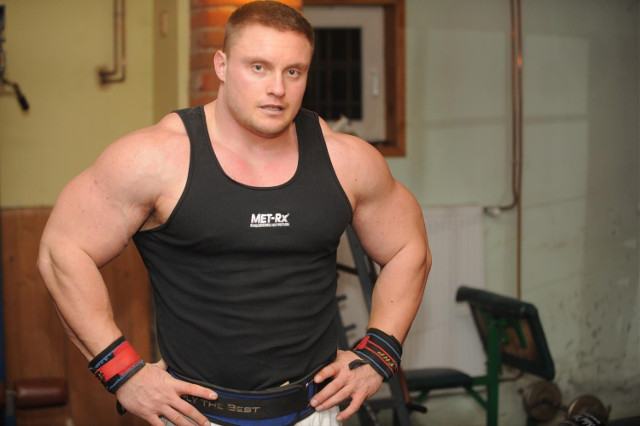
Krzysztof Edward Radzikowski is one of the most important Polish strongmen of the generation that followed the international breakthrough created by Mariusz Pudzianowski. Born in Głowno on 18 August 1981 and formerly a physical-education teacher, Radzikowski built an unusually long and competition-dense international career from 2005 to 2019: 2012 World Strongman Federation world champion, overall Strongman Champions League winner in 2013 and 2015, SCL runner-up in 2014 and 2016, a 2012 World's Strongest Man finalist, and a multiple podium finisher at Arnold Australia and Europe's Strongest Man. He became especially associated with elite overhead strength, including a 217.5 kg log lift, while remaining dangerous in deadlift, yoke, carries and moving events. After his competitive strongman years he became a major Polish television personality through “Gogglebox. Przed telewizorem”, co-created the Strong Ekipa media project and briefly competed in professional MMA.
Krzysztof Edward Radzikowski occupies a distinctive place in the history of modern Polish strongman. He emerged after Mariusz Pudzianowski had already turned Poland into one of the sport's most visible nations, but he did not build his reputation by trying to reproduce Pudzianowski's career. Radzikowski became a different kind of elite athlete: an exceptionally durable circuit competitor whose strength was measured not only in single lifts but in the ability to travel, adapt, score points and remain dangerous across entire seasons. Strongman Archives currently records 110 international contests and 23 international victories for him, in addition to national and single-event appearances. That volume is remarkable in a sport where injuries, travel, irregular equipment and extreme loading often shorten careers. His major achievements tell the story clearly. He won the World Strongman Federation world title in 2012, reached the World's Strongest Man final that same year and placed sixth, finished second at the 2012 Arnold Europe, won the overall Strongman Champions League championship in 2013, finished second in the SCL standings in 2014, reclaimed the title in 2015 and was runner-up again in 2016. He also finished second at Arnold Australia in both 2015 and 2016 and collected multiple podiums at Europe's Strongest Man. His competitive identity was anchored by elite overhead power. A 217.5 kg log lift at the 2016 Arnold Australia became one of the best-known numbers attached to his career, while a 415 kg contest deadlift and a 466 kg Hummer Tire Deadlift showed that he was far more than an overhead specialist. Radzikowski's historical value lies in that combination. He could press at world-class level, pull more than 400 kilograms, move quickly enough to win farmers and medleys, and return week after week with enough consistency to win a global league. His career is therefore best understood as an argument for breadth, durability and competitive intelligence rather than for a single spectacular moment.
Radzikowski was born on 18 August 1981 in Głowno, a town in the Łódź region that remained central to his public identity. The official biography published by the city provides unusually useful detail about his formative years. He attended Primary School No. 1 in Głowno and later Technikum Samochodowe No. 1 in Łódź, an automotive technical school. He then studied physical education and health at the University of Łódź, within the Faculty of Educational Sciences, and later worked as a physical-education teacher at Zespół Szkół Rolniczych in Bratoszewice. These details matter because they place his athletic development in a wider professional and educational context. Radzikowski was not raised inside a full-time professional strongman system. Before international competition became his main occupation, he had technical schooling, university training and experience teaching physical education. That background helps explain the disciplined, structured side of the athlete who would later survive an extremely dense competition schedule. Poland at the time was also experiencing a strongman boom. Pudzianowski's World's Strongest Man titles and extensive television coverage of domestic contests had made strength sport far more visible than it was in most countries. Young athletes could watch major strongman events on television, attend national competitions and see a realistic pathway from local strength training to international stages. Polish media later described Pudzianowski as an early mentor or coaching influence for Radzikowski. The exact nature and duration of that relationship is less thoroughly documented than Radzikowski's competition record, so it is safer to describe it as part of his early strongman environment rather than as a lifelong formal coaching arrangement. What is certain is that he developed inside one of the deepest national strongman scenes of the era. Training and competing around experienced Polish athletes meant learning early that strongman was not simply conventional gym lifting. Implements changed, rules varied, and success required maximal strength, speed, grip, technique and the ability to perform while fatigued.
Statistical archives place the beginning of Radzikowski's competitive strongman career in 2005. His rise was not instantaneous, and that gradual progression is important to understanding him. He spent several years developing from a capable Polish competitor into an athlete who could challenge for European and world-level podiums. Strongman in the mid-2000s was less standardized than many modern fans assume. Contest organizers frequently used locally built implements, unusual loading heights and event combinations that could change substantially from one weekend to another. Athletes who traveled internationally needed more than gym strength. They needed to solve new objects quickly, recover from flights and long drives, compete in different climates and manage six or seven events in a day without losing technique. Radzikowski became particularly well suited to this ecosystem. At roughly 1.88 metres and around 145 to 150 kilograms during his prime, he carried enough mass for maximal static events while remaining mobile enough for yoke, farmers and medleys. His overhead ability soon became the most recognizable technical feature of his profile. Competition records show an 183 kg axle press at the 2010 Europe's Strongest Man, and his pressing numbers continued to rise throughout the following years. Biographical profiles have also reported gym bests around 400 kg in the raw squat and 300 kg in the raw bench press. Those figures are worth recording as reported personal bests, but they are less securely documented than his contest lifts and should not be treated as equivalent evidence. What can be verified is that by the early 2010s he had become a powerful deadlifter, an elite presser and a reliable moving-event athlete. Another defining trait appeared early: he was willing to compete often. His career eventually took him through Europe, Russia, the Middle East, Asia, Australia, Africa and the Americas. The geography itself became part of the achievement. Radzikowski was a true circuit athlete, able to appear in one country and then adapt to a completely different contest only days or weeks later.
Between 2008 and 2010, Radzikowski moved from promising domestic athlete to established European contender. The official Głowno biography lists him third at Poland's Strongest Man in both 2008 and 2009. In 2009 he also became runner-up at Europe's Strongest Man and runner-up at the European Log Lift Championship. Together, those results reveal the two sides of the athlete he was becoming. The overall European podium demonstrated broad event competence, while the log result identified overhead strength as a genuine international weapon. The context inside Poland was demanding. Pudzianowski's dominance had set an extraordinary benchmark, and any emerging Polish strongman was inevitably compared with him. Radzikowski's career, however, developed in a different direction. He would become much more strongly associated with international league competition, especially Strongman Champions League, where regular travel and cumulative points rewarded a particular form of durability. By 2010, even when his overall placing at Europe's Strongest Man was not among his career highlights, the competition produced a useful benchmark: an axle press of 183 kg. At that time overhead strength was evolving quickly, driven above all by athletes such as Žydrūnas Savickas, and a competitor who wanted to remain relevant could not afford to be merely competent in pressing. Radzikowski steadily became one of the athletes who could turn an overhead event into a scoring advantage. More importantly, he learned how to avoid catastrophic weaknesses. In a league format, finishing second or third in an unfavourable event can matter more than winning one spectacular discipline and taking last place in another. The period from 2008 to 2010 was therefore less about one signature victory than about building the competitive architecture that later made his championship seasons possible. By the time he reached the biggest international stages, he already had several years of national podiums, European pressure and exposure to the unpredictability of strongman equipment.
The 2011 season moved Radzikowski into a new level of international visibility. Winning Giants Live Poland mattered for more than the trophy itself. Giants Live had become one of the primary pathways into World's Strongest Man, so a victory on that circuit carried both prestige and practical value. Radzikowski entered the WSM system that year and competed in Group 5. Strongman Archives records him fourth of six athletes, which was not enough to reach the final but established him inside the relevant international field. World's Strongest Man rewards a different competitive skill set from a season-long league. In SCL, consistency across many weekends can absorb one weak event or one poor contest. In WSM qualification groups, a handful of events can decide everything. For an athlete whose greatest strength was repeated high-level performance, the compressed risk of WSM could be less forgiving. Nevertheless, the 2011 appearance provided experience that would become crucial one year later. Elsewhere that season, Radzikowski placed second at Globe's Strongest Man in Moscow and third at the WSF Persian Cup, confirming that he could podium in very different environments. Retrospective strongman records also credit him with an exceptional kettlebell pressing performance at the Moscow contest, where he completed nine repetitions with an 80 kg implement. Historical rep records across different shows must always be treated cautiously because implement shape and judging can vary, but the performance still illustrates a key point: Radzikowski was not only a maximal presser. He could repeat heavy overhead work at speed. That capacity was strategically valuable because strongman regularly uses overhead events for repetitions. By the end of 2011 he had a Giants Live victory, international podiums and WSM experience. The next step was no longer becoming internationally relevant. It was winning major titles.
If one season best explains Radzikowski's transformation from elite competitor into world champion, it is 2012. In February he won the World Strongman Federation World Strongmen Championships in Abu Dhabi. IronMind published the final standings with Radzikowski first on 35 points and Laurence Shahlaei second on 33. The historical prestige of WSF and World's Strongest Man is not identical, but the distinction should not obscure the achievement: this was a legitimate world title within an international federation and one of the defining wins of his career. The rest of the season confirmed that it was not an isolated result. Radzikowski won the WSF World Cup in Uzbekistan, Giants Live Poland, Elite Strongman Moscow and the Slavic Cup. He finished fourth at Europe's Strongest Man and then, at Arnold Europe in Madrid, placed second overall behind Žydrūnas Savickas by only 2.5 points. That Arnold competition also produced his 415 kg contest deadlift, the conventional deadlift figure most strongly supported by the historical results archive. The combination tells us more than either result alone. Radzikowski was already known for overhead strength, yet he could pull more than 400 kg in an Arnold setting and still score strongly enough in farmers, holds and mixed events to finish second overall. He also placed second at the World Log Lift Championships that year, reinforcing his status among the leading overhead athletes of the period. Most importantly, 2012 was the year he converted his growing experience at World's Strongest Man into a place in the final. The season therefore contained almost every category of success available to a professional strongman: a federation world title, major circuit victories, an Arnold podium, a world-class deadlift and a WSM final. At age 31, he had reached an ideal balance between mass, technical experience, confidence and conditioning.
World's Strongest Man 2012 in Los Angeles remains Radzikowski's most important WSM appearance. He qualified for the final and finished sixth with 32.5 points. Žydrūnas Savickas won the title, followed by Vytautas Lalas and Hafþór Júlíus Björnsson, while Brian Shaw finished fourth and Mike Jenkins fifth. Looking back at that field makes Radzikowski's placing easier to appreciate. Several finalists already possessed or would later possess World's Strongest Man or major Arnold titles, while Lalas and Jenkins were exceptional all-round athletes in their own right. The final included Super Yoke, Max Log Lift, Bus Pull, Deadlift, Natural Stones and Power Stairs. That event selection demanded nearly the entire strongman spectrum: speed under load, maximal overhead power, pulling strength, deadlift ability, stone technique and anaerobic endurance. Radzikowski did not have one event that created a large enough advantage to push him onto the podium, but he also avoided a disastrous weakness. That pattern reflects the central logic of his career. He accumulated points rather than depending on one spectacular discipline. At WSM, however, that style can be punished when rivals win multiple events and create larger scoring swings. Savickas, Lalas, Björnsson and Shaw could all generate those peaks. Radzikowski returned to World's Strongest Man in 2013, 2015 and 2018, but he never reached another final. Strongman Archives therefore records five WSM appearances, one final and sixth place as his best result. This does not diminish his broader résumé. Instead, it demonstrates how differently competitive formats can reward athletes. Radzikowski's strengths were most fully expressed over long seasons, where repeated high placings mattered. WSM gave him a compressed opportunity, and in 2012 he converted it into a top-six finish at the sport's most famous competition.
The 2013 season may be the clearest demonstration of what made Radzikowski unusual. Strongman Champions League operated as a travelling championship with stages across multiple countries and points accumulated over the year. Winning demanded far more than one brilliant weekend. An athlete needed health, travel tolerance, technical adaptability and the discipline to keep scoring even when the event selection was imperfect. Radzikowski was almost ideally designed for that system. He won the Lapland stage, SCL Czech Republic, SCL Portugal and SCL Poland. He also reached podiums at FIBO, Holland, Slovakia, Hungary, Gibraltar, Estonia, the Savickas Classic, Brazil and the World Finals. The result was an overall championship with 257 points, comfortably ahead of Žydrūnas Savickas on 193 and Ervin Katona on 175. The 64-point gap over Savickas should not be treated as a statement that Radzikowski possessed greater absolute strength than one of the greatest strongmen in history. It demonstrates what a season championship measures. Savickas could enter selected contests and dominate individual events, while Radzikowski repeatedly appeared, performed and accumulated. In the same year he finished fourth at the Arnold Strongman Classic in Columbus, where he pulled 466 kg in the Hummer Tire Deadlift. He was third at Europe's Strongest Man and won Poland's Strongest Man. He also finished second at Giants Live Poland. These performances show that the SCL crown did not come from an isolated competitive environment. He was simultaneously relevant at Arnold, Giants Live, European and national level. The main disappointment was World's Strongest Man 2013, where he finished third in his qualifying group and missed the final. Again, the contrast between a short elimination tournament and a long league could hardly have been clearer. One contest could close the door; a season rewarded the athlete who returned over and over. By the World Finals in Kuala Lumpur, Radzikowski had transformed durability into a championship.
After winning the league in 2013, Radzikowski confirmed in 2014 that the title had not been a statistical accident. He continued to compete at punishing frequency and won SCL stages in Hungary, Poland, Zambia and Romania. The geography of those victories is itself revealing. Travelling from Central Europe to southern Africa and back means changing climate, sleep, food, equipment and recovery conditions while still being expected to perform near maximal strength. In a professional team sport, athletes often move inside highly controlled systems. Strongman competitors historically faced far less predictable logistics. Radzikowski's ability to remain productive across those changes became one of his great advantages. The annual championship race was exceptionally close. Martin Wildauer finished with 198 points and Radzikowski with 195, a difference of only three. The Polish athlete also placed third at the SCL World Finals in Malaysia, behind Hafþór Júlíus Björnsson and Eddie Hall, which provides useful context for the quality of the field. Not every contest that year was equally successful. His Arnold Strongman Classic and Força Bruta results were less prominent, reminding us that even a highly consistent athlete could suffer poor event matchups, fatigue or ordinary competitive variation. The season also coincided with a moment when a younger generation was reshaping the sport. Hall was becoming a major international force, Björnsson was moving closer to dominance, and league specialists such as Wildauer and Dainis Zageris were making the SCL standings increasingly difficult. Finishing only three points from another championship in that environment was a mature performance. In March 2014, the Głowno city council formally honoured Radzikowski as a distinguished citizen. The recognition moved his career beyond specialist sport and into local civic history. His hometown preserved his education, teaching work and athletic achievements as part of its official record.
If 2013 established Radzikowski as a league champion, 2015 confirmed that the achievement was repeatable. Early in the year he placed second at SCL Norway and reached another high-level podium in Britain. In March, Arnold Australia produced one of the finest performances of his career. Radzikowski finished second overall behind Brian Shaw and ahead of Robert Oberst and Eddie Hall. He won the Farmer's Walk in 23.06 seconds and tied Shaw for first in the Dumbbell Press with eight repetitions. He also pulled 400 kg in the deadlift and pressed a 190 kg log. The result demonstrated the balance that made him difficult to beat across a complete contest. He did not need to own the largest static lift if he could win a moving event, share an overhead victory and remain close to the leaders everywhere else. In April he won SCL FIBO in Cologne, taking the tire deadlift, medley and Max Log Lift at 206 kg. He later won the Festival des Hommes Forts de Warwick in Canada, finished second at Europe's Strongest Man and collected more SCL podiums. World's Strongest Man again proved less forgiving: he finished fourth in his group and missed the final. Yet his response illustrated exactly why the league format suited him. Instead of allowing one elimination to define the season, he kept competing. The year culminated at the SCL World Finals in Antalya, Turkey. Contemporary IronMind reporting had Radzikowski leading after the opening day and chasing the championship; the final standings confirmed both the event victory and the overall crown. He finished the annual table with 256 points, ahead of Dainis Zageris on 213 and Jean-François Caron on 130. His second overall SCL championship is arguably the strongest single argument for his historical status. One league title can arrive in a perfect season. Winning twice, with a runner-up year between them, demonstrates sustained superiority within the unique demands of the circuit.
In 2016 Radzikowski produced the lift most closely associated with his name: a 217.5 kg Max Log Lift at Arnold Australia. The broader contest was equally impressive. He finished second overall behind Hafþór Júlíus Björnsson and narrowly ahead of Žydrūnas Savickas. He placed second in Farmer's Walk, second in Super Yoke, third in the natural-stone event, tied for first in the deadlift at 410 kg and won the log outright at 217.5 kg. The lift became associated with the Polish national record and remains one of the defining numbers of his résumé. Its context matters. This was not a single-event meet where the athlete could dedicate the entire day to one maximal press. It came within a full strongman competition after other demanding events, making it an especially strong expression of competition-specific overhead power. Radzikowski also won SCL FIBO again in April and placed third at Arnold South America. Later in the year he finished second at SCL Portugal and second at the SCL World Finals in Dubai. In the season standings, Dainis Zageris took the championship and Radzikowski finished second. The result completed a remarkable four-year sequence: first in 2013, second in 2014, first in 2015 and second in 2016. Few statistics describe his career better. Four consecutive seasons at either first or second in a global travelling league require more than exceptional strength. They require availability, recovery, strategic judgement and technical breadth. The 2016 season also demonstrated how complete his static profile had become. A 217.5 kg log and a 410 kg deadlift in the same contest made it impossible to reduce him to one event.
As Radzikowski moved beyond his mid-thirties, he entered a period when many strongmen reduce their schedules or leave international competition altogether. He kept going. In 2017 he competed at the Arnold Strongman Classic in Columbus and later finished second at Arnold Europe in Barcelona, showing that more than a decade after beginning the sport he could still reach the podium at an international Arnold event. The following year brought another strong SCL campaign. He won SCL Norway and SCL FIBO, finished second at SCL Romania in Brașov and second at the SCL World Finals in Cancún. He also placed fourth at Arnold Europe and returned to World's Strongest Man in Manila. His WSM Group 4 result, fifth of six, did not take him into the final, but the return itself illustrated unusual longevity. Very few athletes retain the international standing required to appear at WSM across such a long span. The year also gave Radzikowski a record of a very different kind. On 23 November 2018, during the Italian television production “La Notte dei Record” in Rome, he held two 5.2 kg sledgehammers against his head for 1 minute 36.93 seconds. Guinness World Records officially lists the achievement under his full name. The event may appear eccentric next to a 400 kg deadlift, but eccentric strength demonstrations are part of strongman's historical DNA. Grip, leverage, static holds and unusual implements have always existed beside more standardized events. The Guinness appearance also anticipated a broader shift in his career. By this stage Radzikowski was increasingly visible in Polish entertainment media. His identity was beginning to expand beyond the athlete seen only under maximal effort.
The 2019 season is the final year included in Radzikowski's active strongman range by Strongman Archives, and in many ways it compresses his entire career into a few months: victory, injury, rehabilitation and return. In January he won SCL Norway in Vinstra. In April he won SCL FIBO in Cologne, taking the deadlift and scoring highly across the remaining events. At 37 years old, nearly fourteen years after the beginning of his competitive career, he could still win international league stages. In June, however, SCL Holland in Ulft brought one of the most serious setbacks of his career. Polish media reported that Radzikowski tore his biceps during the contest. The injury required surgery to reattach the tendon and an initial rehabilitation period estimated at roughly eight weeks. In strongman, a biceps rupture is especially feared because the sport repeatedly exposes the elbow flexors to heavy mixed-grip deadlifts, stones, tire flips, carries and awkward pulling positions. Surgical repair may restore function, but the athlete must also rebuild trust in movements that once felt automatic. Radzikowski nevertheless returned before the end of the year. He competed at SCL Curaçao and World's Ultimate Strongman Dubai and then finished fourth at the SCL World Finals in November. The archived event results show him second in the deadlift, second in dumbbell press, second in bus pull and first in shot put at that final. Producing such placings only months after major arm surgery says a great deal about his residual strength and technical experience. There was no universally reported farewell contest presented as a ceremonial retirement, but no later strongman competitions appear in his principal statistical record. It is therefore reasonable to treat 2005 to 2019 as his competitive strongman career while noting that his involvement in strength culture continued. The ending was not theatrical. It was an organic transition after a season in which his body had made the costs of nearly fifteen years of high-frequency competition impossible to ignore.
Technically, Radzikowski is easiest to identify through overhead strength. The 217.5 kg log at Arnold Australia 2016 is his best-known contest mark, while a 206 kg SCL giant log at FIBO 2015 shows that the performance was not dependent on one familiar implement. Strongman logs can differ in diameter, handle spacing, balance and cleaning mechanics, so transferring high-level pressing across equipment requires both power and technical adaptability. Radzikowski had already pressed a 183 kg axle at Europe's Strongest Man in 2010, and throughout his career he produced strong results in dumbbell, Viking press, kettlebell and overhead medley events. This is why calling him merely a log specialist understates the breadth of his pressing. He possessed both maximal strength and repeatability. Deadlift formed the second static anchor. Strongman Archives records 415 kg at Arnold Europe 2012 and 466 kg in the Hummer Tire Deadlift at the 2013 Arnold Strongman Classic. These figures cannot be compared directly because the Hummer setup uses a different bar and pulling height, but together they demonstrate an elite posterior chain across multiple deadlift variations. Reported gym figures of approximately 400 kg in the raw squat and 300 kg in the raw bench press appear in biographical sources, but they are best treated as reported personal bests rather than competition results supported by the same level of documentation. What made Radzikowski a league champion, however, was not simply the combination of log and deadlift. He could score heavily in Farmer's Walk, Super Yoke, frame carries, Power Stairs, truck pulls and medleys. At Arnold Australia 2015 he won Farmer's Walk. At other SCL stages he repeatedly used moving events to protect his overall position. For a competitor close to 150 kg, the ability to accelerate, turn and maintain technique under fatigue was a genuine weapon. That mobility prevented rivals from treating him as a static specialist with an obvious weakness.
At approximately 1.88 metres and around 148 kg during his competitive prime, Radzikowski had proportions well suited to open-weight strongman in the 2010s. He was tall enough to benefit from useful leverages in deadlift and moving events but not so tall that every overhead movement became excessively long. His body mass provided stability and absolute-force potential, while the cost of carrying that mass made conditioning an essential part of the equation. His results in farmers, yoke and medleys therefore reveal as much about preparation as his static records do. There is no complete, publicly verified training diary covering his prime, and many generic internet articles describe a supposed 'Radzikowski workout' without documenting what he actually performed in each phase. A serious biography should resist inventing a precise weekly split. What can be inferred cautiously from his competition schedule is that his training had to prioritize implement familiarity, recovery and flexible load management. An athlete entering numerous SCL stages cannot treat every week like a peaking powerlifting block. Some competitions effectively become training stimuli, and gym volume must be adjusted around travel and accumulated fatigue. Radzikowski managed that equation better than most. His overhead results imply repeated exposure to log, axle, dumbbell and leg-driven pressing. Pulling more than 400 kg required a deep base of maximal posterior-chain strength. Strong yoke and farmers performances required foot speed, bracing, grip and technical practice under moving load. SCL also used unusual local events: holds, barrels, stairs, stones and custom implements. No gym could reproduce every variation exactly. Experience itself became part of training. After dozens of contests, a veteran can often understand an unfamiliar object during warm-up and save seconds through better positioning. Radzikowski accumulated that form of practical intelligence across hundreds of events. His body provided the horsepower; repeated exposure taught him how to apply it under conditions that were never perfectly standardized.
For international audiences, Polish strongman is inevitably associated with Mariusz Pudzianowski, but reducing an entire national tradition to one athlete hides how deep the Polish scene became. The country produced competitors such as Sebastian Wenta, Grzegorz Szymański, Mateusz Baron, Robert Szczepański and many others who created a difficult domestic environment and fed athletes into European competition. Radzikowski emerged from that system but represented a different historical phase. Pudzianowski's mythology was built above all around World's Strongest Man and the highly televised classic format. Radzikowski was almost perfectly suited to the era of overlapping international circuits. He competed in a world where an elite strongman could appear at Arnold, Giants Live and SCL within the same season, each organization rewarding slightly different qualities. His greatness did not consist of replicating five WSM titles. It consisted of creating an alternative form of elite career: two overall SCL championships, a WSF world title, multiple Arnold podiums, a WSM top-six finish and an extraordinary volume of international contests. That distinction matters because strongman has never had one single championship system. WSM rewards a peak over a short tournament. SCL rewards a season. Arnold competitions have often emphasized extreme static strength and very heavy implements. Giants Live combines spectacle, elite competition and qualification pathways. Radzikowski was good enough to podium across several systems but truly exceptional in the one that demanded sustained yearly consistency. His 2013 and 2015 SCL titles are therefore not secondary footnotes. They are the key to his historical identity. He carried the Polish strongman tradition from the Pudzianowski era into a more globalized landscape and demonstrated that Polish relevance did not end when one superstar changed sports.
One of the most interesting transformations in Radzikowski's biography is that his public relevance did not end when strongman competition did. In Poland, many strength athletes become far less visible after retirement. Radzikowski moved in the opposite direction and became familiar to people who may never have watched an SCL stage. Since the mid-2010s Polish media have associated him with TTV's “Gogglebox. Przed telewizorem,” a programme in which participants watch television and comment on it spontaneously. Radzikowski formed a particularly popular pairing with Dominik Abus. The contrast was immediately effective: a former elite strongman, physically enormous compared with an ordinary television personality, appearing not under a yoke or log but on a sofa, joking and reacting to everyday entertainment. The format revealed qualities that competition footage rarely shows. In an arena, an athlete's public expression is filtered through maximal effort, concentration, adrenaline and fatigue. On Gogglebox, audiences saw humour, friendship, timing and self-irony. That did not erase his athletic history. Instead, his physical presence and reputation as an exceptionally strong man became part of the television persona without having to dominate every conversation. The transition is important to the cultural history of strength sport. Strongman gave Radzikowski recognition, but mainstream television extended the life of that recognition beyond the competitive window. For older viewers he remained the athlete who had fought Savickas, Shaw and Björnsson. For younger or more casual audiences he could first be the familiar figure from Gogglebox and only later the man who had pressed 217.5 kg and won two SCL championships. Both identities coexist. That rare crossover from niche elite sport into durable mainstream entertainment helps explain why Polish media continue to report on Radzikowski years after his final archived strongman contest.
Television was not the final stage of Radzikowski's media career. He also became closely associated with Strong Ekipa, a Polish YouTube project developed with Konrad Karwat and featuring a wider circle of friends, athletes and entertainment personalities. Channel-monitoring sources describe the project directly through the names of Krzysztof Radzikowski and Konrad Karwat and record an audience in the hundreds of thousands of subscribers with well over one hundred million cumulative views by 2026. Those totals change constantly, but the scale makes one point clear: Strong Ekipa is not a minor post-retirement hobby. It created a second public life for Radzikowski's experience in strength sport. The content is broader than training instruction. It includes conversations, challenges, humour, reactions, visits, sport and internet culture. For a purist, that mixture may seem distant from competition, yet it performs an important function for strongman history. A retired champion can stay connected with an audience without pretending to remain at peak competitive weight or strength. Radzikowski can discuss old contests, training and injuries while also showing ordinary life after elite sport. Online media also preserve something television handles less well: long-form informal memory. Interviews and conversations can return to events with details that never appear in official result sheets. Such material must be used critically because memory can be approximate and casual conversation can contain exaggeration, but it remains valuable as human context. Strong Ekipa therefore extends Radzikowski's legacy beyond medals. It allows an athlete from the 2005-2019 competitive era to speak directly to an audience formed partly in a completely different media generation.
In 2021, two years after his last archived strongman season, Radzikowski accepted a completely different athletic challenge: mixed martial arts. At FAME 12 on 20 November 2021, he faced Piotr “Bestia” Piechowiak. Tapology and Sherdog record the bout as Radzikowski's professional MMA debut. The weigh-in listed him at roughly 117.8 kg, dramatically below the 145-150 kg range associated with his peak strongman years. The fight lasted all three rounds and ended in a unanimous decision for Piechowiak. Polish MMA reporting listed all three scorecards at 30-26. Nothing in the result suggests that Radzikowski was beginning a second elite sporting career, and his professional record remained 0-1. The significance of the episode lies elsewhere. A strongman in his forties moving into MMA must reorganize almost every physical priority. Strongman rewards extreme body mass, maximal force and short bursts of work. MMA demands mobility, repeated cardiovascular effort, striking defence, grappling, tactical decision-making and the ability to remain technically coherent while being hit or controlled by another person. Strength helps, but it cannot replace years of sport-specific skill. Radzikowski's much lower body weight already demonstrated how seriously the physical transition had to be taken. His defeat should neither be mocked nor romanticized. He lost clearly on the scorecards, but he also entered a rule set in which decades of strength training did not automatically provide expertise. The bout is best understood as a short post-strongman experiment within Poland's popular entertainment-fight scene. Biographically, it reinforces a recurring pattern: Radzikowski did not freeze his identity at the moment his strongman career ended. He was willing to change bodyweight, learn unfamiliar skills and expose himself to a new form of public risk.
Despite becoming a highly visible television and online personality, Radzikowski has generally maintained a clearer boundary around his family than around his own public life. Polish entertainment media repeatedly noted that he did not constantly expose his relationship or home life. His partner is Michalina Pyszkiewicz. In June 2021 the couple became parents to a son, Antoni, often referred to affectionately as Antoś in Polish reporting. Biographical coverage gives 24 June 2021 as his birth date. In 2024 the family welcomed a daughter, Hania. Dzień Dobry TVN, RMF FM and Fakt reported the announcement on 14 June 2024 after Radzikowski publicly shared a photograph of the newborn and her name. In a profile centred on athletic history, such information should be handled proportionately. The fact that his partner and children appear in public sources makes basic mention appropriate, but their lives should not be treated as material for unnecessary investigation. The biographical relevance is the transition itself. For more than a decade, Radzikowski's calendar was organized around travel, training, food, recovery and competitions. Fatherhood arrived in the post-strongman phase, when his public identity was shifting toward television and online media. Polish coverage of him increasingly reflects that change. Images of Radzikowski with his children contrast sharply with the competition photographs in which he pulled trucks or pressed logs heavier than many adults. They show a different scale of life after elite sport. Importantly, he has not turned family exposure into the sole basis of his public brand. Michalina and the children appear from time to time, but his media identity remains broader. The appropriate factual conclusion is simple: his publicly known family includes partner Michalina Pyszkiewicz and their children Antoni and Hania, and the growth of that family belongs to the same period in which competitive strongman gave way to a more stable media and post-athletic life.
One of the most visible changes after competition was Radzikowski's major reduction in bodyweight. Strongman databases list him around 148 kg during his competitive career. For the FAME 12 MMA debut in 2021, he weighed approximately 117.8 kg. Polish media continued to follow the transformation and by 2023-2026 repeatedly described him as more than 30 or 35 kilograms lighter than during his strongest years. That change means more than a before-and-after photograph. The body of an open-weight professional strongman is purpose-built for a very unusual task: generating maximum force against implements weighing hundreds of kilograms. Maintaining 145 to 150 kg demands a high caloric intake, creates significant orthopaedic and cardiovascular load and organizes daily life around recovery. Once the competitive objective disappears, the same mass may no longer be useful. Radzikowski followed a path seen in several veteran strength athletes: reducing bodyweight substantially while retaining a muscular build and a recognizable identity as a strength athlete. The change also clarifies how profile statistics should be read. The approximately 148 kg figure belongs to the historical competition context. It should not be presented as a claim about his current bodyweight. By 2021 he had already dropped to roughly 118 kg, and later Polish coverage continued to emphasize the leaner physique. For viewers, the transformation unintentionally teaches something important about elite strongman. A competitor does not simply 'naturally weigh' 150 kg in a fixed personal sense. That mass is often created and maintained because the sport rewards it. When the goal changes toward mobility, health, family life, television or combat-sport conditioning, the body can be recalibrated. Radzikowski's post-career transformation makes that transition unusually visible.
A career containing more than one hundred international contests cannot be understood only through medals. Every strongman start exposes the athlete to loads near the limits of human tissue and technique. A season containing ten or more competitions can mean hundreds of heavy pulls and presses, repeated yoke and farmers sprints, stones, awkward carries and unfamiliar objects performed under fatigue. Radzikowski sustained that rhythm for years, which demonstrates extraordinary robustness, but robustness is not invulnerability. The 2019 biceps tear is the clearest documented major injury from the closing phase of his career. Returning within months did not make the injury trivial. Tendon repair changes not only tissue but confidence. A movement that once felt automatic can become psychologically charged because the athlete now knows exactly what failure feels like. Strongman compounds this problem because competition rarely provides perfectly controlled loading. Radzikowski proved that he could return to heavy pulling and pressing, but by his late thirties the biological equation was different from the one he faced in 2012. This is why the question 'why did he stop competing?' should not be reduced to motivation. After nearly fifteen years, a major tendon injury, a growing television career and new opportunities outside competition, the risk-to-reward ratio had changed. Strongman historically does not provide the guaranteed long-term contracts or pension systems found in major professional team sports. Another serious injury can affect the rest of an athlete's working life. Seen in that context, Radzikowski's move toward television and digital media was not a retreat from strength culture. It was a rational career transition that preserved his public relevance while reducing the need to expose his body to maximal contest stress every month.
Radzikowski's career can be underestimated if it is viewed exclusively through World's Strongest Man. He made five WSM appearances and reached one final, finishing sixth in 2012. For casual audiences who treat WSM as if it were synonymous with the entire sport, that line may appear modest. Professional strongman in the 2010s was a multi-centred ecosystem. Arnold competitions offered exceptionally heavy contests and enormous prestige. Giants Live provided major shows and WSM qualification routes. Strongman Champions League organized a global season. World Strongman Federation held its own international championships. Radzikowski won in the systems that best rewarded his particular strengths. The 2012 WSF world title, two SCL overall championships, two SCL runner-up seasons, two Arnold Australia runner-up finishes, an Arnold Europe runner-up result and repeated Europe's Strongest Man podiums form a résumé far stronger than a single WSM line suggests. Strongman Archives currently credits him with 110 international contests and 23 international victories. Historical databases can change as new result sheets are recovered, but the scale is unmistakable. His career also spans nearly every major family of strongman event. He won or scored highly in overhead pressing, deadlift, farmers, yoke, medleys, pulls and holds. This is why he can be described as a championship-system athlete. His value becomes clearest when hundreds of event performances and multiple seasons are considered together. In cycling there are specialists for one-day classics and athletes built for multi-stage tours. Strongman has a comparable distinction. Radzikowski was exceptionally suited to the long season: statically powerful enough to win heavy events, mobile enough to avoid major losses on movement, and durable enough to keep collecting points.
Radzikowski's Arnold record deserves separate attention because Arnold strongman contests often tested a heavier and more static form of the sport than an ordinary SCL stage. The Arnold Strongman Classic in Columbus became the laboratory of extreme strength during the Savickas-Shaw era, using giant deadlift implements, heavy presses and events that rewarded absolute force. Radzikowski finished fourth there in 2013 and pulled 466 kg in the Hummer Tire Deadlift. Later results in Columbus were less prominent, but the expanding international Arnold series suited him well. At Arnold Australia 2015 he finished second to Brian Shaw. In 2016 he again finished second, this time to Hafþór Júlíus Björnsson and ahead of Žydrūnas Savickas. Those consecutive podiums are among the most valuable results of his career because they show that his success was not limited to a speed-based league format. In 2015 he won Farmer's Walk and shared first in the Dumbbell Press. In 2016 he shared the deadlift victory at 410 kg and won Max Log Lift with 217.5 kg. In other words, he could score decisively both while moving and in the heaviest static events. Arnold Europe adds further evidence. Radzikowski finished second in 2012, third in 2016, second again in 2017 and fourth in 2018. These results matter because international Arnold contests attracted men who had won or would win the most prestigious championships in strength sport. Finishing ahead of such athletes in a complete contest validates Radzikowski beyond the SCL system. The league showed his durability. Arnold showed that when the equipment became brutally heavy, he still belonged near the front.
Europe's Strongest Man offers another useful lens through which to view Radzikowski's development. The official Głowno biography records him as European runner-up in 2009, one of the first major achievements of his international rise. In 2010, even though the overall result was not among his best, he produced the 183 kg axle press that remains a useful benchmark of his early overhead strength. He finished fourth in 2012, third in 2013 and returned to second place in 2015. Spread across six years, those results show unusual ability to remain in the continental podium conversation as the field changed around him. Europe was the geographical centre of elite strongman during this period. Savickas came from Lithuania, Björnsson from Iceland, Lalas from Lithuania, Shahlaei and Hall from Britain, while Central and Eastern Europe continually produced world-class competitors. A European podium was therefore not an easier route around the world's best athletes. It frequently meant meeting them directly. For Radzikowski, Europe's Strongest Man also connected his specialist overhead identity with his broader all-round value. He was not simply a medalist in a log-lift side event. He finished second overall against a field requiring performance across multiple disciplines. The 2015 runner-up result is particularly significant because it came deep into his career, after he had already accumulated years of travel and competition and while a new generation was becoming stronger. Remaining on the European podium after winning WSF and SCL championships showed that his success had not been confined to one brief peak. It was sustained across changing formats and changing opposition.
Strongman Archives records five World's Strongest Man appearances for Radzikowski: 2011, 2012, 2013, 2015 and 2018. Only in 2012 did he move from the qualifying group into the final. At first glance, one final from five appearances may appear surprising for a man who twice won the Strongman Champions League season. The explanation lies partly in competitive format. WSM qualifying groups are highly sensitive to the particular opponents and events assigned to each group. An athlete can possess a very high season-long average and still meet two rivals whose strengths align perfectly with the available events. In 2013, for example, Radzikowski finished third in his group and missed qualification by one position. In 2015 he was fourth in his group, and in 2018 fifth. Those outcomes do not mean that he had suddenly fallen outside the elite in those seasons, because his performances elsewhere show major SCL and Arnold results at the same time. They show how much risk WSM compresses into a small number of events. This is important when interpreting strongman history statistically. Fans often rank entire careers by WSM medals alone, but such a method ignores different contest systems and the role of qualification structure. Radzikowski is a particularly useful example because his total career looks much stronger than his WSM summary in isolation. When the events and form aligned in 2012, he reached sixth in the final. In other years, one group ended the opportunity. His WSM history therefore does not contradict his league success. It highlights the difference between proving oneself repeatedly over a season and surviving a short elimination tournament where a few points can erase months of form.
The figure of 110 international contests can look abstract until its logistical meaning is considered. Professional strongman is not a closed league with identical venues, charter travel and standardized medical support. Radzikowski competed in northern and central Europe, the Balkans, Russia, the Middle East, South America, North America, Africa, Australia and Asia. He moved from winter conditions in Scandinavia to heat in Brazil, the Gulf or the Caribbean. He competed in arenas, exhibition halls, outdoor city spaces and temporary venues, often with implements built specifically for a local show. Every destination carries travel fatigue, food changes, disrupted sleep and equipment uncertainty. A 400 kg yoke does not feel identical on two frames with different crossbars or flex. Farmer's handles can change diameter and pick height. Logs vary in balance and clean mechanics. Veteran circuit athletes learn to interpret those differences during warm-up. Radzikowski turned adaptation into a competitive skill. That is why contest count is not just trivia. It is an indirect measure of health, reputation, economic viability and organizer trust. An athlete continues to receive invitations because promoters believe he can perform and because audiences want to see him. Remaining part of that network from 2005 through 2019 demonstrates more than personal enthusiasm. It shows that Radzikowski retained competitive and commercial value across several phases of the sport. He also had to solve the hidden problem of recovery. Every flight after a six-event contest begins the preparation for the next one. There is no clean boundary between competition, travel and training. His league championships were built inside that messy reality, which makes the raw number of appearances an important part of the sporting achievement.
In strongman, overhead pressing is not one movement. The log requires a clean from the lap or abdomen, control of a thick implement and efficient transfer of leg drive through the torso. The axle changes both the clean and the balance of the press. A giant dumbbell is unilateral and demands extraordinary stability. Viking press rewards rhythm, speed and repeated effort. Radzikowski was effective across all of these families, which is why the label 'log specialist' is accurate but incomplete. The 217.5 kg log is the iconic number, yet his career also contains high-level results in axle, dumbbell and Viking press. At Arnold Australia 2015 he tied Brian Shaw for first in the Dumbbell Press. At SCL FIBO 2015 he won the max log at 206 kg after competing in other events. At different SCL stages he demonstrated high repetition capacity in Viking-style presses and overhead medleys. This points to a complete overhead system: maximal power, repetition endurance, coordination and the ability to handle different objects. Biomechanically, such a profile requires more than large shoulders and triceps. The legs must create force efficiently, the trunk must remain rigid enough to transfer it, and breathing must be controlled under heavy bracing. At weights above 200 kg, small errors in the clean or rack position can determine whether the press even begins. Radzikowski accumulated enough technical experience to make movement efficiency a multiplier of raw strength. That is one reason his overhead performance remained competitive even as younger specialists entered the international field. He was not simply muscling objects upward. He had spent years learning how different implements behaved.
Reducing Radzikowski to overhead strength would ignore one of the most important parts of his competitive record: the deadlift. A 415 kg conventional-style competition pull at Arnold Europe 2012 was elite for the period, while the 466 kg Hummer Tire Deadlift at the 2013 Arnold Strongman Classic showed how well his posterior-chain strength transferred to a raised, long-bar variation. In 2016 at Arnold Australia he tied for first in the deadlift at 410 kg alongside Björnsson, Savickas and Eben le Roux. Even in 2019, after the biceps injury and surgical repair, he returned to finish second in the deadlift at the SCL World Finals. Together, these performances demonstrate both force and technical longevity. Strongman deadlift is rarely one perfectly standardized powerlifting movement. Athletes may encounter thick bars, elevated pulls, cars, frames, tires or unusual flex. The ability to change start position, timing and bracing is critical. Radzikowski was not the absolute world-record deadlifter of his generation, particularly once Eddie Hall and later athletes pushed the discipline toward unprecedented numbers, but he was powerful enough that opponents could not count on taking a major scoring advantage from him. For a league champion, that matters enormously. A competitor can survive being slightly behind the best specialist; it is much harder to survive having one foundational event that repeatedly sends him to the bottom of the table. Radzikowski's deadlift prevented that structural weakness. It also complemented his overhead ability, giving him two static pillars around which the rest of his contest strategy could be built.
A circuit champion must think differently from an athlete chasing a single-event record. Sometimes the smartest decision is not to attempt another ten kilograms but to secure third place, preserve the body and attack the next four events. Radzikowski's results strongly suggest this kind of competitive maturity. In many contests he did not dominate every discipline, but he remained close to the leaders. At Arnold Europe 2012, for example, enough high placings accumulated to leave him only 2.5 points behind Savickas. Across SCL seasons, repeated second and third places were structurally as important as stage victories. A win creates a spike in points; ten podiums build a championship. Strongman is often marketed as a sport of maximal gestures, yet a season championship is also a sport of management. Athletes must choose attempts, estimate risk, understand rivals and accept that fourth place in one event can be a strategically good result. Radzikowski excelled in this economy of points. His four-year run of first, second, first and second in SCL from 2013 through 2016 cannot be explained by raw strength alone. It reflects experience acquired through hundreds of events: knowing when to attack, when to protect position, how to recover between disciplines and how to avoid emotional decisions after a mistake. Competitive intelligence is difficult to photograph, but it appears clearly in long-term standings. Radzikowski repeatedly converted it into championships.
Radzikowski's later success in television would have been difficult to predict from competition photographs alone. In the arena he appeared massive, focused and often visibly transformed by maximal effort. Belts, wraps, chalk and the posture of a man preparing to move hundreds of kilograms created an intimidating image. Gogglebox revealed something very different: conversational timing, humour, self-irony and a willingness not to treat his own strength persona as sacred. That contrast helped him cross from specialist sport into mainstream Polish entertainment. It also influenced how audiences could perceive strongmen. Instead of the stereotype of a giant man who exists only to lift objects, viewers saw someone with ordinary reactions, friendships and domestic routines. Radzikowski was not the first athlete to make such a transition, but the durability of his media relevance is notable. He remained recognizable years after leaving competition and carried part of that audience into Strong Ekipa. For the sport, this kind of visibility has cultural value. Niche disciplines need former athletes who remain public enough to keep the history alive. Even when a television segment or YouTube episode has nothing to do with strongman, the presence of a former champion keeps the connection available. A younger viewer may discover the athlete through entertainment and later find footage of the 2016 log lift or the 2013 SCL season. Radzikowski's public identity therefore became a bridge between eras of media as well as eras of strongman.
A balanced historical assessment should avoid two opposite errors. The first would be to elevate Radzikowski above multiple World's Strongest Man champions simply because he accumulated an enormous number of contests. The second would be to reduce him to 'a sixth-place WSM finalist' and ignore the rest of the sport. His real position is more interesting. Radzikowski was one of the finest circuit strongmen of his era: a two-time overall Strongman Champions League champion, WSF world champion, repeated European medalist, two-time Arnold Australia runner-up and world-class overhead athlete. His long career also connected different phases of modern strongman. He was active during the later Pudzianowski period, competed through the Savickas-Shaw era, faced the rise of Björnsson and Hall and remained good enough to win SCL stages in 2019. That historical span made him a living link between generations. In Poland his role is especially clear. After Pudzianowski, relatively few Polish strongmen combined comparable international volume, league success and public visibility. Radzikowski was not a copy of his famous predecessor. He was produced by the same powerful national culture but optimized for a different competitive world. His legacy can therefore be summarized through three qualities: strength, consistency and longevity. The numbers are impressive, but the larger achievement was remaining useful in almost every type of contest for long enough to turn repeated usefulness into championships.
Viewed retrospectively, the period from 2012 through 2016 forms the competitive core of Radzikowski's career. Almost every season within those five years contains a result that could stand as the defining achievement of an international strongman's entire résumé. In 2012 he became WSF world champion, finished sixth in the World's Strongest Man final and placed second at Arnold Europe, where he pulled 415 kg. In 2013 he was fourth at the Arnold Strongman Classic, third at Europe's Strongest Man and overall Strongman Champions League champion with 257 points. In 2014 he missed another SCL title by only three points after winning league stages in Hungary, Poland, Zambia and Romania. In 2015 he reclaimed the overall championship, finished second at Arnold Australia and second at Europe's Strongest Man. In 2016 he again finished second in the SCL season and second at Arnold Australia, where he pressed the 217.5 kg log and tied for the deadlift win at 410 kg. The continuity of those results is central to any evaluation of his peak. An athlete's prime should not be measured only by the heaviest object lifted on one afternoon. It should also be measured by the length of time over which he can reproduce elite outcomes against elite opposition. Five years is a long period in strongman. Event selections change, new athletes arrive, tissues accumulate damage and travel imposes its own fatigue. Radzikowski remained relevant through all of it. The period also sits across two generations. Savickas and Shaw were established champions; Björnsson was becoming increasingly complete; Eddie Hall was moving toward WSM victory; Lalas, Zageris, Caron, Shahlaei and others made every major event deep. Radzikowski did not benefit from an unusually weak competitive window. He produced his best years during a period of exceptional international strength. When he finished ahead of a world champion in a particular contest, that did not mean he possessed greater absolute ability in every dimension. It meant his combination of events, execution and consistency was better on that weekend. That distinction is the essence of strongman. There is no single form of strength. There are different expressions of force applied to changing objects, distances, time limits and rules. Between 2012 and 2016, Radzikowski demonstrated almost every form of elite competitive competence: maximal static force, repetition endurance, speed under load, implement technique, recovery and the ability to repeat all of them season after season.
A strongman's biography becomes meaningful only when placed beside the athletes he had to beat. Radzikowski competed in a period when Žydrūnas Savickas could win both World's Strongest Man and the Arnold while setting extraordinary overhead standards, Brian Shaw combined enormous size with exceptional technical efficiency, Hafþór Júlíus Björnsson evolved from a tall and mobile newcomer into one of the most complete strength athletes in history, and Eddie Hall pushed deadlift toward the once-unthinkable 500 kg barrier. Within Strongman Champions League, Dainis Zageris, Ervin Katona, Martin Wildauer, Jean-François Caron and other circuit specialists could turn any stage into a difficult points battle. Radzikowski therefore did not have one simple defining rivalry. His real rival was the standard of the generation. Sometimes he defeated Savickas in an event and sometimes he finished well behind him. In Australia he could beat enormous men in Farmer's Walk or share a deadlift victory with some of the strongest pullers in the world. In SCL, Zageris became consistent enough to beat him across the 2016 season after the Pole had controlled other years. This diversity of opposition forced Radzikowski to remain adaptable. He could not build a strategy around one decisive strength. If Savickas dominated the press, points had to be recovered in movement. If a faster athlete won the yoke, Radzikowski needed a podium in deadlift or log. The league championships were created from that arithmetic. For this reason, his rivalries are better understood as a network than as one dramatic head-to-head feud. There is no single opponent who explains his career. Instead, an entire era of remarkable strongmen formed the measuring stick. This makes his longevity particularly meaningful. He competed through the later Pudzianowski years, the Savickas-Shaw centre of gravity, the rise of Björnsson and Hall, and still remained capable of winning SCL stages in 2019. An athlete who can stay near the front while champions, event records and contest styles change around him has demonstrated more than raw talent. He has demonstrated adaptation.
Any serious strongman profile must address a problem that frequently distorts record discussions: two identical numbers do not necessarily describe identical performances. A conventional deadlift bar, an elephant-style long bar, a Hummer Tire Deadlift and an 18-inch pull differ in geometry, range of motion, flex and starting position. Logs can vary in diameter, handle spacing and centre of mass. Farmer's handles change in thickness and pick height. Even the surface under a yoke can alter an event dramatically. That is why Radzikowski's 415 kg conventional-style contest deadlift and his 466 kg Hummer Tire Deadlift are recorded separately rather than presented as if the second number automatically meant he was fifty-one kilograms stronger in an ordinary deadlift. The same principle applies to overhead records. His 217.5 kg log is linked to the 2016 Arnold Australia context, where the implement and judging are known, while the reported 400 kg squat and 300 kg bench press are treated as personal bests found in biographical sources rather than as contest results supported by equivalent primary documentation. This distinction does not weaken the athlete. It protects the biography from mythology. Strongman has a strong oral culture, and impressive numbers can circulate for years after their original context is lost. Databases such as Strongman Archives make historical reconstruction much more reliable, but they too can evolve as old result sheets are found and corrected. The responsible approach is therefore to attach a contest, year and event type whenever possible. Radzikowski's verifiable figures are impressive enough without exaggeration: 415 kg in the Arnold Europe deadlift, 466 kg in the Arnold Classic Hummer Tire Deadlift, 217.5 kg in the Arnold Australia log and 183 kg in an Europe's Strongest Man axle event. His Guinness World Record belongs to yet another category with its own official verification. Strongman is a sport of objects rather than perfect laboratory standardization. That variety is part of its appeal, but it also requires historical discipline when comparing athletes across years and organizations.
The final part of Radzikowski's legacy is not contained in a results table. It lies in the way he built a public life after the competition body was no longer the central objective. For strongmen, this transition can be among the hardest parts of a career. For years, daily identity is organized around one basic question: what must I do today to be stronger at the next contest? Meals, sleep, travel, recovery and relationships are filtered through a sporting calendar. When that calendar disappears, the athlete has to rebuild more than body composition. He has to rebuild routine and purpose. Radzikowski did so through television, family, Strong Ekipa, public appearances and even the short MMA experiment. He lost tens of kilograms without abandoning the broader identity of a strength athlete. He remained connected to gyms and strength culture without pretending that he was still the 148 kg competitor who fought Shaw and Savickas. That acceptance of change is meaningful. For younger Polish strongmen, his example is not only 'win competitions.' It also demonstrates the value of building skills and relationships that survive the competitive years. Strongman historically offers limited long-term financial security compared with major professional leagues. Media literacy, education, communication skills and a relationship with an audience can therefore become important parts of an athlete's future. Radzikowski's earlier experience as a physical-education teacher, his relaxed television presence and his familiarity with sport all provided tools for a second phase. Not every champion needs or wants to become a television personality, and media visibility should never be the sole measure of post-career success. But Radzikowski shows that retirement from competition does not have to mean disappearance. It can mean changing platforms. The SCL champion, the former teacher, the father, the television personality and the online creator are not separate biographies. They are successive forms of the same life.
Krzysztof Radzikowski's legacy sits at the intersection of performance, durability and popularization. As an athlete, he demonstrates why professional strongman cannot be reduced to a single championship. As a Polish competitor, he carried one of the world's strongest national traditions into an era of increasingly global circuits. As an overhead specialist, he left the 217.5 kg log and numerous high-level axle, dumbbell and Viking press performances. As an all-round strongman, he paired that pressing with 400-plus-kilogram deadlift strength and enough movement ability to win farmers, medleys and other dynamic events. As a public figure, he turned athletic recognition into a durable media career rather than allowing retirement to erase him from view. The primary statistical foundation for this profile is Strongman Archives, which provides his competition chronology, international totals and documented event performances. His early biography, education, teaching career, locally recognized titles and civic distinction are anchored by the official biography published by the City of Głowno. The unusual 2018 sledgehammer achievement is verified through the official Guinness World Records database. WSF results and contemporary SCL reporting were cross-checked against IronMind, while Arnold, WSM and other contest data were compared with event archives and historical result sources. Post-strongman information was checked against Dzień Dobry TVN, RMF FM, Polish sports and entertainment reporting, and the MMA databases Tapology and Sherdog. Where sources differ or a figure exists only as a reported gym best, this profile labels it accordingly rather than converting it into a false competition record. That methodology matters because strongman history is full of changing implements and imperfect archives. What remains clear after the evidence is separated from folklore is the scale of Radzikowski's career. From 2005 through 2019 he was one of the most active and effective international strongmen in the world, and after competition he remained culturally visible enough for his name to continue travelling far beyond the arena. That combination of athletic substance and post-sport relevance makes him one of the defining Polish strength figures of his generation.
To understand why Radzikowski's two Strongman Champions League titles matter so much, it is necessary to understand what the circuit actually measured. SCL was not one contest repeated under identical conditions. It was a sequence of competitions held in different countries, often using different implements, surfaces, weather conditions and event combinations. The athlete had to be extremely strong, but also healthy and motivated enough to travel again after a contest that had already taken his body close to its limits. In such a system, each stage becomes part of a larger equation. Second place in Portugal, third in Malaysia and a victory in Poland are not isolated episodes. They are fragments of the same campaign. Radzikowski understood that logic exceptionally well. He scored 257 points to win the 2013 championship and returned to win again with 256 in 2015. Between those titles he was runner-up in 2014, and after the second title he finished second again in 2016. Four consecutive seasons therefore placed him permanently inside the top two of a championship specifically designed to punish inconsistency. That statistic has special value because it reduces the influence of one bad day. A failed implement, slippery bar, strict judging call or poor event match can destroy an individual contest. Across a full season, those accidents tend to balance out and the athlete's average level becomes more visible. Radzikowski's average level was extraordinarily high. He was not always the strongest man present in an absolute sense and he did not win every stage, but he rarely surrendered enough points to disappear from the overall fight. This is why his SCL titles represent a different form of excellence from a world record. A record tells us how high an athlete could climb in one moment. A season championship tells us how often he could climb very high under changing conditions without collapsing. Radzikowski demonstrated both forms of strength, but the second one defines his career most accurately.
Seen from a distance, Krzysztof Radzikowski's career offers lessons that extend beyond one athlete's biography. The first is that strongman cannot be reduced to one title or one organization. A competitor can fail to dominate World's Strongest Man and still rank among the defining athletes of his generation through achievements at Arnold, SCL, WSF and continental championships. The second lesson concerns longevity. Remaining internationally competitive from 2005 through 2019 did not happen through inertia. Radzikowski had to modify training, bodyweight, technique and effort selection repeatedly. The methods that work for a 28-year-old strongman cannot simply be copied unchanged at 37. The third lesson concerns identity. Elite sport can occupy almost all of an athlete's mental space, and retirement can leave a vacuum more difficult to manage than a physical injury. Radzikowski transferred the social capital of competition into television and online media without denying his past and without remaining trapped inside it. The fourth lesson concerns documentation. His career spans a period when strongman moved from fragmented records and local television coverage toward digital databases, social media and near-instant results. Early achievements sometimes have to be reconstructed from old result sheets, municipal biographies, IronMind reporting and independent archives, while the later years leave a much larger digital trace. Building his profile is therefore also an exercise in sports history: separating verified contest results from oral memory, competition records from training personal bests, and relevant public facts from private details that do not improve understanding of the athlete. The result is a stronger portrait than a simplified legend. Radzikowski was an extraordinarily strong man, but his career was not built from kilograms alone. It was built from presence, repetition, adaptation and the ability to continue long enough for success to become a pattern rather than an accident.
One final dimension helps explain why Radzikowski's record is more impressive than a list of podiums can show: the practical craft of surviving a professional strongman calendar. Elite strength is usually discussed through training variables such as sets, repetitions, intensity and exercise selection, but a circuit athlete must solve a much wider system. He has to decide when a competition itself will function as the week's heaviest training session, when to reduce gym volume, when an injury can be managed conservatively and when continuing would threaten the season. He has to travel with enough equipment to feel prepared without assuming that the venue will resemble his home gym. He has to eat enough to support a body approaching 150 kg while airports, hotels and event schedules disrupt normal meals. He has to sleep after adrenaline-heavy contests and then begin recovery before soreness has even peaked. None of these problems appear beside a name in a results table, yet all of them influence the result. Radzikowski's career suggests unusual competence in this hidden discipline. Winning SCL in 2013 and 2015 meant being strong repeatedly, not theoretically. The athlete who produces a magnificent gym lift but arrives exhausted at the third international event of the month does not win a season championship. Radzikowski repeatedly arrived capable of scoring. His moving-event success also implies that body mass was managed as a functional tool rather than pursued for its own sake. At roughly 148 kg he was large enough to resist heavy yokes and produce world-class pressing, yet mobile enough to win farmers and remain relevant in medleys. That balance is difficult because every additional kilogram may help absolute force while increasing the metabolic cost of movement. The same tension appears in event selection. Preparing exclusively for a max log could improve one spectacular number while leaving stones, carries and pulls undertrained. Preparing every possible event equally would dilute intensity. Experienced strongmen therefore build transferable qualities and then sharpen specific implements as competition approaches. Radzikowski's ability to perform across log, axle, dumbbell, deadlift, yoke, farmers, holds, truck pulls and stairs over many years suggests that he mastered this transfer better than most. His career also demonstrates the importance of psychological reset. League competition gives little time to mourn a failed event. A dropped implement or bad referee call can cost several points, but the next event may begin minutes later and the next contest may arrive the following weekend. Champions learn to prevent one mistake from becoming a chain of mistakes. The repeated podiums across his peak years suggest precisely that emotional stability. This is another reason the 110-contest international record matters. Every appearance was a new technical and psychological problem, and Radzikowski solved enough of them to remain a championship threat for more than a decade. When his career is viewed from that perspective, consistency stops sounding like a passive compliment. It becomes an active skill, built from recovery, judgment, preparation, adaptability and the ability to perform while life is less controlled than a training plan on paper.
Iron Hall data
415 KG
Max Deadlift · 2012 Arnold Europe; competition best recorded by Strongman Archives
Verified
466 KG
Hummer Tire Deadlift · 2013 Arnold Strongman Classic
Verified
217.5 KG
Max Log Lift · 2016 Arnold Australia; Polish record associated with his career
Verified
183 KG
Max Axle Press · 2010 Europe's Strongest Man
Verified
400 KG
Raw Squat — reported training/personal best · Reported personal best in biographical profiles; not a Strongman Archives contest result
300 KG
Raw Bench Press — reported personal best · Reported personal best in biographical profiles
2008
An early major national podium recorded in his official Głowno biography.
3rd place
2009
Second consecutive year on the Polish national podium.
3rd place
2009
One of the first major international results of his career.
2nd place / European runner-up
2009
An early confirmation of his exceptional overhead-pressing ability.
2nd place
2011
A major home-soil victory on the Giants Live circuit.
Champion
2012
Won the WSF final in Abu Dhabi, finishing ahead of Laurence Shahlaei in the official results reported by IronMind.
World champion
2012
Second consecutive Giants Live Poland victory.
Champion
2012
Won an 18-man field in Žilina.
Champion
2012
His only WSM final and his best result at the contest.
6th place in the final
2012
Finished 2.5 points behind Žydrūnas Savickas and recorded a 415 kg contest deadlift.
2nd place
2013
One of his best Arnold USA results; he pulled 466 kg in the Hummer Tire Deadlift.
4th place
2013
A European podium during one of the sport's strongest eras.
3rd place
2013
A major national title during his dominant SCL season.
Champion
2013
Won the year-long SCL standings after stage victories in Lapland, the Czech Republic, Portugal and Poland plus numerous international podiums.
Champion, 257 points
2014
Only three points behind champion Martin Wildauer; the season included SCL wins in Hungary, Poland, Zambia and Romania.
2nd place, 195 points
2015
Runner-up to Brian Shaw; won Farmer's Walk and shared first in the Dumbbell Press.
2nd place
2015
One of the most important European podiums of his mature career.
2nd place
2015
Won the World Finals in Turkey and completed the season on top of the overall standings.
Champion
2015
His second SCL overall championship, finishing well clear of Dainis Zageris.
Champion, 256 points
2016
Runner-up to Hafþór Júlíus Björnsson; tied for first in the 410 kg deadlift and won Max Log Lift with 217.5 kg.
2nd place
2016
SCL season runner-up behind Dainis Zageris.
2nd place
2016
Victory in Cologne, one of the signature SCL stages of his career.
Champion
2017
Returned to the Arnold Europe podium in Barcelona.
2nd place
2018
Victory in a season that also saw him return to World's Strongest Man.
Champion
2018
Runner-up in the Cancún final behind Dainis Zageris.
2nd place
2018
1 minute 36.93 seconds holding two 5.2 kg sledgehammers against the head, Rome, 23 November 2018.
World record
2019
Won in Vinstra, showing he remained an elite SCL competitor at age 37.
Champion
2019
The final major international victory recorded in his strongman résumé.
Champion
2019
Returned in the same season after a biceps tear suffered in the Netherlands and finished fourth at the World Finals.
4th place
2021
Faced Piotr Piechowiak on 20 November 2021 in a heavyweight/open-weight bout that went the full three rounds.
Loss by unanimous decision