
2008
Ukraine's Strongest Man
National runner-up behind Oleksandr Lashyn.
2nd place
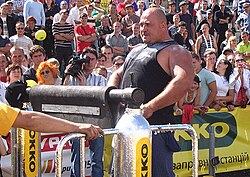
Iron Archives
Two-time Ukraine's Strongest Man, two-time World's Strongest Man competitor and circus dumbbell world-record holder
Retired athlete
Kostiantyn Ilin (Костянтин Ільїн), a Ukrainian strongman from Chernivtsi, was one of the most active and durable European circuit competitors of his generation. Strongman Archives records a competitive span from 2007 to 2020, 87 international contests and 18 international wins, two Ukraine's Strongest Man titles in 2009 and 2014, two World's Strongest Man appearances, and an eighth-place finish at the 2010 Arnold Strongman Classic. He was especially dangerous in overhead events: at the Strongman Champions League final in Kyiv in December 2010 he set a world record by completing 10 repetitions with a 95 kg one-arm dumbbell, surpassing Derek Poundstone's previous mark. His résumé also includes victory at SCL Slovakia 2011, numerous wins across the Central European Strongman Cup, Slavic Cup, Sword of Matúš Čák and World Strongman Cup circuits, and third place at the 2019 Ultimate Strongman Masters World Championships. Strongman Archives lists contest bests including a 429 kg Hummer Tire Deadlift, 380 kg deadlift, 195 kg axle press and 175 kg log lift. Away from competition, public biographical sources consistently connect him with Chernivtsi and report studies in physical education, military and law-enforcement/emergency-service experience, work in security and later as a firefighter; he has kept most details of his family life private.
Kostiantyn Ilin, whose name also appears in English-language records as Kostyantyn Ilin, Konstantin Ilyin or Iljin Kostyantin, is one of the Ukrainian strongmen who connected two distinct eras of the sport. He emerged after the period in which Ukrainian strongman was internationally identified above all with Vasyl Virastyuk, yet before the modern calendar became concentrated around a smaller number of highly professionalized global shows. Ilin's career unfolded in a dense European ecosystem of Strongman Champions League stages, national championships, regional cups and independent contests staged almost every weekend. He never acquired the mainstream profile of a World's Strongest Man champion, but the volume of his competitive record explains why his name recurs so frequently in the archives of the period. Strongman Archives credits him with 87 international contests and 18 international victories between 2007 and 2020, four appearances in Ukraine's national championship with two titles, two World's Strongest Man appearances and an invitation to the 2010 Arnold Strongman Classic. Those numbers describe more than longevity. They describe a circuit professional capable of traveling repeatedly, adapting to unfamiliar implements and remaining competitive across organizations that did not share a single technical standard. Strongman in the late 2000s and early 2010s was much less standardized than it is today. Distances, implements, surfaces and even the interpretation of an event could change from one promoter to the next. A weekend might feature a log press and car deadlift; the next could offer a truck pull on asphalt, a Conan's Wheel and a locally built medley combining yoke, farmers and loading. Ilin was effective in that environment because his profile was not narrow. He possessed enough static strength for heavy deadlifts, exceptional overhead ability for his generation, strong repetition capacity and, in the right contest, very good speed on stones, yoke and pulling events. Seen as a whole, his career is almost a map of European strongman across two decades rather than a simple collection of podiums.
His reputation also rests on a handful of moments that rise above consistency alone. In December 2010, at the Strongman Champions League final in Kyiv, Ilin completed ten repetitions with a 95 kg one-arm dumbbell. IronMind reported at the time that the performance surpassed Derek Poundstone's previous mark and was recognized as a world record. In April 2012, at the Chernivtsi Open, the opening stage of the Central European Strongman Cup, he won the contest and produced another performance reported by Ukrinform and UNIAN as a world record: he carried and loaded four spherical implements weighing 120, 140, 160 and 180 kg from decreasing distances in 1 minute 4.37 seconds. During the same broad period he won Ukraine's Strongest Man in 2009, reclaimed the national title in 2014 and collected victories in Slovakia, the Czech Republic, Germany, Belarus and Ukraine. Overhead strength remained the most recognizable feature of his athletic identity: a 195 kg axle press at Giants Live Turkey in 2010, a 175 kg log in 2017, event wins in log and dumbbell across several circuits, and the historic 95 kg dumbbell set in Kyiv. At the 2010 Arnold Strongman Classic he pulled 429 kg in the Hummer Tire Deadlift, one of the largest verifiable numbers attached to his career, although the elevated and flexible nature of that event means it cannot be compared directly with a conventional powerlifting deadlift. Nine years later, at the 2019 Ultimate Strongman Masters World Championships, he won the max deadlift event with 380 kg and finished third overall. The distance between those two heavy pulling performances says almost as much about Ilin as the dumbbell record. He was not a one-season eruption. He remained strong enough, healthy enough and motivated enough to compete against successive generations in a sport where injuries, travel costs, organizational turnover and physical wear often shorten careers dramatically.
Public Ukrainian biographies and strength-sport databases consistently connect Kostiantyn Ilin with Chernivtsi in western Ukraine, the city where he was born and to which he repeatedly returned as an athlete and local sporting figure. Even apparently simple biographical facts require careful treatment because the sources disagree. Strongman Archives and several modern result databases give his date of birth as 26 August 1975, while Wikipedia and a number of older or derivative biographies list 26 March 1975. An archived form of the older Ukrstrong profile cited by encyclopedic sources appears with the August date, suggesting that the discrepancy is not merely a recent typographical error. Height is similarly inconsistent: Strongman Archives records 1.83 m and roughly 137 kg, while some older profiles listed him around 1.92 m. This profile uses the current Strongman Archives values in the structured statistical fields because it is the specialist database used for the competition record, while the conflict is stated openly in the biography. Beyond those measurements, sources are more consistent about his formative environment. Ukrainian biographical material describes an early interest in sport, including boxing and karate, before weight training became central. That sequence fits the developmental path of many Eastern European strength athletes of his generation: combat sport or martial arts in youth, then bodybuilding-style or barbell training, powerlifting and eventually strongman. The important point is that Ilin did not enter strongman as a teenager developed from the outset inside a professional strongman system. By the time he began appearing in major strongman events, he already had the physical maturity of a man in his thirties and years of general strength work behind him. That background helps explain why his transition, once it began, was relatively rapid.
Chernivtsi matters in Ilin's story not simply as a birthplace but as part of his sporting identity. Regional media repeatedly described him as the strongman or bogatyr from Chernivtsi, and his home victories carried a symbolic weight that international result tables cannot capture. In 2012, when the Central European Strongman Cup staged an event in Philharmonic Square, Ilin was not merely another competitor. He was the local international name, an athlete who had already appeared at World's Strongest Man, the Arnold Strongman Classic and Giants Live, now performing in the center of his own city. The stone-loading record from that contest became one of the best documented moments of his career in the Ukrainian general press. UNIAN photographs show the performance in a public square, surrounded by spectators, which is almost a perfect image of traditional strongman culture: oversized objects, a civic setting, a crowd within meters of the athletes and a hometown competitor turning international-level strength into something immediate for the community. Chernivtsi also appears in sources discussing his professional life. A Ukrainian biographical profile states that he worked in law-enforcement or security structures and later in emergency services as a firefighter, while a 2009 regional list of leading Bukovynian athletes associated him with the Dynamo sporting society and the emergency ministry. Those elements are less comprehensively documented than his competition results, but they recur often enough to outline a life in which elite strength sport did not exist separately from ordinary professional responsibilities. That context changes how 87 international starts should be read. For an athlete who does not appear to have lived exclusively from strongman prize money, each contest involved the additional problem of combining work, family, recovery and a demanding travel calendar.
Before Ilin's name became a regular feature of strongman result sheets, there is a clear competitive trace in powerlifting. OpenPowerlifting lists Kostiantyn Ilyin at the 2003 UkrainePF Ukrainian Powerlifting Cup in the 125 kg class. At a bodyweight of 112.2 kg he squatted 250 kg, benched 150 kg and deadlifted 280 kg for a 680 kg total and seventh place. Seen through the lens of the numbers he later produced in strongman, that total may appear modest. Its real value is historical. It provides a documented baseline and removes the mythology of an athlete who supposedly began with world-class strongman strength fully formed. In 2003 Ilin was a capable national-level powerlifter, not yet an extraordinary international strength phenomenon. Over the following years his bodyweight increased, his specialization changed and his pulling and overhead strength advanced dramatically. Older profiles connected with World's Strongest Man later circulated declared gym or personal bests of roughly 380 kg in the squat, 220 kg in the bench press and 385 kg in the deadlift. Those figures are not all supported by official powerlifting meet sheets in the same way as the 2003 result, so they should be separated from verified strongman performances. Strongman Archives, by contrast, confirms a 380 kg max deadlift in competition at the 2019 Masters Worlds and 429 kg in the Hummer Tire Deadlift at the 2010 Arnold. A Hummer Tire Deadlift is not equivalent to a standard barbell deadlift because the start height, implement flex and geometry differ substantially, but the numbers together show the trajectory of an athlete who turned a solid powerlifting foundation into enough static strength for some of the heaviest contests in the world.
More important than the 2003 total is the technical alphabet powerlifting gave him. Strongman requires far more varied movement, yet squatting and deadlifting teach bracing, control under load, progressive overload and tolerance for heavy axial stress. In Ilin's case that foundation is particularly visible in repetition events. At the 2009 World's Strongest Man he completed six stages of a squat ladder progressing from 280 to 370 kg. At SCL Ukraine in 2010 he won the squat event with 20 repetitions. Across car-deadlift and repetition formats he repeatedly produced large totals: 17 repetitions in SCL Ukraine 2009, 15 repetitions in a deadlift event at the 2010 SCL final and 15 at SCL Russia in 2012. Such results are different from a powerlifting one-repetition maximum. The athlete has to manage breathing, pacing and rapid local fatigue, often after several other events on the same day. For a strongman best known as an overhead specialist, the ability to remain competitive in squat and deadlift prevented catastrophic point losses. He did not need to win every static-strength event if he could remain in the upper half while taking maximum points on dumbbell or log. Powerlifting also likely supplied the mentality of long-term progression. Secondary biographies place his more serious strength-sport involvement around 2000 and his strongman debut around 2006, while Strongman Archives begins its documented strongman record in 2007. That suggests a transitional period during which Ilin had to learn implements absent from powerlifting: yokes, farmers, logs, stones, tires, vehicles and unstable objects. The shift was not instantaneous, but by 2008 and 2009 the results show that he had adapted quickly enough to challenge for the Ukrainian title.
Ukrainian biographies generally place Kostiantyn Ilin's strongman debut around 2006, while Strongman Archives indexes his first major national result in 2007, when he finished eighth out of twelve at Ukraine's Strongest Man. For an athlete moving over from powerlifting relatively late, eighth place was not dramatic, but it provided entry into a rapidly developing competitive ecosystem. Ukraine already possessed an unusually strong tradition. Vasyl Virastyuk had won World's Strongest Man in 2004 and the IFSA World Championship in 2007, while athletes such as Oleksandr Pekanov, Oleksandr Lashyn, Mykhailo Starov and later Serhiy Konyushok created a deep domestic field with international experience. Becoming relevant nationally therefore required more than simply being large and strong. In February 2008, Strongman Archives lists Ilin third at the Vasyl Virastyuk Cup in Kryvyi Rih, while Ukrainian media recorded him in a series of Virastyuk-associated tournaments later that year. Gazeta.ua described the Chernivtsi athlete, then 32, as a former special-forces serviceman and reported a stage victory in Kolomyia after he had also won in Ternopil. Another round in Chernihiv was won by Ilin after six events. These contests mattered because they were not merely elite showcases. They traveled through Ukrainian cities, promoted the sport in public spaces and functioned as a practical talent-development circuit. For Ilin they were an ideal school. In the same year he rose to second at Ukraine's Strongest Man behind Oleksandr Lashyn. The jump from eighth in 2007 to national runner-up in 2008 shows how rapidly he absorbed the event-specific skills that separate a strong gym athlete from a strongman competitor.
The 2008 season also exposes the physical characteristics that would define Ilin at his best. He was not among the tallest men on the circuit and, if the 1.83 m Strongman Archives figure is accepted, he carried roughly 137 kg on a comparatively compact frame for an open strongman. Such a build can support stability under logs and axles, efficient leg drive and a relatively short path to lockout, while potentially creating disadvantages in events where height and reach improve leverage. Later results fit that mixed picture. Ilin became outstanding with the dumbbell, very good with log and axle, strong in squat repetitions and capable of high-level pulling. Stones and certain movement-heavy medleys were less consistently dominant early in his career, although he improved markedly in those areas later. In 2008, however, the central issue was experience. National and touring competitions forced him to learn how to manage six or seven events, read unfamiliar equipment and conserve enough energy for the final discipline. By the start of 2009, he was no longer a powerlifter experimenting with strongman but a legitimate candidate for the national championship. This is a recurring theme in his career: progression was not simply a matter of adding kilograms to one maximum. It was about widening the repertoire. A strongman can be enormously strong in a gym and still perform poorly if he cannot carry, load, run under a yoke, control an awkward object or reconstruct technique under fatigue. Ilin learned those skills fast enough that within roughly two seasons of his first indexed national result he would become Ukraine's Strongest Man and earn a place at World's Strongest Man.
In 2009, Kostiantyn Ilin made the step that turned a powerful national competitor into an internationally recognized strongman. He won Ukraine's Strongest Man ahead of Oleksandr Lashyn, securing the first of his two national titles. Strongman Archives also records appearances that season at Giants Live Poland and several Strongman Champions League stages, including Slovakia, England, Hungary and Ukraine. That schedule exposed him immediately to a different level of opposition. Instead of seeing largely the same domestic rivals, he now faced specialists from Britain, Scandinavia, Central Europe and the former Soviet sphere. At Giants Live Poland in Malbork he finished eighth out of twelve, completing nine repetitions in the car deadlift and negotiating a medley that combined a 390 kg yoke with 175 kg farmers implements. The overall placing was not a podium, but contests of that type were exactly the filtration system required for the World's Strongest Man level. Ilin had to prove not simply that he was strong, but that he could perform under pressure with heavy, unfamiliar implements against experienced international fields. At SCL Ukraine in November he finished fourth overall and won the dumbbell press with seven repetitions. He also produced 17 repetitions in the car deadlift and took third in a medley combining yoke, farmer's walk and log lift. Those numbers already reveal the competitive profile that would become familiar: the dumbbell was a genuine top-level weapon, while repetition strength in deadlift gave him enough secondary points to remain dangerous in the overall standings.
World's Strongest Man 2009 in Valletta, Malta, was Ilin's first appearance at the sport's most important contest. Strongman Archives places him in Group 1, where he finished third out of six behind Derek Poundstone and Louis-Philippe Jean and therefore missed the final. A third-place heat finish can sound close to qualification, but the system was unforgiving: only the top two advanced, and one weak event could effectively end a campaign. Ilin nevertheless produced clear signs that his best events were already world class. He completed eight dumbbell repetitions and finished second in the group. He was also second in the truck pull in 50.08 seconds. In a squat ladder with seven weights ranging from 280 to 370 kg, he completed six stages in 31.85 seconds and placed fourth. He was fourth again in the car walk. Stones and the carry-and-drag event cost more points, leaving him behind the two qualifiers despite several excellent performances. Historically, however, the debut matters. Ilin was not at WSM as a symbolic representative from an emerging country. He was competitive within the heat and demonstrated two qualities capable of producing elite-level event finishes: unilateral pressing and heavy pulling under time. The WSM appearance also solidified his domestic status. A national title and a strong showing in Malta in the same year moved him from prospect to established Ukrainian representative. For an athlete who had entered strongman after age thirty, the speed of the rise is striking. Within roughly three documented seasons he had moved from eighth nationally to national champion and third in a World's Strongest Man qualifying group.
If 2009 established Ilin internationally, 2010 took him deepest into the global elite. In March he competed at the Arnold Strongman Classic in Columbus, Ohio, a contest famous for emphasizing maximal strength and exceptionally heavy implements. He finished eighth out of ten, but simply reaching such a small invitation-only field reflected his status. The event list illustrates how different the Arnold was from many touring shows: Hummer Tire Deadlift, the enormous Timber Carry, Manhood Stones and Apollon's Wheels. Ilin pulled 429 kg in the Hummer Tire Deadlift, a figure that remains one of the largest verifiable loads of his career even though its mechanics differ from a standard floor deadlift. In the Manhood Stones he loaded the 205 kg stone for one repetition. With the 188 kg Apollon's Wheels he completed the clean but not a full overhead repetition, and he recorded three reps in the dumbbell press. Eighth place demonstrates the extreme level of the contest rather than irrelevance. Within weeks he was third at SCL Lapland. At Giants Live South Africa in April he finished eighth overall but took second in the max log with 170 kg. At Giants Live Ukraine in May he was fifth out of thirteen, placing second in the dumbbell press and third in both Conan's Wheel and the arm-over-arm pull. The spread of those results matters: Ilin was no longer merely a presser who survived everything else. He was collecting high points in static, grip, pulling and movement events.
His second World's Strongest Man appearance came in September at Sun City, South Africa. Assigned to Group 3, Ilin finished fourth out of six. The raw placing was lower than in 2009, but the event breakdown again shows genuine elite qualities. He made eight repetitions in the dumbbell press and finished second in the group. In the deadlift he was third with five repetitions. He placed fourth in the loading race using four 110 kg barrels. Power Stairs, the truck pull and a medley combining farmer's walk with a 450 kg tire cost more points. Once again, the issue was not a lack of absolute strength but the distribution of scores in a qualification format that demanded near-complete consistency. The season continued at Giants Live Turkey, where he finished seventh overall but pressed 195 kg on the axle for third place in the event. At SCL Slovakia he reached the overall podium in third. At the SCL final in Kyiv in December he was fourth overall. Read only as overall placements, 2010 might resemble a year full of results between third and eighth. That would miss the core of what happened. Ilin was repeatedly sharing fields with some of the strongest men in the world and producing event performances that confirmed world-class specialization. It was in that final part of the season that his most famous achievement arrived. In a sport where records are often difficult to compare because implements vary, the Kyiv dumbbell mark has the advantage of clear contemporary reporting from IronMind, including the load, repetition count and the previous record holder.
On 18 December 2010, at the Strongman Champions League final in Kyiv, Kostiantyn Ilin completed ten repetitions with a 95 kg dumbbell using one arm. IronMind, quoting SCL co-founder Marcel Mostert, reported that the Ukrainian had broken Derek Poundstone's previous record, set in Kyiv earlier that year at Giants Live. The context is useful. The final took place during a weekend affected by snow and transportation disruption across Europe, reducing the field to nine athletes. Serhiy Romanchuk won the contest while Terry Hollands accumulated enough points to secure the overall SCL season title. Ilin finished fourth, but the dumbbell event became his signature moment. Ten repetitions with 95 kg are not merely an expression of brute shoulder strength. A circus dumbbell requires a complex sequence: getting a large awkward implement to the shoulder, stabilizing it, generating force through the legs and trunk, locking it overhead and then rebuilding the position rapidly for the next repetition. As fatigue rises, coordination becomes almost as important as strength. Ilin's compact build and powerful pressing base likely helped, but the record also demonstrates technical economy. In the same contest he won the squat event with 20 repetitions and placed third in the deadlift with 15 repetitions. The dumbbell mark therefore did not occur on a day when only one movement worked. He was in a level of condition that allowed very high repetition output across several heavy events, which helps explain why pressing for repetitions remained such a reliable source of points in later seasons.
Ilin's overhead specialization was never limited to the dumbbell. By 2010 he had already produced a 170 kg log in South Africa and a 195 kg axle in Turkey. In 2011 he recorded 160 kg in a max-log event at SCL Bulgaria, and later seasons contain repeated wins in log-for-repetitions formats. At SCL Czech Republic in 2013 he completed nine log repetitions to win the event in a fourteen-man field. At the 2015 Central European Strongman Cup in Čáslav he won the log with eight repetitions, while at Strongman Games Aš he again took the pressing event under a heavier format. In 2016 at Aš he won the log with a 170 kg lift. In 2017, at the Europe Strongman Cup, he reached 175 kg and finished second in the max-log event. These results reveal a rare and useful combination: good maximal strength and outstanding repetition endurance. Some strongmen are spectacular at a single maximum but lose efficiency when the event becomes repetitive; others move moderate loads quickly but cannot approach the 170–195 kg range. Ilin occupied the space between those extremes. The 195 kg axle demonstrates his strength ceiling, the 95 kg dumbbell record shows repetition capacity, and his repeated log victories confirm transfer across implements. That is more informative than a single gym personal best. Strongman rewards adaptability, and Ilin's overhead strength was adaptable. He could move from unilateral dumbbell to log, from axle to medley and from maximum weight to repetitions without his performance collapsing. That flexibility allowed him to remain dangerous even when the rest of a contest did not perfectly suit his physique.
After two World's Strongest Man appearances and an extremely busy 2010 season, Ilin shifted from the center of global qualification shows into the role of a protagonist on the European circuit. Strongman Champions League was an ideal environment for his competitive profile. The season required numerous stages, repeated travel and the ability to accumulate points under very different conditions. He began 2011 with fifth at SCL Lapland, moved through FIBO and stages in Holland and Bulgaria, then produced the defining result in September: victory at SCL Slovakia in Košice, ahead of a thirteen-man field. Strongman Archives records the win as one of his most important victories in a mature international series. It was not an isolated success. During the same year he won Sword of Matúš Čák in Trenčín, the Slavic Cup in Žilina and, in December, Sport Festival Slovakia in a field of seventeen. Four major victories in one year across differing formats show a competitor who had reached a superior level of repeatability. Even when he did not win, he gathered useful points. At SCL Bulgaria he was fourth overall, with second in the crucifix hold, third in farmer's walk and fourth in both Atlas Stones and super yoke. At SCL Holland, despite finishing only seventh overall, he was second in the loading race. That distribution explains why touring competition suited him. Ilin did not depend on a single script. If overhead pressing failed to provide maximum points, he could compensate with loading, a hold, a carry or a pulling discipline. He was complete enough to remain in contention deep into a contest.
The 2011 season also demonstrates how strongly Ilin's career became linked with Central Europe, especially Slovakia. Košice, Žilina, Trenčín and other Slovak venues recur through his record almost until the end. For many Eastern European athletes, these contests formed a bridge between national championships and the heavily televised international shows. They offered serious fields, enthusiastic crowds, experienced promoters and a geographically accessible calendar. Ilin used that network more successfully than most. He did not treat regional stages as a demotion after World's Strongest Man, but as a platform where he could win, test implements and remain active. That choice helps explain the 87 international starts in the archive. A career built exclusively around Arnold, WSM and Giants Live would have produced far fewer appearances. Ilin instead combined global peaks with a density of European competition that offered both victories and considerable wear. By modern standards, when many elite athletes select a handful of major contests per year, his schedule can look excessive. Strongman of that period operated differently. Prize money, visibility and future invitations were strongly tied to repeated presence. A professional circuit athlete had to be available. Ilin was available for years. In 2011 that availability became more than participation; it became a competitive identity. He had become the athlete who could arrive in a new city, face a fresh event list and still have a credible chance of winning. That mentality would culminate in 2012, the season with the greatest concentration of victories and one of the most memorable performances of his career, achieved in front of his home crowd.
The 2012 season can reasonably be described as the period of greatest competitive density in Kostiantyn Ilin's career. Strongman Archives records an extraordinary sequence of starts across Central and Eastern Europe, and victories accumulated at a rate that explains why his name is so prominent in regional records. He won the Central European Strongman Cup stage in Chernivtsi, then stages in Čáslav, Plzeň and Štrbské Pleso, the World Strongman Cup in Košice, the Sachsen Cup in Germany and Monster Strong in Minsk. He also competed in Strongman Champions League, Arnold Europe and other international contests. Not every result was a win, and that is precisely why the season is revealing. Ilin alternated major fields in which even an event victory might still yield a mid-table overall finish with regional cups where his breadth allowed him to control the standings. At Arnold Europe, for example, he finished ninth overall yet won the dumbbell press with eleven repetitions. At SCL Bulgaria he won the log with nine repetitions. At SCL Russia he produced fifteen repetitions in the car deadlift. By 2012 he no longer needed to demonstrate that he could lift heavy weights. The challenge was converting his strengths into points across a long season. He did that repeatedly. The fact that victories came in different countries, under different promoters and with different equipment makes the season more significant than a simple trophy count. European regional strongman did not possess standardized apparatus. A log could differ in diameter, balance and handle spacing, a car deadlift could use a completely different lever system, and stones could be loaded to different heights. Winning across systems demonstrated adaptability, not merely specialization.
The best documented performance of that season came at home in Chernivtsi in April. Ukrinform and UNIAN reported on the opening stage of the Central European Strongman Cup in Philharmonic Square, where Ilin won the overall contest with 47.5 points. In an event described in Ukrainian reports as a ball or stone loading challenge, the athletes had to carry and load four spherical implements weighing 120, 140, 160 and 180 kg from progressively shorter distances of 10, 8, 6 and 4 meters. Ilin completed the sequence in 1 minute 4.37 seconds. Organizers announced it as a world record and compared the time with a previous 1 minute 10.64 mark attributed to an Icelandic athlete. In a sport where the phrase world record requires caution whenever equipment and event dimensions are not universally standardized, the precise formulation is that the performance was reported and recognized by the organizers as a world record for that format. Its athletic quality does not depend on the label. Moving four objects that increase to 180 kg before loading them demands hip-extension strength, speed, grip, positioning and the ability to avoid wasted seconds between implements. For an athlete primarily known as an overhead specialist, the win demonstrates how much broader his repertoire had become by 2012. It also carried unusual biographical weight. The record was not produced in an anonymous training hall or a distant international show, but in the city most closely associated with his identity. Local media could therefore present Ilin not simply as an international competitor but as a hometown champion producing a world-level performance in front of his own community.
The burst of results in 2012 did not mark the end of Ilin's relevance. In 2013, Strongman Archives records victories in the Central European Strongman Cup at Čáslav and Kolomyia, along with continued appearances in Strongman Champions League. At the Czech SCL stage he finished sixth overall in a field of fourteen but won the log lift with nine repetitions. Once again, his technical identity remained obvious: even on a day when the overall result was not a podium, his pressing could still beat the entire field in one discipline. The same period includes good results in movement and pulling events, challenging any simplistic description of Ilin as a purely static presser. As he approached forty, the ability to compete frequently became an achievement in itself. Strongman does not permit perfect recovery between events, and consecutive weekends can mean starting a new competition before the accumulated fatigue of the previous one has disappeared. Shoulders, elbows, knees, the lower back and biceps are exposed to heavy and often unpredictable loads. One technical mistake on a stone, yoke or deadlift can end a season. Ilin's continued high-frequency participation therefore suggests not only physical durability but a degree of intelligent load management. Public evidence is insufficient to reconstruct his exact training program, recovery methods or injury history, so it would be speculative to claim more. The results themselves provide the important fact: he remained present and capable of returning to victory after years of dense competition.
In 2014, Ilin won Ukraine's Strongest Man for the second time. Strongman Archives places him first in a field of thirteen, ahead of a new generation of Ukrainian competitors. Five years separated the titles of 2009 and 2014, and during that interval Ilin had competed at World's Strongest Man, Arnold, Giants Live, Strongman Champions League and dozens of European tournaments. The second national title therefore carried a different meaning from the first. The 2009 victory certified his rise; the 2014 title confirmed longevity and the ability to remain a domestic reference point after an already extensive international career. He also finished second at the Slavic Cup and won Sport Festival Slovakia that season, reinforcing the long relationship with the Slovak circuit. The 2014 championship is also a useful marker for understanding Ilin's place within Ukrainian strongman history. He was not a direct replacement for Virastyuk in the sense of becoming an absolute world champion, nor did he dominate every edition of the national title. Ukraine produced several internationally capable strongmen at the same time. Ilin's distinction lies in how long he remained near the center of that group and how effectively he converted national relevance into an unusually broad international résumé. Two national titles, two WSM appearances, an Arnold start and eighteen international wins describe an athlete with multiple competitive phases rather than one short window of form. In a discipline that still lacked a single standardized qualification system, the ability to move successfully between organizations was itself a valuable sporting skill.
During the second half of the 2010s, Ilin's career gradually shifted away from the major World's Strongest Man qualification ecosystem toward the Central European and WSF circuits, without the events becoming trivial. In 2015, at the Central European Strongman Cup in Čáslav, he won both the car deadlift with twenty-two repetitions and the log lift with eight. At Strongman Games Aš he again won the log under a heavier format. These results matter because they came roughly five years after the dumbbell world record and show that overhead strength had not been merely a quality of his physical prime. He retained the technical efficiency and muscular endurance required to keep beating strong fields. In 2016 he returned to first place at the Slavic Cup and won the Central European Strongman Cup stage in Chernivtsi. At Strongman Games Aš that year he won several events, including log, yoke and the Atlas Stones series, whose final stone weighed 190 kg. The last detail is especially revealing. Stones had cost him points at World's Strongest Man in 2009; by 2016, at more than forty years of age, he could win a stone event ending at 190 kg. That does not mean Atlas Stones suddenly became his universally dominant discipline, but it does demonstrate substantial improvement in an event family that had once been less consistent. In the same year he finished fifth at the WSF World Cup in Omsk, showing that even after a decade of strongman he could remain in the top five of a meaningful international field.
At the 2017 Europe Strongman Cup, Ilin pressed 175 kg on the log and placed second in that event. Strongman Archives also records an Atlas Stones victory, completing five stones in 55.81 seconds, and second place in the truck pull. This contest is an excellent snapshot of his competitive maturity. Early in his career, the profile could be described through a few obvious weapons and a few vulnerabilities. By the later years, the differences between event families had narrowed. He had not become the fastest strongman in the world, nor the greatest deadlifter of his generation, but he could score heavily in very different disciplines. That versatility is crucial on regional circuits, where the event selection is not designed around one type of athlete. One weekend can favor a presser, another a mobile competitor, another a deadlift specialist. Ilin continued to appear across all of those formats. From a development perspective, 2015–2017 also marks the transition from chasing an absolute peak to managing longevity. At forty to forty-two years old, a realistic objective was no longer necessarily a return to a WSM final but the preservation of a level that allowed wins, podiums and international participation without accumulated wear ending the career. Maintaining a 175 kg log and the ability to load a 190 kg stone at that age indicates a slower decline than many open strongmen experience. The overall placings did become more variable, and in some contests Ilin dropped toward the middle of the field. That is normal for an athlete aging in an extreme sport. What distinguished him was that he remained good enough to keep winning individual events and, on the right day, entire competitions.
The 2018 and 2019 seasons provide a rare look at a strongman who did not disappear as soon as he moved beyond the center of the open circuit. In 2018, Ilin won Sword of Matúš Čák in Trenčín again, seven years after his first victory in the same contest. That year he also entered the Ultimate Strongman Masters World Championships in Belfast and finished fifth. Strongman Archives credits him there with a remarkable squat-for-repetitions event win at thirty-one repetitions. The number should not be treated as equivalent to a conventional powerlifting squat because the apparatus and rules differ, but the work capacity is unmistakable. One year later, at the 2019 Masters World Championships, Ilin reached the overall podium in third. More importantly for his static-strength profile, he won the max deadlift with 380 kg. A 380 kg competition deadlift at age forty-three, sufficient to win the event at a world-level Masters contest, is strong evidence of exceptional physical longevity. The same season took him to the Siberian Power Show, where he finished fifth overall, won the arm-over-arm pull and took second in the tire flip. Even in the last part of his career, therefore, the repertoire remained broad: maximal deadlift, high-repetition squat, heavy pulling and tires. This is not the profile of an athlete surviving on one favorite movement but of a competitor redistributing his advantages as his body and the competition landscape changed.
Strongman Archives closes Ilin's indexed international chronology in 2020 with sixth place at the Slavic Cup. The year 2020 is difficult to interpret statistically for any athlete because global competition calendars were heavily disrupted. There is no widely documented public retirement announcement that fixes an exact ceremonial date, so the retired status used in this profile reflects his absence from indexed international contests after 2020 and the clear end of his high-level competitive period, rather than a claim about a specific official retirement day. That distinction matters for a competitor whose career was spread across numerous organizations and local events. Strongman archives are excellent for reconstructing international results, but they do not necessarily capture exhibitions, small regional contests or appearances without complete standings. What can be said confidently is that between 2007 and 2020 Ilin accumulated an unusually large body of competitive work. If the reported 2006 strongman debut and the earlier powerlifting phase are included, the result is nearly two decades of documentable strength sport. The career did not end with one final televised world title. It ended in a manner more representative of the entire story: one more appearance at a Slavic circuit contest, in the same regional network where he had built victories and relationships for years. In that sense, the 2020 Slavic Cup is not a minor footnote. The athlete whose reputation was built through availability, travel and consistency leaves the international record in exactly the same kind of touring competition that had sustained so much of his career.
If Kostiantyn Ilin's technical profile had to be reduced to one idea, it would be overhead efficiency. The ten repetitions with the 95 kg circus dumbbell are the signature performance, but they should never be isolated from the rest of the record. The 195 kg axle at Giants Live Turkey, the 175 kg log in 2017, the eleven-repetition dumbbell event win at Arnold Europe 2012 and repeated log-for-repetitions victories all express the same quality through different implements. Strongman pressing is not simply an enlarged shoulder press from a gym. The athlete has to clean the implement, settle it into position, generate force through the legs and hips, transfer that force through the trunk and stabilize an often awkward mass overhead. With the dumbbell, asymmetry increases the demand on the torso and shoulder. With the axle, bar diameter and limited rotation complicate the clean. With the log, the center of mass sits in front of the body. Ilin's success across all three formats indicates a genuine technical and neuromuscular base rather than an advantage restricted to one apparatus. Deadlift was a second major strength, though less dominant. The 429 kg Hummer Tire pull and 380 kg standard max deadlift are large verified contest numbers, while high repetition totals in car deadlift confirm work capacity. Squatting for repetitions was also consistently useful, including twenty reps at SCL Ukraine 2010 and thirty-one at the 2018 Masters Worlds in their respective formats. Pulling events offered another recurring source of points, from second in the truck pull in his 2009 WSM heat to the arm-over-arm victory at the 2019 Siberian Power Show.
His limitations are harder to summarize because they changed throughout the career. In his first World's Strongest Man appearances, medleys, Power Stairs and certain stone series could remove important points. That does not mean Ilin was fundamentally poor in movement. Later competitions show wins in yoke, Atlas Stones and loading, while the Chernivtsi record was essentially a speed-under-load event. A more accurate statement is that at WSM level, where margins between athletes are small, his moving-event profile was not as exceptional as his overhead pressing. Fourth or fifth in a WSM heat event can be excellent in absolute terms and still be fatal to qualification when only the top two advance. His relatively compact frame probably supported stability and efficient pressing while potentially reducing leverage advantages on high loading platforms, although any biomechanical interpretation must remain cautious because even his reported height differs between sources. The pattern of results is more reliable than anatomical speculation. Over time Ilin became more complete. He won stone events after forty, stayed effective in heavy pulls and maintained high repetition output in static disciplines. That suggests continued adaptation to earlier weaknesses. From a coaching perspective, his career illustrates a basic truth of strongman: specialization can win individual events, but breadth prolongs competitive life. Ilin became known through dumbbell and overhead strength, yet he remained relevant because he refused to become only a dumbbell specialist.
Kostiantyn Ilin's life outside competition is less thoroughly documented than his sporting record and should therefore be presented without filling gaps with speculation. Public Ukrainian biographical sources describe him as having studied in the field of physical education at a university in Chernivtsi and mention military service followed by work in law-enforcement, security or institutional structures and, at a later stage, emergency-service work as a firefighter. A 2009 list of leading Bukovynian athletes links Ilin to the Dynamo sports society and the Ukrainian emergency ministry, providing an independent anchor for part of that professional narrative. Media from 2008 also described him as a former member of special forces. It is therefore reasonable to state that his biography included military and institutional experience, but the public record is not strong enough to reconstruct exact units, job titles, dates or operational responsibilities. For that reason, this profile deliberately excludes more sensational claims that appear in isolated secondary biographies when those claims cannot be independently corroborated. The caution is especially important for athletes from the pre-social-media era. Online biographies were frequently copied from one site to another until anecdote began to look like established fact. The securely documented version of Ilin's life is compelling enough: he built an international strongman career while his professional identity appears not to have been limited to full-time paid sport. That places him within the classic European strongman model of the period, in which elite competition coexisted with a profession, public institution or local occupational role.
Public sources state that Ilin is married and has children, and a local school page provides indirect confirmation that he is a father. The identities and private details of family members are not necessary to evaluate his sporting career and are not reproduced here. That restraint is intentional. A comprehensive athlete profile does not need to turn the private lives of relatives into archival material simply to appear richer. What matters biographically is that Ilin appears to have built his career as an adult with professional and family responsibilities rather than as an athlete shaped from adolescence within an exclusive high-performance system. His relatively late transition into strongman, following powerlifting and earlier professional experience, helps explain the pragmatic character of the career. The accessible sources do not present a mythology centered on one famous coach, one legendary gym or a secret training system. Instead, the result record suggests continual learning and the ability to integrate into different sporting communities. His repeated return to Chernivtsi, frequent competition in Slovakia and the Czech Republic, and participation in Ukrainian events designed to popularize strongman all indicate a relationship with the sport broader than the pursuit of WSM qualification alone. For local spectators, Ilin also served as visible proof that an athlete from Chernivtsi could reach Malta, Sun City, Columbus and major European stages. That representative role is difficult to quantify, but it forms part of the legacy of athletes who built the sport before social media turned every training session into a global product.
When assessing Kostiantyn Ilin's legacy, it is tempting to choose one headline: the ten repetitions with a 95 kg dumbbell, the two Ukraine's Strongest Man titles or the two appearances at World's Strongest Man. All matter, but the number that may describe the career best is 87. That is the number of international contests Strongman Archives attributes to him between 2007 and 2020, with eighteen victories. In a collision sport involving heavy objects, where every start carries injury risk and every trip affects recovery, eighty-seven contests represent enormous accumulated work. The number changes the image of Ilin from an athlete who happened to compete at WSM into an important piece of the European circuit's infrastructure. He filled fields, raised the standard of regional stages, gave promoters a recognizable international name and forced younger competitors to beat an experienced benchmark. He competed during the transition from the fragmented post-IFSA era toward more modern structures, when European strongman was divided among SCL, Giants Live, WSF, national championships and regional cups. Winning in several of those environments gives his record particular historical value. The pressing record supplies brilliance and the national titles supply legitimacy, but the volume of competition supplies historical weight. His Masters years extend the story further. Third at the 2019 Masters Worlds and a 380 kg event-winning deadlift show that the career did not end with the first half of the 2010s.
A rigorous profile of Ilin must also accept that strongman archives are imperfect. His birth date appears as 26 August 1975 in Strongman Archives and several modern profiles but as 26 March 1975 in other biographies. Reported height ranges from roughly 1.83 m to 1.92 m in historical sources. Some personal bests circulate as athlete-profile claims without official meet sheets. The phrase world record can refer to a specific implement configuration rather than a universally standardized event. This profile therefore prioritizes Strongman Archives for contest chronology and event figures, OpenPowerlifting for the documented 2003 powerlifting result, IronMind for the 2010 dumbbell record and contemporary Ukrainian news reporting for the Chernivtsi performance and local biographical context. Where sources disagree, the disagreement is stated. Where a dramatic claim appears only in a secondary biography and cannot be corroborated, it is not converted into fact. That method does not make Ilin's story smaller. It makes it stronger. No added legend is necessary. The record already contains a documented powerlifter in 2003 who within a few years became Ukrainian champion, reached World's Strongest Man and the Arnold, broke a recognized pressing world record, won competitions across Central and Eastern Europe and, more than a decade later, pulled 380 kg to win a Masters world-championship event. That is the essential legacy of Kostiantyn Ilin: not one podium photograph, but a long, dense and extremely difficult career to reproduce.
To understand Kostiantyn Ilin's level correctly, it is necessary to look at the domestic competition from which he emerged. Ukraine was not a country where a sufficiently large athlete could collect a national title in the absence of serious rivals. During the 2000s, Ukrainian strength sport benefited from the extraordinary visibility created by Vasyl Virastyuk, winner of World's Strongest Man in 2004 and the IFSA World Championship in 2007. Around that success existed a competitive culture that produced or attracted athletes such as Oleksandr Lashyn, Oleksandr Pekanov, Serhiy Konyushok, Mykhailo Starov and other men capable of entering international competitions. This gives Ilin's 2008 runner-up finish and the national titles of 2009 and 2014 more weight than a bare résumé line suggests. He had to win within a strongman system that already possessed international standards and experienced technical models. The touring events organized around Virastyuk's name also acted as mechanisms of selection and popularization. Stages held in different cities brought strongman into public squares, made athletes recognizable to spectators who might never watch WSM, and offered competitors a frequency of starts impossible to obtain from one annual national championship. Ilin developed within exactly that environment. When he reached Malta in 2009, he was not emerging from an isolated domestic system but from a circuit that had forced him to compete often and learn quickly. His apparently late rise should therefore be interpreted in context. He entered strongman at an age when many modern athletes already have several years of event experience, but he entered a setting capable of compressing the learning process through repeated exposure to competition.
His career also demonstrates the diversity of the Ukrainian school. Virastyuk was associated with enormous mass, raw power and the presence of an absolute champion. Ilin built a different reputation: a more compact athlete, exceptional in unilateral pressing, very good at repetition events and capable of converting sufficient mobility into a touring advantage. Oleksandr Lashyn was an important national rival with a different set of strengths, while Serhiy Konyushok followed another trajectory again. There was no single Ukrainian strongman template. The depth of internal competition instead produced several athletes prepared for European fields. Ilin was one of the men who exported that competitive culture repeatedly into Slovakia, the Czech Republic, Poland, Germany, Finland, Russia, Belarus and beyond. He can therefore be understood as a bridge between the global fame brought to Ukraine by a champion such as Virastyuk and the everyday infrastructure of the sport, formed by dozens of smaller but essential contests. Strongman history is often written through WSM winners, yet the sport could not exist without the competitors who sustain its circuits every season. Ilin belonged precisely to that category. He had enough ability to reach WSM and Arnold while retaining the willingness to compete in a Central European square or regional cup only weeks later. His résumé therefore offers a useful view of how strongman actually develops: major titles create symbols, but dense regional competition creates athletes.
Ilin's competition list is also a map of European strongman from 2007 to 2020. Chernivtsi, Kyiv, Košice, Bratislava, Žilina, Trenčín, Čáslav, Plzeň, Aš, Štrbské Pleso, Minsk, Kitzscher, Omsk and many other locations form a network that bears little resemblance to a centralized sports league. For the athlete, every trip required logistical adaptation before sporting adaptation even began. Long drives or flights, equipment transport, food, sleep, weigh-in schedules and recovery affected performance before the first event. Many competitions were also outdoors, where temperature, rain and surface type could radically alter an event. A farmer's walk on dry asphalt is not the same task on wet paving; a truck pull with reliable traction changes completely when the surface becomes slippery. Ilin competed in northern climates, across Central Europe, in Russia, Turkey and South Africa. Not every appearance produced a victory, but the accumulated exposure created a reservoir of experience that likely became an advantage over less-traveled athletes. In strongman, familiarity with the unknown is a real skill. No gym can reproduce every truck, log or frame exactly. What an experienced athlete can learn is how to read an implement quickly, identify its balance point and build a workable technique during a short warm-up. A career of eighty-seven international contests strongly suggests that Ilin became highly proficient at solving exactly that problem.
Geography also helps explain why Ilin may be less familiar to fans who follow only World's Strongest Man. A large portion of his career unfolded in European competitions that never received comparable international television distribution. Before the explosion of social platforms and livestreaming, a result from Košice or Chernivtsi could be significant within the sport and nearly invisible to a fan in the United States or Britain. Digital archives partially correct that distortion. When the results are placed in sequence, it becomes clear that Ilin was not simply a two-time WSM participant followed by a long tail of minor appearances. He was one of the athletes who moved continuously through the continental ecosystem. Victories in Slovakia, the Czech Republic, Germany, Belarus and Ukraine were frequently earned against fields containing men with SCL, WSF or WSM experience. Repeated travel also created recurring rivalries. Strongmen did not meet only once per year but several times under different event selections. An opponent who beat Ilin on yoke one weekend might lose to him on log or deadlift the next. Repetition creates a particularly demanding form of selection because a reputation cannot be built on one perfect day. The athlete has to return. Ilin returned dozens of times, and eighteen international wins mean that roughly one in five of his indexed starts ended in first place. That ratio is not an absolute ranking tool, but it illustrates how often he was able to turn experience into victory.
Viewed chronologically, the events tell a story almost as clearly as the podiums. At his first World's Strongest Man in 2009, Ilin was already excellent at dumbbell and truck pull, solid in squat and car walk, but lost important ground on stones and the more technical carry-and-drag combination. In 2010 the overhead ceiling rose further: a 170 kg log, 195 kg axle and the ten-repetition record with the 95 kg dumbbell. At the same time came the 429 kg Hummer Tire Deadlift and high repetition totals in squat and deadlift. From 2011 through 2013, that base was converted into a touring profile built around log repetitions, loading, farmers, holds and medleys. The 2012 Chernivtsi record demonstrated the ability to combine movement and loading against the clock. By 2015–2017, stones and yoke appeared increasingly often among his strongest results while log remained reliable. In 2018–2019, when Masters competition became relevant, static strength returned to the center: thirty-one squat repetitions in one contest format and a 380 kg max deadlift. There is no single uninterrupted upward line because no athlete improves uniformly for fifteen years. Instead, there is redistribution. Some maximums stabilize, some events become more technically efficient, and experience reduces costly mistakes. That is one of the most interesting features of Ilin's record: age did not merely turn him into a weaker version of the 2010 athlete. It produced a different competitor, more experienced and likely more selective in how he spent energy across a long competition.
Ultimately, Kostiantyn Ilin deserves to be viewed as an example of a complete career in the older strongman sense. He did not win World's Strongest Man and did not reach a WSM final, so he should not be artificially placed among the absolute champions of his era. An assessment that stops there, however, ignores most of what he accomplished. He became national champion twice in a country with a powerful strongman tradition, reached WSM qualifying groups twice, earned an Arnold Strongman Classic invitation, set a contemporaneously reported world record in overhead pressing, won a Strongman Champions League stage and numerous international cups, produced top-level performances in log, axle, dumbbell, deadlift, squat, stones and pulling events, and remained a world Masters podium finisher late in his career. Above all, he competed for long enough that his evolution can be observed rather than imagined. For projects that preserve strongman history, athletes of this kind are indispensable. They show what the sport looks like between the televised finals: long drives, public squares, locally built implements, dozens of opponents, exceptional days and mediocre ones, recoveries and adaptations. Ilin is not interesting despite never becoming WSM champion. He is interesting because his résumé reveals the enormous competitive layer on which world championships are built. Within that infrastructure, for more than a decade, he was one of the names that mattered.
Iron Hall data
429 KG
Hummer Tire Deadlift · 2010 Arnold Strongman Classic; 7th in the event
Verified
380 KG
Max Deadlift · 2019 Ultimate Strongman Masters World Championships; event winner
Verified
195 KG
Max Axle Press · 2010 Giants Live Turkey; 3rd in the event
Verified
175 KG
Max Log Lift · 2017 Europe Strongman Cup; 2nd in the event
Verified
95 KG
One-arm Circus Dumbbell · 10 repetitions at SCL Ukraine, Kyiv, 18 December 2010; world record at the time
Verified
205 KG
Manhood Stone · 1 repetition at the 2010 Arnold Strongman Classic
Verified
190 KG
Atlas Stone in series · Final stone in the 130/150/170/190 kg series at 2016 Strongman Games Aš; event winner
Verified
2008
National runner-up behind Oleksandr Lashyn.
2nd place
2009
His first national strongman title.
Champion
2009
WSM debut in Valletta, Malta; missed the final in a group won by Derek Poundstone.
3rd in group
2010
Competed in Columbus against the world's elite; 429 kg Hummer Tire Deadlift.
8th place
2010
Second WSM appearance, in Sun City, South Africa.
4th in group
2010
10 repetitions with a 95 kg dumbbell, surpassing Derek Poundstone's previous mark.
World record
2010
Podium finish in Kuusamo, Finland.
3rd place
2010
Podium finish in Bratislava.
3rd place
2011
Victory at the Strongman Champions League stage in Košice.
1st place
2011
Victory in Žilina, Slovakia.
1st place
2011
Victory in Trenčín.
1st place
2011
Won the Trenčín contest in a 17-athlete field.
1st place
2012
Won the contest with 47.5 points and completed the 120/140/160/180 kg stone sequence in 1:04.37, announced as a world record.
1st place + world record
2012
International victory in Slovakia.
1st place
2012
Victory in Belarus.
1st place
2012
Victory in Kitzscher, Germany.
1st place
2012
Won the dumbbell press event with 11 repetitions.
9th place
2013
Victory in a 16-athlete field.
1st place
2013
Victory on Ukrainian soil.
1st place
2014
Second national title of his career.
Champion
2014
Runner-up in Žilina.
2nd place
2014
Victory in Trenčín.
1st place
2016
Returned to the top step in Žilina.
1st place
2016
Home victory in Chernivtsi.
1st place
2016
Top-five finish in Omsk.
5th place
2018
Victory in Trenčín, seven years after his first win in the same contest.
1st place
2018
Top-five Masters world finish in Belfast.
5th place
2019
Masters world bronze; won the max deadlift with 380 kg.
3rd place
2019
Won the arm-over-arm pull and finished second in the tire flip.
5th place
2020
Final international appearance indexed by Strongman Archives.
6th place