2011
WSF World Cup Belarus
Earliest international appearance recorded by Strongman Archives.
7th of 8
The Georgian Bull | World's Strongest Man finalist and elite maximal-strength competitor
Active athlete
Konstantine Janashia (born 30 August 1990) is a Georgian professional strongman known internationally as the Georgian Bull. The first athlete from Georgia to reach a World's Strongest Man final, he finished fourth in 2016 and reached five WSM finals in total. He placed second at Europe's Strongest Man in 2018 and third in 2019 and 2022. His documented competition lifts include a 440 kg conventional deadlift, a 510 kg 18-inch deadlift and a 202.5 kg log press. He won the 2017 Savickas Classic and the 2021 Siberian Power Show and remained an international competitor through at least 2025.
Konstantine Janashia, born on 30 August 1990, is a Georgian professional strongman whose international career has extended from documented appearances in 2011 through at least June 2025. Known to audiences as the Georgian Bull, he became the first athlete representing Georgia to reach a World's Strongest Man final and finished fourth at his first final in 2016. He subsequently reached four more WSM finals, collected three Europe's Strongest Man podium finishes, won the 2017 Savickas Classic and the 2021 Siberian Power Show, and registered major individual performances in deadlifting and overhead lifting. His public competition record also contains strong results in frame carries, yoke races, vehicle pulls and Atlas stones. It is therefore misleading to summarize his athletic identity exclusively through the largest weight he has lifted. His results are better understood as the record of a multi-event competitor who faced changing opponents, implements and scoring formats over more than a decade. This account distinguishes documented results, statements Janashia has made in interviews, contemporary sporting reports and subjects that remain unverified. [S1, S2, S3]
Giants Live lists Janashia at 1.96 metres tall and approximately 170 kilograms in competition weight. These are published athlete-profile figures rather than a measurement guaranteed to remain unchanged through every season. Likewise, the figures attached to his strength records need precise event labels. A 440-kilogram conventional deadlift at the 2017 WSM final, a 510-kilogram deadlift from an 18-inch starting height at the 2018 World's Ultimate Strongman contest in Dubai, and a 476-kilogram Hummer Tire Deadlift at the 2022 Shaw Classic are different sporting achievements. The implements, starting positions and permitted equipment are not identical. His 202.5-kilogram log lift at Europe's Strongest Man in 2019 belongs to another category again, combining the clean of a large cylindrical implement with a heavy overhead press. Understanding those distinctions helps preserve rather than diminish the significance of each lift. The current profile uses the designation 'active' because the consulted sources do not document a definitive retirement; it separately identifies the Santa Monica Classic in June 2025 as his latest indexed competition. [S1, S2, S4]
The most substantive first-person material about Janashia's early sporting years appears in an interview published by the Georgian magazine Sarke and reproduced by Sarkenews on 30 January 2019. The article describes him as a young athlete from Kutaisi whose recognition in Europe and the United States contrasted with the still-developing public awareness of strongman in his home country. Janashia explained that he had been interested in several sports since childhood and that rugby was the last discipline he pursued before moving toward strongman. Secondary biographical accounts place his introduction to weight training at approximately eighteen years of age. Rugby provides useful context for a general discussion of contact, acceleration and movement under resistance, but it does not justify reconstructing his exact youth-team position, complete competitive rugby career or training history. Those details cannot be established from the accessible sources. His childhood is relevant because it shows that strongman was not an isolated first encounter with competitive physical activity, although the precise chronology of each earlier sport remains incomplete. [S5]
In the same interview, Janashia stated that strongman emerged as an organized discipline in Georgia in 2009 and that he joined the country's strongman federation during that year. This provides a useful starting point for the personal history he has described, but it should not be confused with the beginning of his recorded international competition career. Strongman Archives indexes his international appearances from 2011 onward, leaving a difference between his reported involvement in 2009 and the earliest results available in that particular database. Both facts can be presented together without inventing missing competitions. Janashia also explained that the variety and total physical demands of strongman attracted him because he felt able to devote more energy to this discipline than to the sports he had previously tried. That statement tells us something about his own account of the decision; it is not evidence for a specific exercise programme or a particular physiological trait. At a time when the international circuit still contained relatively few Georgian athletes, joining the sport meant developing skills with unusual objects while seeking routes into competitions beyond the domestic scene. [S2, S5]
The Kutaisi connection also appears in the less visible story of training infrastructure. In 2019, Janashia reported that the Kutaisi municipality and municipal sports service assisted his team by covering rent and utilities for its training space. He said public funding did not meet its salary or travel costs and described additional support associated with the international strongman structure through which he competed. These statements provide a dated account of how at least part of his professional preparation was made possible. Heavyweight strongman requires more than conventional gym access: specialized implements, appropriate surfaces, adequate storage and costly travel are practical considerations when an athlete moves between different countries and organizing bodies. Nevertheless, there is no reliable basis for assigning Janashia a currently operating gym, an exact present-day sponsorship budget or a particular personal income from that interview alone. The account describes his circumstances as reported in 2019; it is not a verified financial profile for 2026. Similarly, no independently confirmed current head coach has been identified in the sources used here. [S5]
The first competition indexed in Strongman Archives is the WSF World Cup in Minsk, Belarus, in September 2011. Janashia placed seventh among eight competitors. His next recorded appearances suggest that he quickly widened his competitive geography. At the WSF World Cup in Tashkent, Uzbekistan, in March 2012, he was fifth among fourteen entrants; in June that year he reached the podium at Holland's Got Power, finishing third of ten. These results do not establish an uninterrupted rise in every event, because the composition of the field and the demands of each contest varied. They do establish that the Georgian athlete was entering international settings with distinct rules, equipment and opponents. That experience was particularly relevant in a discipline in which simply repeating a successful gym lift does not guarantee a strong placing. A contest may require a maximum repetition count on a bar in one event, followed by a timed carry and an awkward-object load in the next. The early records are consequently useful for understanding the breadth of competition exposure preceding his later recognition. [S2]
In August 2014, Janashia finished fifth of twelve at Giants Live Hungary in Budapest. Participation in a Giants Live event placed him within an established international platform closely associated with the professional strongman circuit and qualification opportunities for World's Strongest Man. It also gave him exposure to competitors familiar to an audience outside Georgia. His next major recorded milestone came at the Arnold Amateur Strongman World Championships in Columbus, Ohio, in March 2015, where he finished third among ten finalists. This placing should be identified specifically as an Arnold Amateur result rather than confused with a title at the professional Arnold Strongman Classic. In his January 2019 interview, Janashia described himself as a two-time Arnold-associated European amateur champion. The available statistical records do not fully establish the exact editions and divisions behind that broader statement, so it is retained as an attributed account rather than converted into a set of independently confirmed championship entries. The third-place result in Columbus, by contrast, is documented by the competition archive and clearly belongs in his main achievement list. [S2, S5]
This preliminary phase of the career matters because the different strongman circuits were not interchangeable. A World Strongman Federation event, a national or independent European contest, Giants Live and Arnold Amateur could present considerably different selections of implements and different fields of competitors. An athlete who enters multiple environments learns the practical demands of unfamiliar equipment and the tactical implications of an aggregate points system. Such experience can be inferred from Janashia's documented participation, although precise details of his coaching arrangements and training progression remain unavailable. By the spring of 2015, he had achieved international podium positions and had competed on both sides of the Atlantic. The following year, that accumulated exposure preceded the performance that brought his name firmly into World's Strongest Man history. It would be unnecessarily dramatic to portray every earlier event as an inevitable step towards a predetermined outcome; the record instead shows several years of participation that made the 2016 opportunity possible. [S2]
The 2016 World's Strongest Man, staged in Botswana, stands as the defining international breakthrough of Janashia's career. He qualified from his preliminary group and finished fourth in the ten-man final. More importantly for Georgian sporting history, he became the first athlete representing Georgia to contest a WSM final. The final placing was not the result of a single lift being ranked across the entire competition. WSM is a multi-event contest: competitors acquire points from the relative positions they earn in distinct events, and the aggregate determines the overall standings. A participant can perform exceptionally in one event yet lose ground in another. Janashia's 2016 result was built across tasks that tested heavy lifting, rapid movement with substantial loads, pulling and loading. Reaching fourth place at his first final, rather than merely surviving the qualifying stage, provided a concrete basis for his emerging international recognition. Subsequent articles frequently recalled that performance, while his record continued to expand in Europe and other circuits. [S1, S2]
The qualifying results show how Janashia obtained access to that final. He won the car deadlift with ten repetitions, was second in the dumbbell press with five repetitions, and shared a second-place-level result in the keg toss after clearing 6.75 metres. He also finished third in Fingal's Fingers, moving four of the large hinged implements in 39.64 seconds. He scored additional points in loading and Atlas stones. The variation is significant. A car deadlift primarily tests repeated heavy extension under the competition's specific apparatus and rules. Fingal's Fingers demands that the athlete lift and progressively rotate long hinged structures, while the keg toss introduces an explosive throwing task with its own technical requirements. These performances demonstrate that his successful group campaign was not dependent on the favourable configuration of one isolated lift. Nor should the individual event figures be used as universal personal records outside their precise competition format. The weights, heights and movement sequences were set for that particular edition. [S2]
In the final, Janashia finished second in the frame carry with a time of 22.82 seconds and third in the circus barbell event with seven repetitions. He pulled 420 kilograms in the maximum deadlift, placing fourth in that event, and recorded 24.06 metres in the plane pull, again finishing fourth. He placed fifth in the kettlebell toss and seventh in the Atlas stones after loading four of the five stones in 29.92 seconds. The combination produced fourth place overall. This is particularly useful evidence when evaluating the athlete's competitive repertoire. He scored well in a hand-held carry, overhead repetitions, maximal barbell lifting and vehicle traction within the same final, while the stone event delivered fewer points. Instead of retrospectively declaring a universal strength or weakness, the responsible conclusion is that the 2016 programme yielded that specific distribution of results. It remains his highest documented WSM overall placing and an important historical marker for Georgian participation in the sport. [S2]
Janashia's 2017 season supplied evidence that his Botswana performance was not a solitary high point. In April, he placed fourth among eleven at Europe's Strongest Man in Leeds, where his axle press reached 180 kilograms. In May, he returned to the World's Strongest Man final in Botswana and finished eighth. His qualifying group again illustrated a varied skill set: he won the elephant carry with 69.94 metres, the deadlift for repetitions with eight lifts and the bus pull in 42.69 seconds. He also placed second in the load-and-drag event and fifth in the log lift. The final brought a landmark conventional deadlift of 440 kilograms, the highest maximum pull recorded for him in that class of event in the consulted archive. The final placing was lower than in 2016, but the 440-kilogram result, the range of qualifying victories and a second consecutive appearance among the world's finalists each provide distinct information about that season. [S2]
On 30 September 2017, the Giants Live World Tour Finals in Manchester incorporated the World Deadlift Championships. In the deadlift event, the athletes attempted as many repetitions as possible with a fixed 400-kilogram load within sixty seconds. Janashia completed five repetitions, matched by Canada's Jean-François Caron; the pair shared the top performance in that contest. Giants Live's own report identifies the tied result and records a notably close overall finish. Žydrūnas Savickas won the World Tour Finals with 36 points, Janashia followed on 35.5 and Caron was third with 35. The figures are important because they distinguish an individual deadlift victory from the broader five-event or multi-event championship standings. Janashia did not win that day's general World Tour Finals title, but he was joint leader in its deadlift championship and finished only half a point behind the overall winner. Reporting the weight, repetitions, time allowance and nature of the tie is more useful than attaching an unqualified world-record label divorced from its particular rules. [S6]
In October, Janashia won the Savickas Classic in Vilnius, Lithuania, finishing first among eight competitors. He also took third place at Viking Apocalypse in Denmark and fifth at Arnold Europe during the season. Those events underline a central feature of his international record: high-profile individual performances could coexist with strong aggregate showings in competitions that asked athletes to complete very different tasks. The Savickas Classic victory was an overall contest result; the five deadlift repetitions in Manchester were an event result; and the second place in the World Tour Finals was an overall result in yet another competitive setting. Maintaining these distinctions prevents exaggerated or contradictory career totals. The 2017 season brought his highest indexed conventional deadlift, a share of the honours at the World Deadlift Championships, an international overall victory and a further WSM final. It also broadened the range of evidence available for understanding his career beyond the novelty of being the first Georgian WSM finalist. [S2, S6]
The 2018 Europe's Strongest Man competition in Leeds brought Janashia the highest continental overall placing of his career. He finished second on 36 points behind Hafþór Júlíus Björnsson, who earned 44. Mateusz Kieliszkowski was third with 35, and Žydrūnas Savickas followed on 33. The unusually close contest for second place illustrates the role of aggregate scoring: each finishing position within an event contributed to a final margin of just one point over the next competitor. The programme included a maximum log lift, axle deadlift for repetitions, farmer's walk, car walk and Atlas stones. With such a collection of events, an athlete could not secure the overall podium through one outstanding static lift while scoring almost nothing elsewhere. Janashia's eventual placing represented a combination of heavy overhead strength, repeated pulling, stone loading and competitive carrying performances. The original Giants Live final standings provide an authoritative check on both the placement and the exact points, making this a securely documented milestone rather than a claim dependent on a retrospective biographical profile. [S2, S7]
Janashia pressed a 200-kilogram log and finished second in that event. He was also second in the deadlift for repetitions, with five successful lifts, and third in Atlas stones after loading all five stones in 36.14 seconds. The series of stones ranged from 120 to 200 kilograms in that competition. A farmer's walk completed in 23.77 seconds brought fourth place, while his 20.95-second car walk placed him sixth. The distribution offers more insight than the runner-up label by itself. His overhead result and deadlift each contributed near-maximum points, the stone loading further supported his position, and the car walk limited his overall total relative to the event's leaders. No attempt is made here to attribute that variation to fatigue, technical choices or other private factors, because the standings alone cannot prove such explanations. What they do establish is that his high placing was produced across several kinds of strength, with sufficient consistency to finish immediately behind the champion in a field containing established international competitors. [S2, S7]
He then returned to World's Strongest Man, staged in Manila in the Philippines, reached the final for a third consecutive year and finished ninth. His qualifying campaign included second place in the progressive deadlift, where he lifted six weights on a ladder ranging from 290 to 380 kilograms, and second in a combined sandbag and farmer's walk event. He added third in the bus pull and fourth-place finishes in the dumbbell press and kettlebell toss. In the final, his stronger individual placements included third in the frame carry and fifth in the car deadlift after seven repetitions. There is an important distinction between the successful qualification and the eventual final placing: athletes face a stronger and differently configured challenge in the final, and points from earlier stages do not turn the whole championship into one continuous comparison of identical tasks. Ninth place did not reproduce his first WSM result, but it was another completed final on a programme that required both extremely heavy lifts and technically complicated event work. [S2]
A later appearance in 2018 supplied one of the most widely circulated numbers attached to Janashia's name. At World's Ultimate Strongman in Dubai in October, he lifted 510 kilograms in an 18-inch deadlift and placed third in that specific event. He finished sixth overall among twelve competitors. The starting height is essential information: eighteen inches corresponds to approximately 45.7 centimetres, and the bar begins higher than in a standard floor deadlift. This changes range of motion and mechanical demands, so the 510-kilogram figure cannot legitimately replace his 440-kilogram conventional deadlift when describing his maximum from the floor. Dubai's programme also contained a super yoke, a stone loading and carrying sequence, arm-over-arm pulling and truck pulling. Janashia's position in the deadlift event was excellent, but the aggregate contest included those additional challenges. The coexistence of a 510-kilogram event performance and sixth place overall is therefore completely consistent with strongman's points structure. It also reinforces the need to store each record with a clearly specified implement and event format. [S2]
At Europe's Strongest Man in April 2019, Janashia returned to the overall podium in third place with 28.5 points. Hafþór Björnsson won the event with 35.5 and Mateusz Kieliszkowski took second with 31. Janashia's most prominent individual result came in the log lift, where he pressed 202.5 kilograms, placed second in the event and set a Georgian national mark as reported at the time. This was 2.5 kilograms heavier than his log performance during the previous European championship. Such a difference looks small when written as an ordinary number, but attempts at the upper limit of overhead pressing are sensitive to increments because the athlete must clean and stabilize a large awkward implement before completing the press. The 202.5-kilogram figure comes from a documented competition rather than an extrapolation from a training video. The World Log Lift Championships were associated with the same event, so the log result is best identified through its exact year and meeting without multiplying it into several independent personal bests. [S2, S8]
Janashia's remaining results in Leeds explain his third-place overall finish. He completed nine repetitions in the deadlift, earning second place, and loaded five Atlas stones from 120 to 200 kilograms in 28.52 seconds for third. He placed seventh in the Hercules Hold and seventh again in the Flip and Drag. His log, deadlift and stones were therefore the main sources of his higher event points, while the grip-hold and combined movement event restricted his aggregate placing. These details should not be recast as permanent physiological conclusions. Hercules Hold results depend on the handle arrangement and the particular structure used in a meeting, while Flip and Drag involves a different combination of explosive and sustained movements. Their outcomes describe how he performed on the day. With a second-place finish in 2018 and third place in 2019, Janashia had secured consecutive European podiums after his fourth-place appearance in 2017. Those results would later be complemented by another third place in 2022. [S2, S8]
In June, Janashia appeared at the World's Strongest Man championship in Bradenton, Florida. During the group phase he won the truck pull with a time of 50.41 seconds and achieved second-place results in the log lift, car deadlift and a loading-and-carrying medley that combined farmer's walk and two yokes. He qualified for his fourth consecutive final. The final, however, was interrupted by a reported triceps tear sustained during the overhead medley, with contemporary coverage specifically referring to an attempt involving a circus dumbbell. He withdrew from the remaining events and was classified tenth overall. The sporting facts and medical-reporting boundaries are separate: qualification, withdrawal and the final placing appear in competition records; the reported triceps injury appears in contemporary news accounts. This biography does not infer a precise clinical diagnosis beyond those reports, nor does it claim knowledge of his treatment, recovery timetable or long-term symptoms. [S2, S15]
Looking at the whole 2019 season prevents two opposite distortions. A summary that only lists tenth place at World's Strongest Man conceals his success in the qualifying stage and his European podium and log record earlier in the year. A profile that mentions only the national log record, meanwhile, creates an equally misleading picture of a season without interruption. Strongman athletes move between independent competitions and qualifying events whose rules and equipment are not uniform. Injury reports, when they are supported by contemporary evidence, belong in the chronology, but they should not be used to construct elaborate narratives about every later result. Janashia's published record provides abundant detail without those inventions: a continental podium, a competition log lift of 202.5 kilograms, another WSM final and a documented withdrawal. That combination is both more informative and more respectful of the limitations of the evidence. [S2, S8, S15]
The COVID-19 pandemic heavily affected the international strength-sports calendar in 2020. Janashia nevertheless won Georgia's Strongest Man in Batumi in August, finishing first among six competitors. It is one of the domestic championship victories recorded in detail in the consulted competition database. Older secondary biographies have also attributed a run of six earlier Georgian national titles to him, often attached to the 2009–2014 period. The available detailed archive does not individually corroborate all those editions. Accordingly, the present achievement table lists the national wins directly supported by the consulted records and treats references to further titles as claims requiring more specific competition documentation. This approach is important for athletes competing in countries where the preservation of historic domestic results may be uneven: incomplete records are a reason for careful qualification, not a licence either to invent or casually dismiss unverified editions. [S2, S5]
In September 2020, Janashia took part in the World's Ultimate Strongman Feats of Strength series, confronting Estonian strongman Rauno Heinla in a 400-kilogram deadlift-for-repetitions challenge. Janashia achieved two repetitions; Heinla completed six and improved the reference result in that specific format. Janashia's two repetitions should not be compared superficially with his five repetitions at the 2017 World Deadlift Championships as though both contests had identical preparation and circumstances. They occurred three years apart and within distinct events. Later that year, Janashia publicly announced that he could not compete in the postponed 2020 World's Strongest Man after receiving a positive COVID-19 test. Contemporary FitnessVolt coverage reproduced his announcement, in which he also said he had suffered a tear in his right hamstring before the competition. These were dated statements about the obstacles of that season; they cannot establish his present health or justify medical speculation. They do establish why his name was absent from the eventual WSM field. [S2, S14]
Janashia's first indexed international contest of 2021 was World's Ultimate Strongman Strength Island in Bahrain. He finished fourteenth of fifteen, but the breakdown shows that the overall standing did not reflect identical performance across all events. In the progressive axle deadlift he completed all five increasingly heavy bars, ranging from 300 to 440 kilograms, in 30.14 seconds, placing fourth. Other events, including the dumbbell press and flag hoist, yielded substantially fewer points. That contrast highlights a fundamental feature of strongman scoring: completing a very heavy deadlift ladder quickly may be an outstanding individual result without producing an overall podium in a multi-event competition. His appearance in Bahrain also marked a documented return to international competition after the disruption of the previous year. The archive does not provide sufficient medical or private training information to identify one exclusive explanation for his position at that specific contest. [S2]
In early April 2021, Janashia won the Siberian Power Show in Krasnoyarsk, Russia, leading a field of thirteen competitors. This overall victory joined the 2017 Savickas Classic as one of the clearly indexed international contest wins in his record. The event breakdown explains how it was achieved. He won the log lift with five repetitions and the Power Stairs by completing twelve steps with implements ranging from 175 to 275 kilograms in 98.98 seconds. His 40.94 seconds in the Hercules Hold placed him second, and he was third in both Atlas stones and the sandbag toss. This combination demonstrates that the victory was assembled from useful standings across several different categories rather than exclusively from one favourable maximum lift. Pressing an awkward log, climbing stairs with heavy implements, sustaining grip under load and manipulating stones require different technical and physical responses. Janashia accumulated sufficient points across them to win the contest despite the mixed form shown at his preceding international appearance. [S2]
At World's Strongest Man in Sacramento in June 2021, Janashia qualified for a fifth final and placed sixth overall. In the preliminary group he won the loading medley and placed second in the pickaxe hold, overhead medley, Fingal's Fingers and deadlift for repetitions. Once in the final, he recorded second place in the Giant's Medley, completing its combination of a 440-kilogram yoke and 350-kilogram frame in 20.31 seconds. He finished fourth in the keg toss, clearing 7.26 metres, and fifth in the log lift after pressing 195 kilograms. He placed sixth in the deadlift and Atlas stones and ninth in Titan's Turntable. This spread of results supports the factual statement that he was competitive across multiple event categories again, while also explaining why the final placing was sixth rather than a return to the 2016 top four. The 2021 final is his most recent WSM final identified in the archive available for this profile. [S2]
His 2021 programme did not end with Sacramento. He finished tenth among sixteen at the Shaw Classic in Colorado and fifth among ten at World's Ultimate Strongman Dubai. At Shaw Classic, his event results included a 454-kilogram Hummer Tire Deadlift, a 181-kilogram maximum log and third place in the Super Yoke. In Dubai, he reached third place in both the farmer's walk and distance-based Super Yoke events. These appearances matter when reconstructing the season because their programmes differed considerably from those of Siberian Power Show and WSM. A variety of event formats generates a fuller competitive profile but also makes direct comparisons between overall placements more difficult. The evidence supports describing 2021 as a season containing an international overall win, a WSM final, and further top-level appearances. It does not support claims about his exact weekly training volume, injury-management protocol or personal diet between these events. [S2]
Janashia returned to the Europe's Strongest Man podium on 2 April 2022, finishing third in Leeds with 38.5 points. Oleksii Novikov won with 52, Luke Stoltman was second on 48, and Pavlo Kordiyaka followed Janashia in fourth on 37. These totals come from Giants Live's official results and illustrate how narrow the difference was between the final two places on the podium. A major innovation in that edition was the inclusion of a deadlift ladder, presented for the first time in the European contest's programme. Competitors faced five progressively heavier bars, ranging from 300 to 400 kilograms, and were allowed 75 seconds to complete as many as they could. Janashia lifted four bars in 35.04 seconds and won the event. None of the entrants completed all five lifts, so the winning result was determined by the speed of the four successful lifts rather than a completed ladder. Both the number of implements and the time matter when identifying this achievement; to say merely that he won a maximum deadlift event would describe a materially different contest. [S2, S9]
The deadlift ladder provided a distinctive test compared with Janashia's earlier headline lifts. A fixed-weight repetition event asks athletes to repeat a movement against the same external resistance, while a maximum deadlift is primarily a competition over the heaviest successful single lift. A ladder adds transitions: the competitor must move between bars, reset the starting position, adjust effort as weight increases and prevent errors that waste precious seconds. Janashia's victory demonstrates effective performance under the precise conditions used in Leeds. It does not prove that his time could be transferred unchanged to another ladder with different weights, bar specifications or distances between stations. In the same competition he pressed 170 kilograms in the log event and gained the additional points required to secure the overall podium. The result was his third documented European top-three finish after second place in 2018 and third in 2019. Because he did not win the overall European title in any of those editions, the correct description is a European runner-up finish together with two third-place finishes. [S2, S9]
His wider 2022 schedule included World's Strongest Man, the Shaw Classic and Arnold UK. At WSM in Sacramento, he finished fifth of six in his qualifying group and did not advance to the final, ending the run of five WSM finals recorded for earlier appearances. At the Shaw Classic in August, he placed ninth of fifteen. The competition included his 476-kilogram Hummer Tire Deadlift, which improved on his result in that distinct event from the 2021 edition, and he placed second in the Super Yoke. At Arnold UK in September, Janashia was seventh among fourteen entrants, with third place in Atlas stones and fourth in the Super Yoke among his individual results. Those contests show why an annual season should not be judged from one final placing alone. He combined a European championship podium and event victory with more variable standings in other organisations and rulesets. There is no need to speculate about a particular training injury or a single cause for the differences: the documented event results and the changing competition programmes already explain why separate rankings must be kept distinct. [S2]
The return to a European podium in 2022 is especially relevant to the shape of Janashia's long-term career. His first runner-up result had come four years earlier, and the intervening period included a national log record, a disrupted world final, the COVID-affected season and an international overall victory in Siberia. The 2022 podium was therefore neither the continuation of a simple uninterrupted winning streak nor an unexpected first appearance among major European contenders. It was a further documented result in a career already containing high finishes across several event formats. Giants Live's season review explicitly identifies the Georgian as winner of that year's European deadlift ladder, and its official competition results confirm the overall third place. These complementary sources allow the biographer to associate a memorable individual achievement with its proper general championship position. The distinction also guards against the common tendency of promotional sports writing to promote every event victory into an overall championship. [S2, S9]
The 2023 Europe's Strongest Man contest, held in Leeds in April, featured a different group of tests: log ladder, load and push, deadlift, Conan's Wheel and Atlas stones. Janashia finished eighth of thirteen with 30.5 points in an edition won by Ukraine's Pavlo Kordiyaka. His event record is detailed enough to reconstruct the result. He lifted three logs in 33.51 seconds, placing eighth in the ladder. His load-and-push time of 54.36 seconds was ninth, and three deadlift repetitions placed him joint seventh. He completed 363 degrees on Conan's Wheel, which brought tenth place. His highest relative event placement was fifth in Atlas stones after loading all five implements, ranging from 100 to 180 kilograms, in 23.69 seconds. The numbers illustrate the heterogeneity of a strongman championship: an athlete can complete a full stone series efficiently enough to place in the upper part of that event's standings while obtaining fewer points from other challenges. For this particular meeting, the combination produced eighth place overall. [S2, S10]
Later in April, Janashia entered World's Strongest Man at Myrtle Beach, South Carolina. He was drawn into the first preliminary group and placed fourth among six athletes, missing the final. In the deadlift-machine event he completed six lifts in a sequence with implements escalating from 290 toward 385 kilograms and placed second in his group. In the loading race he moved five implements in 61.10 seconds, finishing fourth. His remaining group results were not sufficient to reach the final qualifying positions. This was his seventh WSM appearance recorded in Strongman Archives, following 2016, 2017, 2018, 2019, 2021 and 2022. His five final appearances had occurred in 2016–2019 and 2021; the 2022 and 2023 entries ended in qualifying. The distinction is important because short biographical summaries sometimes conflate the number of World’s Strongest Man participations with the number of finals reached. Both figures matter, but they describe different levels of progression within the contest. [S2]
On 6–7 May 2023, Janashia won Georgia's Strongest Man in Tbilisi, collecting 27 points across five events. Nikoloz Lekaidze finished second on 24, followed by Chabuka Chigladze. Janashia's route to the title was broad-based: he won the arm-over-arm pull in 24.66 seconds, the Super Yoke in 9.91 seconds and the log lift with eight repetitions. He pressed 180 kilograms in the maximum axle event, finishing second, and took third in the squat lift. These individual results show that the victory was not built solely around his most famous deadlift records. It required success in pulling, carrying and overhead lifting, supported by sufficient points in the remaining event. The competition is directly documented in both statistical archives and a contemporary report published by Breaking Muscle. Together with the 2020 edition, it forms the pair of fully indexed national championship victories in the consulted archive. Other reported national successes from earlier years are acknowledged separately because they have not all been supported by accessible edition-specific results. [S2, S11]
The Tbilisi competition also helps explain the relationship between international experience and a country's domestic strongman scene. National championships can give developing athletes a stage on which to face established competitors, while allowing internationally experienced participants to remain visible to home audiences. In 2023, Janashia's three event victories spanned disciplines with markedly different demands, and his overall win came despite not leading the squat event. This is a useful reminder that consistent points accumulation usually matters more than a perfect event record. His participation connected a man with five WSM finals to a Georgian competition in which newer athletes were also appearing. It would be speculative, however, to treat this participation as proof that he personally coached those competitors, organised the contest or controlled an ongoing national development programme. The documented facts are already significant without those additions: he entered, won three event disciplines and took the overall national championship. [S11]
In April 2024, Janashia returned to Europe's Strongest Man and finished twelfth of twelve. A precise career account should report that result plainly alongside the earlier European podiums. It should not invent a medical reason for the lower placing or assume that one result permanently defines an athlete's future. The field, implements and event order vary from year to year, and the published tables alone do not disclose all the factors behind an individual's performances. This was part of the same documented international career that had produced second place at the 2018 European championship, third in 2019 and third again in 2022. Juxtaposing those results is more accurate than selecting only achievements that create a polished promotional narrative or only recent setbacks that imply a definitive decline. A useful biography is a chronological sporting record that identifies what can actually be established about participation and achievement at a given time. [S2]
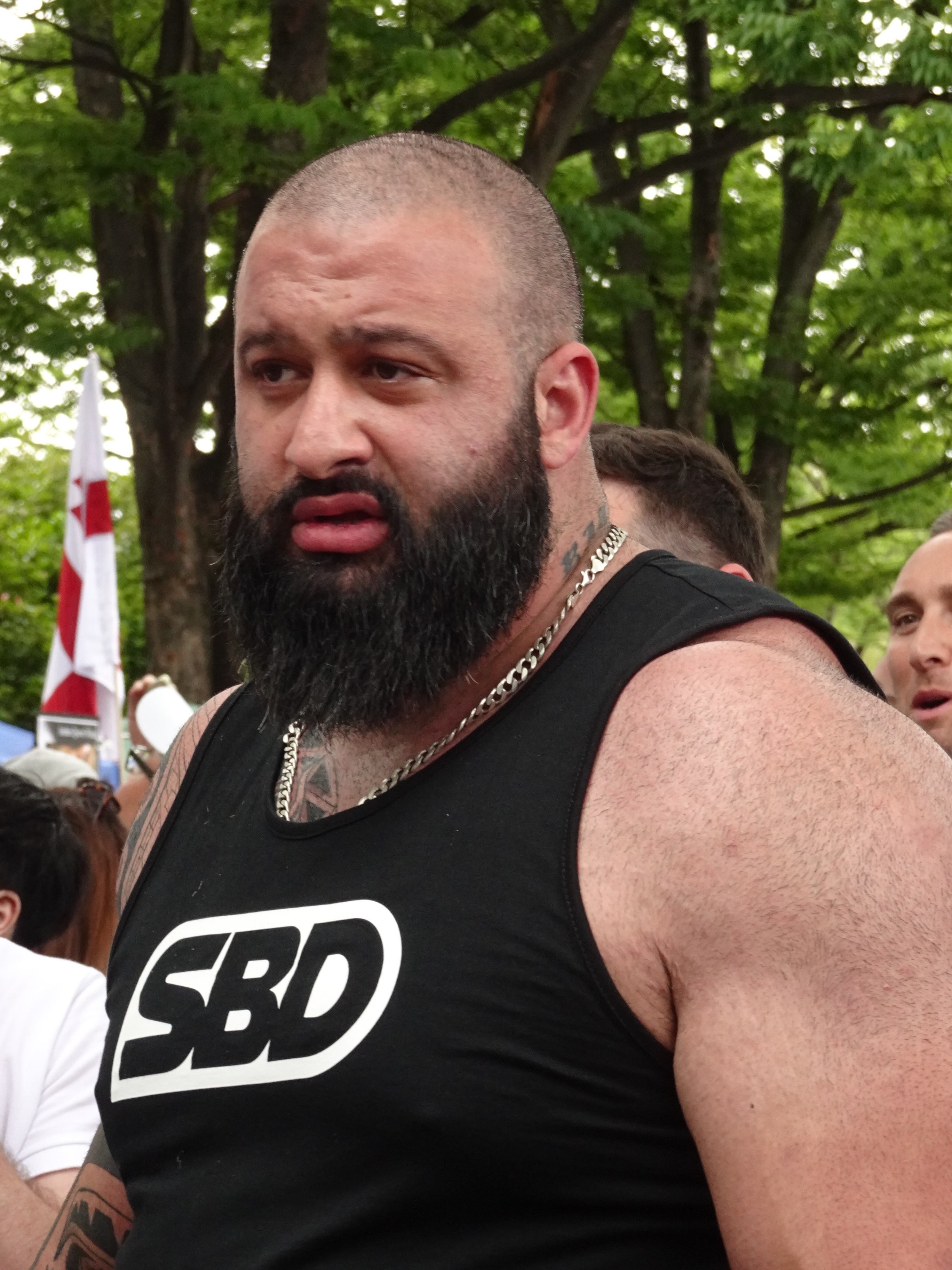
An unusual public appearance from the following summer is preserved in a photograph taken at the Georgia Festival in Tokyo's Yoyogi Park on 15 June 2024. The Wikimedia Commons file, photographed by RuinDig / Yuki Uchida, identifies Janashia alongside Georgian armwrestler Levan Saginashvili during a tug-of-war demonstration and describes the exhibition as ending 1–1. The image is valuable evidence of his presence at a cultural and sporting event outside the conventional professional strongman calendar. It is not a basis for adding a formal armwrestling title or recording a competitive win against another specialist. Rather, it illustrates the ways in which a nationally recognised athlete can appear in international cultural settings and introduce his sport to audiences who may not follow WSM or the European championships. The photograph is reproduced in this profile under the stated Creative Commons Attribution 4.0 licence, with its author and source properly credited. Its documentary status is different from that of a competition results table, and the profile preserves that distinction. [S12]
The latest international competition indexed in the consulted archive at the time of writing is the Santa Monica Classic in California, staged on 28–29 June 2025. Promoted by former WSM champion Martins Licis, the inaugural event brought together eleven athletes for a programme that included a car deadlift, log lift, frame carry, dumbbell press, Super Yoke and loading race. Janashia finished eighth on 20.5 points, with the results table recording that he withdrew before completing the full contest. He managed four repetitions in the car deadlift with a 324-kilogram vehicle and four repetitions with the 145-kilogram log. In the 340-kilogram frame carry he covered 10.97 metres, and he recorded no successful repetition with the 91-kilogram dumbbell. He was listed as withdrawn from the remaining yoke and loading events. These figures come from BarBend's dated results report and should be presented without inventing a diagnosis or private explanation for his withdrawal. [S2, S13]
As of the editorial review date of 30 September 2026, the available records do not establish that Janashia has formally announced retirement. His indexed international results run through the 2025 Santa Monica Classic, and specialized profile material continues to describe his competitive career without a confirmed definitive retirement date. The administrative status field in this profile is therefore set to active, but that designation must not be interpreted as proof that he has entered a competition during 2026. These are three separate questions: when he last competed in a documented event, whether he continues to train, and whether he has formally retired. The first is supported by the public record available here; the latter two would require current first-person statements or fresh authoritative reporting. Future results or a verified announcement should trigger a review of the status and career-year fields rather than a retrospective rewrite of previously confirmed performances. [S2, S4, S13]
A rigorous athletic biography explains what competition numbers represent rather than arranging every large weight in a single, misleading list. Janashia's documented results can be divided into several descriptive event families: maximum and repeated deadlifting; heavy overhead lifting; carrying substantial loads with frames or a yoke; pulling vehicles or other resistance-based apparatus; and controlling awkward objects such as Atlas stones. These categories are a method of analysing competition records, not a claim to possess Janashia's personal training plan. Heavy deadlifts account for several of his most widely circulated performances, but podium-level results in the Giant's Medley, Super Yoke, frame carry and stone loading were also important contributors to his career. He accumulated strong points in static and dynamic disciplines within the same contests, while other events yielded lower scores at particular meetings. That variation is precisely what distinguishes a multi-event strongman from a record specialist who performs only one movement. The useful analytical question is not which single number sounds most impressive without context, but how the athlete performed when different abilities were tested under the rules and scoring system of a particular contest. [S2]
His 440-kilogram conventional deadlift at the 2017 WSM final is a notable maximum because it is attached to a clearly identifiable professional competition. Yet even conventional strongman deadlifts require attention to permitted equipment. Straps and supportive suits may be allowed, so direct comparisons with unequipped powerlifting records can be inappropriate unless the relevant rules are explicitly aligned. Janashia's five repetitions at 400 kilograms in the 2017 World Deadlift Championships represent a different type of accomplishment: repeated heavy work performed under a sixty-second time limit. The equal number of successful lifts completed by Jean-François Caron meant the top event result was shared. Neither performance should be converted into an invented one-repetition maximum calculated from a gym formula. Maximum singles and repetition events carry different technical, pacing and fatigue demands, and even apparently identical weights can be used under different regulations. The most dependable description preserves each original competition format, records what was actually completed, and refrains from extrapolating performance into environments the athlete did not compete in. [S2, S6]
The 510-kilogram lift in Dubai in 2018 was completed from an 18-inch starting height. This distinction changes the interpretation of the number because the athlete begins the lift higher than with a standard barbell resting on the floor. Range of motion, joint positions and the distribution of mechanical demands are altered. The performance is legitimate within that event, but it is not a 510-kilogram conventional floor deadlift and should never be presented as one. Similar care is needed when reporting a Hummer Tire Deadlift. Janashia pulled 454 kilograms in that event at the 2021 Shaw Classic and 476 kilograms at the 2022 edition. The specialised bar and tyres, their geometry and the resulting movement conditions make it a distinct test from both the normal deadlift and the 18-inch variant used in Dubai. Recording the three main figures separately protects the credibility of the profile and allows readers to appreciate the event-specific progress evident in the Shaw Classic results. It also prevents a falsely inflated personal record from circulating through repeated inaccurate summaries. [S2]
Janashia's overhead record includes a 202.5-kilogram log lift from Europe's Strongest Man 2019 and a 180-kilogram axle press documented at Europe's Strongest Man 2017 and matched at the Georgian championship in 2023. Both are overhead tests, yet their implements impose different practical demands. A log is a large cylinder with neutral handles; the athlete must bring the implement from the ground to the upper body, position it and complete the press. An axle typically presents a thicker bar without the freely rotating sleeves of a conventional Olympic barbell. These properties can change handling during the clean and the overhead phase. Such descriptions reflect the general mechanics of the events, not laboratory observations or a verified technical analysis of every Janashia repetition. The public record does nevertheless show that he achieved high competition results with both kinds of implement, including a reported Georgian national log record in 2019 and a strong axle performance in the 2023 domestic championship. Overhead strength is thus an identifiable part of the competitive profile, not an inference based on appearance or social-media training clips. [S2, S8, S11]
Carrying events add another dimension to the record. Janashia was second in the frame carry at the 2016 WSM final, second in the Giant's Medley at the 2021 final and second in the Super Yoke at the 2022 Shaw Classic. Although these events all require the athlete to move substantial loads over a defined course, the objects and the way their weight is supported differ. A frame is carried in the hands; a yoke rests across the upper body and must remain balanced during movement. A medley may combine several implements and demand quick transitions between them. These differences make it unhelpful to construct a universal speed ranking from times achieved at separate competitions. Instead, each result should be read against the field and equipment of its own event. The repeated high placements across several years demonstrate that heavy carries provided meaningful competitive points during some of Janashia's strongest campaigns. They also illustrate why a single category label such as 'static lifter' would erase important documented aspects of his sporting performance. [S2]
Atlas stones are especially useful for understanding event specificity. The competitor must control a large spherical object, often lift it into the lap, extend the body and load it onto a raised platform, sometimes repeating the process for stones of increasing weight. Janashia's results changed from contest to contest. At the 2016 WSM final, four of five stones brought seventh place. At Europe's Strongest Man in 2018, he loaded all five stones in 36.14 seconds and placed third. In 2019, another five-stone series brought third place in 28.52 seconds. He was third again in the stones at Arnold UK 2022 and fifth at Europe's Strongest Man 2023. Those times should not automatically be treated as directly comparable, because stone surfaces, platform heights and the weight sequence may vary. The results do show that a discipline yielding fewer points in one final could contribute strongly at other major contests. His performance in stones is therefore best described through the specific documented results rather than reduced to a permanent and categorical strength or weakness. [S2]
'The Georgian Bull' is the arena nickname through which Janashia has become familiar to international strongman audiences. Giants Live and other competition and profile sources use the name consistently, making its public status well documented. The story of its origin is more specific and rests mainly on Janashia's own account. In the January 2019 Sarke interview, he said the nickname had been given to him at a gym in the United States after a competition in New Jersey. He associated the incident with a 406-kilogram barbell lift and explained that his pronounced trapezius muscles and general build had prompted the comparison. The interview provides an interesting first-person account of how he believes the name originated. However, the exact American event, its date and independent recognition of the reported 406-kilogram local record were not corroborated by the competition documents available for this biography. The correct editorial treatment is therefore to regard the nickname as established public identity while presenting the detailed origin story as the athlete's dated recollection, not an independently authenticated record entry. [S1, S5]
Arena nicknames can serve practical purposes beyond entertainment. They help spectators recognise a competitor in large international fields, give commentators a concise identifier and associate a sportsperson with a particular national background or physical style. In Janashia's case, 'Georgian' directly identifies the country he represents, while 'Bull' evokes the visual impression of great mass and strength. That is an interpretation of a sporting name, not a psychological assessment of the individual. His appearances with the Georgian flag at competitions in Europe, North America and elsewhere further established that public identification. Demonstration events and media appearances have also brought his work to audiences who may never follow full strongman championship results. A well-researched profile can discuss those promotional and cultural functions without inventing endorsements, claiming that he possesses a particular private temperament or treating an unverified anecdote as an official competition achievement. [S1, S2, S5, S12]
The available public record is far richer in competition results than in personal information about Janashia. His January 2019 interview with Sarke, reproduced by Sarkenews, offers a limited but useful first-person view of the latter. At that time, he said that he was in a romantic relationship and did not have immediate plans to marry. He explained that his partner understood his sporting commitments and said she also trained recreationally. He described the demands of his schedule, including frequent competitions and comparatively little free time. These statements belong to a particular interview given more than seven years before the editorial review date. They cannot establish whether the relationship continued, identify a current spouse or support claims about children or other relatives. The absence of independently verified contemporary information is not an invitation to fill the gap with speculation. For a living athlete, preserving privacy and identifying the time period of personal disclosures are essential parts of professional biographical writing. [S5]
The 2019 interview also suggests how extensive travel intersected with Janashia's daily life, though it does not provide a complete personal schedule. His public competitive calendar confirms travel across Europe, Asia, the Middle East and North America over several seasons. It does not reveal precisely how he divided his time among home, work, relationships and training or identify a permanent household situation. The consulted sources do not provide a reliable comprehensive account of his university education, previous occupations, religious beliefs, personal finances or present family composition. These subjects should not be inferred from his geographical origins, sporting profession or the social-media imagery associated with him. A substantial biography can be built without intruding on other people's identities. His publicly described beginnings in Kutaisi, the move from rugby into strongman, the documented travel and the rare personal comments he chose to make are enough to give readers a meaningful picture of the available human context while remaining transparent about the limits of the record. [S2, S5]
Another anecdote from the Georgian interview concerns a televised public performance. Sarke described how audiences in Georgia came to recognise Janashia through an appearance on the local talent programme Nichieri, during which he reportedly pulled an aircraft and flipped a four-wheel-drive vehicle. Janashia also said that he had pulled an aircraft of approximately fifty tonnes in the Philippines in fifty-one seconds, while noting that this was not recognised as an official world record. The demonstration is relevant to his public visibility, but the self-reported aircraft result lacks the full independently documented conditions needed for direct record comparisons. A vehicle's stated mass does not by itself establish pulling resistance; the surface, gradient, distance and mechanical characteristics all matter. Accordingly, the biography attributes the story to the athlete instead of promoting it into a verified championship record. From a cultural perspective, a large aircraft visibly moving under human effort can communicate the appeal of strongman to spectators who have no ready frame of reference for specialist barbell numbers. [S5]
His appearance at the June 2024 Georgia Festival in Tokyo provides a second, independently documented example of his public role outside professional contest standings. The photograph of Janashia and Levan Saginashvili taking part in a tug-of-war demonstration is a record of participation in a cultural and sporting presentation, not evidence that either athlete won an officially sanctioned contest in the other's discipline. The image's caption and the licensing information can be checked through Wikimedia Commons. A photograph is a different kind of source from a contest results database: it can firmly establish that an identifiable event took place and who was pictured, while offering far less information about training decisions, financial arrangements or broader sporting outcomes. The profile uses the image under Creative Commons Attribution 4.0 and supplies credit for photographer RuinDig / Yuki Uchida. Responsible use of documentary images is integral to the same editorial standard that requires accurate event names and properly differentiated lifting records. [S12]
Public attention to professional strength athletes often concentrates on spectacular weights rather than the less visible resources needed to develop and sustain performance. Janashia's 2019 interview gives a rare account of those resources from his own perspective. He explained that the municipality of Kutaisi and its sports service assisted with the rental cost and utilities of the space used for training, while salary and travel costs were not covered by public funding in the arrangement he described. He also referred to assistance from the international strongman organisation associated with his professional competitions. These are useful historical details because they reveal a particular model of support during a period when Janashia was already an internationally established WSM finalist. They do not provide audited figures, a present-day sponsorship agreement or proof that identical funding remained in place during later seasons. Nor should a biographer estimate his personal earnings, net worth or commercial endorsements from the size of his audience or the number of competitions he entered. A careful account distinguishes documented competition travel from the precise financial arrangements that made each journey possible. [S5]
His competition performances identify the kinds of physical tasks for which preparation must be relevant, but they do not disclose his complete training programme. A WSM final might require a maximum pull, repeated heavy pressing, rapid carrying, throwing, vehicle traction and stone loading over a condensed competitive schedule. In general, serious preparation for these tasks involves exposure to event-specific equipment as well as the development of broader lifting capacity. Yet the available sources do not supply a verified year-by-year training diary for Janashia, a precise weekly schedule, complete sets and repetitions, an identified current head coach or the internal structure of his peaking cycles. It would be poor scholarship to assign him a conjugate model, a particular form of block periodisation or a standard strongman training template merely because it sounds plausible. The athletic evidence is more robust when it remains anchored in competition: recorded implements, measurable weights, timed distances, repetition totals and results relative to the field. Those numbers can support responsible technical discussion without being transformed into invented private methods. [S2]
The same caution applies to nutrition and body mass. Giants Live's published estimate of approximately 170 kilograms provides a useful indication of his heavyweight size, but it is not a substitute for dated body-composition measurements or a personal nutrition interview. The public record consulted for this profile does not establish an exact daily calorie intake, food list, supplement protocol or medical monitoring system. Different successful strongman athletes may reach and maintain high body mass through very different approaches; assuming Janashia followed one of them would create unsupported material in an otherwise evidence-based biography. What can be discussed is the difference between the tasks he performed at that published size. Moving a heavy frame quickly, pressing a log close to his maximum and throwing a keg to a measured height place distinct demands on the athlete. The general lesson from his results concerns the specificity and variety of strongman events, not a secret diet that can be reconstructed from his appearance. [S1, S2]
Two dated health-related episodes clearly affected Janashia's participation in major events, according to public sporting reports. The first was the triceps injury reported during the 2019 WSM final, associated in contemporary coverage with an attempt involving a circus dumbbell in the overhead medley. The event archive records his withdrawal from the remaining final disciplines, and contemporary articles describe the injury as a triceps tear. That term is reproduced from public reporting rather than presented as an independent interpretation of medical images or clinical records. The second episode occurred shortly before WSM 2020. Janashia announced in a public Instagram statement, reproduced by FitnessVolt, that he had tested positive for COVID-19 and consequently could not compete. In the same statement he reported an earlier tear in his right hamstring. These facts help explain the interruptions in his contest schedule at two identifiable moments. They do not establish his medical status in 2026, the detailed severity of the injuries or the precise treatments and rehabilitation methods used afterward. [S14, S15]
The later competition record establishes that Janashia continued to perform after the reported episodes. He won the Siberian Power Show and reached sixth place in the WSM final in 2021, followed by another European podium in 2022. These are direct pieces of sporting evidence, but they cannot reveal the full clinical course of the preceding injuries. A similar limitation concerns the Santa Monica Classic in 2025: the dated results report confirms his withdrawal after several events, yet does not establish a specific medical cause. There is therefore no responsible basis for attributing that withdrawal to recurrence of a previous injury or using it to estimate future ability. Athletic biographies should not become medical case histories assembled from speculation. Accurate accounts can report what the athlete publicly disclosed, what contemporary journalists recorded and which competitions were completed or interrupted, while leaving unverified health details outside the narrative. [S2, S13, S14, S15]
Janashia's historical significance can be described through measurable competitive milestones without declaring an unsupported absolute ranking. He became the first Georgian athlete to reach the World's Strongest Man final and finished fourth in 2016. He returned to the final in 2017, 2018, 2019 and 2021, reaching five finals from seven recorded WSM appearances. At Europe's Strongest Man, he finished runner-up in 2018 and third in both 2019 and 2022. He won the Savickas Classic in 2017 and the Siberian Power Show in 2021, while the detailed national records consulted here confirm victories at Georgia's Strongest Man in 2020 and 2023. These results belong to different circuits and should not be collapsed into a single exaggerated championship count. Together, however, they document sustained participation on the international stage and several different routes to competitive success. His distinctive role in Georgian strongman history is supported most clearly by the first WSM final qualification, a factual national milestone rather than a promotional comparison with other athletes. [S1, S2, S9, S11]
A first finalist from a country changes how that country appears in the historical record of an established global championship. Before Janashia qualified in 2016, no Georgian athlete had reached the WSM final; subsequently, he returned to that stage on four more occasions. This placed Georgia repeatedly among the represented nations in a competition followed by an international audience. Claims about the precise impact on youth participation, public investment or the subsequent growth of strongman in Georgia would require specific national data rather than an assumed causal relationship. The 2019 interview does show that Georgian media recognised him as a prominent representative of the sport and that a televised strength demonstration had helped introduce him to a domestic audience. His 2023 national title and 2024 appearance in Tokyo further document public participation in contexts connected with his national identity. Those facts are sufficient to describe him as an internationally visible representative of Georgian strongman without inventing formal administrative responsibilities or treating him as the exclusive source of the sport's development in his country. [S2, S5, S11, S12]
For historical presentation, Janashia's career can be divided into four descriptive phases. The first, from the involvement he reported in 2009 to the Arnold Amateur podium in 2015, contains his early exposure to Georgian strongman, the first internationally indexed contests in 2011, the 2012 Holland's Got Power podium, the 2014 Giants Live appearance and third place at Arnold Amateur in 2015. The second, 2016–2019, encompasses four consecutive WSM finals, a fourth-place world finish, the 440-kilogram conventional deadlift, the tied five repetitions at 400 kilograms, the Savickas Classic victory, a European runner-up result and the 202.5-kilogram log. The third, 2020–2022, covers a domestic championship, the interruption of the 2020 WSM campaign, the Siberian win, the sixth-place WSM final in 2021 and the European podium of 2022. The fourth, 2023–2025, includes another Georgian championship, further European participation and the indexed Santa Monica Classic appearance. These phases are an editorial aid to understanding the record, not training cycles attributed to the athlete. [S2, S5, S6, S8, S9, S13]
His WSM record is particularly clear when the phases of the competition are kept separate. He was fourth in the 2016 final, eighth in 2017, ninth in 2018 and tenth in 2019 after withdrawing during the final. He returned to the final in 2021 and finished sixth. In 2022 and 2023 he participated in the qualifying groups but did not reach the final. Thus, 'five WSM finals' describes the number of occasions on which he advanced to the final round, whereas 'seven WSM appearances' describes editions in which he competed. Neither figure should be silently substituted for the other. At Europe's Strongest Man, his principal indexed placings were fourth in 2017, second in 2018, third in 2019, third in 2022, eighth in 2023 and twelfth in 2024. The archive does not provide evidence for an appearance at every possible intervening edition, so no missing placement has been invented to create an artificially complete annual list. [S2]
Strongman Archives distinguishes international overall competitions, national contests and individual-event championships. Some published biographies produce different headline totals because they include or exclude national titles, stand-alone records and contests from which an athlete withdrew. The most reliable approach for a detailed profile is to store major results individually, with dates, categories and placements that readers can verify. The joint World Deadlift Championships result from September 2017, for example, remains separate from Janashia's second-place general result at the Giants Live World Tour Finals on the same day. The 2023 Georgian national title is not counted as an additional international overall victory. The Dubai 510-kilogram 18-inch lift is not relabelled as his maximum conventional floor deadlift. This level of detail makes it easier to update the record later without disturbing accurately classified earlier achievements, and it limits the spread of misleading figures through subsequent summaries. [S2, S6]
The event-level record also clarifies the 2024 Europe's Strongest Man campaign, which would be inadequately described through twelfth place overall alone. The competition archive records that Janashia completed two bars of a deadlift ladder featuring loads from 300 to 380 kilograms, stopping the clock at 22.90 seconds. In the car walk, however, he finished in 22.38 seconds and took fifth place among the twelve entrants. In the Nicol Stones carry, an event involving two unevenly weighted stones, he covered 10.21 metres and placed twelfth. Even in a championship he finished last overall, he therefore achieved an upper-half finish in one of the individual events. This illustrates why the biography preserves relevant individual performances together with overall standings. A contest-wide ranking cannot be substituted for every technical result, just as a good individual performance cannot alter a confirmed overall ranking. The contrast also helps the reader understand the considerable variation in skill and physical demand between carrying implements with different balance characteristics and completing a heavy pulling ladder under time pressure. [S2]
A further statistical problem concerns the meaning of a 'competition' in strongman databases. A sporting festival may have an overall championship and, on the same day, independently named deadlift or log-lifting championships embedded within its programme. Manchester in 2017 is a particularly clear example: Janashia was second in the Giants Live World Tour Finals overall and jointly won the accompanying World Deadlift Championships with Jean-François Caron. Counting both results as separate overall championships would exaggerate his career total, while reporting only second place in Manchester would omit a documented individual victory. An analogous issue arises when Europe's Strongest Man integrates the World Log Lift Championships. The 202.5 kilograms Janashia pressed in 2019 was one competition lift associated with the relevant meeting, not two unrelated personal records achieved independently. This profile consequently uses the exact event names, separates overall championships from individual-event achievements and avoids totals that are not accompanied by the category being counted. That method also keeps the biography open to later corrections if organisers publish additional original documents or statistical archives revise their classifications. [S2, S6, S8]
This biography draws on different types of evidence for different claims. Strongman Archives provides the principal statistical framework for contest appearances, standings and event-level results; Giants Live's official athlete material, historical reports and results pages offer corroboration for major European and Tour Final performances. The Georgian Sarke/Sarkenews interview from January 2019 is used for first-person information about childhood sport, early strongman involvement, the nickname, training infrastructure and personal life as it existed at the time of the interview. Its claims are attributed when independently published competition documents do not establish them. BarBend provides a dated breakdown of the June 2025 Santa Monica Classic. The Wikimedia Commons photograph is the direct visual source for the Tokyo appearance and supplies the terms under which the image can be reproduced. Contemporary fitness journalism supplies the limited documented background of the 2019 injury and the athlete's own 2020 public statement. These sources are complementary, not equally authoritative for every category of information. [S1–S15]
Several subjects remain unresolved in the available public record. No sufficiently reliable up-to-date source was identified for the exact name of Janashia's permanent training gym in 2026, his present head coach, a personally managed official website or verified active accounts on every social-media platform. Nor do the consulted materials establish a full education history, exact nutrition programme, private income or current relationship status. Earlier reports of a sequence of Georgian national titles and the 406-kilogram New Jersey anecdote remain in the account only with appropriate attribution where the underlying individual competition documents have not been independently located. These limitations are not evidence that the reported events never occurred. They are a reminder that an editorially complete biography should distinguish what is known, what a subject has personally reported and what requires further confirmation. The supported record is already extensive: five WSM finals, three European championship podiums, two indexed international overall wins and major performances across numerous types of strongman event. [S1, S2, S5]
Viewed across its documented span, Janashia's career is neither a simple uninterrupted ascent nor a story reducible to one record. It begins in the regional and amateur circuits, reaches a world final at the first attempt in 2016, develops through further international finals, major event results and European podiums, encounters reported disruptions, and continues with later wins and contest appearances through at least 2025. Fourth place at WSM 2016 is the milestone through which Georgian strongman first entered that championship's final. The European runner-up result in 2018, third-place finishes in 2019 and 2022, and wins at the Savickas Classic and Siberian Power Show show additional dimensions of the same competitive career. The 440-kilogram conventional deadlift, 510-kilogram 18-inch deadlift and 202.5-kilogram log lift illustrate the importance of describing achievements in their own technical categories. This profile is intended to remain open to documented corrections, verified personal statements and newly published competition records without weakening the evidential basis of the achievements already established. [S1, S2, S6, S8, S9]
[S1] Giants Live, official Konstantine Janashia athlete profile: https://giants-live.com/athlete/konstantine-janashia/ . [S2] Strongman Archives, biographical record, full competition index and event results: https://strongmanarchives.com/viewAthlete.php?id=181 . [S3] Giants Live, historical World's Strongest Man and Europe's Strongest Man event coverage: https://giants-live.com/ . [S4] FitnessVolt, athlete profile and competition-status information: https://fitnessvolt.com/strongman/athletes/konstantine-janashia/ . [S5] Sarke / Sarkenews, Georgian-language interview of 30 January 2019: https://sarkenews.ge/2019/01/konstantine-janashia-sheqhvarebuls-isethi-movtsonvar-rogorits-var-mas-msophlioshi-qarthveli-kharis-sakhelith-itsnoben/ . [S6] Giants Live, World Tour Finals 2017 report: https://giants-live.com/news/the-world-s-strongest-man-tour-final-2017-at-the-newly-opened-manchester-arena/ .
[S7] Giants Live, Europe's Strongest Man 2018 official results: https://giants-live.com/shows/europes-strongest-man-2018/ . [S8] Giants Live, Europe's Strongest Man 2019 results and event review: https://giants-live.com/news/europe-s-strongest-man-2019-results-and-event-round-up/ . [S9] Giants Live, Europe's Strongest Man 2022 results and highlights: https://giants-live.com/news/europes-strongest-man-2022-full-results-and-highlights/ . [S10] StrongmanIntel, Europe's Strongest Man 2023 standings and event breakdown: https://strongmanintel.com/competition/94c9685c-7e5c-4320-ae25-ccc9f360e77f . [S11] Breaking Muscle, Robert Zeglinski, Georgia's Strongest Man 2023 results, 16 May 2023: https://breakingmuscle.com/2023-georgias-strongest-man-results/ . [S12] Wikimedia Commons, RuinDig / Yuki Uchida photograph of Georgia Festival Tokyo, 15 June 2024, CC BY 4.0: https://commons.wikimedia.org/wiki/File:Georgia-Festival-Tokyo---2024-06-15_631.jpg . [S13] BarBend, Phil Blechman, Santa Monica Classic 2025 results, 30 June 2025: https://barbend.com/news/2025-santa-monica-classic-results/ . [S14] FitnessVolt, Derek Hall, report of Janashia's positive COVID-19 announcement and injury statement, 6 November 2020: https://fitnessvolt.com/konstantine-janashia-withdraws-wsm/ . [S15] FitnessVolt, coverage of the 2019 WSM final and reported injuries: https://fitnessvolt.com/2019-worlds-strongest-man-final-results/ .
Photographic credit: the profile and hero image show Konstantine Janashia at the Georgia Festival in Tokyo, 15 June 2024. Photographer: RuinDig / Yuki Uchida. Original source: https://commons.wikimedia.org/wiki/File:Georgia-Festival-Tokyo---2024-06-15_631.jpg . Licence: Creative Commons Attribution 4.0 International, https://creativecommons.org/licenses/by/4.0/ . The photograph has been used without modification.
Iron Hall data
440 KG
Maximum conventional deadlift · 2017 World's Strongest Man final; strongman-permitted equipment
Verified
510 KG
18-inch deadlift · 2018 World's Ultimate Strongman Dubai; raised starting height, not comparable to standard deadlift
Verified
476 KG
Hummer Tire deadlift · 2022 Shaw Classic; event-specific bar, tyres and range of motion
Verified
202.5 KG
Maximum log lift · 2019 Europe's Strongest Man / World Log Lift Championships; reported Georgian national record at the time
Verified
180 KG
Maximum axle press · 2017 Europe's Strongest Man; matched at the 2023 Georgian championship
Verified
400 KG
Deadlift for repetitions · 5 repetitions, 2017 World Deadlift Championships / Giants Live
Verified
2011
Earliest international appearance recorded by Strongman Archives.
7th of 8
2012
5th of 14
2012
3rd of 10
2014
5th of 12
2015
3rd of 10
2016
First Georgian WSM finalist; 420 kg in the maximum deadlift event.
4th in the final
2016
5th of 12
2017
4th of 11
2017
440 kg maximum deadlift in the final.
8th in the final
2017
Odense, Denmark, 17 June 2017; five Atlas stones loaded in 27.55 seconds.
3rd of 10
2017
23 September 2017; second in deadlift for repetitions and frame carry.
5th of 12
2017
400 kg for five deadlift repetitions in the accompanying deadlift championships.
2nd of 10
2017
1st of 8
2018
200 kg log lift; overall runner-up to Hafþór Björnsson.
2nd of 10
2018
9th in the final
2018
Southampton, England, 3 June 2018; second in the 18-inch deadlift with 480 kg and third in farmer's walk.
3rd of 12
2018
Manchester, 15 September 2018; five deadlift repetitions and a 180 kg maximum axle press.
9th of 11
2018
510 kg 18-inch deadlift.
6th of 12
2019
202.5 kg log lift and second place in that event.
3rd of 9
2019
Reached the final; withdrew from final events following a reported triceps injury.
10th in the final
2020
1st of 6
2021
Riffa, Bahrain, 13 March 2021; fourth in the progressive axle deadlift, completing five bars up to 440 kg in 30.14 seconds.
14th of 15
2021
1st of 13
2021
6th in the final
2021
10th of 16
2021
5th of 10
2022
Won the deadlift ladder: four bars in 35.04 seconds.
3rd of 12
2022
Sacramento, California; documented participation in the qualifying phase.
5th of 6 in qualifying group; no final
2022
476 kg Hummer Tire deadlift and second place in the Super Yoke event.
9th of 15
2022
7th of 14
2023
8th of 13
2023
4th of 6 in Group 1; did not reach final
2023
27 points; event wins in arm-over-arm pull, super yoke and log lift.
1st of 6
2024
12th of 12
2025
20.5 points; latest indexed competition in the consulted archive.
8th of 11; withdrew