
1978
Icelandic Junior Bodybuilding Championship
National junior bodybuilding title during the period in which he was building his strength base.
Champion, +90 kg
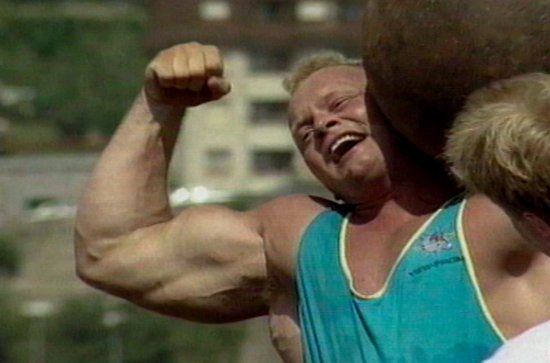
Iron Archives
“The Viking” — the first four-time World's Strongest Man
In memoriam
Jón Páll Sigmarsson (28 April 1960 – 16 January 1993) was an Icelandic strongman, powerlifter, weightlifter and bodybuilder who became one of the defining personalities of televised strongman in the 1980s. He was the first athlete in history to win World's Strongest Man four times, taking the title in 1984, 1986, 1988 and 1990. Strongman Archives records seven WSM appearances and seven finals: alongside his four victories, he finished second in 1983 and 1985 and third in 1989. He also won the World Muscle Power Classic five times, Europe's Strongest Man in 1985 and 1986, and the landmark 1987 Pure Strength contest against Bill Kazmaier and Geoff Capes. In powerlifting he became European champion in the 125 kg class in 1983 and earned bronze at the 1981 IPF World Championships; at the 1984 Icelandic Invitational he totaled 970 kg with a 365 kg squat, 235 kg bench press and 370 kg deadlift. His explosive arena persona, contrasted with a quieter off-stage reputation, helped turn “The Viking” into an icon of Icelandic sport. He died at only 32 while training in Reykjavík and was posthumously inducted into the World's Strongest Man Hall of Fame in 2012.
Strongman history contains champions who raised the athletic standard and personalities who changed the way the public understood the sport. Jón Páll Sigmarsson did both. Born in Hafnarfjörður, Iceland, on 28 April 1960 and gone far too early on 16 January 1993, he became the first athlete to win World's Strongest Man four times, taking the title in 1984, 1986, 1988 and 1990. Strongman Archives records seven WSM appearances and seven finals for him: four victories, two runner-up finishes and one third place. In an era when events were far less standardized than today and athletes arrived from powerlifting, Olympic lifting, track and field, Highland Games or combat sports, Sigmarsson became one of the first complete definitions of the modern strongman: strong enough to win deadlifts and presses, athletic enough for loading races and truck pulls, and charismatic enough to make a strength contest work as television.
His record extends far beyond World's Strongest Man. He won the World Muscle Power Classic five times, in 1985, 1986, 1989, 1990 and 1991; won Europe's Strongest Man in 1985 and 1986; and took the landmark 1987 Pure Strength contest in a direct showdown with Bill Kazmaier and Geoff Capes. Before becoming a global strongman star, Jón Páll was already an international-level powerlifter, winning bronze at the 1981 IPF World Championships and the 1983 European title in the 125 kg class. He also competed in Olympic weightlifting, where the Icelandic federation archive preserves a 270 kg total, and spent time in bodybuilding. That plurality matters. Sigmarsson was not built in an age of perfect specialization. He developed in an ecosystem in which a strong man was expected to express strength in almost any physical language, and strongman gave him the stage on which those qualities could meet.
Icelandic biographies and later retrospective accounts place Jón Páll's childhood far from the sports industry that would eventually make him famous. He was born in Hafnarfjörður to Dóra Jónsdóttir and Sigmar Jónsson and was raised by his mother and stepfather, Sveinn Guðmundsson. The family moved to Stykkishólmur when he was around two and later, when he was about nine, to Reykjavík. Biographical sources describe summers in Skáleyjar where he participated in farm and household work. Such details can easily be turned into the familiar mythology of a child forged by stones and hard labour, but exaggeration is unnecessary. The important point is simpler: physical effort was not foreign to him, and the Icelandic environment in which he grew up did not completely separate strength from everyday life. Heavy objects, weather, work and practical independence were part of the setting before they became contest events.
Popular accounts of his youth also describe an unusually broad range of physical activities, including glíma, the traditional Icelandic form of wrestling, as well as football, handball, gymnastics, swimming, middle-distance running and karate. Not every childhood anecdote can be documented with the precision of a powerlifting score sheet, yet the general picture is consistent with the athlete who later appeared at World's Strongest Man. Jón Páll was not merely a large man capable of producing slow force. He had coordination, competitive instinct and a relationship with movement that developed before specialization in weights. That mattered enormously in 1980s WSM, where a contest might move from a heavy deadlift to carrying, throwing, tug of war, caber toss or loading within a few hours. A pure specialist could dominate one event and disappear in the next; Sigmarsson grew in the intersection.
Accounts of his beginning in strength training usually place his introduction to weights in the mid-1970s and 1978 as a key year for serious training at Jakaból, one of the gyms that became legendary within Icelandic strength culture. Jakaból was more than a room with bars and plates. In a country with a small population, the training community had a multiplier effect: powerlifters, weightlifters, bodybuilders and future strongmen exchanged ideas, techniques and competitive standards. For a young athlete with unusual size and ambition, that environment could accelerate learning far more quickly than isolated training. In 1978 Jón Páll won the Icelandic junior bodybuilding title in the over-90 kg class, and the aesthetic component remained visible for much of his career. By strongman standards of the 1980s he carried an unusual combination of mass, visible muscularity and mobility.
Bodybuilding should not be treated as a curiosity detached from his later career. Hypertrophy-oriented training gave him muscle mass and body awareness, and stage presentation was already familiar before televised strongman made full use of his personality. Yet his results quickly showed that his potential reached beyond aesthetics. The heavy bar became the primary measure. In powerlifting his squat, bench and especially deadlift rose rapidly, and results preserved by OpenPowerlifting show an athlete who, by the early 1980s, could compete with the best super-heavy strength athletes in Europe. The first constant of his career is already visible here: Jón Páll did not choose between being athletic, muscular and strong. For a period he tried to be all three at once.
The Icelandic Weightlifting Federation's results archive fills in another piece of the picture. In 1978, competing at 82.5 kg, Jón Páll is listed with a 62.5 kg snatch and 80 kg clean and jerk. A year later, at the Icelandic youth championship, he had reached 95 and 130 kg. In 1980, competing in the +110 kg class at the Icelandic Championships, he lifted 120 kg in the snatch and 150 kg in the clean and jerk for a 270 kg total; a Nordic junior/youth meet from the same year records a 125 kg snatch. Those figures do not make him a world-class senior Olympic lifter, but they reveal something technically important. Before logs, rock presses and awkward objects, his body had already learned to accelerate a load, receive it and coordinate hips, knees and arms explosively.
The transfer to strongman was not mechanical, because a log is not an Olympic bar and a stone has no handle. But the alphabet of movement was already present. Weightlifting develops timing and speed under load, qualities that matter when cleaning a thick log, picking an object from the ground or producing fast extension during a loading event. Sigmarsson became famous primarily for deadlifting and object manipulation, yet his Olympic-lifting background helps explain why he often moved more fluidly than his bodyweight alone would suggest. 1980s strongman rewarded the generalist. Jón Páll was becoming one by accumulating several languages of strength.
Powerlifting is the best-documented part of his development before strongman. He reached the European podium in both 1980 and 1981, then took bronze at the 1981 IPF World Championships in the 125 kg class. OpenPowerlifting records a bodyweight of 119 kg and a 912.5 kg total at that meet: a 337.5 kg squat, 220 kg bench press and 355 kg deadlift. He was roughly twenty-one years old. Ernie Hackett and Tom Magee finished ahead of him, names that illustrate the strength of the field. For an athlete later remembered mainly through WSM, such an early IPF podium demonstrates that his base strength was not a television illusion. It was measurable in one of the most standardized environments available to him.
In 1983 Jón Páll became European powerlifting champion in the 125 kg class. OpenPowerlifting lists a 357.5 kg squat, 227.5 kg bench and 340 kg deadlift for a 925 kg total. A month later he won the Nordic Under 23 Championships with a 950 kg total, recording 355 kg in the squat, 230 kg on bench and 365 kg in the deadlift. Beyond the numbers, this period shows an ability to perform inside strict rule systems with limited attempts. Strongman would later let him improvise and use his personality; powerlifting demanded technical discipline and patience. The two identities were not contradictory. One built the engine, while the other gave it a much broader road.
In 1981, before his first World's Strongest Man appearance, Jón Páll was named Icelandic Sportsperson of the Year. The honour matters because it shows that his national reputation did not begin with British television or WSM victories. Iceland already recognized him as an international-level strength athlete through powerlifting. In a small country, an athlete capable of bringing home a world podium in a strength discipline had unusually high visibility. Strongman would later amplify that visibility until he became a cultural symbol, but the foundation of the reputation was already in place.
That early recognition also helps explain how his career could expand across several fronts. Sigmarsson was not an unknown who accidentally received a World's Strongest Man invitation. He was an established strength athlete with verified results and a domestic audience. As strongman evolved into an international television product, he arrived with precisely the combination promoters wanted: serious numbers, a spectacular physique and a personality that did not disappear when a camera was pointed at him.
Strongman Archives marks 1982 as the beginning of Jón Páll's international strongman career through Viking 82 in Vänersborg, Sweden. He finished second among eleven competitors, but the event results are more revealing than the overall placing. He won the vertical lift at 142.5 kg, one-arm deadlift at 210 kg, max deadlift at 367.5 kg and bench press at 230 kg; he was third in the max squat with 355 kg. He also moved 900 kg in the back lift, though he placed lower in that particular event. The contest captures the transition between powerlifting and strongman almost perfectly: several disciplines remained close relatives of classical lifts, but variations were beginning to demand grip, balance and tolerance for unusual positions.
For Jón Páll, Viking 82 demonstrated that standardized strength could survive in a mixed environment. Winning the deadlift and bench was predictable for a European-level powerlifter, but taking the one-arm deadlift and vertical lift showed adaptability. Over the following years, that quality separated WSM champions from specialists: being the strongest on a bar was not enough. An athlete had to transform a new event into a mechanical problem his body could solve, often with very little preparation.
At the 1983 World's Strongest Man in Christchurch, New Zealand, Jón Páll entered the title fight immediately. He finished second behind Geoff Capes. Strongman Archives shows him winning the loading race, vertical lift and farmer's walk; in the 18-inch deadlift he pulled 525 kg for second place, and he also finished second in the rock press. The result is notable not only because this was his WSM debut, but because of the range of events. Loading and farmer's walk demanded speed and conditioning, vertical lift and deadlift demanded raw strength, and rock press added overhead strength on an awkward implement. Sigmarsson was competitive across the entire spectrum.
The same year he also reached the podium at Europe's Strongest Man, finishing third. There he lifted 130 kg in the max log, placed well in bar bending, crucifix hold and boat pull, and experienced a form of contest in which strength was inseparable from spectacle. For a 23-year-old athlete, 1983 changed the scale of the career. Until then he had been an excellent Icelandic powerlifter who also competed elsewhere; after Christchurch he was a legitimate contender for the title of strongest man in the world.
The 1984 WSM, held in Mora, Sweden, produced Jón Páll's first great strongman triumph. Strongman Archives records event wins in the rock press, caber toss and truck pull, plus second-place finishes in arm wrestling, the loading race, sled push and front hold. That spread of points says more than the trophy itself. He did not win because one event created an impossible advantage. He won because his competitive floor was extremely high. Even where he was not first, he remained near the top. Strongman championships are accumulated rather than isolated, and Sigmarsson was learning their arithmetic.
The victory also sharpened the rivalry with Geoff Capes. Capes was an established champion and a central personality in British strength sport, while the younger Icelander was entering a stage built largely around existing stars. The title was therefore more than a change in standings: it announced a new type of champion. Jón Páll was more theatrical, more willing to communicate directly with the crowd and to turn adrenaline into part of the performance. That dimension would become increasingly important.
In December 1984, after already becoming World's Strongest Man, Jón Páll competed at the Icelandic Invitational in powerlifting. OpenPowerlifting preserves one of the clearest snapshots of his raw capacity: a 365 kg squat, 235 kg bench press and 370 kg deadlift for a 970 kg total in the 125 kg class. Those figures are especially useful because they came within a much more standardized setting than strongman. They provide a technical baseline and confirm that the dramatic televised feats on unusual objects did not hide any absence of classical strength.
The powerlifting data also reveal a useful contrast between image and reality. Although the deadlift became one of his defining lifts, the 970 kg total was built on an enormous squat and a solid bench as well. Sigmarsson was more complete than the popular caricature of a wild deadlifter sometimes suggests. For strongman, that completeness was ideal: the squat fed carries and loading, the deadlift transferred directly into many events, and the bench and upper-body mass provided a base for pressing even though the log and rock press demanded different techniques.
In 1985 Geoff Capes regained World's Strongest Man and Jón Páll again finished second. The archive shows Sigmarsson winning the loading race and barrel lift, finishing second in arm-over-arm pull, the medley and max deadlift, but losing important points in the truck pull. The contest reinforced the rivalry and demonstrated strongman's volatility: a champion could win multiple disciplines and still lose the overall title because of point distribution. During the same season Sigmarsson won the World Muscle Power Classic and Europe's Strongest Man, proof that second at WSM did not represent a general collapse in form.
Strongman Archives also credits him with the Húsafell Stone event win at Iceland's Strongest Man in 1985. The Húsafell Stone later became one of the global symbols of Iceland's strength tradition, and Jón Páll's association with natural objects reinforced his public Viking identity. The image was not merely costume. He genuinely came from a culture in which stories of strong people, testing stones and physical work belonged to the national imagination. Sigmarsson understood instinctively how to translate that culture into a stage identity recognizable across borders.
The World's Strongest Man Hall of Fame remembers him not only through titles but through phrases that became part of the contest's folklore. One of the best known is the short declaration, “I am not an Eskimo! I AM A VIKING!” It captures the way Jón Páll turned identity into activation. The roaring, facial expressions, humour and exchanges with spectators were not accessories pasted onto performance. For him, spectacle appears to have been part of the ritual by which he raised his arousal before an attempt.
Away from the arena, accounts from contemporaries and later profiles describe a quieter and more reflective person than the televised character. The contrast matters because it prevents caricature. Jón Páll was not permanently the man shouting at cameras. He could build a competitive version of himself and switch it on when required. In strength sports, where a decisive attempt may last only a few seconds, the ability to generate intensity quickly can be an advantage. Sigmarsson turned that ability into a public trademark.
World's Strongest Man 1986 in Nice was Jón Páll's answer to losing the crown a year earlier. Strongman Archives records victories in the loading race, max deadlift, McGlashen Stones and carry & drag, with second-place finishes in tug of war, crucifix hold and arm-over-arm pull. That is almost a textbook definition of a complete contest. Sigmarsson did not limit his dominance to static lifting; he won moving events and stones, and where he did not win he often remained near the top. A second WSM title put him level with Geoff Capes and confirmed that 1984 had not been an anomaly.
The 1986 season was broader than WSM. Jón Páll again won the World Muscle Power Classic and Europe's Strongest Man, and Strongman Archives also lists him first in the strongman competition staged in Edinburgh in the context of the Commonwealth Games. He finished second at the Défi Mark Ten International in Montréal. This competitive volume is essential to understanding the period. Top athletes did not necessarily build a year around only two or three peaks; they travelled frequently and faced implements that changed from contest to contest. Sigmarsson was unusually well suited to that instability.
The 1986 WSM also matters in the history of stone lifting. McGlashen Stones became a visual precursor to the Atlas Stone series that would later close countless World's Strongest Man finals. Sigmarsson won the event, manipulating stones ranging approximately from 70 to 150 kg. For a powerlifter, stones demand a complete change in the relationship with load: there is no bar, handle or imposed path, and the object must be squeezed into the body, lapped and then extended toward a platform. Jón Páll was one of the champions who demonstrated publicly that elite strength also meant controlling imperfect objects.
The ability to adapt to natural or semi-standardized objects became one of the signatures associated with the Icelandic school of strongman. It would be wrong to attribute an entire national tradition to one athlete, yet the image of Jón Páll lifting stones, pulling vehicles and roaring toward the crowd did more to export Icelandic strength culture than a list of records ever could. The generation of Magnús Ver Magnússon, and later Hafþór Júlíus Björnsson, entered a sport in which Iceland already possessed a recognizable identity.
In 1987 the Pure Strength contest at Huntly Castle in Aberdeenshire delivered the matchup strength fans had wanted: Jón Páll Sigmarsson, Bill Kazmaier and Geoff Capes competing directly. The three represented much of the central history of World's Strongest Man from the first half of the decade. Kazmaier had won three consecutive titles from 1980 to 1982 and had not been present at WSM during the Icelander's ascent, feeding arguments over who was truly strongest. Pure Strength reduced that theoretical dispute to an actual field.
Strongman Archives lists Jón Páll as champion ahead of Kazmaier and Capes, and the event breakdown shows the scale of the performance: wins in max deadlift, wheelbarrow carry, max log lift, vertical lift, caber toss, arm-over-arm pull, Manhood Stones and sword hold, with second place in the remaining two events. He did not win through one specialization. He won maximal lifting, carrying, overhead, throwing and endurance-style events. In a three-man field every point was severe and there were no weaker competitors from whom to recover easy placements. Pure Strength therefore remains one of the strongest pieces of evidence for Sigmarsson's peak competitive form.
Jón Páll's rivalries are sometimes simplified too aggressively. Geoff Capes was not merely the British obstacle of 1983–1986, and Bill Kazmaier was not merely the absent legend the Icelander needed to defeat. Each opponent represented a different combination of strengths. Capes brought track-and-field throwing roots, great size and experience; Kazmaier carried one of the most formidable powerlifting bases of the era and his own intense competitive persona. Sigmarsson had to be strong enough not to be crushed in the heavy lifts and mobile enough to create separation in complex events.
Pure Strength 1987 cannot mathematically settle every debate about greatness because ages, injuries, rules and peak periods differ. It can document one simple fact: in that direct ten-event confrontation, Jón Páll was superior. For a historical profile, that matters more than retrospective mythology. He entered as a WSM champion, faced a three-time champion he had not previously met in the same phase of his career, and won clearly.
At the 1988 World's Strongest Man in Budapest, Sigmarsson won his third title. Strongman Archives records victories in the McGlashen Stones, weight throw, truck pull and loading race, second in carry & drag, and third in the front hold and max log lift. In the partial deadlift he lifted 460 kg for fourth place. Again, the profile of the results is more interesting than the simple victory: he won stones, throwing, vehicle pulling and loading, a mixture of strength, explosion, conditioning and speed.
By 1988 the public character and the athlete had fully fused. Spectators expected the roars, the interactions and the theatrical moments, yet beneath the showmanship there was increasing efficiency. Sigmarsson had learned how to preserve points, adapt quickly and use the crowd's energy without letting it destroy his rhythm. A third victory placed him alongside Bill Kazmaier at the top of the historical WSM title table and created an obvious next target: becoming the first four-time champion.
World's Strongest Man 1989 in San Sebastián ended with Jón Páll in third place. Strongman Archives shows him winning Stone to Shoulder with six repetitions, taking second in the farmer's walk and car flip, and third in the truck pull and max log. He lost significant points in the cart carry and crucifix hold. A superficial reading might frame the result as the beginning of decline after the 1988 title. The rest of the season says otherwise: Sigmarsson won the World Muscle Power Classic, Kraftur and Finland's Strongest Man.
Kraftur 1989 is especially informative about his technical profile. Strongman Archives records him first in natural stones, completing 100, 130 and 145 kg stones in 8.63 seconds; first in the max log with 162.5 kg; and first in the distance throw at 7.81 metres. He was second in the wheelbarrow carry, loading race and weight throw, but only fifth in the truck pull and last in the front hold. He still won the contest. It is an excellent demonstration of how an elite strongman can absorb one very poor event if the rest of his profile is deep enough and the weakness does not become a series.
The 1990 World's Strongest Man in Joensuu, Finland, became the contest that placed Jón Páll in a separate historical category. He won for the fourth time and became the first man ever to reach that mark. Strongman Archives credits him with victories in the back load carry and medley, second place in the loading race and rock press, and third in the back lift and truck pull. He did not dominate every discipline. He was sixth in the arm-over-arm pull and fourth in the front hold. That is precisely what makes the title instructive: the championship was built through point distribution rather than invulnerability.
By then his status no longer depended on a single rivalry. Capes had left the scene, Kazmaier remained relevant in other contests, and a new generation was beginning to appear. Jón Páll had to win in a sport that was changing. His fourth title in 1990 demonstrated that he could cross that transition. Four WSM championships would later be matched by Magnús Ver Magnússon and Brian Shaw and surpassed by Mariusz Pudzianowski, but Sigmarsson was the first to show that an athlete could repeatedly return to the summit across several competitive cycles.
The World Muscle Power Classic is sometimes overshadowed today by World's Strongest Man, but in the 1980s and early 1990s it was a major point on the international calendar. Strongman Archives records Jón Páll as champion in 1985, 1986, 1989, 1990 and 1991, with second place in 1987 and third in 1988. That sequence offers another view of his consistency. WSM took place once a year and could be decided by a single error; World Muscle Power gave him repeated opportunities to demonstrate, under a different format, that he remained among the absolute elite.
Five victories in a major international contest spread from 1985 to 1991 also show the length of his peak. This was not an athlete who produced one perfect season and then lived on reputation. Six years separated his first and last World Muscle Power titles, and within that period he won three of the four WSM championships that define his career. For historical evaluation the series is essential because it reduces the risk of treating WSM as the only measure of form.
After the 1990 WSM title, Jón Páll continued competing. In 1991 he won the World Muscle Power Classic again and finished third at European Hercules. In 1992 Strongman Archives lists him third at Kraftur, sixth at European Hercules and eighth at World Mighty Man in Johannesburg. The results are more uneven than during his peak years, but they do not indicate a complete retirement. He remained part of the circuit in a period when accumulated wear and health were becoming increasingly important factors.
In retrospect it is tempting to interpret every weaker placing as a warning of his death in 1993. Responsible biography should resist that construction. Placings can depend on form, injury, travel, event selection and priorities. What can be said is that 1991–1992 represent the late stage of a career that had begun very young and had combined powerlifting, strongman, commercial appearances and a high training load over many years.
If one family of movements has to summarize Jón Páll's raw strength, the deadlift is the obvious candidate. In powerlifting, OpenPowerlifting records a competition best of 370 kg at the 1984 Icelandic Invitational. In strongman, Strongman Archives preserves 367.5 kg at Viking 82 as his database PR in the standard max deadlift and 525 kg in the 18-inch deadlift at the 1983 WSM. In 1988 he lifted 460 kg in a partial-deadlift setup. Those figures must not be blended together. Start height, bar and geometry radically change difficulty, and an 18-inch pull is not equivalent to a deadlift from the floor.
His importance as a deadlifter was not only about one number. He could pull heavy across different configurations and repeat that ability deep into long contests after other events. Strongman deadlifting often requires adapting to flexible bars, frames, vehicles, tyres or elevated starts. Sigmarsson came with a powerlifting foundation solid enough to turn variation into an advantage. When an implement became strange, he did not begin from zero; he began with an internationally proven hip-and-back engine.
The 365 kg squat and 235 kg bench press from 1984 are often overshadowed by his deadlifts and televised object events. They matter mechanically. A squat of that level at 125 kg bodyweight gave him enormous reserve for early yoke-type events, loading, stone lifting and any discipline in which an object had to be broken from the ground and moved. The bench, although not a perfect transfer to log pressing, demonstrates the pressing strength of his chest and triceps.
Viking 82 even captures him winning the bench press with 230 kg and finishing third in the max squat at 355 kg. Those results came before WSM built his global image. They show that his physique was not designed only for preferred events. He possessed general strength. In strongman that is the difference between an athlete who needs a favourable set of disciplines and one who can enter almost any contest with a realistic route to the podium.
By modern standards a 165 kg log lift can look modest, but direct comparison across eras is misleading. Strongman Archives lists 165 kg at the 1987 Iceland's Strongest Man as Jón Páll's max-log PR. At Kraftur 1989 he won the max log with 162.5 kg. At WSM he also excelled in the rock press, winning the event in 1984 and finishing second in 1990 with 120 kg in that contest's particular setup. Implements, diameters and cleaning methods were far less standardized than they are today.
The historical value of those performances is better understood through placing than raw number. Jón Páll could win overhead events in a period that attracted massive powerlifters and throwers. At Pure Strength 1987 he won the max log ahead of Kazmaier and Capes. He did not have the modern advantage of standardized implements, widespread event coaching or thousands of technique videos. Much of the technique had to be built through direct experience, and the object at the next contest could still be different.
Sigmarsson is remembered for roaring and lifting, but the results archive reveals another quality that deserves more attention: he could be exceptionally fast in loading events. He won the WSM loading race in 1983, placed second in 1984, won again in 1985 and 1986, won the loading race at the 1988 WSM, and finished second in both 1989 and 1990. Such consistency in a speed-based event challenges the caricature of 1980s strongman as little more than powerlifters moved outdoors.
Loading demands acceleration, technique on differently shaped implements, the ability to turn quickly and tolerance of severe metabolic fatigue. Repeating those actions against a clock is expensive for an athlete around 133 kg. Jón Páll was able to make body mass an advantage without becoming its prisoner. In 1990, when he won the WSM medley and back load carry, that ability was still present almost a decade after his first international strongman results.
Stones hold a special place in Jón Páll's story because they connect modern sport to Iceland's older culture of testing stones. Strongman Archives credits him with the Húsafell Stone win in 1985, McGlashen Stones victories at the 1986 and 1988 WSM, a Stone to Shoulder win at WSM 1989, and victory in the natural-stones event at Kraftur the same year. These are different disciplines: carrying, loading and shouldering require their own techniques. What they share is the absence of an ideal grip and the need to squeeze an awkward mass against the torso.
For the public image of “The Viking,” such events were perfect. Beyond symbolism, however, they show an athlete with an effective relationship between static strength and object control. A huge deadlift does not automatically produce fast stone work. The athlete must find the angle, position the forearms, use the hips and keep the object close to the centre of mass. Sigmarsson did those things well enough to win repeatedly in major contests.
Caber toss, weight throw and distance throw appear repeatedly in his results. He won the caber toss at WSM 1984 and at Pure Strength 1987; won the weight throw at the 1988 WSM; and at Kraftur 1989 won the distance throw with 7.81 metres while placing second in the weight throw. These performances remind us that older strongman retained a visible connection with Highland Games and traditional throwing disciplines.
Throwing rewards explosiveness, timing and coordination, not simply muscle mass. An athlete can have an enormous deadlift and still fail to turn that force into an efficient trajectory. Sigmarsson was versatile enough to win such events against opponents with serious athletic backgrounds. That is another reason his profile cannot be reduced to powerlifting plus personality.
Strongman Archives lists Jón Páll at approximately 1.90 m and 133 kg. His bodyweight varied across his career and other sources may give different figures by season, but the number is a useful reference. Compared with modern super-heavyweights in the 180–200 kg range, he appears relatively light. Within the context of the 1980s he was nevertheless a large, heavily muscled athlete, heavy enough for elite absolute strength without sacrificing all speed.
That compromise is visible in the results. He could deadlift at world level while winning loading races and truck pulls. He could handle stones and perform in tug of war or caber toss. Modern strongman gradually pushed body mass upward, but Sigmarsson's career shows that performance is not a simple equation in which more kilograms automatically create a better athlete. Every kilogram has to produce enough force to justify its cost in acceleration, conditioning and recovery.
There is no complete, verified training diary that allows every Jón Páll week to be reconstructed, and popular biographies sometimes fill the gaps with legend. What can safely be inferred from his career is a combination of heavy foundational work, hypertrophy volume and repeated exposure to implements. Powerlifting demanded planned squats, benches and deadlifts; bodybuilding added muscle-building volume; strongman demanded objects, carries and conditioning.
Jakaból and later Gym 80 functioned as environments in which strength culture was collective. Athletes watched one another's attempts, exchanged ideas and built solutions for events that had no textbook. Hjalti Árnason and other members of Iceland's strength community appear frequently in histories of the period. That network matters. The individual legend of Jón Páll was born inside a group of people collectively pushing standards higher.
His bodybuilding period influenced not only his physique but his presentation. In photographs and film from the 1980s, Sigmarsson looks different from many modern strongmen: a relatively controlled waist, visible muscular separation and an aesthetic closer to the heavy bodybuilding of the period. That appearance probably increased his impact on television. Viewers could immediately identify a body built deliberately, not only a large man capable of lifting.
That does not mean aesthetics permanently dictated his preparation. During strongman seasons performance took priority, and bodyweight and composition could change. But bodybuilding experience gave him a relationship with stage, image and audience that relatively few powerlifters possessed. In a sport created for television, that was a genuine resource.
Jón Páll's success coincided with World's Strongest Man becoming an international television product. For Iceland, the emergence of a champion who could beat men from far larger countries carried obvious symbolic force. Later Icelandic media routinely describe him as one of the country's most beloved athletes, and documentaries and biographies still return to his story decades after his death. He was not merely a champion imported onto Icelandic screens; he became part of the way Iceland exported an image of itself as a nation of strong people.
That cultural dimension should not be confused with objective athletic evaluation. A sportsperson can be popular without being historically elite. In Sigmarsson's case, however, the symbol was supported by results: four WSM titles, five World Muscle Power championships, two European strongman titles and Pure Strength. Charisma amplified an already exceptional career; it did not replace one.
Jón Páll had a son, Sigmar Freyr Jónsson, born in 1983. The fact is confirmed by Icelandic media through later interviews with Sigmar Freyr. In a 2013 Vísir piece, his son recalled that he was around nine when his father died and that the loss was an enormous shock. Such testimony adds a dimension that contest footage cannot show. Behind “The Viking” character was a parent whose private life continued alongside tournaments, travel and training.
A serious biography should resist turning private relationships into retrospective entertainment. Sources about his romantic life vary in reliability and often come from books or documentaries designed for a broad audience. What is relevant and documentable is that fame carried private costs: frequent travel, media pressure and a life structured around the body and performance. The fact that his son spoke publicly about him two decades later shows the persistence of a family legacy, not merely a sporting one.
Several retrospective portraits emphasize the contrast between competitor and private person. On stage Sigmarsson was expansive, provocative, loud and often funny. In conversation he could be polite, calm and curious. Some accounts even describe him as studious or interested in reading. Such details should be treated as cultural portrait rather than psychological diagnosis, but they help illuminate an important skill: Jón Páll was not simply trapped inside his competitive temperament. He could intentionally build intensity.
Modern athletes are familiar with the difference between competitive activation and everyday personality. Some need calm, others aggression. Jón Páll turned activation into a public act, and the audience fed energy back to him. That loop between athlete and crowd became one of his unofficial innovations. He showed that strongman did not only have to be watched; spectators could feel they were helping produce the attempt.
Icelandic media have reported that Weider entered a significant sponsorship agreement with Jón Páll in 1984, placing him within the early professionalization of Icelandic strength sport. In an era when strongman prize money and contracts were far smaller than in established sports, sponsorship could transform a career. Sigmarsson was commercially attractive not only because he lifted heavy weights, but because he possessed an instantly recognizable image.
The Viking identity worked without lengthy explanation. Hair, physique, accent, roaring and Icelandic origin formed a coherent package. In modern terms, Jón Páll understood personal branding before athletes had social media. Every television appearance strengthened it. That recognition helped him and, indirectly, helped make strongman more marketable.
The final part of Jón Páll's biography is inseparable from health, and this is exactly where editorial discipline is most necessary. Strongman Archives states that he died on 16 January 1993 after an aortic rupture while deadlifting. Icelandic media and accounts from fellow athletes confirm that the event occurred at Gym 80 in Reykjavík. Magnús Ver Magnússon later described arriving at the gym while attempts were being made to resuscitate Jón Páll. He was only 32 years old.
Later Icelandic sources have discussed cardiovascular problems, cholesterol and the use of anabolic substances within strength sports of the period. Some biographies report that Jón Páll knew he had health concerns and had sought medical assessment abroad. Those claims are largely retrospective testimony and must be separated from the documented immediate cause of death. This profile therefore does not turn association or hypothesis into a medical diagnosis. What can be stated securely is that his death was an acute cardiovascular catastrophe, that it occurred while training and that it ended the life of an unusually young elite athlete.
There is something symbolically difficult to separate from his career in the fact that Jón Páll died in a gym, near the movement that had defined so much of his reputation. A responsible biography should not romanticize the moment. It was a medical tragedy. People present attempted to intervene, emergency help was called, and the news hit both the strength community and the Icelandic public hard. Magnús Ver Magnússon later described the shock of arriving for training and seeing the resuscitation effort.
His death came before strongman entered its next Icelandic chapter, dominated by Magnús Ver. The continuity is one of sporting history's bitter ironies: Iceland remained at the top of WSM, but the man who had built much of the modern mythology of Icelandic strength did not live to see how powerful that tradition would become. In later years, every major Icelandic success would inevitably be measured against Jón Páll's standard.
Magnús Ver Magnússon has spoken in Icelandic media of Jón Páll as a hard rival but also a good friend from whom he learned a great deal. Their relationship symbolizes a generational handover. Magnús did not try to copy Jón Páll's theatrical character and has said explicitly that such imitation would have been artificial. He built a more restrained identity of his own while pursuing, matching and in some cases surpassing records associated with his predecessor.
Historically, that difference is healthy for a sport. A powerful legacy should not create copies; it should create standards. Jón Páll demonstrated that an Icelander could dominate World's Strongest Man and become an international star. Magnús showed that the achievement could be repeated through a different temperament and competitive profile. Hafþór Björnsson would later add a third major version of the Icelandic champion.
In 2012 World's Strongest Man posthumously inducted Jón Páll Sigmarsson into its Hall of Fame. For a sport whose early historical archives can be fragmented, such official recognition matters. WSM presents him as the first athlete to win four titles and preserves his personality as part of the identity of the contest. He is not simply a name in a results table; he is part of the event's institutional memory.
The Hall of Fame also helps separate legend from documentation. Fans can debate the ordering of the greatest strongmen, but the fact that Jón Páll was the pioneer of the four-title threshold is verifiable. So are seven WSM finals from seven appearances and the victories in other major circuits. His legacy does not require exaggeration to remain enormous.
His name continued through memorial competition as well. The Jón Páll Sigmarsson Classic was staged in Iceland beginning in 2010, at a time when a new generation of strongman was already being defined by athletes such as Brian Shaw and Hafþór Júlíus Björnsson. Shaw won the first two editions and Björnsson the 2012 contest. Having athletes from another era compete under Jón Páll's name created a concrete bridge between generations.
A memorial contest serves a different function from a statue or documentary. It returns the athlete to the language for which he was known: heavy objects, points and competition. For younger fans, the name becomes a question that leads backward into history. For veterans, it provides a frame for seeing how standards changed without pretending that the eras are identical.
In Iceland, Jón Páll's life has repeatedly returned through books and documentaries. Sölvi Tryggvason's 2013 biography and the documentary “Þetta er ekkert mál” helped preserve a more complex image in which victories sit beside private life, health and the controversies of the era. In 2026 Icelandic media announced a cinema return for the documentary around the twentieth anniversary of its original release, an unusual indicator of the story's staying power.
That cultural survival matters because most champions in niche sports gradually disappear from general public memory. Jón Páll remained recognizable not only through results but through the visual archive. Television preserved his voice, gestures and rhythm. In such a physical sport, film is almost as important as statistics: later generations can see what his strength looked like instead of reading numbers alone.
Directly comparing Jón Páll with modern champions is tempting and often misleading. Today, deadlifts beyond 450–500 kg, logs over 200 kg and athletes approaching 200 kg bodyweight have changed the absolute scale. Implements are more standardized, technique moves instantly through video, nutrition and recovery are more specialized, and international talent pools are deeper. Saying that a larger modern number automatically makes a modern athlete historically greater ignores that evolution.
A more useful comparison asks how far an athlete stood from the standard of his own era, how often he won and how broad the demands were. By those measures Sigmarsson remains exceptional: four WSM victories from seven appearances, every one of those appearances ending on the podium, together with a dense record in other contests and world-level powerlifting results. Modern athletes pushed the numbers higher; Jón Páll helped create the path on which those numbers could climb.
Claims of dozens of world records circulate around Jón Páll. Some are plausible, others depend heavily on definition and on incomplete historical records. Strongman allows records in weight, time, distance, repetitions or a unique apparatus. For that reason, this profile keeps only clearly documented reference points and names them precisely: a 370 kg powerlifting deadlift, 367.5 kg strongman max deadlift at Viking 82, a 525 kg 18-inch deadlift at the 1983 WSM, a 460 kg partial deadlift at the 1988 WSM, and a 165 kg max log in 1987.
That precision does not weaken the legend; it protects it. If 525 kg is simply presented as a “deadlift,” a modern reader may assume a conventional pull from the floor and compare it incorrectly with current records. Calling it an 18-inch deadlift keeps the performance impressive while making it technically honest. A serious archive should prefer specific truth to spectacular numbers without context.
Strongman Archives attributes 30 international contests and 12 wins to Jón Páll, plus three national contests and three national wins within its database. Other sources give different totals, especially for Icelandic titles and regional competitions. The difference does not automatically mean one database is wrong. Strongman in the 1980s had no single global registry, and criteria for what counts as an international contest, national championship or exhibition can vary.
In such cases this profile uses Strongman Archives as the chronological skeleton and supplements it with OpenPowerlifting, the Icelandic weightlifting archive, official World's Strongest Man material and Icelandic press. Where sources differ, preserving the qualifier and the source is more accurate than inventing certainty. For 1980s strength sport, history is still partly an act of reconstruction.
It is difficult to imagine the modern perception of Iceland in strongman without Jón Páll. He did not invent the country's strength culture and was not the first powerful Icelander, but he made that culture globally visible in the television era. After him, Magnús Ver Magnússon won four WSM titles, and Hafþór Júlíus Björnsson became champion and one of modern strongman's best-known figures. This is not a direct genealogy, but it forms a recognizable competitive tradition.
For a small country, repeated success has a powerful modeling effect. Young athletes no longer see strongman as an entirely foreign sport; they have national examples. Gyms can build culture around real champions, and promoters can draw on local history. Jón Páll was the first great international figure in that continuity.
Strongman is both sport and spectacle, and Jón Páll understood that instinctively. He did not weaken the athletic component in order to entertain; he used entertainment to amplify the sporting stakes. A heavy attempt became a small dramatic scene. Rivalry had lines, victory had gestures, and the audience could recognize the athlete before a graphic showed his name.
Traces of that model are obvious in contemporary strongman. Athletes cultivate characters, speak to cameras and use contests to build communities. Today they also have social media, podcasts and professional personal brands. Jón Páll did part of that work in an era when a few minutes of international television had to be enough. It worked because the image was concentrated, authentic and memorable.
Four titles are the famous number, but the full sequence may be an even cleaner measure of his WSM consistency. In 1983 Jón Páll finished second, in 1984 first, in 1985 second, in 1986 first, in 1988 first, in 1989 third and in 1990 first. Every WSM appearance ended on the podium. The only missing year in that sequence is 1987, when he was not in the WSM field but won Pure Strength against Kazmaier and Capes.
That run describes a career with remarkably few empty seasons at the top level. In a sport with variable events, every appearance ending on the podium is extraordinary. A minor injury, a grip failure or one badly suited discipline can destroy a championship. Sigmarsson reduced volatility by having many different routes to points.
Technically, Jón Páll was not perfect by any modern definition. There were events in which he could finish low, as front holds and occasional truck pulls demonstrate. His advantage was the density of qualities. He had elite deadlifting, a huge squat, competitive overhead strength, good grip, loading speed, stone experience and throwing ability. When one event exposed him, the next several often gave him a way to recover.
He was also excellent at turning a contest into an emotional problem for opponents. A rival was not only fighting the weight but facing an athlete who seemed to grow with the noise. The psychological effect cannot be measured retrospectively, but the behaviour can be observed: after a successful lift Sigmarsson occupied space, communicated and projected confidence. In a sport of indirect confrontation, that created its own kind of pressure.
A complete biography should not turn a champion into a contradiction-free character. Jón Páll lived in an era of strength sport with less medical knowledge, different drug-control structures and a culture of risk that the present views more critically. He was ambitious, at times excessive, and built around the idea that limits existed to be pushed. The same qualities that produce elite performance can impose costs when recovery or health cannot keep pace.
His death at 32 makes it impossible to know what the second half of his life might have looked like. Would he have become a coach, promoter, businessman, commentator or simply a retired public figure? Any answer would be fiction. What we know is that he never received the chance for a slow transition into veteran status. His career and life ended almost at the same point, leaving the public image of a man permanently young and powerful.
There is no objective formula for deciding a single greatest strongman in history. The sport has changed too much, and different criteria can privilege WSM titles, total contest wins, records, longevity or absolute strength. Jón Páll nevertheless has a factual record that keeps him central to any historical discussion: first four-time WSM champion, five World Muscle Power wins, Pure Strength 1987, European titles, world-level powerlifting results and an outsized cultural influence.
Perhaps the most accurate description is not “the greatest,” but one of the athletes who helped define what greatness in strongman could look like. WSM had legendary champions before him. After him, expectations of a champion had changed: he had to be strong, versatile, recognizable and capable of carrying an event in front of a camera. Jón Páll united all of those roles.
Jón Páll Sigmarsson moved through nearly every identity in strength sport within one short life: weightlifter, bodybuilder, powerlifter, strongman, world champion and star. He came from an island culture of strength and translated it into a language international audiences understood. His results show that showmanship was not a mask hiding limited performance. It was the outer layer of a very serious athletic base.
Four World's Strongest Man titles alone would guarantee a place in history. Five World Muscle Power championships, Pure Strength, world-level powerlifting podiums and influence on Icelandic identity add depth. His early death left the story unfinished, but not empty. Athletically, Jón Páll had already demonstrated almost everything available in his era. Culturally, he accomplished something even rarer: he turned strength into a character the world still recognizes.
Viewed retrospectively, 1978–1982 looks like a logical staircase toward strongman, but Jón Páll's route was not yet predetermined. In 1978 he appears in Olympic weightlifting at 82.5 kg and wins a junior bodybuilding title in a heavy class. Within only a few years, his bodyweight and strength numbers rise dramatically and the centre of gravity shifts toward powerlifting. The evolution shows that his talent was not tied to one fixed morphology. His body changed with his goals, and each discipline left something useful: control and explosiveness from weightlifting, mass and training volume from bodybuilding, maximal force and attempt discipline from powerlifting.
By 1982, when Viking 82 placed him in a recognizably strongman format, Sigmarsson was no novice with weights but an athlete already educated through repeated competition. That helps explain why his transition was so fast. Many athletes need years to learn contest pressure; Jón Páll already understood warming up for maximal attempts, missing and returning, and the simple but decisive difference between a gym performance and an official result. Strongman changed the objects. It did not introduce him to competition for the first time.
The 1983 and 1984 seasons can be read as one story in two acts. In the first, Jón Páll enters WSM and discovers that he can immediately win events and challenge for the title. In the second, he applies the information. Christchurch showed both his strengths and the cost of a very poor event, such as the truck pull in 1983. One year later at Mora, the truck pull is among the events he wins. Without his training logs we cannot prove a direct cause-and-effect relationship, but the progression illustrates a champion's adaptability: yesterday's weakness becomes tomorrow's concrete problem.
During the same interval his powerlifting remained extremely strong. Instead of immediately abandoning standardized competition after WSM success, Sigmarsson continued producing major totals and reached 970 kg in 1984. The coexistence of the two careers is notable because the adaptations are not perfectly compatible: powerlifting rewards specialization in three lifts, while strongman disperses training resources across many qualities. For several years Jón Páll carried that tension and turned it into a competitive advantage.
In sport, the response to losing a title can reveal more than the first victory. In 1985 Jón Páll fails to stop Geoff Capes at WSM even while winning other major contests. The following year he returns with an almost ideal scoring profile: four event victories at WSM 1986 and three second places. That distribution dramatically reduces risk. Even if one of the remaining disciplines had gone poorly, his points base was already enormous.
The 1986 season also illustrates the difference between being very strong and knowing how to win strongman. The first concept can be measured by a lift. The second involves energy management, pacing, assessment of opponents and acceptance that sometimes second place is enough. On film Jón Páll often appears to operate at maximum intensity, but the results suggest that beneath the theatre was a sophisticated understanding of contest structure.
Jón Páll's absence from World's Strongest Man in 1987 might have created a gap in his career narrative if the season had not produced Pure Strength. Instead, the matchup with Kazmaier and Capes became an alternative form of validation. For critics who could argue that Sigmarsson had won WSM without meeting the three-time American champion during their shared competitive window, Huntly Castle offered the most concrete available answer: same contest, same ten events, clear victory for the Icelander.
Returning to WSM in 1988 and winning a third title closed the cycle. Sigmarsson did not depend on one organization for legitimacy, and Pure Strength had not made him treat WSM as a finished chapter. He came back and won again. Historically, the 1987–1988 combination is one of the strongest sequences of his career: first he defeats two of the most important champions of the era directly, then he reclaims the WSM crown.
Third place in 1989 provides a useful image of his limits. The front hold and cart carry cost points, and WSM did not allow him to convert event wins and podiums into the overall title. Yet victories elsewhere in the same year show that he had not physically disappeared. That is important when evaluating longevity: a weaker result in one final is not automatically equivalent to a global decline.
In 1990, rather than requiring spectacular domination of every event, the WSM results show an efficient construction: two wins, two second places, two thirds and sufficient control over losses. The fourth title is therefore also a display of maturity. The young champion of 1984 had won through explosiveness and consistency; the 1990 champion could win without being first in half the programme.
After becoming the first four-time WSM champion, Sigmarsson's competitive motivation did not simply stop. His World Muscle Power title in 1991 demonstrates that he could still win a major contest. That fact is often lost in narratives that jump directly from WSM 1990 to his death in 1993. Between those points there was still sport: training, travel, podiums and the attempt to remain relevant as new athletes arrived.
In 1992 his placings show reduced consistency rather than the complete disappearance of competitive ability. Third at Kraftur coexisted with weaker results at European Hercules and World Mighty Man. Such variation is understandable for an athlete with a decade of international strongman behind him and several years of strength sport before that. Without complete contemporary medical data it is not legitimate to attribute every result to health, but accumulated wear across a very dense career can be acknowledged.
A common mistake when evaluating historical strongmen is to focus only on their biggest numbers. Strongman is not a single-record competition; it is a points system. An athlete can own the biggest lift of the day and still miss the podium if too many points are lost in carries, medleys or throws. Jón Páll learned through experience that overall victory requires a profile without major holes.
His WSM results illustrate the logic. In 1988 he did not win the partial deadlift despite being one of the generation's great deadlifters, but he won stones, weight throw, truck pull and loading. In 1990 he did not win the back lift, rock press or loading race, but accumulated enough podium-level finishes. For a modern coach, the lesson is clear: specialization can produce records, but the absence of major weaknesses produces championships.
Jón Páll's profile can be divided into two broad families. Statistically, he had the deadlift, squat and pressing strength to remain competitive with specialists. Dynamically, he could load quickly, pull vehicles, throw and carry. Many bodies excel predominantly in one family. The mass and rigidity that aid maximal lifting can slow running, while a body built for speed may surrender too much absolute strength. Sigmarsson found an unusually effective compromise for his era.
Compromise does not mean mediocrity in both directions. A 370 kg powerlifting deadlift and 365 kg squat are elite figures, while repeated loading-race wins are elite dynamic results. He did not need to be the absolute number one in the world at every physical quality. Across eight or ten events, integration is the value.
Results in farmer's walk, stones, wheelbarrow and arm-over-arm events point to very good functional grip. Strongman grip is more complex than isolated squeezing strength. The hand has to tolerate traction, rotation, sweat, different diameters and sometimes impact. Jón Páll won the farmer's walk at WSM 1983 and finished second with 76 metres in 1989; at Pure Strength he won the wheelbarrow carry and arm-over-arm pull.
Those results suggest not only strong fingers but a complete chain capable of holding form under load: traps, upper back, trunk and hips. Excellent hands attached to a collapsing body do not carry very far. Sigmarsson could turn contact with an implement into a body structure rigid enough to keep moving.
Conditioning is easy to overlook in old footage because cameras follow the object rather than the athlete's pulse. Loading races, medleys, carries and repeated pulls nevertheless show that Jón Páll had a high work capacity. Winning a fast event early in a contest is one thing; continuing to produce top results after several heavy disciplines is another. Recovery between events becomes part of the competition.
For an athlete above 130 kg, conditioning has to be developed without consuming maximal-strength capacity. That tension still exists today. Sigmarsson did not have modern monitoring, GPS, lactate analysis or online conditioning systems. The solution was experiential: extensive specific work, frequent competition and empirical pacing adjustments. His results indicate that he found a very effective balance.
It is tempting to explain Jón Páll's victories through an unmeasurable “Viking mentality.” A more rigorous analysis can stay with observable behaviours. He used verbal self-cueing, gestures, crowd contact and a deliberate rise in intensity before attempts. Successful lifts were followed by celebration that reinforced the state. Such behaviour can function as an activation routine and a way of managing pressure without requiring invented claims about hidden psychology.
At the same time, exuberance should not be confused with lack of control. An athlete who spent maximum emotional energy before every discipline would probably exhaust himself. The fact that Sigmarsson won long contests suggests that he regulated intensity better than television montages might imply. The camera preserves the explosion; the standings preserve the management.
Jón Páll appeared at an ideal moment for turning an athlete into an icon. World's Strongest Man was young enough that personalities could still define its language, but widely distributed enough for images to circulate internationally. A strongly recognizable figure could become synonymous with the contest. Sigmarsson had the advantage of a distinctive silhouette, memorable voice and behaviour that could not easily be confused with anyone else's.
In the pre-internet era, the annual return of WSM worked almost like a serialized programme. Viewers came back to familiar rivals, and continuity built characters without social media. Geoff Capes, Bill Kazmaier and Jón Páll were not just names on a leaderboard; they were faces in an unfolding story. The Icelander's ability to create memorable visual moments helped his appearances survive in public memory longer than many technically comparable results.
The nickname “The Viking” works on several levels. It is simple and effective marketing, but it also has cultural roots: Iceland is historically connected to the medieval Norse world, and physical strength has a visible place in sagas and modern popular culture. Biography should nevertheless avoid confusing the historical person with a reconstruction of a medieval warrior. Jón Páll was a twentieth-century athlete shaped by gyms, sponsors and television.
The power of the character came precisely from that combination: old symbol, modern technology, new sport. He could carry a natural stone and then appear in a global television format. He could invoke the Viking as identity while building performance through powerlifting, Olympic lifting and bodybuilding. Myth and method coexisted.
Jón Páll, Magnús Ver Magnússon and Hafþór Júlíus Björnsson represent three very different phases of strongman. The first belongs to the experimental and television-shaped 1980s, the second to the more mature competitive structure of the 1990s, and the third to a professionalized, global and digital era. Raw-number comparison between them says relatively little without context.
More interesting is what each preserves from the tradition: versatility, the importance of stones, the status of a national champion becoming global, and the idea that Iceland can repeatedly produce athletes capable of dominating an international sport. Jón Páll is the first great chapter of that modern narrative, not its final one.
Reconstructing the career of a 1980s strongman requires a hierarchy of sources. For standings, event results and implements, this profile prioritizes specialist databases such as Strongman Archives, OpenPowerlifting and the Icelandic Weightlifting Federation's results archive. Official World's Strongest Man material is used for WSM historical status. Icelandic press is used for personal life and cultural context, with care taken to distinguish testimony from sporting record.
That method explains why some popular stories are not presented as certain facts. Strongman naturally produces folklore: weights grow in retelling, quotations mutate and demonstrations become “world records.” A professional biographical profile should preserve the charm of the period without sacrificing the distinction between what can be verified and what is transmitted through legend.
Jón Páll's legacy survives through two types of archive. The first is statistical: titles, kilograms, places and dates. Without it, legend becomes impossible to calibrate. The second is visual: footage of roaring, smiling, failed attempts and successful lifts. Without that archive, numbers cannot explain why a champion from four decades ago continues to generate an emotional response.
The two archives correct one another. Film can make a moment appear statistically larger than it was, while a table can make a career seem colder than it felt. In Sigmarsson's case the combination produces the complete image: a verifiably extraordinary athlete and a performer who changed the emotion of the sport.
For contemporary athletes, Jón Páll is not a programme to be copied mechanically. Methods, sports medicine and event standards have changed. His relevance is conceptual: build a genuine base, become competent across multiple forms of effort, learn how to compete, and make the audience understand why your attempt matters. Those principles do not depend on era.
His career also offers an editorial lesson: there is no need to choose between athlete and character. In the best strongman, the two support one another. Results give credibility to spectacle, while spectacle gives memory to results. Jón Páll Sigmarsson was among the first to demonstrate that equation on a global scale.
Another reason Jón Páll's performances require context is equipment. Strongman in the 1980s did not offer today's degree of uniformity in bars, straps, belts, footwear, tacky, protective equipment or implements. A log could have a different diameter and centre of mass from one contest to another; a stone could be natural, irregular and difficult to grip; a truck pull could be transformed by surface, rope and gradient. Limited standardization made adaptation a competitive quality in its own right.
That is why historical records are best read as performances in context rather than a simple linear scale leading to the present. A 165 kg log in one 1987 contest is not automatically equivalent to 165 kg on a modern standardized log, and a truck pull cannot be compared properly without distance, gradient and setup. Sigmarsson excelled in a period in which the unknown was part of the event. Athletes often received less information and had to solve the implement almost in real time.
Jón Páll's calendar took him from Iceland to Sweden, New Zealand, Portugal, France, Hungary, Spain, Finland, Canada, Japan, Scotland and South Africa. Athletic travel remains exhausting today, but teams now have easier access to instant information, planned nutrition, professional support and recovery infrastructure. In the 1980s a strongman could arrive in another country with far less control over meals, sleep and logistics and then face implements he did not own at home.
Sigmarsson's ability to remain internationally competitive for close to a decade should also be read through that logistical burden. The body recovered not only from squats, deadlifts and stones but from time zones, flights, disrupted schedules and repeated competition stress. Those costs do not appear in result tables, which is one reason consistency is such a powerful historical indicator.
A phrase strongly associated with Jón Páll in Icelandic memory is “Þetta er ekkert mál fyrir Jón Pál,” approximately “This is no problem for Jón Páll.” The formula became recognizable enough for the documentary about his life to use “Þetta er ekkert mál” as its title. The important point is not to treat every repetition of the phrase as a stenographic quotation from one specific day, but to notice what it became culturally: shorthand for the confidence and exuberance of his public character.
Such phrases are part of sporting memory just as records are. Audiences do not always retain the difference between 162.5 and 165 kg, but they remember the way an athlete made an impossible task appear approachable. Sigmarsson turned confidence into a repeatable narrative. In an era when clips did not become viral within hours, the survival of a phrase for decades is itself evidence of impact.
A modern champion may have a manager, video editor, social-media specialist, nutritionist, physiotherapist and dedicated coaches. Jón Páll belonged to an era in which the athlete carried more of his own public story. The post-event interview, spontaneous reaction and treatment of fans were largely unfiltered tools of image. That environment favoured competitors who could be recognizable without a script.
Sigmarsson acted as an informal ambassador for both strongman and Iceland through that autonomy. Not every gesture needs to be idealized, and no public personality is perfectly polished, but viewers encountered a person rather than a corporate product. For niche sports, authenticity can be a form of leadership: a champion teaches the public how to watch the discipline.
At roughly 133 kg, his 970 kg powerlifting total represented more than seven times bodyweight across the three lifts combined. That ratio should not be turned into a universal score because equipment and rules of the period matter, but it provides useful perspective on strength density. Sigmarsson was not simply large; he produced an exceptional amount of force for the mass he had to move.
That density helps explain his dynamic-event success. A heavier athlete may gain absolute advantage in a deadlift or back lift but must also move his own body during loading and pulling. Jón Páll possessed enough absolute strength for the objects of his era and enough relative strength to accelerate. The compromise is one of the most elegant features of his athletic profile.
If his career is separated into three columns, the case remains strong in each. Performance: four WSM titles, five World Muscle Power championships, Pure Strength, two Europe's Strongest Man titles and world-level powerlifting results. Influence: a major role in exporting Icelandic strength identity and in turning the strongman champion into a television character. Documentation: enough score archives, footage and testimony to reconstruct his life more rigorously than that of many contemporaries.
That combination explains why interest has not faded. If only the numbers existed, he would remain a statistical champion. If only the showmanship existed, he would remain a television personality. Because both existed, Jón Páll Sigmarsson became one of the figures through whom strongman history itself can be told. Not every legend needs to be true; the verified performances are already large enough.
With Jón Páll, the date of a contest and the exact name of an event are essential if a decade of development is not to collapse into one legend. A deadlift from 1982, a powerlifting best from 1984 and a partial deadlift from 1988 belong to different technical contexts; likewise, second place at WSM in 1985 does not erase his major victories elsewhere that same season. Chronology lets the reader see progression, responses to defeat and changing standards. For that reason this profile preserves years, contests, implement names and sources whenever they are available instead of turning an entire career into a list of superlatives.
Editorial note: competition results and records were checked primarily against Strongman Archives, OpenPowerlifting and the Icelandic weightlifting archive. Personal-life and health details are limited to publicly sourced information and retrospective medical claims are not presented as certain diagnoses. Deadlift variants are named by their exact setup to avoid false comparisons with conventional floor pulls.
Iron Hall data
365 KG
Powerlifting Squat · 1984 Icelandic Invitational; 125 kg class
Verified
235 KG
Powerlifting Bench Press · 1984 Icelandic Invitational
Verified
370 KG
Powerlifting Deadlift · 1984 Icelandic Invitational
Verified
970 KG
Powerlifting Total · 365 squat + 235 bench + 370 deadlift, 1984 Icelandic Invitational
Verified
525 KG
18-inch Deadlift · 1983 World's Strongest Man
Verified
165 KG
Max Log Lift · 1987 Iceland's Strongest Man
Verified
460 KG
Partial Deadlift · 1988 World's Strongest Man; strongman-specific setup
Verified
900 KG
Back Lift · Viking 82
Verified
210 KG
One-Arm Deadlift · Viking 82; event win
Verified
142.5 KG
Vertical Lift · Viking 82; event win
Verified
125 KG
Snatch — Olympic Weightlifting · 1980 Nordic junior/youth, +110 kg
Verified
150 KG
Clean & Jerk — Olympic Weightlifting · 1980 Icelandic Championships, +110 kg
Verified
270 KG
Olympic Weightlifting Total · 1980 Icelandic Championships, +110 kg
Verified
1978
National junior bodybuilding title during the period in which he was building his strength base.
Champion, +90 kg
1980
Archived result: 120 kg snatch, 150 kg clean & jerk, 270 kg total.
1st place, +110 kg
1980
One of the first major continental podiums of his powerlifting career.
2nd place
1981
Second consecutive European podium finish.
2nd place
1981
IPF world podium with a 912.5 kg total.
3rd / bronze, 125 kg
1981
National sporting honour earned before his World's Strongest Man breakthrough.
Winner
1982
First major result in the international strongman timeline preserved by Strongman Archives.
2nd place
1983
European powerlifting champion; OpenPowerlifting records 357.5 kg squat, 227.5 kg bench and 340 kg deadlift.
1st / European champion, 125 kg
1983
WSM debut and first podium, behind Geoff Capes.
2nd place
1983
First major continental strongman podium.
3rd place
1984
First WSM title; the beginning of a historic four-win career.
1st / world champion
1984
365 kg squat, 235 kg bench press and 370 kg deadlift in the 125 kg class.
970 kg total
1985
First of five World Muscle Power Classic titles.
1st / champion
1985
First Europe's Strongest Man title.
1st / champion
1985
Runner-up behind Geoff Capes.
2nd place
1986
Second consecutive title at the contest.
1st / champion
1986
Second consecutive European title.
1st / champion
1986
Victory in the strongman contest staged in the context of the Edinburgh Commonwealth Games.
1st place
1986
Second WSM title, in Nice.
1st / world champion
1987
Won the Huntly Castle showdown against Bill Kazmaier and Geoff Capes, dominating the majority of events.
1st / champion
1987
International podium finish in Canada.
2nd place
1987
Runner-up in the World Muscle Power series.
2nd place
1988
Third WSM title.
1st / world champion
1988
Podium finish in the year of his third WSM title.
3rd place
1988
Runner-up at the Oulu contest.
2nd place
1989
Third World Muscle Power Classic title.
1st / champion
1989
Won events including natural stones and a 162.5 kg max log lift.
1st / champion
1989
International victory in Finland.
1st place
1989
Sixth WSM podium in six appearances, one year before his final title in 1990.
3rd place
1990
Fourth World Muscle Power Classic title.
1st / champion
1990
Fourth WSM title; the first athlete ever to reach that mark.
1st / world champion
1990
International podium during the season of his final WSM title.
2nd place
1991
Fifth title at the World Muscle Power Classic.
1st / champion
1991
European podium in the later stage of his career.
3rd place
1992
One of his final international podiums before his death in 1993.
3rd place
2012
Official recognition of his place in the history of the contest.
Posthumous inductee