
1998
Czech Junior Powerlifting Championships
Won the Czech junior national powerlifting title; OpenPowerlifting records the May 1998 victory.
Champion
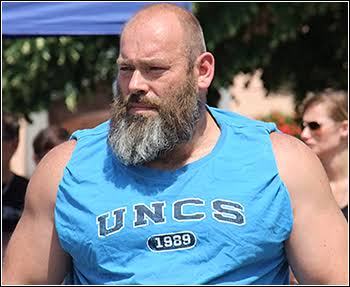
Iron Archives
Pioneer of Czech strongman and international competitor for nearly a quarter-century
Retired athlete
Jiří Žaloudek is one of the pioneers and longest-serving figures in Czech strongman. Born in 1975 in Kutná Hora and long based in Čáslav, he moved through athletics, powerlifting, bodybuilding and bobsleigh before entering strongman around 2000. Strongman Archives lists him as active from 2000 to 2023, with 88 international contests, two international wins and close to one hundred appearances when national and regional contests are included. He competed across the Strongman Super Series, IFSA Grand Prix, World Strongman Cup, Strongman Champions League, Central European Strongman Cup and Slavic Cup. Away from competition he worked as a municipal police officer and museum curator, organized the long-running Strongman Čáslav, founded ČASIM, appeared as a bodyguard in the film Kajínek and, from 2023, has led the Dusík Theatre in Čáslav. His importance rests not only on results, but on longevity, versatility and his role in building Central European strongman culture.
Jiří Žaloudek occupies a distinctive place in the history of Czech strongman, not because his career revolved around a single world title or a brief period of overwhelming dominance, but because he was present close to the birth of the modern Czech scene and remained connected to it for almost a quarter of a century. Strongman Archives records his international strongman career from 2000 to 2023 and lists 88 international contests with two international victories, in addition to national and regional appearances. In a sport that places extraordinary cumulative stress on the body and where competitive generations turn over quickly, longevity of that scale is an achievement in its own right. Žaloudek competed during an era when implements were often improvised, event standards varied widely and athletes routinely had to act not only as competitors but as promoters, equipment builders and organizers. He remained active long enough to see Central European strongman move from a small network of enthusiasts into a far more professional ecosystem that included circuits such as the Strongman Super Series, IFSA Grand Prix, World Strongman Cup, Strongman Champions League and Central European Strongman Cup. His final international appearance listed by Strongman Archives, the 2023 Slavic Cup in Liptovský Mikuláš, ended with a third-place finish at the age of 48. That result is striking not because it rewrites the global record books, but because it closes a competitive arc that began when the sport in his region still had the texture of a frontier. By 2023 he was facing athletes who had grown up with specialized equipment, online coaching, video analysis and a dense international calendar. He had begun when much of that infrastructure simply did not exist.
Understanding Žaloudek requires looking beyond the contest ledger. Several parallel histories meet in his biography: the early development of Czech strongman, the continued sporting exchange between Czechia and Slovakia after the political separation of the two states, the emergence of a Central European strongman circuit and the life of an athlete who refused to remain inside a single professional identity. He was a track athlete, powerlifter, briefly a bodybuilder, a competitive bobsledder, a professional strongman, a municipal police officer, a museum curator, a competition organizer, a film extra in a bodyguard role and eventually a cultural manager. Czech interviews published in 2014, 2016 and 2025 consistently present him as a figure deeply rooted in Čáslav rather than as a sports celebrity detached from ordinary civic life. His record supports that picture. He competed in the 2001 Czech Grand Prix of the Strongman Super Series, IFSA Grand Prix contests such as Strongest Man in Central Europe, the World Strongman Cup, Strongman Champions League, Slavic Cup, Sword of Matúš Čák, International Martin Krpan and numerous Central European Strongman Cup stages. He travelled repeatedly to Slovakia, Hungary, Slovenia, Poland, Croatia and Ukraine at a time when Czech strongman had neither the depth nor the funding of the major Western European markets. Those journeys did more than produce results. The first generation of Central European strongmen built a culture by repeatedly meeting, borrowing ideas for events, sharing equipment solutions and forming the informal networks that later became organized circuits. Žaloudek was one of the people who lived through that construction phase from the inside.
Jiří Žaloudek was born in 1975 in Kutná Hora, with public records giving 26 February as his date of birth. A 2014 Deník interview provides the clearest outline of his early geography: he lived in Rohozec, Malín and Kutná Hora before becoming closely associated with Čáslav from roughly the age of twenty. Čáslav would eventually become the fixed point around which nearly every part of his adult life revolved. He trained there, worked for the municipal police, became involved with the local museum, organized strongman contests in the town and decades later took over executive leadership of the local theatre. Sport entered his life much earlier. In a detailed 2016 interview with Ronnie.cz, Žaloudek said that he had trained seriously from around the age of fifteen and already felt noticeably stronger than boys of the same age. A decisive episode came when the legendary Czechoslovak athlete Jarmila Kratochvílová noticed him at a school competition and began coaching him. For a teenager in Central Bohemia, access to an athlete and coach of Kratochvílová’s stature was an extraordinary opportunity. His routine already showed the work ethic that would later define his strongman years: after school he went directly to training, often spending the remainder of the afternoon on the track or in strength work. He later joked that his electrical high-school studies were difficult in part because daily training left little energy for academics. He sprinted, developed explosive power and learned to move quickly, building a physical foundation very different from the stereotype of the slow heavyweight strength athlete he would later become. That athletic base would remain visible throughout his strongman career, particularly in moving events where acceleration, foot speed and the ability to sustain force while travelling mattered as much as raw static strength.
The family environment described in his interviews appears pragmatic rather than pressuring. His father sometimes saw him return from hard athletics training with injuries and suggested that he stop, yet Žaloudek tended to interpret such moments almost as challenges and continued. His parents allowed him to pursue sport as long as he also fulfilled his responsibilities at home. The detail is small but revealing: he did not grow up inside an insulated elite sports academy. He learned to combine school, family duties and training from an early age. In 1994 compulsory military service interrupted the trajectory. He initially entered a military sports structure that he later described as a secondary version of the Dukla system. When it became clear that he did not possess the level required for a purely elite athletics career, he moved into normal service but continued training with support from people in the unit. This became the first major transition in a pattern that would repeat throughout his life. When one sporting route narrowed, he did not abandon sport; he changed discipline. The sprinter became a powerlifter. The powerlifter experimented with bodybuilding. The strength athlete entered bobsleigh. The bobsledder discovered strongman. These shifts were not random. Each activity used a different proportion of the same physical infrastructure: acceleration, strength, coordination under load, tolerance of discomfort and the ability to produce force repeatedly. In that sense strongman eventually became less a rupture than a place where all of his previous qualities could coexist. A 2025 iDNES profile returned to this point explicitly, presenting him as an athlete whose unusual combination of strength and speed made strongman an unusually natural fit when the discipline was still in its pioneering Czech phase.
Before Jiří Žaloudek became closely identified with Czech strongman, he built a legitimate competitive foundation in powerlifting. OpenPowerlifting preserves results from the second half of the 1990s, making it possible to distinguish precisely between documented platform performances and larger career lifts reported in later interviews. In 1998 he won the Czech junior powerlifting championship in the 125 kg class with a 700 kg total. Later that year he represented Czechia at the IPF World Junior Championships in Győr, Hungary, finishing eighth. His lifts there were 280 kg in the squat, 170 kg in the bench press and 290 kg in the deadlift for a 740 kg total. Those numbers matter because they show that Žaloudek was already an international-level junior strength athlete before his strongman identity fully formed. OpenPowerlifting lists 280 kg squat, 190 kg bench press, 290 kg deadlift and 740 kg total as his best indexed official competition figures. In April 1999 he placed third at the Czech national championship in the 125 kg class with 732.5 kg. In February 2004, already well into his strongman years, he returned to a regional powerlifting meet and won with a 720 kg total. The data counters the temptation to think of early strongman as a discipline without technical foundation. Žaloudek came from a sport where squat depth, referee commands, bench technique and deadlift lockout were standardized and judged. Powerlifting and strongman are not interchangeable, but the absolute strength base and experience of formal competition gave him a useful platform when he moved into a sport in which the objects were less predictable and the rules changed from event to event.
He also briefly tried bodybuilding, an episode he later described with characteristic humour. According to the 2016 Ronnie.cz interview, he entered a contest in Svitavy, qualified to the next stage and then finished last among six finalists. His explanation was not contempt for bodybuilding but a mismatch of temperament. Coming from athletics, he enjoyed direct competition, exertion, adrenaline and the certainty of an objective task. A judged aesthetic presentation did not give him the same satisfaction. At roughly 1.88 metres, he also understood that building the amount of muscle required to dominate visually would demand a very different physical project. Years later iDNES published a set of career strength benchmarks attributed to him: a 300 kg squat, 250 kg bench press and 320 kg deadlift. These are higher than the official bests preserved by OpenPowerlifting and therefore should be treated as reported career performances rather than authenticated powerlifting meet records. The distinction is important. Strongmen often achieve gym, exhibition or non-powerlifting competition lifts that never appear in official federation databases, and the technical standards may differ. The same 2025 profile gives another figure that is especially representative of Žaloudek’s athletic identity: 135 kg in each hand in the farmer’s walk for 85 metres. Strongman Archives, meanwhile, records a 140 kg maximum log at the 2003 Strongest Man in Central Europe and strong moving-event performances, including victory in the max-distance farmer’s walk at that contest. Taken together, the numbers describe an athlete who was not built solely around a massive overhead press or a single maximal deadlift. His strongest competitive identity lay in the combination of strength, movement efficiency, speed and repeated effort.
One of the least expected chapters in Žaloudek’s biography is his competitive bobsleigh career. By his own account, it began almost accidentally. At the stadium in Čáslav he encountered a group of bobsledders training with a wheeled practice sled, among them Jakub Chabada. His combination of strength and sprint speed was obviously relevant to the push start. When he tried the apparatus, his time was good enough for the group to invite him back. He began bobsleigh at around twenty-one. The sport offered something athletics had not provided at the same level: regular international travel and European Cup competition. For an athlete who has said he enjoyed travel, mountains and new experiences, bobsleigh became much more than a side activity. The federation even saw potential for him as a pilot and he completed a course in that direction. Interviews suggest that he performed well enough in internal selection to enter the conversation around the national Olympic team. Deník reported that he was among those considered for the 2006 Winter Olympics in Turin. Ronnie.cz adds the crucial context that a knee problem disrupted his preparation. Žaloudek later described how the knee would shift and hurt for extended periods, while the real cause remained unclear. Only years later did an MRI show a torn meniscus, which was subsequently operated on. In a sport where hundredths of a second in the push can alter team selection and race position, such a problem was costly. He did not become an Olympian, but getting close to selection in a second international sport remains an important measure of his athletic versatility.
Bobsleigh also created a bodyweight dilemma that seems almost absurd from the perspective of strongman. Extra mass can be useful in strongman, particularly in static events and heavy carries. Bobsleigh, however, imposes combined weight limits on the sled and crew. In the 2025 iDNES interview, Žaloudek described reaching roughly 116–117 kg in summer for strongman and then reducing to about 106–107 kg in winter for bobsleigh, leaving him with the sense that he was permanently hungry. That seasonal transformation may have been one of the most demanding physiological features of his early career. Instead of specializing his body for a single sport, he repeatedly changed it to fit two disciplines with opposing weight incentives. In summer he needed mass, maximal strength and the ability to move huge objects. In winter he had to preserve explosiveness and force while becoming lighter. The experience helps explain why his strongman statistics never tell the entire story. During his formative years he was a genuinely hybrid athlete. He ran, lifted, pushed, pulled and manipulated his bodyweight according to the calendar. When strongman became the principal direction around 2000, many of those qualities transferred naturally. A bobsleigh start is an exercise in horizontal force production; farmer’s walk and yoke require acceleration under load; truck pull rewards leg drive, rhythm and the capacity to sustain force while the cardiovascular system is under severe stress. Žaloudek himself later summarized the fit simply: he had always been oriented toward both strength and speed. Strongman gave those qualities a single competitive home.
At the end of the 1990s Czech strongman was still pioneer territory. In his interviews, Žaloudek identifies Georgis Patenidis as the figure who systematically introduced and promoted the discipline in Czechia through events, contacts and exposure in fitness media such as Muscle & Fitness. Early contests were far removed from the infrastructure familiar to modern competitors. The athlete pool was small, many entrants came from throwing events or other strength sports, and equipment was frequently fabricated by organizers and athletes themselves. Žaloudek recalled noticing cup-style strongman contests around 1998 and deciding to try them. By 1999 he had made contact with Patenidis and competed in events connected to his gym. Soon he began travelling regularly to Slovakia at a time when relatively few Czech athletes made those trips. Strongman Archives records a fourth-place finish at Slovakia’s Strongest Man in Trenčín in 2000 and second place at the same contest in 2001. That year he also entered the Czech Grand Prix of the Strongman Super Series, a much tougher professional-level competition, where he finished last. The placement should not be read in isolation. It represented a jump from a regional scene still building its identity into an international field. The event program included tire flip, farmer’s walk, keg loading, wheelbarrow carry, power stairs, Hercules hold, log lift and truck pull. In a single day the athlete had to function as a weightlifter, loaded sprinter, grip specialist and pulling machine. For someone with Žaloudek’s mixed background, the variety was precisely the attraction.
Žaloudek later explained why strongman captured him more deeply than powerlifting. He respected powerlifting, but felt that it lacked some of the spectacle and direct communication with the crowd that strongman offered. Strongman had a theatrical dimension without ceasing to be a serious strength sport: unusual objects, easily understood challenges, head-to-head races and the possibility of turning strength into something visually immediate. As he gained experience he became increasingly comfortable engaging with spectators, a skill that later helped him as an organizer. In the first years, however, the motivation was straightforwardly competitive. He has recalled that in his twenties and early thirties he still carried the idea that he might become a major champion. The results show a clear movement toward the regional elite. In 2002 he was second at Sword of Matúš Čák and second at the Czechoslovak Strongman Cup in Prague. In 2003 he finished fourth at the IFSA Grand Prix Strongest Man in Central Europe in Osijek, third at Visegrád 4 Strongest Man and won Strongman Liptov in Jasná. In 2004 he won the Czechoslovak Strongman Cup in Čáslav, placed third at Sword of Matúš Čák and finished fifth at Strongest Man in Central Europe in Győr. Strongman Archives credits him with two international victories, and the wider record shows repeated podiums across the Czech-Slovak and Central European scene. He never reached the World’s Strongest Man final and his career was not built around Western television exposure, yet within Central Europe he became a recognizable benchmark and a bridge between the earliest organized generation and the athletes who followed.
The 2002–2004 period offers the clearest picture of Žaloudek as an international athlete approaching his competitive peak. Sword of Matúš Čák, the long-running Slovak contest, appears repeatedly in his record and functions almost as a chronological marker. He finished second in 2002, second again in 2003 and third in 2004, returning in later years for further podiums. At the 2003 Strongest Man in Central Europe in Osijek, Strongman Archives preserves not only his fourth-place overall finish but detailed event results. Žaloudek won the maximum-distance farmer’s walk with 72.5 metres, took second in the tire flip, fourth in Conan’s wheel and climbed eleven steps in the power stairs. In the maximum log lift he made 140 kg. The technical profile is consistent with his background: dynamic events and locomotion under load gave him a clear advantage. A year later, at the Győr edition of the same IFSA Grand Prix, he finished fifth overall. He again lifted 140 kg in the log, placed third in Conan’s wheel with 1,220 degrees and second in the tire flip. Those event results are more informative than a single personal-record number because they reveal the kind of strongman he was. Žaloudek was not the athlete expected to win every pure overhead test. He was a rounded competitor capable of taking large amounts of points in events where technique, rhythm, speed and work capacity mattered. During the same period he won Strongman Liptov in 2003 and the Čáslav stage of the Czechoslovak Strongman Cup in 2004. The Čáslav victory carried particular symbolic weight because the town would become both his long-term base and one of the Czech strongman centres he personally helped sustain.
That peak should not be mistaken for a perfectly linear career. Strongman results can swing dramatically according to the event selection, injury status, implement design and quality of the field. In 2005, for example, Žaloudek posted more modest placements at several contests while his sporting calendar still overlapped with bobsleigh and ordinary professional life. This is where the quality that would define the rest of his career becomes visible: he remained present even after the simple narrative of constant upward progression had ended. He continued travelling through Czechia, Slovakia and neighbouring countries, returning to familiar contests and accumulating a level of practical experience younger athletes actively sought out. A Ronnie.cz retrospective on Czech professionals records that in 2005 another athlete contacted Žaloudek specifically because he lived nearby and wanted to try strongman events. Shortly afterward that athlete also came into contact with Georgis Patenidis and entered competition. The episode illustrates the informal recruitment mechanism of the era. There were not dozens of commercial gyms equipped with yokes, farmer handles, stones and logs. If someone wanted to enter strongman, he found an experienced competitor, travelled to where the equipment existed and learned by doing. Žaloudek therefore became, intentionally or not, one of the nodes through which strongman knowledge passed to the next generation. That contribution never appears in a points table, yet it matters greatly when evaluating the historical importance of a pioneer.
By the middle of the 2000s, Žaloudek’s career acquired a second dimension. He was no longer only a man entering contests; he was increasingly one of the people making contests possible. Strongman Fest 2009 in Čáslav is a useful landmark. Contemporary Ronnie.cz coverage identified him as the founder of ČASIM, the Czech Association of Strong Men, and noted that together with the town he organized the tenth anniversary edition of the Čáslav strongman competition. The event brought professional and amateur athletes together and sat within a wider Central European competitive structure. In a young sport, a reliable annual contest can be nearly as important as a champion. Without a calendar, referees, implements, sponsors, public space and organizational continuity, no competitive culture can develop. Žaloudek understood that reality early. Čáslav gradually became a recognizable stop within Czech strongman, and in different periods its contest was linked to the Czechoslovak Strongman Cup, the Central European Strongman Cup and international matchups. In 2023, Kulturistika.com still described him as the organizer of one of the country’s longest-running strongman traditions. That continuity says much about the invisible labour behind the sport. A strongman show is not simply five events and a final scoreboard. It means permits, the transport of implements weighing hundreds of kilograms, safety procedures, sponsors, accommodation for invited athletes, promotion, timing, judging and the difficult task of convincing spectators to return. Žaloudek performed this work while also competing, a dual role typical of the first generation of organizers who had to build the sport while practising it.
The fact that younger athletes sought him out to learn the events completes the picture of an informal mentor. Strongman technique in that era could not be acquired from a printed program alone. Tire-flip mechanics, positioning under a yoke, pacing a farmer’s walk, finding the rack position on a log, using the rope in a truck pull and learning to lap and load an Atlas stone all required contact with the actual implements. One Czech professional later recalled contacting Žaloudek in 2005 because he was the nearest experienced strongman and travelling to him to test the events. About a month later, contact with Patenidis followed and the athlete entered competition. This is how the sport often reproduced itself before social media. Žaloudek was not the only athlete offering that access, but he was one of its stable points. In the 2016 interview he looked back on the growth of the Czech scene with a mixture of satisfaction and concern. He believed the athletic standard had risen sharply and that several Czech competitors were capable of testing themselves against international opposition. At the same time, he criticized the fragmentation of a relatively small community into too many associations. His position is understandable from the perspective of someone who had lived through a period when nearly everyone in the sport knew one another and shared the same limited set of contests. Growth was a success, but professionalization also created institutional rivalry. Žaloudek’s biography therefore provides not only the story of an athlete but an insider’s view of how a marginal strength discipline becomes a national sporting structure.
After the early-decade peak, Žaloudek did not disappear. Between 2007 and 2014 he became one of the most persistent travellers on the regional circuit. Strongman Archives places him third at Sword of Matúš Čák in 2007, fourth at the Czechoslovak Strongman Cup in Litvínov and fifth in Liberec. In 2008 he stood on the podium in Čáslav and competed in Bratislava, Košice and Radotín. In 2009 he finished third at International Martin Krpan in Ljubljana and repeated third place there in 2010. That same year he took third at Central European Strongman Cup stages in Čáslav and Žilina. The 2011 season was one of the most consistent of the mature phase of his career: third in Lublin, second in Čáslav, third at Sword of Matúš Čák, fourth in Janowiec and fourth at Sport Festival Slovakia. In 2012 he finished runner-up at Czechia’s Strongest Man in Hodonín. These placings do not carry the global prestige of World’s Strongest Man, but they must be read within the correct geography. Central Europe in those years supported a dense system of contests where Polish, Slovak, Czech, Slovenian, Hungarian and Ukrainian athletes met repeatedly. For a competitor without the commercial support available to the biggest Western stars, maintaining such an international schedule was difficult. Travel, employment, recovery and the organization of his own events overlapped constantly. Žaloudek managed that rhythm for years, which helps explain why Strongman Archives ranks him among the most experienced Czech international competitors in its historical database.
In 2013 he entered the Strongman Champions League Czech Republic contest in Plzeň, finishing thirteenth in a field of fourteen. On paper the result looks modest, but the event list and circuit level explain the difficulty: Conan’s wheel, super yoke, a farmer’s walk and frame-carry medley, front hold, tire flip and log lift. He was ninth in the medley and tenth in both the yoke and front hold, losing more ground in the tire flip and log. The same year he competed in the World Strongman Cup at Michalovce, the Slavic Cup and other regional events. His willingness to keep entering harder contests even when he was no longer a favourite is central to understanding his longevity. Many athletes narrow their calendar when podium chances decline. Žaloudek seems to have retained an appetite for competition itself. The 2016 interview supports that interpretation. He spoke of contests as a continuing part of life and said he intended to compete for as long as his body allowed. Even when a hamstring tear had destroyed his preparation for a competition, he still arrived, tested what was possible and accepted that the result was poor. His relationship with strongman was therefore broader than pursuit of a single personal record. The identity included travel, meeting other competitors, confronting unfamiliar objects and remaining part of a community. When the archive shows dozens upon dozens of appearances over more than two decades, the volume is not merely statistical accumulation. It is evidence of a long allegiance to the culture of the sport.
Jiří Žaloudek’s professional life is almost as unusual as his sporting path. Deník presented him in 2014 as both a municipal police officer in Čáslav and a curator at the town museum. He explained that history had interested him for many years and that he eventually completed university study in the field at Hradec Králové. Later official sources use the academic title Mgr., confirming the completion of higher education. His museum work was not purely administrative. The 2016 interview refers to curatorial responsibility for collections, exhibitions and regional events, while local sources show him involved in projects that brought Čáslav’s history to a wider public. In 2016, for example, he participated in the reopening of the revitalized Hrádek site and the presentation of an outdoor educational exhibition. The combination challenges the easy stereotype of a strongman defined solely by body mass and competitive aggression. In Žaloudek, two forms of memory coexist: the embodied memory of sporting technique and the historical memory of the community in which he lives. As a curator he handled objects that needed to be preserved and interpreted; as a strongman he handled objects designed to be lifted, carried or dragged. The contrast is dramatic, but both roles demand a concrete relationship with material objects and with the stories attached to them. In interviews, he does not present history as a decorative hobby used to soften a sporting image. He describes it as a genuine intellectual interest that he eventually transformed into formal qualification and professional work.
His work as a municipal police officer also intersected directly with strength sport. Deník reported that in 2014 Žaloudek won a strongman competition for municipal police teams in Vsetín. The team contest included tasks such as lifting a 100 kg log and walking with 120 kg implements. The same coverage noted that he had been involved in the creation of the competition several years earlier. Strength therefore entered his professional environment without becoming mere exhibition. It demonstrated applied force, work capacity and cooperation among local police units. During the same broad period Žaloudek also became involved in the civic life of Čáslav, and municipal records have listed him as a member of the town council across different terms. For a sporting biography, the continuity of that involvement matters more than the electoral label attached to any particular cycle. Žaloudek was not a visitor who arrived in Čáslav only for a strongman show. He worked within the town’s institutions, became involved in museum projects and public events, participated in local administration and later took responsibility for a major cultural institution. That embedded relationship with the town also helps explain the durability of Strongman Čáslav. Its organizer understood local institutions from the inside and had relationships built over years rather than a single event cycle.
Twenty-three years of recorded strongman competition layered on top of athletics, powerlifting and bobsleigh inevitably left physical consequences. The 2016 Ronnie.cz interview is one of the clearest public sources on Žaloudek’s injury history. The meniscus damaged during his bobsleigh years went undiagnosed for a long period before imaging finally identified the tear and surgery followed. During a tire flip he tore his right biceps, a classic strongman injury when an athlete tries to curl or pull the tire with the arm in a vulnerable position. His back had troubled him in the years preceding the interview, and in 2016 a hamstring tear seriously disrupted his season. He described these episodes without excessive drama. Sometimes he attempted to return too quickly; at other times he accepted that preparation was inadequate and entered a contest simply to discover what his body could tolerate. From a modern performance perspective the culture can appear severe, but it was common among early strongman generations who had much less access to physiotherapy, detailed programming and workload monitoring. Žaloudek himself later remarked on how radically training methods and equipment had improved. In his early years athletes frequently built or improvised implements. Later, specialized manufacturers and commercial gyms made yokes, farmer handles, logs, frames and heavy tires much easier to obtain. That professionalization allowed younger athletes to begin with technical knowledge and equipment that pioneers had often acquired through trial, error and injury.
His own training method, as described in 2016, was strikingly uncomplicated. In the off-season he trained four or five times a week, beginning with higher volume, lighter relative loads and more repetitions. Specific strongman events entered the program later as the competitive season approached. For recovery he mentioned conventional staples such as protein and creatine and said he did not make his diet unnecessarily complicated. The approach reflects both his generation and his personality more than contemporary sport-science language. He did not claim to possess a hidden system. The foundation was continuity. That may explain his longevity better than any single exercise: the capacity to return to manageable work, rebuild after injury and keep strength sport integrated into ordinary life. Modern sources list him at roughly 188 cm and around 129 kg during his strongman years, although his bodyweight varied substantially, especially while combining bobsleigh and strongman. Event data shows an athlete more mobile than his size alone would suggest. Farmer’s walk, tire flip, Conan’s wheel and other moving events repeatedly appear among his strongest results. He won the farmer’s walk at the 2003 IFSA Grand Prix and later reported an 85-metre carry with 135 kg in each hand. The ability to preserve rhythm under load helps explain why his sprinting and bobsleigh background remained relevant long after his physique had transformed into that of a heavyweight strongman.
After 2015 Žaloudek’s overall placings became less spectacular, but arguably more impressive when viewed through age and accumulated wear. In 2015 and 2016 he continued entering professional Czech and Central European contests, some built around brutally heavy events. At the 2016 Europe Strongman Cup in Golčův Jeníkov, for example, the program included Atlas stones reaching 170 kg and tire flips involving 450 kg implements, with an 800 kg tire also appearing in the event structure. Žaloudek finished ninth overall. He remained on national and regional start lists in 2017, 2018 and 2019, including Czechia’s Strongest Man and Central European Strongman Cup appearances. Those later placements were modest compared with athletes in their physical prime, yet that is precisely what makes the period historically interesting. Žaloudek was still competing after forty in a sport that accumulates extraordinary stress on tendons, the lumbar spine, knees, shoulders and biceps. In 2020, at 45, he returned to the Slavic Cup and finished fifth. Three years later at Liptovský Mikuláš he reached the podium, taking third with 14.5 points in a five-man field. Strongman Archives treats the 2023 Slavic Cup as his final international appearance and closes his active-years range at 2023. Some general sports aggregators still use generic active labels, but the specialized archive and later interviews describe his competitive career primarily in the past tense. For the present profile, retired is therefore the most cautious editorial status, without inventing a ceremonial retirement date that Žaloudek himself may never have announced.
His longevity also has historical meaning. Žaloudek competed against athletes connected to the 1990s generation and later against men who learned strongman in a world of online video, specialized gyms, purpose-built implements and far more advanced programming. He lived through the transition from almost artisanal strongman to a sport with databases, professional media production and increasingly standardized international calendars. In 2025, speaking to iDNES, he observed that training had become more sophisticated, equipment had improved and the sport had expanded significantly, including the growth of women’s strongman, a development he viewed positively. That attitude matters. Pioneers sometimes become trapped in the idea that their own era was the only authentic one. Žaloudek appears more interested in the fact that the discipline became stronger. He acknowledges that modern athletes are capable of greater performances and benefit from better tools. His legacy therefore does not depend on pretending that a 140 kg log from an earlier period should be compared in a vacuum with present-day world records. Its value lies partly in helping create the environment in which later standards became possible. The 2023 podium becomes a fitting image of that continuity: an athlete who entered strongman when implements still had to be improvised was still standing on an international podium in an age when the sport had become digital, data-rich and globally connected.
Žaloudek’s public biography contains several episodes that look almost incompatible until they are viewed through the same pattern of accepting opportunities. Ronnie.cz reports that he worked in security connected with Karel Gott, one of the best-known figures in Czech popular music, and that he appeared in the film Kajínek. The official materials for the 2010 film list Jiří Žaloudek in the cast, while Czech film databases identify the role as a bodyguard. Such casting is hardly surprising for a large strongman, but acting never became a separate career. The appearance is better understood as one of several moments in which his sporting physique opened a door into another environment. More significant in the later stage of his life is the move into cultural management. In May 2023 the municipal authorities in Čáslav announced the appointment of Mgr. Jiří Žaloudek as managing director of Dusíkovo divadlo Čáslav. The official announcement emphasized his long connection with local cultural life, earlier museum work and involvement in events and amateur theatre. The institution’s current contact page continues to list him in executive leadership, and the 2025 iDNES profile describes him as the director of the municipal theatre. The move from strongman implements to responsibility for a cultural institution seems dramatic, yet there is organizational continuity beneath the surface. For decades Žaloudek had already dealt with event logistics, audiences, municipal relationships, public programming and the practical work of turning an idea into a live event. Strongman promotion was, in its own rough way, training in production.
This later stage also clarifies how his private life should be handled in a responsible biography. The publicly available sources do not consistently document a spouse, children or other intimate relationships, and those gaps should not be filled through inference. What is public and well documented is his unusually strong attachment to the community of Čáslav. From about the age of twenty the town becomes the principal setting of his adult life. He works there, studies and presents its history, organizes strength contests, participates in civic and cultural projects and eventually takes responsibility for its theatre. For many modern strongmen, public identity is constructed through social-media output and personal branding. Žaloudek belongs to a different generation. There is no rich archive of daily Instagram stories or YouTube training episodes documenting every phase of his career. Instead his traces are distributed across newspaper interviews, contest records, municipal announcements, museum activities, agency photographs and results databases. The resulting portrait is more fragmented but arguably richer. It reveals a sportsman whose public life cannot be separated neatly into athlete and non-athlete. His strength career gave him visibility and contacts; his local institutional work gave the sport a stable home; his historical and cultural interests later provided a professional direction that survived beyond the competitive peak. That is a more substantial story than inventing private details simply because a conventional celebrity biography expects them.
A closer reading of Žaloudek’s event results helps separate reputation from measurable competitive tendencies. His strongest historical identity is not that of an extreme specialist in a single static lift. It is the identity of an all-round athlete whose earlier sprinting and bobsleigh experience remained visible in moving events. At the 2003 Strongest Man in Central Europe he covered 72.5 metres in a max-distance farmer’s walk to win the event, while also placing second in the tire flip. At the 2004 edition he again performed strongly in the tire and Conan’s wheel. Across later contests, farmer’s walk, yoke-type work, tire flipping, loading and medleys repeatedly produced respectable scores even when his overall placement was not high. The 2025 iDNES profile’s figure of 85 metres with 135 kg in each hand is therefore believable within the broader pattern of his documented event strengths, although it is best described as a reported career performance rather than a formally standardized world record. The same distinction applies to his reported 300 kg squat, 250 kg bench press and 320 kg deadlift. They illustrate the ceiling of his training and strongman-era strength, while OpenPowerlifting supplies a different category of evidence: judged competition bests of 280, 190 and 290 kg with a 740 kg total. The two sets of numbers do not conflict once the source context is respected. One records federation competition; the other describes wider career performance.
His overhead record also needs historical context. Strongman Archives lists a 140 kg maximum log in the 2003 and 2004 Strongest Man in Central Europe contests. In the modern super-heavyweight era, when elite log specialists can press dramatically more, 140 kg does not look extraordinary in isolation. Yet raw cross-era comparison is misleading. Implement diameter, clean technique, judging standards, bodyweight, equipment and specialization have changed substantially. More importantly, Žaloudek’s competitive value did not depend on winning the log. At Osijek in 2003 he finished fourth overall because he accumulated points across a broad event set, including the farmer’s walk win and second place in tire flip. That pattern illustrates a central truth of strongman: championships are often decided not by the athlete with the single largest lift but by the one who loses the fewest points across incompatible tasks. Žaloudek’s career was especially suited to that older form of mixed-event strongman. He could pull vehicles, carry implements, flip tires, turn Conan’s wheel, climb power stairs and remain sufficiently strong in presses and deadlifts to stay competitive. His physique and background made him a generalist in a sport that rewarded generalists. This is also why merely listing his three powerlifting numbers produces an incomplete portrait. His real competitive skill was the ability to turn conventional strength into movement under awkward conditions.
Čáslav is more than a location in Žaloudek’s biography. It functions almost as a second protagonist. He settled there as a young adult, trained there, met the bobsleigh group that changed the direction of his sporting life, served in municipal policing, worked with the museum, organized strongman contests and eventually became the executive figure at the town theatre. The 2004 Czechoslovak Strongman Cup victory in Čáslav therefore sits inside a much larger relationship between athlete and place. In modern elite sport, competitors often relocate toward the best gym, coach or sponsorship market. Žaloudek’s career largely moved in the opposite direction: he made a local base increasingly capable of supporting his sporting and professional identities. Strongman Čáslav became a recurring event rather than a one-off spectacle, helping the town acquire a recognizable position on the Czech strength-sport map. By the 2009 jubilee edition, coverage described a decade of continuity. By 2023 the contest was still being presented as one of the country’s long-standing traditions. That kind of persistence depends on local memory. Spectators know the event, municipal staff understand what it requires, sponsors recognize the format and younger athletes know there will be a place to compete. Žaloudek’s historical training and his later museum work make this relationship to continuity especially appropriate. He spent part of his professional life preserving the past of Čáslav while simultaneously creating a small part of its modern sporting history.
The Čáslav connection also helps explain why his career cannot be assessed solely through global rankings. A professional athlete can maximize personal prestige by chasing only the highest-paying or most visible contests. A scene-builder often makes different choices. Organizing a home event, mentoring local newcomers and maintaining relationships with regional promoters may contribute less to an international résumé while contributing more to the survival of the sport around him. Žaloudek did both. He travelled widely enough to accumulate 88 international starts, but repeatedly returned to the same regional network and to his own town. That balance is one reason his name appears across so many layers of Czech strongman history. He was a participant when the sport needed participants, a travelling professional when Czech athletes needed international exposure, an equipment contact for newcomers when specialist gyms were rare and an organizer when the calendar needed stable events. His later cultural work suggests that this organizational instinct was not accidental. The common thread is the creation of public experiences: a competition, an exhibition, a historical program or a theatre season all require planning, communication, logistics and an understanding of an audience. The implements changed, but the underlying skill remained recognizable.
Jiří Žaloudek’s legacy cannot be reduced to the question of whether he was the strongest Czech athlete of his era. He did not dominate every national championship and he never reached the World’s Strongest Man final. But sporting history is not written only by absolute champions. It is also written by people who keep contests alive, cross borders when a circuit is still small, make equipment available to beginners, organize events for years and remain involved long enough to connect multiple generations. From that perspective Žaloudek is a major figure in Czech strongman. Strongman Archives’ 88 international appearances place him among the most experienced Czech competitors represented in the modern historical record. Two international victories, repeated podiums in Slovakia, Czechia, Slovenia and Poland and second place at Czechia’s Strongest Man in 2012 give that longevity meaningful competitive substance. Individual performances add detail: a 140 kg competition log, a max-distance farmer’s walk victory at an IFSA Grand Prix, international-level junior powerlifting and reported later career lifts of 300 kg squat, 250 kg bench press and 320 kg deadlift. Yet the importance of his profile lies precisely in the fact that those numbers do not stand alone. They sit beside the founding of ČASIM, the organization of Strongman Čáslav and his role as an accessible link for younger athletes entering the sport.
Culturally, Žaloudek represents the transition of strongman from an exotic demonstration of unusual strength toward an organized sport. He experienced the period when spectators came to watch a small number of very strong men handle improvised objects and remained involved into the era of searchable databases, professional video and increasingly standardized equipment. He watched athletes become larger, training become more specialized and women’s strongman grow into a serious competitive branch. Rather than becoming only a relic of the pioneering era, he stayed involved long enough to participate in the transition. That explains why Czech media in 2025 could reasonably describe him as a legend of the local scene. The term need not mean that he was the country’s most decorated athlete. It recognizes structural presence. Remove Žaloudek from the historical map of Czech strongman and a visible gap appears between the first promoters, the regional circuits and the later professional scene. His post-competition path also gives the story an unusual ending, or rather a continuation. He did not simply disappear from public life. The organizational energy moved toward culture and community. From athletics track to powerlifting platform, from bobsleigh start to truck pull, from the Čáslav town square to a museum and then a theatre, his biography is less the story of perfect specialization than of an uncommon ability to remain active, curious and useful in very different environments.
This biography is built by cross-checking several different categories of evidence rather than relying on a single profile. Strongman Archives is the primary source for the strongman competition record, including the 2000–2023 active range, international appearance count, overall placings and event-level results. OpenPowerlifting is used for formal powerlifting data, including the 1998 IPF World Junior Championships and his judged platform bests. Biographical information comes principally from the long Ronnie.cz interview published in 2016, the Deník profile from 2014 and the extensive iDNES interview from 2025. Czech strength-sport coverage supplies details on Strongman Fest 2009, ČASIM and the later Strongman Čáslav tradition. His current cultural role is supported by the official 2023 announcement from the town of Čáslav and the contact information published by Dusíkovo divadlo. His Kajínek appearance is corroborated by the film’s official cast information and Czech film databases. When sources provide different numbers, the profile does not force them into artificial agreement. OpenPowerlifting, for example, preserves a 190 kg competition bench press, while the 2025 interview reports 250 kg as a career performance. Both can be true when the context is retained. The same principle is used for strongman records, where implement specifications and judging standards vary and a reported training or exhibition performance should not automatically be labelled a standardized competition record.
The same caution is applied to private life. The sources consulted provide limited information about his parents in the context of youth sport but do not document a spouse, children or other intimate relationships consistently enough to justify detailed claims. Those subjects are therefore left out rather than filled with assumptions. The profile instead develops the well-supported personal dimensions: the places of his childhood, the move toward Čáslav, early athletic formation, military service, university study of history, work in municipal policing and the museum, the bobsleigh chapter, injuries, competition organization and his present cultural leadership. The purpose is for the page to function both as a useful strongman profile and as a defensible historical document. It should explain the person behind the rankings while allowing important factual claims to be traced back to public evidence. This discipline matters especially in Žaloudek’s case because his life has been unusually varied. A shallow biography can make that variety sound improbable. A documented biography shows that the variety is not decoration at all. It is the actual structure of his career: strength sport, civic work, history and cultural organization repeatedly overlapping rather than following one another in neat separate phases.
For Žaloudek, one of the decisive differences between strongman and the classical strength sports was the relationship with an audience. Powerlifting offered an unusually precise measurement of strength, but its structure is intentionally repetitive and ritualized: three lifts, standardized commands, ordered attempts and strict judging. Strongman introduced objects that carried their own visual narrative. A truck does not need to be explained to a spectator in order to look heavy. A giant tire, a log, two steel suitcases, a yoke or a sequence of stones immediately creates a human scale of difficulty. That accessibility mattered enormously when the sport was trying to build local audiences. Žaloudek learned not only to perform the events but to present them, to interact with spectators and to understand that event order, physical layout and pacing are part of the experience. When he moved increasingly toward organization, his years as a competitor gave him an obvious advantage. He knew what a poor surface could do to a farmer’s walk, how much clear space a yoke race required, what became dangerous during a tire flip and how dramatically the contest changed when an implement was either too light or effectively impossible. Good strongman promotion requires a difficult balance among safety, fairness and drama. Events must separate athletes without producing a scoreboard full of zeroes; they must entertain spectators while remaining clear enough that competitors know what is expected. Because Žaloudek competed, judged and organized, he developed the rare perspective of someone who understood all of those pressures from inside the arena.
That public dimension helps explain the remarkable lifespan of Strongman Čáslav. A local strength contest cannot survive for decades through athletic quality alone. It needs an identity recognizable even to spectators who do not follow international strongman. A town square, oversized objects, music, commentary, head-to-head races and foreign guests transform strength sport into a civic event. Reports from Čáslav repeatedly show that combination of serious competition and public spectacle. In 2016, for example, the program brought together the Czech strongman league and professionals from several countries, using related event formats with heavier loads for the professional field. Žaloudek appeared there as a referee as well as the historic organizer associated with the contest. Moments like this illustrate the natural maturation of a pioneer. At first the objective is to lift more than the other men. Later, the veteran begins to guarantee that other men have a credible arena in which to compete. In many sports, leaving the front line means disappearing. In strongman, where local scenes still depend heavily on experienced individuals, the transition from athlete to referee, promoter or mentor can be as important as the final years of personal results. Žaloudek made that transition without severing his identity as a competitor. That is why his name appears in Czech sources in several roles at once, and why his contribution cannot be represented adequately by a medal table alone.
A serious historical profile must resist the temptation to compare a 2003 strongman number mechanically with a 2026 number. Strongman is not powerlifting, where a standardized bar and relatively stable movement rules allow more direct comparison across time. A log may differ in diameter, balance and cleaning rules. A farmer’s walk can use different handle heights and thicknesses, different distances and radically different surfaces. A deadlift may be conventional from the floor, elevated, performed with an axle, a car, a frame or another apparatus. Even Atlas stones vary in diameter, platform height, surface texture and tacky rules. For that reason Žaloudek’s 140 kg log in an IFSA contest in 2003 should not be converted into a simplistic ranking against modern 200-plus-kilogram specialists. Technical context, athlete bodyweight, specialization and access to implements have changed. What can be compared more responsibly is how competitive an athlete was within his own field, how consistently he collected points and how broad his event competence remained. Žaloudek’s fourth place at the 2003 Strongest Man in Central Europe was built from a mixture of results, including a farmer’s walk win and second in tire flip, rather than one extraordinary static number. That is the correct historical lens: not pretending that every old and modern implement is identical, but measuring how effectively the athlete solved the tasks and opponents of his era.
Žaloudek’s own late-career reflections show an awareness of this distinction. He does not appear to argue that his generation was simply stronger than the present one. Instead, he recognizes methodological and technical progress. Equipment is better, athletes can prepare specifically at an earlier age, information moves instantly, and recovery and nutrition practices have become more sophisticated. At the same time, the pioneers faced a difficulty that statistics cannot quantify easily: they had to invent parts of the process. If a suitable log did not exist, somebody had to build one. If there was no specialized coach, technique developed through experimentation. If a contest introduced a new implement, the athlete sometimes had to solve it in real time. That uncertainty created a different skill, closer to practical improvisation. Žaloudek lived through precisely that stage and then remained long enough to watch the sport move toward specialization. His career is therefore useful as a case study in strongman’s development. Its historical value does not depend on owning the absolute record of every period. It comes from crossing the periods and making the transformation visible from within.
Once a strength athlete moves beyond forty, experience begins to express itself differently. Recovery slows and maximal physical qualities may become harder to maintain, but event reading, emotional control and technical economy can improve. By the late stages of his career Žaloudek had seen dozens of variations on the same underlying ideas: short and brutally heavy farmer’s walks, long carries, truck pulls with or without a rope, different surfaces, maximum or repetition logs, fast yokes and crushingly heavy yokes. That practical library allows a veteran to identify the traps of an event quickly. His organizer’s perspective added another layer because he understood why an implement behaved as it did, not merely how to survive it. Access to such a veteran can be valuable for younger athletes in ways that are difficult to measure. The lessons are not always glamorous. They may concern how not to tear a biceps on a tire, how not to destroy grip strength in the opening metres of a carry or when a maximal attempt is no longer worth the risk. Žaloudek’s own injury history supplied plenty of those lessons. In a sport that often romanticizes excess, the veteran can paradoxically become one of the most important sources of restraint precisely because he has already paid the cost of certain mistakes.
The 2023 Slavic Cup podium provides an appropriate competitive closing image. It was not the numerically greatest result of his career and should not be presented as such. Its value is chronological and symbolic. At 48, Žaloudek was no longer competing with the body he had possessed at 28. He was competing with the accumulated consequences of three decades of serious sport. Behind every event stood the repaired meniscus, torn biceps, back problems and hamstring injury, the repeated bodyweight changes required by bobsleigh and thousands of training sessions. The fact that he could still reach an international podium says something about technique, effort selection and resilience. Strongman Archives ends his active period there, and the boundary is appropriate for the profile. There is no need to invent a cinematic final lift. Many real careers do not contain a ceremonial retirement scene. They conclude through a gradual reduction of competition, a shift toward organizing and professional life, and a contest that becomes the last one without necessarily being announced as such beforehand. In Žaloudek’s case, that organic transition suits a life in which sport was never the only identity.
If this profile were reduced to a statistical column, it would leave 88 international contests, two international wins, numerous regional podiums, an official 740 kg powerlifting total and nearly a quarter-century of recorded strongman competition. Those are substantial figures, but they are incomplete. They do not show that the same man came close to an Olympic pathway through bobsleigh, studied history, worked with the heritage of a town, wore a municipal police uniform, organized strength contests, appeared briefly in cinema and eventually became responsible for a theatre. Nor do they explain why an athlete continues entering contests after the probability of major podiums declines. For Žaloudek, the answer appears to be that the sport became a form of belonging. Strongman offered competition, travel, friendship, spectators and a role in community life. That relationship lasts longer than a single peak season. It is why his name appears in archives at the beginning of the 2000s, in competition reports throughout the 2010s and on a podium again in 2023. Continuity is the thread joining his different sports and professions: once he entered an environment, he rarely treated it as something merely to consume before moving on. He tended to become part of the structure and, where possible, leave something usable for others.
From that perspective Jiří Žaloudek belongs in an Iron Archives project not simply as a name attached to old results, but as an example of the type of athlete without whom European strongman history would be incomplete. Major world titles give the sport easily recognizable heroes. National scenes, however, are built by people who transport equipment, find sponsors, host foreign athletes, judge events, explain the sport to spectators and, when necessary, step under the yoke themselves. Žaloudek belonged to that category. He was strong enough to matter competitively and involved enough to matter institutionally. That dual quality explains his historical significance better than a slogan. His is not a story of absolute domination but of foundation building: a man who helped Czech strongman move from experiment toward tradition and who, after his body was no longer the principal instrument of his public life, continued organizing, administering and working with the memory of his community. In a sport naturally obsessed with the largest weight lifted today, that is a different form of strength, but a real one nonetheless.
Iron Hall data
280 KG
Squat — official powerlifting competition best · 1998 IPF World Juniors; highest squat in the official results indexed by OpenPowerlifting
Verified
190 KG
Bench Press — official powerlifting competition best · Official competition result indexed in 1998 and 1999
Verified
290 KG
Deadlift — official powerlifting competition best · IPF World Juniors / Czech League, 1998
Verified
740 KG
Powerlifting Total — official competition best · Total achieved in 1998; OpenPowerlifting
Verified
300 KG
Squat — reported career performance · Career performance reported in a 2025 iDNES interview; distinct from his official powerlifting competition best
Verified
250 KG
Bench Press — reported career performance · Career performance reported in a 2025 iDNES interview
Verified
320 KG
Deadlift — reported career performance · Career performance reported in a 2025 iDNES interview
Verified
140 KG
Max Log Lift · 2003 Strongest Man in Central Europe; competition PR listed by Strongman Archives
Verified
135 KG / HAND
Farmer's Walk · 85 m, career performance reported by iDNES in 2025
Verified
160 KG
Stone Over Bar · 4 reps at the 2011 International Martin Krpan
Verified
100 KG
Overhead lift for repetitions · 10 repetitions in one minute, documented in a January 2007 iDNES retrospective caption
Verified
1998
Won the Czech junior national powerlifting title; OpenPowerlifting records the May 1998 victory.
Champion
1998
Competed in the 125 kg class and totalled 740 kg.
8th place
2000
One of his earliest recorded international strongman appearances.
4th place
2001
An early international podium during the first phase of his strongman career.
2nd place
2001
Competed in Prague at a Strongman Super Series contest during the formative era of the professional circuit.
11th place
2002
The first of several podium finishes at the long-running Slovak contest.
2nd place
2002
Podium at one of the representative Czech-Slovak regional contests.
2nd place
2003
Won the max-distance Farmer's Walk with 72.5 m and lifted 140 kg in the max log.
4th place
2003
International podium in Hungary.
3rd place
2003
One of the two international wins recorded by Strongman Archives.
Champion
2003
A second consecutive podium at the contest.
2nd place
2004
A major home victory in the city with which he became closely associated as both athlete and organizer.
Champion
2004
Third consecutive podium at Trenčín.
3rd place
2004
Placed third in Conan's Wheel and lifted 140 kg in the Max Log Lift.
5th place
2007
Another podium at one of his recurring Slovak contests.
3rd place
2008
Home-city podium.
3rd place
2009
International podium in Slovenia.
3rd place
2010
Second consecutive podium at the Slovenian contest.
3rd place
2010
Podium in the Central European circuit.
3rd place
2010
Another international podium in Čáslav.
3rd place
2011
Podium in Poland.
3rd place
2011
One of his strongest placements in the mature phase of his career.
2nd place
2011
Another Trenčín podium nearly a decade after his first runner-up finish there.
3rd place
2012
His strongest major national placing recorded by Strongman Archives for this phase of his career.
2nd place
2013
Competed in an SCL stage featuring yoke, medley, front hold, tire flip and log lift.
13th place
2019
Still competing professionally after nearly two decades in strongman.
10th place
2020
International contest appearance at age 45.
5th place
2023
His final appearance listed by Strongman Archives and a remarkable podium at age 48.
3rd place
2009
Organized the jubilee edition with the city of Čáslav; contemporary coverage also identifies him as founder of ČASIM.
Organizer
2023
Continued the tradition of one of Czechia's longest-running strongman contests.
Organizer