
2007
North America's Strongest Man
First major documented international appearance, in Gatineau.
5th place
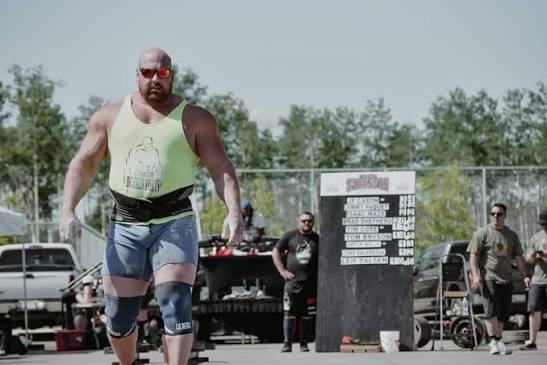
Iron Archives
9-time Canada's Strongest Man • 2020 World's Strongest Man podium finisher
Retired athlete
Jean‑François “JF” Caron is one of the most durable and consistent strongmen of the modern era: nine consecutive Canada's Strongest Man titles (2011–2019), nine World's Strongest Man finals, and a third-place finish at WSM 2020. The Quebec athlete became renowned for elite deadlifting, squatting and static strength, while building an international career that spanned almost two decades and later mounting a remarkable comeback after the severe bilateral knee injury he suffered in 2022.
Jean-François “JF” Caron was born on June 29, 1982, and comes from Les Hauteurs, a small rural community in the Bas-Saint-Laurent region of Quebec. His story as a strength athlete did not begin inside an elite training center, and it was not mapped out by a junior development program. In a long 2026 interview, Caron described growing up on a dairy farm where physical work was simply part of ordinary life. Hay had to be moved, stones had to be cleared from fields, equipment had to be handled, and difficult jobs were completed because the farm required them. None of that was “strength training” in the modern programming sense, yet it created an early familiarity with labor, fatigue and the practical use of strength. He has said that he always enjoyed forcing against something heavy. The decisive change came later, when he discovered that strength could be measured, compared and systematically developed. As a child and teenager, his main organized sports included hockey and competitive alpine skiing. His family lived close to a ski center, making skiing a natural part of his athletic life. Those sports did not obviously predict a future 155 kg professional strongman, but they gave him coordination, competitiveness, leg strength and familiarity with training. They also helped create a broader athletic base before his body became specialized for extreme strength. The regional context matters as well. Quebec has an unusually deep cultural memory of strongmen, extending from Louis Cyr to modern professional athletes. Caron has remarked that people in Quebec immediately understand the idea of an “homme fort”, while in some other places a massive athlete may be mistaken for an American football player or professional wrestler. For him, the transition from rural work to strength sport therefore happened inside a culture that already had a language for physical power. His later career would take him around the world, but the image remained distinctly Quebecois: practical, work-oriented, less interested in theatrical self-mythology than in what could actually be lifted, carried, pulled or loaded.
After high school, Caron studied agriculture at La Pocatière. Quebec press has described his college training as a diploma related to animal production. The detail is more than a biographical footnote because he later connected that education to the way he thought about food and performance. He never presented himself as a clinical nutrition professional, but learning how energy intake, feed composition and production interact gave him a practical framework for thinking about his own diet. After his studies he worked at a feed mill producing food for cattle. It was there that strength sport entered his life almost by accident. Several coworkers trained in an improvised gym area in the warehouse, and Caron joined them. He has explained that he had not previously been a conventional gym enthusiast. The weights revealed something immediately useful: the raw strength developed through farm work and sport could be translated into measurable performance. Around age 22 he began training seriously, and in 2004 he entered his first strongman contest. In his 2026 account, the progression was quick. By 2006 he was competing at the Quebec Cup level, and in 2007 he received an opportunity to enter North America's Strongest Man in Gatineau. He weighed roughly 270 lb at the time, substantially lighter than the 340-plus-pound bodyweight associated with his later prime. He finished fifth. That result is important because it shows the athlete before the final strongman physique had been built. Caron was not initially the largest super-heavyweight in the field. He was a comparatively lighter competitor who already possessed substantial strength and learned to compensate with efficiency, conditioning and technical adaptability. The Quebec scene made the climb difficult. Athletes such as Hugo Girard, Jessen Paulin, Louis-Philippe Jean, Christian Savoie and Dominic Filiou meant that qualifying through Canada, and particularly through Quebec, offered no easy path. Caron had to become internationally good before he could even establish uncontested national supremacy.
Before international audiences associated Caron with truck pulls, Atlas Stones and the Hummer Tire Deadlift, he developed a serious powerlifting base. That phase should not be treated as a side story because it explains the most recognizable technical quality of his career: exceptional pulling strength. Giants Live records a 390 kg deadlift performed without straps in 2010 in Sherbrooke, when Caron weighed around 130 kg. Sources from the period have associated the lift with a record in the organization in which he competed. Federation rules and equipment vary, so the number should not be treated as directly interchangeable with every modern powerlifting result, but the strength-to-bodyweight relationship is striking. Powerlifting gave Caron more than a large deadlift. It trained technical patience, familiarity with maximal attempts, the ability to organize volume and a disciplined relationship with numbers. Strongman then required him to transfer that strength to objects with different heights, grips, bar flex, ranges of motion and time limits. Over the following decade he became one of the rare athletes who could remain dangerous across almost every major deadlift variation. Strongman Archives documents 463 kg on the Rogue Elephant Bar at the 2018 Arnold Strongman Classic, 520 kg from 18 inches at World's Ultimate Strongman Dubai in 2018, and roughly 545 kg in the Hummer Tire Deadlift at the 2020 Shaw Classic. At the 2017 World Deadlift Championships he completed five repetitions with 400 kg and shared the event win. At the 2021 Rogue Invitational he won the Elephant Bar Deadlift with 420 kg. These lifts use different mechanics and cannot be ranked as though they were identical tests. The important fact is adaptability. Flexible bars require different timing from stiff bars. Elevated deadlifts shorten the range and emphasize lockout. Repetition events demand both maximal strength and fatigue resistance. Hummer Tire setups create extreme bar flex and their own pulling rhythm. Caron repeatedly solved all of them. His reputation as a deadlifter was not built on one viral lift but on more than a decade of high-level event results.
Squatting became the other major pillar of his static-strength profile. At the 2022 Arnold Strongman Classic, only hours before the injury that would transform his career, Caron won the Double T Squat with 438 kg. At almost 40 years old, after years of travel and high-level competition, he was still capable of beating an elite field in a maximal-strength event. The timing matters. His later injury did not occur after a long visible collapse in competitive ability. It happened while he was still producing world-class performances. This helps explain why the 2022 Arnold remains such a powerful moment in his biography. Caron's technical identity was broader than the phrase “great deadlifter” suggests. He was built around general force production: deadlift, squat, holds, heavy carries and difficult pulls. His overhead strength was very good in absolute terms, but not historically dominant; his documented competition best on the log reached 195 kg at World's Strongest Man 2021. Against the greatest overhead specialists of his era, that could cost points. What protected his overall ranking was the absence of catastrophic weaknesses. In a sport where a zero on one event can destroy an entire weekend, Caron usually found a way to score. On a less favorable event, he stayed in contact with the field. When deadlift, squat or grip arrived, he attacked. That ability to manage a contest, rather than simply chase the largest possible isolated lift, became one of his defining skills. Powerlifting supplied the engine, but strongman forced him to turn the engine into a complete vehicle. The result was nine World's Strongest Man finals and a career that remained relevant across several generations of champions.
Strongman Archives lists 2007 as the beginning of Caron's internationally documented competitive period. At North America's Strongest Man in Gatineau he finished fifth of twelve. For an athlete still early in his development, that was enough to establish that his strength belonged beyond the local scene. In 2008 came the first major jump. He finished second at Canada's Strongest Man and made his World's Strongest Man debut in Charleston, West Virginia. He did not reach the final, but the heats already showed the pattern that would define his later career: pulling strength was ahead of several other skills, while experience on diverse events still needed to catch up. A WSM invitation itself confirmed that he was no longer simply a promising Quebec athlete. In 2009 he finished third at Canada's Strongest Man and second at North America's Strongest Man. In 2010 he was second in both. The trajectory was clear. Caron was closing the gap to Canada's best, and the distance between raw ability and complete strongman performance was shrinking. His powerlifting work in the same period strengthened the reputation he would carry into international competition. The 390 kg deadlift from 2010 became a recurring reference point because it was achieved at a bodyweight far below his later peak. Then 2011 changed his national status completely. Caron won Canada's Strongest Man for the first time, beginning a run of nine consecutive titles. The contest showed that he was no longer merely a static-strength specialist. He could win or score heavily across holds, stones, power stairs, tire flips, squats and other events. Internationally, he was second at Strongman Champions League Canada, second at SCL Latvia and highly competitive in the SCL season structure. He returned to World's Strongest Man in 2011, again missing the final, but by the end of the year the picture had changed. Caron was the champion of a country with a substantial strongman tradition, and he was regularly capable of making international podiums.
The significance of the 2011 Canadian title lies in what followed. Winning once can happen through a favorable event set or an exceptional weekend. Repeating the result year after year requires adaptation to changing opponents, injuries and contest formats. Canada was not a weak field waiting for a dominant athlete to appear. Quebec in particular had produced a deep generation of professional strongmen. Caron therefore had to emerge from an existing tradition rather than fill an empty space. His style was already becoming recognizable: few major mistakes, reliable points across most events, and decisive advantages when the contest reached a heavy pull, squat, hold or grinding strength test. This was also the period in which his “marathon” quality as a strongman became clear. Strongman Champions League demanded frequent travel and rapid recovery across different countries, climates and equipment. To remain successful on that circuit, an athlete had to be strong and available. Strongman Archives ultimately credits Caron with 74 international contests and 10 international wins, in addition to national, regional and single-event appearances. The volume itself is a sporting achievement. Caron would eventually compete against athletes from the Žydrūnas Savickas and Brian Shaw generation, then remain relevant through the Hafþór Júlíus Björnsson era, and later face Oleksii Novikov, Tom Stoltman, Martins Licis and other younger champions. His career became a bridge between versions of professional strongman. In 2011 he was not yet a realistic World's Strongest Man podium candidate. In 2020, at age 38, he would stand on that podium. The nine years between those points were not defined by a magical breakthrough. They were built through gradual accumulation: more body mass, better event technique, better attempt selection, more sophisticated recovery and a deeper understanding of how to convert raw strength into points.
The 2012 season marked Caron's transition from national champion with international potential to World's Strongest Man finalist. He retained Canada's Strongest Man and won North America's Strongest Man after two previous runner-up finishes. More importantly, at World's Strongest Man in Los Angeles he reached the final for the first time and placed eighth. The result did not yet make him a medal favorite, but it proved that he could survive the unique WSM format, where heats and finals may demand very different strengths within a short period. For a Canadian athlete, preparation also involved a practical problem Caron has discussed in interviews: access to exact replicas of major international implements was limited. Before modern strongman equipment became widely commercialized, athletes frequently built, modified or improvised their own objects. That environment encouraged transferable skill. You could not rely on having trained the exact frame or log that would appear overseas. In 2013 Caron retained both Canada's Strongest Man and North America's Strongest Man. He reached the podium at SCL China and continued accumulating experience on a global circuit that moved between surfaces, climates and organizational styles. Modern fans accustomed to social media previews and standardized event announcements can underestimate how much uncertainty existed. Caron thrived in that uncertainty because his foundation was broad. In 2014 he won a fourth consecutive Canadian title and returned to the WSM final, finishing eleventh. The raw placing looked like a step backward, but repeated qualification mattered more to the long-term story. Strongman careers rarely move in a clean upward line. Event selection, groups, minor injuries and tactical errors can radically alter one weekend. Caron's great skill was returning, identifying where points had disappeared, and protecting his strengths for the next opportunity.
By 2015, the improvement had become impossible to ignore. Caron won a fifth consecutive Canadian title, took first at Strongman Champions League Portugal and finished sixth in the World's Strongest Man final. From that point through 2021, every WSM final he reached ended with a top-six result. Such consistency is difficult in a contest whose event composition changes every year. Caron did not possess the absolute overhead ceiling of the greatest pressers in history, nor was he always the fastest moving athlete, but there were few scenarios in which a contest could completely remove him from contention. A heavy deadlift, squat, hold or pull offered an opportunity for major points. Carries, medleys and stones could usually be managed well enough to limit losses. This architecture made him difficult to beat across an entire contest. His body had also changed dramatically from the roughly 270 lb athlete of his early international period. In his prime, published profiles list him around 155 kg at 1.91 m. The increase was not merely cosmetic. Open strongman had become heavier, and events such as yoke, frame, deadlift and squat rewarded enough body mass to stabilize and absorb enormous loads. Caron later spoke candidly about the cost of building and maintaining that body. In a 2026 appearance on Prends Un Break, he discussed periods of eating more than 8,000 calories per day and the broader sacrifices demanded by professional strongman. Food was not a permanent pleasure. It was another job. Training could occupy a few hours, but the athlete's entire day was organized around meals, sleep, recovery, travel and the next session. That reality is essential to understanding his rise. The public sees the lift; the professional life exists in the hours surrounding it.
The 2016 season provides one of the clearest images of Caron's dominance in Canada. At Canada's Strongest Man he won all eight events, a remarkable clean sweep in a sport where even overwhelming favorites usually have at least one relative weakness. It was his sixth consecutive national title, but the manner of victory matters more than the number alone. Winning across pulling, pressing, moving and loading events demonstrates completeness. In the same year he won the Festival des Hommes Forts de Warwick and placed fifth in the World's Strongest Man final for the first time. That fifth-place position would repeat in 2017 and 2018, creating a level of consistency that became central to his reputation. The podium during this era was occupied by athletes such as Brian Shaw, Hafþór Júlíus Björnsson and Eddie Hall, men who defined the period and frequently possessed event-specific advantages of historic scale. Caron did not take the overall WSM title, but he stayed close enough that a favorable event, a mistake by a rival or a handful of extra points could materially change the standings. In 2016 he also produced one of the spectacle performances frequently mentioned in later profiles: at the Arnold Strongman Classic he flipped a giant tire weighing roughly 612 kg four times. Giants Live includes the feat among his notable records. Strongman records always require context because implements and standards differ, yet the performance illustrates the evolution of Caron as an athlete. He had moved far beyond being a powerlifter transferred into an unusual sport. He could apply force to massive, unstable objects whose technique had little to do with a conventional barbell. Guinness World Records also documents a different feat from this broader period: 13 car rolls in five minutes in Jiangyin, China, on January 11, 2015. Later biographical material has referred to multiple Guinness achievements, but the car-roll mark is the one readily verifiable in the official Guinness database and is therefore the one treated here as formally confirmed.
In 2017 Caron again won Canada's Strongest Man, took victories at Strongman Champions League Norway and SCL Canada, and finished third at the Giants Live World Tour Finals in Manchester. At the World Deadlift Championships he delivered one of the cleanest demonstrations of his specialist status, completing five repetitions with 400 kg and sharing the event victory. Five reps at that load inside a competition are not simply equivalent to a gym set. The athlete must travel, warm up within event constraints, manage public pressure and often perform around other maximal events. For Caron, 400 kg had become more than a one-attempt barrier; it was a repeatable competition weight. He finished fifth at World's Strongest Man again. Repeating the same overall position can look static when a career is viewed only through trophies, but in his case it shows how high the performance floor had become. At 35, when many heavy athletes begin losing speed or tolerance for volume, Caron was still improving maximal strength. The biggest numbers of his career were still ahead. This stage also reinforced his role as Canada's most recognizable representative on the international stage. The flag, the Quebec accent and his understated manner became familiar elements of broadcasts. He rarely needed a dramatic public persona. His identity was built around reliability. When a contest included a truly heavy deadlift, experienced fans expected him to matter. When it included a long weekend of mixed events, they expected him to remain somewhere near the top because he made fewer destructive mistakes than many athletes with flashier individual strengths.
The 2018 season produced some of the most spectacular static-strength numbers of Caron's career. At the Arnold Strongman Classic in Columbus he pulled 463 kg on the Rogue Elephant Bar. The apparatus matters: an Elephant Bar is longer and more flexible than a standard power bar, so the plates leave the floor progressively and the athlete must control a changing bar shape through the pull. Later that year, at World's Ultimate Strongman in Dubai, he lifted 520 kg from 18 inches. An 18-inch deadlift has a shortened range of motion and cannot be compared directly with a floor pull, but 520 kg still represents extraordinary top-end force production. The same season brought overall success across very different contests. Caron won Arnold Africa, finished second at Arnold Australia and placed fifth at World's Strongest Man for a third consecutive year. He also secured his eighth straight Canada's Strongest Man title. Looking backward, 2018 captures the dual nature of his athletic profile. He could chase numbers that belonged in world-record conversations while still remaining complete enough for excellent overall placements. Many deadlift specialists surrender too many points in pressing or moving events to threaten the full standings. Caron generally prevented that collapse. His 195 kg competition log in 2021, while not a world record, later showed how strong even a relative weakness could become. That balance explains why his career should not be summarized simply as “elite deadlifter.” Deadlift was the signature weapon, but championship standings came from his ability to turn almost any event list into points.
In 2019 the national streak reached the symbolic number of nine. Caron won Canada's Strongest Man for the ninth consecutive time, completing a run from 2011 through 2019 that defined an era of Canadian strongman. He also won the Festival des Hommes Forts de Warwick again and placed third at Arnold Europe in Barcelona. At World's Strongest Man he took another step forward, finishing fourth. It was the best WSM result of his career to that point and a reminder that, at 37, he was not following a simple decline curve. In some respects he was still raising his ceiling. Strongman rewards experience in ways that complicate conventional ideas about athletic aging. Pure speed may deteriorate, but attempt selection, object technique, transition efficiency, psychological tolerance and maximal strength can continue improving. Caron had become a master of contest economy. He understood when to attack and when to preserve energy, how to avoid an unnecessary zero and how to recognize the events that could produce a large swing in points. By this stage his professional life also extended beyond competition. Quebec media described him as a co-owner of Santé X-Trem Gym in the Lac-Saint-Charles area. A strongman-specific facility is more than a business convenience. Commercial gyms often cannot accommodate dropping giant implements, storing stones, pulling vehicles or practicing yokes and farmer's walks. A dedicated gym lets the athlete build the environment around the sport. It also provides a path toward a longer professional life, because prize money alone does not always offer a stable career. Coaching, facility ownership and event organization can convert athletic reputation into durable work. The pandemic would soon demonstrate how vulnerable that structure could also be.
The 2020 season became the great paradox of Caron's career. COVID-19 disrupted international sport, gyms closed and travel became uncertain, yet he produced the most important overall result of his professional life. Quebec reporting noted that the closure of his gym affected income and complicated training. Strongman cannot simply be moved into a small apartment. The sport depends on space, specialized implements, heavy flooring and training partners. Despite that disruption, Caron arrived at World's Strongest Man in Bradenton ready to do what had escaped him for years: stand on the podium. He finished third behind Oleksii Novikov and Tom Stoltman. In the final he won the Hercules Hold with 52.67 seconds and scored strongly across other events, including the keg toss and Atlas Stones. The bronze medal was not the product of one lucky weekend. It followed WSM final finishes of sixth, fifth, fifth, fifth and fourth in the preceding years. His progression had been slow enough to be almost architectural. Quebec media emphasized the regional significance of the achievement and the continuity with the province's strongman tradition. At age 38, in a sport that punishes tendons, joints and the nervous system, Caron reached his best WSM result at an age when conventional sporting logic would normally expect decline. The podium changed the interpretation of everything that came before it. Three consecutive fifth places no longer looked like a ceiling. Fourth in 2019 became a step, not an ending. Caron's great competitive lesson was that longevity can generate real improvement when the athlete preserves foundational strength while becoming more efficient at converting it into contest points.
Later in 2020, the inaugural Shaw Classic produced a second defining result. Caron finished second overall and won the Hummer Tire Deadlift with a load recorded by Strongman Archives at roughly 545 kg. Some sources state the weight in pounds and convert it to approximately 542 kg, while others use the rounded competition load of 545 kg. The profile records the Strongman Archives figure and preserves the implement context rather than pretending every source uses identical conversion conventions. That context is essential. A Hummer Tire Deadlift is not the same test as a standard deadlift, an Elephant Bar pull or an 18-inch deadlift. Yet the variety makes Caron's record more impressive in another sense. He excelled across several versions rather than mastering only one. His second-place finish overall at the Shaw Classic also confirmed that the WSM podium was not an isolated spike. The year 2020 became his season of maximum international validation: third at World's Strongest Man, second at the Shaw Classic, a marquee Hummer Tire Deadlift and elite static-strength results. In a generation crowded with enormous personalities and highly marketable champions, Caron remained comparatively understated. His numbers became their own language. When an athlete is still standing on global podiums nearly two decades after first entering the sport, and can also produce one of the heaviest deadlift performances seen in strongman, longevity stops being merely the length of a career. It becomes a competitive achievement in itself.
Caron's long career also illustrates how training has to change when both the athlete and strongman itself evolve. Early on, the priority was general strength. Powerlifting offered a relatively simple framework: squat, bench, deadlift, progressive loading and large amounts of basic work. International strongman destroyed that simplicity. One season could require log, axle, giant dumbbell, yoke, farmer's walk, frame carry, truck pull, arm-over-arm, keg toss, Atlas Stones, loading medleys, multiple deadlift variations and a squat apparatus that did not exist in an ordinary gym. Preparation therefore became a process of turning general strength into a technical vocabulary. Caron benefited from a strong foundation and access to a facility where implements could be built or modified. He has not promoted his preparation as a rigid branded system, which is revealing. His success is better explained by adaptation than by a single recipe. A maximal-deadlift contest requires a different fatigue strategy from a WSM week with many events. Carries require footwork, breathing under compression and turning skill, not just leg strength. Stones demand contact position, hip timing and confidence around an awkward object. Over two decades Caron accumulated these skills until experience became movement economy. An older athlete does not always need to be faster than the youngest man if he loses less time setting his grip, makes fewer unnecessary steps and understands exactly where to place the implement. That efficiency helped keep Caron competitive after pure speed could no longer be assumed to remain at its youthful maximum.
Recovery inevitably became a larger component of that training. In strength-sport culture, recovery is often reduced to massage, supplements or gadgets. For an international strongman, the more important concept is load management. No athlete can test a true maximum every session for twenty years and reasonably expect the body to remain intact. Caron had to learn when to leave repetitions in reserve, when to simulate an event without using its full contest weight and when to abandon a session because protecting the next competition mattered more than winning training. His longevity suggests considerable practical intelligence in dosing stress, even though the catastrophic 2022 injury demonstrates that risk can never be fully engineered away. Strongman remains a sport in which tissue failure can happen within a fraction of a second. After surgery, training acquired an entirely different meaning. At first the goal was not to add weight to a bar. It was to restore knee extension, range of motion, muscle mass, control and confidence. Squat and deadlift variations came later, then carries and event work. His 2025 results show that the process eventually became strong enough to support competition again, but that should not be confused with making reconstructed tissue “as new.” Caron's mature public perspective reflects this difference between capability and invulnerability. An athlete may return to enormous loads while still carrying permanent consequences. In 2026 interviews, he has been able to discuss not only what elite strength gave him, but what it cost in food, time, travel, relationships and physical wear.
The season after his 2020 peak showed that Caron's World’s Strongest Man medal had come from a stable level rather than a one-contest window. At WUS Strength Island in Bahrain he finished second. At World's Strongest Man in Sacramento he reached the final again and placed fifth, his ninth final in eleven WSM appearances. He won the deadlift-for-repetitions event in the final and reached 195 kg in the max log, the competition best recorded for him in the major statistical databases. Later, he finished third at the Shaw Classic after having been second the previous year. At the Rogue Invitational he placed fifth overall and won the Elephant Bar Deadlift with 420 kg. He was also fourth at Arnold UK and fourth at WUS Dubai. These results matter because they came in very different competitive environments: outdoor heat, stadium formats, Rogue-specific equipment, traditional strongman objects and purpose-built implements. At nearly 40, Caron still had enough mobility and work capacity for excellent overall standings, and enough static strength to defeat athletes more than a decade younger in individual events. The season also captured a generational transition. Oleksii Novikov, Tom Stoltman, Trey Mitchell, Martins Licis and other newer stars were reshaping the top of the sport, while several rivals from the Shaw-Savickas-Hall era no longer occupied the same positions. Caron connected those worlds. That bridge is historically useful. It allows fans to observe how event weights increased, how contest structures professionalized and how training culture changed without making simplistic claims that one generation was automatically superior to another. Caron competed long enough to adapt his body and methods to multiple versions of modern professional strongman. In 2021, immediately before the major injury that followed, there was no clear evidence that he had become irrelevant. His strongest qualities were still world class.
The opening months of 2022 were almost ideal. At Força Bruta in Brazil, Caron won the contest and all three events, evidence that his general competitive form remained excellent. Then came the Arnold Strongman Classic in Columbus. On the first day he won the Double T Squat with 438 kg, one of the largest documented squats of his career. During the log press, however, while attempting a log of roughly 420 lb, Caron suffered catastrophic injuries to both knees. Quebec reporting, including 98.5 FM, described bilateral patellar-tendon ruptures. Some English-language reports used different anatomical wording, including references to quadriceps tendons. Because those descriptions have not always been consistent, the careful formulation is that he sustained severe bilateral disruption of the knee extensor mechanism, with contemporary Quebec sources specifically identifying the patellar tendons. The practical reality was unambiguous. Caron could not simply leave the arena and travel home normally. He required emergency surgery and specialized transport, and he later described the sound and sensation of the injury as something that remained vividly present in his memory. A single patellar-tendon rupture is a major injury for any strength athlete. A bilateral rupture removes the healthy leg that would normally compensate during the earliest stages of rehabilitation. Standing up, transferring, walking and basic daily tasks become logistical challenges. For a man whose body mass had been built to exceed 150 kg, those problems are magnified. The injury therefore attacked more than competitive ability. It temporarily removed the ordinary physical independence that had defined Caron's identity since childhood.
Rehabilitation became a project as demanding, in a different way, as preparing for World's Strongest Man. Quebec media followed the process as Caron gradually recovered function and returned to strength work. Before his competitive comeback in 2023, he was notably realistic about what recovery meant. He did not claim that surgery would erase the injury or automatically restore his old elite level. He understood that repaired tissue, age, lost muscle mass and months away from maximal loading imposed a new set of constraints. That realism is central to understanding the comeback. In sport, the word “comeback” is often marketed as though the past can simply be recreated. Caron approached it more as an exploration of a new ceiling. The early objectives were basic: walk normally, regain knee control, rebuild quadriceps mass and tolerate loading. Only later could heavy strongman movements return. Community support mattered. Local sources described the backing he received from athletes, organizers and people at the gym. Strongman is an individual contest built on a deeply communal infrastructure. Athletes share implements, travel knowledge, rehabilitation experiences and training spaces. They often referee one another's regional competitions and later become promoters or mentors. Caron was already embedded in that network through his gym and the Quebec circuit, so rehabilitation did not occur in isolation. The 2022 injury effectively ended the phase in which a full-time chase for an open World's Strongest Man podium was realistic, but it did not end his relationship with strength sport. If anything, it accelerated a broader transition from athlete participating in the circuit to veteran helping sustain the circuit itself.
In 2023, roughly a year and a half after the bilateral knee injury, Caron returned to international competition at the World Strongman Championships in Talsi, Latvia. Strongman Archives records him in tenth place out of twelve, with withdrawal before the final events. Judged only by the overall ranking, this was not a return to his 2020 level. Judged biomechanically and personally, simply performing in a heavy strongman contest after bilateral extensor-mechanism reconstruction was extraordinary. An athlete who had needed surgery and extensive rehabilitation was again deadlifting, carrying and handling competition implements. Caron treated this stage as an investigation of his new limits. It is important not to rewrite the comeback as a perfect upward curve. There were constraints, missed events and continued adaptation. That imperfection gives the story credibility. In 2025 the comeback gained two much stronger competitive markers. At Expo Agricole Rimouski on the Circuit Hommes Forts, Caron won the overall contest. Strongman Archives records event wins in the Tire Flip and Hercules Hold, second place in the Flintstone Barbell with 193 kg and competitive results across the remaining events. Winning an open contest at age 43, after the 2022 injury, demonstrated how much usable strength he had rebuilt. It should not be confused with returning to his exact 2020 world-podium form, but it should not be minimized either. The body that had first been rehabilitated for ordinary function was again tolerating the cumulative stress of a full strongman contest.
In November 2025, Caron competed at Masters World's Strongest Man in Arlington, Texas, and finished second overall behind Dimitar Savatinov. He won the Natural Stones event, loading all four stones from 136 to 159 kg in 28.92 seconds, and finished second in both the Dumbbell Ladder and Deadlift Ladder. The performance provides an elegant late-career echo. At the beginning, Caron had been the relatively light young strongman trying to establish himself against Quebec's established names. In his prime, he became the deadlift specialist and perpetual WSM finalist. After injury, he had to rebuild basic physical function. At 43, he was again loading heavy natural stones, completing a deadlift ladder that reached 363 kg and standing on the podium of a world-level Masters contest. Strongman Archives lists his internationally documented active years as 2007 through 2025, while Caron himself dates his first strongman competition to 2004. For that reason this profile describes the competitive career as 2004–2025, while noting that comprehensive international documentation begins in 2007. In 2026 public material presents him primarily as a former full-time elite athlete, promoter, referee and important figure in Quebec strongman rather than as a regular open-division touring professional. The profile therefore uses “retired” as his sporting status, without implying that he could never again appear in a Masters contest, regional event or exhibition. Strongman retirement is often porous. Veterans may return for selected competitions long after leaving the full international schedule.
Jean-François Caron's private life is considerably less public than his competitive career, and that boundary should be respected. Reliable sources provide meaningful information about his family background, childhood, studies, employment, community ties and the sacrifices required by elite sport, but they do not justify inventing details about a spouse, children, wealth or other private relationships. Caron grew up in a farming family and has remained strongly connected to Quebec. In 2026 podcast appearances he discussed how the demands of his career sometimes made him less present for people close to him and how becoming an elite strongman carried a personal price. That admission corrects the romantic image of professional strength sport. A competition is not merely two televised hours on a weekend. It is daily training, repeated meals, sleep organized around recovery, travel, jet lag, pain management, physiotherapy, professional compromises and time taken away from family and friends. At his heaviest, maintaining a body capable of world-class open strongman required enormous food intake. Caron has spoken about periods exceeding 8,000 calories a day. Older Quebec reporting described his practical approach to diet and the way his agricultural education influenced how he thought about energy and performance. Animal-production studies are not a substitute for human clinical nutrition training, but they helped give him a systems-oriented mindset: intake, output, digestion and adjustment. Local profiles have also shown a lighter side, including his enthusiasm for seafood and lobster, a useful reminder that strongman nutrition is more varied than the stereotype of endless beef and rice. For Caron, eating at that scale eventually became logistics rather than indulgence.
Santé X-Trem Gym became another major component of his professional life. Le Journal de Québec described him in 2018 as a co-owner of the facility in the Lac-Saint-Charles area, and later reporting repeatedly identified the gym as a training base. A strongman facility has requirements that ordinary commercial gyms may not tolerate: dropping heavy implements, storing yokes and farmer's handles, loading stones, pulling sleds and vehicles, and building or modifying equipment. The gym becomes part workshop, part laboratory and part community center. For Caron it also provided a route toward professional continuity. Strongman prize money is not always stable enough to support a long career by itself. Gym ownership, coaching and event involvement allow competitive capital to become a longer-lived profession. The pandemic in 2020 exposed the vulnerability of that model when gym closures affected revenue at the same time Caron was preparing for the biggest contests of his life. Later, Circuit Hommes Forts became even more central. In the 2026 Whats Up Podcast interview, Caron said that the circuit belongs to him and described how it travels through Quebec festivals, agricultural fairs and rodeos. The structure creates a near-perfect circle in his biography. The farm boy who discovered strength through manual work, then traveled the international strongman world, returned to rural public spaces to present the sport to a new generation. The circuit is more than a business schedule. It is sporting infrastructure: stages, crowds, opportunities for developing athletes, judging standards and cultural continuity.
Caron's World's Strongest Man record deserves to be viewed as a sequence because it captures his development better than any single summary. He debuted in 2008 and did not reach the final. He returned in 2011 and again remained in the heats. In 2012 he made his first final and finished eighth. In 2014 he placed eleventh. Then came the extraordinary run of stability: sixth in 2015; fifth in 2016, 2017 and 2018; fourth in 2019; third in 2020; fifth in 2021. It is not a perfectly ascending line, but it is an unusually clear maturation curve. Eight years separate the first final from the podium. In a social-media era that rewards stories of immediate breakthrough, Caron's career demonstrates the opposite. He became a podium athlete through hundreds of small adjustments. Every WSM supplied information: an event where points were lost, a slow transition, an attempt chosen badly, an implement that required more practice. The 2020 medal did not come from an athlete who suddenly reinvented himself. It came from the accumulated version of every previous final. The record also explains his standing among other athletes. Qualifying for nine finals is difficult in a sport where one small injury, one difficult heat or one event-specific weakness can eliminate even a famous name. From 2015 through 2021, every final he entered ended in the top six. That is an exceptionally high competitive floor. He did not dominate WSM, but he was almost permanently close enough that rival mistakes mattered and event victories could shift the podium.
The WSM sequence also highlights an important psychological quality: tolerance for partial failure. Fifth place at World's Strongest Man is an elite result, yet it can be deeply frustrating for an athlete chasing a medal. Caron finished fifth three consecutive times and kept returning. Publicly, he did not turn each near miss into a crisis narrative. His style was practical. The contest ends, the athlete identifies what went wrong, returns to training and tries again. That attitude fits the work-centered language he uses when describing his upbringing. On a farm, a hard day is not necessarily a dramatic story; it is a day that has to be completed. In strongman, the same mentality can become a competitive advantage. It does not eliminate emotion, but it places emotion inside a process. The 2020 podium therefore carried a different meaning from a young athlete reaching the medal positions immediately. It validated a decade of attempts. From a legacy perspective, that persistence may be more instructive than an isolated championship. Most athletes will never win the largest title in their sport. The relevant question becomes how a valuable career can be constructed without the ultimate trophy. Caron's answer was consistency, national dominance, international podiums, event records and repeated presence at the biggest finals. His career demonstrates that the history of strongman is not composed only of champions. It is also built by the athletes who define the standard that champions must overcome.
Technically, Caron can be described as a strongman built around elite static strength and unusually reliable all-around scoring. Deadlift sits at the center of the profile. The documented results cover nearly every important family of the event: 390 kg in powerlifting without straps at roughly 130 kg bodyweight, 463 kg on the Elephant Bar, 520 kg from 18 inches, about 545 kg in the Hummer Tire Deadlift, five repetitions with 400 kg, and 420 kg for the event win at the 2021 Rogue Invitational. These numbers are not interchangeable because each setup changes the movement, but together they demonstrate adaptation. A flexible bar rewards patience in building tension and maintaining position as the plates rise progressively. An elevated deadlift shortens the range and shifts emphasis toward the upper pull and lockout. Repetition events punish breathing, grip and spinal endurance after the first few reps. Hummer Tire configurations introduce extreme flex and unusual timing. Caron was competitive in all of them. Squatting formed the second major weapon, culminating in 438 kg at the 2022 Arnold. Grip-based events also fit his physiology and temperament. His victory in the Hercules Hold at World's Strongest Man 2020, and another event win in the same discipline at Rimouski in 2025, show how long that capacity survived. In a hold, there is little room for tactical disguise. The athlete must tolerate huge forces pulling the hands open while maintaining posture and breathing. Caron's thick back, large frame and strong hands translated naturally to the event. Heavy pulls and holds therefore created predictable scoring opportunities, which meant rivals could not afford to give away points earlier in the contest.
His relative weaknesses are equally important to understanding the overall record. Caron's overhead strength was excellent by any normal standard, but the top of professional strongman has included historically exceptional pressers. A 195 kg log can still lose points when several rivals are capable of more than 200 kg or can repeat a lighter weight faster. Very explosive moving events could also favor younger or lighter athletes. Caron's solution was not to pretend every event could become a signature event. He reduced the damage. Instead of turning a weakness into a zero, he aimed for a middle or upper-middle placing and waited for a heavier static event where he could recover the points. This is championship arithmetic. In a ten-man contest, finishing tenth instead of fifth may cost five points, which can erase the benefit of an event victory elsewhere. Complete strongmen survive by preventing collapse. Caron was one of the clearest modern examples. His attempt choices often reflected this mentality. The most impressive possible weight was not always the best strategic weight. A successful second attempt could be worth more than a dramatic failed third if the standings made the extra risk unnecessary. On carries, his mass and structural stability helped with heavy objects even when he did not possess the fastest foot speed. On stones, accumulated experience improved lap position, extension and transitions. His Natural Stones win at the 2025 Masters World's Strongest Man, years after knee reconstruction, shows that technique remained available even when the body had changed. Strongman skill becomes a kind of physical memory. Caron spent more than two decades building that memory.
Truck pull and arm-over-arm events reveal another feature of Caron's style. They combine maximal force with rhythm, body angle and the ability to keep producing power after the initial acceleration. A very strong athlete can perform badly if the harness angle is inefficient or if the feet slip, while a technically experienced athlete can convert a slightly lower force ceiling into a better time. Caron's rural-work background is not a scientific explanation for success in these events, but it fits the practical character of his movement: he was comfortable applying force to something that did not behave like a barbell. Strongman rewards that comfort. Yokes sway, frames flex, tires bounce and trucks do not accelerate smoothly. Athletes who require perfect conditions can lose large amounts of time. Across his career Caron became increasingly effective at accepting imperfect feedback and continuing the task. That quality is difficult to quantify in a personal-record list, but it helps explain his consistency. He rarely looked surprised by the fact that an object was awkward. Awkwardness was the sport. This is also why dedicated implement training at facilities such as Santé X-Trem mattered. General barbell strength creates the horsepower; repeated exposure teaches the athlete how to steer it.
The nine consecutive Canada's Strongest Man championships from 2011 through 2019 form the backbone of Caron's national career. Repetition is the essential point. One title can be influenced by a perfect day, a favorable event selection or an absent rival. Nine in a row means surviving changes in opponents, event design, accumulated injuries and the athlete's own aging. Caron did not dominate an empty domestic scene. Canada continued to produce strong athletes, and Quebec maintained one of the deepest regional ecosystems in North America. Winning each year also required balancing domestic competition against an increasingly demanding international schedule. The Canadian title could not simply be treated as an easy appearance between larger events. The streak created a particular relationship with the public. By the middle of the decade, Caron appearing at World's Strongest Man felt less like an individual athlete traveling abroad and more like a familiar national representative. The Canadian flag and his unmistakable Quebec identity became part of the broadcast image. He did not erase his regional background to become more marketable internationally. French remained central to his public life, and he continued competing, training and later promoting in Quebec. In a sport globalized largely through English-language media, that cultural continuity matters. It demonstrated that a strongman could become internationally recognizable without becoming culturally generic.
Quebec's relationship with strength sport gives the streak additional meaning. Louis Cyr belongs to a completely different era, with different rules, objects and forms of public exhibition, so kilogram-for-kilogram comparisons between Cyr and modern strongmen are usually misleading. The meaningful connection is cultural rather than statistical. Quebec possessed a public memory of the “homme fort” long before modern televised strongman. Caron has noted that Quebec audiences understand the concept almost instinctively. A child at an agricultural fair does not require a long explanation of why pulling a truck or loading a stone is impressive. The task is visible. Caron benefited from that culture and later helped reproduce it through Circuit Hommes Forts. Fairs, rodeos and festivals place strength sport in front of people who may never buy a ticket to a specialist arena event. This resembles the historical logic of strongman before television while using modern safety standards, judging and promotion. In that sense Caron's role evolved from beneficiary of the Quebec strength ecosystem to one of its maintainers. Records will eventually be broken because implements improve and new generations train specifically for numbers the previous generation made imaginable. Infrastructure can last longer. A circuit that gives developing athletes stages, officials and audiences may influence the sport long after an individual deadlift mark has been surpassed.
Professional strongman has produced some extremely theatrical personalities. Caron's public presence has generally been more restrained. He did not build his reputation around feuds, provocative predictions or elaborate self-mythology. Interviews tend to be practical, technical and dryly humorous. That difference should not be mistaken for a lack of personality; it is the personality. Fans learned to associate Caron with stability. He arrived, lifted something extremely heavy, offered a matter-of-fact explanation and went back to work. In the social-media era, that understated authenticity can be as distinctive as spectacle. He rarely needed to tell audiences that he was dangerous on the deadlift because the results already communicated it. After the 2022 injury, longer podcast formats made another side of his public persona more visible. Caron could discuss fear, rehabilitation, food, relationships, career sacrifice and the strange experience of life after full-time elite competition. Those conversations expanded the public image beyond “the Canadian who deadlifts enormous weights.” They showed a veteran capable of evaluating his own career critically rather than treating every sacrifice as automatically noble. Not every kilogram of bodyweight was romanticized. Not every missed family moment was justified as a necessary price. That nuance is valuable in a sport where young viewers often encounter only the final ten-second record clip. The athlete knows the years around the clip, including the meals eaten without appetite, the flights taken while injured and the quiet sessions when performance moves backward. Caron's later public voice helps preserve that hidden history.
His communication style also reflects a useful distinction between confidence and performance theater. Elite strength athletes need genuine belief because maximal attempts leave little room for hesitation, but confidence does not have to be verbal aggression. Caron often appeared most convincing when speaking precisely about what he believed he could do. This analytical temperament fits his competition strategy. He was rarely rewarded for reckless opening attempts; his career was built on making lifts, collecting points and surviving weekends. The same mindset appears in his return from injury. He did not publicly promise that he would simply become the 2020 version of himself again. He acknowledged uncertainty and worked within it. That kind of realism can coexist with extraordinary ambition. In fact, it may be one reason the comeback reached competition at all. Rehabilitation becomes psychologically dangerous when every session is judged against the athlete's historical maximum. A veteran who accepts smaller intermediate goals can accumulate progress without interpreting each limitation as defeat. Caron's public comments around the comeback repeatedly suggested that he understood the difference between recovering identity and reproducing old numbers. By 2025, winning in Rimouski and placing second at Masters WSM gave that approach competitive validation.
Statistics provide another way to understand Caron's career, provided they are used carefully. Strongman Archives credits him with 74 international contests and 10 international victories, alongside 12 national appearances with nine wins, plus regional and single-event competitions. Those totals are not simply evidence of longevity; they reveal repeated exposure to competitive risk. Every contest creates opportunities for injury, poor event selection, travel fatigue and a damaging low placing. A short career can preserve an impressive win percentage by appearing selectively. Caron frequently competed. His record therefore contains victories, podiums, mid-table finishes, withdrawals and difficult weekends. That is not noise to be removed from the biography. It is what makes the stronger results meaningful. The nine Canadian titles were not produced by protecting a perfect record. The WSM podium came after years in which the final exposed weaknesses. The Shaw Classic runner-up result came in a field designed to be brutally heavy. His career has statistical texture rather than a curated highlight reel. For historians of the sport, this makes him a useful reference athlete. Because he appears repeatedly across SCL, Arnold, Giants Live, WUS, WSM, Shaw, Rogue and Canadian circuits, his performances help connect otherwise separate competitive ecosystems. A result against Caron in 2012 and another against him in 2021 do not prove direct equivalence between athletes, but they provide a human bridge across changing eras. Few open strongmen remain internationally relevant long enough to offer that continuity.
The distribution of his best results also challenges the assumption that a strength athlete must peak early. Caron's first Canadian title came around age 29. His most consistent WSM period began in his early thirties. His best WSM placing arrived at 38. The 545 kg-class Hummer Tire Deadlift came in the same year. The 438 kg squat arrived at 39, immediately before the major injury. Then, after reconstruction and rehabilitation, he won an open Quebec contest and reached the Masters world podium at 43. This does not mean aging is irrelevant. Recovery slows, connective tissue accumulates damage and speed can decline. Caron's own injury history demonstrates those realities. What the timeline shows is that maximal strength, technical knowledge and competitive judgment can mature for a long time, especially in a sport where the best performance is the sum of several different abilities. Strongman therefore has a different age curve from many speed-dominant sports. Caron's career is an extreme example of how experience can partially offset biological decline until injury or accumulated wear changes the equation. The lesson is descriptive rather than prescriptive. His longevity does not guarantee that another athlete should pursue the same body mass or competition volume. It shows what happened in one unusually durable career.
The 2022 injury adds a final dimension to Caron's legacy, but it should not be romanticized. Bilateral tendon rupture produced pain, emergency surgery, financial and logistical burdens, rehabilitation risk and the possibility that ordinary function might never feel normal again. It was not a useful hardship that had to occur for character development. It was a traumatic sporting accident. The meaningful part is what Caron did after it happened. He accepted that the old competitive ceiling might no longer be available, rebuilt function and then chose how far to push the return. That preserves agency without pretending that severe injury is secretly beneficial. The distinction matters in strength culture because dramatic comeback videos can unintentionally make catastrophic injury look like a heroic prerequisite. Caron's actual story is more complicated. Before the injury he was still capable of winning a 438 kg squat against an elite field. After the injury, he had to learn what the reconstructed knees could tolerate. The career on either side of that moment should therefore be evaluated under different conditions. A tenth-place international comeback in 2023 may look modest beside third at WSM, yet the body producing the later result had undergone a completely different history. By 2025, the Rimouski win and Masters runner-up finish showed that the post-injury version of Caron could create its own accomplishments rather than simply chase a copy of the past.
That distinction also clarifies retirement. Caron's status is best described as retired from full-time elite open strongman rather than absent from strength sport. Public material in 2026 centers on Circuit Hommes Forts, organizing, refereeing, interviews and the transmission of experience. Selected Masters events, local contests or demonstrations remain compatible with that status. In strongman there is rarely a formal retirement mechanism comparable to the end of a professional league contract. The sport is organized through multiple promoters and federations, so a veteran can disappear from the world tour and still compete at a fair years later. Caron's career after 2022 illustrates this porous boundary. The important shift is not whether he will ever touch another competition implement. It is where the center of professional identity now lies. During his prime, the next WSM, Arnold or Shaw Classic structured the year. In the current stage, the circuit, community and preservation of Quebec strongman culture occupy more of the public role. That transition is not a lesser version of the career. It is one way a sport retains expertise that would otherwise leave when an athlete's body can no longer tolerate the full open calendar.
Jean-François Caron's legacy is not organized around a World's Strongest Man title, which he never won. It is built from a combination that is harder to compress into one trophy. He won Canada's Strongest Man nine consecutive times, won North America's Strongest Man twice, reached nine WSM finals in eleven appearances, stood on the WSM podium in 2020, made consecutive Shaw Classic podiums, won Arnold Africa, won Strongman Champions League events and collected individual event victories against several generations of elite athletes. The statistical database documents 74 international competitions, while his own account places the beginning of strongman in 2004 and competitive results extend through 2025. He therefore competed across three calendar decades. During that period professional strongman changed from a heavily television-centered seasonal product into a digital ecosystem with livestreams, social platforms, multiple premium competitions and increasingly specialized preparation. Event weights increased. Equipment became easier to purchase and reproduce. Athletes gained more access to sports science and full-time professional structures. Caron adapted instead of being erased by those changes. That is why his duration matters. Longevity is not merely staying alive on a start list. It is remaining good enough that the sport continues to care what you do.
For Canadian strongman, the nine-title streak created continuity through an entire decade. For Quebec, Caron links historical strength culture with the realities of contemporary professional competition without pretending the eras are directly comparable. For athletes, his career offers an alternative model to the brief spectacular peak. Progress can be slow. A fifth-place finish can be part of a future podium rather than proof of a permanent ceiling. A specialist can remain relevant by building enough competence around the specialist event. A catastrophic injury can end one version of a career without necessarily ending every competitive possibility. And retirement can evolve into promotion, refereeing and mentorship instead of simple disappearance. None of these lessons require treating Caron as flawless. His career included losses, limitations, injuries and sacrifices he has discussed openly. That is precisely why it is useful. It shows professional strongman as a long negotiation among ambition, body, money, relationships and time. The 545 kg deadlift is spectacular because the camera can capture it. The more difficult accomplishment may be everything required to still be capable of such a lift after years of competition.
The final measure of influence may be what remains after the records move on. Strongman numbers are fragile. A future athlete will eventually lift more, a new apparatus will change the standard, or a promoter will create a slightly different variation that produces a different record. Competitive culture lasts through people. A gym where young athletes can touch a yoke for the first time, a regional circuit that gives them a platform, an experienced referee who knows how an event should be run, and a veteran who can explain both the glamour and the costs all contribute to the sport's institutional memory. Caron's work in Quebec gives his career that second life. The athlete who once needed a local ecosystem to begin now helps provide that ecosystem to others. This circularity may be the most fitting conclusion to his biography. The farm taught him physical work, the warehouse introduced organized lifting, Quebec strongman gave him a stage, international competition gave him a career, and the veteran returned with enough knowledge and visibility to strengthen the place where the story started.
If World's Strongest Man supplies the most visible landmarks of Caron's career, his years in Strongman Champions League help explain how he became so adaptable. SCL was not a single annual championship. It was a traveling sequence of events in different countries, often using local organizers, locally built equipment and conditions that forced athletes to solve problems quickly. For Caron, those contests became a permanent school. He reached podiums in Canada, Latvia, China and elsewhere, and won stages in Portugal, Norway and Canada. These results should not be dismissed as secondary trophies compared with WSM. They provided high-level repetitions of the exact uncertainty that WSM demanded once a year. One weekend might use a vehicle deadlift, another a conventional bar, then a frame on an uneven surface or a truck pull on asphalt with different traction. An athlete who depends on one familiar implement can become disoriented. Caron learned to read the object quickly. How much does the frame swing? Where is the center of mass? How aggressive should the first steps of a pull be? Is one extra repetition worth the fatigue if three events remain? Those decisions do not appear in a personal-record table, but they build circuit athletes. SCL also taught recovery. A competitor might race, fly home, train for a few days and leave again. There was not always a perfect eight- or twelve-week peak for every event. Caron needed a base level of readiness strong enough to answer the calendar. That encouraged reliable performance rather than a single artificial peak. The same pattern later appeared at World's Strongest Man, where he repeatedly made finals without depending on one miraculous event.
Circuit life also involves a quantity of travel that disappears from results pages. Professional strongman does not possess the infrastructure of the largest team sports. Athletes manage their own belts, sleeves, footwear for different surfaces, straps, suits where regulations permit them, food routines and often oversized bodies inside ordinary commercial travel systems. For an athlete above 150 kg, a long flight can itself become a recovery problem. Sleep is fragmented, hips and backs stiffen, hydration changes and familiar meals may not be available. Caron competed across North America, Europe, Asia, Africa, the Middle East and South America. Every trip added variables before the first event even began. Part of his longevity came from learning to perform when the environment was not ideal. Modern fans sometimes see the final event list and assume that all competitors arrive under comparable conditions. In reality one athlete may have crossed an ocean while another has driven two hours. Over many seasons Caron accumulated routines that reduced the damage: arrive early when possible, simplify meals, move after travel, and avoid turning inconvenience into a psychological emergency. This form of stability is difficult to quantify. It does not lift 500 kg by itself, but it can determine whether the nervous system and energy needed for the platform are available. Across more than seventy documented international appearances, learning how to travel became almost another strongman event.
Caron's physical transformation from roughly 270 lb in his early international years to about 155 kg in his prime belongs to the logic of the open division. There is no upper bodyweight limit, and absolutely heavy events tend to reward enough mass for stability, inertia and muscular cross-sectional area. That does not mean heavier is automatically better. Every added kilogram must also be moved through medleys, supported cardiovascularly and fed every day. Caron had to find a range where body mass increased his capacity in deadlift, squat, yoke and holds without destroying speed and conditioning. His ability to remain competitive in moving events suggests that the balance worked for him. Food, however, became training by another name. When an athlete talks about eating more than 8,000 calories per day, the number sounds extravagant, but for a body above 150 kg performing hours of heavy work, intake is not merely indulgence. It is the logistics of preserving mass and recovering from training. At the same time, this profile does not present that intake as a recommendation. The requirements of an elite open strongman are extreme and individual. Caron has described the burden retrospectively: eating when hunger is gone, structuring travel around meals and living everyday life in a body designed for a highly specialized competitive task. A flight seat, staircase or night's sleep all feel different at that size. Retirement can therefore involve more than losing an athletic identity. It can also bring relief from the obligation to maintain a body that is optimized for something almost no ordinary life requires.
His agricultural education adds an unusual layer to the nutrition story. Caron has explained that studying and working around animal production accustomed him to thinking in terms of energy input, output and adjustment. Human physiology cannot be reduced to livestock models, and he has not claimed otherwise. The useful transfer was the habit of measurement. Strength athletes watch bodyweight, gym performance, digestion, sleep and recovery. If bodyweight falls and performance collapses, intake may be insufficient. If mass climbs while speed and conditioning deteriorate, more weight may no longer be productive. Caron had two decades to observe these relationships in his own body. Not every strategy used early in his career would necessarily match what a modern sports-science team might prescribe, but longitudinal experience has its own value. When he started in 2004, there were fewer specialized coaches, fewer online strongman resources and much less standardized information about structuring an open-division season. Caron and his generation learned heavily through trial, error and athlete-to-athlete exchange. By the time he discussed the cost of eating and body mass in 2026, the reflections had been filtered through thousands of training days rather than a short experiment.
Refereeing and promoting appear less dramatic than breaking a record, but they are essential to a mature strongman culture. The rules look simple until two athletes are separated by a fraction of a second or one repetition is disputed. A referee has to define knee and hip lockout in a deadlift, control in an overhead lift, line crossings on carries, stability on stones, legal strap use and dozens of details that can decide placings. A veteran such as Caron brings the perspective of someone who has been judged under many systems and understands where ambiguity appears. Promotion requires the reverse mindset of competition. The athlete asks, “How do I win this event?” The organizer has to ask, “Is the event safe, understandable, visually effective and balanced enough to test what it claims to test?” The weight must be heavy enough for the level of the field without producing meaningless zeros for half the athletes. The surface has to work. Implements need to survive repeated use. Warm-up, timing, volunteers and transitions must be coordinated. Circuit Hommes Forts gives Caron a role in this second engineering of the sport. Experience from WSM, Arnold, Giants Live, SCL, Shaw, Rogue and WUS can be translated into better regional competitions. That is direct legacy rather than symbolic legacy. An elite athlete can inspire through an image; a good promoter can materially change the environment in which the next generation develops.
Promotion also requires an understanding of spectators. Strongman is one of the few sports whose basic challenge can often be explained immediately: lift more, carry faster, hold longer, pull the object across the line. Yet a good event still needs rhythm and narrative. A maximal deadlift can drag if attempts are organized poorly. A medley becomes confusing if the route is not visible. A static hold can appear motionless if the announcer does not communicate time. Caron has lived those formats as an athlete and can now view them from the production side. Agricultural fairs, festivals and rodeos are especially suitable environments because people circulate, stop briefly and need to be captured by something visually obvious. A giant yoke or tractor tire tells the story before the announcer finishes speaking. The connection to Caron's own agricultural background is striking without requiring embellishment. He grew up lifting and carrying as part of farm life; decades later he helps organize strongmen lifting and carrying in front of crowds at agricultural exhibitions. Professional sport made the implements more specialized, but the central question remained elemental: how strong can a human become, and what can that strength actually move?
Viewed as a whole, Caron has occupied nearly every role available in the strongman ecosystem: regional beginner, national champion, touring professional, world finalist, event record holder, gym owner, catastrophically injured athlete, comeback veteran, Masters competitor, referee and promoter. That range makes his profile richer than a medal list. Each role changes the meaning of the same event. The beginner sees a truck and wonders whether it can move. The champion wonders how many seconds can be taken from a rival. The injured athlete wonders whether the reconstructed knee will tolerate the first step. The referee asks whether the standard is clear. The promoter asks whether the audience can see and whether the surface is safe. Few athletes remain around a discipline long enough to complete the circle. Caron has, which helps explain why his influence in Quebec does not end with his last full-time open-season appearance. His knowledge is no longer only about producing force. It includes how strength sport is built, presented, judged and preserved.
This profile was assembled by cross-checking competition data from Strongman Archives with the Giants Live athlete profile, Quebec news reporting, the official Guinness World Records database and Caron's 2026 long-form podcast appearances. Strongman Archives was treated as the primary statistical source for contest dates, placings and individual event results because it allows a result to be traced to a specific competition and event. Caron's 2026 Whats Up Podcast interview was used for childhood, farm background, agricultural studies, feed-mill employment, the accidental beginning of his gym training and his current role in Circuit Hommes Forts. Quebec reporting close to the 2022 Arnold was prioritized for the injury and rehabilitation. Guinness was used for the officially documented car-roll record. Where sources differ, such as kilogram conversion for the 2020 Hummer Tire Deadlift or exact anatomical terminology in early reports of the 2022 knee injuries, the text identifies the discrepancy rather than forcing false certainty. Unverified claims about spouse, children, wealth or other private details have intentionally not been added. Principal sources include: https://www.strongmanarchives.com/viewAthlete.php?id=69 ; https://giants-live.com/athlete/jean-francois-caron/ ; https://www.journaldequebec.com/2018/01/10/une-discipline-herculeenne ; https://www.journaldequebec.com/2020/11/19/la-question-ne-se-pose-plus ; https://www.985fm.ca/nouvelles/468620/le-bruit-est-encore-present-dans-ma-tete-jean-francois-caron ; https://www.journaldequebec.com/2023/04/21/lhomme-fort-jean-francois-caron-fera-un-retour-a-la-competition-un-peu-plus-dun-an-apres-une-effrayante-blessure ; https://www.guinnessworldrecords.com/world-records/most-times-to-roll-a-car-in-5-minutes-by-an-individual ; and the 2026 Jean-François Caron episodes of Whats Up Podcast and Prends Un Break.
Iron Hall data
463 KG
Max Deadlift – Elephant Bar · 2018 Arnold Strongman Classic
Verified
520 KG
18-inch Deadlift · 2018 World's Ultimate Strongman Dubai
Verified
545 KG
Hummer Tire Deadlift · world record at the time, 2020 Shaw Classic
Verified
195 KG
Max Log Lift · 2021 World's Strongest Man
Verified
438 KG
Double T Squat · event win, 2022 Arnold Strongman Classic
Verified
400 KG
Deadlift for Repetitions · 5 repetitions, 2017 World Deadlift Championships
Verified
390 KG
Powerlifting Deadlift · strapless, at ~130 kg bodyweight; Sherbrooke 2010
Verified
340 KG
Giant Barbell Squat for Repetitions · 7 repetitions, 2019 World's Strongest Man
Verified
317.5 KG
Circus / Giant Barbell Squat for Repetitions · 13 repetitions, 2017 World's Strongest Man
Verified
220 KG
Atlas Stone – Max in Series · final stone in a five-stone series, 2017 Arnold Australia
Verified
136 KG
Inver Stone Press · 2020 Arnold Strongman Classic; joint event record at the time
Verified
650 KG
Giant Tire Flip · 4 flips, 2016 Arnold Strongman Classic / Rogue Record Breakers
Verified
317.5 KG
Hercules Hold · 52.67 seconds, 2020 World's Strongest Man
Verified
18.144 TONS
Uphill Truck Pull · 24 m in 42.44 seconds, 2019 Canada's Strongest Man
Verified
0.5 TONS
Car Flip · minimum 500 kg Volkswagen, 13 rolls in 5 minutes; Guinness World Record
Verified
2007
First major documented international appearance, in Gatineau.
5th place
2008
An early national podium in the run that would establish him as the benchmark Canadian strongman of his era.
2nd place
2008
World's Strongest Man debut in Charleston, West Virginia.
Heats / WSM debut
2009
Runner-up in Gatineau.
2nd place
2010
Second consecutive runner-up result before his 2012 and 2013 victories.
2nd place
2011
First of nine consecutive national titles.
1st place
2011
International podium during his breakthrough period.
2nd place
2011
One of the podiums that confirmed his international level.
2nd place
2012
Second consecutive Canadian title.
1st place
2012
Victory in Gatineau after two consecutive runner-up finishes.
1st place
2012
First World's Strongest Man final.
8th place
2013
Third consecutive national title.
1st place
2013
Second consecutive North American title.
1st place
2014
Continuation of his national dominance.
1st place
2014
Second WSM final.
11th place
2015
Fifth consecutive Canadian title.
1st place
2015
Established himself firmly among the world's elite.
6th place
2015
Strongman Champions League victory.
1st place
2016
Won all eight events, a unique clean sweep in the contest's history.
1st place
2016
Major home-country victory.
1st place
2016
First of three consecutive fifth-place WSM final finishes.
5th place
2017
Seventh consecutive Canadian title.
1st place
2017
International victory in Norway.
1st place
2017
Victory in the Canadian SCL stage.
1st place
2017
Giants Live podium in Manchester.
3rd place
2017
Second consecutive fifth-place WSM finish.
5th place
2018
Eighth consecutive Canadian title.
1st place
2018
Arnold Pro Strongman World Series victory.
1st place
2018
Arnold Pro Strongman World Series podium.
2nd place
2018
Third consecutive fifth-place WSM finish.
5th place
2019
Ninth consecutive title, completing the record 2011–2019 streak.
1st place
2019
Second Warwick victory.
1st place
2019
Podium finish in Barcelona.
3rd place
2019
His best WSM placing to that point.
4th place
2020
One of his best Arnold Columbus finishes.
4th place
2020
His career-best WSM podium; won the Hercules Hold event in the final.
3rd place
2020
Runner-up at the inaugural edition; 545 kg Hummer Tire Deadlift.
2nd place
2021
World's Ultimate Strongman podium in Bahrain.
2nd place
2021
Ninth WSM final; won the final's deadlift event.
5th place
2021
Second consecutive Shaw Classic podium.
3rd place
2021
Won the Elephant Bar Deadlift with 420 kg.
5th place
2022
Victory in Brazil, winning all three events.
1st place
2022
Won the squat with 438 kg before suffering bilateral patellar-tendon ruptures during the log press.
10th / withdrew after injury
2023
International comeback after the 2022 injury; withdrew before the final events.
10th place
2025
Quebec circuit victory, including event wins in the Hercules Hold and Tire Flip.
1st place
2025
Masters world runner-up in Arlington; won the Natural Stones event.
2nd place