
2016
Ultimate Strongman Junior World Championships
World junior podium in Gatineau, Canada, one of the first major international milestones of his strongman career.
3rd place
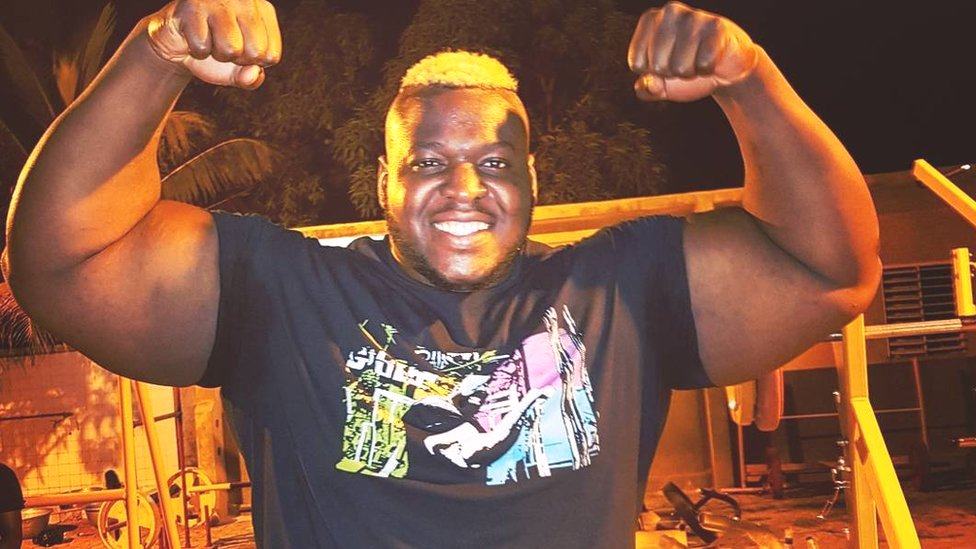
Iron Archives
World Log Lift record holder and one of the greatest overhead pressers in strongman history
Active athlete
Cheick Ahmed al-Hassan Sanou, known worldwide as Iron Biby, is the Burkinabè strongman who turned overhead pressing into an almost signature discipline. A multiple World Log Lift champion, holder of the 231 kg world record set in Birmingham in 2024 and owner of a 217 kg world record Axle Press, Biby is one of the defining overhead strength athletes of the modern strongman era. His path runs from Bobo-Dioulasso through university studies and powerlifting in Canada to the biggest Giants Live stages, where his raw power, log technique and stage presence made him a national sporting symbol for Burkina Faso. Beyond competition, he has increasingly connected his public role to youth development, the growth of strength sports in Africa and projects such as the Iron Biby Sports Festival.
Cheick Ahmed al-Hassan Sanou, known throughout the strength world as Iron Biby, occupies an unusual place in modern strongman history. He is not merely an athlete who won overhead events, but one of the very few men who actually changed the numerical standard by which an entire generation measures overhead strength. When he pressed a 229 kg log in 2021, he moved beyond the absolute record that had long been associated with Žydrūnas Savickas. When he increased that mark to 230 kg in 2023 and 231 kg in 2024, he demonstrated that the first breakthrough was not a one-day anomaly but the beginning of a period in which his name would become attached to the upper limit of the event. At the same time, his 217 kg axle press world record at the Royal Albert Hall in 2021 showed that his superiority was not dependent on one implement. The pressing power was transferable. In a sport whose mythology had largely been built around Northern Europe, Britain, North America and Central Europe, the rise of a champion from Burkina Faso carried a geographical and cultural significance of its own. Biby became one of the clearest modern examples that elite strongman could produce historically important figures outside the sport’s traditional centres. His story therefore contains three narratives at once: the athletic story of an extraordinary overhead specialist, the personal story of a child who was mocked for his body and eventually learned to reinterpret difference as an advantage, and the public story of an athlete who became a national sporting symbol and a promoter of strength sports in Burkina Faso. As of late September 2026, Giants Live still lists him as active and advertises him for the World Tour Finals & World Log Lift Challenge in Glasgow on 17 October 2026. Guinness World Records continues to recognise his 231 kg log lift, while Strongman Archives lists his international strongman career from 2016 through 2026. Yet the meaning of Iron Biby is larger than the numbers. His career is a case study in how a body once experienced as a social burden can be transformed through training, competition and public purpose into the foundation of an identity built around strength, perseverance and national representation.
His full name is Cheick Ahmed al-Hassan Sanou, and the major strongman databases list his date of birth as 20 April 1992. His public identity, however, is inseparable from the name Iron Biby. In interviews with West African media, he has explained that “Biby” was a childhood nickname that existed long before strength sports entered his life. According to his own account, it came from a word or sound he repeated as a very small child, and the family adopted it as his familiar name. “Iron” was added later, once serious training and competition made metal, bars, plates and heavy implements central to his daily life. The result is simple, memorable and almost perfectly fitted to an athlete whose reputation would be built around one of the most primal images in strength sport: taking a massive object and driving it overhead. Biby is consistently associated with Burkina Faso and especially with Bobo-Dioulasso. When Le Monde visited him there in 2019, the training space in the family home contained both standard gym equipment and adapted objects: Atlas-style stones, tractor tyres, benches, free weights and even a eucalyptus trunk converted into a heavy training log. The image says a great deal about the environment in which his strength was developed. His international career unfolded on polished stages in London, Glasgow, Manchester, Birmingham, Dubai and Las Vegas, but an important part of his preparation remained connected to a home environment where strongman infrastructure could not simply be taken for granted. Building or adapting equipment became part of the process. Bobo-Dioulasso is therefore not only a birthplace or a biographical label; it is a recurring base of return. After competitions abroad, Biby repeatedly came back to Burkina Faso, where he was received by supporters and officials and where he increasingly tied his name to projects designed to grow local sport. In 2025 the first Iron Biby Sports Festival was announced in Bobo-Dioulasso, bringing together strongman, amateur MMA, traditional wrestling, armwrestling, gymnastics and other activities. In August 2026 he organised an MMA evening in the same city featuring Burkinabè and Cameroonian athletes. His international career did not sever him from his place of origin. Instead, it created a circulation between the global strongman stage and the local community that shaped him.
One of the most consistent themes in Iron Biby’s interviews is the way he describes childhood. Before unusual body size became an athletic asset, it was a source of social discomfort and insecurity. In Burkinabè and French reporting, as well as in a Guinness World Records feature, Biby has said that he was overweight from an early age and that other children mocked him for being larger and slower. He does not present that experience as a convenient motivational anecdote invented after success, but as something that shaped the way he understood his own body. Le Monde portrayed a shy child who loved sport, tried different diets and activities, and became frustrated because his body did not move toward what he then imagined as a more “normal” physique. A frequently repeated story from his childhood describes a moment around the age of nine when he reacted physically to an older boy who had been provoking him. Biby later stressed that he did not see himself as violent and that his father had taught him to respect others. The importance of the episode lies not in the confrontation itself but in the conclusion he says he drew from it: the body he had been ashamed of could also contain power. That reinterpretation would later become central to his public message. In Guinness material focused on his life, Biby explicitly connects past bullying with his desire to show children that ridicule does not have to determine identity. He talks about turning negative experience into motivation and learning to be comfortable with one’s own body. The story should not be reduced to the simplistic formula that a bullied child became a world champion. The transformation was gradual. Biby experimented with different sports, had ambitions unrelated to strongman, and moved to Canada primarily for education. Strength sport became the central path only after weight training revealed that his body responded to heavy loading in an exceptional way. Only then did a physique once experienced as an obstacle become raw material for performance. That trajectory helps explain why his public appearances often move beyond records and toward confidence, difference and the idea of using sport as a tool for personal construction.
In public sources, Iron Biby’s family story is most visible through his father, Lancina or Lacina Sanou, described in reporting as a school director and later a retiree. Journalists who visited the family in Bobo-Dioulasso portrayed a relationship in which pride in athletic achievement sits alongside a strong emphasis on education, work and respect. Biby has repeatedly attributed to his father the idea that physical strength is incomplete without knowledge and character. That principle remained visible during the Canadian years. Even as his lifting results began to attract attention, he continued his studies in business administration rather than abandoning education for sport. Canadian sources described him as graduating in business from the Université de Moncton, while francophone interviews referred to advanced study in business administration and management. The exact degree terminology varies among sources, so the most defensible formulation is that he completed university-level business administration studies in Canada with a management focus. Le Monde later reported that while studying he worked nights as a casino security guard to help pay for accommodation. After returning to Burkina Faso, he was described as assisting with the administration of his father’s schools, helping with family projects and building or modifying training equipment. These details matter because they resist the stereotype of the athlete defined only by the gym. Biby’s sporting life developed alongside an education in administration, work and self-reliance. Later public projects reflected the same combination: ideas for sports centres, older plans for security-related ventures mentioned in interviews, festival promotion, MMA events and, by 2025, an expressed interest in acting and cinema. Reporting has also repeatedly emphasised his calm, approachable manner. His father described a child who was physically stronger than other children but gentle, and Biby himself often returns to the language of respect. That public image has helped shape his popularity. His dimensions can be intimidating, but his public persona is more often built around humour, smiles and accessibility to children and supporters. In 2019, Le Monde noted that young people from the neighbourhood would come to his home to see the equipment, ask questions or try training. In a sport where theatrical aggression is sometimes part of the show, Biby’s identity has largely been built on the contrast between extreme physical mass and a reputation for warmth and restraint.
Iron Biby did not grow up with a clear plan to become a strongman. In his interviews, childhood and adolescence appear as a period of athletic searching. He tried football, basketball, handball and martial arts, with basketball holding particular appeal. Le Monde even recorded his youthful dream of reaching the NBA. Retrospectively, that goal was improbable, but it reveals something essential: the ambition to make sport into a major part of his identity existed before he knew which discipline best suited him. His body gave advantages in some contexts and limitations in others. The mobility, speed and technical demands of team sports did not fully exploit the qualities of a young man who would later discover an extraordinary capacity to generate force. Moving to Canada in 2009, at roughly seventeen, changed the environment. Access to gyms and a more organised strength-training culture gave him a new path. Biby has said that he originally trained partly with the intention of losing weight, but the result was not what he expected: rather than simply becoming lighter, he became rapidly stronger. That observation shifted the goal from changing the body to exploiting its potential. Around 2013, people around him directed him toward powerlifting, a sport he had barely known. He learned quickly and progressed fast enough to compete. Canadian reporting from 2015 described him as having already produced world-level junior powerlifting performances, including a bench press of roughly 485 lb and a deadlift of roughly 685 lb at a 2014 world-level meet. Those numbers were far below what he would later lift as a strongman, but they are valuable as a snapshot of an athlete still near the beginning of his development. They show the base from which the later transition was made: a very strong pressing foundation, enough posterior-chain strength to build on, and an ability to adapt quickly to heavy training. Strongman eventually offered a better fit because it did not reduce strength to three standardised lifts. It allowed him to express power through logs, axles, dumbbells, yokes, carries, holds and vehicles. What began as an attempt to manage bodyweight gradually became a project of maximising strength.
The move to Canada was one of the decisive breaks in Biby’s biography. He left Burkina Faso in 2009, at about seventeen, primarily to study. Canadian reporting linked him to the Moncton–Dieppe area of New Brunswick, where he became part of a francophone community that first knew him as a student and local lifter rather than an international strongman star. His business studies remained important even after his sporting potential became obvious. Global News reported in 2015 that he had completed a business degree at the Université de Moncton and quoted the importance he placed on education. Le Monde later added the detail that he worked at night as casino security to help cover living costs. That period provides useful context for the work ethic he would later describe. His schedule was not that of a fully funded professional athlete. It combined study, paid employment and training. Canada also gave him access to a culture where people could recognise and channel unusual strength. Local gyms offered equipment, powerlifting communities and competitive pathways. Biby’s entry into organised lifting appears to have happened through encouragement from people who saw how quickly he was progressing. Once he entered competition, the results validated their judgement. The important shift was that strength became measurable. Bars acquired numbers, contests produced rankings, and body mass could be evaluated in relation to performance rather than appearance alone. Canada therefore gave Biby more than an academic qualification and a period of independence. It gave him the competitive language through which he could understand the physical potential that had previously been experienced mainly as difference.
Before appearing on Giants Live stages, Biby was a heavyweight powerlifter. That phase is crucial to understanding why the move into strongman happened so quickly. Powerlifting exposed him to maximal effort, technical discipline and a culture of progression measured kilogram by kilogram. Canadian sources from 2015 described junior heavyweight performances that included approximately 485 lb on the bench press and 685 lb in the deadlift at a 2014 world-level competition. Those lifts did not become the records for which he is remembered, but they show that pressing was already a major advantage. From a developmental perspective, powerlifting built the trunk, shoulders, upper back and hip extensors that later transferred into strongman. Biby did not, however, have the profile of a lifter who wanted to spend an entire career optimising only the squat, bench and deadlift. His later comments suggest that unusual objects and broader strength challenges appealed to him. Strongman widened the vocabulary. Pressing could be expressed through log, axle, dumbbell or medley; body mass and total-body power could be used in yoke, carries, truck pulls and holds. The powerlifting period nevertheless left a visible legacy. When Biby pulled 425 kg at the 2024 Giants Live USA Strongman Championships, the performance was the continuation of more than a decade of familiarity with very heavy pulling. Likewise, the way he approaches overhead records, with confidence under maximal loads and comfort in small numerical progressions, reflects a sport where every added kilogram is itself a target. Strongman expanded his language of strength, but powerlifting had already taught him its grammar.
The year 2016 marks the documented beginning of Iron Biby’s international strongman career in the major results databases. In September he competed at the Ultimate Strongman Junior World Championships in Gatineau, Canada, finishing third out of twelve athletes. The junior podium was enough to move him from the category of unusually strong powerlifter to a name worth following in strongman. Only a few months later, in December, he competed at the open Ultimate Strongman World Championships in Newcastle upon Tyne. He finished eighth of twelve, but the overall placing hides the most important signal: he won the Axle Press event. Strongman Archives also records a 360 kg deadlift and participation in yoke, tyre flip and Atlas Stones. The pattern that would define much of his career was already visible. His overhead ability could be world class even when his overall placing was mid-table. For an athlete who would eventually become the absolute reference point in log lifting, that is not a weakness in the biography but a key characteristic. Biby would later prove capable of strong overall finishes, including fourth at the 2017 Giants Live World Tour Finals and third at the 2021 Strongman Classic, but his historical importance would be built through domination of a family of events rather than through a World's Strongest Man title. In 2016, the distinction became visible for the first time. Powerlifting strength had transferred successfully, and the axle immediately looked like a strategic weapon. From that point onward, promoters and spectators increasingly saw not simply a very large athlete from Burkina Faso, but a potential world benchmark in overhead strength.
In 2017, Biby moved deeper into the Giants Live circuit. At the North American Open in Martinsville, Indiana, he finished seventh overall, but the event-by-event results showed an athlete more complete than the later label of “log specialist” might suggest. He placed second in the Overhead Medley and third in the Super Yoke, indicating that his body mass did not prevent him from producing speed under load. A few months later, at the Giants Live World Tour Finals in Manchester, he recorded one of the strongest overall finishes of his career: fourth place out of ten. He won the Frame Carry, finished second in the Super Yoke, completed all five Atlas Stones and produced six repetitions in the Log Lift. This contest matters when evaluating Biby because it challenges the idea that he was unable to perform in dynamic events. In the right condition, he could move very heavy loads quickly. The issue across his career was less an absolute inability in moving events than consistency across the full event spectrum and from season to season. An all-round strongman must balance deadlift, overhead, grip, carries, loading, stones and pulling. Biby developed extraordinary peaks in some of those areas and more visible weaknesses in others. In 2017, the balance was good enough to bring him within one place of the podium at a major final. The season also strengthened his stage identity. He was immediately recognisable, unusually massive and representing a country almost absent from the mainstream strongman narrative. Every strong result therefore carried an additional layer of visibility. He was not merely another new professional. He was extending the map of the sport.
The 2018 season consolidated Biby’s status as one of the most dangerous overhead athletes in the world. At the World Log Lift Championships he lifted 213 kg, and at the Giants Live World Tour Finals in Manchester he won the Max Axle Press with 207 kg. The axle differs from the log in grip, clean mechanics and the way the thick fixed bar transfers force. Dominating both implements suggested a transferable upper-body quality rather than a narrow technical adaptation. At the World Tour Finals, he also finished third in the Car Walk, but lost significant points in deadlift, carry and drag, and stones, ending eighth overall. A few weeks later at World's Ultimate Strongman in Dubai, a similar profile emerged: fourth in the overhead medley, but weaker results in several other events and twelfth overall. Historically, those contrasts are useful. They explain how Biby can simultaneously be one of the greatest overhead pressers ever and an athlete without a victory in a major full-format international contest. Event specialisation and all-round championship success are different forms of excellence. The 2018 season made that distinction especially visible. At the same time, Biby was closing in on the 220 kg log barrier, a psychologically and historically significant level. Žydrūnas Savickas still represented the horizon of the event, and Biby had not yet become the record holder, but he was already among the very small number of athletes for whom an assault on that standard looked realistic rather than promotional.
The year 2019 was when Iron Biby moved from being a star within the strongman niche to a sporting figure with much broader recognition. On 6 April in Leeds, he won the World Log Lift Championships with 220 kg. Media in Burkina Faso and Le Monde treated the victory as a historic achievement, emphasising that a Burkinabè athlete had become world champion in a strength discipline long associated mainly with Europe and North America. Only a few weeks later, on 23 April in London, Biby set a Guinness World Records title of a very different kind: 82 overhead presses of a person in one minute. Guinness officially confirms the number, location and date. The feat does not have the same sporting status as a log or axle world record, but its media value was considerable. It introduced Iron Biby to an audience much larger than the regular strongman fan base and allowed the story of the child mocked for his body to be retold globally as a story of confidence and transformation. Within strongman, the season remained productive. He finished sixth at the Giants Live World Tour Finals, placing second in the Car Walk, third in the Dumbbell Press and fourth in the Hercules Hold. At WUS Dubai he finished eleventh overall but won the Log Lift for repetitions. The pattern of middling overall positions combined with spectacular event wins became increasingly characteristic. His return to Burkina Faso after major victories also altered his social status. Reports described enthusiastic receptions, supporters recognising him in the street and an athlete who had become difficult to separate from the language of national pride. The year 2019 is therefore where his three identities clearly converged: international competitor, record-setter and public symbol.
The year 2020 occupies less space in Biby’s public competition record than the seasons around it. The international strongman calendar was heavily disrupted by the COVID-19 pandemic, with events cancelled, postponed or restructured. For Biby, the period functioned largely as a bridge between the 220 kg world-title level of 2019 and the decisive assault on absolute records that would follow in 2021. At that stage, simple linear progress was no longer realistic. Once an athlete is operating above 200 kg in the log, every additional kilogram requires an increasingly difficult combination of strength, joint health, technical precision, bodyweight management and competitive opportunity. The relative quiet of 2020 therefore makes the impact of 2021 even clearer. Biby did not return merely to match his previous level. He returned to move two historically important overhead records. Retrospectively, the transition from 2020 into 2021 is the point at which he shifted from world champion to deliberate absolute-record hunter.
The Giants Live Strongman Classic on 24 July 2021 at the Royal Albert Hall is one of the most important full-format contests of Iron Biby’s career. He finished third overall and demonstrated that his competitive value extended beyond overhead pressing. Strongman Archives records a win in the Hercules Hold at 75.12 seconds, a win in the Max Axle Press at 217 kg, third place in an axle-bar deadlift for repetitions and fifth in the Frame Carry. The 217 kg axle became a world record and remains one of the central numbers in his career. The axle is a punishing implement: the thick bar makes handling and cleaning difficult, and the athlete must establish overhead stability after an energy-intensive first phase. Biby turned that event into a demonstration of his advantage. Yet the overall podium may be equally important in evaluating him. It proves that when health, conditioning and event selection aligned, Biby could compete among the very best across a full Giants Live contest. Winning the Hercules Hold demonstrated grip and static endurance, the frame showed moving ability, and the deadlift result confirmed a substantial posterior-chain base. The Royal Albert Hall performance is therefore an important corrective to an overly narrow reading of his career. Iron Biby is indeed a historic overhead specialist, but at his best he was also a podium-level all-round strongman.
On 4 September 2021, Iron Biby produced the lift that permanently defined his place in strongman history: a 229 kg log press. Giants Live records the performance as surpassing the previous 228 kg absolute record associated with Žydrūnas Savickas, the athlete who had driven the development of the event for years. The symbolic importance is difficult to overstate. Savickas was not simply the owner of a number; he was the technical and historical reference point for the log lift. Surpassing him meant entering a very small historical conversation. Biby had previously attempted record weights and failed, including a 230 kg attempt in 2018, which made the 229 kg success more meaningful rather than less. It represented the end of a multi-year pursuit. The lift also strengthened Biby’s public standing in Burkina Faso. He was later received by President Roch Marc Christian Kaboré, and sporting authorities presented the achievement as a national success. Biby used the moment to speak about taking the record higher and expanding the visibility of log lifting. From a strictly competitive perspective, 229 kg changed the hierarchy of the event. From that point onward, every discussion of the strongest overhead presser of the era had to include him, and every future World Log Lift Challenge would be measured against a standard he had set.
In 2022 Biby entered the season not simply as a champion but as the world record holder, and that status changes competitive pressure. In an interview with Burkinabè media before the World Log Lift Championships, he spoke openly about a back problem he was managing during preparation. On 2 April in London he nevertheless defended his title with 218 kg. To a casual observer, a lower number than the world record may look like regression. In elite strength sport, however, winning on a day when a record is not realistic is evidence of competitive maturity. Maximal log lifting places enormous stress on the whole body: the clean taxes the back and hips, the rack position challenges breathing and trunk rigidity, and the final drive demands stability under extraordinary loads. Biby’s ability to remain the best on the day despite physical limitations showed a more tactical phase of his career. Not every appearance needed to become a record attempt. Sometimes the correct objective was simply to win. Burkinabè authorities again publicly congratulated the performance, further reinforcing the connection between his sporting career and national public life. The 2022 season is less dramatic numerically than 2021, 2023 or 2024, but for a complete biography it is valuable precisely because it reveals the management side of elite performance rather than only the moments when every variable converges on a world record.
At the 2023 World Log Lift Championships, held within the Giants Live World Tour Finals in Glasgow, Biby increased the world record to 230 kg. One kilogram can appear almost symbolic, but at the absolute limit of a strength event it may represent an entire training cycle. The number 230 also had special psychological significance because Biby had attempted it unsuccessfully in the past and had spoken publicly about reaching it. Achieving the number transformed an old failure into a stage of progression. The lift also demonstrated continuity. Biby was not a record holder who had enjoyed one perfect day in 2021; he could return to the same limit and move it again two years later. That matters enormously when evaluating a specialist historically. A record itself is important, but so is control over the process of setting and resetting it. Biby had turned the log lift from a chase of Savickas’s number into a chase of his own. His overall result at the 2023 Strongman Classic was much weaker, tenth of eleven, but he still placed fourth in the Viking Press with 15 repetitions. Once again, even in a poor all-round contest, pressing remained competitive. That separation between overall form and overhead form explains much of his longevity as the central figure of the World Log Lift Challenge.
On 7 September 2024 at the Strongman Open in Birmingham, Iron Biby lifted 231 kg and once again established the absolute world record in the log lift. Guinness World Records officially confirms the weight, date and location, while Giants Live describes the performance as the third log world record of his career after 229 and 230 kg. Burkinabè authorities presented the victory as his sixth World Log Lift title. Historically, 231 kg is the number that currently defines the Biby era. The lift did more than edge his previous record upward. On the same day, the nearest top performances were 210 kg, creating a 21 kg gap between Biby’s record and the best of the rest. That separation illustrates the depth of his specialisation. After returning to Burkina Faso, he received an official welcome and later presented the trophy to President Ibrahim Traoré. In public comments, Biby immediately identified a new ambition: 240 kg. The statement was characteristic of the way he had built his career, turning every record into a platform for the next target rather than treating it as an endpoint. Later that month, at the Giants Live USA Strongman Championships in Las Vegas, he returned to a full contest and pulled 425 kg in the deadlift, listed by Strongman Archives as his competition personal best. He finished eighth overall and also completed five repetitions in the dumbbell press. The deadlift added another important dimension to the profile. At thirty-two, after years of extreme overhead training, Biby still possessed enough posterior-chain strength to move into a level occupied by the world’s better deadlifters, even if overhead pressing remained the centre of his historical legacy.
It is tempting to reduce an Iron Biby profile to two numbers: 231 kg on the log and 217 kg on the axle. That would be too simple. His career includes strong results in carries, grip and deadlift during several periods. He won the Frame Carry at the 2017 Giants Live World Tour Finals, finished second in the Super Yoke at the same contest, won the Hercules Hold at the 2021 Strongman Classic and reached 425 kg in the deadlift in 2024. In 2019 he was second in the Car Walk at the World Tour Finals, while multiple contests produced strong dumbbell or overhead-medley placings. His more inconsistent areas included Atlas Stones, some loading events and certain speed-based tasks, while his deadlift performance fluctuated substantially from season to season. This is where the particular nature of his career becomes clear. Full-format strongman demands almost contradictory adaptations: enough body mass for maximal strength, enough mobility for yoke and farmers races, enough technique for stones and enough conditioning for repeated high-output efforts. Biby, whether deliberately or through the natural interaction of talent and body structure, pushed one family of qualities to a historical extreme. That means overall placings should not be used to minimise his overhead records, but the records should not be used to invent an all-round championship record he does not have. The more accurate assessment is also the more interesting one: Iron Biby is one of the most important event specialists in strongman history and, at his best, he was complete enough to stand on a Giants Live overall podium. He is not a World's Strongest Man champion and does not possess the all-round title record of athletes such as Savickas, Brian Shaw or Mitchell Hooper. In maximal overhead pressing, however, his name stands as a reference point independent of any overall title.
Biby’s log performances come from a rare combination of body mass, structure, trunk strength, shoulders, triceps and technical experience accumulated through years of specific work. The log lift is not simply a shoulder press. The athlete must first bring the implement onto the body, roll or pull it into position, load it onto the abdomen and chest, establish a stable rack, and then convert leg and hip extension into an impulse that the upper body can finish. The large diameter of the log pushes the centre of mass forward and places heavy demands on the upper back and trunk. Biby compensates with a massive chest, exceptional shoulder-girdle strength and unusually large arms. Giants Live reported an unofficial arm measurement of roughly 71 cm in 2021, a striking promotional figure that should not be treated as a standardised anthropometric record. More important is function: his triceps and shoulder complex can finish loads that many elite strongmen would struggle even to clean into a stable rack. The axle provides a different challenge, and the fact that he reached a world record 217 kg on that implement confirms transfer. His pressing strength is not dependent on log geometry alone. Results in dumbbell, Viking Press and repetition events add another layer. They suggest that the base is not only a single maximal contraction but also the ability to tolerate repeated high-force efforts at a bodyweight where conditioning itself becomes difficult. In strongman, this combination separates a one-off record attempt from long-term dominance within an event family.
Iron Biby’s published physical statistics vary by source and period. Giants Live currently lists him at approximately 1.88 m and 170 kg, while Strongman Archives gives 1.90 m and 170 kg. Reporting from 2018 and 2019 often placed him around 180–183 kg, and promotional material has occasionally cited bodyweights above 200 kg. Variation is common in strongman. Athletes fluctuate between off-season, contest preparation, travel and deliberate phases of weight gain or reduction, while profile pages are not always updated at the same time. For a current editorial profile, 170 kg is the most defensible figure because it appears on both the 2026 Giants Live profile and the Strongman Archives entry. Height can reasonably be described as roughly 1.88–1.90 m. Burkinabè media have often presented his dimensions in an almost mythic register: arm circumferences above 60 cm, very large shoe sizes, enormous meals and homemade equipment capable of supporting extraordinary loads. Those details helped build the public character of “Iron Biby,” but they should be separated from standardised sporting data. What can be stated with confidence is that he has an extreme build even by professional strongman standards and that much of his functional mass is arranged in a way that strongly favours pressing. A thick torso, massive shoulders and large arms create a stable platform for the log, while total body mass can become a disadvantage in long moving events or loading races that require repeated acceleration. Biby’s physique is therefore both part of the explanation for his dominance and one of the variables that made all-round consistency more difficult.
One of the defining images of Iron Biby’s preparation comes from reporting in Bobo-Dioulasso: a world champion training in a courtyard where industrial equipment exists beside implements built or adapted locally. Le Monde described a eucalyptus trunk turned into an approximately 200 kg training log, together with stones, tyres and strength equipment. Biby has said that he sometimes builds his own implements. That self-reliance matters. Strongman is unusually dependent on event-specific equipment, and access to a competition-style log, adjustable yoke or standard stones cannot be assumed in a city without a mature strongman infrastructure. Adaptation becomes part of training itself. The same reporting described sessions lasting three to four hours per day. There is not enough public information to reconstruct a responsible week-by-week programme, and methods inevitably change across training cycles. What can be observed is the principle of repeated exposure to specific implements and very heavy loads on top of a powerlifting foundation. A 231 kg log cannot be prepared through strict pressing or bench pressing alone. The clean, rack position, breathing under compression, leg timing and overhead stabilisation have to be trained as an integrated system. By turning his personal training space into a laboratory, Biby created the repetition environment necessary for that specialisation. The image of a champion preparing on a locally improvised wooden log before breaking records on major European stages carries symbolic weight as well: some of the world’s most advanced strongman performances were built far from the sport’s most advanced infrastructure.
Francophone media made famous a statement from Biby that during certain phases of preparation he could eat as many as eight chickens in a day and consume food roughly every three hours. Interviews from 2019 described five or six meals and substantial daily food costs. The figures quickly became part of strongman folklore, a sport in which enormous meals are almost as easy to turn into headlines as enormous lifts. They need context. They refer to a particular period and style of preparation, not necessarily to a permanent diet maintained throughout his career. The energy needs of a 170–180 kg athlete training for hours can be extremely high, but food quality, macronutrient distribution and bodyweight strategy change over time. For Biby’s biography, the detail is useful mainly because it illustrates the logistical cost of maintaining a strongman body. Preserving muscle mass and recovery capacity at that scale requires not only training but also food volume, hydration, sleep and planning. Biby has also pushed back against being mechanically defined by the “eight chickens” headline, noting in interviews that he eats according to what is required. That nuance matters. Sports mythology prefers one memorable number; actual preparation is more variable and less theatrical.
Few contemporary strongmen have such a direct relationship between individual performance and national representation as Iron Biby. After major titles and records, his returns to Burkina Faso have repeatedly been treated as public events. In 2021, after the 229 kg record, he was received by President Roch Marc Christian Kaboré. In 2024, after 231 kg and what Burkinabè authorities described as his sixth world log title, he was received by President Ibrahim Traoré and senior sports officials. Local reporting described airport crowds, public celebrations and a level of attention unusual for a sport that remains niche in many countries. Biby has consistently used that platform to speak about Burkina Faso, young people and the idea that his results should demonstrate that athletes from his country can succeed at the highest international level. In 2021 he even spoke about the hope that log lifting could achieve wider recognition and mentioned a long-term ambition to see the discipline enter the Olympic conversation. That should be understood as an aspirational statement rather than an indication of any formal Olympic pathway. What is indisputable is that Biby made log lifting recognisable in Burkina Faso in a way no external marketing campaign could easily have achieved. For many young people in the country, strongman did not arrive primarily through Western television but through a compatriot who repeatedly returned home with trophies and world records.
Even before the absolute world records, Biby spoke about creating sports infrastructure in Burkina Faso. Interviews and international reporting from 2018–2019 recorded plans for sports centres, youth support and an environment where local talent would not disappear for lack of equipment or guidance. Over time, the idea became more concrete. The Iron Biby Sports Festival announced for April 2025 in Bobo-Dioulasso was designed as a multisport event rather than a simple log-lift exhibition. Its programme included strongman, amateur MMA, traditional wrestling, armwrestling, gymnastics, roller sports and cultural performances. Biby described the purpose as developing the “relève,” the generation that comes after him, and creating a setting where competitive sport could connect with local culture. International guests were also intended to bridge Burkina Faso with the global strength community. This kind of project marks a transition from a career centred on the athlete to one concerned with institutionalising influence. A world record will eventually be surpassed or transformed by rule changes; an ecosystem of athletes can last much longer. Biby appears increasingly aware of that difference. Recent interviews have placed greater emphasis on developing strength and combat sports in Burkina Faso and the wider Sahel. The full durability of those projects can only be assessed over time, but the direction is clear: he wants “Iron Biby” to function not merely as the name of a champion, but as a platform from which other athletes can emerge.
After the 2024 record, Iron Biby’s public activity broadened. In 2025, alongside the Iron Biby Sports Festival, Burkinabè media reported his interest in cinema, expressed during FESPACO, the Pan-African film festival in Ouagadougou. The idea was not entirely new. As early as the 2019 Le Monde profile, Biby had joked or half-seriously suggested that he could imagine himself in action films. His physique, visibility and heroic sporting image make that direction understandable. In 2026, his involvement in combat sports became more concrete. On 21 August in Bobo-Dioulasso he organised an MMA evening featuring Burkinabè and Cameroonian fighters, presented as an effort to popularise the discipline and create local opportunities. At the same time, Giants Live continued to keep him within the competitive strongman circuit. The organiser’s current profile lists him for the World Tour Finals & World Log Lift Challenge in Glasgow on 17 October 2026. At the time this biography is being prepared, that contest remains in the future and therefore cannot be treated as a result. The fact that Biby is still advertised as an active competitor at thirty-four, after more than a decade in strength sport, nevertheless underlines the longevity of his specialisation. An athlete whose relevance depends on one exceptional quality can have a short peak if that quality declines rapidly. Biby has so far maintained enough overhead strength to remain part of the world-record conversation long after his first international appearance. The later phase of his career therefore appears to combine three directions: preserving or extending the record, using fame to build sporting events in Burkina Faso, and exploring public roles beyond the strongman platform itself.
After pressing 231 kg in 2024, Biby publicly identified 240 kg as his next major target. A nine-kilogram jump is enormous at the current limit of the event. Maximal-strength records usually advance in small increments precisely because the athletes are already operating near a combined physiological and technical ceiling. For that reason, 240 kg should be treated as a declared ambition rather than a predictable outcome. It is, however, entirely consistent with the way Biby has built his career. In 2019 he spoke about 230 kg when the world record was still below that mark. In 2021 he surpassed the old record. In 2023 he finally reached 230. In 2024 he added another kilogram. His public psychology is organised around the next limit even when that limit appears disproportionately far away. In Guinness material, Biby has spoken about wanting to “defy gravity” and attempting things people assume a man of his size cannot do. The phrase captures the logic of world records. A record is not only a number but an ongoing negotiation with what is currently perceived as impossible. Reaching 240 kg would move the log lift into an entirely new zone and would likely require not merely more strength but an unusually successful cycle of health, timing, technique and competitive opportunity. Whether he ever reaches it or not, the target is already part of the final competitive chapter of his story.
Strongman history is often told through the winners of World's Strongest Man, the Arnold Strongman Classic and major all-round tours. If that were the only criterion, Biby would rank behind champions who dominated overall leaderboards for many seasons. But the sport also has another history: the history of athletes who redefined individual events. In that history, Iron Biby is central. Žydrūnas Savickas elevated the log lift to a standard that seemed nearly untouchable, and Biby was the athlete who moved beyond it and continued moving it. The 217 kg axle record strengthens his historical position as an overhead specialist because it shows that the power transfers across implements. Wins in Hercules Hold, carries and repetition pressing also demonstrate that his strength was not entirely monolithic, even if pressing remained the centre. Cultural importance expands the legacy further. Biby made Burkina Faso visible in a sport with almost no West African representation at the elite record-setting level and provided an identification point for African athletes who could not easily see themselves in the traditional strongman genealogy. His personal story adds another layer: a child uncomfortable with his size becomes an adult who turns those same dimensions into a world-class performance tool. A rigorous profile does not need to call him “the strongest man in the world” in a broad all-round sense. A more precise statement is both stronger and easier to defend: in his era, very few athletes have had such a clear and measurable impact on a single major strongman event.
This profile was built by cross-checking several types of sources. Strongman Archives, Giants Live and Guinness World Records were prioritised for competition results, records and chronology. Strongman Archives provides contest history, event placings and competition personal bests; Giants Live supplies official context for major events and the current athlete profile; Guinness confirms the 231 kg log lift from 7 September 2024 and the 82 overhead presses of a person in one minute achieved on 23 April 2019. For biographical material and life in Burkina Faso, this profile draws on reporting and interviews from Le Monde Afrique, Agence d’Information du Burkina, Burkinabè local media, Global News Canada and francophone West African outlets. For official recognition and national projects, statements from the Presidency of Burkina Faso and sports institutions were consulted. The sources are not perfectly uniform: height appears as either 1.88 or 1.90 m, bodyweight has varied substantially across the years, and some older articles use different title counts or terminology for the log championships. Where this happens, the profile prefers current organiser data and clearly indicates when a title count is being reported by Burkinabè authorities. It avoids speculation about private relationships, medical matters or other subjects for which sufficient public evidence is unavailable. Principal sources include giants-live.com/athlete/iron-biby/; strongmanarchives.com/viewAthlete.php?id=352; guinnessworldrecords.com/world-records/760344-heaviest-log-lift-male; guinnessworldrecords.com/world-records/535888-most-overhead-presses-of-a-person-in-one-minute-male; Giants Live reports on the 2023 and 2024 World Log Lift Challenges; Le Monde’s 2019 Bobo-Dioulasso profile; AIB reporting; the Presidency of Burkina Faso; Global News Canada; and Burkinabè sports media covering his 2024–2026 projects.
Viewed as a whole, Iron Biby’s competition timeline shows two careers running in parallel. The first is the all-round strongman career, with results ranging from podiums to mid-field or lower finishes depending on the contest. The second is the single-event career, where his win rate, especially in the log lift, is dramatically stronger. Strongman Archives lists a relatively modest number of complete international contests compared with athletes who spend full seasons pursuing World's Strongest Man qualification points. In single-event competition, however, his success rate is exceptional. In 2016, eighth at the Ultimate Strongman World Championships came with an Axle Press event win. In 2017, fourth at the World Tour Finals was built on an unusually balanced combination of carries and pressing. In 2018, eighth at the same final coexisted with victory in the Max Axle Press. In 2019, sixth at the World Tour Finals and eleventh at WUS Dubai came with top performances in car walk, dumbbell and log. In 2021, when health and event selection aligned, he reached the Strongman Classic podium. By 2023 and 2024, his full-contest overall placings were less competitive, yet the log records continued to rise. The pattern suggests a career strategy that increasingly prioritised the events in which he could create historical value. For an athlete above 170 kg, a full strongman contest has an enormous recovery cost. If the primary objective is an overhead world record, it is logical to shape training around that peak even if other events lose a few percentage points. Biby’s career is therefore best read through successive performance peaks rather than through a single list of overall placings.
Biby’s log and axle records should be analysed together to understand the full level of his overhead ability. The log uses neutral handles inside a large cylinder positioned in front of the athlete, favouring lifters who can create a stable platform through the chest and control a bulky implement. The axle is a thick, rigid bar without the comfortable rotation of an Olympic barbell. The clean can be more demanding, the grip is different and the implement does not provide the same natural shelf as a log. An athlete can be extraordinary at one and merely very good at the other. Biby reached world-record level in both. That dual excellence is why “great overhead presser” is more accurate than “log specialist.” It indicates that his neuromuscular qualities, structure and technical skill can express force in multiple configurations. Results in dumbbell and Viking Press add further evidence. In strongman, overhead pressing is not one movement but a family of tasks with different diameters, grips, centres of mass and clean demands. Biby demonstrated elite transfer across that family. Historically, 231 kg and 217 kg are therefore not separate footnotes but mutually reinforcing arguments. If he had only the log record, it would be easier to argue that the implement’s geometry uniquely favours him. The axle record closes much of that objection: the pressing power remains when the object changes radically.
World records in strongman are brief public moments prepared by months or years of work. On the day of the attempt, an athlete may have only one or two realistic opportunities to turn preparation into an official number. For Biby, the pressure increased with every record. Before 229 kg, the target was Savickas. After 229, the principal opponent became his own number. That change may sound small, but psychologically it is significant. Chasing someone else’s mark provides an external reference. Once you are the record holder, every failed attempt can be interpreted publicly as stagnation, while every appearance becomes a possible defence of reputation. Biby has managed that environment through a very stable public language: work, belief, the next target. There is no basis for turning that into a psychological diagnosis, but the communication pattern is observable. In Guinness material he talks about transforming bullying into motivation. After titles he speaks about continuing the work. After 231 kg he immediately talks about 240. The consistency protects identity from the inevitable fluctuations of performance. A missed lift becomes information for another attempt rather than the end of the narrative. For a world-record athlete, that capacity to return may be almost as important as raw strength.
Iron Biby’s importance cannot be measured only in kilograms because his emergence also changes the geographical representation of the sport. Modern professional strongman developed around circuits and media markets concentrated in Europe and North America. Africa has produced powerful athletes, but very few became central figures in world-record strongman during the Giants Live era. Biby did exactly that while representing Burkina Faso, a country without a major institutional tradition in the sport. For African audiences, this means more than a flag beside a name. It means a model who speaks French, grew up in West Africa, developed partly through educational migration, and then returned to invest symbolic and practical energy in the place he came from. His popularity has contributed to a local culture of strength sports visible in new competitions, imitators and younger athletes who cite him as a reference. Burkinabè reporting in 2025 and 2026 describes expanding interest in strongman and bodybuilding, while the appearance of athletes nicknamed “Iron Biby Junior” shows how quickly a champion can become an archetype. The full legacy can only be judged years from now, when it becomes clear how many athletes and institutions remain after his competitive retirement. Even now, however, it is reasonable to say that Biby did for the visibility of strongman in Burkina Faso what an outside marketing campaign would have struggled to achieve: he connected the discipline to local pride and to a recognisable human story.
At the end of September 2026, Iron Biby’s story remains unfinished. He is thirty-four, listed as active, holder of the Guinness-recognised 231 kg log record and still associated with the 217 kg axle press world record. He has moved through powerlifting, strongman podiums, single-event victories, physical setbacks, returns and several stages of extending his own record. Away from competition, he has evolved from the young man building or adapting equipment in the family courtyard into a promoter of festivals and sports events in Burkina Faso. That combination makes his profile richer than the biography of a record holder alone. Biby demonstrates how sport can reorganise the meaning of a body, move the centre of a discipline toward a new region and turn individual fame into a platform for other people. The most accurate description of him is not the broad media phrase “the strongest man in the world,” but something more specific and more defensible: one of the most important overhead pressers modern strongman has produced and the athlete who pushed the world log record to 231 kg. If he reaches 240 kg, the numerical history will gain another extraordinary chapter. If he does not, what he has already achieved is enough to secure his place in the sport’s archive. For Burkina Faso, the legacy extends beyond the record. He demonstrated that an athlete from Bobo-Dioulasso could establish the world standard in an event historically dominated by other regions. In that sense, Iron Biby did not only lift a log. He lifted the visibility of an entire sporting scene.
To understand the athlete accurately, it is useful to look more closely at the results that are not world records. They reveal the actual architecture of Biby’s strength. At the 2017 Giants Live World Tour Finals, for example, he did not approach the podium through the log alone. He won the Frame Carry, finished second in the Super Yoke and completed all five Atlas Stones, demonstrating that at that stage of his career he combined enormous body mass with surprisingly effective movement. At the North American Open in the same year he was third in the yoke and second in an overhead medley. In 2018 at the World Tour Finals he placed third in the Car Walk and first in the Max Axle Press, while at WUS Dubai he completed three of four implements in the overhead medley and finished fourth in that event. In 2019 at the Giants Live final he was second in the Car Walk, third in the Dumbbell Press and fourth in the Hercules Hold, and at WUS Dubai he won the Log Lift for repetitions. The 2021 Royal Albert Hall contest may offer the most balanced snapshot of all: first in the Hercules Hold, a world record in the axle, third in the deadlift for repetitions and fifth in the Frame Carry. Those results describe an athlete with strong grip, the ability to move huge loads and impressive static endurance, not simply powerful shoulders. At the other end of the profile, stones and some loading events cost him major points. At WUS Dubai in 2019 he did not complete an Atlas Stone in the series, and in several contests he finished in the lower half in events requiring a fine combination of mobility, transition speed and technique. In strongman, that asymmetry is decisive. An athlete can be the best in the world at two or three events and still fail to win the contest if he gives away too many points elsewhere. That is why Biby’s historical status needs precision. It is not built on continuous all-round domination but on an overhead peak so high that it became a category of comparison by itself. Even his deadlift progression supports this interpretation. In 2016 he pulled 360 kg in a major contest; in 2018 he managed 400 kg from 18 inches; in 2019 he pulled 400 kg from the floor at WUS; in 2024 he reached 425 kg. The progression shows that his general strength base continued to improve even while pressing remained the centre of preparation. For an athlete of his size, maintaining world-record overhead capability alongside competitive grip and a 400-plus-kilogram deadlift is remarkable. Yet because strongman rewards balance rather than one singular extreme, his overall championship record remains different from that of the great tour champions. That difference does not diminish his importance. It defines it more accurately.
Iron Biby’s career has another dimension that statistical summaries rarely capture: the logistics of being an international professional strongman based in West Africa. The major contests he entered took place in Britain, continental Europe, North America or the Middle East. That means long flights, time-zone changes, adaptation to different temperature and humidity profiles, transport of personal gear and the challenge of maintaining very high body mass while travelling. For a 170–180 kg athlete, the journey itself can be more taxing than it is for a middleweight competitor. Aircraft space, hydration, sleep, access to suitable meals and the ability to continue light training before competition all become performance variables. Biby also did not emerge from a strong national strongman system able to provide exact replicas of every international implement. He compensated through adaptation. Building equipment in Bobo-Dioulasso, training in the family courtyard and using locally available objects to simulate events reveal a culture of solutions rather than perfect conditions. That should not be romanticised. Limited infrastructure can slow technical development and create problems when competition implements feel very different from training equipment. In Biby’s case, however, improvisation became a skill. He learned to transfer force across objects, which may be one reason his world-level pressing was not confined to a single implement. Recovery is another critical element. A log above 220 kg cannot be attacked frequently without imposing enormous stress on elbows, shoulders, back and the nervous system. A massive athlete must balance the stimulus needed for progression against the danger of arriving at competition fatigued or injured. The 2022 interview in which Biby discussed back problems offers a rare glimpse into this less glamorous side of his career. Records make headlines; recovery blocks do not. His longevity through 2026 nevertheless suggests that he managed the tension well enough to keep returning at world level for roughly a decade. In a sport where biceps tears, lumbar injuries and joint problems are common, simply remaining capable of maximal competition is itself a form of body management. Climate is not neutral either. Reports from Bobo describe him training in intense heat, while many of his biggest contests take place in climate-controlled British arenas or completely different environments. Repeatedly adapting to those conditions is part of professional performance. The number 231 kg, therefore, hides a large personal infrastructure: years of travel, improvisation, eating, recovery, planning and the capacity to peak in environments that do not always resemble the place where the work was done.
An interesting part of Iron Biby’s career is the way he has moved between two kinds of visibility: competitive strongman and the broader culture of spectacular record attempts. His 2019 Guinness World Records achievement of 82 overhead presses of a person in one minute is not the sporting equivalent of a 231 kg log world record. The first is a special record format designed to measure an unusual feat that is easy for a general audience to understand. The second is a central competitive benchmark pursued for years by the best overhead athletes in the sport. Yet the two forms of performance helped one another. Guinness gave Biby’s story an audience the strongman circuit did not always reach, while his standing as an elite strongman gave the spectacular record credibility beyond simple entertainment. The combination strengthened his public image. In Guinness material, personal narrative is placed beside the feat: the child who suffered because of his body becomes the adult capable of repeatedly pressing another human overhead. It is highly effective storytelling because it turns a statistic into a human arc. Biby appears to understand that logic intuitively. His public appearances are often energetic, accessible and built around the idea of making the impossible visible. In Burkina Faso, media sometimes call him “the strongest man in the world,” a celebratory phrase that should not be confused with an official competition title. He has not won World's Strongest Man. But the fact that a national audience understands him through that phrase reveals how powerful the symbol has become. For serious editorial work, the solution is not to remove spectacle from the profile but to separate it from competitive hierarchy. The Guinness record of 82 repetitions is authentic and verified. The log world record is authentic and verified. His world log titles are documented by organisers and Burkinabè authorities. Phrases such as “the strongest man in the world” belong to media and emotional language. Keeping those levels distinct makes the biography more credible while also showing how effective the “Iron Biby” persona became: the name, body, smile, records and geographic origin create a recognisable figure even for people who never follow Giants Live scoreboards. For the growth of a niche sport, figures like this are extremely valuable. They translate technical numbers into something the broader public can feel and remember.
Biby’s education and his interest in projects outside competition provide an important key to the mature stage of his career. His business-administration studies in Canada did not remain an isolated detail from youth. After returning to Burkina Faso, involvement in family administration, discussion of entrepreneurial ideas and especially the organisation of sporting events suggest that he sees fame as a resource that can be structured. A strongman athlete has a limited competitive window. Even in the best scenario, joints, recovery speed and motivation change with age. If public identity depends only on holding an active world record, influence can fade quickly after retirement. Biby appears to be building a different exit. The Iron Biby Sports Festival is the clearest example: the athlete’s name becomes the brand of an event that can theoretically continue even when he no longer competes. His MMA involvement creates a similar effect by expanding the network of athletes and spectators beyond strongman. Interest in cinema broadens the public persona again, while business ideas mentioned over the years suggest that he thinks in terms of brand, opportunity and long-term value. Not every publicly announced idea should be treated as a completed project; some remained intentions. But the direction is consistent. Biby does not talk only about the next contest. He also talks about what can be built around the status the contests created. For Burkina Faso, that transition has important potential. One career can inspire, but infrastructure, a recurring festival or a competition network can multiply effects. If young people who admire him gain access to training, events and international connections, his legacy will no longer depend on how long the 231 kg record survives. In that sense, business education and a life lived between two continents meet the sporting story. Canada gave him access to an institutionalised strength environment. Burkina Faso gave him identity and the place where he wants to leave something behind. The mature stage of Iron Biby’s career is therefore no longer only about how much more he can lift. It is about how effectively he can convert the symbolic capital of world records into opportunities for a generation that will not have to start from zero.
Viewed from 2026, Iron Biby’s career can be divided into four stages that explain his development better than a simple chronological list. The first is the discovery stage, beginning with the move to Canada and ending with his entry into international strongman. Education, gym culture, powerlifting and the realisation that body mass could be transformed from a source of insecurity into a performance tool were the decisive elements. During this period he built the base: bench pressing, deadlifting, tolerance for heavy loading and the identity of an athlete beginning to believe that world-level competition was possible. The second stage is integration into strongman, roughly 2016–2019. Biby learned the implements, travelled, entered Giants Live, reached the junior world podium, finished fourth at the World Tour Finals and began winning axle and log events. This is when audiences realised that his overhead strength was not merely good but abnormal even by professional standards. The same period also exposed the all-round limitations: stones, loading and certain dynamic events could remove him from podium contention even while he won pressing. The third stage is the world-record era, 2021–2024. Here the career becomes more focused. A 217 kg axle, 229 kg log, then 230 and 231 transform Biby from a dangerous specialist into a historical benchmark. Each World Log Lift Challenge now carries a different tension because the question is no longer simply whether he can win, but whether he can move the global limit again. His overall podium at the 2021 Strongman Classic proves that he can still compete across a full contest, but the direction is unmistakable: pressing becomes the legacy. The fourth stage begins after the 231 kg record is consolidated and is still unfolding. Biby remains an active athlete, but his role expands toward organiser, promoter and sporting symbol. The Iron Biby Sports Festival, MMA events, public discussion of youth development and interest in other forms of media visibility indicate a transition from individual performance toward symbolic and practical infrastructure. This four-stage view matters because it shows that his success was not an isolated explosion. There was accumulation, learning, event dominance and now a process of converting fame into legacy. At thirty-four, with Giants Live advertising him for the 2026 World Tour Finals & World Log Lift Challenge, the final two stages overlap: the record holder still wants to lift, while the public figure is beginning to build something intended to last beyond the final contest. That overlap makes the present phase especially interesting. Biby is not yet a retired champion whose story can only be written in the past tense, but neither is he only a competitor focused on the next attempt. He is at the point where performance, national identity, sporting entrepreneurship and the future memory of a career begin to meet. The 231 kg figure fixes his name in the record tables. What he does with the years that follow will determine how large a place the name occupies outside them.
Iron Hall data
231 KG
Max Log Lift · world record, Birmingham 2024
Verified
217 KG
Max Axle Press · world record, Strongman Classic 2021
Verified
425 KG
Max Deadlift · World Deadlift Championships / USA Strongman Championships 2024
Verified
400 KG
18-inch Deadlift · WUS Dubai 2018
Verified
2016
World junior podium in Gatineau, Canada, one of the first major international milestones of his strongman career.
3rd place
2016
Major early open-level appearance; he won the Axle Press event.
8th place
2017
His strongest overall Giants Live final result of the period; 1st in Frame Carry and 2nd in Super Yoke.
4th place
2018
213 kg at the World Log Lift Championships, further establishing his status as an elite overhead specialist.
Joint winner / champion
2019
220 kg in Leeds; a world title and one of the performances that made him a major sporting figure in Burkina Faso.
1st place
2019
82 valid repetitions in 60 seconds, London, 23 April 2019.
World record
2021
Podium at the Royal Albert Hall; won the Hercules Hold and Axle Press, setting the 217 kg axle world record.
3rd overall
2021
229 kg, surpassing the absolute log lift record previously held by Žydrūnas Savickas.
Champion / world record
2022
Retained his world title with 218 kg in London, sharing the top result while also managing back issues during that period.
Joint 1st / title retained
2023
230 kg in Glasgow, improving his own world record.
Champion / world record
2024
231 kg in Birmingham on 7 September 2024; reported by Burkinabè authorities as his sixth World Log Lift title.
Champion / world record
2024
Pulled 425 kg and finished 8th overall at the USA Strongman Championships in Las Vegas.
425 kg deadlift
2025
Launched a multisport festival in Bobo-Dioulasso aimed at developing a new generation of athletes, featuring strongman, MMA, wrestling, armwrestling and other disciplines.
Founder / promoter
2026
Organised an MMA event in Bobo-Dioulasso featuring Burkinabè and Cameroonian athletes, continuing the expansion of his local sports initiatives.
Promoter