2011
England’s Strongest Man U105 kg
Under-105 kg championship victory.
Champion
2019 Britain’s Strongest Man and 2023 World Deadlift Championships winner
Active athlete
Graham “Hixxy” Hicks (born 15 November 1985 in Morecambe, England) is a British strongman and powerlifter. The 2019 Britain’s Strongest Man champion and 2023 World Deadlift Championships winner with a 470 kg lift, he also achieved a 220 kg British competition log-lift record at Europe’s Strongest Man 2020 and an 1,100 kg total at Pro Raw Big Dogs 4 in 2019. He reached the 2020 World’s Strongest Man final but withdrew through injury, then returned to international competition and won Strongman Champions League Poland in 2025. A former BAE Systems engineer, Hicks has also developed a career in strength coaching and gym ownership.
Graham “Hixxy” Hicks, born on 15 November 1985 and associated with Morecambe in Lancashire, is a British strongman and powerlifter whose career spans more than one weight class, multiple international circuits and several distinct expressions of strength. His competitive achievements include the 2019 Britain’s Strongest Man title, the 2023 World Deadlift Championships title with a 470 kg pull, a 220 kg log press at Europe’s Strongest Man 2020, his first World’s Strongest Man final in 2020 and a three-lift powerlifting total of 1,100 kg at Pro Raw Big Dogs 4 in 2019. These accomplishments cannot be reduced to one ranking or one lift. A multi-event strongman championship measures the capacity to accumulate points across very different implements; a single-event world deadlift championship identifies the best result in that specific contest; and a powerlifting total combines three lifts under another set of rules. Hicks has demonstrated considerable strength in all three contexts. Understanding his career requires keeping them separate while tracing how the same athlete adapted to each challenge.
His physical profile is also more nuanced than a single line of statistics suggests. Published sources consistently place his height at approximately 178 cm. Strongman Archives gives a bodyweight reference of approximately 150 kg, whereas Giants Live has listed 163 kg and the official weigh-in at Pro Raw Big Dogs 4 in November 2019 recorded 164.1 kg. Those figures belong to different moments and should not be forced into a false contradiction. Elite Open strongmen can alter bodyweight between seasons, and the archival figure chosen for a current profile is a reference point, not a claim that the athlete has maintained an identical mass throughout his career. Perhaps the most important physical fact about Hicks is his development from the under-105 kg division, where he won English and British championships in 2011, into an Open competitor capable of challenging much larger men. The story is therefore not merely about one exceptionally heavy deadlift, but about a long transformation in which technical skill, force production, experience and changing competitive objectives all played a part.
This biography follows both the sporting and professional strands of that development. It examines his early results, European and world-level appearances, national title, powerlifting performances, injuries documented in public reporting, later international success, work as an engineer, development of a strength-coaching business and family details voluntarily made public. Where a contest database, organiser, athlete website or dated interview uses different language, the difference is explained rather than hidden. Where reliable material is unavailable, notably private family details and the identity of a confirmed current personal coach, the absence is acknowledged rather than replaced with invented biographical colour.
The beginnings of Hicks’s athletic life were not exclusively tied to strongman. His Giants Live profile describes a young man interested in sport, with football an important part of his early sporting experience. His attention subsequently shifted towards weight training and then, after encouragement from a friend, towards the unusual demands of strongman. Available sources document the broad sequence but do not provide a complete day-by-day account of his childhood or adolescence. They also offer no sound basis for detailed claims about family circumstances, school experiences or the specific moment at which he first decided to pursue elite competition. The first clearly documented competition is the 2010 North of England’s Strongest Man in the under-105 kg division, where he finished seventh. This is an instructive starting point for a biography because it precedes the physical development and achievements with which he later became associated.
Strongman demands skills that ordinary gym training can develop only in part. A conventional deadlift measures a lifting pattern with a comparatively predictable bar and floor height; a loading event asks the athlete to pick up objects of different shapes, move with them and transfer them to a platform under a time limit. A log press combines a demanding clean with a lift overhead. Carrying events require force, balance, foot speed and an ability to maintain posture while the implement swings or shifts. For a newcomer, familiarity with the exact equipment and competition rhythm can be almost as important as general strength. Hicks’s seventh-place debut provides no evidence of an immediately dominant athlete, and there is no reason to pretend otherwise. The significance lies in what followed: by 2011, he had developed sufficiently to win both England’s Strongest Man U105 kg and Britain’s Strongest Man U105 kg.
Morecambe remained a visible part of his public identity long after he began appearing internationally. Local reporting continued to identify him with the Lancashire town, while an extended interview published by Beyond Radio in November 2022 took place at Infinity gym on Coastal Road in nearby Hest Bank. By that point he was no longer simply a regional athlete who had made an impression on the national stage. He had become a British champion, an international record-holder, a coach and, according to that dated report, a gym operator alongside his wife. The connection between the place where he developed and the local training environment he helped build gives his story a geographical continuity that is easy to miss when following only results from major international competitions.
It is tempting to work backwards from a 470 kg deadlift and imagine that Graham Hicks was always an enormous Open-class strongman. The historical record tells a different and more interesting story. His first known competition took place at under 105 kg, where he finished seventh in northern England in 2010. Within approximately a year, he won the English and British U105 titles. This progression matters because strength in a weight-limited division is not the same task as strength in the Open class. An under-105 kg athlete must balance force production against the restrictions imposed by bodyweight, whereas Open competitors can carry substantially more mass, provided that increased size does not undermine speed, conditioning or the ability to move efficiently around heavy implements. Moving between these settings requires far more than adding kilograms to a scale.
The two U105 titles in 2011 gave Hicks a national foundation, but they did not guarantee that he would immediately challenge established Open athletes. The events may share names across divisions, yet their absolute loads and competitive demands change considerably. Heavy farmers’ walks, giant logs, elevated deadlifts and loading races test a body differently as implements become heavier and the athletes grow larger. For Hicks, the transition demanded greater absolute strength while maintaining enough athletic competence to score across events. His later results illustrate that the process succeeded, but the beginning should not be rewritten as inevitable. Many strong competitors remain in lighter divisions; others move into Open without repeating their earlier titles. Hicks progressed from one successful competitive identity to another over a period of training, testing and repeated exposure to stronger opponents.
His height adds another layer to this transition. At approximately 178 cm, he is shorter than many of the most visible Open strongmen of the period. That fact does not automatically give him an advantage or disadvantage in any particular event; individual lever lengths, technical choices, implement dimensions and training history all matter. It does, however, show why biographical material that focuses only on his later bodyweight misses an important transformation. Hicks was not introduced to the sport as a finished heavyweight. He accumulated experience while competing at a lower bodyweight, then adapted his preparation and performance to an environment where the strongest competitors frequently outweighed him or possessed very different frames. The 2011 titles are therefore not a footnote preceding the better-known achievements. They are the earliest clear evidence of high-level competitive ability and the starting point for understanding his technical evolution.
Hicks finished fourth at Britain’s Strongest Man in 2012 and made his World’s Strongest Man debut that year in Los Angeles. According to Strongman Archives, he placed fifth of six competitors in his qualifying group, but he also won the group’s loading race. This combination is revealing. A fifth-place overall group result might suggest that he was not yet ready to compete consistently with established world-class opponents, while victory in a loading event demonstrates that he could produce an excellent result in a demanding event that required more than stationary strength. The difference between the two observations illustrates the scoring mechanics of strongman. Athletes earn points across several events, so an isolated win cannot fully compensate for repeated finishes near the bottom of the field. In his first international season, Hicks already showed both meaningful competitive strengths and areas that would require further development.
The following year brought another fifth place at Britain’s Strongest Man, along with a second World’s Strongest Man appearance in Sanya, China. His national performances included a 390 kg maximum deadlift, second place in log lift and victory in a loading race. At World’s Strongest Man, the event breakdown in Strongman Archives gives him second in the deadlift hold and third in axle press and super yoke, but lower results in several other events. Once again, the distinction between strong individual performances and a complete qualifying campaign was decisive. An axle press rewards the ability to drive a difficult implement overhead, while the deadlift hold tests sustained grip and positional strength. A truck pull, by contrast, may place greater emphasis on the ability to generate traction and coordinate movement under changing tension. Competence in one cannot simply be assumed from competence in the other.
The significance of the 2012 and 2013 seasons lies in how quickly Hicks reached major international competition after beginning in the U105 class. He encountered a demanding schedule, larger and more experienced opponents, and event formats unlike those in his early regional contests. That experience did not immediately produce a world final. It provided an education in elite competition and established a series of measurable benchmarks against which his later progress could be understood. By the beginning of 2014, he was no longer an unfamiliar newcomer whose presence could be explained solely by success in a lighter division. He had become an established British Open competitor with repeated appearances on the international stage.
The 2014 season supplied the first major confirmation that Graham Hicks could challenge leading Open strongmen for overall podiums. He finished runner-up at Britain’s Strongest Man and third at Europe’s Strongest Man in Leeds. The national contest included a victory in log lift and second places in loading and medley events. At the European competition, Strongman Archives records him second in loading, dumbbell press and front hold, third on Atlas Stones and fourth in super yoke. His 400 kg maximum deadlift did not achieve the same high event placing, which illustrates the depth of the field and the importance of collecting points across different types of strength events rather than relying on a single specialist maximum.
For a competitor who had won two under-105 kg championships only three years earlier, those podiums represented substantial progress. They also show why the description of Hicks as an exclusively static-strength competitor would be inaccurate for this stage of his career. His success in loading, carrying and stone events demonstrates that he could score heavily in dynamic disciplines as well. That does not mean that those events remained equally strong in every later season. The field of opponents, implement specifications and format can vary greatly between competitions, and individual results must be read in their original context. By the end of 2014 he had demonstrated the capacity to compete for major British and European podiums in the Open category.
At World’s Strongest Man 2014 in Los Angeles, Hicks finished third in his qualifying group, again missing the final but improving on some of his earlier group performances. His important World Log Lift Championships success belongs to the following year, not to 2014: Strongman Archives records the Doncaster edition of 14 February 2015 as a shared victory for Hicks, Eddie Hall and Žydrūnas Savickas. He added another title at the competition in 2017. The distinction matters because an event victory and a maximum lift achieved years later are different records. His eventual 220 kg contest log came in 2020. Correctly dating the 2015 shared title preserves the historical sequence while allowing the 2014 season to retain its actual significance: two major Open podiums and another appearance on the world championship stage.
Hicks’s career did not progress in an uninterrupted upward line after his 2014 European podium. In 2015 he returned to World’s Strongest Man in Putrajaya, Malaysia, where the archival record shows that he did not complete several events. At Britain’s Strongest Man that year he finished eighth overall, although he won the maximum log lift with 211 kg. The contrast is an important reminder that a multi-event ranking measures more than peak ability in the athlete’s strongest discipline. A single event victory can demonstrate outstanding strength without determining the overall champion, particularly when other results are affected by incomplete participation or weaker performances. The public information available about every event in this period does not support a detailed explanation for each missed lift or withdrawal, so the documented result is preferable to speculation.
In 2017 he returned to the national podium with third place at Britain’s Strongest Man. Giants Live also lists another World Log Lift Championships victory that year. Strongman Archives records further international participation in Strongman Champions League events in the Netherlands and Germany and a podium at the SCL World Overhead Lift Championships in Kaunas, Lithuania. This range of appearances suggests the breadth of the competition calendar available to him at the time. Different promoters used different equipment and event structures; an athlete travelling between them could encounter repeated tests of adaptation rather than a single standard programme. For a developing professional career, this was valuable competitive experience, even when a particular event did not produce a podium.
The 2018 season included another runner-up result at Britain’s Strongest Man, fifth at Europe’s Strongest Man and a further World’s Strongest Man group appearance in Manila. As a chronological sequence, the years from 2015 through 2018 might appear less dramatic than the 2014 breakthroughs or the 2019 title. Their significance is continuity. Hicks repeatedly returned to demanding competitions, maintained high standards in the overhead events and remained close enough to the top of British strongman to challenge for its championship again. During this period he also began recording notable results in powerlifting, culminating in a 405 kg raw deadlift in 2018. The transition into more formal three-lift competition would demonstrate that his strength extended beyond the unconventional equipment of the strongman arena.
On 19 January 2019, at the FlyDSA Arena in Sheffield, Graham Hicks became Britain’s Strongest Man. The official Giants Live results record 54.5 points for Hicks, 53 for Adam Bishop and 46.5 for Tom Stoltman. With only one and a half points separating the top two, the championship was won through a collection of performances rather than through an overwhelming lead. One of the decisive results was Hicks’s victory in the 150 kg log press for repetitions, where he completed eight successful lifts. The event connected directly to a strength he had demonstrated for years, but the overall title also required him to avoid surrendering excessive points elsewhere. A competitor cannot win a multi-event championship of this kind merely by producing a memorable lift and ignoring the rest of the programme.
The victory had a substantial history behind it. Hicks had finished runner-up at the British championship in both 2014 and 2018 and third in 2017. His 2019 title was therefore not the unexpected result of a single favourable evening by a newcomer. It was the outcome of repeated involvement near the top of the national field and the eventual conversion of those near-misses into a win. The identity of his opponents also gives the result sporting context. Adam Bishop went on to win British titles, while Tom Stoltman subsequently became a multiple World’s Strongest Man champion. Those later developments should not be projected backwards as though the 2019 contest were a hypothetical comparison between each man at the peak of his career. The actual event establishes something narrower and more meaningful: under the rules and selection of events in Sheffield that night, Hicks scored more points than every other competitor.
His route from the seventh-place U105 beginner recorded in 2010 to British Open champion in 2019 took almost a decade. It included a major change in bodyweight, exposure to international competition, podium finishes, years without the national title and gradual development of pronounced strengths. The result demonstrates why event experience and all-round point management matter just as much as the spectacular maximum lifts often associated with the sport. For a full biography, the 2019 championship sits alongside the later world deadlift title rather than beneath it. They represent two different kinds of competitive achievement, one across a complete programme and the other in a specialist test of maximal force.
The powerlifting chapter of Hicks’s career offers unusually useful evidence of his strength outside strongman’s changing implements. OpenPowerlifting records that he won the 2018 Andy Bolton Deadlift Challenge with a 405 kg raw deadlift. At the 2019 Pro Raw Big Dogs 4 competition in Australia, he then completed a 440 kg squat, a 270 kg bench press and a 390 kg deadlift. Those successful lifts produced a three-lift total of 1,100 kg. The event was contested in a category that permitted knee wraps, an equipment distinction that belongs alongside any reference to his squat or total. His official weigh-in for the event was 164.1 kg. This measurement also provides a useful historical counterpoint to the different bodyweight references published by strongman databases.
There is a small but instructive ranking issue in the published powerlifting data. Hicks’s individual OpenPowerlifting profile labels his result as second in the recorded division, while an overall meet table arranged by a scoring coefficient displays him on the third row, behind Yury Belkin and Odell Manuel. Without specifying the division or ranking method, a statement that he simply finished second or third can mislead readers. The three validated lifts and their 1,100 kg sum, however, are directly verifiable and require no such qualification. Giants Live has described the performance as the largest British total at that time. That is an historical claim associated with the circumstances and rules of the 2019 competition, rather than an assertion about every federation or later record.
It is equally important not to compare his 390 kg deadlift at Big Dogs as though it represented his maximum capacity in all settings. He performed that lift after completing the squat and bench press sections of a full meet. His 405 kg raw performance in the 2018 deadlift-only competition and the much heavier strongman pulls recorded in subsequent seasons were different tests, conducted under different conditions. In an international strongman deadlift event, equipment and bar specifications may permit lifts that are not directly comparable with raw powerlifting. Hicks’s powerlifting results are impressive because they establish substantial performance across three movements in a regulated competitive environment, not because they can be merged indiscriminately with records achieved on unusual strongman equipment. Taken together, the two careers offer a more complete view of his athletic range than either can provide alone.
Although his world deadlift victory became a defining achievement in 2023, the log lift was central to Graham Hicks’s competitive identity much earlier. Strongman Archives records him as a joint winner of the 2015 World Log Lift Championships with Eddie Hall and Žydrūnas Savickas and as the winner of the 2017 edition in Kaunas. British national competition records also document repeated log-event victories. The movement requires far more than a conventional barbell press with unusual equipment. Its thick cylindrical implement, neutral handles and difficult clean create technical and mechanical demands that differ substantially from a standard barbell. The athlete must bring the log to the upper body, establish stability through the trunk and transfer force efficiently into the overhead phase. Exceptional strength in a conventional standing press does not guarantee equal performance with a log, particularly if the initial clean is challenging.
Hicks produced results in different log formats. At Britain’s Strongest Man 2019, eight repetitions with 150 kg helped him win the overall championship. In September 2020, at Europe’s Strongest Man in Harrogate, he completed a 220 kg maximum log press. The organiser described this as a British competition record when it occurred, and Strongman Archives lists it as his recorded maximum in that event. The date and terminology are important. Other British competitors, including Luke Stoltman, made very heavy lifts under different organisers and formats in the same general period. A precise record description identifies the weight, event and historical context rather than claiming without qualification that Hicks holds the current absolute British record in every possible competition setting.
The European event in 2020 also illustrates the distinction between an individual event victory and the overall competition result. Hicks won maximum log but finished fourth in the full contest because other athletes collected more points across the programme. In 2021 he again won the European log event, this time with 195 kg. These repeated results, alongside his national successes and the earlier world log championship titles, establish a long competitive history with the implement. The 220 kg result is the recorded peak within that history, rather than a single isolated achievement on which his entire overhead reputation depends. His performance illustrates why a specialist profile should document successful maximum lifts, repetition-based events and complete-contest placings separately.
World’s Strongest Man had been a recurring objective in Hicks’s career since his 2012 debut. He competed in qualifying groups over multiple editions, coming relatively close to advancing in 2014 but failing to reach the final during his earlier appearances. That changed in 2020 at Bradenton, Florida, when he qualified for his first World’s Strongest Man final. Strongman Archives records him as tenth among the finalists, but any responsible biography must explain the circumstances behind that number. Hicks did not complete the final after a biceps injury. Both contemporary reporting and later accounts identify the injury as the reason his competition was interrupted. Describing the result merely as a tenth-place finish without the withdrawal would create the misleading impression that he completed the full programme and accumulated fewer points than the entire remaining field across all events.
Qualification itself was a significant result. Hicks had continued to return to World’s Strongest Man through different phases of his career, including the period after his early European podiums and the years surrounding the British championship. The 2020 final represented a sporting milestone independent of what happened once he got there. It also arrived in a season in which he had achieved an exceptional 220 kg log press at Europe’s Strongest Man. Taken together, these results document a very high standard in one of his strongest events and the ability to earn a place among the finalists of the world championship. They do not establish how he would have ranked had he been able to complete the final, because such a hypothetical result cannot be derived from records of the events he did not contest.
The following season introduced another distinction that sometimes disappears in shortened competition histories. In 2021, organisers confirmed that Hicks withdrew from World’s Strongest Man before contesting his qualifying group, with Ervin Toots entering as a replacement. This was not a second completed world final and should not be counted as one. A biographical record should differentiate between receiving an invitation, being named in an initial field, appearing in qualifying events and actually reaching the final. Such precision is important for every athlete, but particularly for Hicks, whose genuine 2020 breakthrough is better understood when the qualification, the injury and the later withdrawal are not compressed into an inaccurate run of placings.
The results of 2021 are an important counterweight to the interrupted World’s Strongest Man appearances. Hicks finished third at Europe’s Strongest Man in Leeds and third at Britain’s Strongest Man in Sheffield. The European archive credits him with victory in the maximum log lift at 195 kg and second place in the deadlift-for-repetitions event. In the British championship he won the deadlift event and finished second on Atlas Stones. These performances show that he continued to achieve podium-level results in major contests while facing challenges to his competition schedule. They do not provide a complete medical history, nor should they be used as evidence that every issue documented in previous reporting had been permanently resolved. They show what matters for a sporting record: dates, events, validated results and points earned against the fields present.
He also competed at the 2021 Shaw Classic, one of the major independent international competitions of the period. Although his overall finish was eleventh among sixteen competitors, his specialist lifts remained formidable. Strongman Archives records a 499 kg Hummer tyre deadlift and a 200 kg maximum log lift. The Hummer tyre result is sometimes shortened in secondary material to an almost 500 kg deadlift, but the qualifier is essential. A Hummer tyre deadlift uses a specialised bar and large wheels and may start from a different height and employ a different mechanical configuration from a normal deadlift. It therefore cannot be treated as directly interchangeable with the maximum lifts at the World Deadlift Championships. The number remains substantial and relevant, provided it is attached to the event in which it was achieved.
The contrast between a lower overall placing at Shaw Classic and his European and national podiums earlier in the year illustrates the variable nature of strongman. A specific event programme can favour or disadvantage certain athletic qualities, and a field with different specialists can significantly alter the value of the same absolute performance. Rather than explain these differences through unsupported stories about physical form or motivation, an evidence-based biography can demonstrate them through the event record itself. Hicks’s 2021 season included both high individual lifts and successful multi-event competitions. It strengthened the evidence that his career was not over following the difficulties of the previous year, while also showing the limits of evaluating a strongman through one contest result.
At the 2022 Giants Live World Open in Cardiff, Hicks finished fourth overall and achieved a 453.5 kg deadlift during the associated World Deadlift Championships. The weight placed him at approximately the symbolic thousand-pound threshold, which had become a major benchmark for international deadlift specialists. The broader competition and the deadlift championship sometimes appear as separate entries in specialist databases because the individual lifting title was contested within the wider programme. Readers should therefore avoid counting them as wholly independent weekends or confusing the maximum-deadlift ranking with Hicks’s fourth place in the full contest. His 453.5 kg result showed that he had moved well beyond the 405 kg raw powerlifting deadlift recorded in 2018, while the different rules and equipment still prevent a strict kilogram-for-kilogram comparison.
Later that year he represented the United Kingdom in World’s Strongest Nation, a team-format event against the United States in Liverpool. Contemporary local reporting recorded a British team victory and credited Hicks with seven repetitions at 360 kg in a deadlift event. The format was different from an individual championship, where every competitor performs across an entire programme and takes sole responsibility for their total score. In a team competition, athletes can make especially valuable contributions through events that suit their particular strengths. Hicks’s seven repetitions were therefore both a measurable individual performance and part of a collective result. The event also demonstrated how British strength athletes from different sporting backgrounds could appear together in a competition designed around national teams.
November 2022 brought a Beyond Radio interview that helps connect the international results to his life in Lancashire. The report described his return to serious competition following setbacks, his ambitions for the next British championship and his involvement at Infinity gym. It also discussed the decision to step away from full-time engineering work for a period to focus more closely on strength sport. The timing of the article matters. It establishes what Hicks said or what the journalist reported in late 2022, but it does not independently establish that his professional schedule or ownership arrangements remained unchanged in every subsequent season. Placing the interview alongside the competition records allows the biography to cover professional decisions without presenting dated personal circumstances as permanent facts.
On 28 January 2023, Hicks returned to the podium at Britain’s Strongest Man in Sheffield, finishing third behind Adam Bishop and Gavin Bilton. It was four years after his national title and nearly a decade after his first runner-up finish in the same championship. The event breakdown provides a more useful description of the performance than the final placing alone. Strongman Archives records him second on the deadlift ladder and Viking press, third in power stairs and third in the car walk. Those results show that he did not depend on winning one specialist maximum lift while scoring poorly in everything else. Instead, he collected points repeatedly through a mixture of heavy lifting and moving events.
The deadlift ladder required athletes to complete a progression of five increasingly heavy bars, starting at approximately 300 kg and ending at 380 kg. Hicks completed the sequence in 31.79 seconds and placed second in the event. The task differs from a maximum deadlift because the athlete must move between implements, repeatedly establish a successful starting position and manage effort against a clock. At the Viking press he completed twelve repetitions, another demonstration of overhead strength in a format based on muscular endurance at a high load rather than a single heaviest lift. The power stairs and car walk introduced different demands again, combining leg drive, coordination and movement under awkward loading. The podium was the product of this broader score profile.
By early 2023 the British field had changed considerably from the one Hicks entered after leaving the U105 class. New athletes had developed into regular podium challengers, while established competitors such as Bishop remained active. Hicks’s ability to finish third in that field confirmed that his national competitiveness had not depended on one exceptional year. It did not establish that his performance capacity was identical to his 2019 championship form; neither the event selection nor the opponent field was exactly the same. A sound historical comparison records the podium, examines the event breakdown and avoids pretending that every edition of a national title is a standardized test repeated under identical conditions.
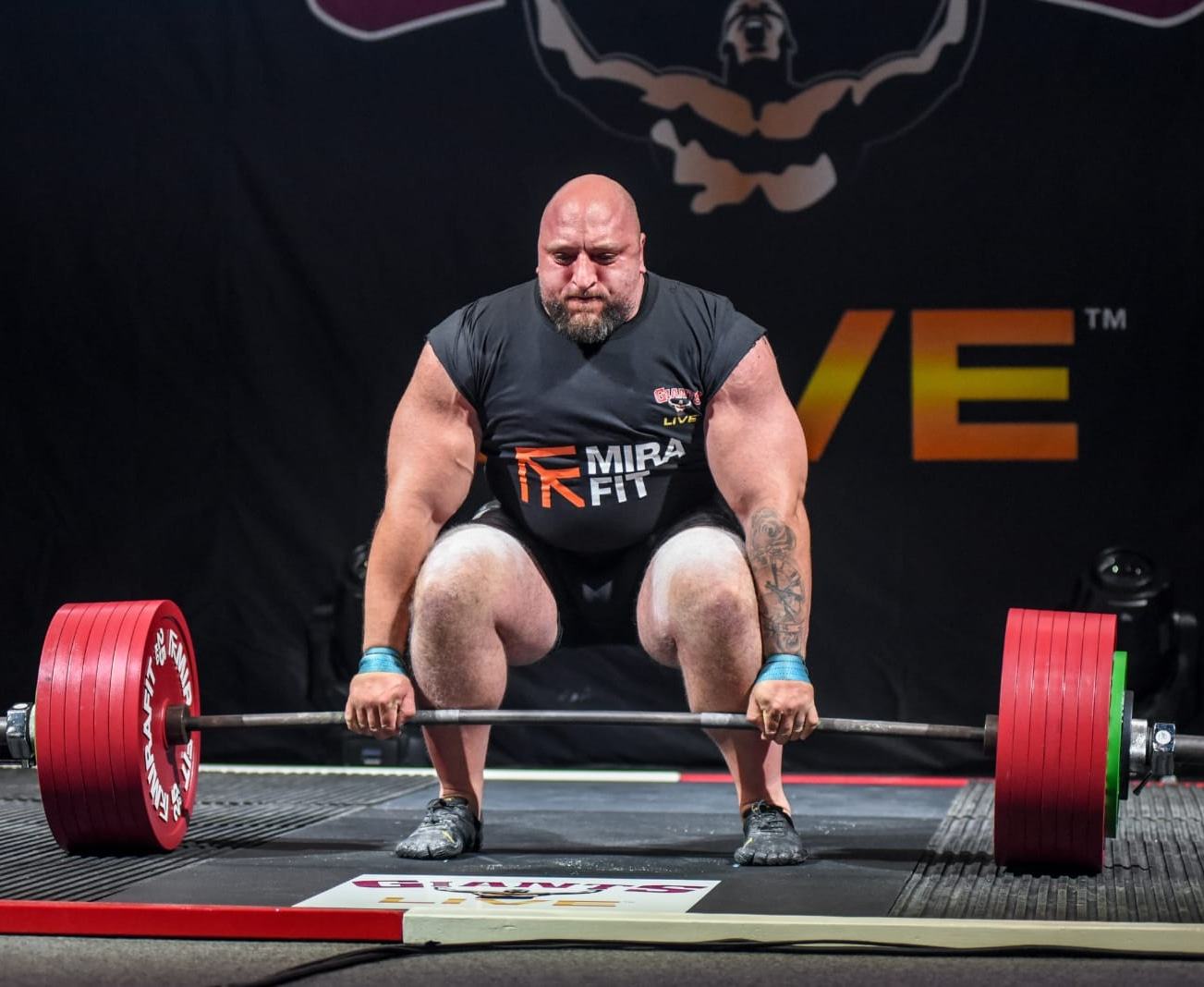
The clearest specialist victory of Hicks’s later career arrived on 2 September 2023 at the World Deadlift Championships in Cardiff. He won the competition with a successful 470 kg deadlift, as confirmed by organiser Giants Live and Strongman Archives. He subsequently attempted 505 kg but did not complete the lift. The distinction between the successful 470 kg attempt and the unsuccessful 505 kg attempt is fundamental. A failed attempt at an exceptionally ambitious weight can be part of the sporting story, but it must never be added to an athlete’s list of verified records or described as though it were a successfully completed lift. The winning result was 470 kg, and it earned a world title in a specific event rather than a World’s Strongest Man overall championship.
That victory can be placed within a broader chronology of competitive deadlifting. Hicks had reached 390 kg at Britain’s Strongest Man in 2013 and 400 kg at Europe’s Strongest Man in 2014. He pulled 405 kg raw at a 2018 powerlifting deadlift competition and recorded a 390 kg deadlift within his 2019 three-lift total. In strongman, he achieved 453.5 kg in 2022 before the 470 kg winning attempt in Cardiff. These figures show a career with steadily increasing high-end benchmarks across several years, but they do not represent a controlled progression through identical tests. Equipment, bar characteristics, fatigue and competition requirements differed. The 470 kg result belongs to a specialist strongman deadlift championship and should be compared with results achieved under similarly defined conditions.
The title is especially significant when viewed alongside his 2019 British championship. Winning Britain’s Strongest Man required scoring across a collection of events; winning World Deadlift Championships required producing the decisive validated result in one of the sport’s most closely followed lifts. Hicks achieved both, in different phases of his career. A complete account must resist two opposite errors: presenting the deadlift title as though it made him overall World’s Strongest Man, and dismissing it as a noncompetitive demonstration. It was an officially organised specialist world championship, achieved against the field present at Cardiff. For an athlete whose identity had already been established through the log press and whose route to a world final had been disrupted in 2020, the deadlift victory added a distinct international achievement to an already lengthy competitive record.
A biography organised around successful lifts alone would distort the nature of Hicks’s career. The year of his world deadlift victory also included less successful appearances. At World’s Strongest Man 2023 in Myrtle Beach, South Carolina, he finished fifth in his qualifying group and did not advance to the final. The event record explains some of the distribution of points. Hicks placed second on the deadlift machine and third on the log ladder, results consistent with his history of strong performances in heavy lifting events. He finished near the bottom of the group in kettlebell toss, Conan’s Wheel and loading race. Those results show how a strongman can perform at a high level in events that suit his strengths while losing enough points in others to miss qualification. The explanation is grounded in the contest scores, without requiring claims about his motivation or physical condition that the sources do not establish.
His Europe’s Strongest Man appearance that year also ended well below the podium. The archival record shows participation in only part of the scheduled programme. Without comprehensive public explanations for each event not completed, it would be inappropriate to construct an elaborate causal story from the placing. A full biography should include the appearance and its result while recognising the limits of the evidence. Competitive careers are made of completed contests, unfinished contests, breakthroughs, lower placings and changes in the event formats themselves. Omitting everything that does not fit a narrative of success produces a flattering account but not an accurate sporting history.
Strongman Archives also records a 425 kg result for Hicks at the 2024 World Deadlift Championships. It is lower than the previous year’s winning 470 kg, but one competition result cannot establish permanent decline, a particular physical limitation or the precise aims of an athlete’s preparation. It documents a successful lift on a specific date under that year’s conditions. Such caution becomes particularly important when reviewing a long career across several generations of opposition and repeated changes in competitive priorities. The central finding for the 2023–2024 period is that Hicks combined a major specialist world title with continued participation in both individual events and multi-event competitions, each of which supplied a different view of his performance.
On 23 August 2025, Hicks won Strongman Champions League Poland in Gdańsk with 51.5 points across five events. Independent competition reporting and Strongman Archives confirm the result. His opponents included Oskar Ziółkowski, Evans Nana Aryee, Péter Juhász, Kevin Hazeleger and Aivars Šmaukstelis. The events were the 18-inch deadlift, sandbag toss, log lift, frame carry and loading race. The programme is important because it required a broader collection of capabilities than the specialist world deadlift championship he had won two years earlier. At Gdańsk, Hicks did not need to be first in every event. He needed to combine decisive results in his stronger movements with sufficiently consistent placings in the throwing, moving and loading disciplines.
He won the 18-inch deadlift with nine repetitions at 360 kg, a total matched in repetition count by Aivars Šmaukstelis. Hicks also placed second in the log lift, third in the sandbag toss and loading race, and fourth in the frame carry. These results show a well-balanced competition under the conditions used that weekend. The victory was not the product of an exclusively static lifting programme; he collected points in each of the dynamic events as well. For a mature athlete who had already accumulated international experience, the performance was evidence of effective all-round competition on a particular day, not proof of permanent superiority across every possible strongman programme.
Earlier in 2025 he had finished sixth at England’s Strongest Man despite winning the deadlift ladder, which required rapidly completing a progression from 320 to 380 kg. That contrast with his Gdańsk victory is instructive: the choice of events, the calibre and strengths of the opposition and an athlete’s performance on the day all affect the outcome. His wider Strongman Champions League calendar also included a fourteenth-place finish in the United States, sixth in Dubai and ninth at the World Finals. In Dubai he won the car deadlift event with twelve repetitions; at the finals he placed second in the deadlift. The season therefore contained a major international victory, lower overall placings and repeated high specialist results. Reading all of them together provides a more realistic assessment of what a professional strongman season looks like than isolating either its highest or lowest placing.
As of 30 September 2026, Graham Hicks should be described as an active competitor, not a retired athlete whose story ended with his major victories or with the interruptions of previous seasons. On 7 February 2026, he finished fifth at Britain’s Strongest Man in Sheffield, with 37.5 points. The event records include second place in the car walk with a time of 16.08 seconds, fourth in the axle deadlift with six repetitions and fifth in the power stairs. He also completed four successful lifts in the overhead medley within 68.97 seconds. Tom Stoltman won that edition, ahead of Adam Bishop and Paddy Haynes. For Hicks, the fifth-place result demonstrates continued national-level participation in a field containing competitors from different generations. It is neither a repeat of his 2019 championship nor evidence that the earlier title has lost its importance.
On 30 May 2026, Hicks competed at Strongman Champions League Czech Republic in Liberec and finished fourth of twelve athletes. The shorter three-event programme featured a maximum log lift, a maximum deadlift and the hammer press. Hicks recorded 450 kg in the deadlift, second in the event, and 182.5 kg on the log, placing fourth there. His hammer press result was less competitive, limiting his overall ranking. The contest was won by Oleh Pylypiak, followed by Evans Nana Aryee and Adam Roszkowski. The event illustrates a familiar pattern in Hicks’s statistical record: exceptional results remain possible in one of his representative lifts, but an overall podium depends on the entire distribution of points. He can be close to the leading athletes in the deadlift and still finish outside the top three when other events favour different strengths.
The most important editorial consideration is the date of the information. Both results are verified as of the September 2026 update, but they are not necessarily a complete list of every appearance in that calendar year, nor do they establish his plans for subsequent seasons. Strongman Archives may add results as organisers release them. His own professional activities may also evolve without immediate updates to a personal website. A living athlete’s biography should therefore be treated as an evolving record and identify the time at which its factual status was checked. As of that date, the appropriate description of Hicks combines established achievements with ongoing competitive participation.
Hicks’s professional life outside the competition arena is an important part of his biography. Giants Live describes his earlier role as a design support engineer at British Aerospace, subsequently known as BAE Systems, and reports that he entered the company through an apprenticeship. On his own coaching website, Hicks states that he worked full-time as an engineer at BAE Systems for almost twenty years before choosing to concentrate more heavily on his athletic preparation and on coaching others. A dated Beyond Radio interview in November 2022 provides additional context, reporting that he had taken an extended break from his regular job so that he could focus on strongman. Taken together, these sources document a substantial engineering career and a professional transition. They do not justify describing him as a current full-time employee of the company in September 2026 without newer independent confirmation.
This working background helps explain a structural reality of professional strongman. Elite-level participation may require considerable time for training, recovery, equipment access and travel, yet not every competitor can rely exclusively on competition income or commercial partnerships. Hicks is an example of a high-level athlete who also maintained a conventional professional career for many years. The available evidence establishes his employment history and the later change in focus, but it does not provide the complete economics of his household, the exact working hours he maintained during each season or a reliable breakdown of his income. Responsible biography does not need those unverified details to explain how two demanding fields coexisted in the same period.
His personal site now presents him as a professional strongman and coach, offering individualised programming for strongman, strongwoman, powerlifting and general fitness. His stated approach includes technical feedback from training videos, progression adapted to the client and consideration of obligations outside the gym. There is a natural connection between a long career in several strength disciplines and an interest in teaching others, although the fact that an athlete has lifted extraordinary weights does not automatically establish the quality of every client outcome. The relevant documented change is clear: Hicks developed from an athlete balancing engineering and competition into someone who also built a professional identity around strength coaching. That strand of his life belongs beside the event results, not in a minor footnote after the record list.
Competitive biographies often contain extensive event statistics but relatively little reliable information about the athletes’ private lives. In Hicks’s case, a local interview provides several specific and attributable details. Beyond Radio reported on 30 November 2022 that he was married to Kimber-Lee and was the father of three children. The same article described both Graham and Kimber-Lee as strength athletes who trained for competition and operated Infinity gym together in Hest Bank. At that time, Kimber-Lee was preparing for a powerlifting competition with the objective of qualifying for the British championship. These details are sufficient to show that strength sport had become a shared element of the family’s public activities, but they do not amount to permission to reconstruct their entire domestic life.
The interview is valuable because it offers a perspective rarely captured by results databases. Hicks is presented in a setting where he is not only an international competitor but also a husband, father and gym operator. Competition demands may interact with childcare, travel, employment and business responsibilities, but an author cannot know from that interview precisely how the Hicks family allocated those duties or negotiated private decisions. It would likewise be inappropriate to publish identifying details about his children that are not necessary to explain the sporting career and are not supported by reliable, relevant public statements. Respecting those limits is not a failure of research; it is a distinction between evidence-based biography and speculation about people who have not chosen to become public figures themselves.
The family’s documented involvement in the gym provides a concrete link between personal life and professional development. By 2022, the couple were associated with Infinity, where both trained and contributed to the local strength community. The reporting also indicated that Graham was pursuing renewed competitive ambitions after earlier setbacks. As with all dated personal sources, the account establishes circumstances at the time it was published. It should not be silently converted into an assertion that every relationship, business arrangement or training objective was unchanged in late 2026. By retaining the date and avoiding unsupported additions, the biography can acknowledge the importance of family to Hicks’s public story without intruding into aspects of his private life that the sources do not document.
Infinity gym, located on Coastal Road in Hest Bank, features prominently in the November 2022 Beyond Radio account of Hicks’s professional life. The report described the site as a gym developed by Graham and Kimber-Lee in premises that had previously housed another fitness facility, and said it had been operating for approximately a year at the time of the interview. For someone whose sport involves unusually heavy and specialised equipment, a dedicated training environment can offer greater freedom over event selection, scheduling and the coaching of others. Those possible advantages help explain why a strongman might be attracted to gym ownership, but they should not be presented as verbatim statements or confirmed business motives unless Hicks himself has expressed them in an identifiable source. The documented facts are that the couple operated the gym in the period reported and that Graham was also developing his coaching services.
On his own website, Hicks presents individualised online coaching for strongman, strongwoman, powerlifting and broader strength training. The material describes programming adapted to a client’s goals, video-based technical feedback and practical adjustment around work and family responsibilities. It also emphasises progressive training that protects a lifter’s long-term ability to participate. Rather than chase the fastest possible personal best regardless of technical quality, the coaching philosophy published on the site aims to allow sustainable improvement and a long lifting career. These principles are self-described professional claims. They offer insight into how Hicks chooses to present his work as a coach, but they should not be mistaken for independent research demonstrating that every client experiences the advertised results.
His experience across different competitive formats gives the coaching narrative particular relevance. He has competed as an under-105 kg strongman and in the Open class, achieved results at national and international championships, tested himself in raw and wraps powerlifting, and continued to participate across several periods of his sporting life. A coach with that history can discuss event specificity and the differences between an individual maximum lift and an entire multi-event contest from personal experience. At the same time, a biography should not invent training templates, supplementation practices or detailed methods merely because the author considers them plausible. The public material confirms the services he offers and the importance he assigns to technical feedback, individualisation and longevity. Those are the professional details that can be responsibly included.
Hicks’s record illustrates why the term deadlift requires precise qualification in strongman. OpenPowerlifting verifies his 405 kg raw deadlift in the 2018 Andy Bolton Deadlift Challenge and the 390 kg lift that formed part of his 2019 three-lift total. Strongman Archives records 453.5 kg at the 2022 World Deadlift Championships and 470 kg at the 2023 edition, while his 2021 Shaw Classic result includes 499 kg in the Hummer tyre variant. A reader who sees these four or five numbers without the names and conditions of the events might mistakenly conclude that they form a simple ladder of comparable standard deadlifts. They do not. The equipment permitted in a strongman deadlift can differ from that used in raw powerlifting, the bar may have different properties, and a Hummer tyre setup changes the implement and effective start position. Any meaningful comparison must account for those differences.
Maximal deadlifting involves the coordination of several physical and technical components. Hip and knee extension provide the primary movement, while the trunk must transmit force and resist unwanted movement. Grip strategy, setup, leverages, bracing and the rate at which an athlete can generate force all influence a successful attempt. At extremely heavy weights, equipment and the precise characteristics of the bar can also affect the pattern of force application. An elevated deadlift may favour a different portion of the movement from a standard pull off the floor. None of these general biomechanical observations establishes the exact relative contributions in Hicks’s own technique without direct analysis of his measured limb lengths, training methods and movement data. The confirmed conclusion is that he has produced exceptional performances under several different sets of competition rules.
Deadlifting for repetitions adds another layer of specificity. Hicks’s nine repetitions with 360 kg at the 2025 SCL Poland 18-inch deadlift were not merely an attempt at a maximum using a lighter load. Repeated heavy lifts within a time limit require pacing, rapid re-establishment of a successful setup and the ability to continue producing substantial force as fatigue accumulates. His repeated high event placings across standard, elevated and car deadlift variations show competitive effectiveness in more than one format. That breadth, combined with the specialist 470 kg world title, explains why deadlifting became one of the best-documented aspects of his career. Precision about the implement makes these achievements more useful to readers who want to understand strength sport rather than merely collect large numbers.
Overhead strength is the second major technical theme in Hicks’s competitive history. His 220 kg log press is the most easily quoted figure, but the event record contains a much wider range of performances: multiple national and international log-event wins, strong results in the dumbbell press and Viking press, and competitive finishes in medleys that required transitions between different overhead implements. Each event changes the task. A log has a large diameter, a neutral grip and a demanding clean; a circus dumbbell creates a significant unilateral stabilisation challenge; a Viking press uses a pivoting mechanism; and a thick axle changes the mechanics of the initial lift and grip. The ability to perform well with one implement is useful preparation for another, but it does not make their outcomes interchangeable.
The 2019 British title offers a practical example of overhead performance expressed as repeated work. Hicks completed eight repetitions with a 150 kg log and won the event. The 220 kg maximum at Europe’s Strongest Man 2020 measured a different ability: producing the heaviest valid single lift within the specified event. The following year, he won another European log event at 195 kg. Taken together, these results indicate competitive proficiency across different log-lift formats, not just a solitary peak. They also demonstrate the importance of preparation that reflects the actual contest programme. An athlete who has prepared exclusively for a one-repetition maximum may be surprised by the cardiovascular and muscular demands of a log for repetitions, just as a technically efficient endurance performer may require a different strategy for attempts close to absolute maximal capability.
The archive records a lower but still substantial maximum log of 182.5 kg at SCL Czech Republic in 2026. It would be incorrect to describe that result as evidence of a fixed present-day ceiling, because the conditions and objectives of a single competition cannot establish an athlete’s absolute ability across time. Equally, it would be misleading to publish the historic 220 kg as though Hicks necessarily reproduces it at every appearance. An accurate technical profile uses the personal best to establish a recorded high point and the season-by-season results to describe competitive activity. Hicks’s overhead career is therefore better understood as a sustained pattern of high-level performances, with a peak record and notable victories across more than a decade.
The numerical details of Hicks’s physique require greater care than athlete fact boxes usually provide. His height is consistently reported as approximately 178 cm, but his competition bodyweight has varied considerably from the under-105 kg limit of his early career. His official weigh-in at Pro Raw Big Dogs 4 in November 2019 was 164.1 kg. An older Giants Live profile gives 163 kg, a later local article used an approximate figure closer to 152 kg, and Strongman Archives displays approximately 150 kg as a reference weight. Each source may be accurate for its time and purpose. It would be methodologically unsound to calculate a fictional constant bodyweight from those measurements or claim that one figure represents every phase of his career. Open-class strongmen are not required to remain below a fixed limit, and bodyweight can change with preparation, competitive priorities and ordinary seasonal variation.
Moving from U105 titles to international Open competition was a complex athletic transition. Additional body mass may support the development of absolute strength, but strongman scoring also rewards movement, repeated effort and technical control. A heavier athlete must continue to manage the energy cost of carrying and loading events, while a comparatively shorter athlete may encounter very different equipment geometries from those experienced by taller opponents. Hicks’s competition history demonstrates that he successfully navigated the transition to national and continental podiums, and later to national and specialist world titles. It does not tell us exactly how much of the change involved muscle, fat, training adaptation or other factors over a fifteen-year period. Those conclusions would require physiological data not available in the public record.
Biomechanical commentary also needs restraint. A shorter frame is sometimes discussed as an advantage in particular lifting patterns, but height alone cannot reveal exact limb proportions, individual mobility, efficient lifting positions or the interaction between technique and an unusual strongman implement. Hicks’s results are a more reliable guide to his competitive capabilities than generalisations drawn from appearance. He achieved a national title in U105, a later Open national title, a massive three-lift total and international performances with implements of very different sizes. The physical transformation makes this record distinctive, but it is the validated achievements and the chronology of adaptation that establish its sporting importance.
The interval between Hicks’s documented 2010 debut and his confirmed 2026 performances spans sixteen calendar years of competitive activity. That span includes a transition in weight class, a series of British and European podiums, an international championship final, an exceptional powerlifting total, a national Open title, a specialist world deadlift title and a later international multi-event victory. The meaning of longevity is not that every season produced a personal best or that the athlete maintained exactly the same competitive condition throughout. It is that he remained involved in demanding strength competition across different stages of his life and through substantial changes in the opponent field, event formats and his professional priorities. A complete historical account includes interrupted appearances and lower finishes alongside titles, since those results are part of the record of remaining active.
The objectives associated with particular phases can be identified through performances rather than assumptions about personal motivation. The 2011 victories belonged to U105. From 2012 onward, Hicks accumulated Open-class experience and repeatedly entered World’s Strongest Man. In 2014 and 2018, the national runner-up finishes showed that he was close to securing a major Open championship; 2019 supplied that victory. His powerlifting results added a test of strength under three-lift competition rules. The 2020 log record and world-final qualification created different international benchmarks, while the following years included a mixture of podiums, event performances and competition interruptions. The 2023 deadlift championship and the 2025 Polish Strongman Champions League title demonstrated further success under separate formats. In 2026, he was still recording high results in national and international competitions.
Hicks’s coaching website states a preference for programming that allows athletes to progress while preserving the possibility of a long lifting career. That expressed philosophy sits naturally alongside a sporting record extending over many seasons, but a biography should not retrospectively treat it as proof that every earlier training decision or competitive result followed a single unchanging method. The documented fact is continuity; the stated coaching principle is his published professional position. Separating the two allows readers to understand his career without turning longevity into an unsupported story of perfectly planned progress. His future competitive plans must likewise remain open unless confirmed by a reliable public announcement.
Hicks is a particularly useful subject for explaining the difference between strongman and powerlifting because his recorded results in both are substantial. In a conventional powerlifting meet, the athlete receives attempts in the squat, bench press and deadlift, and the best successful attempt from each forms the three-lift total. Competition equipment and categories can differ, but the overall scoring concept remains anchored to three specific movement patterns. Strongman is less standardised across events. A promoter can build a contest from overhead pressing, carries, pulls, object loading, throws and other tasks, awarding event points that accumulate into a final ranking. Victory at Britain’s Strongest Man 2019 therefore measures a different competitive achievement from an 1,100 kg powerlifting total. Neither can be converted into the other through a simple formula.
The published Big Dogs 4 results provide a concrete example of why detailed source reading matters. Hicks’s individual OpenPowerlifting listing records him as second in the applicable division, while an overall table sorted using one scoring coefficient displays him third behind two other competitors. An article that mentions a placing must specify the basis on which the competitors were ranked. By contrast, the individual lifting values are unambiguous in the official database: 440 kg in the squat, 270 kg in the bench press and 390 kg in the deadlift, for 1,100 kg in total, in the equipment category permitting knee wraps. The most defensible biography records the validated lifts and explains any ranking variation rather than selecting whichever presentation appears more impressive.
The same principle applies to individual deadlift records. Hicks’s 405 kg raw deadlift from 2018, 390 kg deadlift within his 2019 three-lift total, 470 kg specialist strongman pull from 2023 and 499 kg Hummer tyre result from 2021 all deserve a place in his career record, but each deserves the name of its event and the equipment context. Calling the Hummer variant simply a heavier version of the world-championship deadlift obscures differences in start height and implement design. Similarly, a strongman log press is not equivalent to a powerlifting bench press, and a victory in a specialist log championship should not be described as winning the entire European championship unless Hicks also led the complete event standings. Accuracy in classification is the best way to preserve the scale and meaning of his accomplishments.
Hicks’s place in British strength sport can be described through documented results without making speculative comparisons between athletes or eras. He won the English and British under-105 kg championships in 2011, progressed to repeated British Open podiums, became Britain’s Strongest Man in 2019 and qualified for a World’s Strongest Man final in 2020. He also reached the Europe’s Strongest Man podium in 2014 and 2021. His specialist achievements include a 220 kg log press that represented a British competition benchmark in 2020 and victory at the 2023 World Deadlift Championships with 470 kg. In addition, he produced a three-lift total of 1,100 kg at a major 2019 powerlifting contest and later won a five-event Strongman Champions League competition in Poland. This distribution of results across divisions and disciplines is the foundation for an evidence-based account of his significance.
There is a wider historical context to the numbers. British strongman has featured competitors whose identities were defined by different event strengths: lifting, moving, overhead pressing, grip or unusual combinations of those qualities. Hicks developed a particularly visible reputation for log lifting and deadlifting, but the national title and later Polish victory show that his career also includes complete-contest success. The record does not imply that he dominated every European or world championship he entered; Strongman Archives contains both podiums and much lower finishes. Including that full range gives his victories their proper competitive meaning. They were achieved within a career that also required repeated adaptation and the management of an extensive contest calendar.
His work outside competition provides another documented contribution. Public material describes a long engineering career, subsequent strength coaching, a personal training website and involvement in a Lancashire gym. These activities indicate that his public role extended beyond appearing on competition platforms. They do not prove any particular level of influence upon the training methods of the sport as a whole, nor do they justify inventing a list of famous pupils. The visible facts are sufficient: Hicks has been a competitive athlete, national champion, specialist world champion, coach and local strength-business operator. Because he continued to compete in 2026, his biography remains an account of an active career rather than a retrospective obituary for a sporting era.
The earliest competition identified by organiser Giants Live is the 2010 North of England’s Strongest Man U105 kg, where Hicks finished seventh. In 2011 he won both England’s Strongest Man U105 kg and Britain’s Strongest Man U105 kg. His move into Open competition produced fourth place at Britain’s Strongest Man and a World’s Strongest Man debut in 2012. He returned to both in 2013, recording strong individual performances without reaching the world final. In 2014 he finished runner-up at Britain’s Strongest Man and third at Europe’s Strongest Man. On 14 February 2015 he shared the World Log Lift Championships title at Doncaster with Eddie Hall and Žydrūnas Savickas, as documented in Strongman Archives, while continuing to compete in other major events.
In 2017 Hicks finished third at Britain’s Strongest Man and won the World Log Lift Championships in Kaunas. In 2018 he was runner-up at the British championship and won the Andy Bolton Deadlift Challenge with a 405 kg raw pull. The 2019 season delivered two different benchmarks: the Britain’s Strongest Man title with 54.5 points in January and a 1,100 kg powerlifting total at Pro Raw Big Dogs 4 in November. In 2020 he recorded a 220 kg log press at Europe’s Strongest Man, a British competition benchmark at the time, and qualified for his first World’s Strongest Man final. In 2021 he returned to the podium at both Europe’s Strongest Man and Britain’s Strongest Man and lifted 499 kg in the specialised Hummer tyre deadlift at Shaw Classic.
In 2022 Hicks recorded a 453.5 kg pull at World Deadlift Championships, finished fourth at Giants Live World Open and contributed to the United Kingdom’s World’s Strongest Nation victory. The year 2023 added another British championship podium, an appearance in the World’s Strongest Man qualifying groups and victory at World Deadlift Championships with 470 kg. His 2024 specialist championship entry lists 425 kg. In 2025 he finished sixth at England’s Strongest Man, won SCL Poland with 51.5 points and appeared at additional Strongman Champions League events in the United States, Dubai and the World Finals. By 30 September 2026, confirmed results included fifth place at Britain’s Strongest Man and fourth at SCL Czech Republic, where he deadlifted 450 kg. The chronology is a synthesis of documented competition results, not an assertion that every local contest, exhibition or appearance has necessarily been located.
This profile draws on several source types, each suited to different questions. Organiser Giants Live provides the historical biography, particular records and official contest results. Strongman Archives supplies structured international, national and single-event results and detailed event tables extending into 2026. OpenPowerlifting is the principal source for Hicks’s validated attempts, equipment category, weigh-ins and competition totals in powerlifting. Beyond Radio’s dated November 2022 interview provides publicly disclosed family and professional information, while Hicks’s own website documents his coaching services and the principles he chooses to publish about them. Specialist reports on Strongman Champions League complement the archival record for recent contests. These sources should be read together rather than treated as interchangeable; an organiser profile can become outdated, a results database can omit a local event and a personal website may retain an old age or professional description.
The distinctions within the source material have direct editorial consequences. Hicks’s bodyweight is presented as a dated and variable measurement, not as one number that has applied since his first contest. His competition debut in 2010 is acknowledged even though some international databases begin their career summaries with his 2012 Open appearances. The 220 kg log press is described in the historical context of the 2020 competition, not as a claim about a universal record in every later year. His 505 kg deadlift attempt in 2023 is identified as unsuccessful and excluded from his list of validated personal records. The 499 kg Hummer tyre deadlift remains separate from his standard strongman and raw powerlifting results. At Big Dogs 4, the recorded division and the basis of overall ranking are differentiated. Likewise, the 2020 World’s Strongest Man final qualification is reported together with the subsequent injury-related interruption, without projecting an unearned hypothetical final placing.
The same discipline applies to personal information. Public sources confirm that Hicks worked in engineering for almost two decades, developed coaching services and was reported in 2022 to operate Infinity gym alongside his wife Kimber-Lee, with whom he had three children. They do not provide a complete account of his family’s private decisions, the current identity of his individual coach or a verified present-day financial history. Those details have not been invented. What the reliable public record does establish is an unusually varied strength-sport career: a U105 champion who became a British Open champion, a European podium finisher, a World’s Strongest Man finalist, a specialist world deadlift champion and an international contest winner more than a decade after his earliest successes. With further verified competition appearances recorded in 2026, the story remains open to factual updates rather than requiring a manufactured final chapter.
Giants Live, official Graham Hicks profile: https://giants-live.com/athlete/graham-hicks/ ; Strongman Archives, full athlete results and event breakdowns: https://strongmanarchives.com/viewAthlete.php?id=193 ; OpenPowerlifting, validated lifts and contest totals: https://www.openpowerlifting.org/u/grahamhicks ; Giants Live, Britain’s Strongest Man 2019: https://giants-live.com/shows/britains-strongest-man-2019/ ; Giants Live, World Deadlift Championships reporting: https://giants-live.com/news/deadlift-records-to-fall-strongman-open-preview/ ; Beyond Radio, interview dated 30 November 2022: https://www.beyond.radio/news/local-news/interview-morecambe-powerhouse-graham-hicks-aims-to-regain-britains-strongest-man-crown/ ; Graham Hicks’s own website and coaching information: https://www.grahamhicks.co.uk/ ; Fitness Volt, 2025 SCL Poland result: https://fitnessvolt.com/strongman/competitions/2025-scl-poland/ ; Fitness Volt, athlete archive and results: https://fitnessvolt.com/strongman/athletes/graham-hicks/ . These sources have been cross-checked wherever possible to distinguish organiser-reported results, archival results, verified powerlifting attempts, personal statements and dated local reporting.
Iron Hall data
470 KG
Deadlift, World Deadlift Championships · 2023 champion in Cardiff; strongman rules and permitted equipment
Verified
220 KG
Competition log lift · 2020 Europe’s Strongest Man; British record at the time
Verified
499 KG
Hummer tyre deadlift · 2021 Shaw Classic; different implement and lift height from standard deadlift
Verified
440 KG
Powerlifting squat · 2019 Pro Raw Big Dogs 4, raw with knee wraps
Verified
270 KG
Powerlifting bench press · 2019 Pro Raw Big Dogs 4
Verified
405 KG
Raw powerlifting deadlift · 2018 Andy Bolton Deadlift Challenge
Verified
1100 KG
Powerlifting total (three lifts) · 2019 Pro Raw Big Dogs 4: 440 kg squat + 270 kg bench + 390 kg deadlift
Verified
2011
Under-105 kg championship victory.
Champion
2011
Added the British U105 kg championship.
Champion
2012
4th
2012
World championship debut in Los Angeles; won his group’s loading race.
5th in group
2013
Second on log, winner of loading race and 390 kg maximum deadlift.
5th
2013
Sanya appearance, with strong finishes in deadlift hold, axle press and super yoke.
5th in group
2014
Runner-up
2014
3rd
2014
Competed in Los Angeles without advancing to the final.
3rd in group
2015
14 February 2015, Doncaster: 211 kg, joint first with Eddie Hall and Žydrūnas Savickas, confirmed by Strongman Archives and contemporary event reporting.
Joint winner with Eddie Hall and Žydrūnas Savickas
2015
Won the maximum log-lift event with 211 kg.
8th
2015
The archive records several events not completed.
6th in group; incomplete appearance
2017
3rd
2017
Winner as listed by Giants Live
2018
Runner-up
2018
5th
2018
World championship appearance in Manila.
5th in group
2018
405 kg raw deadlift.
Winner
2019
54.5 points; ahead of Adam Bishop and Tom Stoltman, eight reps with a 150 kg log.
Champion
2019
1,100 kg total: 440 kg squat + 270 kg bench + 390 kg deadlift; second in the division recorded on his OpenPowerlifting profile, third in the overall meet table when ordered by coefficient.
2nd in the recorded division
2020
220 kg log lift, then a British competition record.
4th overall; 1st in max log lift
2020
A biceps tear prevented him from contesting the final.
Qualified for final; listed 10th following withdrawal
2021
3rd
2021
3rd
2021
499 kg Hummer tyre deadlift and 200 kg log lift under their respective event rules.
11th overall
2022
4th overall; 453.5 kg deadlift
2022
Seven deadlift reps at 360 kg.
Winning team
2023
3rd
2023
5th in qualifying group
2023
470 kg in Cardiff; unsuccessful attempt at 505 kg.
Champion
2024
Recorded in Strongman Archives; distinct from his 2023 personal best.
Contest appearance, 425 kg
2025
6th
2025
14th
2025
51.5 points in Gdańsk across five events.
Champion
2025
6th
2025
9th
2026
37.5 points, including second in car walk.
5th
2026
450 kg maximum deadlift, second in the event.
4th