
2025
England's Strongest Woman
22 February 2025, Doncaster; won four of the five events.
1st of 13 / champion
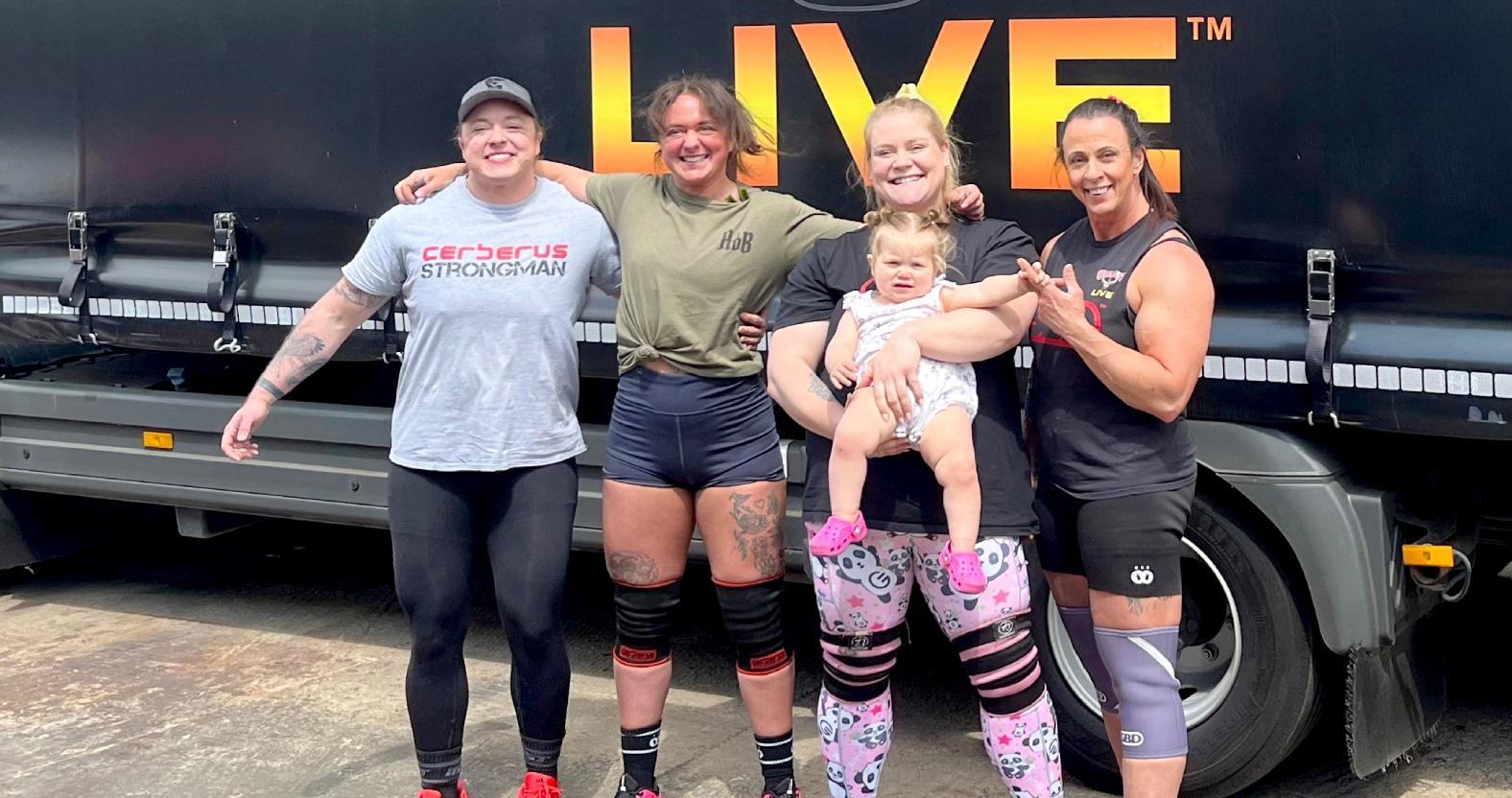
Iron Archives
Two-time England's Strongest Woman • Britain's Strongest Woman 2026 bronze medallist
Active athlete
Grace Hilbourne is a British strongwoman athlete, the 2025 and 2026 England's Strongest Woman champion and the bronze medallist at Britain's Strongest Woman 2026. After finishing 12th at the 2025 British contest, she returned in 2026 to take third place with 35.5 points, winning the demanding Sandbag Steeplechase in 43.81 seconds. Her documented competition performances include 11 reps on a 200 kg deadlift, nine reps on an 80 kg log and two reps with 280 kg on a trump-bar deadlift. As of October 2026, she was listed among the entrants for the Rogue Invitational.
Grace Hilbourne is a British strongwoman competitor whose verified results establish an increasingly prominent place in the sport. She won England’s Strongest Woman in February 2025, defended that title in January 2026, and finished third at Britain’s Strongest Woman in July 2026. Her rise in the British contest was particularly striking: she was listed twelfth in 2025 after withdrawing before the closing events, then returned the following summer to collect 35.5 points and a place on the podium. Those results create a compelling sporting narrative without requiring invented conversations, unverified childhood stories or presumed training secrets. They show a competitor achieving major domestic success across changing formats, followed by an improvement in her standing against a strong field of internationally experienced athletes. The purpose of this biography is to examine what the records establish, explain the events behind the numbers and separate confirmed personal information from claims that cannot currently be substantiated.
Hilbourne is identified as representing the United Kingdom and, in England-specific and British events, England. The distinction between England’s Strongest Woman and Britain’s Strongest Woman is central to any accurate account. The former is an English title, while the latter brings together elite athletes from the constituent nations of Britain in a separate contest. Winning two English editions does not make an athlete the overall British champion, just as a British bronze medal does not diminish the significance of two prior domestic victories. Grace’s documented major results include four competitions between February 2025 and July 2026. That is the extent of the reliably identified championship record used here, not an assertion that she had never competed before 2025. Training history, local contests and early achievements may exist without appearing in the available results databases.
In the Open division, competitors are not separated by the lower bodyweight caps used in lightweight strongwoman classes. Performance therefore depends on solving demanding and varied tasks rather than demonstrating only one conventional gym lift. Implement size, the rules for repetition counting, the route required by a carry and the exact relationship between weight and speed can all change from show to show. A deadlift for repetitions measures something different from a deadlift ladder; a stable loading platform creates different constraints from balancing a natural stone on one shoulder; a standard farmer’s implement differs from an awkward anvil. Hilbourne’s career to date is best understood through these distinctions. They allow her real results to be appreciated on their own terms and prevent a profile from transforming competition-specific achievements into unsupported personal records.
Reliable public documentation reviewed for this profile does not establish Grace Hilbourne’s date of birth, age, childhood home, parents, partner, children, educational background or civilian occupation. Nor does it identify a particular workplace or establish the career decisions that may have accompanied her competitive development. These omissions should not be filled with a generic inspirational story about discovering weights as a child, receiving family encouragement or sacrificing a conventional career for training. Such themes are common in sports journalism, but they become biographical facts only when supported by interviews, first-person accounts or trustworthy independent reporting. No such detailed personal source was found during the present research. A biography that acknowledges the boundary between public competition results and private life respects the athlete more than one that produces an appealing but imaginary personal history.
The same standard applies to her training arrangements. Published score sheets do not reveal the name of a coach, the location of a training gym, the frequency of sessions, her nutrition programme, sponsors or medical history. Nine successful log repetitions may demonstrate strong event execution; they do not disclose her weekly pressing split. A fast sandbag course does not tell us how often she trains carries, and a difficult result on a yoke does not establish an injury. Discussions of these disciplines in the following sections therefore concern their general competitive demands, not an invented personal method attributed to Hilbourne. This distinction is especially important when writing at length about an athlete who has attracted more coverage for performances than for extensive interviews. There is ample room for meaningful technical and historical context without pretending to know private facts.
On 22 February 2025, in Doncaster, Grace Hilbourne won England’s Strongest Woman ahead of Annabelle Chapman and Leanne Coghlan. The published championship table lists thirteen athletes and places Hilbourne first overall. Its five events were a deadlift for repetitions, an overhead medley, a sandbag toss, a combined sandbag loading-and-carry event, and Atlas Stones. This assortment matters because it did not permit an athlete to rely exclusively on one lift. It demanded repeated heavy efforts, efficient transitions, control of awkward objects and the ability to continue working against the clock. The English title was therefore not a single spectacular lift turned into a championship by publicity. It was a scored performance over a full programme. The individual results show that Hilbourne was at or near the top across every discipline, an unusually consistent distribution that explains the final placing.
The deadlift at the 2025 event used 200 kilograms and a sixty-second time limit. Hilbourne completed ten repetitions and placed second on the event. This is a substantial competition performance, though it must not be mistaken for a verified maximum single repetition. Estimating a one-rep maximum from a high-repetition strongwoman event can be misleading because the allowable equipment, technique, bar characteristics and event duration affect how a result transfers to a different setting. What the source establishes is clear: ten successful lifts at 200 kilograms, with the second-highest placing among the competitors that day. Such a test rewards the ability to repeat technically demanding work while fatigue accumulates. It differs fundamentally from taking several minutes between heavy gym singles or attempting an entirely different implement.
The overhead medley combined an 80-kilogram log with an 85-kilogram axle. Hilbourne was credited with six repetitions and a share of first place in the event results. A log is a large, cumbersome implement that must be brought into a pressing position before being driven overhead; an axle introduces its own grip and clean-related challenges. The overall repetition number documents successful work within that combined format, not the sequence of every individual lift or a maximum on either piece of equipment. Nevertheless, the result shows that she could compete effectively in a high-pressure overhead discipline against the strongest entrants at that championship. Alongside her deadlift, it provides early evidence of broad strength capability rather than a narrow specialist whose success depended on just one favourable event.
In the sandbag toss, athletes were required to send five bags of 11, 13, 15, 15 and 17 kilograms over a four-metre bar. Hilbourne cleared the series in 24.91 seconds and won the event. While those weights are small beside a 200-kilogram deadlift, throwing presents a distinct combination of coordination, explosive extension, release angle and rhythm. Competitors cannot earn time back by merely demonstrating that an implement is liftable; they must clear the barrier and move efficiently to the next object. Grace’s event victory accordingly shows a form of performance beyond slow maximal force. This becomes an important theme when her later results are examined. Throwing and moving awkward implements were repeatedly productive for her in the English championships, although the event formats changed and should not be treated as identical technical tests.
The sandbag medley at Doncaster required an 80-kilogram bag and a 100-kilogram bag to be brought to the shoulder, followed by a fifteen-metre Husafell-style sandbag carry. Hilbourne completed the sequence in 37.92 seconds and took another event victory. Here the crucial task was not simply lifting one load from the floor. A competitor had to transition between substantially different ways of securing weight, work with a flexible implement whose shape could shift, and still complete a carry at speed. Grace’s performance is one of the documented reasons that the 2025 title was so comprehensive. It is also an interesting precursor to the Sandbag Steeplechase she would win at Britain’s Strongest Woman the following year. The two events were not equivalent, but both rewarded effective handling of cumbersome bags during timed work.
The Atlas Stones event involved five progressively heavier stones, weighing 90, 100, 110, 120 and 130 kilograms. Hilbourne completed four stones in 48.30 seconds and won the discipline. The source therefore supports a successfully completed stone up to 120 kilograms in that series; it does not support recording the final 130-kilogram stone as completed. Such precision matters in strongwoman because simply reaching or attempting the final implement is different from securing a valid lift. Loading successive stones also challenges positioning and speed under rising fatigue. To complete four and finish first among thirteen competitors represented another high-scoring contribution to Hilbourne’s championship victory, reinforcing the pattern seen in throwing, overhead work and the bag medley.
Taken together, Doncaster 2025 presents a coherent sporting picture: second in the deadlift and at the top of the standings in the other four events, including a shared first in the overhead medley. Strongwoman rewards points earned across changing tests; winning the overall title generally depends on keeping weaker events from erasing the value of strong ones. In Grace’s case the published event placements support the conclusion that she performed consistently throughout the programme. They do not reveal what she ate that morning, how she felt during the final or how she celebrated afterward, and none of those details should be invented. The publicly recorded achievement stands on its own. She had won a meaningful English title in a field of thirteen athletes, and her score sheet contained several distinct examples of high-level competition execution.
On 19 July 2025, Britain’s Strongest Woman was held in York under the Giants Live banner. The field included Lucy Underdown, Rebecca Roberts, Naomi Hadley, Andrea Thompson, Donna Moore and other established competitors. Hilbourne finished twelfth of twelve with 8.5 points, a markedly different outcome from her English title five months earlier. Contemporary results in BarBend show that she withdrew before the final two events, but the reviewed material does not establish why. It would be irresponsible to insert an unverified injury, illness or coaching decision into the story. What can be stated is that her participation was incomplete and that the official classification placed her last. This is a genuine part of her competition history, yet it needs to be read against the constraints of the specific show rather than presented as a permanent judgement on her ability.
The first York event was a four-bar deadlift ladder progressing from 190 to 250 kilograms. Grace was credited with one completed lift in 9.72 seconds and finished twelfth on the discipline. The ladder’s format differed sharply from the 200-kilogram repetition test she had contested in Doncaster. Transitions between implements, escalating loads and the need to execute several separate lifts against the clock introduce demands that cannot be translated into a conventional single-lift personal best. One completed stage does not establish that 190 kilograms was the heaviest bar the athlete could ever lift. It records what was completed according to the rules on that day. This distinction later becomes essential when comparing her 2025 result with the heavy trump-bar repetitions she would achieve in York in 2026.
In Shield Carry, Hilbourne covered forty metres and shared sixth place. That performance was considerably stronger in its own event ranking than the deadlift ladder result, illustrating why it is misleading to describe a whole competition through a single disappointing lift. Shield carries demand the control of a bulky implement against the torso, a stable walking rhythm and the capacity to continue moving despite sustained loading. The result documents that Grace remained competitive in at least one movement event at the British show. It does not, however, reveal the mass and exact geometry of every shield used in other competitions. Comparisons with her later 52.4-metre carry at Doncaster in January 2026 should therefore be descriptive rather than presented as a controlled test of improvement on identical equipment.
The super yoke produced her poorest measurable event result at Britain’s Strongest Woman 2025. She was recorded as covering 1.96 metres and placed twelfth. This was a partial distance, not a completed course, and it should never be reported as a fast yoke time. Carrying a frame on the shoulders is mechanically different from hugging a shield to the body. Oscillation, bracing, steps under load and frame dimensions all affect the task. The short distance alone does not explain whether setup, load, balance, fatigue or another factor determined the outcome. Without a reliable statement from the athlete, that question remains open. Her later victory with a 240-kilogram yoke at England’s Strongest Woman 2026 also cautions against branding her permanently incapable of yoke work.
The 2025 British results list no scoring performance for Hilbourne in the closing log lift and sandbag medley because she had withdrawn. This means that the final total of 8.5 points is partly a reflection of an incomplete competition. At the same time, it would be inaccurate to erase the result or replace it with a hypothetical total based on what she might have scored had she continued. Official sport involves the actual attempts and outcomes, not a reconstruction of imagined ones. The twelfth-place finish remained on her record, providing an unusually clear contrast with the podium she would earn twelve months later. Such changes can make a sports biography compelling, but they should not be turned into a psychological screenplay without supporting interviews or testimony.
A few interpretive cautions are therefore necessary. The 2025 and 2026 British competitions had different numbers of participants, different events and different states of completion for Hilbourne. Finishing twelfth in one and third in the other is a genuine ranking improvement; it is not a laboratory demonstration of a specific percentage increase in strength. Nor is it proof that one training system replaced another, that an injury healed or that a particular sponsor enabled the change. Those possibilities would require separate evidence. The strongest defensible narrative is narrower but still remarkable: after winning a national English title and experiencing a difficult British show, Grace returned the following season with results that placed her among Britain’s leading competitors.
Grace Hilbourne returned to Doncaster on 18 January 2026 and won England’s Strongest Woman for a second consecutive edition. This time twelve athletes competed, with Michaela Pearson taking second overall and Vikki Mills finishing third. The most remarkable feature of Hilbourne’s score sheet was its distribution across the five events: she won four and placed second in the remaining discipline. Such a result points to exceptional consistency within the particular competition, rather than a narrow victory secured through one favourable movement. It also shows why the national championship title belongs in her career summary independently of the later British bronze. The English contest was a distinct sporting achievement, with its own entrants, implements and conditions. Describing it accurately means preserving both the fact of the title defence and the individual performances that produced it.
The 2026 deadlift used 200 kilograms for repetitions, with a seventy-five-second time limit. Hilbourne completed eleven repetitions and won the event. The earlier 2025 championship had seen her lift the same nominal weight ten times in sixty seconds. The 2026 result therefore features one additional repetition but also a longer time allowance. A careful comparison should acknowledge both facts. It would be premature to conclude that strength improved by a fixed percentage, or to identify a specific conditioning method as the reason for the extra repetition. What is established is that Grace performed at a high level in repeated heavy deadlifts across both English editions and led the 2026 field. For a strongwoman contest, completing eleven successful repetitions at 200 kilograms is a clear demonstration of competition strength and work capacity under demanding conditions.
In the log lift, competitors attempted as many repetitions as possible with an 80-kilogram implement during sixty seconds. Hilbourne achieved nine repetitions and placed first. This test differed from the 2025 overhead medley that combined a log with an axle. A repetition event focused on one implement rewards repeated successful cycles and economical transitions, while a medley adds movement between different implements and changes in technique. The nine repetitions should not be reported as a one-repetition maximum or turned into an unverified personal record using a formula. The published results do not provide a full video breakdown of every command or execution. They do, however, establish that her overhead capacity was highly competitive in the format presented. Combined with the previous year's shared event lead, the result shows repeated success in important pressing disciplines.
Titan’s Toss required five implements listed in the archives as 14, 9, 8, 7 and 7 kilograms, thrown over a bar approximately 3.4 metres high. Grace completed the series in 11.29 seconds and won the event. This was not the same layout or loading progression as the 2025 sandbag toss, which had involved heavier bags sent over a four-metre bar. Accordingly, the two completion times should not be used to calculate a direct percentage improvement. Yet they are valuable as separate pieces of evidence: throwing events delivered victories in both editions of England’s Strongest Woman. Speed, coordinated hip extension, release timing and moving quickly between objects all matter in these tests. The result belongs to a pattern of strong competitive execution, not to a claim that she holds an absolute record in every throwing variation.
The super yoke event at Doncaster in 2026 used a 240-kilogram frame over a thirty-metre course. Hilbourne completed the distance in 20.97 seconds and took first place. This result deserves attention in light of the short 1.96-metre distance recorded in the 2025 British yoke event. Because the competitions did not necessarily use identical implements, loads or routes, it would be inaccurate to present those numbers as a standardized before-and-after strength test. What they do demonstrate is that the athlete could win a substantial yoke event under national championship conditions. The contrast illustrates the versatility and variability of strongwoman events: performing poorly on one version of a carry does not establish a universal weakness in every version, just as a single victory does not prove that an athlete will dominate all future frame carries.
Shield Carry was the only event in the 2026 English championship that Hilbourne did not win. She carried the implement for 52.4 metres and finished second. The result completed a remarkably balanced day of four wins and one runner-up position. Carrying a shield typically stresses sustained torso positioning, arm engagement and the ability to maintain breathing and movement while a heavy object compresses the body. Its demands differ from a yoke and from individual handles suspended at the sides. The 52.4-metre measurement is a valid event result, but without confirmation that the same shield and conditions were used in 2025, it should not be advertised as a standardized personal improvement over her forty-metre British performance. Even so, it provides a meaningful indication of her effectiveness within that day's field.
The combination of eleven deadlift repetitions at 200 kilograms, nine log repetitions at 80 kilograms, five tosses in 11.29 seconds, 240 kilograms carried over thirty metres in 20.97 seconds, and 52.4 metres with the shield gives the second title unusual documentary substance. Each result refers to a defined exercise with its own rules. They should not be blended into a vague description of someone who is simply 'very strong'. Instead, they show a competitor accumulating high points in tasks that alternated between endurance under load, pressing, speed, moving implements and sustained carrying. The specificity also makes the biography useful to other strength athletes, coaches and historians. Readers can compare events only where the implement, weight, time and rules make the comparison meaningful.
On 25 July 2026, Britain’s Strongest Woman returned to York Barbican. Giants Live assembled ten athletes for a five-event championship featuring a dumbbell medley, farmer’s carry, trump-bar deadlift, stone to shoulder and sandbag steeplechase. The field included Lucy Underdown, Rebecca Roberts, Donna Moore, Naomi Hadley, Claire Myler, Michaela Pearson, Rachel Greener, Sam Taylor and Nicola Bennett alongside Hilbourne. This was a serious competitive environment, with multiple athletes already established through British and international performances. Underdown and Roberts occupied prominent positions in the contest's recent history, while Moore brought the experience of a three-time World’s Strongest Woman champion. Hadley had earned British bronze in 2025. To reach the podium, Hilbourne would need to gather points against a field where many competitors could win individual events.
The return to York carried an obvious historical contrast with Grace’s twelfth-place finish in 2025. The records support that contrast, but they do not tell us whether the athlete approached the event seeking redemption, feeling anxious or pursuing a particular private objective. Such descriptions are tempting narrative shortcuts and are best avoided unless substantiated by her own words. What can be examined is the structure of the championship. None of the five events was a straightforward copy of all the events used in the English title defence. The athlete had to negotiate heavy overhead dumbbells, awkward anvils, a two-weight deadlift format, a natural stone and a fast obstacle course with sandbags. A podium finish in that setting required competition across several distinct skill sets.
The opening dumbbell medley required two successful lifts at 40 kilograms, two at 50 kilograms, two at 60 kilograms and, for those who progressed far enough, a final 70-kilogram attempt. The time limit was seventy-five seconds. Hilbourne completed four lifts in 29.98 seconds, finishing fourth and scoring seven points. Rebecca Roberts won the event by completing all seven lifts; Lucy Underdown was second and Donna Moore third. For Grace, fourth represented a useful opening position without making her the immediate leader. The event standings also show how tightly matched some competitors were. Moore completed four lifts in 26.01 seconds, Hilbourne in 29.98 and Claire Myler in 32.05. Among athletes completing the same number of lifts, even a few seconds changed the distribution of valuable championship points.
Four completed lifts in this specific medley correspond to the 40- and 50-kilogram stages of the programmed sequence. They do not constitute proof of a successful 60- or 70-kilogram single lift in the event. Similarly, the time of 29.98 seconds refers to completing those four lifts and should not be detached from the number of repetitions. In strongwoman, the structure of a medley can reward very different choices from a test of maximum dumbbell weight. A competitor must make a decision about pace and transitions while obeying standards for a successful lockout. Hilbourne’s result established early points and demonstrated good execution relative to most of the field. The significance becomes clearer when considered alongside the next event, where her position would deteriorate sharply.
The farmer’s carry involved two anvils weighing 100 kilograms each, with a thirty-metre course and a sixty-second time limit. Hilbourne covered 17.42 metres and finished ninth, earning two points. Rebecca Roberts completed the course in 17.65 seconds, Lucy Underdown in 24.38 and Naomi Hadley in 29.32. This is an important example of why event results must retain their units. Grace’s 17.42 represents metres, not seconds, while the times recorded for athletes who completed the course describe how quickly they travelled the full distance. After two events she had nine points, a tally that left substantial work to do if she was to reach the podium. The anvil carry was her lowest individual placing at this edition.
Anvils are not identical in feel to conventional farmer’s walk handles, even when the mass loaded in each hand is the same. Their shape, balance and the placement of the gripping surface affect how the load moves during acceleration and walking. It would nevertheless be speculative to conclude that Hilbourne's ninth place was caused by grip failure, poor preparation, injury or a tactical mistake. The results provide a distance and a ranking, not a complete mechanical diagnosis. This distinction does not make the statistic any less useful. It identifies the precise event in which she lost ground against her competitors and explains why the later heavy deadlift, shoulder stone and sandbag challenge became decisive for her overall placing.
One of the distinctive features of strongwoman scoring is the opportunity to recover from a single disappointing event. A competitor rarely needs to win every discipline; rather, she must accumulate enough points over the full programme. That requires strong later performances, particularly when rivals who have moved ahead are also scoring consistently. After the anvil carry, Hilbourne’s challenge was measurable rather than rhetorical. She had taken seven points from the opening medley and only two from the carry. Three events remained, and each offered a different means to gain positions. It is therefore more accurate to describe the shape of her 2026 performance as a recovery in event standings than as a competition she led comfortably from beginning to end.
The trump-bar deadlift provided a turning point. Athletes could attempt repetitions at 240 or 280 kilograms within a seventy-five-second period. Hilbourne performed two successful repetitions with 280 kilograms and one with 240 kilograms. She finished third in the event and received eight points, bringing her running total to seventeen. Only Lucy Underdown, with four repetitions at 280 kilograms, and Claire Myler, with three heavy repetitions and another at 240, scored higher. This was one of the strongest quantitative performances in Grace’s public record. It showed that she could execute multiple repetitions at a demanding load and, crucially, earn a top-three placement in a field including athletes renowned for heavy pulling.
The implement must be identified accurately. A trump-bar deadlift is not automatically interchangeable with a conventional straight-bar deadlift or with a powerlifting lift performed under a federation's rules. Handle position, bar geometry, range of motion and scoring regulations may differ. Consequently, the 280-kilogram result is recorded in this profile as two competition repetitions on a trump bar, not as an independently verified maximum straight-bar lift. Nor should those two repetitions be used to announce a higher estimated world record. A useful athletic database values precise, reproducible descriptions over inflated numbers. Grace’s actual performance needs no embellishment: two lifts at 280 kilograms, plus one at 240, secured third place in a high-quality national event.
Giants Live explained that the availability of two weights had a significant effect on the standings. Roberts worked with the 240-kilogram implement and could not receive the same points as athletes successfully repeating the heavier weight. This demonstrates that choosing the correct load under a given scoring system can be as important as accumulating repetitions. Hilbourne’s heavy attempts earned her points over some competitors who performed more lifts at 240 kilograms. The distinction is not a verdict that one athlete possessed universally greater deadlift ability than another. It concerns the rules of a particular strongwoman contest. That technical context is precisely what makes the result intelligible and guards against misleading comparison with different competitions.
The fourth event at Britain’s Strongest Woman 2026 required athletes to lift a 110-kilogram natural stone to the shoulder and demonstrate sufficient control for the referees to award a valid repetition. Hilbourne successfully completed one repetition and tied for second place with Rebecca Roberts. Lucy Underdown won with two, while the remaining athletes failed to score a valid lift. Grace received 8.5 points and moved to 25.5 overall with one event remaining. This was a highly consequential result because a single successful attempt separated the three highest scorers on the event from most of their competition. The event did not simply measure whether an athlete could raise the stone toward her chest; it required completing the defined finishing position. Hilbourne’s successful repetition therefore represented both strength and correct execution under the particular standards enforced at York.
Stone to Shoulder should be distinguished from a conventional Atlas Stone load onto a platform. The former requires stabilizing a heavy object on one shoulder, while the latter involves controlling the stone’s path and placement onto or over a target. The difference is especially pronounced when a natural stone has a less regular surface or centre of mass than manufactured competition spheres. At York, several athletes reportedly brought the stone high but could not demonstrate the stable position needed to complete the lift. The official Giants Live report singled out Underdown, Roberts and Hilbourne as the only three who received successful repetitions. That detail reinforces the significance of Grace’s performance. The result should be kept in the record as one valid competition repetition at 110 kilograms, rather than as a generic Atlas Stone personal best across all possible stone events.
The scoreboard after this event showed how much the competition had shifted. Hilbourne had started with seven points from the dumbbell medley and added only two from the anvil carry, but the deadlift and stone produced 16.5 points between them. She was now much closer to the leading group and in a position to consolidate a podium place with a successful final. This pattern illustrates a core feature of multi-event strength sport: different implements reward different strengths and create considerable movement in the standings. No unsupported claim about the athlete’s mental state is needed. There is no reliable public basis for reconstructing a private conversation before the stone event, a supposedly decisive motivational speech or a particular emotional response after the lift. The arithmetic itself tells the competitive story.
The closing Sandbag Steeplechase involved two 100-kilogram sandbags, a twenty-metre route and a 1.2-metre barrier positioned partway along the course. Athletes needed to complete the specified handling sequence, recorded in the official results as four elements, under a sixty-second time limit. Hilbourne finished all four in 43.81 seconds, winning the event and earning ten points. Naomi Hadley followed with 47.65 seconds and Lucy Underdown with 52.03. Hilbourne’s advantage over Hadley was 3.84 seconds, a meaningful gap in a short event where repositioning a bag can determine the order of finish. The victory brought her final score to 35.5 points. It was not only the end of a good competition; it was the decisive closing performance that confirmed her third-place overall finish.
A 100-kilogram sandbag behaves very differently from a balanced barbell. The bag can deform, its contents can settle unevenly and the athlete must maintain contact with a surface that does not provide the fixed gripping points of a conventional implement. Adding a barrier complicates the task further because continuous carrying must be interrupted or adapted for the obstacle. A strongwoman needs to combine pulling an implement from the floor, controlling it against the body, transporting it, manipulating it around the obstacle and restarting movement without losing unnecessary time. The event results show that Hilbourne did this faster than every opponent that evening. They do not reveal her exact training sessions or authorize a claim that a specific technique alone caused the win. They establish a major accomplishment in a particularly demanding blend of strength and speed.
The Sandbag Steeplechase result also connects with her earlier domestic victories. At England’s Strongest Woman 2025, Hilbourne won a bag medley that included shouldering 80 and 100 kilograms before carrying an awkward implement. Although that contest had a different format from the 2026 steeplechase, both outcomes demonstrate high-level execution with bags in timed sequences. This is a more defensible description of an apparent strength than simply announcing that she is the best sandbag athlete in the world. Results from different competitions cannot be ranked without a common event standard. Within the documented competitions, however, sandbag handling stands out as one of the clearest recurring competitive successes of her career.
The final British ranking was headed by Lucy Underdown with 46 points, followed by Rebecca Roberts with 41.5 and Hilbourne with 35.5. Naomi Hadley finished fourth on 27, Claire Myler fifth on 26 and Donna Moore sixth on 21. Grace ended the show 8.5 points ahead of the nearest athlete outside the podium. The numbers matter because they demonstrate that her bronze medal was not decided by an imperceptible fraction of a point. A strong final event enlarged the difference between third and fourth. At the same time, she remained 6 points behind Roberts and 10.5 behind Underdown, so the result cannot legitimately be rewritten as a near-win over the eventual champion. An accurate profile can celebrate the podium without obscuring the scoring margins.
Hilbourne’s placements across the five British events were fourth in Dumbbell Medley, ninth in Farmer’s Carry, third in Trump Bar Deadlift, joint second in Stone to Shoulder and first in Sandbag Steeplechase. This 4–9–3–2–1 progression is noteworthy because it traces the change in her event rankings after a difficult carry. Strongwoman results should not be reduced to a single maximum lift, and this contest offers a particularly clear illustration. She lost ground in one discipline, recovered much of it in two technically different tests, and finished by beating the entire field in the final. The bronze medal was the product of that cumulative performance. This is a stronger historical explanation than attributing it to generic determination or describing the evening as uninterrupted domination.
The most readily quoted statistic in Hilbourne’s career is her move from twelfth at Britain’s Strongest Woman 2025 to third in 2026. It is a genuine nine-position improvement in the final standings. Yet it is important to understand what is and is not being compared. The 2025 field contained twelve athletes; the 2026 field contained ten. In 2025 she withdrew before the final events, whereas in 2026 she completed all five. The exercises, equipment and judging requirements also changed. A direct comparison of finishing places therefore reveals an improved competitive outcome, not a precise measurement of increased maximal force, health or technical proficiency. Respecting those differences makes the improvement more credible, not less dramatic.
The official Giants Live account highlighted Hilbourne’s turnaround, noting her advance to the podium after a last-place finish the year before and describing her progress as substantial. This assessment is supported by the verified scores. She competed against elite British strongwomen, finished third overall and took a clear event victory. What the report does not establish is an entire unseen personal story about why those achievements became possible. Training changes, coaching decisions, recovered injuries and alterations to family or work life must be treated as unknown unless documented. It is not necessary to borrow such motifs from fictional sports storytelling. The contrast between the two results is already sufficient to illustrate how much a strongwoman can improve her standing within a single national competition.
The England’s Strongest Woman results provide an important intermediate perspective. Grace’s difficult British showing in 2025 was not preceded by a complete lack of success. She had won the English championship earlier that year with victories across several disciplines. Similarly, the 2026 British bronze did not appear without a documented competitive step: she defended her English title in January with four event wins and one second place. Taken together, the sequence is more nuanced than the simple narrative of a weak athlete suddenly becoming strong. It describes a highly effective domestic competitor who struggled at a particular British event, then produced another strong English championship and performed at a much higher level in the subsequent British edition.
Hilbourne’s recorded events suggest effectiveness across different combinations of strength and movement. She won the 2025 English sandbag medley, sandbag toss and stone series, led the overhead medley jointly, and returned in 2026 to win deadlift, log, toss and yoke at the English championship. At York she scored well in heavy deadlift and stone to shoulder and won the concluding bag event. This distribution points toward breadth and strong event skills rather than exclusive specialization in one gym exercise. It also explains the value of storing detailed event records. A statement that a competitor won 'many events' may be broadly true but gives the reader no tools for distinguishing static strength, speed, pressing, carrying and awkward-object manipulation.
At deadlift, the clearest documented results are ten and eleven repetitions at 200 kilograms in consecutive English championships and two repetitions at 280 kilograms on the trump bar at York in 2026. The first group of results describes repetition capacity at a fixed weight; the second demonstrates performance with a heavier, differently designed implement. None should be converted into an unconditional straight-bar maximum without evidence. These distinctions are especially useful when strength enthusiasts attempt to compare athletes across federations and organizers. A competition lift is meaningful within the rules that define it. Proper documentation preserves the implement, nominal mass, number of repetitions, time limit and event date instead of compressing every outcome into a single number beside the athlete’s name.
Her overhead results also deserve a differentiated reading. Six total repetitions in the 2025 log-and-axle medley, nine 80-kilogram log repetitions in 2026 and four completed stages in the later dumbbell medley are related but not interchangeable achievements. The implements require different positioning and movement patterns. Completing a log repetition does not automatically specify the load that could be pressed with a circus dumbbell, and a timed multi-implement event rewards efficient transitions as well as lifting capacity. In the contests under review, Hilbourne earned important points from overhead disciplines across multiple formats. That is a sound conclusion. Claims about an unrecorded 1RM, a distinctive personal training method or an all-time overhead ranking would require additional verified information.
Carrying events present a mixed but instructive picture. She covered forty metres with a shield at the 2025 British show, won a 240-kilogram yoke race at the 2026 English event and placed second on a 52.4-metre shield carry in the same championship. On the other hand, she recorded only 1.96 metres in the 2025 British yoke and placed ninth with anvils at York in 2026. The available data therefore do not support a simplistic label of uniformly dominant or uniformly weak at carries. The implement, load, route and competitive conditions vary, and scores reflect the outcome of the task actually set. A responsible performance profile includes both successes and lower finishes, leaving causal explanations open when the supporting evidence is unavailable.
Sandbags and stones appear repeatedly among Hilbourne’s stronger results, but even here an editor should avoid overgeneralizing. In one contest she shoulder-loaded bags and carried a Husafell-style object; in another she moved bags around a barrier. In one stone event she completed a progressive Atlas series; in another she secured a single natural stone on her shoulder. These disciplines overlap in their demand for awkward-object handling but remain distinct tests. The strongest conclusion is that the records show success across several such events, including event victories and important championship points. The narrative becomes less reliable when it jumps from those specific outcomes to unsupported claims that all awkward implements are interchangeable or that Grace has established a universal world record in them.
As of 9 October 2026, the verified major competition milestones in this profile are two England’s Strongest Woman titles, won in 2025 and 2026, third place at Britain’s Strongest Woman 2026, and the earlier twelfth-place British appearance. The separate victories in individual events provide technical context for those results but are not additional overall championship wins. This is not an exhaustive claim about every local or informal contest she may have entered. Some online databases list only the two British appearances, while the wider Strongman Archives record also includes the English championships. Differences in coverage should be identified rather than treated as evidence that a title never occurred. Cross-checking the organization’s standings, established results databases and independent sports reporting produces a more complete and reliable career record.
Another significant milestone is Hilbourne’s presence on the official competitor list for the 2026 Rogue Invitational, scheduled in Aberdeen, Scotland, later in October. The strongwoman line-up published by Rogue Fitness includes Grace alongside Olga Liashchuk, Inez Carrasquillo, Angelica Jardine, Lucy Underdown, Andrea Thompson, Katie Blunden, Rebecca Roberts, Jennifer Lyle and Jackie Osczevski. As of the editorial cutoff of 9 October 2026, the event had not yet taken place. Therefore, an announced entry must not be presented as a completed appearance, an achieved placing or an additional championship title. The selection is important in itself: it places the English champion and British bronze medallist on the roster of a notable international strength competition. Future results should be added only after the organizer publishes verified standings.
The preliminary programme identified for the 2026 women’s contest includes a deadlift ladder, Viking press, Conan’s wheel, a carry-and-press challenge, a grip medley and the Mons Meg stones. These names show the range of capabilities such a field may have to display, but the presence of an event on an early schedule is not a guarantee that every detail will remain unchanged. Nor do Hilbourne’s previous results establish how she will score in unfamiliar implementations of those tasks. Performing well with a log does not guarantee the same result on a Viking press. Winning a sandbag medley cannot determine a placing in a grip event, and an Atlas stone series is not mechanically identical to the Mons Meg challenge. A serious athletic profile records the future engagement while resisting the temptation to forecast exact lifts or rankings as if they were already historical facts.
Participation at international events also changes the context in which an athlete is assessed. The opponent group may include competitors with substantially different national competitive pathways, equipment familiarity and event histories. This makes any simple extrapolation from England’s Strongest Woman or Britain’s Strongest Woman less reliable. Hilbourne’s domestic record gives a legitimate reason to watch her performance, especially in awkward-object events and heavy repetition work, but international classification ultimately depends on what happens on the contest floor. At the present date, this biography therefore treats Rogue as a forthcoming opportunity, rather than as part of her completed medal tally. Preserving that timeline will also make the profile easier to update accurately after the event.
Modern strongwoman competition has increasingly developed recognizable national and international stages. The most prominent athletes may be known for world records, but champions can also distinguish themselves through the less easily summarized capacity to score consistently across varied implements. Hilbourne’s two English titles demonstrate this second form of excellence. At Doncaster in 2025, she accumulated strong placings through pressing, throwing, stones, sandbags and deadlifts. In 2026, she was again highly competitive across the programme, winning four of five events. Her British bronze added a different kind of confirmation because the field included competitors whose achievements extend beyond the English championship. The trajectory is therefore significant not simply because a number increased, but because her documented results crossed the boundary between domestic success and a major British podium.
Sharing a podium with Lucy Underdown and Rebecca Roberts places Grace’s July 2026 achievement in a demanding sporting context. Underdown is associated with some of the most important performances in women’s deadlifting, and Roberts has accumulated major strongwoman honours over multiple seasons. Hilbourne did not defeat both athletes in the overall standings at York, and the account should not imply otherwise. She did, however, complete a five-event contest strongly enough to join them on the podium and beat the entire field in the Sandbag Steeplechase. Those are meaningful claims backed by the official scoreboard. Their value is not increased by declaring that she already possesses the same long list of titles or records as her more established opponents.
Another noteworthy feature is the relatively concentrated period covered by the available major results. Between February 2025 and July 2026, Hilbourne won two English championships and a British bronze. This does not prove that she only began strength training in 2025; a recorded competition history is not identical to a lifelong athletic history. It does show that a substantial public record of success had been established by the middle of 2026. Future events may eventually make the present period appear to be an early chapter in a longer international career, or they may show a different direction. A biography written before those events should leave that question open. What is already certain is that the results justify her inclusion among notable contemporary British strongwomen.
The strength disciplines in which Hilbourne has competed place varied demands on the body. Repetition deadlifts require repeated force production as fatigue grows; logs demand overhead control; stones require loading or shouldering awkward shapes; and carries involve locomotion while managing substantial weight. These are general properties of the events, not an account of her personal training calendar. The present sources do not substantiate the identity of a coach, a precise strength programme, dietary practices or a recovery schedule. The athlete should not be assigned a supposedly typical split, calorie intake or supplement routine merely because such details might make a long profile seem more complete. A useful biography identifies what is known and does not smuggle conjecture into apparently authoritative prose.
Health deserves the same restraint. Withdrawal from a competition, a short carry distance or an uneven series of event results cannot establish a specific injury or diagnosis. No reliable source reviewed here provides sufficient support for describing the cause of Hilbourne’s withdrawal at Britain’s Strongest Woman 2025. Accordingly, this biography does not assert that she was injured, recovered from surgery or trained through a documented medical condition. If the athlete chooses to discuss such matters publicly in the future, the information may be relevant to a revised sports profile, provided that the quotation is accurate and the context is preserved. In the meantime, silence is preferable to constructing an invented recovery story around a compelling shift in the standings.
Strongwoman statistics can be distorted easily when weight, implement type, repetitions and competition context are stripped away. Hilbourne’s 280-kilogram trump-bar repetitions at York should not be labelled an independently ratified straight-bar world record. Her 80-kilogram log result in Doncaster refers to nine successful repetitions, not a maximum of one. Four completed stones in a series ending at 130 kilograms do not establish that the 130-kilogram stone was lifted. A distance result, such as 17.42 metres on the anvil carry, should never be reported as a time in seconds. These distinctions are not pedantic. They are what allow fans, historians and athletes to understand genuine accomplishments and avoid circulating false personal bests through copied statistics.
Similarly, a first-place finish in a championship event is not itself a separate championship title. Hilbourne won the 2026 Sandbag Steeplechase and placed third in the overall British championship. She won England’s Strongest Woman in both 2025 and 2026, while her 2025 British appearance was classified twelfth. All four statements can be simultaneously true, and each should retain its proper meaning. The same principle applies to announced future competitions: appearing on the Rogue Invitational competitor list represents selection and a planned start, not an already earned result. A carefully maintained archive stores these elements separately, preserving source references so that readers can verify what was measured and when.
Detailed athlete profiles often privilege individuals who have given extensive interviews or accumulated a large catalogue of media appearances. Grace Hilbourne’s results support a substantial entry even though her personal circumstances remain comparatively undocumented. There is no need to invent a birthplace, training facility, sponsor or profession to justify her place in a database devoted to strength sport. Likewise, a photograph cannot establish height, bodyweight, age or occupation. The images retained in this profile serve as illustration, not as anthropometric evidence. Social-media accounts also require identity verification; an account with a similar name should not be linked automatically to a real athlete. These precautions may leave some fields unfilled, but they protect the integrity of the record and the person it represents.
The sources consulted differ in scope. Some athlete directories list Hilbourne’s appearances at Britain’s Strongest Woman while omitting the separate English championships. The broader Strongman Archives results identify the English victories, and Giants Live provides official standings and event information from the 2026 British edition. BarBend’s coverage of the 2025 competition corroborates the earlier British outcome, while FitnessVolt offers an additional presentation of the 2026 results. Rogue Fitness is the authoritative source for the forthcoming invitational roster. Cross-referencing these materials is preferable to relying on a single automated profile that happens to omit relevant competitions. The biography should be understood as a researched account of verified major results, not a guarantee that every local appearance has been recovered.
It would be premature to assign Grace Hilbourne a permanent ranking among the greatest strongwomen of all time. Her public major-event history is still developing, and the most consequential international comparisons may lie ahead. Yet the achievements already recorded are meaningful: consecutive England’s Strongest Woman titles, a British bronze medal, an event win against a powerful British field and an announced place at the 2026 Rogue Invitational. This combination establishes her significance within the contemporary national scene. In the years ahead, updated results may broaden the picture, provide new records or refine assessments of her strongest events. Until then, the fairest way to honour the athlete is to describe the performances she has actually delivered, neither diminishing them nor inflating them into unsupported global distinctions.
The story of her 2026 British bronze is especially valuable because it contains both difficulty and recovery within the same competition. A fourth-place opening event was followed by ninth on the anvil carry, then third in the heavy deadlift, joint second on the shoulder stone and victory on the sandbag course. The sequence demonstrates that a strongwoman championship is a cumulative test and that one lower finish need not erase the value of later excellence. It also shows how varied the sport’s demands have become. Hilbourne’s legacy at this point is not a single isolated gym number but a competitive record built through multiple events, titles and increasingly prominent stages. That record deserves to be preserved carefully and updated as new, verifiable information becomes available.
This biography was prepared using information publicly available through 9 October 2026. Competition classifications and measurements come from results databases, event organizers and independent sports reporting. Technical discussion explains the nature of strongwoman events and should not be read as an interview with the athlete or a claim about her private training. The career label beginning in 2025 refers only to the earliest major appearance located in the reviewed record, not to an authenticated first day in the gym. Details of family, date of birth, height, bodyweight, profession, coaching and personal relationships are deliberately not stated without satisfactory verification. The October Rogue Invitational is recorded as upcoming, not as a completed competition, and will require a separate update when results become official.
Principal references: Strongman Archives, Grace Hilbourne athlete record and linked event results, https://www.strongmanarchives.com/viewAthlete.php?id=3142 ; Giants Live, “Underdown on Top in York,” 26 July 2026, https://giants-live.com/news/underdown-on-top-in-york/ ; Giants Live, Britain’s Strongest Woman 2026 standings, https://giants-live.com/shows/britains-strongest-woman-2026/ ; BarBend, Britain’s Strongest Woman 2025 results, https://barbend.com/news/2025-britains-strongest-woman-results/ ; FitnessVolt, Britain’s Strongest Woman 2026 results, https://fitnessvolt.com/2026-britains-strongest-woman-results/ ; Rogue Fitness, official 2026 Invitational roster, https://www.roguefitness.com/invitational/competitors .
Iron Hall data
280 KG
Trump-bar deadlift · 2 reps at 280 kg plus 1 rep at 240 kg; Britain's Strongest Woman, 25 July 2026. Not a confirmed straight-bar PR.
Verified
200 KG
Deadlift for repetitions · 11 reps with 200 kg at England's Strongest Woman, 18 January 2026.
Verified
80 KG
Log lift for repetitions · 9 reps at England's Strongest Woman, 18 January 2026 (not a single-rep maximum).
Verified
240 KG
Yoke carry, timed event · 240 kg over 30 m in 20.97 s; England's Strongest Woman, 18 January 2026.
Verified
110 KG
Stone to Shoulder · 1 valid rep with a 110 kg stone; Britain's Strongest Woman, 25 July 2026.
Verified
120 KG
Atlas Stones, heaviest completed in series · 4 stones from the 90–100–110–120–130 kg series in 48.30 s; 2025 England's Strongest Woman. The 130 kg stone was not completed.
Verified
100 KG
Sandbag to Shoulder, heavy bag in medley · 100 kg shoulder bag in the winning 37.92 s medley at 2025 England's Strongest Woman.
Verified
2025
22 February 2025, Doncaster; won four of the five events.
1st of 13 / champion
2025
19 July 2025, York, 8.5 points; withdrew before the closing events according to the published results. The reason for withdrawal is unconfirmed.
12th of 12
2026
18 January 2026, Doncaster; four event wins out of five, second in Shield Carry.
1st of 12 / champion
2026
25 July 2026, York, 35.5 points; won Sandbag Steeplechase in 43.81 seconds.
3rd of 10 / bronze
2026
Aberdeen, Scotland; official competitor roster. No final result as of the editorial date. Source: https://www.roguefitness.com/invitational/competitors
Announced entrant (upcoming as of 9 October 2026)