
2003
Strongest Man in Serbia
Katona's first major national title; the Niš contest established him as Serbia's strongest man.
1st / champion
Iron Archives
2011 Strongman Champions League champion and World's Strongest Man finalist
Retired athlete
Ervin Katona is one of the most important strongmen produced by Serbia and the former Yugoslav region. Overall Strongman Champions League champion for the 2011 season, twice series runner-up in 2008 and 2010, a three-time World's Strongest Man finalist and winner of numerous international contests, the Subotica athlete built an elite career through consistency, static strength, pressing ability and unusual durability across a punishing schedule. Strongman Archives credits him with 120 international contests and 25 international wins from 2002 to 2015.
Ervin Katona holds a distinctive place in European strongman history of the 2000s and the first half of the 2010s. Born on 5 January 1977 in Subotica, then part of Yugoslavia, he represented Serbia on the major stages of strength sport during an era in which the international calendar was divided among several organisations and elite athletes constantly had to adapt to different formats, implements, refereeing standards and qualification systems. Strongman Archives lists an indexed career from 2002 to 2015, with 120 international contests and 25 international victories, plus two national wins and several single-event appearances. Those numbers matter beyond statistics. They describe one of Katona's defining qualities: availability and consistency. In a sport where injury, joint wear, long-distance travel and an unusually dense season quickly remove competitors from contention, he remained for years one of the athletes who could be invited almost anywhere in the world and still produce a competitive performance.
His résumé has several major anchors. Katona won the overall Strongman Champions League title for the 2011 season after already finishing second in the series in 2008 and 2010. He made four appearances at World's Strongest Man in the modern WSM system and reached three consecutive finals, in 2010, 2011 and 2012, achieving his best finish of seventh in Sun City in 2010. He also competed in the IFSA era, at the Arnold Strongman Classic, Europe's Strongest Man, the United Strongman Series, World Strongman Cup, Fortissimus, Força Bruta and an extraordinary number of Strongman Champions League stages. His public profile was strengthened further by Guinness World Records performances: holding back a 980 kg vehicle on a 45-degree incline for 1 minute 2 seconds in Milan in 2009, and covering 20 metres with a 300 kg barbell on his shoulders in 8.15 seconds in Beijing in 2011. The overall picture is not that of a one-event specialist, but of an all-round strongman capable of collecting points across very different forms of strength.
Katona's sporting story began well before his first strongman contest. In an interview with Univerzitetski odjek, he recalled starting kickboxing at roughly fourteen or fifteen years of age. A slightly older friend who also trained in a gym gradually introduced him to weight training. During high school, his schedule already resembled the total commitment that would later define his strongman career: he trained with weights in the morning, attended school in the afternoon and went to kickboxing practice in the evening. Serbian biographical sources describe him as a former national junior kickboxing champion, suggesting that before he became a strength athlete he had already learned competition discipline, tolerance for hard training and the psychological rhythm of preparing for a performance. After finishing school and beginning regular work, the demands of two separate sports became too difficult to maintain, so he left kickboxing and concentrated on strength training.
Subotica remained the geographical and symbolic centre of his career. The multicultural city in Vojvodina appears repeatedly in sources not only as his birthplace but as his training base, the site of his first exposure to strongman and later the home of his own gym. Local media sometimes referred to him as the 'Giant from Subotica', an effective summary of the way he was perceived publicly: physically unmistakable, unusually large and strongly connected to his hometown. In an era when many Central and Eastern European strongmen relied on improvised facilities, locally fabricated implements and limited travel budgets, owning a training base was a serious competitive advantage. Katona repeatedly described his gym as one of his most meaningful personal accomplishments because it gave him continuity, autonomy and the ability to make strength sport part of everyday life rather than an activity that existed only around contests.
Before strongman, bench press was one of Katona's main competitive interests. He explained that in the gym he had always been drawn primarily to strength and heavy weights. The Serbian interview cited above includes his recollection of a junior bench-press competition and a 212.5 kg junior record; the year printed in that interview is difficult to reconcile with his confirmed date of birth, so the chronology should be treated cautiously rather than repeated as an unquestioned fact. Later Pansport material listed personal bests of a 400 kg squat, 300 kg bench press and 400 kg deadlift, while Strongman.org featured him in 2013 performing four repetitions with 230 kg on the bench press. Not all of these numbers come from formally standardised competitions, but taken together they reveal the shape of his strength foundation: a powerlifting-oriented base, especially strong in pressing, that could be converted into the unusual implements of strongman.
Katona described his own programme as a mixture of powerlifting and Olympic-style weightlifting, supplemented by dedicated strongman-event practice. At his peak he typically trained four or five times per week, usually for two to three hours, and strongman-specific sessions could take even longer. That structure was necessary because a single contest might contain deadlift, log lift, yoke, farmer's walk, truck pull, Atlas stones and a static hold, each demanding a different combination of strength, speed, technique and endurance. He said that he preferred pure-strength and static events, but he also recognised that his best results came from the absence of a major weakness. He was not necessarily the best athlete in the world in one isolated discipline, yet he was good enough across almost everything to keep scoring. That balance became the central competitive logic of his SCL success.
Katona's entry into strongman was, by his own account, almost accidental. In 2002 a sports exhibition at the Expo Center in Subotica included a strongman demonstration. He tried some of the events and only two weeks later was already competing, even though he had not previously followed strongman seriously on television. The speed of that transition says a great deal about his pre-existing strength. For most athletes, the gap between gym lifting and strongman is enormous: implements have unstable centres of mass, grips are unfamiliar, distances are raced against the clock and technical errors are punished instantly. Katona learned those demands in competition. Strongman Archives dates the beginning of his strongman career to 2002, and in 2003 he won Strongest Man in Serbia in Niš.
A January 2003 Blic report presented that victory as confirmation that Katona was Serbia's strongest man. The contest brought together thirteen strength athletes and used six events. In one of them, competitors had one minute to lift the rear of an approximately 750 kg Daewoo Matiz as many times as possible; Katona completed twenty-four repetitions, four more than his closest rivals. The pattern that would define his later career was already visible: not merely a single maximal effort, but repeated heavy work, competitive rhythm and the ability to keep producing force under fatigue. By 2004 he had reached Europe's Strongest Man and finished seventh of ten. Moving from a local demonstration to a major European field in roughly two years made it clear that Serbia had produced an athlete capable of operating on the professional international circuit.
The middle of the 2000s was a fragmented period in professional strongman. The split between World's Strongest Man and the International Federation of Strength Athletes created separate competitive ecosystems, and many of the world's best athletes spent significant time inside the IFSA structure. Katona was one of them. Strongman Archives lists him at the 2005 IFSA World Open in São Paulo and then across several IFSA, United Strongman Series and World Strongman Cup events in 2006. He won USS Belgrade in June 2006, finished third at USS Moscow and third at the World Strongman Cup event in Vienna, and competed at the IFSA Strongman World Championships in Reykjavík. The championship placing itself was not a podium result, but competing in that field put him inside one of the strongest professional groups in the sport at the time.
In 2007 he continued to develop within that environment. He placed third at the IFSA Bulgaria Grand Prix, sixth at the IFSA European Championships in Kyiv and returned to the IFSA World Championships in Geumsan, South Korea. These seasons are important because they built the competitive experience that later made him so effective in the Strongman Champions League. Katona learned to compete across continents, on different surfaces and with implements that were not standardised from organiser to organiser. The IFSA years forced him to develop overhead pressing, deadlifting, moving events, grip, pulling and general work capacity at the same time. When the SCL series emerged in 2008, he was no longer a developing athlete. He was already an experienced professional who understood how to survive an international season.
The launch of the Strongman Champions League in 2008 created a competition model that suited Katona almost perfectly. SCL rewarded not only peak performances but consistency across multiple stages, the ability to travel, remain healthy and score under very different combinations of events. Katona opened the season with second place in Subotica behind Žydrūnas Savickas and ahead of Andrus Murumets. He followed that with fourth in the Netherlands, third in Bulgaria, fifth in Lithuania, second in Romania and third in Finland. He finished second overall with 72 points behind Savickas. By the end of the inaugural season, Katona had become more than a solid international athlete: he was one of the men around whom a global multi-stage strongman circuit could reliably be built.
The Constanța stage in Romania became one of the defining near-wins of his career. IronMind reported that Savickas and Katona fought through two days and eight events, with only half a point separating them in the final standings: 83.5 to 83. Katona effectively lost the contest in the final barrel-loading event, where Savickas was just two tenths of a second faster. The significance of that result goes far beyond second place. It showed that Katona could stay level with the most dominant strongman of the era across a complete multi-event contest, including speed, loading, static strength and endurance. His twelfth-place result at Fortissimus later that year was much less impressive, but competing in that famously heavy event added another layer of experience. By the end of 2008, the model for the rest of his career was visible: accumulate points, avoid disastrous events and remain dangerous over an entire season.
The 2009 season combined one of Katona's most prestigious appearances with one of his most serious injuries. In March he competed at the Arnold Strongman Classic in Columbus, Ohio, a contest known for unusually heavy events and elite fields, and Strongman Archives places him eighth of ten. The trip also carried a personal dimension. After returning from Big Brother VIP the following year, Katona spoke in Serbian media about meeting Arnold Schwarzenegger and the positive impression Schwarzenegger's attitude toward the athletes had made on him. Only weeks after the Arnold, however, Katona suffered a torn biceps at the SCL Serbia contest in Subotica. For a strongman who depended on pulling, farmer's walks, stones, deadlifts and awkward objects, a biceps tear had the potential to end an entire season or permanently alter performance.
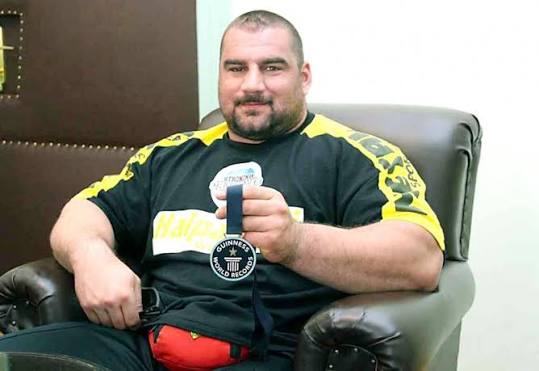
Yet 2009 did not become a lost year. Katona recovered quickly enough to compete at World's Strongest Man in Malta. He did not qualify for the final, finishing fourth in a six-man group, but the event-by-event results show that he was already competitive again: he completed the progressive deadlift ladder up to 363 kg and placed third in that event, and he was also third in the truck pull and carry-and-drag. In October he won SCL Spain in Los Barrios, confirming that the comeback was more than symbolic. Earlier that year he had also set a Guinness World Record in Milan by restraining a 980 kg vehicle on a 45-degree incline for 1 minute 2 seconds. Katona himself distinguished that record from a multi-event sporting result, but it expanded his public profile and underlined one of his preferred qualities: static strength under sustained tension.
In 2010 Katona converted years of experience into his strongest combination of circuit success and World's Strongest Man performance. He won three SCL stages, in Bulgaria, Serbia and Slovakia, reached the podium in the Netherlands and finished second overall in the series with 106 points behind Terry Hollands. The Slovakia victory came soon after WSM, and IronMind noted that his hands had recovered from the punishment of the world championship and that he was again able to show his true level. The schedule itself was extreme. Katona said in interviews that at his peak he might enter fifteen to eighteen competitions in a year. Once the season was underway, traditional training became largely maintenance between contests, because there was simply not enough time to rebuild from scratch every week.
The high point was the 2010 World's Strongest Man final in Sun City, South Africa. Katona qualified for the final for the first time and placed seventh of ten, the best WSM finish of his career. His event results reveal the all-round profile that made the achievement possible: seven repetitions in the car deadlift, 35.8 metres in the frame carry, 155 kg in the max log, eight kegs over the bar in 41.69 seconds and three Atlas stones in the final. He did not win an event, but he scored enough across the contest to remain in the middle of the world's best field. Later that year, at Giants Live Turkey, he also pressed a 185 kg axle and completed fifteen repetitions in the car deadlift. The 2010 season established beyond doubt that Katona was not merely an SCL points specialist. He could perform on the sport's most visible stage as well.
The 2011 season represented the peak of Katona's career as a circuit athlete. He opened with third at SCL Lapland, placed fourth at FIBO and then won SCL Serbia in Novi Sad. He finished third in Finland, second in the Netherlands and then narrowly won SCL Bulgaria ahead of Vytautas Lalas. IronMind reported that the Atlas Stones decided the contest: Katona completed all five stones in 17.93 seconds, while Lalas finished in 18.42, leaving only the smallest margin in the overall points. Katona later won the Canary Islands stage as well. Even when he did not win, he remained near the podium, and that consistency created the decisive advantage in a season-long championship.
When the season was finally completed with the Sarajevo final in February 2012, Katona was the overall Strongman Champions League champion with 201 points, ahead of Žydrūnas Savickas and Laurence Shahlaei. The title was not simply the sum of several good placings. SCL demanded repeated adaptation to travel, weather, surfaces, event equipment and short recovery windows. Katona was almost perfectly built for that environment. In interviews he said that he did not view himself as the world's best in one isolated discipline, but that he had very few genuinely weak events. The data supports him: across the same period he won Viking Press, Front Hold, Frame Carry, Truck Pull, Log Lift and Atlas Stones in different contests. His championship was the statistical expression of versatility and durability.
Also in 2011, Katona produced one of the most visually striking performances of his career. Guinness World Records confirms that on 17 August, on the set of the CCTV Guinness World Records Special in Beijing, he covered 20 metres while carrying a 300 kg barbell on his shoulders in 8.15 seconds. The task resembles a yoke race, but a barbell placed directly across the shoulders creates additional bounce and instability. The athlete must accelerate without allowing the load to oscillate out of control, keep the trunk rigid enough to transfer force and still move the feet fast enough to turn extraordinary strength into speed. The 8.15-second mark therefore reveals much more than raw load-bearing ability. It captures the combination of power and movement that made Katona effective in dynamic events.
Performances of this kind also explain how elite strongman intersected with entertainment during that era. Top athletes were not only competitors in formal championships; they also appeared in Guinness formats, television specials and public demonstrations of strength. Katona moved naturally between those spaces. His Milan vehicle-restraint record in 2009 and Beijing shoulder-carry record in 2011 gave casual viewers images that were instantly understandable without needing a six-event points table. For someone who did not follow strongman, 'holding back 980 kg on an incline' or 'carrying 300 kg for 20 metres in 8.15 seconds' communicated extreme strength immediately. These appearances widened his public recognition beyond the SCL and WSM audience.
After finishing seventh in 2010, Katona qualified for the World's Strongest Man final two more years in succession. In 2011 at Wingate University in North Carolina he placed tenth. The final position was lower than the year before, but the repeat qualification carried real weight in an extremely competitive period. IronMind photographs from the 2011 event show him in loading races, where an athlete of his size had to turn body mass into speed and coordination. That contrast is central to WSM. Competitors cannot survive on static strength alone; they must run with sacks, carry frames, throw kegs and load stones under time pressure. Katona's ability to reach a second straight final while simultaneously contesting the entire SCL season illustrates the extraordinary competitive workload he could tolerate.
He returned to the final again in 2012 in Los Angeles and placed tenth once more. Individual events still produced significant markers. In the Max Log Lift he pressed 185 kg, the highest competition log listed for him by Strongman Archives and the same weight recorded at the 2011 World Log Lift Championships. In qualifying he won the Keg Toss in his group, clearing eight kegs in 47.63 seconds. The final event selection, however, was less favourable, with natural stones, bus pull, yoke and power stairs arriving at a point when accumulated seasons and injuries were increasingly relevant. Three consecutive WSM finals nevertheless remain one of the core achievements of his career. They establish him not merely as a regional leader or SCL specialist, but as an athlete who repeatedly earned a place among the ten strongest men in the world's most recognisable strongman contest.
Away from WSM, the 2012 season showed that Katona remained highly competitive across Europe. In May he won SCL Serbia in Novi Sad in an eleven-man field. In June he finished sixth of twelve at Europe's Strongest Man in Leeds, where his results included a 390 kg max deadlift, second place in the frame carry with 30.65 metres and a solid overhead medley performance involving a dumbbell, axle and block press. In July he placed second at SCL Portugal and third at SCL China. Those results matter because they show that the 2011 title was not followed by immediate decline. He was already a veteran, but could still press, move and score against a younger international field.
At the 2012 Arnold Europe in Madrid, Katona finished eighth of ten in a very heavy contest. The event data are valuable for understanding his strength profile: a 400 kg max deadlift, 162.5 kg log lift, 68.04 seconds in the front hold and 14.29 seconds in the farmer's walk. The 400 kg deadlift is one of his clearest verified competition numbers and aligns with the 400 kg personal best reported in Serbian biographical material. Not every number from promotional sources should be treated as an identical official record, however, because rules and equipment varied. For this profile, Strongman Archives results are treated as competition results, while reported squat and bench numbers are labelled as personal bests rather than automatically upgraded to formal records.
In 2013 Katona produced one of his last seasons with several major victories. He won SCL Serbia in Novi Sad with 63 points, ahead of Martin Wildauer and Dainis Zageris. The event breakdown shows how complete that win was: first in the Viking Press with twelve repetitions, first in the Frame Carry, first in the Arm Over Arm Pull and second in the Front Hold. Only the deadlift and weight throw cost him meaningful points. It was an almost textbook example of his competitive model. Katona could win a contest without necessarily producing the heaviest single maximal lift because he recovered points through pressing, moving, pulling and static endurance. In a multi-event points system, that balance often matters more than one spectacular event win.
Later in the season he won SCL Hungary in Budapest and the SCL World Truck Pull Championships in Kauhava, Finland. The truck-pull title carries particular significance because the event is one of strongman's defining spectacles. It requires body mass and posterior-chain strength, but also foot rhythm, trunk angle, traction, breathing and the ability to keep applying force after the initial acceleration. For an athlete best known publicly for pressing and static strength, winning a championship built around truck pulling further confirms his versatility. The season also contained weaker placings, evidence that age and accumulated wear were beginning to matter, but the ceiling remained extremely high when the event mix suited him.
By 2014 Katona had more than a decade of international strongman behind him, yet he was still winning. He opened the year with victory at SCL Martinique, placed third at SCL FIBO, second at SCL Serbia and reached additional podiums in Hungary, Zambia and Romania. In July he won SCL Croatia in Split. Strongman Archives lists him second at SCL Hungary, and the database's Viking Press records credit him with sixteen repetitions at 155 kg there, a performance that still ranks very highly historically for that loading range. He also finished second at SCL Romania in Sibiu. Remaining this competitive after years of fifteen-plus-contest seasons and major injuries is one of the strongest indicators of his physical durability.
The 2015 season is the final year indexed for Katona by Strongman Archives. He appeared at SCL Norway, FIBO, Holland and Bulgaria and also competed at Força Bruta in Rio de Janeiro, where he finished fourth of five. The victories no longer came with the frequency of 2010–2014, but the end of the record closes an unusually dense career: 120 international contests from 2002 to 2015. In strongman, a contest start is not comparable to a single match in many other sports; each appearance may contain five or six near-maximal efforts, loaded sprints and awkward lifts. The cumulative exposure is enormous. His retirement after 2015 is therefore best understood as the natural conclusion of a body that had absorbed more than a decade of professional strongman stress.
When Katona's event results are viewed together, his profile becomes clear. Overhead pressing was one of his greatest weapons. He lifted 185 kg in the Max Log at the 2012 World's Strongest Man final and the same weight appears in the 2011 World Log Lift Championships. At Giants Live Turkey in 2010 he pressed a 185 kg axle. At SCL Serbia in 2011 he produced twenty-two Viking Press repetitions and won the event, while at SCL Hungary in 2014 he completed sixteen repetitions at 155 kg. Those numbers fit both his bench-press background and his stated preference for pressing events. Yet he was never simply a static presser. He won frame carry, arm-over-arm and truck-pull events and regularly scored well in farmer's walk and yoke variations.
The Front Hold was another event in which he repeatedly produced elite results. Strongman Archives records times above a minute on several occasions, including 71.41 seconds at SCL Finland in 2011, 69.15 seconds at SCL Russia in 2012 and 68.04 seconds at Arnold Europe that same year. He also showed major pulling strength: 400 kg in the Arnold Europe max deadlift, 390 kg at Europe's Strongest Man and fifteen repetitions in a car deadlift at Giants Live Turkey. Atlas Stones could vary from a difficult event to a decisive strength; in Bulgaria in 2011 he loaded all five stones in 17.93 seconds to secure the contest. The common theme is range. There were better specialists in individual events, but very few holes in his overall competition profile.
Katona gave unusually clear descriptions of his preparation in interviews. He said the foundation was a blend of powerlifting and weightlifting, layered with separate strongman-event practice. The logic is straightforward: powerlifting develops maximal force in the squat, bench and deadlift; weightlifting contributes explosiveness and coordination; strongman training teaches the body to apply those qualities to logs, stones, frames, vehicles and awkward objects. He usually trained four or five times per week for two to three hours, and strongman sessions could last longer. Those were not continuous three-hour lifting marathons. They involved setting up implements, multiple warm-ups, long recoveries between heavy efforts and repeated technical adjustments.
His annual structure was equally demanding. Early in his career the season lasted only four or five months, but as SCL expanded it could begin in March or April and continue until November. December became the period in which he deliberately reduced weights and tried to allow painful knees, elbows and joints to recover. Serious preparation resumed in January. Once competition season began and contests arrived almost every week, strongman practice was reduced rather than increased; the goal was to maintain the form built in winter, not chase new adaptations between flights. That pragmatic separation between building and maintaining was one of the reasons he could survive long seasons without turning every training session into another competition.
Professional strongman is a sport in which injury is not an exception but a permanent risk. Katona spoke openly about the pain that accumulated in his knees, elbows and joints near the end of each season, while the 2009 biceps tear provides the clearest example of his vulnerability. For an athlete who sometimes competed twice in a month or even more frequently, recovery could never be perfect. Every stage added tissue stress, while long travel reduced sleep quality and control over food and hydration. A heavy yoke compressed the spine and hips; farmer's walks loaded the hands, shoulders and trunk; log and axle pressing stressed the elbows and shoulder girdle; stones and deadlifts exposed the biceps and back to awkward positions. That Katona continued to 2015 after more than one hundred international contests suggests not an absence of pain, but an unusual ability to manage it well enough to remain competitive.
In his Univerzitetski odjek interview, Katona warned younger athletes that strongman could be extremely risky if basic rules were ignored. The message was practical rather than romantic. His generation learned many things directly through experience, often with less access to physiotherapy, sports medicine and monitoring than elite athletes have today. He still emphasised work, willpower and patience, but he also acknowledged danger. That combination matters to his legacy. Strongman imagery can suggest that success comes from aggression and fearlessness, yet a long career requires the opposite as well: discipline, technical caution and knowing when not to chase another maximal effort. Katona was not injury-proof. His achievement was returning repeatedly after the body had reminded him of the sport's cost.
Katona described his lifestyle in terms that were almost monastic. The entire day revolved around training: time in the gym, then eating and resting so that he could repeat the process the next day. For an athlete around 147 kg, maintaining body mass and recovery required a large and consistent food intake. He did not leave behind a detailed public nutrition protocol that can be reconstructed responsibly, so any attempt to invent precise meal plans would go beyond the evidence. What the sources do establish is that he treated eating and sleeping as parts of training rather than as secondary habits. In a 2012 interview after a European strongman cup victory, he summarised the principle by saying that a person had to live like an athlete for twenty-four hours a day, not only during the workout.
That philosophy helps explain how he sustained such a high number of competition starts. Recovery was not just an occasional day off but a daily discipline. For very heavy strongmen of the era, simply living at 145–150 kg added cardiovascular and metabolic strain, while international travel complicated everything further. Katona did not build a modern social-media identity around recovery technology, but his practical approach was sound: eat enough, sleep, build the hard fitness before the season, and avoid trying to progress maximally between competitions. The absence of complicated language should not obscure the intelligence of the method. It was a veteran athlete's solution to the problem of surviving a schedule that gave the body almost no natural reset.
Katona's private life became more visible publicly around 2010. Serbian media presented Marija as his long-term partner and his main source of support away from competition. A Blic article from February 2010 reported that they had been together for roughly six years and were living together; later Pansport material introduced them as Ervin and Marija Katona and described Marija as a body-fitness competitor. She had been a finalist at the women's European Championship held in Novi Sad that year. Their shared sporting environment matters because the life of a professional strongman involves far more than hours in a gym. Travel, food, injuries, money and calendar decisions affect the household around the athlete. Contemporary reports suggest that Marija was also involved in managing the gym, especially while Ervin was away competing.
The gym in Subotica became a central project in their lives. In 2010 Serbian media reported that it had opened around six months earlier, while a 2019 local feature still presented Katona as an entrepreneur and gym owner who offered advice to people training there. To him, the gym was more than a business. Earlier biographical material records that he regarded owning a training facility as one of his greatest personal achievements. The reason is easy to understand. A strongman who had begun in an environment where specialised implements were difficult to access had created his own permanent base. After retirement from the international circuit, that base also allowed his knowledge to remain useful to the local strength community.
In 2010 Ervin Katona entered the Serbian celebrity edition of Big Brother and finished fifth after twenty-eight days. The episode may look peripheral to his athletic career, but it matters when considering how strongman was perceived in the region. Katona already had significant international results, yet the sport did not enjoy the visibility of football or basketball. Appearing on reality television placed him in front of an audience that did not watch Eurosport or follow SCL results. In interviews after leaving the house, he said he had never expected to win and that the experience allowed viewers to see more than an intimidating physique. Serbian coverage repeatedly emphasised the contrast between his roughly 150 kg body and a personality described by people close to him as calm and kind.
The exposure also had a practical purpose. Marija told Serbian media that despite representing the country internationally, Katona did not receive enough domestic support and was looking for sponsors. Strongman was expensive: travel, recovery, food, equipment and time away from normal work created constant financial pressure. The reality show therefore gave a niche athlete access to a broader platform at a moment when public recognition could translate into sponsorship, clients for the gym or media opportunities. The episode illustrates a reality shared by many strongmen of his generation: even a WSM finalist and series champion often had to build the financial structure of a professional career personally.
Katona is also an interesting example of sporting identity in Vojvodina. His name, Subotica's multicultural environment and sources that describe him through both Serbian and Hungarian cultural frames reflect a region where ethnic and national identities overlap. In international strongman competition, however, he represented Serbia, and contemporary result databases list him under the Serbian code. That representation became central to his sporting image. Serbia did not possess a global strongman tradition comparable to Lithuania, Poland or the Nordic countries, so for many years Katona was the country's most visible athlete in the discipline. When he won SCL Serbia or reached the World's Strongest Man final, the result carried a wider symbolic meaning: an athlete from a smaller infrastructure could stand directly against the established centres of the sport.
That regional role can also be seen in the number of SCL events staged in Serbia in cities such as Subotica, Belgrade and Novi Sad. Having a local athlete of Katona's calibre gave promoters a clear home favourite. He was second in Subotica in 2008, won SCL Serbia in Belgrade in 2010 and then won again in Novi Sad in 2011, 2012 and 2013. Repeated home victories helped turn strongman from an imported spectacle into a sport with a recognisable national protagonist. Even after his retirement, Katona's name remained a reference point in Serbian coverage of strength sport history.
To evaluate Katona fairly, the quality of his opposition must be considered. His peak seasons overlapped with Žydrūnas Savickas at or near his dominant best, with Terry Hollands and Laurence Shahlaei as major circuit figures, and with elite athletes such as Vytautas Lalas, Brian Shaw, Hafþór Björnsson, Mikhail Koklyaev, Andrus Murumets and Krzysztof Radzikowski. Katona did not possess Savickas's absolute pressing power or the size of later giants such as Shaw, but he compensated through balance and competitive availability. Finishing runner-up in the SCL twice and winning the series once in fields of that quality is a stronger achievement than the words 'series champion' convey on their own.
His rivalry with Savickas is particularly instructive. In 2008 Katona finished second to the Lithuanian in the SCL standings and lost the Constanța contest by only half a point. In the 2011 season the order reversed, with Katona collecting 201 points and finishing ahead of Savickas. That does not mean Katona was simply 'stronger than Savickas' in an absolute sense that year. Series tables reward attendance and consistency, and athletes build different calendars. It means that under the competition system both entered, Katona produced the most effective season. Preserving that distinction is essential in serious historical analysis.
Sources on Katona contain several different types of strength numbers and they should not be treated as interchangeable. Strongman Archives documents competition results such as the 185 kg log, 400 kg deadlift and 185 kg axle press. Pansport, by contrast, published a personal-best list including a 400 kg squat, 300 kg bench press and 400 kg deadlift. Strongman.org later featured a 2013 training performance of 230 kg for four bench-press repetitions. These figures can all be true without belonging to the same verification category. A gym personal record can be legitimate without being a formally judged competition lift, while a strongman deadlift may use different handles or apparatus from a powerlifting deadlift.
The Guinness performances form a third category and are the most clearly externally documented special records. Guinness World Records officially confirms both the 2009 Milan vehicle-restraint performance and the 2011 Beijing 300 kg shoulder carry. They are not 'strongman world records' in the narrow sense of an SCL or WSM event table, because they were created in special record formats. Their value lies in independent measurement and in their visual clarity. Similarly, the sixteen Viking Press repetitions at 155 kg from SCL Hungary in 2014 appear in a historical Strongman Archives event ranking, giving them a useful comparative context. A professional profile should keep these categories separate rather than flattening them into one list of supposedly equivalent records.
After the final internationally indexed season in 2015, Katona did not disappear from the strength-sport environment. A 2019 Moj Novi Sad feature presented him in his own gym, speaking about sport, competitions and lifestyle. The description of him as an entrepreneur and gym owner indicates that his post-competition transition remained connected to the world in which he had developed. This continuity matters. The technical knowledge built through hundreds of strongman events is difficult to transfer fully through written programmes. Details of yoke position, truck-pull rhythm, log clean efficiency or medley pacing are forms of practical knowledge best learned through direct experience.
His legacy is cultural as well as competitive. For Serbian audiences, Katona was simultaneously an elite athlete, television personality, entrepreneur and representative of a sport without a massive domestic infrastructure. He demonstrated that an athlete from Subotica could reach the Arnold Classic, World's Strongest Man and SCL podiums around the world. At the same time, his interviews exposed the work beneath that image: long training hours, food, rest, injuries, financial pressure and the search for sponsors. His biography therefore becomes more than a list of placings. It is also a portrait of how professional strongman developed in Central and South-Eastern Europe during the 2000s.
Viewed as a whole, Katona's career rests on four pillars: competitive volume, versatility, longevity and genuine elite results. He was the overall Strongman Champions League champion, a three-time World's Strongest Man finalist, a winner of stages across multiple countries and continents and a Guinness World Records holder. Just as important, he accumulated an exceptional number of starts during a transitional era in professional strongman. He may not be the first name raised in discussions of absolute all-time records, but he was one of the athletes who made a dense international circuit possible: the competitor who arrived, scored, travelled and returned the following week. In that sense, Katona is one of the defining figures of early Strongman Champions League history.
This profile is built by cross-checking several source types. Strongman Archives provides the main competition chronology, placements and event results. Guinness World Records verifies the 2009 and 2011 records. IronMind offers contemporary reporting on SCL, World's Strongest Man and the 2008 Romanian stage. The Univerzitetski odjek interview provides Katona's own account of his beginnings, training and competitive philosophy. Serbian newspapers and local Subotica and Novi Sad publications provide context on his personal life, gym and television appearances. Pansport and Strongman.org add information on reported personal records and bench pressing. Where sources disagree, competition databases are preferred for contest facts and biographical claims are stated cautiously rather than forced into false certainty.
Pressing was probably the area in which Katona's gym strength transferred most directly to strongman. Heavy bench pressing gave him substantial triceps, chest and shoulder strength, but overhead events demanded much more than raw pushing power. The log carries its centre of mass forward and must usually be cleaned to the chest before the press. The axle is thick, difficult to grip and often requires a continental clean. The Viking Press turns overhead strength into repeated work in which rhythm and breathing can matter almost as much as a maximal single. Katona succeeded across all three. A 185 kg log, a 185 kg axle and very high-repetition Viking Press sets are not expressions of one identical skill. They show the ability to adapt pressing strength to different implements and energy demands.
His pressing was also not merely maximal. Winning sets of twelve, sixteen or even twenty-two Viking Press repetitions reveal a combination of relative strength, technique and tolerance for rapid fatigue. In high-repetition overhead work, an athlete who over-locks every rep or wastes time resetting the breath can exhaust himself quickly. Katona appears to have found an efficient rhythm in which each repetition satisfied the referee without costing unnecessary energy. That kind of movement economy is difficult to see in a simple results table, but the repeated event wins across several seasons show that the pattern was real. Pressing remained one of the stable anchors of his career from the IFSA period almost to the end of his SCL years.
The basic-strength numbers attributed to Katona should be read carefully, but together they describe a very strong athlete even outside strongman implements. Pansport published a 400 kg squat, 300 kg bench press and 400 kg deadlift as personal bests. Of those, the 400 kg deadlift is independently supported by his Arnold Europe 2012 contest result. The 300 kg bench is consistent with sources describing him as a competitive powerlifter and with the 230 kg for four repetitions training performance shown in 2013. The 400 kg squat appears as a reported personal best rather than a separately verified powerlifting result. The evidentiary categories differ, but the broader conclusion is stable: his strength base was large enough to support international-level performance on the heaviest strongman events.
His deadlifting illustrates the difference between powerlifting and strongman particularly well. The results database includes maximal pulls, car deadlifts, repetition events and progressive ladders. In the 2009 WSM qualifying group he completed all seven lifts in a ladder rising to 363 kg. At Giants Live Turkey in 2010 he performed fifteen repetitions in the car deadlift. At Europe's Strongest Man in 2012 he lifted 390 kg, and at Arnold Europe he reached 400 kg. Those results demand different qualities: maximal force, repetition endurance and adaptation to handle height and apparatus. Being competitive in all of them explains why the powerlifting base mattered, while also showing why it was never sufficient on its own.
One of Katona's most interesting traits was his ability to move efficiently at roughly 145–150 kg bodyweight. Frame carries, farmer's walks, yokes and loading races require short, fast steps, control of implement swing and enough trunk stiffness to stop energy leaking through unnecessary motion. Katona won frame-carry events, placed well in farmer's walks and yokes and ultimately set the Guinness mark of 8.15 seconds over 20 metres with a 300 kg barbell across his shoulders. That performance is perhaps the clearest public demonstration that his size did not make him slow. He could accelerate while carrying loads that would immobilise most trained lifters.
Moving events also had strategic value for him. If a contest contained pressing and static holds, where he was especially strong, a respectable farmer's walk or frame carry prevented him from giving those points back immediately. Katona acknowledged that he preferred strength and static events, but he also said he performed well in the faster disciplines. That balance is visible in his best seasons. Championship points did not come from one type of effort. The mobility of a 147 kg athlete multiplied the value of his strength and made it much harder for lighter, faster competitors to create separation.
Front Hold appears so frequently among Katona's best event results that it deserves separate attention. The event looks simple: an athlete holds a load at arm's length in front of the body, usually around shoulder height, for as long as possible. In practice it combines deltoid endurance, trunk rigidity, grip, pain tolerance and exact positional discipline. A small drop in arm angle can end the attempt, while every second makes a fixed load feel progressively heavier. Katona repeatedly won or placed near the top in the event and produced times above one minute. At SCL Finland in 2011 he recorded 71.41 seconds; later results include 69.15 seconds at SCL Russia and 68.04 seconds at Arnold Europe in 2012. Those are not accidental performances. They show that static endurance was a genuine specialist strength within his otherwise broad skill set.
Static holds also suited Katona's competitive temperament. Unlike a truck pull or frame carry, they offer almost no technical escape once the clock begins. The athlete knows the implement is not changing, yet the body experiences an accelerating sense of failure. Success becomes a negotiation with discomfort measured in seconds. In a close SCL contest, a ten-second advantage in a hold could be as valuable as a dramatic event win elsewhere. Katona turned that type of work into a reliable scoring weapon. Combined with his pressing, it meant opponents often entered a contest knowing that several upper-body events were likely to favour the Serbian, forcing them to recover points in deadlift, stones or moving events.
Atlas Stones, strongman's most recognisable finishing event, produced both difficult days and decisive victories for Katona. In the 2010 World's Strongest Man final he loaded three stones from the 100–180 kg series and finished at the bottom of that event, showing that stones were not always his most profitable discipline against the absolute elite. One year later at SCL Bulgaria, however, he loaded all five stones in 17.93 seconds and won the event, beating Vytautas Lalas by less than half a second. That run secured the overall contest victory. The contrast demonstrates why stone results cannot be interpreted only as a measure of back or arm strength. Platform height, stone diameter, tacky, sequence and transition speed can transform the event from weakness to weapon.
Loading races and medleys demanded the same adaptability. In 2009 WSM qualifying he placed third in the carry-and-drag, and across the SCL calendar he repeatedly handled combinations of farmer's walks, tyres, kegs, frames and awkward objects. For an athlete of his mass the challenge was not simply to move quickly but to control oxygen debt. A loading event performed fourth or fifth in a contest punishes every inefficient pick, turn and transition. Katona was not remembered primarily as a loading specialist, yet his ability to remain technically competent under fatigue helped protect the points won through pressing and holds. His career is a reminder that in strongman, a 'weak' event at world level can still be objectively exceptional.
The 2008 Strongman Champions League contest in Constanța, Romania, works almost as a miniature version of Katona's career. After two days and eight events, Žydrūnas Savickas had 83.5 points and Katona had 83. IronMind reported that the final barrel-loading event was separated by only 0.20 seconds. Across such a long contest, half a point means that nearly every rep, transition and minor placing mattered. Katona had not produced a single miracle event that erased a large deficit. Instead, he stayed close enough across the entire programme that the greatest strongman of the era could not create meaningful separation. That was the essence of Katona's best years: an opponent might beat him in one event, but had to keep beating him because the Serbian rarely surrendered a large block of points.
The Constanța stage also matters in the regional history of strongman. Romania was developing its own organised scene, and local athletes shared the field with international stars. Katona arrived from neighbouring Serbia not simply as another visitor but as a model of what a Balkan athlete could become inside the global circuit. His near-victory over Savickas gave the audience a contest that was both internationally elite and geographically close to home. SCL's expansion through places such as Constanța, Subotica, Novi Sad and Sofia helped build a network of Eastern and South-Eastern European strongman culture, and Katona was one of the athletes who connected those venues season after season.
Katona's seventh place at World's Strongest Man in 2010 deserves more attention than the number alone receives. A WSM final differs fundamentally from a long league season. There is no reward for appearing at many events, no opportunity to recover points over several months and no guarantee that the event selection will match an athlete's strengths. A poor result in one discipline can drop a finalist several places immediately. Katona entered that environment after years spent partly in the IFSA ecosystem and after missing the 2009 final. Qualifying and then finishing seventh demonstrated that his SCL consistency translated into the sport's most visible tournament format.
The performance was also significant for Serbian strongman. World's Strongest Man carried a level of public recognition that even a full season of SCL results could not always match. Becoming a WSM finalist gave Katona a simple, universally understood credential when he returned home: he had competed among the final ten. That legitimacy reinforced everything that followed. The 2011 SCL title was not an isolated regional success but the championship of an athlete who had already demonstrated his level at WSM. In historical terms, seventh place became the bridge between his reputation as a durable circuit competitor and his reputation as a genuine world-class strongman.
Katona's record in Serbian SCL stages is striking. He was second in Subotica in 2008, then won in Belgrade in 2010 and in Novi Sad in 2011, 2012 and 2013. Home advantage in strongman is practical rather than magical. Avoiding long flights can improve sleep, digestion, mobility and hydration, all of which matter for an athlete close to 150 kg. Familiar language and surroundings reduce logistical stress as well. Yet the advantage is paired with pressure. Katona was the athlete local spectators expected to challenge international stars, so every mistake carried more emotional weight. Repeated victories show that he handled that expectation rather than shrinking under it.
The 2013 victory is especially informative because the event results are detailed. Katona won the Viking Press, Frame Carry and Arm Over Arm Pull, placed second in the Front Hold and limited damage in the deadlift and weight throw to finish on 63 points. That was not a contest rescued by one favourable discipline. It was a balanced win created by four high-value events and competent work elsewhere. Repeated home victories also mattered for the growth of the sport. A domestic audience is more likely to return when it has a recognisable local champion, and Katona gave Serbian promoters that figure for several seasons.
After the 2011 championship, Katona entered a different phase of his career. He was no longer the athlete trying to prove that he belonged at elite level; he was the veteran younger competitors had to beat. During these years athletes such as Hafþór Björnsson, Krzysztof Radzikowski, Martin Wildauer, Dainis Zageris and later Matjaž Belšak became increasingly prominent. Many were younger, taller or built around the evolving demands of modern strongman. Katona did not reinvent himself completely. Instead, he leaned on experience, efficient technique and the ability to identify where points could be won without wasting energy.
The results show a veteran who was less dominant across entire seasons but still capable of winning individual contests. He won three notable SCL competitions in 2013 and two more in 2014, with additional podiums in Serbia, Hungary, Zambia and Romania. This is a different form of excellence from the 2011 championship. It depends less on controlling the whole calendar and more on experience, pacing and the ability to recognise a favourable event set. Katona could no longer assume that durability alone would separate him from younger rivals, yet on the right weekend he remained capable of beating them outright.
Katona's 2013 SCL World Truck Pull Championships victory offers an excellent case study in applied strength. A truck pull is not simply a matter of pulling as hard as possible. The start requires enough force to overcome inertia, after which the athlete has to convert that initial surge into short, consistent steps. Trunk angle must remain low enough to transmit force through the harness but not so low that stride length collapses. The rope introduces an additional upper-body rhythm, while breathing becomes progressively more difficult as the vehicle accelerates. Katona was competitive in truck pulling across several seasons, including solid results at World's Strongest Man and SCL events.
The dedicated truck-pull title therefore confirms something that gym numbers alone cannot show. A 400 kg deadlift explains part of the engine, but it does not guarantee that an athlete can move a vehicle efficiently. Foot mechanics, traction, ankle mobility, hip position and the ability to keep producing force when speed disappears all matter. Katona had enough event experience to turn what is often a survival event into a scoring opportunity. That is one reason descriptions of him as merely a presser or static-strength athlete are incomplete.
The list of places in which Katona competed reads almost like a map of international strongman in his era: Serbia, Bulgaria, Slovakia, Romania, Hungary, Finland, the Netherlands, Germany, Portugal, Spain, Lithuania, Russia, Ukraine, Canada, the United States, Brazil, South Africa, South Korea, China, Malaysia, Zambia, Martinique and more. For an athlete close to 150 kg, travel itself was a performance variable. Airline seats, limited legroom, time-zone changes, unpredictable access to food and dehydration could all influence the body before a contest. A few hours of poor sleep become meaningful when the next task is a 400 kg yoke or maximal deadlift.
Katona's ability to perform repeatedly in that environment should be considered part of his athletic achievement even though it never appears in a score sheet. Strongman Champions League was conceived as an international touring series, and the champion had to be both strong and available. Katona became one of its most dependable competitors because he could appear in Finland one week, the Balkans soon after and another continent later in the season without disappearing from the points race. That availability probably added to long-term physical wear, but during his peak years it transformed consistency into a measurable competitive advantage.
Serbian reporting from 2010 offers a rare glimpse into the economics behind Katona's career. Marija explained that Ervin had international recognition but relatively limited support at home and was actively seeking sponsors. That situation was common for strongmen of the 2000s. Prize money was uneven, travel was constant and the cost of eating, training, rehabilitation and maintaining specialist equipment was substantial. An athlete could appear on international television and still lack the financial stability normally associated with the word 'professional'. Strongman careers were often assembled from several income streams rather than funded by a single contract.
Katona Gym can be understood partly in this context. The gym gave him a permanent training base but also an economic activity connected to the expertise he had developed. His Big Brother VIP appearance increased recognition at a time when greater visibility could attract sponsors and clients. The structure around his career therefore included competition, a gym business, media appearances, local partnerships and personal support. This entrepreneurial layer is important because it explains how strength athletes survived before social media, online coaching and modern content sponsorships created additional income opportunities.
A recurring thread in Serbian media was the contrast between Katona's physical appearance and the way people close to him described his personality. Around the period of Big Brother VIP, Marija noted that strangers sometimes found him intimidating simply because of his size, even though his everyday manner was much calmer than the visual image suggested. Strongman deliberately builds bodies that communicate mass and force, and televised contests compress athletes into a few dramatic minutes of effort. Reality television, interviews and local profiles allowed audiences to see a different rhythm: patience, humour, relationships and ordinary routines.
Those details are useful historically because strength sport is especially vulnerable to mythmaking. Athletes can become collections of bodyweights and records rather than people. Katona himself frequently emphasised the friendships he made through strongman and considered them one of the best parts of the sport. Rivalry did not exclude camaraderie. The same athletes met each other ten or more times during a season, travelled together and shared the unusual experience of preparing bodies for extreme tasks. This social dimension helps explain why many relationships from his generation lasted beyond competition.
The end of Katona's internationally indexed competition career in 2015 did not mean a clean break with strongman. In April 2016, Subotica.com reported that the former Strongman Champions League champion had become an SCL referee and was travelling to Brazil to judge at Arnold Classic Brasil. The report described him as having competed for roughly fifteen years and stated that he had begun officiating in the previous year. The transition is a logical one. Strongman refereeing often requires an intuitive understanding of unusual implements, lockout standards, control calls and the difference between a technically imperfect repetition and an unsafe one. A veteran of more than a hundred international contests carries an enormous library of such situations.
Officiating also changed the meaning of his continued presence at major events. As a competitor, Katona had been evaluated by referees under rules that could vary significantly across organisers and years. As a referee, he became part of the mechanism responsible for consistency and safety. The Arnold Classic Brasil appointment was symbolically fitting because he had competed at the Arnold Strongman Classic earlier in his career and had spoken positively about meeting Arnold Schwarzenegger. By 2016 his relationship to elite strength sport had shifted from proving his own strength to helping define valid performance for the next generation.
The first lesson is that versatility wins championships. Katona did not build a 120-contest international record around one exceptional event. He built it by reducing weaknesses. The second lesson is the value of a broad strength base. Powerlifting and weightlifting supplied foundational force and explosiveness; specific implement training converted those qualities into usable strongman performance. The third lesson is realistic periodisation. Katona clearly separated winter preparation from in-season maintenance. Once contests arrived almost weekly, the goal was no longer to set a personal record in every gym session. It was to preserve enough strength, speed and health to compete again.
A fourth lesson is that recovery is part of training. Katona discussed eating, sleeping and deliberately reducing weights in December as survival requirements, not luxuries. A fifth is the importance of infrastructure: owning a gym gave him control over his training environment and a professional identity beyond the podium. Finally, his career demonstrates mental consistency. Not every event was good and not every season ended with a title, but one poor stage did not automatically become a failed year. He returned from a torn biceps, from weak placings and from long stretches of travel. In a sport built around extremes, the ability to return may be as valuable as the ability to produce one perfect day.
Katona's career is also a useful case study in the mathematics of league strongman. A single contest can reward an athlete who is perfectly suited to five or six particular events. A season championship asks a different question: who can collect valuable points across many weekends and many event combinations? That distinction explains why Katona's lack of catastrophic weaknesses mattered so much. A specialist might win a log lift and finish near the bottom in a moving event, surrendering much of the gain. Katona more often remained clustered around the upper half of the field, with enough event wins to convert consistency into podiums.
His 2008, 2010 and 2011 SCL seasons illustrate three versions of the same competitive skill. In 2008 he was runner-up behind Savickas without needing to dominate every stage. In 2010 he won three stages and still finished second overall behind Terry Hollands, showing how much total participation and point accumulation mattered. In 2011 he finally combined victories with sufficient consistency to finish first in the championship. The progression is valuable because it shows that Katona learned the series as a system. He was not merely becoming stronger. He was becoming better at managing an entire competitive year.
The 2011 championship becomes even more impressive when placed between Katona's other major commitments. He entered the year as the reigning SCL runner-up and a WSM finalist, then immediately returned to the touring circuit. He placed on podiums, won stages in Serbia, Bulgaria and the Canary Islands, travelled repeatedly across Europe and still prepared for World's Strongest Man in the United States. The season did not end neatly in December; the final stage that confirmed the championship was held in Sarajevo in February 2012. In effect, his title campaign stretched across calendar years, compressing recovery before the next cycle had even begun.
That context explains why the 201-point total is more than an abstract statistic. Each point represented a performance produced after another flight, another heavy event and another recovery window. The title also arrived when Katona was in his mid-thirties, not at the beginning of adulthood. In strength sports, athletes can peak later than in speed disciplines, but the accumulated tissue stress of strongman remains substantial. His 2011 campaign therefore combined mature strength with a body that had already absorbed nearly a decade of international competition.
Strongman Archives currently credits Katona with 120 international contests and 25 wins. Older biographies often quote lower totals because they were written before the database was expanded or because they counted only selected circuits. The modern figure should therefore be understood as an indexed archival total rather than a number that was necessarily published during his active career. Even with that caution, the scale is exceptional. One hundred and twenty strongman contests can represent several hundred individual events, many performed at maximal or near-maximal intensity.
The total also helps distinguish longevity from mere duration. An athlete can technically have a ten-year career while competing only a few times per season. Katona's record was dense. At his own peak estimate of fifteen to eighteen contests in some years, competition itself became a major component of training load. That density explains why his legacy should not be measured only by championships. The capacity to remain selectable, healthy enough and internationally relevant through so many starts was itself a form of sporting excellence.
Ervin Katona remains important to strongman for two complementary reasons. The first is the résumé: the 2011 overall Strongman Champions League title, second-place series finishes in 2008 and 2010, three World's Strongest Man finals, a career-best seventh at WSM in 2010, wins across numerous countries, verified Guinness World Records and competitive appearances in IFSA, Arnold and Europe's Strongest Man. The second is the function he served in the sport's ecosystem. He was one of the athletes who gave the early SCL years continuity, one of the dependable names promoters could place on international start lists and a competitor who connected Serbian audiences to the global strongman circuit.
A one-line summary might call him an SCL champion and WSM finalist, but that description misses the texture of the career. Katona belonged to an era when strongman was globalising rapidly and athletes had to operate simultaneously as competitors, constant travellers, promoters of their own careers, entrepreneurs and public figures. He crossed the IFSA period, helped consolidate the Strongman Champions League, represented Serbia at the highest level, created a gym in Subotica and later remained involved as a referee. His legacy is ultimately that of a complete professional: not only powerful, but durable enough to become part of the sport's infrastructure.
The biceps tear Katona suffered at the 2009 SCL event in Subotica deserves to be treated as a turning point rather than a minor biographical note. The biceps is unusually vulnerable in strongman because many implements force the arm to stabilise load in positions rarely seen in conventional barbell training. Stones, tyres, farmer's implements, axle cleans and some deadlift variants can place severe stress on the tendon. For an athlete in the middle of a touring season, a tear can mean months away from specific events and a lasting loss of confidence in pulling. Katona nevertheless returned within the same year and reached World's Strongest Man in Malta, where he missed the final but remained competitive in the deadlift, truck pull and carry-and-drag.
More importantly, the injury did not close his performance window. He won SCL Spain later in 2009. The following season brought three SCL victories, second overall in the league and seventh at World's Strongest Man. Two years after the tear he became the overall SCL champion. Public sources do not provide enough medical detail to reconstruct the precise surgery, rehabilitation protocol or return-to-training timeline, and this profile does not invent them. What the results establish is more meaningful anyway: one of the major injuries of his career was followed immediately by the most successful period of his competitive life.
Owning a gym can look modest beside a World's Strongest Man final, but Katona Gym had deeper significance. Strongman requires space and equipment that ordinary commercial facilities often do not provide: logs, yokes, farmer's handles, stones, frames, tyres and areas where heavy implements can be dropped safely. Controlling a permanent base allows an athlete to repeat event technique until it becomes automatic. For Katona, who entered strongman when specialised implements were difficult to access in Serbia, creating such an environment represented genuine independence. The gym reduced dependence on temporary facilities and made year-round specific preparation more realistic.
After his competitive career, the same facility became a bridge between international experience and the local training community. A 2019 local feature still described Katona as a gym owner offering advice to people training there. Public evidence is not detailed enough to claim that he created a formal strongman academy with a documented roster of elite protégés, so this profile avoids that exaggeration. The more defensible conclusion is already substantial: a former SCL champion remained physically present inside Subotica's strength culture, with a place where knowledge accumulated through more than a hundred international contests could be shared directly.
Katona's career also belongs to the broader development of strongman in the Balkans. When he entered the sport in 2002, the region had far less specialised infrastructure and media coverage than the Nordic countries, Poland or Lithuania. Local organisers relied on public squares, improvised implements and regional sponsorships. International circuits such as SCL changed that environment by bringing established global athletes to cities in Serbia, Romania, Bulgaria, Croatia and Hungary. A local champion who could challenge those visitors made the events more than travelling exhibitions. Katona gave Serbian audiences a participant with a realistic chance to win.
His success therefore had an infrastructural effect even when he was not formally acting as a promoter. Every home victory created a reason for spectators, sponsors and local media to take the discipline seriously. His appearances in Romania, Bulgaria, Croatia and Hungary also made him a familiar regional figure rather than a distant celebrity. The strongman network of South-Eastern Europe grew through repeated contact: athletes crossed borders, organisers exchanged formats and spectators learned the names of events and competitors. Katona was one of the most persistent human links in that network during the period when it became increasingly professional.
Strongman history from the 2000s is not documented with the uniformity of an Olympic sport. Some contests survive with full event tables, others mainly through promoter reports, newspapers or archived websites, and personal records are often repeated without explaining whether they were performed in a gym, exhibition or judged competition. Even the total number of contests attributed to an athlete can change as databases recover older results. Katona is a good example: older biographies frequently quote lower career totals than the present Strongman Archives profile. That difference does not automatically make an older author unreliable. It often reflects a smaller archive available at the time.
The same caution applies to personal recollection. Katona's interview about his early bench-press career includes a printed year that is difficult to reconcile with his confirmed date of birth. Rather than hiding the inconsistency or choosing a convenient answer, this profile treats the broad claim as evidence of an early bench-press background while flagging the chronology as uncertain. Competition placements are prioritised from specialist databases and contemporary reports; Guinness records are taken from Guinness itself; personal philosophy comes from direct interviews; private-life details are kept to what local reporting actually supports. The goal is a rich biography without allowing repeated internet lore to harden into false certainty.
There is a temptation in strength sports to define athletes only by their largest number. That approach does not suit Katona. His historical significance is not captured by asking whether another athlete later pressed more, deadlifted more or moved a heavier yoke. His competitive identity came from repeatedly converting broad strength into points. The best evidence is the structure of his résumé: runner-up in SCL twice before becoming champion, three consecutive WSM finals, victories in different countries and on very different event sets, and a career long enough to overlap multiple generations. He was rarely dependent on one perfect implement.
That makes Katona an especially useful athlete for understanding strongman as a sport rather than a collection of records. The champion of a multi-event contest has to manage risk, order of events, fatigue and the probability of losing points. Katona's best seasons show those skills repeatedly. He could accept fourth or fifth in one discipline if it protected enough energy for an event he could win later. He could return after travel and injury without demanding that every appearance become a personal record. This strategic intelligence is difficult to quantify, but the repeated high overall placings are its evidence.
The central source for competition chronology is Strongman Archives, particularly the Ervin Katona athlete profile and its linked contest and record pages: https://strongmanarchives.com/viewAthlete.php?id=262 . The two special-record performances are verified through the official Guinness World Records entries for the fastest 20 metres carrying a 300 kg barbell on the shoulders and the longest time restraining a vehicle on an incline. Katona's own account of his kickboxing background, introduction to strength training, accidental entry into strongman, training structure and competitive philosophy comes principally from the Univerzitetski odjek interview: https://www.univerzitetskiodjek.com/intervju/sport/ervin-katona-samo-uz-snaznu-volju-dolaze-dobri-rezultati .
Contemporary Strongman Champions League reporting was cross-checked with IronMind, including its reports on the 2008 Romanian stage and Katona's 2010 victory in Slovakia. Serbian sources including Blic, Pansport and local Subotica and Novi Sad publications were used for his personal life, Big Brother VIP appearance, Marija, gym ownership and public image. Subotica.com's 2 April 2016 report documents his post-competition role as an SCL referee and his appointment at Arnold Classic Brasil. Strongman.org provides additional context for his heavy bench-press training. Using these different source types reduces dependence on any single secondary biography and makes it possible to separate competition facts, reported personal records and personal recollections.
When Katona's results are read chronologically, the career does not follow a simple pattern of rapid rise, brief peak and decline. The early years were about accumulation: a national title, access to international circuits and adaptation to the IFSA era. Strongman Champions League then provided the environment that matched his qualities. Second overall in 2008 proved that he could sustain a season; the 2009 biceps injury tested whether he could return; 2010 produced three SCL victories, second overall and the best World's Strongest Man final of his career. The 2011 championship therefore did not appear from a sudden burst of form. It was the result of a competitor who had learned the circuits, implements, travel demands and his own body well enough to treat each contest as a problem to solve rather than a gamble.
For that reason, the word that best describes his career is not 'record breaker', even though he held Guinness records and possessed impressive strength numbers, but 'competitor'. Katona was built for overall standings. He could win pressing, front hold, frame carry, truck pull or stones, yet just as importantly he could finish high enough when victory was unavailable. In a maximal lift the result is close to binary: the weight goes up or it does not. In a six-event contest success is an equation. Fourth place without an error may be more valuable than gambling everything for an event win and losing a large block of points. Katona's repeated season results suggest that he understood this logic instinctively. It is why his league record remained strong even as younger athletes and bigger absolute specialists entered the field.
His legacy can ultimately be read on three levels. Athletically, he is the 2011 Strongman Champions League champion, the 2008 and 2010 series runner-up and a three-time consecutive World's Strongest Man finalist with a career-best seventh in 2010. Professionally, he is one of the most prolific international competitors of his generation, with 120 indexed international contests, 25 wins, Guinness World Records and experience across nearly every major strongman format of the period. Regionally, he gave Serbia and Subotica a globally recognisable strongman figure, created his own training base and remained involved as a referee after retirement. Together those dimensions make him important not only for what he lifted, but for the continuity he gave the sport. Ervin Katona represents the kind of champion an international circuit depends on: strong, adaptable, present and durable enough to turn years of competition into a coherent sporting identity.
Iron Hall data
185 KG
Max Log Lift · 2012 World's Strongest Man; same value also indexed at the 2011 World Log Lift Championships
Verified
400 KG
Competition Max Deadlift · 2012 Arnold Europe
Verified
185 KG
Competition Max Axle Press · 2010 Giants Live Turkey
Verified
155 KG
Viking Press · 16 reps at 2014 SCL Hungary
Verified
400 KG
Squat — reported personal best · PB published in Pansport biographical material; not treated as an official competition result
300 KG
Bench Press — reported personal best · PB published in Pansport biographical material
2003
Katona's first major national title; the Niš contest established him as Serbia's strongest man.
1st / champion
2006
International victory in Belgrade in an 11-man field.
1st place
2006
Podium finish in Vienna on one of the major international circuits of the era.
3rd place
2007
An IFSA podium that confirmed Katona's international level before the SCL era.
3rd place
2008
Runner-up in the inaugural SCL season behind Žydrūnas Savickas; second in Serbia and Romania and third in Bulgaria and Finland.
2nd overall
2008
Finished only 0.5 points behind Žydrūnas Savickas after eight events; the contest was decided in the final barrel-loading event.
2nd place
2009
Appearance at one of the world's heaviest strongman contests in Columbus, Ohio.
8th place
2009
SCL victory in Los Barrios during the same season in which he returned from a biceps tear suffered in the spring.
1st place
2009
Restrained a 980 kg vehicle on a 45-degree incline for 1 minute 2 seconds in Milan on 25 April 2009.
World record
2010
His career-best WSM result and first qualification for a World's Strongest Man final.
7th place
2010
The first of his three SCL victories during the 2010 season.
1st place
2010
Victory in front of the Serbian crowd in Belgrade.
1st place
2010
His third SCL win of 2010, earned in Bratislava after returning from World's Strongest Man.
1st place
2010
Finished the season with 106 points, runner-up to Terry Hollands.
2nd overall
2011
Covered 20 metres carrying a 300 kg barbell on his shoulders in 8.15 seconds in Beijing on 17 August 2011.
World record
2011
Victory in Novi Sad during the season that would bring him the overall SCL title.
1st place
2011
Narrow victory over Vytautas Lalas; the Atlas Stones decided the contest.
1st place
2011
His third SCL victory of the 2011 season, in Gran Canaria.
1st place
2011
His second consecutive WSM final.
10th place
2011
Season champion with 201 points, ahead of Žydrūnas Savickas and Laurence Shahlaei; the season finale was held in Sarajevo in February 2012.
1st overall / champion
2012
Continued his run of home-country victories with another win in Novi Sad.
1st place
2012
A strong sixth-place result in Leeds against an elite international field.
6th place
2012
His third consecutive WSM final; lifted 185 kg in the Max Log Lift.
10th place
2013
Won in Novi Sad with 63 points, ahead of Martin Wildauer and Dainis Zageris.
1st place
2013
Victory in Budapest during a season in which he remained one of the circuit's most consistent athletes.
1st place
2013
Won the dedicated truck-pull championship in Kauhava, Finland.
1st place
2014
Victory in Fort-de-France early in the 2014 season.
1st place
2014
Victory in Split, underlining his competitive longevity more than a decade after his debut.
1st place
2014
A Romanian podium that became one of the final major results of his international career.
2nd place
2015
One of his final significant international appearances in the last indexed season of his career.
4th place