
2004
U105 Strongman World Championships – Imatra
World championship in Finland.
4th of 12
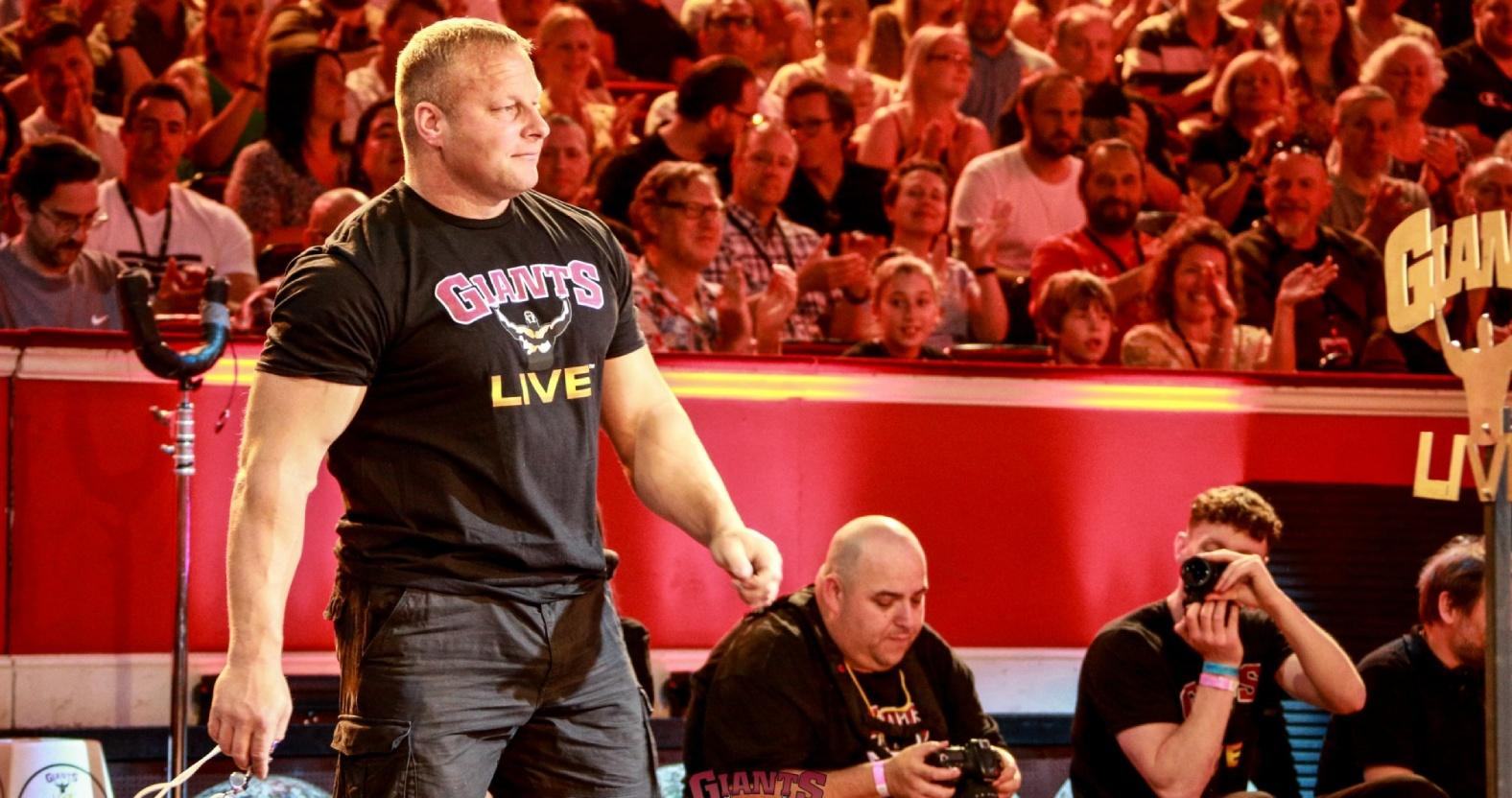
Iron Archives
2006 U105 World Champion • Four-time World's Strongest Man competitor • Giants Live co-founder
Retired athlete
Darren Sadler (born 22 March 1980 in Boroughbridge, North Yorkshire) is a retired British strongman, the 2006 under-105 kg world champion and a four-time World's Strongest Man qualifying-stage competitor (2006, 2007, 2009 and 2010). Standing 173 cm tall, the “Pocket Rocket” competed against open-weight heavyweights and finished third at Britain's Strongest Man in 2007. After building Absolute Fitness with his wife Jenna, he became a promoter, referee and Giants Live co-founder alongside Colin Bryce. His last documented contest was Britain's Strongest Man on 30 January 2016, where he placed sixth and won the Conan's Wheel.
Darren Sadler occupies a distinctive place in British strongman history because his contribution continued long after his final competitive lift. Born on 22 March 1980 and closely associated with Boroughbridge in North Yorkshire, he first established himself as an athlete. He became the under-105 kg world champion in 2006, appeared in the qualifying groups of four World's Strongest Man editions, and finished third at Britain's Strongest Man in 2007. His subsequent career as an entrepreneur, event promoter, referee and partner in Giants Live brought him into another part of the sport: creating the competitions in which later generations would perform. These careers should be examined separately before being considered together. A world title at U105 is a specific championship victory, whereas four WSM appearances refer to participation in the open-weight competition's qualifying stage; the available competition archive does not list a WSM final for Sadler. Both achievements matter, but they are not interchangeable. His reported height of 173 cm also shaped his public identity. Competing against men often considerably taller and heavier, he acquired the nickname Pocket Rocket. The nickname captures the audience's impression, while individual event results reveal the measurable athletic performance behind it. This profile brings together competition databases, the official Giants Live biography, regional reporting and institutional records. It distinguishes independently documented results from retrospective claims and limits discussion of private life to information already made public.
Boroughbridge is more than a biographical birthplace in the Darren Sadler story. It is the community with which his sporting beginnings, family business and later civic initiatives have remained associated. In a June 2024 interview with The Stray Ferret, Sadler recalled beginning to visit a gym at approximately sixteen because he wanted to lose weight. The article describes him as a strong child who had not been especially committed to organised sport. The official Giants Live biography places his introduction to lifting at seventeen. Rather than assuming that one account must be wrong, the distinction between first attending a gym and subsequently training in earnest offers a reasonable way to understand the two statements. Neither source supports an elaborate account of childhood athletic titles or a pre-planned route into professional strongman. What is documented is a gradual discovery of an aptitude for strength and a connection with the local sporting community. Despite later competing overseas and helping stage major arena events, Sadler retained a strong professional presence near his home town. His gym, Absolute Fitness, operates in Roecliffe, while reporting on Giants Live has described the event business as working from an office nearby. The subsequent Boroughbridge Sports Village proposal further illustrates this continuing local connection. These publicly verifiable links provide a fuller account of his background than speculation about schooling, relatives or private family circumstances.
A significant figure in Sadler's transition from general gym training to strongman was Dave Warner, himself a former World's Strongest Man competitor who subsequently became a familiar referee in the Giants Live environment. According to Sadler's account in The Stray Ferret, Warner recognised his potential while he was still training locally. Darren also recalled welding strongman equipment together with his father. This practical detail is revealing. During the late 1990s, specialist strongman implements were not as widely available in ordinary commercial gyms as they would later become. Athletes interested in moving beyond barbells often needed to locate, adapt or build equipment that reproduced the demands of competition. The account does not establish an exact training schedule or a catalogue of every homemade apparatus, so those details should not be invented. It does establish a connection between practical ingenuity and the earliest phase of his sporting life. It is tempting to read this experience as proof that he was always destined to organise events, but the sources do not support such a claim about his intentions. Its documentary significance is simpler: a young athlete prepared for a technically unusual sport with the encouragement of an experienced competitor and the help of his family, long before major arena production became his professional field.
The first contest Sadler identifies in his retrospective interview was East Coast's Strongest Man, held at Scarborough in 1998. At eighteen, he finished second. He reported having reached Britain's Strongest Man by 2001, indicating several seasons of domestic involvement before his internationally archived U105 results begin. This chronology requires care because Strongman Archives lists his active years as 2004–2016. That database is an invaluable record of documented competitions, but its starting year should not erase the earlier debut described by the athlete himself. For this profile, 1998 denotes the reported beginning of his competitive career and 2004 the first season of extensive international results in the archive. The intervening years are an important formative period, but their individual competitions, scores and methods cannot be reconstructed responsibly from the material presently available. Strongman is a demanding multi-event discipline. A successful competitor must adapt to loaded carries, static lifts, awkward objects, timed movement and repeated efforts over the course of a contest. Sadler's later results show ability across many of these categories. They do not, by themselves, prove that his technical profile in 1998 was identical to that of the mature athlete recorded a decade later. Preserving the distinction between a documented result and a plausible sporting narrative is particularly important when writing about the early career of an athlete whose later fame extended well beyond the competition platform.
The under-105 kg division offered Sadler a championship in which competitors faced a common upper limit at the weigh-in. Open-weight events imposed no equivalent ceiling, bringing him into direct competition with men who could be much heavier. These two competitive contexts should not be merged into a single undifferentiated record. His U105 results display an exceptionally clear progression: fourth at the 2004 world championship in Finland, runner-up in China in 2005 and world champion in the United States in 2006. During the same broader period, he participated in Britain's Strongest Man, international open-weight meetings and four editions of World's Strongest Man. Regional reporting retrospectively placed his body weight around 120 kg during his open-weight years. That figure is historical, not a verified current measurement, and accordingly should not be entered as an up-to-date weight on a permanent profile. Moving between divisions would have involved different fields, implements and competitive demands. An athlete who wins U105 does not automatically become the leading open-weight competitor, while success at Open should not diminish a world title won within the lighter division. Sadler's career is noteworthy precisely because he established himself in both contexts. A responsible statistical account identifies each result by its competition, year and division before making broader observations about his sporting achievements.
On 27 November 2004, Sadler placed fourth at the U105 Strongman World Championships in Imatra, Finland. Strongman Archives records a field of twelve athletes. This result marks the beginning of the three-championship sequence that culminated in his world title. Fourth place in a multi-event competition conveys much more than a single maximum lift: a strongman must gather points across disciplines that test different combinations of strength, speed, technique and endurance. It would nevertheless be inappropriate to invent particular event wins, injuries or decisive mistakes from a summary placing alone. Not every contemporary event sheet is sufficiently detailed and accessible to support that level of reconstruction. The significance of Imatra emerges most clearly when viewed alongside the next two seasons. Sadler moved from fourth to second and then first in the U105 world championship, demonstrating a sustained progression in the most visible international event of his weight category. This does not prove that he improved at the same rate in every individual event, nor that the competitive depth of each edition was identical. It does establish a sequence of general results that can be verified independently of promotional descriptions. Imatra should therefore be treated as an important competitive foundation rather than embellished into an undocumented dramatic turning point.
The 2005 U105 World Championships took place in Panyu, China, in late November, and Sadler finished second in a field of twenty competitors. Strongman Archives identifies a demanding selection of events, including a medley, Conan's Wheel, pole push, arm-over-arm pull, Atlas Stones, an unusual event listed as Saving Beauty, deadlift, Farmer's Walk, truck pull and Super Yoke. The diversity of this programme helps explain why a world championship podium requires more than excellence at a single favourite movement. Competitors must handle awkward loads, sustain effort, manage transitions and continue accumulating points throughout the event. Sadler's runner-up position demonstrates that the fourth place achieved in Finland was followed by another major international result. It also occurred during a year in which he continued to participate outside his weight class: the archive places him seventh at the IFSA Strongman British Championships in Sheffield in June 2005. The overlap between British open-weight and international U105 competition is an important part of his sporting identity. Available results do not establish every personal preparation method, body-weight manipulation strategy or training programme used that season; assigning him a particular diet or recovery protocol would be speculation. What can be said with confidence is that Panyu elevated him to the world championship podium and set the stage for his title-winning campaign the following year.
On 21 May 2006, at Tulsa, Oklahoma, Darren Sadler won the U105 Strongman World Championships. Fitness Volt and Strongman Archives agree on the essential result: first place among twelve competitors, with 92 points. Latvia's Māris Rozentāls finished second with 80.5 points, while American Kirk Nowack took third with 75. The 11.5-point gap between first and second provides a useful measure of the margin without requiring an invented account of dramatic last-event reversals. The title completed a three-year progression from fourth in 2004 to second in 2005 and victory in 2006. The official Giants Live profile identifies this as Sadler's greatest individual championship title. It also reports that he regards his four invitations to World's Strongest Man as an achievement of particular personal significance. Those two perspectives describe different competitive accomplishments and need not compete with one another. Tulsa recognised his standing in a weight-limited international championship, while subsequent WSM appearances tested him in the far broader open-weight environment. The season did not end with his victory in Oklahoma. He continued appearing at national and international open-weight competitions and made his first WSM appearance later that year. Presenting Tulsa as a specific title at a specific division, with its documented points and opponents, does more justice to the accomplishment than merely adding the word 'world champion' without explaining what was won.
Sadler's 2006 schedule illustrates the demanding overlap between different competitive environments. After winning the U105 world title in May, he placed seventh among eleven competitors at the Poland Grand Prix in Milicz on 12 August. Two weeks later he finished fifth among ten at Britain's Strongest Man, held in Douglas on the Isle of Man. He then competed in the qualifying groups of World's Strongest Man in Sanya, China, in September. The progression from an international weight-category championship to British and international open-weight events is one of the distinctive features of his career. It would be misleading to portray every subsequent appearance as a podium finish or to suggest that winning U105 automatically conferred equal status in the open class. The respective competitions used different fields, equipment and scoring systems. What the chronology establishes is that Sadler was willing and able to compete in both settings within a single season. The result at Britain's Strongest Man can also be broken down: he was second in the log lift, completing eleven repetitions, and third in Atlas Stones, loading five stones between 110 and 150 kg in 27.50 seconds. Other events, including truck pull, yielded fewer points. Such variations explain how a competitor can demonstrate outstanding individual event ability while finishing in the middle of a strong overall field.
At World's Strongest Man 2006 in Sanya, Sadler competed in the third qualifying group and finished fifth among five entrants. The qualification format matters: appearing in the WSM field does not mean reaching the ten-man final. Strongman Archives lists four WSM appearances for him and no final appearances, a distinction that should be maintained even where promotional biographies loosely refer to 'WSM finals'. The detailed event record adds depth to his debut. Sadler placed second in Carry & Drag, third in Car Walk and car deadlift, and fourth in Farmer's Walk, Fingal's Fingers and Loading Race. In Carry & Drag, he moved a 100 kg cannonball for twenty metres and then dragged a 220 kg sled for another twenty, recording 30.87 seconds. His car deadlift result was twelve repetitions, while the Fingal's Fingers challenge involved five successive fingers weighing approximately 200 to 300 kg, completed in 45.59 seconds. These individual finishes do not alter his overall fifth place, but they show that the British newcomer recorded competitive performances in several open-weight disciplines. The 2006 overall WSM title went to Phil Pfister; Sadler's contribution to that edition belongs specifically to the qualifying stage. This is an example of why detailed archival results are more informative than an isolated ranking or a promotional label.
Sadler's third-place finish at Britain's Strongest Man in 2007 stands among his principal open-weight achievements. The competition took place at Minehead in late June, and Strongman Archives lists eight participants. For an athlete strongly associated with the U105 division, a general podium at a national open-weight championship offered a different kind of result: it reflected the ability to gather points across multiple challenges against competitors without the same weight ceiling. Earlier in the season, on 22 April, he had finished eighth among twelve at the Mohegan Sun Grand Prix in Connecticut. There he won the car deadlift event with twenty-one repetitions, a notable individual victory despite the more modest overall placing. This combination is instructive. A strongman may win an event decisively but lose crucial points in other disciplines, since the overall result rewards breadth of performance. At Mohegan Sun, Sadler also finished sixth in Atlas Stones and Viking Press, while Super Yoke was much less favourable. The British podium later that season shows that the year cannot be reduced to his American placing alone. It is equally important not to inflate the result: he was third at Britain's Strongest Man, not the overall champion, and it was not a World's Strongest Man final. Its documented value lies in representing his highest general finish at that particular British open-weight championship.
The 2007 World's Strongest Man competition was staged in Anaheim, California. Sadler competed in the first qualifying group, where he finished fifth among five athletes. He did not qualify for the final, but the appearance forms part of his four-edition WSM record. Viewed in isolation, the group placing might suggest an unremarkable season. Viewed alongside his third place at Britain's Strongest Man and the twenty-one-repetition car deadlift victory at the Mohegan Sun Grand Prix, it reveals a more varied competitive year. The Strongman Archives database also lists an eighth-place finish among eleven competitors at a World Strongman Cup Federation event in Dartford, England, in July. The combination of American and British competitions underlines the international reach of his open-weight schedule. It does not establish the exact financial terms, travel arrangements or personal cost of those appearances. Those details are absent from the confirmed evidence and should not be supplied through guesswork. Anaheim also demonstrates the importance of accurate terminology. Qualifying for a WSM edition, competing in a WSM heat and qualifying for the WSM final are three different statements. Sadler achieved the first two on four occasions, but the archives do not record the third. Maintaining that distinction is essential to a profile intended to function as a reference resource rather than merely a promotional introduction.
In 2008, Darren and his wife Jenna opened Absolute Fitness in the Boroughbridge area, creating the business that would remain central to their professional and community activities. The official Giants Live profile identifies 2008 as the opening year, and the gym's own website lists Darren and Jenna as directors. Located in Roecliffe, near Boroughbridge, Absolute Fitness developed into a facility serving different types of members rather than exclusively professional strength athletes. Contemporary reporting around its opening described an ambition to welcome people of different ages and fitness objectives. Regional coverage in 2024 reported that well-known strength athletes including Bill Kazmaier, Hafþór Júlíus Björnsson, Eddie Hall and Luke Richardson had trained there at various points. These are examples of visits and training sessions, not evidence that all four were permanent members or that Sadler formally coached each of them. He also remained competitively active during the year in which the business opened. Strongman Archives records eighth place at Britain's Strongest Man in June 2008, with a third-place finish in the log-lift event. Some secondary accounts connect the season to a muscular injury, but absent a verified contemporary medical account, the competition results and the business launch should be reported without asserting a specific diagnosis. Absolute Fitness is important to his biography because it provided both a long-term family enterprise and the physical setting for his first documented event-promoting initiative.
Sadler placed fifth among twelve competitors at Giants Live Poland in Malbork on 1 August 2009. According to Strongman Archives, he finished second in Viking Press with thirteen repetitions, third in car deadlift with eleven repetitions, fourth in tire flip and fifth in both Power Stairs and Atlas Stones. This distribution of results illustrates how effectively an athlete must balance static and moving events to remain in the upper half of a strong international field. An image of Sadler at the Malbork contest, credited to photographer Artur Andrzej and preserved in Wikimedia Commons under a Creative Commons Attribution-ShareAlike licence, also documents his presence at the event. Later that year he returned to World's Strongest Man, this time in Valletta, Malta, for what became his best recorded WSM heat placing. The Giants Live result and Malta appearance together show that the gym business had not brought an immediate end to his international career. They also provide useful context for his later association with Giants Live as a promoter: he had first experienced the circuit from the perspective of a competitor. This continuity does not mean that he helped create the tour in 2009. Colin Bryce's official biography identifies Bryce as its founder that year, with the partnership with Sadler developing later.
At the 2009 World's Strongest Man in Valletta, Malta, Sadler finished third among six competitors in his qualifying group. It was the highest group placing of his four WSM appearances. More importantly, the detailed event sheet shows where his points came from. The group contested Carry & Drag, truck pull, a progressive deadlift, car walk, dumbbell press and Atlas Stones. Sadler won the deadlift, completing seven progressively heavier lifts between 270 and 363 kg in 35.19 seconds. He finished third in dumbbell press, recording four repetitions, and third in Atlas Stones, loading four stones in 35.85 seconds. He was fourth in Carry & Drag and truck pull, while car walk yielded fifth place. The resulting third position in the group did not secure a place in the final, but the deadlift victory was a clearly documented result on the World's Strongest Man stage. The numbers also prevent a simplistic account in which his size either guaranteed a disadvantage at every event or produced an automatic advantage in moving events. He won a demanding strength-and-speed deadlift format, placed respectably in loading and overhead work, and lost points elsewhere. Malta provides a particularly useful case study of his mature competitive profile because the archive records not only his overall finish but also the individual performance underlying it.
Sadler's victory in the 2009 WSM qualifying-group deadlift is sometimes lost when biographies focus only on whether a competitor reached the final. The Malta event used seven progressively heavier implements, beginning at 270 kg and culminating at 363 kg, with a 75-second time limit. Sadler completed all seven in 35.19 seconds, winning his group. That outcome demonstrates proficiency in a specific timed format; it should not be confused with a lifetime one-repetition maximum. Giants Live separately reports a competition deadlift best of 397.5 kg and a training best of 400 kg. These figures are recorded under different circumstances and cannot be combined into a single undifferentiated claim. Equally, his twenty-one-repetition car deadlift win at the 2007 Mohegan Sun Grand Prix was a different kind of deadlift event. Regional reporting has described Sadler as a two-time WSM deadlift event winner, but the detailed WSM heat results consulted directly confirm the 2009 victory; a second WSM-specific event win should not be asserted without an equivalent result sheet. Two significant international deadlift victories can nevertheless be independently identified, at Mohegan Sun in 2007 and WSM in 2009. Precise wording is especially valuable when discussing strength records, since implement design, handle height, movement standards, repetition rules and time limits all affect the meaning of a number.
On 8 August 2010, Sadler took fifth place among twelve competitors at Giants Live Poland in Toruń. His strongest individual results came in Atlas Stones and Conan's Wheel. In the stones, he loaded five implements in 44.74 seconds and won the event. In Conan's Wheel, he achieved 732 degrees and placed second. Other events, including a loading race, log medley, carry medley and Farmer's Walk, yielded a mixture of mid-field results. These figures demonstrate the value of looking at more than an athlete's most famous personal best. Conan's Wheel appears repeatedly in Sadler's sporting history and became his signature event, but he was also capable of winning a demanding stone-loading test. The Polish performance is particularly interesting when compared with his final Britain's Strongest Man appearance in 2016, when he won Conan's Wheel but finished last in Atlas Stones. Those contrasting results are not evidence that a technique suddenly disappeared; they reflect performances on different days, against different fields, with potentially different implement configurations and fatigue profiles. The only safe conclusions are those grounded in the recorded conditions and finishes. Poland 2010 also reinforces the fact that Sadler continued to compete internationally while Absolute Fitness and the early stages of his event-promoting career were increasingly important parts of his life.
Sadler's fourth and final documented appearance at World's Strongest Man came in 2010 at Sun City, South Africa. Strongman Archives places him sixth among six competitors in the third qualifying group and records withdrawals from several events. An early medley did not produce a completed tire flip. The available table establishes his result and incomplete participation, but it does not by itself explain the medical, tactical or logistical reasons for each withdrawal. Without an adequate first-hand account or verified medical statement, a biography should not assign him a specific injury merely to supply narrative continuity. The wider 2010 season provides a more useful perspective. In May, he finished third and sixth respectively at two WSM Experience contests in London; in August, he was fifth overall at Giants Live Poland and won Atlas Stones. His last WSM heat therefore should not be treated as the entirety of his year or as proof of an immediate retirement. He continued competing in Giants Live contests in 2011 and 2012 and later returned to Britain's Strongest Man in January 2016. Separating the end of a specific competition series from the end of his broader athletic activity is necessary for an accurate chronology.
At Giants Live London on 19 March 2011, Sadler placed sixth among twelve athletes. Strongman Archives lists a 185 kg Max Axle Press, earning fourth place in that event, and a 390 kg Max Deadlift, which placed him fifth. He was third in dumbbell press with two repetitions and completed five Atlas Stones in 32.93 seconds. His full programme included loading and Farmer's Walk, giving the event a varied competitive profile. These recorded lifts are useful secondary evidence for his static strength, independently of the higher lifetime numbers given in his official Giants Live biography. The same year also marked the beginning of his event-promoting work as described in the 2024 regional interview. Sadler organised a small strongman competition in the car park of Absolute Fitness, providing free entry to spectators and collecting donations for charity. The simultaneous competition and promotion activities make it misleading to describe his career change as a sudden switch from athlete to organiser on a single retirement date. Instead, the roles overlapped. He was still performing at international open-weight contests while experimenting with the practical challenges of bringing athletes, implements and spectators together under his own organisation.
On 21 July 2012, Sadler finished ninth among ten competitors at Giants Live Poland in Kartuzy, one of the last major international contest results appearing in his archived record. The individual event record includes log lift, carry and flip, and Super Yoke, but not every available entry carries sufficient context to explain the cause of each result. Meanwhile, his professional focus was expanding. Having organised a relatively small competition at Absolute Fitness in 2011, he took on Europe’s Strongest Man at Headingley in Leeds in 2012. This represented a dramatic increase in event scale and financial exposure. His own account, reported in 2024, describes the decision to commit personal savings to the project. The date is also important for understanding Giants Live history. Colin Bryce had launched Giants Live as a qualifying tour in 2009; Sadler's partnership with Bryce developed after the Headingley event rather than preceding the original creation of the circuit. The 2012 contest result and the large event he organised that year therefore reveal a genuine transitional period. His involvement in professional promotion grew without retroactively erasing his continuing identity as a competitor.
The last competition documented in Sadler's archived results is Britain's Strongest Man on 30 January 2016 at the Dome Leisure Centre in Doncaster. He finished sixth among eleven competitors with 37 points. This date corrects a notable inconsistency in an older version of his official Giants Live biography, which describes an otherwise matching sixth-place result and Conan's Wheel victory as occurring in 2015. The official Giants Live event page and Strongman Archives both identify 2016, making it the appropriate date for a reference profile. Sadler won Conan's Wheel, completing 835 degrees according to the competition archive, and placed third in Viking Press with ten repetitions. He also finished fifth in front hold, seventh in car walk and deadlift, and eleventh in Atlas Stones. Eddie Hall won the overall event, ahead of Mark Felix and Laurence Shahlaei. For Sadler, the individual wheel victory supplied a memorable final competitive highlight, but it would be misleading to transform sixth place into a podium finish or to present the contest as an undefeated overall farewell. The documented record is more interesting in its actual complexity: a former U105 world champion remained capable of winning his signature event years into his role as an international promoter, while the cumulative scoring of the full contest placed him in the middle of the field.
Conan's Wheel became the event most closely associated with Sadler's competitive identity. Typically requiring an athlete to support a heavily loaded arm in a Zercher-style position and move around a central pivot, the event measures progress in degrees, with 360 degrees representing one complete revolution. It tests sustained loading, trunk stability, movement efficiency and the capacity to continue walking under considerable discomfort. The official Giants Live biography describes Conan's Wheel as his favourite event, states that he retired undefeated in it and gives a historical Giants Live record of 815 degrees. The detailed Strongman Archives result for Britain's Strongest Man 2016, however, credits his event victory with 835 degrees. Rather than silently choose one number or merge both claims, a careful biography should identify their different sources and contexts. The 835-degree figure is the archived result for the specific Doncaster contest, while 815 degrees is the historical number presented in the official promotional biography. The latter should not be advertised as an unbroken current world record, since later competitors have improved various recorded Conan's Wheel marks. Sadler's result in Poland in 2010, where he achieved 732 degrees and placed second, provides an additional documented example of the importance of this event throughout his career. Its significance rests on repeated performance, not on a single potentially ambiguous record label.
The official Giants Live profile lists competition bests of 397.5 kg in the deadlift and 190 kg in the log lift. It separately reports training bests of 380 kg in the squat and 400 kg in the deadlift. The distinction is essential. A reported training lift does not carry the same evidentiary status as a documented result achieved under a specific competition's rules, and two lifts with different implements should not be treated as interchangeable. Strongman Archives provides additional event-level examples: Sadler lifted 390 kg in the max deadlift and 185 kg in the max axle press at Giants Live London in 2011. Neither of those documented lifts should automatically replace the higher personal bests given by the event organiser; they are verified performances in named competitions and can coexist with retrospective record claims. The same principle applies to the progressive deadlift won at WSM 2009, where speed through a sequence of seven weights was the performance being evaluated. Figures gain significance when their context is preserved. In this profile, the record fields identify the event, the unit, whether the performance was competitive or achieved in training, and the source where available. Unverified maximums are not invented merely to populate every possible field.
Sadler's competition archive offers several clues to his strengths and the breadth of his abilities, although it cannot substitute for a complete technical assessment. Winning the WSM 2009 progressive deadlift demonstrates the ability to combine strength and speed under a strict time limit. Winning Atlas Stones at Giants Live Poland in 2010 shows that he could excel in an awkward-object loading event, while his documented Conan's Wheel performances reflect substantial endurance under sustained load. At Giants Live London in 2011 he also produced heavy axle and deadlift attempts, highlighting static strength. These performances occurred in different settings, sometimes years apart, and should not be represented as if they were achieved in a single contest or under identical rules. The more difficult event outcomes are informative too. At Britain's Strongest Man 2016, Sadler won the wheel but finished last in Atlas Stones, proving that event-level performance can change dramatically with time, conditions and competition format. None of these numbers authorises an exact reconstruction of his weekly programming, nutrition or medical history. Those subjects require first-hand evidence that the result tables alone do not contain. The strongest editorial approach is to describe the observable demands of the events and then present what Sadler demonstrably achieved within them.
Absolute Fitness is a central part of Sadler's professional life outside competition. Opened in 2008 with his wife Jenna, the gym developed into a facility serving the Boroughbridge area, with the business's official website listing Darren as a director and Jenna as a director and beauty therapist. Its location in Roecliffe places it within the local community that appears repeatedly in his personal history. The gym was not designed solely as a private training venue for elite strongmen. Reporting around the opening described an inclusive ambition to serve members of different ages and abilities, a theme that would return in the later Boroughbridge Sports Village proposal. The Stray Ferret reported in 2024 that athletes including Bill Kazmaier, Hafþór Júlíus Björnsson, Eddie Hall and Luke Richardson had trained at Absolute Fitness. These names illustrate connections with the wider strength-sport community, but do not establish permanent gym memberships or a formal coaching relationship with Sadler. The business also served as a platform for his first independently organised strongman show, held in the car park in 2011. In that respect, Absolute Fitness links his sporting beginnings, his working partnership with Jenna, the development of Giants Live and his later involvement in a proposal for additional community sports facilities.
Sadler did not follow a simple uninterrupted path as a full-time professional athlete with a ready-made infrastructure around him. In his 2024 regional interview, he described working for David Fox, a Citroën dealership in Harrogate, and training after work. This detail matters because the early years of British strongman often required athletes to organise specialist preparation, travel and recovery around ordinary employment. His account also explains why the later shift toward gyms and event promotion was a genuine professional transition rather than an inevitable continuation of an established corporate operation. In 2011 he was still competing internationally but organised a charitable local strongman event. In 2012 he committed personal savings to a much larger contest at Headingley. These decisions demonstrate an expanding range of responsibilities, but the sources do not provide sufficient financial data to calculate his investment, salary history or business returns. A professional biography should resist precisely such invented detail. The available evidence does show an individual moving from employment and personal competition into ownership of a gym and the promotion of major public events, with those phases overlapping rather than beginning and ending neatly at a single date.
Sadler's first documented event as an independent strongman organiser took place in the car park at Absolute Fitness in 2011. According to his later interview with The Stray Ferret, members of the public could watch without buying a ticket, and donations were collected for charity. The simplicity of the occasion offers a useful contrast with the high-production arena shows that followed. At the car-park stage, the essential challenge was to provide competitors with a functioning environment and spectators with the opportunity to see a demanding sport at close range. Larger events would introduce substantially more complex requirements involving venues, production teams, ticketing, risk management and media. These are general characteristics of event promotion, not a claim that every modern procedure was used identically in 2011. The distinction between this event and the origins of Giants Live is important. Colin Bryce had already created Giants Live in 2009; Sadler's own promotion history began with the local show and expanded through Europe's Strongest Man before the two men's partnership developed. This chronology preserves each person's documented contribution and demonstrates the scale of Sadler's subsequent transition.
The transition from a local car-park contest to Europe's Strongest Man at Headingley in Leeds in 2012 was a pivotal step in Sadler's promotion career. In The Stray Ferret's account, he had contacts with sports-nutrition business Multipower and the Leeds Rhinos organisation, while Gary Hetherington agreed to make the rugby stadium available for the event. Sadler sought to sell roughly 5,000 tickets and later described putting his personal savings into the venture. The report establishes the scale of the risk as he perceived it, although it does not supply a verified financial statement from which exact profits or investment amounts can be derived. Headingley required a fundamentally different form of planning from a free local show, involving a major venue and an audience measured in thousands. It became the bridge to his partnership with Colin Bryce. The 2024 interview places their formal collaboration in 2013, after the Headingley experience. This is more historically precise than promotional shorthand suggesting that Sadler and Bryce jointly launched every Giants Live event from the very beginning. Bryce's own official biography identifies 2009 as the tour's launch year, while Sadler's later contribution helped expand the business and its arena presentation.
Public accounts often call Colin Bryce and Darren Sadler the co-founders of Giants Live. That description reflects their subsequent partnership in building the modern arena business, but the history of the original tour is more specific. Bryce's official Giants Live biography says he launched the new World's Strongest Man qualifying tour in 2009, initially staging an event at Mohegan Sun in Connecticut. Sadler's 2024 interview with The Stray Ferret places their business partnership in 2013, following the large Europe's Strongest Man show he organised at Headingley in 2012. The two accounts are compatible when the distinction is maintained between launching a competition circuit and later developing it through a new partnership. Bryce brought extensive experience as an athlete, commentator, producer and event promoter, while Sadler combined international strongman competition with running Absolute Fitness and organising his own events. The partnership therefore joined relevant, but different, professional backgrounds. It would still be inaccurate to assign a fixed list of individual creative or commercial decisions to either man without contemporary production records. Giants Live's growth required athletes, referees, technical staff, media personnel and venue partners in addition to its public-facing leadership. The biographical value of the partnership lies in its documented role in expanding the circuit, rather than in creating an overly tidy founding myth.
In the years following his busiest competitive seasons, Sadler became increasingly visible in the roles of event organiser, referee and presenter. Giants Live's official biography describes his involvement in designing events and explaining their demands to the audience. This work differs fundamentally from competing. A successful competitor must plan and execute his own performance, whereas an organiser must produce a coherent contest in which many athletes can perform under consistent conditions and spectators can follow what happens. A former competitor's experience can be particularly useful in assessing how an event feels under load, how changing implement positions affect the task and how the accumulated fatigue of a competition day may alter later performances. These are characteristics of the role, not evidence that Sadler personally made every equipment or safety decision at every show. Giants Live's own description of its operations emphasises teamwork across equipment handling, filming, staging, athlete support, officiating, scoring and technical production. Sadler's contribution belongs within that larger structure. His continuing work in front of the camera also gave him an opportunity to translate specialised athletic experience into explanations accessible to viewers who may never have attempted a strongman event. This combination of practical sporting knowledge and audience communication helps explain the continuity between his two careers.
Giants Live's 2016 Europe's Strongest Man and World Deadlift Championships at First Direct Arena in Leeds provides a striking indication of how far the event business had expanded. Sadler's official biography reports an audience approaching 12,000 spectators and describes it as an exceptionally large gathering for a strength competition. This audience figure should be attributed to the organiser rather than promoted as an independently verified all-time attendance record across every strength sport. Its importance to Sadler's professional story does not depend on such a superlative. Only five years had passed since his first reported self-organised event in the Absolute Fitness car park. The move from a free local gathering to a major arena show involved a considerable change of scale, with ticketed spectators, broadcast considerations, complex implement changes and a venue whose audience needed to understand the rhythm of the competition. An arena event also has to balance visibility with the integrity of the sporting challenge. The public sees relatively brief bursts of effort, but each of those moments sits within a much larger production process. Sadler's place in that process was as part of the Giants Live leadership and wider team, rather than as a solitary inventor of the modern format.
In 2021, Giants Live staged The Strongman Classic at London's Royal Albert Hall. The venue carried particular symbolism because of its connection to historic strength exhibitions, including Eugen Sandow's famous Great Competition in the early twentieth century. Official promotional material sometimes compresses or inconsistently dates aspects of that older history, so the modern event should be placed in its verified 2021 context without repeating an uncertain historical interval as fact. The show included a major axle-press performance by Iron Biby, commemorated in the organisers' accounts. For Sadler and his colleagues, Royal Albert Hall represented a different proposition from a conventional sports arena. It placed a modern strongman contest within a building associated with cultural prestige and a much older tradition of public strength performances. The outcome was not merely architectural novelty. Hosting a competition in such a setting can alter how the sport is presented to viewers who may know very little about its regulations or contemporary athletes. At the same time, the Royal Albert Hall event was a collaborative Giants Live production. The available sources establish Sadler's association with the organisation and identify the event as an institutional achievement, not a personal accomplishment for which all creative responsibility can be assigned to one promoter.
The development of strongman as a recurring televised spectacle has made the ability to explain events almost as important to presentation as the visual drama of the lifts themselves. Giants Live states that its arena-tour competitions and the World's Strongest Man broadcasts have appeared on Channel 5 in the United Kingdom, with Sadler contributing in his capacities as organiser, referee and co-host. The official biography specifically describes him explaining the progressive exhaustion athletes experience during events. A viewer unfamiliar with the discipline may not immediately grasp why a loaded carry becomes dramatically harder after several previous tests, or why an apparently successful lift does not always satisfy an event's completion standard. Commentary based on genuine competitive experience can help address this gap. However, his presence in some broadcasts should not be expanded into the assertion that he personally presented every Giants Live programme or held the same production responsibilities every season. Those details vary and require programme-level credits. His documented significance is that he has remained visible on both sides of the contest: first as an athlete subject to the rules, then as someone involved in enforcing and communicating those rules to the public.
By the mid-2020s, Giants Live had developed a schedule spanning prominent British venues, including Royal Albert Hall, First Direct Arena in Leeds, Utilita arenas in Sheffield and Birmingham, and Glasgow's OVO Hydro. The official 2026 calendar documents events such as Britain's Strongest Man, Europe's Strongest Man, The Strongman Classic and The Strongman Open, with the World Tour Finals and World Log Lift Challenge scheduled for October. In the 2024 regional interview, Sadler also discussed the business's reach beyond Britain, including plans involving Las Vegas. Such examples demonstrate the international ambitions of the organisation, although an announced plan should be distinguished from an event verified as having taken place. They also demonstrate why present-tense biographical claims require dates. Social-media audiences cited in a 2024 article, for example, are historical snapshots and cannot be reused uncritically as accurate September 2026 figures. The organisational calendar documents continuing activity by Giants Live, but it does not necessarily establish Sadler's individual physical attendance or exact responsibilities at every listed show. His professional status is best described through the continuing association reported by official sources, with particular event-level involvement added when independently documented.
Professional strongman events depend on details that can be almost invisible to spectators. The course for a loaded carry must be measurable and suitable for the implements, the order of events must be practical, athlete transitions have to be managed, and judging standards should be clear enough to apply consistently. Giants Live's own account of its production work identifies numerous tasks behind each show: transporting and handling equipment, filming, changing sets, supporting athletes, officiating, maintaining scores and solving technical problems. Sadler's former competitor experience gives useful context to his subsequent organisational and refereeing roles, but it would be an overstatement to credit him individually with every procedure or technical decision. Strongman is a collaborative sport even when a single athlete occupies centre stage during a lift. From the competitor's perspective, fair conditions and transparent decisions are essential. From the audience's perspective, clear presentation and manageable transitions keep a multi-hour event intelligible. A promoter must work within both sets of demands. Sadler's documented professional development reflects this movement from the individual challenge of competing to participation in a wider operation intended to make elite competition possible and accessible.
The publicly documented aspects of Darren Sadler's personal life are closely linked to projects developed with his wife, Jenna. Both appear as directors on the official Absolute Fitness website. The Stray Ferret reported in June 2024 that the couple live in the Boroughbridge area with their two children and that the Giants Live operation was based near the gym in Roecliffe. Local authority announcements subsequently identified both Darren and Jenna in the partnership supporting the proposed Boroughbridge Sports Village. These sources establish an enduring personal and professional partnership and illustrate how their family business became connected to both elite sport and local recreational facilities. They do not justify speculation about private relationships, finances or family routines. Identifying details about their children are not required to understand Sadler's sporting or professional contribution and are deliberately excluded. Jenna's documented role also deserves more than a passing reference. She is identified as a director of the gym and appears alongside Darren in official community-project communications. To describe Absolute Fitness solely as Darren's enterprise would overlook a visible part of its actual leadership. The connection between family, business and the local community is therefore relevant, but its presentation should remain proportionate and respectful of the boundary between public achievements and private life.
On 29 February 2024, Boroughbridge Town Council publicly announced a proposed Boroughbridge Sports Village and identified Darren and Jenna Sadler, through Absolute Fitness and Giants Live, among the project partners. The proposed facilities included playing fields, an exercise track, a 100-metre sprint track, multi-use sports areas, a nature reserve, a new fully equipped gym, a health-food café and meeting space for the community. The council presented the initiative as an inclusive development intended to encourage activity among people of different ages and abilities. For Darren Sadler's biography, the project illustrates a further extension of his work with sporting infrastructure. His earlier career involved testing personal strength; his later event work helped create stages for elite competitors; the Sports Village initiative envisaged facilities for the broader local population. The proposal also builds on the commercial and community presence of Absolute Fitness near Boroughbridge. It is vital, however, to keep the tense accurate. The 2024 announcement described planned facilities and launched public consultation. It was not an inauguration notice and does not establish that the entire complex had been approved, funded, built or opened. A historical profile should identify the project's ambitions and confirmed participants while leaving final delivery to subsequent verifiable updates.
Boroughbridge Town Council's later communications show that the Sports Village proposal involved a longer planning process than its supporters had originally expected. In an update dated 9 December 2025, the council described complex pre-planning requirements and reported constructive discussions with a senior planning officer at North Yorkshire Council. The project team expected to progress its plans in the new year. Minutes from the town council meeting of 6 January 2026 add that a planning officer had met the Sports Village committee, Darren Sadler and his team during December, and that the next steps toward an application remained under discussion. These documents establish continued engagement, but they do not provide proof of completed construction or an operational sports complex. The distinction remains relevant as of September 2026. An athlete profile can properly describe Sadler as a named project partner and discuss the intended facilities, yet it should not portray proposals as accomplished facts. Local government records are particularly useful here because they document the procedural status of a public initiative independently of promotional enthusiasm. The evidence is strong enough to establish participation and planning activity, but not to justify a claimed opening date or completed development.
The Mohegan Sun Grand Prix of 22 April 2007 deserves particular attention because it adds a second independently identifiable international deadlift success to Sadler's record. He won the car deadlift with twenty-one repetitions, even though he finished eighth overall among twelve competitors. Strongman Archives also records five Atlas Stones in 38 seconds for sixth place, eight Viking Press repetitions for another sixth, eighth in Hercules Hold and twelfth in Super Yoke. The distribution of results explains how an athlete capable of winning one of the principal strength events could nevertheless finish outside the overall podium. The contrast also offers a useful corrective to narratives focused exclusively on a competitor's preferred exercises. Success at strongman is cumulative, and major points can be lost in moving events even after an outstanding static performance. The car deadlift at Mohegan Sun differed technically from the progressive deadlift Sadler won in his 2009 WSM group, so a biography should name each contest and event rather than treating both as identical lifts. Taken together, the two victories demonstrate a recurring aptitude for deadlift-based competition over several seasons. They do not justify describing him as having won the entire Mohegan Sun contest or, without further evidence, as having won two WSM-specific deadlift events.
The detailed 2006 World's Strongest Man group results help explain why Sadler's debut should not be summarised solely by his fifth-place heat finish. He was second in Carry & Drag after carrying a 100 kg cannonball and pulling a 220 kg sled over successive twenty-metre sections. He was third in Car Walk and in car deadlift, producing twelve repetitions in the latter event. He finished fourth in Farmer's Walk and in Fingal's Fingers, where he completed five implements of progressively increasing weight, while the loading race was a less successful event: he loaded two of the three 100 kg barrels. The results reveal competitive ability across a set of open-weight tasks, but they also show that the total score was insufficient to qualify for the final. This is a particularly useful example of the difference between isolated event results and the general classification. A reader may reasonably recognise the difficulty of reaching second or third in a WSM qualifying event without asserting that Sadler finished second or third overall in the group. Archival precision is not pedantry in this context. It protects the distinction between the challenge actually overcome and a larger achievement that the records do not document.
At Britain's Strongest Man in August 2006, Sadler placed fifth of ten overall while finishing second in the log lift and third in Atlas Stones. He achieved eleven log-lift repetitions, and his stones result comprised five implements between 110 and 150 kg completed in 27.50 seconds. He also placed fourth in Farmer's Walk, but lost ground in the truck pull. Two years later he finished eighth of eight at Britain's Strongest Man, though he was again third in the log-lift event with eight repetitions. His other documented results that day included seventh in car flip and eighth in Farmer's Walk. These two appearances demonstrate why an accurate sports biography needs both event-level and overall classifications. A lower general placing does not erase a high individual event finish, but success in a selected lift cannot stand in for the cumulative result of the contest. Secondary reporting has linked his 2008 campaign with a muscular injury; without a sufficiently verified contemporary medical record, this profile avoids claiming a specific diagnosis or treating it as the sole explanation for the placing. The confirmed facts are the competition outcomes and the concurrent development of Absolute Fitness, which opened in the same year.
Sadler competed in two WSM Experience meetings in London on 29 and 30 May 2010. He finished third among eight athletes on the first day and sixth among eight on the second. Strongman Archives records second-place event finishes in log lift, sixteen-inch deadlift and dumbbell press in the first competition, including six dumbbell repetitions. On the following day he was again second in the raised deadlift and third in dumbbell press but finished last in Farmer's Walk. The weekend offers another example of how substantially an athlete's final rank can change as the mix of events and individual results varies. It also demonstrates sustained competitiveness in deadlift and pressing challenges during a year in which he would later win Atlas Stones at Giants Live Poland. The WSM Experience meetings are separate contests and must not be counted as two additional appearances in World's Strongest Man proper. In an archive, clear categorisation matters as much as correct arithmetic: two appearances in a related branded competition do not enlarge the athlete's record of four WSM qualifying-group appearances. The results are nevertheless meaningful additions to the fuller account of his 2010 season.
Athletic biographies often use injury as a convenient explanation for changing results, interrupted seasons or retirement. For Sadler, some secondary accounts refer to a muscular injury around Britain's Strongest Man in 2008, while the published WSM 2010 results document withdrawals from several events. These are not equivalent kinds of evidence. The first is a retrospective assertion, while the second is an observable competition record that does not itself explain the cause. Unless a clear direct statement or suitable contemporaneous report establishes a diagnosis, the profile should avoid turning a result-sheet abbreviation into a medical conclusion. Similarly, the decrease in the frequency of his archived international appearances after 2012 coincided with increased event-promoting activity, but that does not prove business commitments were the only reason for a reduced competition schedule. He did appear again at Britain's Strongest Man in 2016. A responsible career narrative therefore identifies overlapping changes rather than inventing a decisive injury, dramatic exit or hidden motivation. This approach is especially important for living athletes, whose personal health information should not be inferred from the timing of public appearances. The sporting record contains more than enough documented performances and professional developments to tell an informative story without unsupported medical speculation.
Pocket Rocket is an effective nickname because it conveys an immediate contrast: Sadler's stature was relatively modest in an open-weight field renowned for unusually large competitors, yet he repeatedly produced major lifts and event results. His officially listed height is about 173 cm, and regional reporting retrospectively estimated his open-weight mass around 120 kg. Claims that he was among the lightest World's Strongest Man athletes in history appear in that reporting, but an exact historical rank would require a complete, independently checked record of all entrants' body weights. Rather than rely on an unverified superlative, the measurable record provides ample substance. Sadler won the U105 world title with 92 points in 2006, took third at Britain's Strongest Man in 2007, won the Mohegan Sun car deadlift with twenty-one repetitions, completed all seven progressive deadlifts to 363 kg in 35.19 seconds at WSM 2009, and won the Conan's Wheel event at Britain's Strongest Man 2016. The list includes results from different years and formats and should not be presented as a single competition performance. The nickname helped spectators remember him; the detailed results allow readers to understand what he actually accomplished. That distinction separates serious athletic history from personality-driven promotional writing.
The name of Sadler's 2006 world championship varies slightly across official biographies and modern results databases. Giants Live identifies his major individual victory as the IFSA Under 105 kg World Championships, while Strongman Archives catalogues the Tulsa event as the U105 Strongman World Championships. Both sources agree that Sadler won the relevant under-105 kg world title in Oklahoma on 21 May 2006. A multilingual reference profile should therefore use the clear descriptive formulation '2006 U105 world champion' while preserving the source-specific names when discussing individual records. The variation in wording does not by itself establish two separate championship victories. Strongman has historically included different federations, organisers, titles and qualifying routes, which makes this kind of distinction particularly important. The U105 championship must also be distinguished from the open-weight World's Strongest Man title. Sadler won the former; he appeared in four editions of the latter's qualifying groups without reaching the final. Describing the division and format accurately avoids both understatement of his real world title and overstatement of his open-weight record. The achievement stands securely without any need to blur the structure of the competitions.
The reported beginning of Sadler's competitive career was the East Coast's Strongest Man event at Scarborough in 1998, where he finished second. By 2001, he says he had reached Britain's Strongest Man. The extensive results available from 2004 show fourth in the U105 world championship, followed by second in 2005 and victory in 2006. That title season also produced a top-five British open-weight finish and his first WSM appearance. The following year brought his third place at Britain's Strongest Man and another WSM qualifying heat. In 2008 he opened Absolute Fitness and continued competing; in 2009 he achieved his highest WSM heat placement and won that group's progressive deadlift. He returned to WSM for the last time in 2010, a season that also included success at Giants Live Poland. Competition results continued in 2011 and 2012, while his organisational activities were expanding. His last currently documented contest was Britain's Strongest Man in January 2016. The interval from his reported debut to that final archived result spans eighteen years, though it should not be interpreted as eighteen consecutive seasons at an identical competitive level. Strongman Archives preserves the contests it has documented, not necessarily every local appearance or exhibition. A precise timeline is valuable because it also shows why his promotional career and competition career cannot be separated by a single abrupt retirement date.
There is a meaningful professional continuity between Sadler's early experience as a competitor and his later work in strongman promotion. As an athlete, he was responsible for training, travelling and executing demanding events within someone else's competition. As an organiser, he became part of the team responsible for providing the environment in which those same challenges could be attempted by others. Equipment that can be assembled in the car park of a local gym requires different logistics when it must be transported, safely installed and changed rapidly inside an arena. An event that is intuitive to competitors may need explanation and clear camera coverage for a large audience. Neither aspect is sufficient by itself: strongman remains a sporting contest, but it also becomes a viable public show only when the surrounding production works. The available sources establish Sadler's partnership with Colin Bryce and his continuing roles in organisation, refereeing and presentation. They do not identify every creative decision, production innovation or commercial negotiation attributable to him personally. Recognising the collective nature of this work gives a more accurate account of his second career and situates it within the broader modernisation of televised and arena-based strongman.
Sadler's place in British strongman can be considered through two sets of documented achievements. The first consists of individual athletic results: a U105 world championship, a British open-weight podium, four WSM qualifying-group appearances, victories in major individual events and competition records extending to 2016. The second relates to sports infrastructure and presentation: Absolute Fitness with Jenna, the 2012 Europe's Strongest Man event at Headingley and the later partnership with Colin Bryce in the expansion of Giants Live. These contributions are different in kind and should not be combined into an invented personal ranking against every other British athlete or organiser. The consequences visible in the record include shows at major arenas, continued television coverage and the ongoing existence of a WSM qualifying circuit. At the same time, those outcomes belong to a larger network of athletes, production staff, referees, sponsors and venue partners. The local dimension should not be overlooked either. Absolute Fitness and the proposed Sports Village connect his professional career to opportunities for sport and exercise in the Boroughbridge area. Examining both the elite and community contexts produces a more informative portrait than one focused exclusively on heavy lifts or impressive venue names.
As of 30 September 2026, the sources used for this profile identify Sadler as a retired strongman competitor with continuing associations to Giants Live and Absolute Fitness. The official Giants Live calendar documents an active 2026 season, although the existence of a scheduled event does not establish Sadler's individual attendance or precise duties at every show. Absolute Fitness continues to identify Darren and Jenna among its directors. Public local authority records confirm the couple's involvement in the Boroughbridge Sports Village proposal and describe planning discussions continuing into early 2026; they do not establish that the proposed development has been built or opened. No sufficiently reliable result was identified to justify adding a new competitive appearance after 30 January 2016. Historical descriptions of his weight during the open-weight period are not presented as current measurements, and a formal coach, personal social-media accounts or additional family details are not assigned without adequate verification. This approach treats a biographical profile as a maintained reference work: historical facts remain dated, changing information is checked and unanswered fields remain visibly unanswered rather than being filled with plausible but unsupported details.
Darren Sadler's documented biography encompasses two substantial careers within the same sport. The first began around Boroughbridge, developed under the influence of Dave Warner and progressed from homemade equipment and local contests to a world championship title at under 105 kg. It also included a British open-weight podium and four qualifying-group appearances at World's Strongest Man. The second developed alongside rather than strictly after his competitive career: he opened Absolute Fitness with Jenna, organised a local competition in 2011, brought Europe's Strongest Man to Headingley in 2012 and subsequently joined Colin Bryce in expanding Giants Live. Arena spectacles, television exposure and a proposed community sports development became later parts of the record. The two careers demand different forms of recognition. Competition points, event victories and published lifts belong to the athlete; the development of an international event business was a collaborative undertaking involving multiple professionals. Their intersection nevertheless explains why Sadler's name is relevant both to the statistical history of British strongman and to the development of the sport's modern public presentation. His story is strongest when kept grounded in the results, the people and the institutions that the available sources can actually document.
Giants Live: official Darren Sadler biography. Official career narrative and reported competition and training bests; its outdated 2015 final-contest date was checked against event records.
Strongman Archives: Darren Sadler, full competition and event record. Competition placements, event scores, WSM appearances and the documented 2016 final contest.
The Stray Ferret: The Boroughbridge man with the strength to succeed, June 2024. Regional interview on Sadler's early life, first contest, employment, family business and early event-promoting career.
Giants Live: official Colin Bryce profile. Used to distinguish the tour's launch by Bryce in 2009 from the subsequent business partnership with Sadler.
Fitness Volt: 2006 U105 Strongman World Championships, complete results. Supplemental check of date, location, field size and Sadler's 92-point winning score.
Boroughbridge Town Council: official Sports Village announcement, 29 February 2024. Primary source for the partnership involving Darren and Jenna and for the proposed community facilities.
Boroughbridge Town Council: Sports Village planning update, 9 December 2025. Used to distinguish the planned development from facilities verified as complete.
Absolute Fitness: official gym website. Business and institutional information on the Roecliffe facility.
Giants Live: official Britain's Strongest Man 2016 results. Confirms the event date and Sadler's sixth-place finish with 37 points.
Boroughbridge Town Council: 6 January 2026 meeting minutes. Confirms Darren Sadler's participation in Sports Village planning discussions.
Iron Hall data
397.5 KG
Deadlift – competition · Competition best listed by Giants Live
Verified
190 KG
Log lift – competition · Competition best listed by Giants Live
Verified
380 KG
Squat – training · Training best listed on Giants Live
Verified
400 KG
Deadlift – training · Training best listed on Giants Live
Verified
185 KG
Axle press – documented contest lift · Giants Live London 2011, fourth in event; not asserted as lifetime best
Verified
2004
World championship in Finland.
4th of 12
2005
U105 world runner-up.
2nd of 20
2006
U105 world champion with 92 points.
1st of 12
2006
Open-weight championship appearance.
5th of 10
2006
First of four documented appearances.
5th in heat
2007
His best overall placing at this contest.
3rd of 8
2007
Second WSM appearance.
5th in heat
2008
Documented open-weight finish.
8th of 8
2009
Second in Viking Press, with competitive finishes in other events.
5th of 12
2009
Best WSM heat finish; won progressive deadlift with seven lifts through 363 kg.
3rd in heat
2010
Atlas Stones winner and second in Conan's Wheel.
5th of 12
2010
Final WSM appearance; archives record withdrawals from multiple events.
6th in heat
2011
185 kg axle, 390 kg deadlift and third in dumbbell press.
6th of 12
2012
One of his final recorded international appearances.
9th of 10
2016
Last documented contest, 37 points; won Conan's Wheel with 835° according to Strongman Archives.
6th of 11
2006
Open-weight contest; third in Super Yoke and fifth in Atlas Stones.
7th of 11
2007
Won car deadlift with 21 repetitions; sixth in Atlas Stones and Viking Press.
8th of 12; car-deadlift event winner
2007
International open-weight competition appearance.
8th of 11
2010
Second in log lift, 16-inch deadlift and dumbbell press.
3rd of 8
2010
Second in 16-inch deadlift and third in dumbbell press.
6th of 8