2012
Latvia's Strongest Man / Latvijas Spēkavīru čempionāts
Won the Latvian national championship final with 67 points, ahead of Didzis Zariņš.
Champion
Iron Archives
Two-time Strongman Champions League season champion and 2021 World's Strongest Viking winner
Inactive athlete
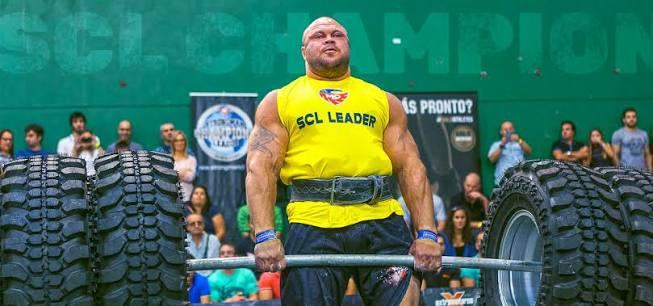
Dainis Zāģeris is a Latvian strongman and powerlifter, born on 19 July 1982 in Talsi, and one of the most consistent and prolific Strongman Champions League competitors of the 2010s. Strongman Archives credits him with 88 international contests and 15 wins between 2009 and 2022, two World's Strongest Man appearances, and a résumé that includes the overall Strongman Champions League season title in 2016 and 2018, the 2021 World's Strongest Viking title, victories at SCL stages across Europe, the Caribbean and beyond, and the 2012 Latvia's Strongest Man championship. At Europe's Strongest Man 2015 he finished level on points with Mark Felix for third; some databases list Zāģeris third, while the official Giants Live standings place him fourth on the tiebreak. He became known for deadlift, log lift, Viking press, loading races, power stairs and the ability to collect points across long multi-stop seasons. In powerlifting he recorded a 255 kg bench press and a 400 kg deadlift at the 2012 SPSS Push-Pull championship. After his final indexed international strongman appearance in 2022, his name remained active in the sport through the Dainis Zageris Cup, and in 2024 he also won a professional MMA bout by submission.
Dainis Zāģeris is one of the athletes who kept Latvian strongman visible on the international stage after the generation of Raimonds Bergmanis, Raivis Vidzis and Agris Kazeļņiks, and before Aivars Šmaukstelis became a dominant figure of the Strongman Champions League. Born on 19 July 1982 in Talsi, western Latvia, Zāģeris built a career that cannot be reduced to one spectacular podium or a single record. Its defining feature is volume: years of travel, consecutive competitions, events held in different climates and on different continents, non-standardized implements, dense schedules and a constant requirement to adapt. Strongman Archives records 88 international contests and 15 victories between 2009 and 2022, along with two World's Strongest Man appearances and a large collection of Strongman Champions League podium finishes. Those numbers matter, but they tell only part of the story. Unlike athletes whose reputations are built around one major annual contest, Zāģeris became representative of the circuit strongman: available across long seasons, capable of scoring in many families of events and durable enough to remain relevant for more than a decade. His static strength, particularly in the deadlift, was supported by international-class overhead pressing and by strong results in loading, Viking press, power stairs, carries and pulling events. That range was essential in a circuit where one weekend could feature a log lift and car deadlift and the next could revolve around a truck pull, keg toss, frame carry, front hold or an implement built specifically for the host city. Zāģeris did not succeed because one extraordinary event protected him from every weakness. He succeeded because a wide range of very good qualities repeatedly added up to a total score that was difficult to beat.
Several landmarks define his place in the sport. He became Latvia's Strongest Man in 2012 after a national final in which he scored 67 points and defeated Didzis Zariņš. He reached World's Strongest Man in 2013 and again in 2015, finishing third in his qualifying group on the second appearance, his best WSM heat result. The 2015 season became one of the most important of his career: victories at SCL Latvia, SCL Romania and SCL Martinique, second place at the SCL World Finals and an outstanding showing at Europe's Strongest Man. In Leeds he finished on 40 points, level with Mark Felix. Sources disagree over the presentation of the final placing. Some historical databases list Zāģeris third, while the official Giants Live standings place Felix third and Zāģeris fourth after the tiebreak. A serious historical profile must preserve that distinction rather than smooth it away. In 2016 Zāģeris progressed from perennial podium contender to overall Strongman Champions League season champion, winning SCL Portugal and the SCL World Finals in Dubai along the way. In 2018 he repeated the overall championship, adding wins in Holland, Curaçao and the World Finals in Cancún. In 2021, at almost 39, he won World's Strongest Viking in Vinstra. In 2022, now 40, he won SCL Bosnia in Sarajevo, the final international victory indexed in his strongman career. Longevity in this context was not simply the passage of time. It meant returning to high-level competition after exhausting seasons, adapting to changing regulations and equipment, facing younger generations and surviving the physical cost of one of strength sport's least standardized disciplines.
Zāģeris's biography begins in a setting far removed from international arenas. Latvian local sources identify Talsi as his birthplace and Balgale as the rural area where he spent his childhood and to which he remained emotionally attached. He attended Dursupe primary school and later Kandava Technical School, where he trained in the trade of agricultural mechanic. He subsequently studied at the Latvian Academy of Sport Education, giving him a formal connection to physical education that would later complement his experience as an athlete and trainer. His route into strength sport was not designed by a specialized strongman academy, because no such pathway meaningfully existed for athletes of his generation. Like many Baltic strength athletes, he arrived through a mixture of sports. Local biographical material describes him as a good football player during his school years and notes that he attended hockey training in Talsi while in the ninth grade. At technical school he became more seriously involved in powerlifting and armwrestling. That mixture matters because each discipline contributes a different layer to the strongman skill set. Football and hockey demand movement, balance and rhythm. Powerlifting develops maximal force under standardized conditions. Armwrestling emphasizes grip, forearm strength, shoulder integrity and the ability to transmit force through the upper body. Strongman would later ask for elements of all of them, then complicate the problem by changing the object and the rules. It would be too neat to claim that one early sport created the strongman Zāģeris became. His development is better understood as an accumulation of physical languages that eventually converged in a discipline where versatility is rewarded.
Another episode mentioned in Latvian sources is a period spent living in Denmark. After returning to Latvia, Zāģeris moved to Riga, marking an important shift from a local environment toward a larger urban and sporting network. Riga offered greater access to training infrastructure, strength-sport communities, events and professional contacts at the moment his competitive ambitions were expanding. His connection to the Talsi region nevertheless remained visible, and after the peak of his international career his name returned to the area through the Dainis Zageris Cup, first indexed in Talsi in 2023 and later in Roja in 2025. Reliable public information about his private domestic life is comparatively limited, and that boundary deserves to be respected. Local material speaks about his affection for Balgale and people close to him in the region, but there is no editorial reason to convert those references into an invented catalogue of relationships, partners, children or family occupations. What can be documented is enough to show continuity. Zāģeris grew up in rural Latvia, experienced living abroad, returned to Riga and then spent years travelling across Europe, Scandinavia, the Caribbean, Africa, Asia, South America and the Middle East as an international athlete. Yet the public identity remained unmistakably Latvian. For a small country with a remarkably rich strongman tradition, each international result carried a national dimension. The tension between local roots and global competition is therefore one of the most interesting features of his life story: the athlete moved constantly, while the place he represented remained stable.
Before Dainis Zāģeris became associated with hundreds of strongman events, powerlifting provided a clean measurement of his basic strength. OpenPowerlifting preserves an important result from the SPSS Push-Pull Bench Press and Deadlift Championship held in Riga on 8 December 2012. Competing raw in the 110+ kg class at a bodyweight of 130.9 kg, Zāģeris recorded a 255 kg bench press and a 400 kg deadlift. Those figures are useful not merely because they are large, but because they come from a formal competition and can be verified independently of the oral culture of strongman, where gym lifts and training maxima sometimes circulate without complete context. The same record lists a 647.5 kg push-pull total. For a developing strongman, such a foundation was exceptionally valuable. A 400 kg deadlift provided access to heavy repetition events, while a 255 kg bench indicated pressing capacity that could later be translated into overhead work through event-specific technique. In strongman he eventually reached a 200 kg log lift at the 2018 SBD World Log Lift Championships and 195 kg on the SCL giant log. The relationship between bench and log is not a simple transfer of strength. A log requires a clean, rack position, leg drive, torso stability, mobility and coordination around a large awkward cylinder. Reaching 200 kg therefore reflects years of event specialization rather than a bench press converted by arithmetic. His deadlift developed in the same way. Strongman Archives records numerous event wins in car deadlift and repetition formats. At SCL Latvia 2016 he won a car deadlift with ten repetitions; at SCL Curaçao 2019 he completed fifteen repetitions on a side-handle version; at the 2019 SCL World Record Breakers he won a 400 kg car deadlift event with eleven repetitions. The progression from a maximal lift to repeated competitive output is one of the clearest signatures of a complete strongman.
Strongman forced him to move far beyond the standardized logic of the powerlifting platform. At an SCL contest, the barbell could disappear entirely and be replaced by cars, barrels, sandbags, stones, frames, stair implements, boats or buses. At roughly 1.80 metres and commonly around 130 to 138 kg, Zāģeris was relatively compact compared with the athletes above 1.95 metres who shaped several eras of the Open class. That stature could be a disadvantage in events involving reach or implements designed around taller bodies, but it also offered potential benefits: a lower centre of mass, stable positions during carries and efficient mechanics in certain presses and repeated lifts. Adaptability was the decisive quality. In 2014 Strongman Archives credits him with a Power Stairs performance using three implements from 225 to 275 kg over 18 total steps in 44.27 seconds, later reported as a world record. The same year at SCL Croatia he completed an arm-over-arm boat pull with a reported mass of 13 tonnes over 20 metres on water in 23.06 seconds, also presented in record listings as a world-record performance. In 2013 at SCL Serbia he threw 25.5 kg over a 5.40 m bar. In 2015 at SCL Poland he held 40 kg in the front hold for 32.11 seconds. None of these events resembles a conventional bench press or deadlift. That is precisely the point. Zāģeris became a strongman not because he could lift a great deal on a bar, but because he learned how to convert general strength into technical solutions for objects and tasks that were constantly changing. That literacy in implements may be the most important invisible skill behind a career of such length.
In Latvia, 2012 was the year in which Zāģeris converted potential into national authority. Local reporting and federation archives describe a season in which he won stages and entered the championship super-final as one of the principal contenders. The decisive national contest was spread across two days in Ventspils and Koknese, a format that demanded more than raw strength because the standings had to be managed after an imperfect opening. Zāģeris finished with 67 points, just two ahead of Didzis Zariņš, while Rolands Fersters took third on 61.5. The narrow margin shows how little room existed for error. Latvian reports noted that the first day had not gone ideally for Zāģeris and that the championship was secured through a recovery in the second part of the contest. That pattern would become familiar in his later career. He did not have to dominate the opening event or lead every intermediate table. He could stay close enough to exploit mistakes by rivals and accumulate points while avoiding catastrophic zeros. In strongman, that is a skill distinct from maximal strength. A contest can be won with two event victories and four solid placements, and it can be lost with a single failed implement. Zāģeris learned the value of consistency early. The 2012 national title also gave him important legitimacy as the international calendar began to expand. In a country with a serious strength-sport tradition, being Latvia's strongest man was not a ceremonial label. It meant defeating competitors who themselves possessed European experience and demonstrating the ability to manage a championship rather than shine in one isolated event.
The Latvian context is essential to understanding that achievement. Relative to its population, Latvia has produced a remarkable concentration of international strongmen. Raimonds Bergmanis was a major finalist and podium-level figure in the 1990s, Raivis Vidzis became internationally recognizable in the following decade, and Agris Kazeļņiks accumulated a large volume of international competition. Behind those names was a domestic culture of contests, demonstrations and federation activity that gave newer athletes direct access to strongman-specific implements. Zāģeris did not emerge in a vacuum. He entered an ecosystem in which spectators understood Viking press, organizers could build a car walk, and local competitors knew the standards required to reach European circuits. His own career nevertheless developed in a distinct direction through a particularly close association with the Strongman Champions League. SCL demanded far more geographical mobility than older calendars centred on a handful of major tournaments. The 2012 Latvian championship can therefore be read as a gate between two levels. Domestically, it established Zāģeris as a leader of his generation. Internationally, it strengthened the case for invitations and opportunities in a circuit where reputation and reliability mattered alongside individual results. By 2013 his schedule included contests in Serbia, Latvia, the Czech Republic, Germany, Finland, Slovakia, Poland, Gibraltar, Lithuania, Brazil and Malaysia, in addition to World's Strongest Man in China. From that point onward, his sporting life became partly a geography of airports and competition platforms. For a circuit strongman, recovery and logistics become almost as important as programming. Travelling repeatedly through changing climates and time zones while attempting maximal or near-maximal efforts is itself a competitive stress. Zāģeris's ability to tolerate that rhythm helps explain why the sheer volume of his career is a performance in its own right.
Dainis Zāģeris made his World's Strongest Man debut in 2013 in Sanya, China, during an era loaded with exceptional competitors. Žydrūnas Savickas, Brian Shaw, Hafþór Júlíus Björnsson, Mike Jenkins, Mike Burke, Terry Hollands, Johannes Årsjö and other established athletes set a brutally high standard across the field. Zāģeris was placed in Group 3 and finished fourth of six competitors. He did not reach the final, yet qualification for WSM was an important threshold for an athlete who only a few years earlier had been building his reputation in regional contests and SCL stages. The group format was unforgiving: a small number of events, few opportunities to recover from lost points and an enormous practical difference between second and fourth place. At that level, one poor event could compromise the entire qualification campaign. For Zāģeris, China measured the distance between being a strong international professional and becoming a World's Strongest Man finalist. At the same time, it confirmed that he could compete inside the same structure as the strongest men of his era. There is no need to rewrite the 2013 appearance as a greater success than it was, but there is equally little reason to dismiss it. WSM participation does not guarantee relevance, and qualifying groups routinely contain future finalists and champions. The fact that Zāģeris returned two years later shows that his first appearance was not an isolated invitation. It belonged to a genuine window in which he was operating at world-class level.
His second WSM appearance, at Putrajaya in Malaysia in 2015, produced a stronger result. Zāģeris finished third in his group, again missing the final but achieving the best WSM heat placing of his career. Historically, that result matters because it came during the same season in which he produced his most consistent run of international results to that point. He was not arriving at WSM on the strength of one isolated performance. In 2015 he won Strongman Champions League stages, reached the podium at the circuit's World Finals and challenged established names at Europe's Strongest Man. Third in his WSM group belongs inside that continuum. Yet the contest also exposed the distinction between circuit consistency and short-format championship success. At World's Strongest Man, an athlete has only a handful of events in which to express an entire season's preparation. Event selection can magnify or punish one weakness, and there is limited time to recover from a mistake. Zāģeris's failure to qualify for a final remained the visible limit of his WSM record: two appearances, no finals. That does not erase his international standing. It defines it more accurately. He was primarily a championship-circuit specialist and a master of points accumulated over long seasons, rather than an athlete whose legacy rests on the WSM final. Modern strongman has several prestige systems. World's Strongest Man is the best-known contest to the general public, but SCL, Giants Live, Arnold events and national championships reward different forms of excellence. Zāģeris was particularly well suited to a structure that demanded repeated availability, quick adaptation and high-level performance many times per year.
Europe's Strongest Man 2015 is perhaps the clearest example of why sports biographies should be built by comparing sources rather than copying one database. The Leeds contest was won by Hafþór Júlíus Björnsson with 52 points, followed by Krzysztof Radzikowski on 48. Mark Felix and Dainis Zāģeris both finished on 40 points. Some historical databases and secondary articles credit the Latvian with third place or present the result as a shared bronze position. Giants Live, however, publishes Felix in third and Zāģeris in fourth after the tiebreak. This profile treats that as the official classification while explicitly preserving the fact that the two athletes scored the same number of points. The difference is more than statistical pedantry. Strongman history is often reconstructed years later from fragmented score sheets, and a tiebreak can alter the way an entire career is summarized. For Zāģeris, the competitive value of the result remains extremely high regardless of medal wording. He finished level on points with Mark Felix and ahead of other world-class athletes in a field containing WSM champions and finalists. The result also occurred during a genuine peak rather than a single favourable day. Around the same period he was winning SCL stages, placing second at the circuit's World Finals and producing his best WSM qualifying result. A points tie for the European podium, whether presented as 40 points or as official fourth place, remains one of the strongest pieces of evidence for the level he reached in 2015.
The distribution of points at Europe's Strongest Man also helps explain the athlete Zāģeris had become. Giants Live deliberately mixed static strength, moving events and muscular endurance. His ability to remain near the top across such a program mattered more than one spectacular event win. By then he possessed a documented 400 kg deadlift from powerlifting, substantial overhead strength and years of experience in medleys, car walks, holds and awkward carries. A contest like ESM turns those qualities into a balancing exercise. Maximal force must be converted into speed, repetition efficiency or stability depending on the apparatus. The result in Leeds also illustrates how little physical appearance alone tells us about elite strongman. An athlete around 1.80 metres could finish level on points with Mark Felix and remain close to competitors much taller and heavier. Strongman does not reward one ideal body shape. Every implement changes the leverage problem. A lower centre of mass may help one carry and hinder another event that rewards reach. Zāģeris thrived because he was not dependent on one geometry. His compact build, powerlifting foundation and large library of event experience gave him ways to solve many different tasks. If an organizer introduced an unfamiliar apparatus, he often had some comparable movement stored in experience: a frame with a similar swing, a pull with a familiar rope angle, a log of comparable diameter or a loading object that demanded a known lap position. That adaptability is why the 2015 ESM performance remains significant even after the tiebreak is reported correctly.
If World's Strongest Man gave Zāģeris international visibility, the Strongman Champions League was the environment in which he built his identity as a champion. The 2015 season made that relationship impossible to ignore. He won SCL Latvia in Olaine, SCL Romania in Sibiu and SCL Martinique in Fort-de-France. He finished second at SCL Poland and then second at the SCL World Finals in Kemer, Turkey. Latvian biographical material also places him second in the overall season standings. The importance of the run lies not only in the number of podiums but in their geography. A home contest in Latvia, a stage in Romania, a Caribbean competition, another in Poland and the final in Turkey meant different weather, travel demands, surfaces and equipment. During that era SCL was not a standardized arena show transported intact from country to country. A large part of its character came from local organizers and locally built implements. Vehicles, industrial objects and regional props could become events. The athlete therefore could not prepare only for one set of dimensions. He needed transferable movement principles: how to assess an awkward object's centre of mass, how to choose between speed and security, how to preserve grip and lower-back capacity after several events, and how to change technique when the implement behaved differently from training equipment. Zāģeris became highly effective at this form of controlled improvisation. Three stage wins in one season and second place at the World Finals cannot be explained by one perfect day. They indicate a skill set that could be reproduced under changing conditions.
The SCL format also rewarded a particular form of competitive discipline. In a stage championship, an athlete cannot treat every weekend as the only contest of the year and still expect to remain healthy through the season. At the same time, too many absences or poor results destroy the overall standing. The body has to be pushed hard enough to score and protected enough to compete again. That is a different problem from peaking for one annual championship. Zāģeris became one of the athletes who handled the economy of a long season particularly well. His record is not a perfectly ascending line. It is a sequence of firsts, seconds, thirds and middle placings that collectively built championship positions. In this sense, 2015 became a laboratory for the 2016 title. He showed that he could win in several countries, remain near the podium when he did not win and reach the end of the calendar still capable of challenging for the final. For spectators, the stage victory is the memorable image. For the athlete, a second place earned on a difficult day may be equally valuable in a season table. Zāģeris became skilled at saving those points. That should not be mistaken for a conservative competitive style. His event records and wins show that he was capable of attacking aggressively when an event suited him. The crucial difference was that he did not need a win in every contest to remain dangerous. In a sport characterized by high injury risk and enormous event variation, that consistency is one of the hardest forms of performance to build.
In 2016 the accumulated experience of the previous seasons turned into a championship. Zāģeris began the international campaign with results that did not suggest uncontested domination but showed exactly the consistency required for a season table: second at SCL Latvia, third in Bulgaria and second in Curaçao. He then won SCL Portugal in Porto with 54 points and closed the season by winning the SCL World Finals in Dubai. At the end of the championship, his name stood at the top of the Strongman Champions League overall standings. This title is central to any assessment of his career because it demonstrates the difference between winning a stage and controlling a season. An overall champion cannot rely on one favourable event selection. Months of competition bring fluctuations in form, travel, minor injuries, changing opponents and weekends when equipment does not suit an athlete perfectly. Zāģeris navigated that entire system. He collected points when he did not win and took decisive victories when the opportunity arrived. Dubai gave the year a fitting conclusion: rather than merely protecting points accumulated earlier, he won the contest that concentrated the final pressure of the season. Historically, the 2016 championship placed him on the short list of SCL overall winners and confirmed that his peak was not limited to the strong results of 2015. It also came during an era when athletes moved frequently between SCL, Giants Live, Arnold events and national competitions, so the opposition was shaped by a genuinely international professional pool.
The 2016 title also highlights the competitive usefulness of Zāģeris's body type and event range. At roughly 1.80 metres and generally 130 to 138 kg, he was compact by Open strongman standards. Yet he possessed enough absolute strength for a 400 kg deadlift and elite pressing, and he could convert that strength into repetitions. At SCL Latvia 2016, for example, he won the car deadlift with ten reps. Elsewhere he remained effective in loading, throwing and moving events. A profile like that reduces dependence on the program. Highly specialized athletes can dominate when a contest emphasizes their ideal events and lose large numbers of points when the selection changes. Zāģeris had weaknesses, as every strongman does, but his competitive record suggests that his range of competence was broad enough that one event family rarely removed him completely from a contest. This helps explain why his SCL career was richer than his WSM record. A stage championship rewarded exactly the versatility and durability he possessed. Winning in 2016 also changed how he was perceived inside the circuit. He was no longer merely the dangerous Latvian capable of upsetting a favourite. He was the defending champion other athletes had to track. Expectations change after a first title, as opponents know the athlete better and every poor result appears more significant. Zāģeris's later return to first overall in 2018 demonstrates that 2016 was not an accidental convergence of circumstances. It was the expression of a competitive maturity that could be rebuilt.
Zāģeris did not repeat the overall championship in 2017, but the season confirmed that he remained at the centre of the fight. Latvian biographical material places him second in the annual Strongman Champions League standings, and the individual results explain why. He finished second at SCL Finland, won in Curaçao and Greece and closed the year with third place at the SCL World Finals in Chetumal, Mexico. The pattern was characteristic: podiums in very different climates and competitive contexts, with enough stability that a season without the title cannot reasonably be described as a major decline. He also continued to test himself outside the SCL structure. At Arnold Europe in Barcelona he finished sixth in a field of twelve, a solid result in an event designed around heavy strength tasks and a strong international lineup. At Europe's Strongest Man his placing was lower, tenth, illustrating the other reality of the sport: form does not transfer identically from one contest to the next. Different events, one costly mistake or simply a poor physical day can change the standings dramatically. A biography becomes distorted if it preserves only podiums and removes ordinary or disappointing finishes. In Zāģeris's case, the contrast demonstrates how demanding the sport actually is. In the same year he could win SCL stages, podium at the circuit final, finish sixth at Arnold Europe and tenth at ESM. There is no contradiction. They are different contests with different fields and programs inside a calendar that required far more starts than most specialized strength athletes would attempt.
The 2017 season also shows how quickly strongman's hierarchy was changing. Younger athletes were emerging while experienced veterans remained competitive. SCL was a platform on which technical knowledge could compensate for some differences in age and mass without erasing them. For an athlete beyond 35, recovery becomes an increasingly visible competitive factor. Tendons, spine, hips, elbows and shoulders accumulate hundreds of exposures to extreme loading, and a circuit professional does not always receive the luxury of a long deload. Zāģeris nevertheless continued to compete frequently. There is no need to invent a secret recovery method to explain that fact. The results themselves document durability. Just as important was the efficiency produced by experience. In repetition events, economical technique reduces wasted energy. In carries, controlled acceleration can prevent the implement from swinging. In loading, body position relative to the platform can save seconds and protect the lower back. Those details rarely appear in a score sheet, but they are reasons an experienced athlete remains competitive even when he no longer has the greatest raw physical potential in the field. By 2017 Zāģeris had accumulated hundreds of event exposures. That gave him a large motor library. An unfamiliar apparatus was rarely completely unfamiliar in principle. He had probably handled something with a similar balance, pulling angle, diameter or loading position. Experience did not guarantee victory, but it reduced the number of truly new problems he had to solve under the clock.
In 2018 Dainis Zāģeris produced perhaps the clearest demonstration of his mature strongman identity. The season opened with strong second-place finishes at SCL FIBO and Abu Dhabi, then developed through victories in Holland and Curaçao. The climax came at the SCL World Finals in Cancún, where he won with 85 points and finished the year as overall Strongman Champions League champion for a second time. A second title has a different meaning from the first. One championship can occur during an ideal window of form, with injuries to rivals or a favourable sequence of events shifting the balance. Repeating the achievement two years later leaves far less room for those explanations. Zāģeris had already shown that he could manage an SCL season. In 2018 he showed that he could rebuild championship form after finishing second overall the year before. The Mexican final was an excellent summary of his athletic profile. Archived results show strong scoring in deadlift, loading and max log, precisely the areas where his powerlifting foundation and strongman experience intersected. A 195 kg max log in the SCL context confirmed elite overhead ability, while the same year he reached 200 kg at the SBD World Log Lift Championships. For an athlete around 137 kg, a 200 kg competition log represents a striking relationship between bodyweight and the implement overhead. More important, the press did not exist in isolation. He could produce that level of static performance and still return to stages involving loading, carries and high-repetition deadlifts. In strongman, the practical value of a personal best is often measured by what an athlete can still do before and after it.
The second overall championship places Zāģeris in a more important historical category than his absence from a World's Strongest Man final might suggest. International strongman is sometimes narrated as a pyramid with WSM at the top and every other contest below it. The reality is more complex. SCL operated as a global stage championship, and winning its season table tested a quality a multi-day tournament does not measure in the same way: management of performance over time. Zāģeris was 36 in 2018, an age at which maximal strength can remain extremely high but the cost of recovery usually becomes more obvious. He did not merely remain competitive; he defeated younger opponents and closed the season with a major win. Technically, this period appears to have been the most balanced phase of his career. His overhead had reached the 200 kg threshold, deadlift remained a major weapon and his experience in dynamic events was enormous. Instead of relying only on youthful explosiveness, he could use refined movement patterns and better-calculated pacing. Years of competition had also taught him how to read a live points table: when a risky event win was worth pursuing, when third place was sufficient and when avoiding a zero mattered more than chasing one additional position. That is one of the differences between a very strong athlete and a season champion. Zāģeris had enough strength to win individual events, but in 2018 he again demonstrated that he knew how to win a championship.
After the 2018 peak, Zāģeris did not disappear from the upper end of the standings. In 2019 he won SCL World Record Breakers in Pyhäjärvi, Finland, finished second in Curaçao and returned to the podium at the SCL World Finals, taking third in Matosinhos, Portugal. The event archives show an athlete who remained dangerous in the families of events that had defined his career. In Finland he won a 400 kg car deadlift for eleven repetitions, a result that gives useful context to the 400 kg maximal deadlift recorded in powerlifting seven years earlier. The load was no longer one standardized maximal attempt. It was an awkward strongman apparatus lifted repeatedly after many additional seasons of wear. He continued to score strongly in log and moving events as well. The 2019 season therefore demonstrates that the second overall title was not followed by a sudden collapse. His career instead entered the phase of an elite veteran, still capable of winning stages but facing a field being refreshed by new athletes. That phase matters historically. Some champions produce a short, brilliant peak. Others remain near the podium for years. Zāģeris belongs more naturally to the second category. The total of 88 indexed international contests says something a trophy list cannot fully communicate: the number of competitive exposures his body absorbed in order for his name to appear so consistently across more than a decade of results.
The COVID-19 pandemic disrupted the normal international strongman calendar in 2020, cancelling or restricting a large number of events. Even in that environment, Zāģeris won SCL Finland in Joensuu. When the circuit began to regain density in 2021, he produced one of the finest late-career victories of his life: World's Strongest Viking, held as SCL Norway in Vinstra. He won with 49 points, ahead of Kelvin de Ruiter, and later added victory at the SCL World Record Breakers in Kenzingen, Germany. He was approaching 39. In a sport where every season accumulates stress on the spine, knees, elbows, shoulders and connective tissue, winning near the end of one's thirties carries its own significance. In 2022, at the age of 40, Zāģeris won SCL Bosnia in Sarajevo, the final international victory recorded by Strongman Archives, and competed at the SCL World Finals, where he finished eighth. His indexed international strongman record ends in 2022. That does not mean a definitive retirement announcement has been documented, which is why this profile uses the status inactive rather than retired. The distinction matters. An athlete may stop entering international contests without formally closing a career and may continue training, coaching, appearing at exhibitions or competing elsewhere. In Zāģeris's case, his sporting identity remained active through a namesake strongman contest and later through a documented professional MMA appearance. The international results stopped; the competitive personality did not simply vanish.
Zāģeris's technical profile can be understood through three connected qualities: a very strong static base, international-class pressing and an unusual ability to transfer strength across different event families. The 400 kg raw powerlifting deadlift provides a clean reference point, while later performances in car deadlift and repetition variations show that it was not merely an isolated maximum. In overhead work, the 200 kg competition log at the 2018 SBD World Log Lift Championships and 195 kg giant-log performances in SCL place him firmly in elite territory without requiring the exaggerated claim that he was the absolute best presser of an era that included specialists such as Žydrūnas Savickas. That proportion is important. Zāģeris did not need to be the greatest log lifter in the world for pressing to generate major points. If he could finish close to specialists on log and then recover positions through deadlift, loading or power stairs, the overall score became highly competitive. His compact build could create stable positions under certain objects, while his powerlifting background supported bracing and force production. In Viking press, where breathing, rhythm and leg drive can decide the difference between seven and ten repetitions, mechanical efficiency may matter as much as a larger strict press. Carries and loading introduce still more variables: grip, acceleration, foot placement and line choice. Zāģeris was sufficiently competent across those areas that he was rarely trapped by one narrow identity. This is the simplest technical explanation for two SCL season titles. Across a championship containing dozens of implement variations, versatility has direct mathematical value.
The more unusual records on his résumé reinforce that picture. Power Stairs with implements reaching 275 kg, a 25.5 kg weight thrown over 5.40 metres, a 40 kg front hold and an arm-over-arm pull involving a reported 13-tonne boat on water all challenge different systems. It is not meaningful to compare them directly, because one kilogram in a front hold is not equivalent to one kilogram in a deadlift. Their value lies elsewhere: they show the range of problems he had to solve. Power Stairs demands repeated explosive extensions, rapid foot placement and the ability to manage fatigue as the steps accumulate. Weight over bar requires violent hip extension and precise timing. Front hold is an isometric fight against leverage and local muscular fatigue. Arm-over-arm pulling combines the back, biceps, grip and whole-body coordination while the athlete tries not to lose rhythm. In a conventional gym those qualities could be trained separately. In strongman they must coexist in the same athlete and often be displayed within an hour or two of each other. Zāģeris was competitively built for that plurality. The evidence does not justify describing him as universally unbeatable in one signature event. It does, however, show that he could win very different events across different years. For a historian of the sport, that repeated adaptation is arguably more revealing than one isolated record.
Unlike athletes whose public biographies contain little beyond contest results, Zāģeris also has documented formal links to sport education. Latvian biographical sources mention his studies at the Latvian Academy of Sport Education, while a Beiker Fitness profile described him as qualified in fitness instruction and experienced in fitness and general physical-preparation coaching. Those facts should not be inflated into claims that he designed every phase of his own elite career or that one particular training philosophy can be attributed to him. The accessible public record does not consistently identify one long-term head coach or one gym that can responsibly be presented as his permanent training base across his entire career. For that reason, the relevant profile fields are written transparently rather than populated with a guessed coach or facility. What can be said is that Zāģeris possessed an educational background that allowed him to approach physical preparation as more than intuition. That matters in strongman because programming has to reconcile conflicting goals: increasing maximal strength without destroying speed, adding body mass without losing conditioning, practicing implements without overloading connective tissue and maintaining competitive form through a long season. His complete training journals are not publicly available, and reconstructing them from assumption would be irresponsible. The competitive outcome is nevertheless visible: years of performance in events requiring very different capacities and a level of longevity that suggests effective management of adaptation and recovery.
Coaching experience adds another dimension to the later part of his sporting life. A strongman with close to ninety international contests possesses forms of knowledge that are difficult to acquire from textbooks alone. He knows what a poorly balanced implement feels like, how grip changes in rain, how the body responds to long travel before a contest and how two nominally similar deadlift apparatuses can behave completely differently. When that practical knowledge is combined with formal sport education, it can become valuable to younger athletes. Public sources are not sufficient to define a distinct Zāģeris coaching school or to attribute other athletes' achievements directly to his programming, so this profile avoids such extrapolation. Yet the appearance of a competition carrying his name and his continued presence around the strength community show that his role did not end with his final international result. In smaller sports, veterans often become bridges between generations without needing a formal title. They do so through presence, demonstrations, event organization, advice and cultural legitimacy. Zāģeris fits that pattern. For young Latvian strongmen, he is not only a name in an old results table. His career is recent enough, and his involvement close enough, to function as living technical and historical reference.
In a long biography there is a temptation to fill every blank area of a person's private life with anecdotes. In the case of Dainis Zāģeris that would be a mistake. Reliable public sources are rich in competition results and much more restrained about family, relationships and domestic life. This profile preserves that imbalance rather than manufacturing intimacy. His birth in Talsi, childhood in Balgale, schooling in Dursupe, vocational education in Kandava, sport studies, period in Denmark and move to Riga can be documented. Local sources also refer to his attachment to the places of his childhood and to people close to him in the region. Beyond those points, there is no sound editorial basis for inventing a detailed family biography. Partners, children, relatives' occupations and private episodes are not added unless supported by strong public documentation. That limit makes the profile more credible, not less complete. Athletes do not surrender ownership of their private lives because they lifted weights in front of cameras. At the same time, the documented details are enough to show a durable identity. Zāģeris grew up in rural Latvia, experienced migration, returned home and built an international career from Riga without allowing Talsi and Balgale to disappear from the story. When a competition bearing his name is later held in Talsi, the biographical circle closes naturally: the place from which the athlete emerged becomes the place where experience gained across four continents is returned to the local strength community.
His Latvian identity also belongs within a wider Baltic strength culture. Lithuania produced Žydrūnas Savickas and Vytautas Lalas, Estonia has deep traditions in powerlifting and strongman, and Latvia itself produced several generations of international competitors. In such an environment, an athlete's success becomes more than an individual record. It enters regional sporting memory through local contests, gyms and recurring events. Zāģeris represented Latvia during a transition. The names of the earlier generation remained familiar, but Strongman Champions League was creating a new type of increasingly global career. Later, Aivars Šmaukstelis would take on the role of leading Latvian international competitor and construct a major résumé of his own. The generations overlap, so the relationship should not be described as a rigid handover, yet the continuity is clear. Zāģeris proved that a Latvian athlete could win not just one international stage but the entire SCL championship, and then do it again. For a small country, that symbolic effect extends beyond the trophy. It changes what appears achievable to the athletes who follow. In that sense, Zāģeris's personal legacy is inseparable from geography. Talsi, Riga, the Latvian national circuit and the Latvian flag beside his name in SCL standings are all parts of the same story.
After his final indexed international strongman appearance in 2022, Zāģeris remained directly connected to the sport through the Dainis Zageris Cup. Strongman Archives indexes an edition in Talsi in 2023 and another in Roja in 2025. The first recorded edition was won by Aivars Šmaukstelis, followed by Didzis Zariņš and Audrius Jokūbaitis. In 2025, Jokūbaitis won, with Zariņš second and Māris Krievelis third. A competition bearing the name of an athlete who remains present in the community is an indicator of cultural status rather than merely a branding exercise. Strongman has always relied on events that connect sporting memory to current practice. Spectators who may never have followed the 2016 SCL season can encounter the Zageris name on a contemporary contest, while younger athletes enter a local genealogy of strength through participation. Holding the first indexed edition in Talsi is particularly appropriate because it returns the name to Zāģeris's birthplace. The path that began in the region, travelled through World's Strongest Man, Giants Live and dozens of SCL stages, comes back as a competitive platform for a new generation. In a sport whose archives are often incomplete and whose public memory can concentrate heavily on a few highly marketed champions, namesake contests also help preserve history. For Zāģeris, the Cup extends the relevance of the career without requiring an athletic comeback of his own. It converts reputation into infrastructure and allows the story to continue through other competitors.
An unexpected chapter appeared in 2024 through combat sports. Tapology lists Dainis Zāģeris with one professional MMA bout, fought in Riga on 17 February 2024, which he won by submission against Madars Trivols. The database therefore gives him an indexed professional record of 1-0. One fight does not justify describing Zāģeris as an established mixed martial artist and it does not redefine his primary sporting career. It is, however, an interesting extension of his athletic profile. Strongman and MMA are radically different disciplines. Body mass and absolute strength can be useful, but fighting requires sport-specific technique, distance management, grappling, conditioning and decision-making under a form of pressure entirely different from a lifting platform. A submission victory at least indicates that the appearance was not reducible to brute strength alone. At the same time, the public record for this chapter is far thinner than the strongman record, and the biography should preserve that proportion. Tapology is a useful specialist database, but a careful profile should not turn a single recorded bout into an invented fighting career. The most reasonable interpretation is simpler: after the age of 40 and after his international strongman calendar had ended, Zāģeris remained interested in competition and physical testing. For someone who spent more than a decade moving impossible objects against a clock, entering a cage represented a radical change of sporting language rather than a disappearance of competitive temperament.
The legacy of Dainis Zāģeris cannot be summarized properly by asking whether he reached a World's Strongest Man final. He did not, and that fact should be stated plainly. He was nevertheless a two-time overall Strongman Champions League champion, won the SCL World Finals in 2016 and 2018, became Latvia's Strongest Man, won World's Strongest Viking in 2021, accumulated 15 international victories in 88 indexed contests and remained capable of winning an SCL stage at the age of 40. Those achievements describe a form of excellence that differs from performance in one WSM final. They speak to availability, durability, versatility and the ability to maintain strength in a chaotic sport. Zāģeris competed during a period when strongman was professionalizing rapidly while still retaining much of its handmade character. Implements were not always standardized, broadcasts did not cover every stage and databases were frequently reconstructed after the fact. Competitors had to accept uncertainty. In that environment, the Latvian became one of the recognizable constants of the SCL circuit. The two overall championships form the centre of his résumé, but they are not the only reason the career deserves detailed treatment. Runner-up seasons, repeated podiums, event records and the simple fact of showing up again and again are equally revealing. The history of a sport is built not only by champions who appear once a year in its biggest show. It is also built by athletes who keep the circuit alive from weekend to weekend.
Within Latvian strongman history, Zāģeris occupies a bridging position. He followed pioneers who had already made Latvia familiar on international stages and remained competitive long enough to overlap with the generation represented by Aivars Šmaukstelis. He carried Baltic strength tradition into a newer format: the global stage championship. He demonstrated that an athlete around 1.80 metres could win an Open season without possessing the dimensions of the sport's largest giants. He also showed that a 400 kg deadlift and a 200 kg log can be foundations rather than conclusions. The deeper achievement is converting that force into dozens of different objects, then repeating the process in different countries for months and years. His career also offers a quieter model of public identity. The available record is dominated by sport rather than by a heavily commercialized private persona. For a historical strongman site, the appropriate tribute is therefore not to invent a legend around areas that remain private, but to reconstruct the athletic life carefully from score sheets, local reporting, archives and context. Dainis Zāģeris does not require mythology. Two SCL championships, almost ninety international contests, more than a decade at professional level and victories extending to age 40 already provide a remarkably dense sporting story.
This profile is built by cross-checking several kinds of sources because no single database covers the entire career. Strongman Archives provides the statistical backbone: international active years, the 88 contests, 15 victories, World's Strongest Man appearances, SCL placings and many event-level results. Giants Live is used for the official classification of its competitions, most importantly Europe's Strongest Man 2015, where a points tie produced different presentations in secondary databases. OpenPowerlifting confirms the 2012 powerlifting performance, including the 255 kg bench press and 400 kg deadlift. Latvian media and local archives add the formative years, the 2012 national championship, education and the personal route through Talsi, Balgale, Denmark and Riga. Strongman Champions League material and reporting around World's Strongest Viking help verify season titles and the 2021 victory. Tapology is used only for the 2024 MMA episode and is treated in proportion to the amount of information available. Where sources disagree, the disagreement is stated rather than hidden. Where information is absent, a blank is not replaced by a guess presented as fact. This principle is particularly important for records, long-term coaching relationships, gym affiliations and private life, areas in which strength-sport internet culture can turn an unsourced statement into a copied biography remarkably quickly.
Bodyweight data should be read in the same spirit. This profile uses approximately 137 kg as a reference figure and 180 cm for height, but a professional strongman's bodyweight is not a fixed biological constant. It changes across seasons, training phases and contests. OpenPowerlifting recorded Zāģeris at 130.9 kg in the 2012 push-pull competition, while other public profiles place him within a broader range of roughly 130 to 138 kg. His sporting status is likewise listed as inactive rather than retired because the international archive ends in 2022 without a definitive public retirement statement appearing in the sources used here. The terminological distinction may seem minor, but it is part of the respect owed to a real athlete. A biography should not close a career on the athlete's behalf or convert absence from a results table into an announcement he did not make. As of this profile's 2026 update, the documentable picture is straightforward: Dainis Zāģeris is a former leader of the international strongman circuit with no indexed international strongman starts after 2022, while remaining connected to strength sport through the competition bearing his name and through later sporting activity. If additional interviews, results or archival material become available, the profile can be expanded. Sports history is not a fixed stone tablet. It becomes more accurate as documents are located and contradictions are resolved.
The indexed international career of Dainis Zāģeris begins in 2009, but his transformation into a recognizable continental competitor was gradual. The early years were defined less by domination than by the accumulation of experience without which the later championships are difficult to explain. Strongman Champions League and regional events provided exactly the environment he needed: international fields, changing event selections and enough competitive frequency for technique to be tested under pressure rather than only in training. By 2012, with the Latvian national title and the formal powerlifting marks of 255 kg in the bench press and 400 kg in the deadlift, the scale of his basic strength was already clear. The 2013 season expanded the career dramatically. He reached the podium at SCL Serbia, SCL Latvia, SCL Poland and SCL Gibraltar and made his World's Strongest Man debut. The calendar describes an athlete transitioning from national success to an almost permanently international sporting life. In such seasons the difficulty is not limited to the weights. One stage may take place in Eastern Europe, the next in Scandinavia, then another in southern Europe or on another continent. Food, sleep, recovery access and even the amount of productive training time between contests become variables. Each organizer may also produce a slightly different log, yoke, frame or deadlift setup. Zāģeris had to learn not a fixed list of events but a grammar of strongman: the principles by which an unfamiliar object can be assessed quickly and turned into a competitive movement. The 2013 podiums are important because they precede the major titles. They show the process through which consistency was built before consistency began producing championships.
The 2014 season continued that maturation and added several event performances that remained associated with his name. He finished second at SCL Portugal and third at SCL Zambia, but the more revealing technical details appear in Power Stairs and arm-over-arm pulling. Record listings credit him with three Power Stairs implements ranging from 225 to 275 kg moved over 18 total steps in 44.27 seconds. At SCL Croatia he pulled a boat reported at approximately 13 tonnes over 20 metres on water in 23.06 seconds. Such records have to be interpreted carefully because strongman conditions are not universally standardized in the manner of track and field or powerlifting. A 13-tonne boat moving on water is not directly comparable to a 13-tonne truck on asphalt, and a Power Stairs set depends on step height, implement shape and rules. This profile therefore preserves the event qualifiers rather than treating the phrase world record as an absolute comparison across every possible variation. Even with that caution, the 2014 performances demonstrate something clear: Zāģeris could produce speed and coordination under enormous loads. For an athlete also known for deadlift and pressing, that dynamic capacity completes the picture. When he entered the 2015 season he was no longer simply a powerlifter converted to strongman or a national champion experimenting internationally. He already possessed years of implement exposure, SCL podiums, a WSM appearance and notable event records. The explosion of results from 2015 through 2018 did not appear suddenly. It was the mature phase of a construction that had been underway for years.
Zāģeris's career is a useful example of the difference between a personal record and strongman performance. In powerlifting, a 400 kg deadlift and 255 kg bench press can be read directly against a rule set and weight class. In strongman, the same idea of strength fragments into dozens of variations. A deadlift may begin from standard height or an elevated position, use a stiff or flexible bar, involve a car, axle or side handles, and be contested for maximum weight or repetitions. Pressing can mean log, axle, dumbbell, block or Viking press. Even a carry changes completely when the object is a yoke, frame, pair of farmer's handles, shield or sandbag. Zāģeris performed well in precisely this area of translation. A 400 kg deadlift gave him strength capital, but winning a car deadlift for eleven or fifteen repetitions required using that capital economically. A 255 kg bench suggested pressing power, but a 200 kg log required years of specific technique. Understanding this distinction allows his records to be evaluated without exaggeration. He is not presented here as the universal record holder in every form of deadlift or overhead press, but as a competitor who achieved elite values across several movement families and then applied those values effectively in contest conditions. That nuance strengthens the assessment because it captures the true complexity of the sport.
The same distinction explains why strongman records should be stored together with their conditions. In this profile, the Power Stairs record is represented by the heaviest 275 kg implement, but the qualifier preserves the 225 to 275 kg set, 18 total steps and 44.27-second time. The boat pull is recorded at 13 tonnes, but the qualifier specifies 20 metres, 23.06 seconds and movement on water. Weight over bar preserves both the 25.5 kg implement and the 5.40 m height. Those details transform a number into an intelligible performance. They also matter for future generations because strongman evolves. Loads increase, equipment changes and records are redefined through attempts at standardization. A 2014 result can be surpassed numerically in 2026 without becoming ordinary in retrospect. The field, the equipment of the era and the frequency of competition all matter. Zāģeris competed during a period when SCL athletes could face an extremely crowded calendar and still be expected to attack local or world records in individual events. Producing such performances while also pursuing an overall championship says a great deal about his ability to combine peak intensity with seasonal resilience. That is ultimately the theme running through his entire career: not strength as a single isolated moment, but strength that remained available again and again, in different places, under different rules, across many years.
Iron Hall data
400 KG
Raw Deadlift · SPSS Push-Pull Bench Press and Deadlift Championship, Riga, 2012
Verified
255 KG
Raw Bench Press · SPSS Push-Pull Bench Press and Deadlift Championship, Riga, 2012
Verified
200 KG
Log Lift · 2018 SBD World Log Lift Championships
Verified
195 KG
SCL Giant Log · 2018 SCL FIBO
Verified
140 KG
Block Press · 2014 Savickas Classic
Verified
25.5 KG
Weight Over Bar · 5.40 m at 2013 SCL Serbia
Verified
275 KG
Power Stairs · 3 implements from 225–275 kg, 18 total steps in 44.27 s; reported as a world record at 2014 SCL Latvia
Verified
13 TONS
Arm-over-arm Boat Pull · 20 m in 23.06 s on water at 2014 SCL Croatia; reported as a world record
Verified
2012
Won the Latvian national championship final with 67 points, ahead of Didzis Zariņš.
Champion
2013
First WSM appearance, in Sanya, China.
4th in group
2015
Missed the final but achieved his best WSM heat placing.
3rd in group
2015
Finished level on points with Mark Felix. Some databases list him third, while Giants Live gives Felix third and Zāģeris fourth on the tiebreak.
40 points; officially 4th after tiebreak
2015
Home victory in Olaine.
1st place
2015
Won the Sibiu stage.
1st place
2015
Won in Fort-de-France.
1st place
2015
Runner-up at the SCL World Finals in Kemer, Turkey.
2nd place
2016
First Latvian credited with the overall SCL season championship.
Overall season champion
2016
Won in Porto with 54 points.
1st place
2016
Won the SCL World Finals in Dubai.
1st place
2017
Finished second overall in the season standings according to Latvian biographical material.
2nd overall
2017
Podium at the Chetumal, Mexico final.
3rd place
2017
Strong finish in the Arnold Pro Strongman World Series in Barcelona.
6th place
2018
Second overall SCL season title of his career.
Overall season champion
2018
Won the Cancún final with 85 points.
1st place
2019
Won the Pyhäjärvi, Finland contest.
1st place
2019
Podium in Matosinhos, Portugal.
3rd place
2020
Won in Joensuu during a season heavily disrupted by the pandemic.
1st place
2021
Won in Vinstra with 49 points, ahead of Kelvin de Ruiter.
Champion
2021
Won the Kenzingen, Germany stage.
1st place
2022
Final indexed international victory of his strongman career, in Sarajevo.
1st place
2023
The first edition indexed by Strongman Archives was held in Talsi and won by Aivars Šmaukstelis.
Namesake competition launched in Latvia
2024
Tapology lists him at 1–0 professionally after a submission win over Madars Trivols.
Submission win