
1978
AAU Senior National Powerlifting Championships
National title in the 125 kg class, an early major benchmark in his powerlifting career.
1st place
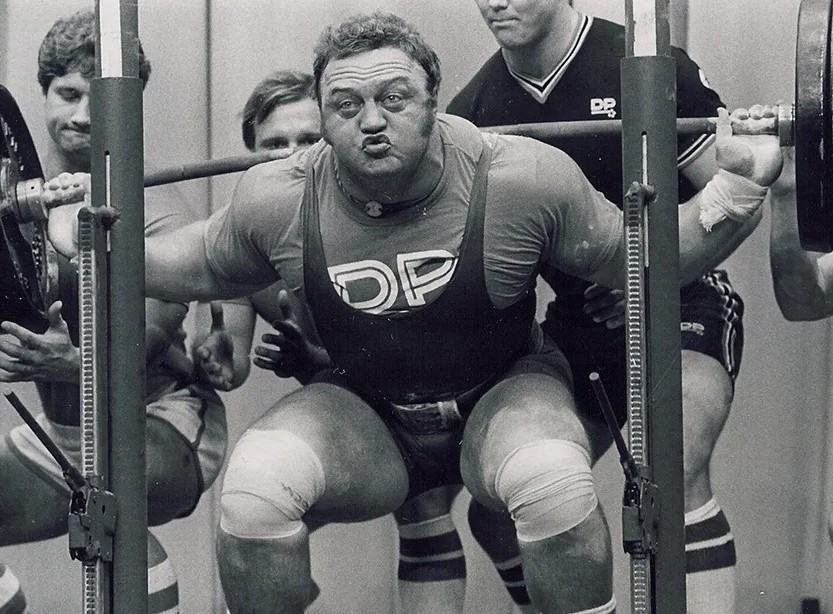
Iron Archives
Three-time World's Strongest Man and two-time IPF World Champion
Retired athlete
William “Bill” Kazmaier is one of the defining figures in strength-sport history: World's Strongest Man champion in 1980, 1981 and 1982, IPF World Powerlifting Champion in 1979 and 1983, and the author of performances that became reference points for later generations. His exceptional static strength, combined with unusual effectiveness across strongman events, allowed him to dominate the early 1980s and return to the WSM podium in 1988. After his competitive career, Kazmaier remained a recognizable voice in the sport through television commentary, public appearances, gym and business work, and motivational speaking.
Modern strength sports have produced champions who dominated one discipline, champions who crossed from one discipline into another, and, far more rarely, athletes whose careers became cultural reference points for the very idea of strength. Bill Kazmaier belongs to that final category. Born in Wisconsin in 1953 and initially developed as a powerlifter, he eventually fused three identities that were not yet clearly separated in his era: the world-class powerlifter, the strongman capable of solving unpredictable event problems, and the television personality who projected an almost archetypal image of physical power. Three consecutive World's Strongest Man titles in 1980, 1981, and 1982, two IPF World Powerlifting Championships in 1979 and 1983, an official 1,100 kg competition powerlifting total, and landmark performances in squatting, deadlifting, log lifting, loading, throwing, and carrying turned his name into a standard that survived long after his retirement. Strongman Archives records six World's Strongest Man finals and three overall victories for Kazmaier, while its historical tables credit him with 20 final-event wins at WSM, a figure that still places him among the most successful event winners in the contest's history decades later. Statistics, however, explain only part of his importance. Kazmaier competed before strongman became a highly specialized and increasingly standardized sport. Contest organizers could move from conventional barbell strength to vehicle pulls, refrigerator carries, bar bending, Highland Games-style throws, stones, wrestling, loading races, and objects designed specifically for television. Athletes were often required to improvise technique under competitive pressure. At the same time, Kazmaier's powerlifting achievements came from an era whose supportive equipment and sport science environment were markedly different from later generations. His reputation therefore rests not simply on raw numbers but on the ability to transfer exceptional basic strength into widely different tasks. A responsible historical profile should also resist repeating every legend attached to his name without context. Some frequently circulated lifts were exhibitions, some came from contests with unusual apparatus, and historical sources occasionally differ in how they label or classify records. The strongest foundation is verified competition data. OpenPowerlifting lists Kazmaier's competition bests as a 420 kg squat, 300 kg bench press, 380 kg deadlift, and 1,100 kg total. Strongman Archives documents a 440 kg max squat at the 1981 World's Strongest Man, a 478.5 kg 18-inch deadlift at the 1982 World's Strongest Man, and a 170 kg max log lift at the 1988 World's Strongest Man. The official World's Strongest Man Hall of Fame presents him as one of the defining champions of the event and emphasizes his run of three consecutive championships. These records show why his legacy has several layers. In powerlifting, he remains one of the defining super-heavyweights of the late 1970s and early 1980s. In strongman, he was the first three-time WSM champion and the first to win three in a row. For a broader television audience, he became one of the earliest instantly recognizable faces of the sport. For later athletes, especially those who built strongman success on elite squat, deadlift, and overhead ability, Kazmaier offered an early model of how enormous general strength could become competitive versatility when paired with athletic experience and event-specific adaptation.
William Kazmaier was born on December 30, 1953, in Burlington, Wisconsin. The Encyclopedia of Alabama, one of the most useful biographical sources for his early life, identifies him as the youngest child of William Bartholomew Kazmaier and Florence Louise Steinhoff Kazmaier and notes that he grew up with one brother, two sisters, and a half-brother. His father operated soda-water bottling plants in Burlington and Kenosha, placing Kazmaier's childhood within the working and entrepreneurial culture of the postwar American Midwest. Long before television audiences associated him with logs, trucks, and enormous barbells, his primary sport was American football. He was a standout high-school athlete and continued playing at the University of Wisconsin for roughly two years. That background matters because it helps explain the movement qualities he later brought into strongman. Football requires acceleration, contact tolerance, positional strength, coordination, and the ability to apply force while balance is being challenged. Although Kazmaier eventually specialized deeply in maximal strength, he did not enter the iron world without an athletic foundation. In 1974, he left university and began focusing much more seriously on weight training at the Madison YMCA. This became one of the decisive turning points in his life. Elite strength sport at the time offered little of the professional infrastructure familiar today. There were no mature strongman academies, no social-media sponsorship systems, and few clearly defined career pathways. The Madison YMCA became both laboratory and school. There Kazmaier learned the fundamentals of powerlifting and discovered how unusually quickly he could adapt to progressive loading. His rise did not occur within financial comfort. Historical accounts describe periods of physically demanding work, including jobs as an oil rigger, bouncer, and lumberjack, and the Encyclopedia of Alabama records that his years in California included significant financial hardship and unstable housing. These details are often folded into motivational mythology, but their biographical importance is more concrete: elite training had to coexist with work, travel, limited resources, and uncertainty. Another important element of the Madison period was spiritual. Kazmaier later described a religious awakening connected with reading Psalm 40. Whether one approaches that account theologically or biographically, it clearly became part of the way he interpreted perseverance and purpose. His later public message, often condensed into the phrase “I can and I will,” carried the same architecture of conviction: belief joined to disciplined action. Physically, the Wisconsin years built the foundation of what would become his signature. His torso, shoulder girdle, arms, hips, and legs developed around heavy compound lifting, producing a body optimized for applying force to large external loads. Psychologically, the same period appears to have reinforced a highly visible competitive style: intensity, confidence stated openly rather than hidden, and the willingness to attack difficult weights without theatrical hesitation. Television later magnified these traits, but it did not invent them. By the time the cameras of World's Strongest Man found him, Kazmaier had already spent years developing a personal identity in which strength was more than an athletic attribute. It was a central organizing principle of work, faith, ambition, and self-definition.
Kazmaier's transformation from former football player into an international-level powerlifter happened quickly enough to become part of his legend, but the progression can be followed in documented results rather than memory alone. At the 1978 AAU Senior National Powerlifting Championships, he competed at 125 kg and won with a 962.5 kg total. OpenPowerlifting records a 355 kg squat, 242.5 kg bench press, and 365 kg deadlift. For an athlete still early in his national career, the total already placed him among the most serious heavyweight lifters in the United States. In April 1979 at the Hawaii International Powerlifting Championships, he totaled 1,030 kg. Then, in November at the IPF Men's World Powerlifting Championships in Dayton, Ohio, he won the 110+ kg division with a 395 kg squat, 282.5 kg bench press, and 362.5 kg deadlift for 1,040 kg. The 282.5 kg bench was more than 622 pounds and represented one of the defining pressing performances of the era. The importance of this phase lies not in a single lift but in the density of his total strength. Kazmaier was not merely a bench specialist and not merely a massive squatter. His three-lift total made him an elite complete powerlifter. That balance became the engine of his strongman career. A huge squat provided reserve strength for lifting, carrying, and leg-driven events. A massive deadlift and powerful grip transferred naturally toward pulls and object lifts. His world-class pressing base could be redirected toward overhead implements. This transfer was never automatic. Many elite powerlifters have entered strongman without becoming dominant because strongman also demands conditioning, object skill, movement efficiency, and rapid technical adaptation. Kazmaier's earlier athletic background appears to have made that translation unusually effective. Accounts of his training emphasize large workloads and an aggressive relationship with the basic lifts. It would be a mistake to project modern periodization language too neatly onto the 1970s. Programming knowledge existed, but the information environment was fragmented, and many elite lifters learned through coaching networks, magazines, gym culture, trial, and direct observation. Kazmaier became known for tolerating substantial volume, particularly in pressing, while still exposing himself to very heavy intensities. That combination helped build the muscle mass and work capacity behind his top-end strength. It also carried consequences. His later career was repeatedly shaped by injury, including severe pectoral damage, hip problems, biceps issues, and ankle trouble. The same willingness to push adaptation hard enough to redefine performance boundaries also exposed tissues to enormous stress. A modern reading of his career should hold both truths at once: the methods produced historic performance, and the methods existed within a risk environment that exacted a significant physical price. By the end of 1979, however, the central fact was clear. Kazmaier was no longer a promising American lifter. He was an IPF world champion, a podium finisher at World's Strongest Man, and a strength athlete whose abilities translated across formal barbell sport and the emerging world of televised strongman.
The year 1979 brought together three developments that would shape the rest of Kazmaier's life: international validation in powerlifting, entry into World's Strongest Man, and movement into the strength-research environment surrounding Auburn, Alabama. At the 1979 World's Strongest Man in California, he finished third behind champion Don Reinhoudt. Strongman Archives provides a more revealing picture than the final placing alone. Kazmaier won the wheelbarrow carry and max deadlift and placed near the top in the caber toss, barrel lift, vertical lift, and max squat. From his first appearance, his competitive profile was already visible. He could express maximal strength, but he was not confined to one static event. In a sport that was still being invented in public, that versatility was decisive. Early WSM did not operate like a modern circuit in which athletes can prepare for relatively stable families of events. Producers mixed traditional strength tests with television concepts and improvised objects. Competitors were expected to solve new movement problems quickly. Third place in 1979 therefore demonstrated that Kazmaier's powerlifting strength could survive contact with unpredictability. At the same time, his personal circumstances remained difficult. Terry Todd, the strength historian, scholar, and central figure in the developing Auburn strength community, recognized Kazmaier's unusual potential and helped bring him into a more stable environment. The Encyclopedia of Alabama documents Todd's role in providing temporary housing, food access, and training opportunities while the National Strength Research Center was being developed with figures including Mike Stone, John Garhammer, and Tom McLaughlin. Calling Todd simply Kazmaier's “coach” would flatten a broader relationship. The support was logistical, intellectual, and institutional as much as technical. For an athlete who had been moving between work, travel, and uncertain living conditions, Auburn offered something rare: a place where strength performance was treated as a serious field of study. Within months, Kazmaier also began working for Diversified Products in nearby Opelika, then a major barbell and fitness-equipment manufacturer. He represented the company at trade shows and in competitions, connecting his athletic identity with the commercial side of the strength industry. This intersection of athlete, research community, and equipment business became a recurring theme in his later life. Auburn and Opelika would remain closely associated with his gyms, business activity, and public work for decades. His 1979 IPF world title reinforced the importance of this transition. His move into strongman was not an escape from powerlifting but an expansion of an already elite athletic career. The television audience saw a massive competitor lifting strange objects, while the established iron-game community knew that the same man had just become a world champion under a more standardized rule set. That double legitimacy intensified his public image. By the end of 1979, Bill Kazmaier had become both a proven powerlifting champion and a credible claimant to the broader cultural idea of the world's strongest man. What followed in 1980 was not a sudden transformation but the acceleration of a trajectory that was already unmistakable.
In 1980, Kazmaier moved from elite contender to the central figure in international strength sport. Early in the year, he won World Strongbow in England. Strongman Archives records victories in the dumbbell press, where he performed 17 repetitions with roughly 55 kg per arm, and the max deadlift at 380 kg. Those event results already summarized one of his defining qualities: he combined maximal strength with enough repetitive pressing capacity to survive nonstandard tests. Later that year, at World's Strongest Man, he produced one of the most decisive wins of the event's early history. The official WSM Hall of Fame highlights his enormous margin over second-place Lars Hedlund, while event data show domination distributed across several categories. Kazmaier won or shared the lead in the log lift, deadlift, squat, bar bend, wheelbarrow carry, and tug of war, while remaining competitive almost everywhere else. The meaning of that pattern is more important than the raw event count. He did not need the entire contest to become a sequence of static lifts. Even when an event such as the truck pull was less favorable, his concentration of wins and high placings elsewhere created a points advantage opponents could not recover. That is the profile of a complete strongman champion. Powerlifting continued to reinforce the image. Historical accounts from Auburn describe bench-press performances in the 630-pound range during major televised events, adding to the sense that Kazmaier was pushing the pressing limits of his era. Record terminology varies across federations and exhibitions, so individual claims must be handled carefully, but the broader trend is beyond dispute: his pressing strength was extraordinary even among the world's heaviest lifters. World's Strongest Man made that ability accessible to a far larger public. Early strongman was built for television, and Kazmaier's physical presence fit the medium perfectly. At well over 140 kg, with an enormous shoulder girdle, thick torso, and visibly intense competitive routine, he embodied the kind of visual shorthand producers wanted. Yet the television persona worked because the performance beneath it was real. He could claim exceptional strength and then enter an event where he physically demonstrated superiority. The confidence therefore felt different from conventional self-promotion. It functioned as a challenge to be verified under the next implement. The 1980 contest also began the championship sequence that permanently fixed his place in WSM history. He entered as a serious contender after finishing third the previous year and left as the athlete against whom the entire field would be measured. The scale of the victory meant that subsequent contests carried an additional question: could anyone stop Kazmaier? That question helped strongman move from a novelty format toward a sport with recognizable stars, rivalries, and historical continuity. Bill Kazmaier was no longer simply one of several powerful men invited to a televised competition. By the end of 1980, he had become the reference point around which the competition itself could tell a story.
If 1980 established Kazmaier as the center of the strongman world, 1981 supplied the statistical case for viewing him as one of the most extraordinary super-heavyweights of his generation. At the West Georgia Open Powerlifting Championships, OpenPowerlifting records a 1,100 kg total: 420 kg in the squat, 300 kg in the bench press, and 380 kg in the deadlift at a bodyweight of roughly 147 kg. The total, equivalent to 2,425 pounds, became one of the enduring benchmarks of early super-heavyweight powerlifting. The 300 kg bench press was especially significant. Pressing 661 pounds in competition placed Kazmaier at the edge of what the sport considered possible in that era, and it reinforced the reputation he was simultaneously building on television. A three-lift total matters because it exposes a lifter's complete profile. Kazmaier was not relying on one spectacular specialty; he could generate world-class numbers in all three competitive movements on the same day. That ability transferred directly into World's Strongest Man later in the year. Strongman Archives records a 440 kg max squat, a 426 kg 18-inch deadlift, and a 163 kg max log lift, all event victories. He also won the loading race and wheelbarrow carry. These results demonstrate why 1981 may be the clearest point of overlap between powerlifter Bill Kazmaier and strongman Bill Kazmaier. He could total 1,100 kg in a formal three-lift competition and then move into loading, carrying, overhead, and unusual apparatus without losing his competitive advantage. The season was not without major physical cost. Historical accounts describe a severe pectoral injury suffered during the bar-bending event at the 1981 WSM, an injury that affected his pressing for years. His decision to continue competing after the injury contributed to his reputation for extreme toughness, but a modern historical account should not romanticize medical risk. Injury management in that era was different, and continuing under serious tissue damage should be understood in context rather than presented as a universal model of competitive virtue. What remains remarkable from a sporting standpoint is that Kazmaier still found enough winning opportunities to secure a second consecutive title. He finished last in wrestling and only fifth in the caber toss, which is instructive. He did not need to dominate every skill domain. His ceiling in the events most dependent on raw force was so high that even significant weaknesses could be absorbed by the scoring system. This pattern would help define strongman strategy for decades: athletes do not need perfection, but they must possess enough event-winning potential to create separation. Kazmaier in 1981 had that capacity in abundance. The year also strengthened the relationship between performance and persona. He was not merely the defending WSM champion. He was simultaneously the man who had produced a 1,100 kg powerlifting total and a 440 kg strongman squat in front of television cameras. His famous confidence therefore operated against a backdrop of measurable achievement. One may reasonably debate the philosophical meaning of “the strongest man who ever lived,” but in 1981 Kazmaier had assembled evidence across two distinct competitive systems that made the claim culturally powerful even if it could never be mathematically settled.
The 1982 World's Strongest Man at Magic Mountain turned Kazmaier's championship run into a dynasty. By winning again, he became the first athlete to collect three WSM titles and the first to win three consecutively. The contest itself was still young, but that sequence gave the sport something it had not previously possessed: a champion with enough repeat dominance to define an era. Strongman Archives documents a 478.5 kg 18-inch deadlift, an event-winning performance of roughly 1,055 pounds, along with victories in the weight throw, max log lift, and truck pull. He also remained competitive in wrestling, the caber toss, and the remaining events, accumulating enough points to control the overall result. The 478.5 kg pull became one of the iconic numbers attached to his career. It must be understood correctly, however, as an elevated deadlift rather than a conventional floor pull. Start height and implement geometry dramatically change what can be lifted, so comparison with standard powerlifting deadlifts requires context. Within the event itself, the number demonstrates how exceptional Kazmaier was at exploiting shortened ranges of motion and applying force to massive loads. That skill reappeared during his 1988 return, when partial deadlifting again became one of his strongest weapons. Historically, 1982 also created one of the great paradoxes of his career. After three straight championships, Kazmaier disappeared from the WSM field. His non-invitation to the 1983 contest is widely documented; the exact reasoning is less certain. Kazmaier later argued that organizers viewed him as too dominant, and many retrospective accounts repeat the controversy, but an evidence-based biography should distinguish the documented fact of his absence from the interpretation of why it occurred. Whatever the administrative reasoning, the effect on strongman history was enormous. Geoff Capes won in 1983, while Jón Páll Sigmarsson emerged as a new force and became champion in 1984. A generational rivalry was therefore delayed. Kazmaier and Sigmarsson represented the peaks of adjacent phases in WSM history, yet they did not meet at the contest during the years in which the Icelandic star was first rising. That gap gave their later meetings at Pure Strength and the 1988 WSM extraordinary weight. The 1982 title also clarified what Kazmaier had contributed to the evolution of the sport. He demonstrated the competitive potential of a world-class powerlifting base when paired with enough athletic range to handle irregular events. Future strongmen became increasingly specialized in carries, stones, moving medleys, and overhead technique, but Kazmaier dominated while the sport was still defining its own categories. His third title therefore set a historical benchmark. From that point onward, any athlete seeking legendary status at World's Strongest Man had a concrete standard against which to be measured, and that standard carried Bill Kazmaier's name.
Kazmaier's absence from World's Strongest Man did not mark the end of elite competition. In 1983, he returned to the more standardized environment of powerlifting and proved that his reputation still rested on world-class results. In July at the USPF Senior National Championships in Texas, OpenPowerlifting records him as the super-heavyweight winner with a 1,042.5 kg total: 412.5 kg in the squat, 250 kg in the bench press, and 380 kg in the deadlift. In November, he won his second IPF World Powerlifting Championship in Sweden with a 385 kg squat, 227.5 kg bench press, and 362.5 kg deadlift for a 975 kg total. The numbers were lower than his 1981 peak, but the injury context was severe. Historical sources describe lingering damage from the pectoral tear and hip-flexor problems before the world championship. The significance of the victory therefore differs from his 1979 title. The earlier championship marked the arrival of a rapidly improving athlete. The 1983 championship showed a veteran learning how to remain competitive in a body that had already absorbed enormous training and contest stress. That distinction matters because the popular myth of Kazmaier often emphasizes invulnerability. The actual career tells a more interesting story. His body was vulnerable, repeatedly. Pectoral, hip, biceps, ankle, and general wear all shaped later performance. The greatness lies not in being immune to damage but in adapting around it. The declining bench numbers in 1983, relative to his 300 kg competition best, show how much the pectoral injury mattered. Yet he still won at the highest federation level in the world. That outcome reinforced the depth of his base strength and experience. It also confirms that World's Strongest Man was never his only source of legitimacy. For the powerlifting community, an IPF world championship carried a different kind of authority: standardized lifts, weight classes, refereeing, and a direct comparison with the best lifters in the federation. Kazmaier's ability to win in that environment after becoming a television strongman champion prevented his career from being dismissed as a media phenomenon. The two competitive identities supported one another. His strongman fame made him visible; his powerlifting results made the underlying strength difficult to dispute. After 1983, elite powerlifting would no longer form the center of his competitive life, but the capacity built in that sport remained crucial to everything he did later. When he returned to the major strongman stage in the late 1980s, he did so not as an aging celebrity borrowing from old glory but as a veteran whose squat, pull, and overhead base was still large enough to win events against a new generation.
One reason Kazmaier became such a convincing symbol of strength is that his achievements were never confined to the powerlifting platform or the equipment designed for World's Strongest Man. His appearances in Highland Games settings and historic stone lifting connected him with older traditions in which irregular objects, local history, and physical improvisation mattered as much as calibrated plates. The Encyclopedia of Alabama records that in 1979 at the Braemar Gathering in Aberdeenshire, Scotland, Kazmaier threw a roughly 560-pound weight to a height of 16 feet 2 inches in front of a crowd numbering in the tens of thousands. The feat should be understood within the specific apparatus and rules of the demonstration rather than treated as a standardized modern record, but it illustrates his ability to apply explosive force to unfamiliar implements. The same source credits him as the first strength athlete to lift the legendary Inver Stone, also known as the Manhood Stone, overhead and later as the first man to lift all five MacGlashen Stones. These performances expanded the meaning of his reputation. Powerlifting offers numerical clarity: barbell, plates, three defined lifts, referees. Historic stone lifting and Highland-style events offer narrative. The object carries a story, a place, a tradition, and often a technique that is not obvious on first contact. Kazmaier could be credible in both worlds. That mattered profoundly to strongman's evolution because the sport built much of its identity by borrowing from these older traditions. The caber toss appeared in early WSM contests. Stones, weight-for-height variations, carrying events, and other rustic or historical implements later became central to the sport. Kazmaier competed during the period when these influences were especially visible. Pure Strength in 1987 would place him in a theatrical castle setting filled with stones, sword holds, throws, and other events that intentionally evoked older forms of physical culture. Instead of treating such events as novelties beneath a powerlifter, he appeared genuinely attracted to the idea of proving strength in multiple forms. That helps explain his later fascination with the Thomas Inch Dumbbell and other classic feats. For Kazmaier, a record did not always have to be a number added to a barbell. It could also be the solution to an object that had defeated generations of strong men. Historical caution is still necessary. Implements vary, rules vary, and direct comparison with modern records is often impossible. The value of these feats is therefore partly cultural rather than strictly statistical. They show the breadth of his strength identity and explain why audiences viewed him as more than a three-lift specialist. He looked capable of entering a room, confronting almost any heavy object, and turning the encounter itself into a test of strength. That image became one of the foundations of the modern strongman archetype.
The period between Kazmaier's third WSM title in 1982 and his official return in 1988 is sometimes described simply as an absence. For strongman history, however, those years are important precisely because they created a new generation of champions who had not faced him at World's Strongest Man during their rise. Geoff Capes won in 1983 and 1985. Jón Páll Sigmarsson won in 1984 and 1986. The sport moved geographically and stylistically toward Europe while the American champion of the early decade remained outside the annual WSM standings. The documented point is straightforward: Kazmaier was not invited in 1983 and did not compete at WSM again until 1988. The frequently repeated explanation that organizers considered him “too dominant” comes largely from Kazmaier's later account and should be presented as his explanation rather than as an uncontested administrative fact. Regardless of motive, the absence generated a question that no retrospective argument could resolve: how would Kazmaier have compared directly with Capes and Sigmarsson during each of those intervening years? Pure Strength 1987 offered the closest possible answer. The contest at Huntly Castle in Aberdeenshire brought together the three men who defined the WSM titles of the decade. Strongman Archives places Kazmaier second behind Sigmarsson, with Geoff Capes third. Event data show Kazmaier winning the medley and weight throw, finishing second in several others, and failing to match the Icelander's overall versatility. The result mattered in two directions. First, it demonstrated that Sigmarsson was not merely a champion created by Kazmaier's absence; he could beat him directly. Second, Kazmaier's runner-up finish showed that years away from WSM and a history of serious injuries had not pushed him out of the elite. He remained capable of challenging the best strongman in the world. In the same period, he won the 1987 Défi Mark Ten International in Montréal, further confirming that the comeback was competitive rather than ceremonial. Pure Strength also created the perfect visual and psychological environment for his rivalry with Sigmarsson. The castle, historical implements, stones, swords, and throws amplified both personalities. Sigmarsson was expansive, theatrical, loud, and charismatic. Kazmaier projected a harder, more controlled certainty. The contrast made excellent television because it rested on genuine athletic stakes. By the end of 1987, the relevant question had changed. It was no longer whether Bill Kazmaier could still compete. It was whether he could return to World's Strongest Man and reclaim the title from the generation that had grown into dominance while he was away. That tension gave the 1988 contest historical meaning before the first event even began.
Bill Kazmaier's return to World's Strongest Man in 1988, staged in Budapest, stands as one of the most significant comebacks in the contest's history. He was 34 years old, six years removed from his last title, and the sport had evolved around him. Jón Páll Sigmarsson was no longer an emerging figure from the post-Kazmaier years but an established multiple champion with a mature combination of athleticism, event skill, and media presence. Seen in that context, Kazmaier's second-place finish was more than a failed attempt to reclaim a trophy. It demonstrated that a champion formed in the first major WSM generation could return and immediately contend with the strongest representative of the next one. Strongman Archives records three event victories for Kazmaier in the 1988 final: carry and drag, max log lift, and max deadlift. He lifted 170 kg in the log and 510 kg in the partial deadlift, and he also placed second in the truck pull and McGlashen Stones. Those results matter because they reject the idea of a nostalgia comeback. Kazmaier remained dangerous in the events that defined strongman strength: overhead pressing, pulling, loaded movement, and irregular objects. The difference from 1980–1982 was that the field had become more balanced and the scoring margins were narrower. One of the contest's most discussed moments came in the front hold, where retrospective accounts describe Kazmaier being penalized for altering his hand position. Fans have long used such details to speculate about alternate outcomes, but the historical result remains simple and should not be obscured: Sigmarsson won, Kazmaier finished second. The rivalry worked because it functioned simultaneously on sporting and theatrical levels. Sigmarsson was exuberant, verbally explosive, and delighted in turning competition into spectacle. Kazmaier projected a more severe, controlled intensity and spoke about strength as an identity that had to be demonstrated under pressure. On camera they represented two contrasting styles of competitive masculinity. What gave the contrast lasting value was the quality of the performances underneath it. This was not a manufactured feud between ordinary athletes. It was a confrontation between the first three-time WSM champion and a man who would become the first four-time champion. Kazmaier's 1988 performance also showed technical continuity. The old pectoral injury and advancing age had not erased his overhead ability; a 170 kg log was still elite for the period. His partial deadlift showed that maximal pulling strength remained extraordinary. At the same time, more dynamic and technically specific events gave his rivals openings, revealing how strongman had evolved. Raw force remained essential, but it was no longer sufficient on its own to secure the title. Kazmaier was complete enough to finish second, while Sigmarsson was more effective across the entire contest. That nuance is precisely why the comeback is historically valuable. It created a direct test between eras and proved that Kazmaier's earlier dominance could withstand serious comparison with a younger, more specialized strongman generation.
Kazmaier returned to World's Strongest Man one final time in 1989 and finished fourth in San Sebastián. Strongman Archives shows an athlete who remained highly competitive but no longer collected event wins at the density of his championship years. He placed second in the crucifix hold, third in the farmer's walk, and second in the max log lift with 165 kg, while losing important points in the cart carry, stone to shoulder, and several other events. Retrospective sources mention ankle problems and a compromised biceps, but injuries should remain context rather than an argument that erases the merit of the athletes who beat him. Fourth place indicates both realities at once: Kazmaier was still elite, and the younger field could now exploit weaknesses that his earlier strength reserve had often hidden. The 1990 season became his final major year in strongman and, importantly, it still contained significant results outside WSM. Strongman Archives records wins at Hreysti in Iceland and Finland's Strongest Man, second place at the World Strongman Challenge in Canada, third at Battle of the Giants, and fourth at the World Muscle Power Classic. His competitive exit therefore did not resemble a sudden collapse. He remained capable of winning international contests even as his peak years receded. Around the same period, his fascination with classic feats of strength continued. BarBend has highlighted his 1990 performance with the Thomas Inch Dumbbell, presenting Kazmaier as the first man to press the famously thick-handled implement overhead. Such demonstrations belong to a different category from standardized contest records, but they are deeply relevant to his legacy because they show what kinds of challenges attracted him. Kazmaier did not appear interested only in accumulating placements. He was drawn to objects that could create a memorable claim about strength itself. The closing years of his competitive career are inseparable from Jón Páll Sigmarsson, but it would be misleading to reduce 1990 to one ceremonial defeat or one single moment of retirement. Rather, 1990 marks the broader transition from frequent high-stakes competition toward other professional activities. This late phase strengthened his reputation in an important way. Had Kazmaier disappeared permanently after 1982, his relationship with the Sigmarsson generation would have remained speculative. The 1988–1990 comeback provided evidence. He did not regain the WSM title, but he finished second in 1988, won major events, and continued winning strongman contests into 1990. That record makes it difficult to dismiss his early dominance as merely the product of a weaker era. At the same time, his inability to retake the championship gave the sport a more honest historical arc. Strongman had progressed, and its new champions were genuine. Kazmaier left competition not as a monument isolated from change but as a participant in the transition that made the sport deeper, more international, and more technically demanding.
Strongman grew because audiences could attach personalities and stories to the numbers, and two rivals are essential to any serious account of Kazmaier's career: Geoff Capes and Jón Páll Sigmarsson. Capes represented the key opponent of the earlier phase. The British athlete came from elite track and field, bringing a shot-putter's movement background and a different balance of mobility and strength. Their meetings helped World's Strongest Man develop a clearer dramatic structure: the massive American powerlifter against the British thrower with elite athletic credentials. Kazmaier generally held the advantage during his championship run, but Capes went on to win WSM during the years when Kazmaier was absent. Their relationship is often remembered as intensely competitive but also marked by significant mutual respect, a tone somewhat different from the more explosive public theater surrounding Sigmarsson. Jón Páll changed the emotional register. The Icelander combined strength, athleticism, instinctive showmanship, and a remarkable ability to verbalize competition while it was happening. When Kazmaier and Sigmarsson finally met directly at Pure Strength 1987 and World's Strongest Man 1988, audiences saw not simply two strength profiles but two personalities that sharpened each other through contrast. Kazmaier projected certainty, control, and severity. Sigmarsson answered with exuberance, shouting, humor, and a visible enjoyment of confrontation. The famous Viking language associated with Jón Páll collided naturally with Kazmaier's recurring insistence that he was the strongest man who had ever lived. The rivalry was easy to understand even for viewers with little technical knowledge. Historically, however, its value lies in the results. Sigmarsson beat Kazmaier at Pure Strength 1987 and WSM 1988, while Kazmaier still won major individual events and remained close enough to make the contests genuinely competitive. Neither man's greatness required the other to be diminished. In fact, each became larger through the existence of the other. The rivalry also helped strongman clarify one of its central philosophical questions: what does “strongest” actually mean? Kazmaier possessed overwhelming evidence in powerlifting and static strength. Sigmarsson was often superior in the blend of movement, event technique, adaptation, and total contest efficiency. Multi-event scoring forces the sport to answer that question through accumulated performance rather than abstract debate. In that sense, their rivalry helped mature the discipline. Capes, Kazmaier, and Sigmarsson represented three distinct pathways toward the same problem, which is why Pure Strength 1987 at Huntly Castle remains so symbolically powerful. It placed three men who had defined almost the entire decade into the same contest. For Kazmaier, rivalries were therefore more than marketing. They gave his strength context, exposed limitations, and prevented his achievements from being evaluated in isolation. They also showed that absolute force and strongman victory are related but not identical concepts, one of the essential truths of the sport.
Kazmaier's training methods should be interpreted within an era in which applied strength science existed but had not yet become the standardized, digitally shared environment familiar to contemporary athletes. His contact with Terry Todd and the National Strength Research Center gave him unusually strong intellectual surroundings, yet the foundation of his practice remained unmistakably rooted in gym culture: basic compound lifts, heavy loading, considerable volume, technical repetition, and confidence in adaptation earned through hard exposure. Accounts of his bench training describe extremely large workloads, while instructional material later released under his name emphasizes progressive loading, sound technique, and integration of the bench press into a complete strength program rather than treating it as a trick lift. The broader principle is more useful than any one exact routine. Kazmaier did not build his pressing strength by attempting maximum singles every day. He accumulated muscle mass, technical efficiency, and work capacity, then converted those qualities into extraordinary top-end strength. The same logic appears in the squat and deadlift, where he repeatedly produced large competition numbers rather than isolated gym legends. In strongman, transfer demanded additional skill. A 300 kg bench press does not automatically create an elite log lift. The athlete must learn to clean an awkward implement, stabilize it on the chest, manage balance, and coordinate leg drive and upper-body extension. Kazmaier's 170 kg log at the 1988 WSM, achieved years after his pectoral injury, shows that overhead strength had become a specific skill rather than a simple by-product of benching. His career also acts as a warning against copying only the most dramatic aspects of old-school training. The injuries were not peripheral. Pectoral damage, hip problems, biceps trouble, ankle issues, and cumulative wear changed what he could do. A modern athlete who imitates only the brutality of the workload while ignoring genetics, training history, technical experience, recovery, nutrition, and medical context would be copying the most visible part of the story rather than the mechanism that made it possible. Kazmaier was an exceptional biological and psychological outlier with years of adaptation behind him. Technically, one of his greatest qualities was whole-body tension. Footage of his squatting and pulling shows a lifter who could turn a massive torso into a rigid force-transfer structure. In pressing, his enormous chest, shoulder girdle, and arms gave him both muscular capacity and favorable stability. His body mass, while advantageous for static strength, became more complicated in carries and moving events because the athlete must transport his own mass in addition to the implement. Strongman repeatedly tested that tradeoff. Kazmaier solved it well enough to win three titles, while later generations pushed the sport toward an increasingly refined compromise between mass, strength, speed, and conditioning. His training legacy is therefore best understood historically rather than as a recipe. It demonstrates the competitive power of an enormous general-strength base when that base is combined with event practice, technical learning, and unwavering belief in the ability to apply force under pressure.
Any Bill Kazmaier profile eventually becomes a conversation about records, and this is precisely where historical discipline is most necessary. Strength culture frequently blends official competition records, world records recognized under contemporary rules, exhibition lifts, gym performances, and numbers achieved on apparatus with very different ranges of motion. A reliable profile must attach each number to its setting. OpenPowerlifting lists Kazmaier's competition bests as a 420 kg squat, 300 kg bench press, 380 kg deadlift, and 1,100 kg total. Those figures are the most useful for internal comparison with powerlifting because they come from indexed meet results. Strongman Archives lists a 440 kg max squat from the 1981 WSM, a 478.5 kg 18-inch deadlift from the 1982 WSM, and a 170 kg max log from the 1988 WSM. Detailed 1988 results also show a 510 kg partial deadlift. There is no contradiction once the event geometry is understood. Start height, apparatus, and range of motion radically change the possible load. Presenting 510 kg partial and 380 kg from the floor as if they were the same movement would be misleading. The same caution applies to the 440 kg strongman squat, which came from a specific contest apparatus and should not automatically be equated with an IPF squat. Context does not weaken Kazmaier's legend; it makes it stronger. He does not need inflated or decontextualized numbers to look extraordinary. A 1,100 kg total in 1981 under the conditions of the era is historically immense. Three consecutive WSM titles and 20 recorded WSM final-event wins are more than enough to establish multi-event greatness. The more difficult issue is cross-era ranking. Strongman in 1980 and strongman in 2026 are related sports, but not identical ones. Modern implements are more standardized, specialized coaching is common, log and stone technique have advanced, athletes can study video, nutrition and recovery systems are more sophisticated, and competitive preparation is far more targeted. Conversely, Kazmaier competed in an environment where the unknown was greater and some events were effectively invented for television. Imagining him transplanted into a modern final and assigning a hypothetical placing is therefore speculation, not history. A better method is to evaluate dominance relative to contemporaries, breadth of strength, repeated championship success, and influence on later standards. By those measures, Kazmaier remains exceptional. In 1980 he won by a huge margin. In 1988, after years away, he could still win the log and deadlift against a new generation. His records therefore have two forms of value: numerical and historical. Numbers can be surpassed. The role those numbers played in defining what an era believed was possible remains part of the sport's permanent memory.
Bill Kazmaier's move into professional wrestling appears almost inevitable in retrospect. He had the physique, the public recognition, the experience of performing in front of television cameras, and a reputation that required very little fictional construction. Audiences already knew him as a man of exceptional strength, so promoters did not need to manufacture the central element of his character. What wrestling revealed, however, was both the usefulness and the limits of transferring genuine strength into a performance discipline. Kazmaier worked in professional wrestling before his most visible national run, including appearances in North American promotions and in Japan, and he became most widely seen in World Championship Wrestling during 1991. WCW at the time frequently sought performers whose backgrounds carried an aura of legitimate athletic credibility. Kazmaier fit that model perfectly. He entered storylines around world champion Lex Luger, appeared alongside Rick Steiner, and was presented through feats of strength that drew directly on his real sporting identity. Online World of Wrestling records the period in which Kazmaier and Steiner advanced within the tag-team title tournament, with television segments using displays such as bending metal to reinforce the idea that his competitive strongman power was not a storyline invention. At Halloween Havoc 1991, Kazmaier defeated Oz by submission, and at Starrcade, under the Battlebowl: Lethal Lottery format, he teamed with Jushin “Thunder” Liger to defeat Diamond Dallas Page and Mike Graham before participating in the broader event. He also worked in Japan, including appearances connected with New Japan Pro-Wrestling, an environment in which legitimate combat-sport and strength credentials traditionally carried particular cultural weight. The Japanese setting exposed him to a different wrestling vocabulary, one that often blurred the boundaries between staged performance, hard physical contact, and sporting realism more deliberately than mainstream American television. Yet Kazmaier never became a technically elite professional wrestler in the same sense as performers who had spent many years mastering ring positioning, timing, bumping, pacing, and the collaborative construction of matches. That distinction is important. Wrestling requires strength, but it also requires a highly specialized set of skills: protecting an opponent, communicating physically, creating believable sequences, working safely while fatigued, controlling tempo, and expressing character through movement. Maximum force alone cannot substitute for those abilities. In this sense, wrestling echoed his earlier attempt to return to football through a Green Bay Packers tryout in 1981. In both cases, extraordinary strength offered entry and credibility but did not erase the technical demands of another sport. His wrestling career, which extended into the early 1990s, was therefore significant less because it produced a second championship legacy and more because it broadened the cultural reach of the Kazmaier name. Before social media allowed strength athletes to build direct global audiences, professional wrestling was one of the few entertainment systems capable of taking a niche athletic celebrity and placing him before millions of viewers. Kazmaier entered that system without abandoning the identity that had made him famous. Instead, his real history became the material from which wrestling constructed its character. The result remains an instructive example of how strength-sport legitimacy can be translated into entertainment while still encountering the boundaries imposed by a new technical craft.
Kazmaier did not wait until retirement to build a professional life around strength. During his competitive prime, his relationship with Diversified Products in Opelika introduced him to the commercial side of the fitness industry, and he later opened KAZ Fitness Center in Auburn, Alabama. The Encyclopedia of Alabama records that the gym operated for more than two decades before closing in 2005. He was subsequently associated with S.W.A.T. Gym in Opelika, while DynaKaz Inc. became part of his broader business activity in fitness equipment and strength-related products. These ventures matter because they illustrate the economic reality facing strength athletes of his generation. The modern ecosystem of direct sponsorships, subscription platforms, social-media monetization, online coaching, branded supplements, and creator-driven merchandise did not exist. A successful strongman or powerlifter could not assume that competitive fame alone would sustain a lifelong career. Income had to be built through appearances, seminars, gyms, equipment, conventional commercial relationships, instructional products, television work, and public speaking. Kazmaier used nearly every one of those routes. His gym functioned simultaneously as a training environment, local business, social center for strength culture, and physical extension of his name. The brand required little explanation. “KAZ” already meant something to strength fans. This gave him a form of commercial capital accumulated through years of performance rather than traditional advertising. The gym also provided continuity when competitive identity began to recede. Retirement can leave elite athletes with a difficult psychological and professional gap: the body that once determined status and income can no longer be pushed indefinitely. By remaining inside training environments, Kazmaier preserved a daily relationship with the activity that had organized his life. Knowledge, presence, and reputation gradually replaced competition as the resources he could offer. Instructional material associated with him focused on the squat, bench press, deadlift, and broader strength preparation, allowing later lifters to encounter his methods through seminars and recorded teaching rather than only archival footage. Historical training material must be treated carefully. Methods developed in one era are not automatically optimal under another era's equipment, rules, medical knowledge, or athlete population. Yet such material is valuable because it preserves how an elite champion actually conceptualized strength before the internet standardized training discourse. Kazmaier's post-competition business life also shows how closely Auburn and Opelika remained connected to his identity. The region was not merely where he happened to live after becoming famous. It had become the institutional environment in which his career was stabilized, where he trained around the National Strength Research Center community, where he worked in the equipment industry, and where he later created his own facilities. That continuity gives the geographical story of his life an unusual coherence: Wisconsin formed the athlete, California exposed the fragility of the early career, and Alabama became the long-term base from which the athlete was transformed into businessman, educator, and public figure. DynaKaz and the gym ventures therefore belong inside the central biography rather than in a footnote. They explain how a champion from an era with limited prize money converted temporary competitive fame into decades of professional relevance. They also demonstrate one of the major themes of Kazmaier's life: strength was never only an event-day activity. It became a workplace, a commercial identity, a teaching subject, and a community through which his life after trophies could remain connected to the life that created them.
For later generations of viewers, Bill Kazmaier's voice became almost as familiar as the competition images from his championship years. After elite competition, he worked extensively as a commentator and analyst around World's Strongest Man broadcasts, including the American ESPN ecosystem, and the official WSM Hall of Fame continues to present him as a champion who remained closely associated with the contest. The role was especially effective because Kazmaier could interpret events from an experiential position unavailable to most broadcasters. He knew what it felt like to approach a log near personal limit after other exhausting events, to enter a vehicle pull with damaged hands and fatigued legs, or to confront a deadlift implement whose balance and starting position differed from anything used in a conventional gym. His commentary could be enthusiastic and theatrical, but beneath the presentation was a genuine technical memory of strongman under pressure. This helped television connect generations. When a new champion emerged, Kazmaier was not simply an outside narrator describing a sport he had studied. He was a former benchmark explaining the benchmark that had replaced him. That relationship gave historical depth to a young sport that otherwise risked presenting each new season as if it existed without a past. Strongman is still young enough that institutional memory often lives in people rather than archives, and former champions who remain visible help create continuity between eras. Kazmaier could speak directly about a period when event designs were less standardized, athlete backgrounds were more diverse, and qualification pathways were informal compared with modern professional circuits. His continued presence therefore functioned as living history. At the same time, public speaking became another major part of his post-competitive work. The Encyclopedia of Alabama documents his involvement with 3D Sports Tech and school and YMCA appearances built around messages of discipline, health, perseverance, and personal responsibility. The phrase “I can and I will” became closely associated with this motivational role. The message fits the broader structure of his biography: the Madison YMCA had been the environment in which he discovered powerlifting, and later YMCA appearances allowed him to return to similar spaces not as an uncertain young lifter but as a world champion speaking to another generation. His religious convictions also remained part of the language through which he understood determination and purpose. A careful biography should distinguish the symbolic value of motivational speaking from claims about measurable program outcomes. Public sources do not allow a scientific assessment of how individual appearances changed student behavior, and it would be inappropriate to make such claims. What can be documented is that Kazmaier himself treated this work as an important extension of his public life, and organizations repeatedly invited him to use his story as an educational tool. The story had obvious narrative power: a young athlete who left university, worked physically demanding jobs, faced financial instability, became a world champion across multiple strength disciplines, endured serious injuries, and built a professional life beyond competition. Whether audiences interpreted that narrative through sport, faith, discipline, or personal ambition, it offered a framework broader than records alone. Through broadcasting, seminars, school visits, trade shows, contests, and fan appearances, Kazmaier became an intergenerational ambassador. This long afterlife of his competitive career is one reason his name remains familiar to athletes who never saw the 1980, 1981, or 1982 World's Strongest Man contests when they first aired.
Compared with the extraordinary visibility of his sporting career, Bill Kazmaier has kept much of his private life outside detailed public documentation. Reliable biographical sources provide substantial information about his family of origin, his Wisconsin childhood, his formative years in football and lifting, and the importance he has attributed to faith, but they offer far less detail about adult domestic life. That asymmetry should be respected rather than filled with rumor. One family member who became publicly visible in a direct and verifiable context is his son, Eric Kazmaier, who communicated with supporters during a serious medical episode in 2025. Kazmaier's spiritual life had already appeared much earlier in his biography. He described an important religious experience during his Madison YMCA years, associated with reading Psalm 40, and faith remained connected to his later language about perseverance, purpose, and personal responsibility. The motivational phrase “I can and I will” can be read within that broader pattern: confidence was not presented merely as emotional excitement but as a commitment to action. In January 2025, a very different dimension of his life became public when strength-sport outlets, drawing on family updates and his official channels, reported that Kazmaier had been hospitalized in the Philippines with a serious cardiac condition. BarBend reported that he underwent angioplasty and that doctors were preparing a further procedure involving an implanted cardiac device with defibrillator and pacemaker functions, while his son Eric organized a fundraising campaign to assist with medical costs. Other strength publications repeated updates provided by the family. These reports belong in a complete biography because they became a major public event in the life of one of the sport's most recognizable figures, but they require particular restraint. The available public sources do not justify an independent clinical reconstruction, a long-term prognosis, or claims about causation. It would be irresponsible to infer that his competitive career, body size, training methods, or any unreported personal factor caused the condition. The accurate historical statement is limited to what was publicly reported at the time: hospitalization, cardiac treatment, a subsequent planned intervention, and family-led communication with supporters. The episode had an additional cultural meaning because it revealed the depth of the relationship between Kazmaier and the strength community. Athletes, fans, publications, and organizations circulated messages of support and fundraising information, demonstrating that his significance had become personal for people who knew him primarily through screens, competitions, seminars, or later commentary. A figure whose public image had been constructed around extreme physical capability was suddenly encountered in a state of ordinary human vulnerability. That contrast invites easy sentimental language, but the stronger historical point is simpler. More than four decades after his first WSM victory, news about Kazmaier's health still moved internationally through the strength world because the community continued to regard him as part of its living heritage. His public Instagram presence under the name @kazmanaught and his official Linktree hub have served as direct channels connecting that older competitive identity with contemporary followers. In the full biography, family, faith, and public vulnerability therefore add dimensions that the result tables cannot capture. Kazmaier is not merely the sum of kilograms, placings, and television images. He is also a man whose public identity was sustained through belief, relationships, work, and a long connection with the community that grew around the sports he helped popularize.
More than four decades after his first World's Strongest Man title, Bill Kazmaier's importance does not depend on the idea that a numerical record must remain permanent. Strength sports advance because records are broken. Modern deadlift, log, squat, and moving-event performances have moved far beyond many of the raw numbers associated with the early 1980s, while specialized coaching, video analysis, nutrition, recovery systems, equipment design, and professional competition structures have produced athletes whose preparation environment would have been almost unimaginable during Kazmaier's first championship run. His legacy is therefore better located in relative dominance, cross-disciplinary achievement, and influence on the public image of strength. He was the first three-time World's Strongest Man champion, and he won all three titles consecutively. He returned after six years away and finished second while still winning major events. He won two IPF world championships, giving him a level of credentialed powerlifting success that few WSM champions have matched in another strength discipline. He competed in Highland settings, lifted historic stones, entered professional wrestling, operated gyms, sold fitness products, taught lifting, commentated major contests, and spoke to younger audiences. The range of activity explains why the name “Kaz” remains recognizable long after most single-era records have disappeared from the top of statistical lists. Within World's Strongest Man history, Kazmaier represents the point at which the competition acquired its first true dynasty. Bruce Wilhelm and Don Reinhoudt were foundational champions, but the 1980–1982 sequence gave the audience a dominant figure who could define multiple seasons. Later eras produced their own giants: Jón Páll Sigmarsson, Magnús Ver Magnússon, Žydrūnas Savickas, Mariusz Pudzianowski, Brian Shaw, and others expanded the standards of the sport in different directions. Yet comparison with Kazmaier remained part of the historical conversation because he had established an early model of repeated dominance. Strongman Archives still places him among the leading WSM final-event winners, while the official World's Strongest Man organization includes him in its Hall of Fame. In powerlifting, databases preserve a record that requires no mythological embellishment: a 1,100 kg competition total in 1981 and world titles in 1979 and 1983. The most defensible historical conclusion is therefore not that Kazmaier can be mathematically proven to have been “the strongest man who ever lived,” a phrase with which he was closely associated and which he used confidently. Such a claim cannot be objectively tested across different eras, rules, implements, bodyweight systems, and sports. A stronger conclusion is that he was one of the most dominant and influential strength athletes of his period and one of the rare men whose résumé combines a World's Strongest Man dynasty with genuine world-championship powerlifting success. That formulation is less theatrical but more impressive because it survives scrutiny. His legend does not require decontextualized numbers or hypothetical victories over athletes born decades later. The verified record is already exceptional. Bill Kazmaier stands as one of the load-bearing figures in the history of strongman, a bridge between early televised experimentation and the professional global sport that followed. His career helped define what audiences expected a strongman to look like, how a champion could project identity on television, and how elite barbell strength could be transformed into performance across unpredictable objects. The sport changed enormously after him, but it changed partly in response to standards that he helped set.
To understand why Bill Kazmaier could dominate both powerlifting and early strongman, it is useful to look beyond the number on a barbell and consider the mechanical profile suggested by his results. At roughly 188 cm and commonly around 145–150 kg during his peak years, Kazmaier carried enough mass to benefit from the leverage and muscular potential of a super-heavyweight without being so tall that every pressing and pulling range became extreme. His thick torso, enormous shoulder girdle, and heavily developed arms created a highly stable pressing structure. Powerful hips, thighs, and spinal erectors supplied the reserve strength behind his squatting and pulling, while his earlier football background had already exposed him to acceleration, collision, bracing, and force production outside a perfectly controlled barbell environment. None of this means that one body proportion explains his career. Biomechanics emerge from segment lengths, muscle mass, technique, mobility, tissue tolerance, and the specific geometry of an event. What makes Kazmaier especially interesting is the breadth of tasks to which the same physical system could adapt. The body that produced a 300 kg competition bench press could also clean and press a log, carry loaded implements, pull vehicles, and manipulate stones. In strongman terms, the strength was not trapped inside one motor pattern. Results from the 1980–1982 WSM contests show an athlete capable of winning static events and movement-based events within the same competition. Physiologically, his high muscle mass created an obvious advantage in maximum force, but it also imposed a metabolic cost whenever the entire body had to be accelerated repeatedly. One of his major competitive achievements was preventing that mass from becoming a permanent weakness. He was not the fastest athlete in every context, yet he possessed enough work capacity to remain highly competitive in loading, carrying, and pulling tasks. Grip strength and trunk rigidity also reduced energy leakage when objects were unstable or poorly balanced. That distinction is fundamental. Powerlifting occurs around predictable barbells and defined planes. Strongman implements rotate, swing, shift their center of mass, force the athlete to move, and often punish small errors in balance. The ability to maintain useful tension under those disturbances separates a very strong powerlifter from an effective strongman. Kazmaier crossed that boundary. His 1988 comeback confirms that the transfer was not merely a product of youth or novelty. Even after major injuries and years away from WSM, he won the log lift, partial deadlift, and carry-and-drag, three events demanding different expressions of force. From a training-history perspective, his profile helps explain why modern strongman still builds much of its foundation on squatting, deadlifting, pressing, and heavy rowing while refusing to stop there. General strength must be converted into event skill. Kazmaier demonstrated that relationship before the phrase “event training” had become part of standardized coaching language. His completeness did not come from being flawless at every task. It came from possessing such a deep and transferable reserve of strength that he could solve an unusually wide range of physical problems at a championship level.
Kazmaier competed at a moment when World's Strongest Man was simultaneously an athletic contest and a television product, and that dual identity shaped how the public learned to understand strength. A specialized powerlifting audience can appreciate squat depth, referee commands, attempt selection, and federation rules. General television needs a more immediate visual grammar. A man pulling a truck, lifting a log, bending steel, or carrying an absurdly heavy object communicates physical difficulty without lengthy explanation. Kazmaier became one of the ideal figures for that grammar because his physique, facial intensity, and competitive behavior signaled effort before the result even appeared. He could stare at an implement, build a visible ritual of concentration, and attack the task with a certainty that bordered on theatrical. Yet the theatrical quality should not be confused with artificiality. Unlike a character created entirely for entertainment, Kazmaier's image was validated by achievements outside the television format: IPF world titles, indexed powerlifting totals, and results across multiple strongman contests. Television did not create his strength. It learned how to turn that strength into a story. In this sense, Kazmaier helped establish a media pattern that later generations of strongman inherited. Audiences respond to recognizable personalities, rivalries, and moments that can be narrated quickly, but the sport preserves credibility only when those characters are supported by performance. His rivalry with Jón Páll Sigmarsson worked so perfectly because both men satisfied both conditions. They were enormous personalities and elite athletes. Later champions entered a sport in which audiences already understood how to follow a narrative across events: the static specialist trying to protect points in a moving medley, the fast athlete attempting to survive a maximum lift, the defending champion under pressure from a rising rival. During Kazmaier's first title run, many of those conventions were still being built. Even the name “World's Strongest Man” contained a productive ambiguity. It was the official title of a contest, yet it also sounded like an absolute statement about human strength. Kazmaier consciously used that ambiguity when he spoke publicly about being the strongest man who ever lived. As entertainment language, the claim was memorable and confrontational. As a scientific proposition, it is impossible to prove across different sports, eras, implements, and rule systems. The friction between those two meanings increased the fascination. Decades later, his role as a commentator completed the media arc. One of the earliest defining characters of World's Strongest Man became a voice explaining new characters to new audiences. His contribution to the sport's media culture therefore extends beyond archival footage. It survives in the way strongman presents heroes today: authentic performance remains the foundation, but the sport also understands that strength becomes culturally powerful when it can be translated into a human story that viewers grasp in seconds.
Comparisons between Bill Kazmaier and later champions are inevitable, but they become historically useful only when they abandon the temptation to produce an absolute ranking. Strongman has changed too much for a simple alignment of weights to decide who was “stronger.” In the early 1980s, there were fewer contests, less event standardization, and a much larger element of improvisation. Athletes arrived from powerlifting, track and field, Highland Games, or other sports and sometimes learned the practical demands of an event almost in real time. By the eras of Magnús Ver Magnússon and Žydrūnas Savickas, strongman technique and annual preparation had become increasingly specialized. During Mariusz Pudzianowski's period, speed and conditioning became especially visible components of championship success. In Brian Shaw's generation, professionalization, athlete size, event-specific preparation, and logistical support reached another level. Each era selected a different balance of maximal force, mobility, technique, body mass, and endurance. Kazmaier is therefore best evaluated through criteria that can travel across eras without pretending the eras are identical: dominance over contemporaries, championship quality, ability to win different event families, elite achievement outside strongman, and influence on the development of the sport. Under those criteria, his record remains extraordinary. Three consecutive WSM titles from only six final appearances represent an unusually high conversion of opportunities into championships. Two IPF world titles provide external confirmation of his strength under a separate and more standardized competitive system. The 20 WSM final-event wins recorded by Strongman Archives show that he was not merely consistent but capable of creating separation through individual victories. The 1988 comeback also weakens the argument that his success belonged only to a uniquely favorable early window. After years away, he finished second in a field that already contained the next great generation and won some of the most important strength events. At the same time, modern strongman contains event structures, competition schedules, technical systems, and specialization levels for which no direct evidence can tell us exactly how Kazmaier would adapt. Assuming that he would automatically dominate today is no more rigorous than assuming modern athletes would automatically dominate if transported into an early WSM contest without preparation. History is not a perfect simulator. What can be said is that his profile anticipated the type of athlete that would remain viable as strongman matured: enormous squat and deadlift foundations, elite overhead strength, enough body mass to control heavy objects, and a willingness to practice the specific skills demanded by competition. Later generations refined that formula and added higher levels of movement efficiency, technique, conditioning, and specialization. Kazmaier does not need to be removed from his own time to become historically great. It is enough to examine how decisively he shaped that time and how many of the questions raised by his career still structure strongman today.
A decisive part of Kazmaier's career was the way he turned confidence into a competitive instrument. Footage and interviews from his peak years show an athlete who did not hide ambition behind cautious language. He spoke about his own strength in absolute terms, approached events with visibly intense body language, and appeared to construct a psychological state built around attack rather than negotiation. For a strength athlete, such certainty can serve several functions. First, it reduces hesitation before maximal loads, where uncertainty can alter setup, timing, and commitment. Second, it projects pressure toward rivals. When one of the strongest squatters and pressers in the field publicly states that he expects to win, the statement is not merely theater; everyone else must answer it through performance. Third, it creates coherence between personal identity and competitive behavior. Kazmaier did not present himself as an ordinary man who happened to lift extraordinary weights. He often behaved as though demonstrating strength was an obligation attached to who he was. That distinction helps explain the intensity that became one of his signatures. Competitive psychology, however, should not be reduced to aggression. His career also demonstrates the ability to continue after injury, defeat, exclusion from a familiar stage, and changes in status. A severe pectoral injury that reduced his pressing, years away from WSM, direct defeat by Sigmarsson at Pure Strength, and second place in the 1988 comeback could all have turned the identity of “strongest” into a psychological trap. Instead, Kazmaier continued competing, entered different arenas, and found new ways to remain relevant. That suggests a form of adaptability beneath the hard-edged persona. Strength was central to his identity, but the identity was not limited to possession of one championship belt. He could redirect himself toward powerlifting, Highland traditions, professional wrestling, gym ownership, business, commentary, and motivational work. Paradoxically, the man associated with absolute declarations built a remarkably flexible professional life. The public persona also carried risks. An image organized around invulnerability can make injury difficult to integrate and can encourage audiences to confuse determination with ignoring biological warning signs. Historical episodes in which Kazmaier continued under significant injury should therefore be understood rather than copied. Courage and discomfort tolerance are useful in sport, but neither cancels tissue limits. The more transferable elements of his mindset are goal clarity, willingness to work over long periods, and the ability to enter competition without conceding psychologically to an opponent's reputation. His rivalry with Jón Páll made this dimension unusually visible. Each athlete attempted to occupy mental space before an event began. The television audience saw entertainment; the competitors were negotiating pressure, status, and self-belief in real time. Kazmaier became one of the earliest strongmen to make that psychological layer so visible that it became part of the sport's permanent memory. His career therefore offers a richer lesson than simple bravado. Confidence can be performance technology when it rests on preparation, but its healthiest long-term form must also survive the days when the result, the body, or the competitive landscape no longer obeys the athlete's preferred story.
This biography was built by cross-checking competition databases with historical reference sources and specialist strength-sport reporting. Strongman Archives was used primarily for contest placings and individual strongman event data; OpenPowerlifting and IPF-related records for powerlifting results; the Encyclopedia of Alabama for childhood, the Wisconsin-to-Auburn chronology, business activity, and public work; the official World's Strongest Man Hall of Fame and timeline for the contest's own historical framing; BarBend and other specialist archives for contextual reporting on the comeback years and publicly reported 2025 medical episode; and Online World of Wrestling for professional-wrestling chronology. Where historical sources differ, competition results and clearly identified event formats are preferred over later anecdotal retellings. Medical information is limited to what was publicly reported by family and specialist publications, without independent diagnosis or causal speculation.
Iron Hall data
420 KG
Powerlifting squat · competition best listed by OpenPowerlifting
Verified
300 KG
Powerlifting bench press · competition best, 1981 West Georgia Open
Verified
380 KG
Powerlifting deadlift · competition best listed by OpenPowerlifting
Verified
1100 KG
Powerlifting total · 1981 West Georgia Open
Verified
440 KG
Strongman max squat · 1981 World's Strongest Man
Verified
478.5 KG
18-inch deadlift · 1982 World's Strongest Man
Verified
510 KG
Partial deadlift · 1988 World's Strongest Man
Verified
170 KG
Max log lift · 1988 World's Strongest Man
Verified
380 KG
Max deadlift · 1980 World Strongbow
Verified
1978
National title in the 125 kg class, an early major benchmark in his powerlifting career.
1st place
1979
WSM debut; podium finish in a contest won by Don Reinhoudt.
3rd place
1979
World title in the 110+ kg class in Dayton, Ohio; 1,040 kg total.
World champion
1980
International victory; won the dumbbell press and max deadlift events.
1st place
1980
First WSM title, won by one of the most dominant margins in the contest's early history.
Champion
1981
Second consecutive title; 440 kg max squat and 426 kg 18-inch deadlift.
Champion
1981
1,100 kg competition total with a 420 kg squat, 300 kg bench press, and 380 kg deadlift.
1st place
1982
Third consecutive WSM title; 478.5 kg in the 18-inch deadlift.
Champion
1983
Super-heavyweight national title; 1,042.5 kg total.
Champion
1983
Second IPF world title, won in Sweden.
World champion
1987
Runner-up in the Huntly Castle showdown with Jón Páll Sigmarsson and Geoff Capes.
2nd place
1987
International victory in Montréal.
1st place
1988
Major WSM comeback; event wins included the log lift and deadlift.
2nd place
1988
Victory in Scotland.
1st place
1988
Victory in Iceland.
1st place
1988
Runner-up finish in Bournemouth.
2nd place
1988
Top-four finish in Oulu, Finland.
4th place
1989
His final World's Strongest Man appearance.
4th place
1989
Fourth place in East Kilbride, Scotland.
4th place
1990
International runner-up finish in Canada.
2nd place
1990
Top-four finish in Glasgow.
4th place
1990
Victory in Iceland.
1st place
1990
Podium finish in Bournemouth.
3rd place
1990
Victory in Turku.
1st place
1990
Runner-up in England.
2nd place