
2007
Strongest Man of Brunssum
His strongman debut according to Dutch biographical accounts; he entered without dedicated strongman preparation and finished on the podium.
2nd place
Iron Archives
Four-time Strongest Man of the Netherlands and World's Strongest Man / Strongman Champions League veteran
Retired athlete
Alex Moonen is a retired Dutch strongman, former high-level judoka and four-time winner of the Strongest Man of the Netherlands title, taking the national crown in 2014, 2016, 2017 and 2018. He competed at World's Strongest Man in 2012 and 2013, became a long-standing presence on the Strongman Champions League circuit, and closed his elite career in 2019 after winning SCL Holland. A geography teacher and former sports instructor within the Dutch defence system, Moonen later continued as a coach, personal trainer, event organiser and founder of De Kracht van het Zuiden in Limburg.
Alex Moonen is one of those strength athletes whose career makes little sense when reduced to a list of placings, kilograms and trophies. In strongman he is best known as a four-time Strongest Man of the Netherlands champion, a two-time World's Strongest Man competitor, a long-standing Strongman Champions League athlete and the winner of SCL Holland in 2019. Yet long before he was pulling trucks, pressing a 180-kilogram log or attacking a run of Atlas Stones, Moonen had already been shaped by another demanding sport: judo. Years on the tatami, exposure to high-performance sport and repeated encounters with injury created an athlete whose profile differed from the stereotypical strongman emerging exclusively from powerlifting. Balance, grip, explosive hip extension, conditioning, technical problem-solving and the ability to keep producing force while tired all remained central to the way he later described his training. That background helps explain why Moonen became more than a specialist in one lift. He could score in vehicle pulls, pressing for repetitions, loading events and stone series because his body had been educated to work as an integrated system. His importance in Dutch and European strongman therefore lies not only in the championships he won, but in the type of athlete he represented: very large and very strong, yet still determined to remain mobile, conditioned and adaptable.
Dutch sources also present Moonen as far more than a former champion. He is a geography teacher, coach, personal trainer, gym owner and event organiser. That continuity is essential to understanding his legacy. Leaving elite competition in 2019 did not remove him from strength sport; it changed the direction in which his experience flowed. De Kracht van het Zuiden, the training facility he developed in Merkelbeek, became the practical expression of that transition. There, his strongman experience meets his judo background, the teaching instincts developed in the classroom and the perspective of someone who went through multiple operations before learning how important recovery and long-term planning really are. He has remained connected to strongman through coaching younger athletes and organising events, while also working with people whose goals have nothing to do with competitive strength. His biography can therefore be read in three broad acts. The first is the combat-sport and high-performance foundation. The second is more than a decade of national and international strongman competition. The third is the conversion of competitive knowledge into education, coaching and community. Each stage explains the next, and together they make Moonen's story substantially richer than the four Dutch titles that first draw attention to his name.
Moonen was born in Heerlen in the province of Limburg, a region in the south of the Netherlands with strong local identity and natural cultural links to Belgium and Germany. Geography would matter throughout his life. Much of his professional career remained rooted in Limburg, and after retiring from elite strongman he established his training base in Merkelbeek. Dutch biographical sources and his Wikimedia Commons entry give his full name as Alexander Catherina Matheus Moonen and his date of birth as 3 May 1983. Some international strength databases list 5 March 1983 instead. The most plausible explanation is a day-month reversal when information moved between European and Anglo-American date formats. This profile follows 3 May 1983 because that is the form supported by Dutch-language biographical records, while retaining the discrepancy as an editorial note rather than pretending it does not exist. The issue illustrates a broader problem in researching strongman athletes from the 2000s and early 2010s. The sport was internationally visible, but its record keeping was far less standardised than it is today, and apparently simple details can differ between databases. Building a reliable profile therefore requires source comparison rather than automatic repetition of a single statistical page.
Sport entered Moonen's life extremely early. In a detailed 2019 interview he explained that he began judo at the age of four. This was not a casual childhood activity but the environment in which his athletic identity developed. Judo gave him balance, explosiveness, control of the centre of gravity, grip strength, mobility, reaction speed and the ability to apply force from awkward positions. All of those qualities have obvious equivalents in strongman. A heavy yoke, an unstable loading implement, a round Atlas Stone or a truck moving against resistance does not behave like a perfectly balanced barbell. The athlete has to organise the entire body around a problem. Moonen later described his preferred style of strength preparation as athletic rather than narrowly powerlifting-oriented, with significant use of repetitions and conditioning. That outlook makes sense when traced back to the tatami. In judo, strength that cannot be expressed quickly, repeatedly and in changing positions has limited value. Even when Moonen became a roughly 160-kilogram strongman, with local reporting saying he reached around 170 kilograms at his largest, he retained the conviction that a very strong athlete should still be able to move. That principle would eventually become one of the foundations of his work as a coach.
Before strongman, Moonen built a serious competitive judo career. Dutch biographical accounts describe him as a national junior heavyweight champion and a bronze medallist at European and World junior level. A secondary career profile identifies the Dutch junior heavyweight title in 2002. More revealing than any single medal is the institutional level he reached. Moonen became part of the Dutch Defence elite-sport structure and has said that he competed at five Military World Championships in judo. He also acquired experience as a sports instructor, including teaching judo and resilience-oriented physical training. That matters because it shows that coaching was present in his life long before he opened a gym. He was learning not only how to perform a movement, but how to explain it to someone else, how to observe errors and how to adapt instruction to the person in front of him. These are different skills from competition. An athlete can be exceptional through instinct; an instructor has to make part of that instinct visible and transferable. Decades later, the same pattern would appear in his work at De Kracht van het Zuiden, where his value is not simply that he once competed at World's Strongest Man, but that he can translate the experience into training decisions for people with completely different objectives.
High-level judo also gave Moonen an early and severe lesson in the physical cost of ambition. In his 2019 interview he said that he underwent five operations in five years, involving both knees, a shoulder and a wrist. Later Dutch reporting similarly described injuries as the factor that closed the path toward his most ambitious judo goals. A feature published by Nummer1 refers to the Olympic trajectory he once imagined and to the way repeated physical problems made that route unrealistic. The irony is striking. A body that appeared too damaged to carry the original judo plan was rebuilt into the body with which Moonen would eventually face some of the strongest men in the world. The transition did not erase the old injuries, and strongman added problems of its own. Shoulder and hamstring issues later interfered with goals such as a 200-kilogram log and a 400-kilogram standard barbell deadlift. That history explains why recovery became so prominent in his later advice. Massage, physiotherapy, progressive loading and a broad physical base were not fashionable additions to his philosophy. They were lessons purchased through surgery, interrupted training cycles and the experience of having one sporting future already redirected by injury. For Moonen, durability became a performance quality in its own right.
After the intense judo years and repeated surgery, Moonen reorganised his professional priorities. Around the age of twenty-three he moved away from the defence-linked elite-sport path and continued his academic training. Public professional records indicate that he completed a bachelor-level qualification to teach geography in 2008 and later continued to master's level, with the higher qualification recorded in 2018. This choice created one of the most interesting dual identities in his strongman years. While he was becoming an international strength athlete, Moonen remained a teacher. He worked at Connect College in Echt, and the school community followed his athletic rise. A 2013 school bulletin proudly presented the geography teacher who had competed at World's Strongest Man. The contrast was memorable: maps, lessons and classrooms during the working week, then deadlifts, logs, trucks and stones in training before travelling to major competitions. Yet the two careers were not truly separate. Teaching refined his ability to explain, observe and adapt. Strongman gave him concrete examples of goal setting, resilience and the management of failure. By the time he later moved more deeply into coaching, Moonen was not starting from zero as an educator; he was transferring an already established professional skill into a different environment.
Recent regional reporting makes the overlap even more visible. Moonen is described not only teaching geography, but also using practical material around nutrition, physical resilience and mental resilience with students. The way he talks about training has a recognisably educational character. He does not sell hidden secrets or pretend that strength can be separated from the rest of the person. He repeatedly returns to foundations: consistent practice, technique, recovery, conditioning, clear goals and enough patience for adaptation to happen. This tone matters in a sport that naturally produces spectacular images. A truck pull, a giant log or an Atlas Stone can make the entire discipline look like a sequence of heroic moments. Moonen's perspective redirects attention toward the work behind the moment: submaximal repetitions, therapy appointments, sleep, aerobic work, technical practice and the decision to stop an exercise before damage outweighs benefit. His career as a teacher therefore was not a backup plan that existed outside strongman. It helped shape the way he understood strongman and later the way he communicated strength training to younger athletes, general clients and students. The classroom and the gym became different versions of the same problem: how do you help another person understand enough to make progress independently?
Moonen did not spend his teenage years planning to become a strongman. The new sport entered his life after the judo chapter had been disrupted, largely through the influence of Jules Bremers, the owner of Haeflandsport, whom Moonen has identified in interviews as the person who encouraged him to try a strongman contest. Local accounts place his debut in 2007 at the Strongest Man of Brunssum. He had not completed a dedicated strongman preparation phase, yet he finished second. The result changed the direction of his athletic life. For a large former judoka already accustomed to serious physical preparation, strongman offered a different arena in which strength, explosiveness, technique and endurance could interact. Moonen later said that he was attracted by precisely that variety. Every competition could change the implements, distances, loading patterns and sequence of events. It was never enough to master one lift. The athlete had to solve physical problems under pressure. That unpredictability was familiar to someone raised in a combat sport where the opponent continually changes the situation. Strongman replaced the human opponent with a truck, log, stone, frame or awkward implement, but the need to adapt remained.
The European environment helped Moonen turn that first experiment into a second competitive career. Strongman in the late 2000s and early 2010s was reorganising around several interconnected circuits. Giants Live was becoming the principal route to World's Strongest Man, while Strongman Champions League offered a large calendar of international stages in Europe and beyond. For an athlete based in southern Netherlands, the geography was favourable. Belgium, Germany and much of continental Europe were reachable without every contest becoming an intercontinental expedition. Moonen used that opportunity extensively. Strongman Archives credits him with 71 international contests during the main 2009–2019 period, while other databases produce slightly different totals depending on how they classify national shows and single-event competitions. The methodological details differ, but the conclusion is clear: he competed often. Every appearance taught him something that a training session could not. He learned how to warm up when schedules changed, how to survive a weak event without destroying the overall result, how to switch between pulling and pressing in the same afternoon, and how to perform when equipment felt different from what he had trained on. Those lessons would later become part of his coaching philosophy.
The first major national confirmation came in 2009, when Moonen finished second at the Strongest Man of the Netherlands. For an athlete still relatively close to his debut, the placing showed that the Brunssum result had not been an isolated surprise. He returned to the national podium in both 2010 and 2011 with consecutive third-place finishes. The progression was not built around one sudden breakthrough, but around accumulation: local podium, national podium, then regular international exposure. These seasons also revealed the shape of the athlete Moonen was becoming. He had the body mass required for open strongman, yet his judo background gave him a different relationship with movement. Vehicle pulls, medleys, carries and pressing for repetitions rewarded his ability to keep working under fatigue. At the same time, international competition exposed the gap that still existed in pure maximal strength compared with established global specialists. His task was therefore not to reinvent himself as a one-lift phenomenon, but to raise his strength ceiling without sacrificing the mobility and conditioning that already made him competitive. The resulting balance became the defining characteristic of his mature career.
Giants Live accelerated that education. Moonen competed in Poland in 2010 against a high-level field and finished near the lower end of the standings. Seen in isolation, the result looks modest; seen as part of development, it represented direct measurement against athletes chasing the same World's Strongest Man pathway. In 2011 he returned to Giants Live in Ukraine and improved to seventh. The difference between domestic competition and a world-qualifying stage was substantial. Implements could be heavier, the pace less forgiving and the punishment for a technical error much greater. Moonen nevertheless accumulated exactly the experience he needed. All of this happened while he continued working as a teacher, an important reality of European strongman during that era. The sport did not provide most athletes with the financial security to live entirely as professionals. Hard training, recovery and travel had to fit around ordinary responsibilities. This helps explain Moonen's later preference for efficient programming rather than endless gym time. In his prime he described weeks built around roughly four purposeful sessions, with the emphasis changing between general preparation and contest-specific work. The approach was practical because his life required it to be, and his results during 2009–2011 show that practicality did not prevent progress.
The 2012 season represented Moonen's first major international peak. Domestically he finished third at the Strongest Man of the Netherlands for a third consecutive national podium. More important was his progress on the Giants Live circuit. At the Hungarian stage he finished sixth overall, but the final placing hides two highly revealing event wins. Strongman Archives credits him with sixteen repetitions to win the Viking Press and with the fastest performance in the Bus Pull. Those results capture his athletic profile unusually well. Viking Press requires pressing strength, but it is also a test of rhythm, breathing and the ability to preserve mechanics while repetitions accumulate. Pulling a bus requires traction, body angle, efficient footwork and the ability to continue applying force when the legs and lungs are filling with fatigue. Moonen did not need every contest to become a static maximum-strength comparison. He could win by combining strength with work capacity. On a circuit built around access to World's Strongest Man, those event victories mattered. They showed that the Dutch athlete could beat world-level opponents under specific conditions and that his versatility had developed to a point where he belonged in the WSM conversation.
World's Strongest Man 2012 was held in Los Angeles. Moonen competed in Group 5 and finished fourth of six, missing the final but producing several performances that were stronger than the simple label of non-finalist suggests. He placed second in the Vehicle Pull and third in both Viking Press and Atlas Stones. In the stones he loaded four implements in 46.61 seconds. For a WSM debutant, scoring well across three very different event families confirmed that versatility was his competitive capital. The appearance also resonated at home. Connect College later highlighted the experience in a school bulletin, presenting the unusual reality of a geography teacher competing among the world's strongest men. Moonen acknowledged the support he received from colleagues and students. That public image mattered because it made elite strength sport tangible outside a specialist gym culture. Students could see the man from the classroom travel to Los Angeles and perform on a global stage. He did not reach the final, but 2012 permanently changed his status. From that point he was not merely a successful Dutch strongman trying to break internationally; he was a World's Strongest Man competitor, and that distinction became part of his sporting identity for the rest of his career.
Moonen returned to World's Strongest Man in 2013, this time in Sanya, China. He competed in Group 4 and finished sixth, again missing the final. The result was less competitive than his 2012 campaign, yet the second consecutive selection mattered. WSM offers very few places, and returning demonstrated that the Los Angeles appearance had not been a one-season accident. In one loading medley he completed four implements in 49.92 seconds and finished fourth in his group, another example of how well dynamic tasks suited him. The same season also pushed him deeper into Strongman Champions League, where a fourth-place finish at SCL Gibraltar placed him just outside the podium. Strongman Archives additionally records a 200-kilogram Stone Over Bar performance at SCL FIBO. By this point Moonen no longer required a single breakthrough to validate his international status. The centre of gravity of his career was moving toward SCL, a circuit whose frequent stages rewarded exactly the qualities he had developed: adaptability, durability and the ability to produce a solid all-round result on many different event sets.
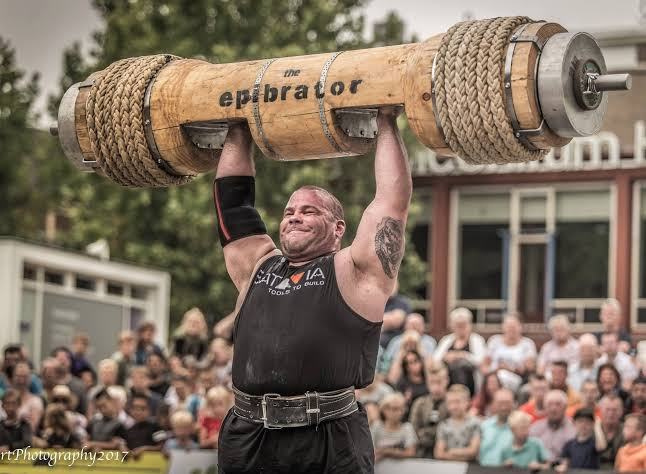
In 2014, years of national podium finishes finally produced the title. Moonen won the Strongest Man of the Netherlands for the first time and simultaneously finished third at SCL Holland, linking domestic supremacy to international competitiveness. The following season strengthened that connection. In 2015 he was third at SCL Romania and then third at the Strongman Champions League World Finals, one of the most significant international podiums of his career. He also competed at the MHP Log Lift World Championships, where he pressed 180 kilograms, the weight listed by Strongman Archives as his official competition best in the event. Moonen later said that earlier in his career he had managed 190 kilograms in training, but the distinction between gym lifts and contest results matters. Strongman equipment, judging standards and conditions vary, so a personal best is not always a single universal number. The 180-kilogram competition log remains the cleanest verified reference point. More broadly, 2015 showed that Moonen could combine heavy overhead strength with enough competence across a full slate of events to reach the podium at a world-level series final. The athlete who had entered the sport almost accidentally was now established at the top end of European strongman.
The 2016 season was one of the most complete in Alex Moonen's career. At the national championship on 9 July, official event records list him as the winner with 60.5 points. The event programme illustrates what open strongman demanded at the time: Max Log, a truck pull with a vehicle of roughly sixteen tonnes, a medley, a forward hold, squats with 240 kilograms and stones ranging up to 180 kilograms. There was nowhere for a specialist to hide. A competitor needed pressing strength, leg endurance, grip, speed and the ability to recover repeatedly during the day. Moonen's second national title therefore carried a different meaning from the first. It proved that the 2014 win had not been a single peak and that, after years of international travel and accumulated physical wear, he could still produce the best all-round performance in the country. The same official results recorded another 180-kilogram log, confirming that his overhead strength remained near his verified competition ceiling. Yet the national title was only one component of the season rather than its sole high point.
Internationally, Moonen finished second at SCL Holland, second at SCL Romania and third at SCL Curaçao before taking sixth at the World Finals. At the Romanian stage he scored 63.5 points and won the Truck Pull, once again confirming his strength in dynamic pulling events. The distribution of those results is important. He performed at home, in Eastern Europe and in the Caribbean on different surfaces, in different climates and with different event selections. Strongman rewards portability: the ability to reproduce quality when the equipment does not feel exactly like the implements in your own gym. By 2016 Moonen had nearly a decade of experience in the sport, and the maturity was visible. He no longer required the contest to be perfectly suited to his strengths in order to remain in the podium fight. Clean execution, controlled pacing and the avoidance of catastrophic mistakes could become points across an entire day. This is precisely why the Strongman Champions League format suited him. A series rewards the athlete who can return again and again with a competitive level, and 2016 is one of the clearest demonstrations that Moonen's national success was fully transferable to international competition.
In 2017 Moonen successfully defended his Dutch title and became a three-time Strongest Man of the Netherlands champion. The official historical standings credit him with 63 points. Internationally he remained near the top, finishing third at SCL Holland and fourth at the SCL World Finals. A fourth-place world-series final may look less dramatic than a championship, but it is an excellent measure of consistency. By then Moonen had reached the stage of a career where experience could compensate for some of the physical wear accumulated over years. He knew how to read an event, choose a sustainable pace, organise a warm-up and avoid the small procedural errors that can turn into zeros or lost points. In strongman, where only a few points may separate third from eighth, those details matter. The fact that an athlete with multiple surgeries in his history remained internationally relevant roughly a decade after entering the discipline also says something about how he managed his body. Moonen's later discussions of massage, physiotherapy and recovery were not retrospective theory. They were tools he had needed in order to keep competing.
The 2018 season brought his fourth and final Dutch title, completing a championship sequence of 2014, 2016, 2017 and 2018. Official records list his winning total as 59 points. The spacing of those titles is significant: the first and fourth were separated by several years, so the achievement cannot be explained by one short window of exceptional form. Moonen also finished second at SCL Holland, third at SCL Curaçao and fifth at the World Finals. At the same time his professional life was continuing to develop. Public education records indicate completion of a master's-level teaching qualification in 2018, meaning that the final phase of his national dominance overlapped with a serious investment in academic development. Regional coverage also showed him participating in sport-related activities with students. Seen retrospectively, 2018 was a year in which his two careers reached maturity at the same time. He was an established international strongman and four-time national champion, but also an experienced teacher with advanced qualifications. The structure of the next phase was already visible: competitive knowledge would increasingly become material for education and coaching rather than an end in itself.
At the beginning of 2019, Moonen gave a particularly useful interview in which he discussed the goals that were still unfinished. He had wanted a 200-kilogram log and a 400-kilogram standard barbell deadlift, but shoulder and hamstring problems had interfered with both. There was, however, another objective he stated very clearly: he wanted to win a Strongman Champions League stage. By that point he had accumulated enough international podiums to prove that he belonged at the front of the circuit, yet an overall SCL victory had remained just out of reach. A few months later, at SCL Holland 2019, the objective became reality. Moonen won the contest with 67.5 points, ahead of Kelvin de Ruiter and Mika Törrö. It was not a victory produced by one fortunate event. Strongman Archives records thirteen repetitions in the Car Deadlift for second place and solid performances across the contest. The ending was especially appropriate: in the Atlas Stones, a six-stone run from 130 to 180 kilograms, he completed the series in 44.20 seconds and won the event. For an athlete who had publicly named an SCL victory as a remaining ambition, achieving it on home soil during his final elite season gave the career a remarkably satisfying competitive conclusion.
The year contained much more than that one win. Moonen placed third at SCL Turkey, second at European Giants, fourth at the World Truck Pull Championships and fourth at SCL Curaçao before finishing sixth at the SCL World Finals. At European Giants he deadlifted 360 kilograms, the number listed by Strongman Archives as his official competition best in the standard deadlift. At thirty-six years old, after a sporting life that had begun with judo and continued through more than a decade of strongman, he was still capable of international podiums and personal-best-level strength. This is why his retirement should not be framed as a forced exit caused by competitive irrelevance. Local reporting later quoted him explaining that he had achieved the goals that mattered to him and that his body needed a step back. The decision was closer to a health and life-direction choice than a collapse in performance. Rather than waiting until injury or decline removed the option, Moonen chose to redirect his experience while he was still highly credible as an athlete. The SCL Holland victory and 360-kilogram deadlift therefore function as a final signature rather than the beginning of another competitive cycle.
Judged only by maximum lifts, Moonen does not belong to the rare category of strongmen whose entire legend is built around one historically enormous number. A verified 180-kilogram competition log and a 360-kilogram competition deadlift are international-level performances, but they are not world records. His competitive value lived elsewhere: in the combination of enough maximal strength with excellent work capacity and technical adaptability. Statistical databases that classify event families show strong results in vehicle pulls, grip-related events and overhead work, while the raw contest archive provides concrete examples. He won the Bus Pull at Giants Live Hungary in 2012, the Truck Pull at SCL Romania in 2016, the Viking Press in Hungary and the Atlas Stones at SCL Holland in 2019. That spread matters. It shows an athlete capable of scoring in traction, repetition pressing and loading events rather than depending on one favourable discipline. His judo background provides a plausible physical explanation: grip, hip control, trunk stability and tolerance for repeated high-intensity efforts all transfer well. Moonen did not need to be the greatest deadlifter in a field if he could recover those points through several event types and avoid major failures across the full contest.
His physical dimensions also need context. Databases consistently list him at 1.87 metres and roughly 160 kilograms during the competitive era, while local reporting says he reached around 170 kilograms at his heaviest. For an open strongman, 1.87 metres is tall enough to provide useful leverage in many events without creating the extreme range-of-motion disadvantages that can affect much taller athletes. Moonen made use of that middle ground: a very large body that remained relatively athletic. In his discussions of training, the need to stay able to move appears repeatedly. This distinction is one of the clearest differences between strongman and a purely static strength sport. A huge squat or deadlift is valuable, but strongman places the athlete in situations where the object is unstable, the ground may be imperfect and time is part of the score. The body must create force while walking, turning, loading and breathing hard. For Moonen, athletic quality was never separate from strength. After retirement, that principle became even more explicit and now sits at the centre of the way he trains other people.
Moonen's 2019 interview is particularly valuable because it describes how he organised training during his competitive career. In the off-season he outlined a relatively simple structure: two full-body strength sessions and two sessions focused on cardio and core work. During the competitive season, specificity increased. He typically used two dedicated strongman sessions, one combined legs-and-back day and a lighter pressing session. This was not programming designed to impress through limitless volume. It was a system intended to create adaptation while fitting the life of a working teacher and the reality of a body with a substantial surgical history. Moonen also placed significant emphasis on repetitions and work capacity. In his view, the ability to produce one maximal effort in a calm gym is not enough preparation for a contest that may last many hours and demand five or six hard performances. A strongman must recover between events, repeat high force outputs and maintain technique after the first waves of fatigue. This is why he valued conditioning and why he recommended occasionally simulating the duration and structure of a competition day. Strength had to remain available late in the contest, not disappear after the first impressive lift.
At the same time, Moonen did not advocate maximum-intensity event training all year. His own descriptions suggest an intuitive form of periodisation: broader physical preparation when the calendar allowed it, increasing event specificity as competition approached, and enough variation to keep the body robust. That robustness is essential in strongman because event selection changes constantly. One contest may use a log, another an axle; one may use a yoke, another a frame; deadlifts can be standard, elevated, with a car apparatus or for repetitions. Training cannot therefore be limited to perfecting one gesture. It has to build families of qualities: hip extension, grip, trunk stability, overhead power, loaded acceleration and the ability to preserve mechanics under fatigue. This way of thinking also explains why Moonen moved naturally into general coaching after retirement. The principle survives even when the equipment changes: identify the real demand, build the base, progress the load and choose exercises that serve the person rather than forcing the person to serve a favourite exercise. In that sense, Moonen is more interesting as a training thinker than a quick glance at his personal records might suggest.
Moonen discussed nutrition with the same practical tone he used for training. He did not describe diet as a collection of secret tricks, but as the consistent application of basic principles. A strongman around 160 kilograms needs substantial energy intake to support body mass, training and recovery, yet Moonen's later life makes an important distinction clear: very high body weight only makes sense in relation to a specific performance goal. Regional reporting states that he reached roughly 170 kilograms during his largest competitive phase and later became around forty kilograms lighter after leaving elite strongman. The change was not a rejection of the body that had made him successful. It was an adaptation to a new task. When the objective is to move enormous external loads, extra mass can support stability and absolute strength. When the objective becomes long-term health, teaching, coaching and staying active, the same mass may no longer be necessary. Moonen's own transition therefore mirrors the advice he now gives clients: physical condition should be judged by what the body needs to do, not by loyalty to a number that belonged to a different phase of life.
Recovery became even more important in his thinking. Five operations in five years, followed by more than a decade in a demanding strength sport, created a direct education in the limits of joints and connective tissue. Moonen has recommended massage, physiotherapy and the gradual construction of a broad physical base before chasing spectacular weights. Strongman can tempt inexperienced athletes to imitate what they see at world level before their technique and work capacity are ready. Moonen's logic points toward a more patient sequence: build general capacity, develop strength, add specific event skill and expose the body to maximal demands only when the foundation is appropriate. Even for an advanced athlete, recovery is not the opposite of hard work; it is what allows hard work to continue. His final season is a useful case study. At thirty-six, after years of accumulated wear, he still won an SCL stage and produced a 360-kilogram contest deadlift. That longevity cannot be separated from the ability to train around injuries, modify goals and treat physical maintenance as part of performance rather than as evidence of weakness.
Moonen has not built his public image around exposing his private life. Most available biographical material concerns sport, education and professional work, and a responsible profile should preserve that proportion. Public professional presentations identify him as the father of a daughter, but family details are not used as entertainment and there is no reason to turn private information into a larger narrative. His own interviews nevertheless offer small details that make the champion less abstract. Moonen has spoken about enjoying films and going to the cinema, as well as listening to music on vinyl. He has also joked about shaving or changing his beard and moustache, a minor detail that suggests a personality more relaxed than the intimidating strongman image might imply. The contrast matters. A man who once weighed around 160 kilograms and pulled vehicles on television also had ordinary interests and a full working life away from the arena. Competitive sport can occupy a vast amount of time, but it does not need to consume the entire identity of the person doing it. Moonen's post-career transition was probably easier precisely because other roles already existed before strongman ended.
In Limburg his public identity has increasingly been built around accessibility rather than nostalgia. Regional reporting shows him working with students, gym members, younger athletes and community events instead of simply retelling old victories. There is a clear continuity between Moonen the teacher and Moonen the coach: both roles require him to turn experience into language another person can use. That is harder than it looks. An exceptional athlete can operate through instinct, whereas a coach has to make the instinct understandable and repeatable. On the De Kracht van het Zuiden website, the target audience extends well beyond strongman. Sport-specific preparation, rehabilitation-oriented training, muscle development, body-composition goals and general health all sit under the same roof. The common principle is not a particular lift but the idea that strength should serve a purpose. For a competitive athlete, that purpose may be a heavier log. For a general client, it may be returning to normal activity after a setback. For a judo athlete, it may be applying more force without losing speed. Moonen's background gives him credibility across those different interpretations of the same word: strength.
In 2019, while his elite competitive career was coming to an end, Moonen was already preparing the next project: his own training facility and personal-training business. De Kracht van het Zuiden in Merkelbeek was not designed as a private shrine for elite strongmen. Its purpose was broader: to translate lessons from high-performance sport into training that could be scaled to many kinds of people. On the facility's website, Moonen describes his motivation in terms of sharing the passion and knowledge accumulated over a lifetime in sport. The services reflect that range, from sport-specific strength work to rehabilitation-oriented training, muscle development, weight-management goals and general fitness. That breadth is significant. During competition, success had been measured in points, seconds and kilograms. As a coach, success might instead mean helping someone return to activity, become more resilient or build enough physical confidence to handle daily life more easily. The gym's name, which can be translated as The Strength of the South, preserves his Limburg identity while also expressing a wider idea: strength can be cultivated locally and used in many forms, not only on a televised contest stage.
The timing of the project was difficult. Regional reporting notes that the gym had barely opened before COVID-19 restrictions disrupted or closed normal operations. For a new small business, the situation could easily have ended the transition before it had properly begun. Moonen continued, combining the gym with part-time teaching, and the facility survived long enough to become a recognised local training base. In later years it appears in public sources not only as a personal-training facility but as a place where young strength athletes prepare, where sport-specific coaching happens and where vocational learning can take place. From 2023, public training-workplace listings identify De Kracht van het Zuiden as a recognised practice environment for education in sport and movement. The development fits Moonen's unusual professional profile almost perfectly. The athlete, teacher and coach are not separate identities competing for space; the facility gives them a common home. What began as a post-retirement business became a small institution capable of preserving and distributing knowledge that would otherwise remain locked inside one athlete's experience.
Moonen's relationship with strongman did not end when he stopped chasing points for himself. One well-documented example is De Sterkste Man Push & Pull, organised in Brunssum in April 2024. The event brought together athletes from the Netherlands, Belgium and Germany and included under-105-kilogram, heavyweight, women's and adaptive categories. That final element is especially significant. Traditional strongman was built around the image of the very large open-weight male athlete, and the expansion toward adaptive competitors changes the public definition of what strength sport can include. For a former WSM competitor to invest energy in a broader format suggests that Moonen does not treat the sport as a museum for his own generation. He preserves the spectacle of heavy objects while widening the group of people who can participate. Organising also requires a different type of competence from competing. The athlete manages warm-up, attempts and recovery; the organiser has to think about equipment, judging, timing, volunteers, athlete safety, audience flow and fairness. Decades of competition provide Moonen with an unusually large library of practical examples of what works and what can go wrong.
This role was foreshadowed in his 2019 interview, when Moonen said that he wanted strongman to remain professional and fair and expressed concern about entertainment sometimes becoming more important than sporting performance. The tension is real. Strongman needs spectacle to attract spectators, sponsors and broadcasters, but its legitimacy depends on clear rules, consistent judging and conditions in which the best athlete on the day has a reasonable chance to win. Moonen had competed in enough countries and under enough organisers to understand how apparently small details can change a result. Start order, equipment setup, rep standards or a few seconds of confusion may separate podium positions. His later work as an organiser gives him the opportunity to apply some of those lessons locally. It also reconnects sport with place. Brunssum is not a global strength-sport capital, but a teenager seeing a strongman contest there for the first time may experience the same spark that Moonen felt when Jules Bremers pushed him toward his own debut. In that sense, organising is not merely post-career activity. It creates the environment from which another athlete's career might begin.
In the years after retirement Moonen became increasingly visible as a coach, and his work has not been limited to general fitness clients. Public material shows him supporting younger strength athletes with international ambitions and working in physical preparation around judo. That combination brings the career almost back to its beginning. Moonen is not a strongman who discovered judo late; he is a former high-level judoka who then spent more than a decade in elite strongman and can now connect the two sports from a coaching position. A judoka needs additional force without losing speed, mobility or technical timing. A teenage strongman needs to build basic strength and event skill without copying the body mass, loading and risk profile of a mature open athlete. Moonen's own history with injury gives him a strong reason to value patience. If his early athletic life was interrupted by five operations, then one of the most meaningful forms of legacy is helping a young athlete reach high performance with fewer avoidable physical costs. Experience becomes valuable when it prevents another person from repeating every mistake required to acquire it.
Public communications from his gym and professional network include examples of teenagers preparing for international strongman championships, evidence that De Kracht van het Zuiden has become a performance-development base as well as a personal-training studio. Moonen can offer more than instruction in how to clean a log or lap a stone. He understands the logistics and psychology of competition: how to organise training around school or employment, how to enter an international field without being overwhelmed by famous names, how to recover after an injury disrupts a cycle and how to separate athletic results from personal identity. That last lesson may be especially important. Moonen's own life never depended on strongman alone. He was already a teacher and former judoka, which meant that retirement did not erase the entire structure of who he was. For young athletes who can easily confuse performance with self-worth, a coach who has both entered and exited elite sport successfully offers a model that extends beyond sets and repetitions. Coaching, in his case, is the natural continuation of a life in which sport and education have rarely been far apart.
An important part of Moonen's post-competition activity is the way he has used strongman visibility in educational settings. Regional media have shown him involved in projects with students and in sport campaigns alongside other well-known Dutch athletes. For children and teenagers, a former four-time national strongman champion has an immediate pedagogical advantage: he captures attention before the lesson has properly started. The useful work begins when that spectacle is translated into a discussion about nutrition, discipline, persistence, recovery and health. In an era in which sport is often consumed through short clips, an enormous lift can easily become pure entertainment. Moonen can explain the years behind the image, including the failed attempts, injuries and repeated ordinary decisions that make a dramatic moment possible. Because he has experienced both achievement and physical limitation, he can also avoid the simplistic message that more effort is always better. Ambition matters, but it has to be organised. A person can train hard and still make intelligent choices about recovery, technical quality and the point at which a particular risk no longer serves the objective.
This is also where the connection between geography teaching and coaching becomes surprisingly clear. A good teacher does not merely deliver facts; the job is to help students understand relationships between systems. Moonen approaches physical preparation in a similar way. Body mass affects strength but also health and movement. Conditioning supports contest performance and recovery between events. Technique can conserve energy and sometimes reduce unnecessary stress. Sleep and nutrition influence what can happen in training. Strength is never isolated from the rest of the system. A Brunssum profile describes Moonen teaching secondary-school students and including practical material around nutrition and physical and mental resilience. The circle is almost complete. A child who began judo at four and learned through sport becomes an adult who uses sport to teach others. Championships give him credibility, but the educational value appears only when that credibility is converted into explanations and behaviours another person can use. This may be one of the most durable aspects of his post-competitive career because it extends beyond people who identify as strength athletes at all.
Vehicle pulling appears repeatedly among Moonen's better results and is one of the easiest event families to connect with his earlier athletic development. Pulling a truck or bus is not simply a horizontal deadlift. The athlete must create an efficient body angle, maintain tension through the harness or rope, generate enough initial force to overcome inertia and then find a stride frequency that keeps the vehicle moving. The opening seconds are explosive; the finish can become a severe conditioning test as speed slows and fatigue rises. Moonen won the Bus Pull at Giants Live Hungary in 2012 and the Truck Pull at SCL Romania in 2016, while placing second in the Vehicle Pull in his 2012 WSM heat. Results spread across several years suggest a stable skill rather than one fortunate event. Viking Press produced a similar pattern for a different reason. Sixteen repetitions at Giants Live Hungary required pressing strength, but also pacing and the ability to sustain force output after the first few repetitions. For an athlete whose background had trained him to operate under repeated effort, these were opportunities to turn conditioning into scoreboard points.
Atlas Stones provided another suitable territory. The event demands hip extension, control of an object without handles, trunk stability and the ability to repeat the same sequence while breathing becomes progressively harder. At World's Strongest Man in 2012, Moonen loaded four stones and placed third in his heat. Seven years later, on the day he won SCL Holland, he completed a six-stone series from 130 to 180 kilograms in 44.20 seconds and won the event. The connection between those performances is revealing. A quality visible on the WSM stage in his first appearance remained strong enough to help decide an international contest in his final season. Strongman Archives also records a 200-kilogram Stone Over Bar at SCL FIBO in 2013, evidence that the event family involved substantial absolute strength as well as speed. Tire flips, medleys and grip events fit the same broader pattern: Moonen was comfortable when force had to be applied to an imperfect object and then reorganised for the next repetition. Here, his judo background is not merely a romantic biographical detail. Hip control, close-body force production, trunk organisation and rapid transitions are all qualities he had spent years developing before strongman entered his life.
Strongman Archives credits Moonen with 71 international contests during the main 2009–2019 record, including one overall victory, SCL Holland 2019, as well as ten national contests in its database with four wins. Other statistical sites produce slightly different totals because they separate national shows, single-event competitions and international stages differently. The variation does not undermine the overall picture if the methodology is stated clearly. Moonen had a high-volume competitive career. In strongman, every start carries more physical cost than the few seconds or minutes visible to the audience. A truck pull may last less than half a minute, but preparing for it requires weeks of heavy traction and conditioning. A stone run may be completed in under a minute, while the repeated loading stresses the biceps, back, hips and cardiovascular system. A dense international calendar therefore becomes a continuous recovery problem. This is why contest count matters as more than an attendance statistic. It describes how often Moonen had to build enough form to compete, expose himself to maximal or near-maximal demands and then recover quickly enough to do it again in another country with another event set.
At World's Strongest Man, the archive records two appearances, no finals and a best heat placing of fourth in 2012. A superficial reading might reduce the experience to the fact that he never advanced. Event-level results tell a more informative story: second in the Vehicle Pull and third in both Viking Press and Atlas Stones in his first WSM heat. Giants Live Hungary in the same season produced two event victories. Strongman Champions League provides an even broader sample, with podiums in the Netherlands, Romania, Curaçao and the World Finals before the 2019 win. This difference in granularity matters for any serious athlete biography. Overall placing tells us who collected the most points across one day; it does not always tell us what kind of competitor a person was. In Moonen's case, event results reveal the pattern: strong when force had to be sustained, effective at repetition pressing, reliable on awkward objects and vehicle pulls, and less dependent on a single maximum lift to construct a strong overall score. The archive becomes most useful when its numbers are interpreted rather than simply copied.
Recent profiles describe Moonen as roughly forty kilograms lighter than during his largest strongman years. The visual change is obvious, but the reasoning behind it is more important. He no longer needs to organise his body around the demands of pulling a truck, pressing a 180-kilogram log or racing through a series of 180-kilogram stones. The objective has shifted toward function, health, coaching and the ability to remain active over the long term. This makes his post-career body an instructive example in the wider discussion of retirement from strength sport. Athletes may spend years building mass that directly serves competitive performance, only to discover that the same mass is unnecessary once the competitive task disappears. Reducing it is not a rejection of strength or an admission that the earlier body was a mistake. It is simply another form of specificity. Moonen appears to have made that transition deliberately. The principle is the same one that guided his training: the body should be adapted to the job it has to perform now, not permanently frozen in the shape demanded by an earlier goal.
At the same time, he has not separated himself from high-performance culture. Coaching strength athletes, supporting young strongmen and contributing to judo preparation keep him close to ambitious sport even though his own body no longer needs to resemble an open-weight competitor. This position gives him an unusual perspective. He understands the athlete who wants another ten kilograms on the bar because he has lived that obsession. He also understands the moment when another ten kilograms no longer justifies the cost because he has lived that transition as well. For general clients, the distinction helps him separate what is specific to elite strength sport from what is useful for ordinary health. For competitors, it helps him avoid confusing caution with low ambition. His current philosophy sits between two extremes: serious enough to demand progressive work and honest performance, but flexible enough to change direction when the body and the objective stop asking for the same thing. That balance may ultimately be more valuable to the people he coaches than any attempt to reproduce his old competitive programme exactly.
Four Strongest Man of the Netherlands titles place Moonen in a restricted group of athletes who repeatedly reached the top of Dutch open strongman. Yet his significance is not explained by trophy count alone. He competed during a period when European strongman was becoming more global, more frequent and more professionally organised. He was good enough to reach World's Strongest Man twice, durable enough to complete dozens of international appearances and consistent enough to stand repeatedly on Strongman Champions League podiums. At the same time, the career remained recognisably Dutch. The national championships, SCL Holland stages and his deep connection to Limburg were not merely pauses between foreign contests; they formed the centre of his sporting identity. This is what gives the 2019 SCL Holland win so much symbolic force. After competing across Europe, China, the Caribbean and other international venues, the first overall international win recorded for him by Strongman Archives came at home. For a veteran who had publicly said that an SCL victory remained one of his goals, the result closed a competitive circle in a way that statistics alone cannot fully express.
His legacy also needs to be measured through continuity with the athletes and communities that followed. A national strength scene does not grow only through champions who appear on television. It grows through gyms, coaches, local contests, training groups and people capable of converting international experience into domestic infrastructure. Moonen has done that conversion. De Kracht van het Zuiden preserves knowledge in a physical location. Coaching transfers it directly to athletes. Events create opportunities to compete. Teaching places the lessons in a wider health and educational context. From this perspective, retirement did not reduce his sporting influence; it diversified it. A national championship remains a permanent line in a record book. A young athlete who reaches an international championship after years of intelligent preparation, a client who regains physical capability after a setback or a local contest that includes categories previously excluded are harder to quantify, but their effect may last longer than a trophy. Moonen therefore belongs to the kind of champion whose relevance continues through the small institutions built after the competitive spotlight moves elsewhere.
Moonen's career offers a useful lesson about the difference between strength and performance in strongman. If the sport were merely a contest of maximum gym numbers, his record would be difficult to explain. A 180-kilogram log and 360-kilogram deadlift do not place him among the greatest historical specialists in those movements. Four national titles, two WSM selections, a World Finals podium and repeated SCL top finishes cannot be dismissed as accidental, however. They demonstrate that strongman rewards a wider collection of qualities: technique, pacing, grip, loaded movement, decision-making, event adaptation, cardiovascular tolerance and the ability to remain useful across an entire day. Moonen was an example of an athlete whose complete package was greater than any individual number on the record sheet. For coaches, this has practical consequences. Programming should not only chase maximums; it should also reduce the probability of zeros, teach athletes to execute while tired and prepare them for events that may change after the training cycle has already started.
A second lesson concerns the shape of a long sporting life. Moonen began judo at four, reached international junior level, underwent repeated surgery, changed disciplines and continued competing in strongman until thirty-six. That trajectory is not linear. It includes losses, recalibrations and ambitions that were never completed in their original form. The Olympic path in judo disappeared. The 200-kilogram log and 400-kilogram standard deadlift remained outside his official record. A World's Strongest Man final never came. Yet a career cannot be measured only by the goals it missed. Around those unfulfilled objectives Moonen built other achievements: four Dutch championships, international podiums, an SCL victory, an educational career and eventually his own training facility. For athletes who interpret performance through an all-or-nothing lens, the story offers a useful counterexample. Longevity sometimes requires refusing to repeat the same plan after the context has changed. Adaptation is not surrender. In Moonen's case it became the mechanism that allowed one sporting life to transform into another without losing the values that made the first one meaningful.
Reconstructing Alex Moonen's career requires several kinds of evidence. Strongman Archives provides the statistical backbone: appearances, overall placings, event results and verified competition bests. The historical records of the Strongest Man of the Netherlands confirm his national titles in 2014, 2016, 2017 and 2018 as well as earlier podium finishes, while 2016 contest documents add event-level detail. The long Bodybuilding.nl interview from March 2019 is essential for Moonen's own voice on judo, injuries, training structure, recovery, ambitions and the plan to open a gym. Regional features from Limburg, including Nummer1 and Ons Brunssum, add the teaching career, post-retirement weight change, community projects and event organisation. De Kracht van het Zuiden's own site documents his current professional direction. None of these sources is sufficient on its own. Used together, they allow a distinction between verified results, first-person statements and later editorial interpretation. This is especially important for a sport whose historical data were never centralised in one official archive.
The clearest disagreement concerns date of birth. Strongman Archives and several sites that reproduce international database information list 5 March 1983. Dutch biographical sources and Wikimedia Commons instead give 3 May 1983, together with the full name Alexander Catherina Matheus Moonen and a local biographical context. Because 03/05 and 05/03 are exactly the kind of values that reverse when information crosses date-format conventions, this profile uses 3 May 1983 while documenting the discrepancy. Contest totals also differ slightly between databases because of inclusion criteria. Rather than force false precision, the profile attributes Strongman Archives numbers specifically to that archive and treats national or single-event records according to their own sources. The same rule applies to lifts. Moonen's reported 190-kilogram training log is useful context, but the verified 180-kilogram competition log is listed as the formal record. The goal is not to erase uncertainty; it is to mark where certainty ends and still build the most coherent account supported by the available evidence.
If Alex Moonen's biography had to be reduced to one image, the most revealing one might not be a trophy photograph. It could be the transition between two scenes. In the first, a roughly 160-kilogram athlete prepares to pull a vehicle, press a massive log or load a 180-kilogram stone. In the second, the same man explains to a student or younger athlete how to become stronger without treating the body as disposable. The images do not contradict one another. The second exists because the first was lived at full intensity. Moonen experienced success and limitation in equal measure: junior judo medals, repeated operations, a change of sport, national titles, two WSM appearances without a final, international podiums, strength goals that remained unfinished and finally the SCL victory he had explicitly wanted. His story is not one of invulnerability. It is a story of adaptation. When the original route closed, he found another. When elite strongman had given him what he needed, he changed the objective again. The continuity lies less in the events than in the habit of turning one stage into preparation for the next.
Within Dutch strongman history, four national titles already guarantee Moonen a distinct place. World's Strongest Man and more than a decade on international circuits give the record a wider dimension. The complete picture, however, only appears when judo, teaching, coaching, gym ownership and event organisation are added. Moonen was an athlete before he became a strongman and remained an educator after he stopped being an elite competitor. Strength passed through several forms across his life: the strength to compete, the judgement to accept limits, the confidence to change direction and the ability to make accumulated experience useful to someone else. In 2019 he closed his top-level strongman career with a home SCL victory and a 360-kilogram competition deadlift. In the years that followed, he remained present in strength sport without needing his name at the top of a leaderboard. For a champion, that may be one of the more difficult transitions. It is also one of the clearest signs that the career produced something more durable than medals.
This profile was built by cross-checking Strongman Archives (strongmanarchives.com/viewAthlete.php?id=255), the historical records and event documents of Strongest Man of the Netherlands at nksterksteman.nl, the detailed Alex Moonen interview published by Bodybuilding.nl in March 2019, the official De Kracht van het Zuiden website, regional features published by Nummer1 and Ons Brunssum, Connect College material concerning his World's Strongest Man participation, Strongman Champions League results and local reporting on competitions and community projects involving Moonen. Dutch biographical sources and Wikimedia Commons were also checked for identity and date-of-birth information. Statistical claims are attributed to the databases that record them, and source conflicts are documented rather than silently resolved.
Iron Hall data
360 KG
Deadlift — competition best · 2019 European Giants; competition best listed by Strongman Archives
Verified
180 KG
Log Lift — competition best · 2015 MHP Log Lift World Championships; the same weight was also lifted at the 2016 Strongest Man of the Netherlands
Verified
200 KG
Stone Over Bar · 2013 SCL FIBO; one recorded competition repetition
Verified
180 KG
Atlas Stones — heaviest stone in winning series · 2019 SCL Holland; six-stone series from 130–180 kg completed in 44.20 s, event win
Verified
150 KG / HAND
Hercules Hold · 2009 Strongest Man of the Netherlands; 38.87 seconds
Verified
2007
His strongman debut according to Dutch biographical accounts; he entered without dedicated strongman preparation and finished on the podium.
2nd place
2009
His first major national result recorded in modern strongman databases.
2nd place
2010
3rd place
2011
3rd place
2012
3rd place
2012
Won the Viking Press and Bus Pull events, two of his strongest event victories of that international season.
6th place
2012
First WSM appearance; placed second in Vehicle Pull and third in both Viking Press and Atlas Stones in his heat.
4th in group
2013
Second World's Strongest Man appearance, held in Sanya, China.
6th in group
2013
4th place
2014
The first of his four national strongman titles.
Champion
2014
3rd place
2015
3rd place
2015
One of the most significant international podiums of his career.
3rd place
2015
Lifted 180 kg, listed by Strongman Archives as his competition best in the log lift.
6th place
2016
Second national title; official contest records list him as the winner with 60.5 points.
Champion
2016
2nd place
2016
Won the Truck Pull and finished the stage with 63.5 points.
2nd place
2016
3rd place
2016
6th place
2017
Third national title, won with 63 points.
Champion
2017
3rd place
2017
4th place
2018
Fourth national title, completing his 2014–2018 championship run.
Champion
2018
2nd place
2018
3rd place
2018
5th place
2019
3rd place
2019
Pulled 360 kg in the deadlift, his competition best listed by Strongman Archives.
2nd place
2019
His first and only international overall win recorded by Strongman Archives; he also won the Atlas Stones series and finished the contest on 67.5 points.
Champion
2019
4th place
2019
4th place
2019
One of the final major appearances of his elite strongman career.
6th place
2024
Organised an international contest with -105 kg, heavyweight, women's and adaptive athlete divisions, continuing his involvement in the sport after retirement.
Organiser